Japan city forgoes applying for government survey on nuclear waste site

The mayor of Tsushima in southwestern Japan said Wednesday he has decided
against applying to the state for a preliminary survey to gauge the island
city’s suitability to host an underground disposal site for highly
radioactive waste from nuclear power generation. The decision comes in
contrast with the local assembly’s approval earlier this month of a request
filed by proponents urging the city to accept the survey.
“There is insufficient consensus among the public,” Mayor Naoki Hitakatsu said at a city assembly session, with some fearing the potential impact on tourism and primary industries such as fisheries.
He later told reporters he also has concerns about reputational damage that may arise from conducting the survey.
The preliminary survey is the first step in a three-stage process spanning two decades to select a permanent disposal site for nuclear waste. Struggling to find one, the central government is looking for municipalities willing to accept the survey, but only two municipalities in Hokkaido have so far done so.
Tsushima, on a remote island in Nagasaki Prefecture, was identified as a potential disposal site on a map of such locations released by the central government in 2017.
Hitakatsu has raised worries about hosting such a site, saying, “The risks that may arise from unperceived factors cannot be ruled out.”
Opponents of the plan have also said it would not be appropriate for the city to host a disposal site for nuclear waste given the history of the U.S. atomic bombing of Nagasaki city in 1945.
Local construction groups and other proponents argued that state subsidies of 2 billion yen ($13.4 million) for accepting the survey could be used for measures to rev up the shrinking city’s economy and support child-rearing.
The mayor, who may seek a third four-year term after his current term expires in March, told a press conference that the reputational damage that may arise from carrying out the survey “cannot be covered by a subsidy of 2 billion yen.”
He also said he “judged it would become difficult to reject” the subsequent geological research if the preliminary survey showed that the city is suited as a site for the final disposal of nuclear waste.
The surveys, conducted by the Nuclear Waste Management Organization, a quasi-government body in Tokyo, involve checking land conditions and volcanic activity based on published geological sources.
Following Tsushima’s decision, the central government said it will continue efforts to find more areas to carry out preliminary surveys.
“We are very grateful that Tsushima showed interest and had considered” accepting the survey, said Chief Cabinet Secretary Hirokazu Matsuno at a press conference.
Fast-aging Tsushima, where the number of residents fell below 30,000 in 2020, depends on squid fishing and pearl farming but is struggling to find young people to carry on the running of its industries.
It is located closer to the South Korean port city of Busan, 50 kilometers away, than any major Japanese cities.
High-level radioactive waste, produced when extracting uranium and plutonium from spent fuel, must be stored in bedrock at least 300 meters underground for tens of thousands of years until the radioactivity declines to levels that pose no harm to human health or the environment.
Japan, like many other countries with nuclear plants, is struggling to find a site for such disposal.
Kyodo News 27th Sept 2023
UK government decides not to take Allerdale further in GDF nuclear waste siting process due to limited suitable geology
Nuclear Waste Services (NWS) has been engaging
with the Allerdale community about the potential for hosting a Geological
Disposal Facility (GDF) to dispose of the UK’s most radioactive waste. As
part of this process NWS obtained existing data and undertook assessments
to understand if six siting factors, safety and security, community,
environment, engineering feasibility, transport, and value for money, could
be supported if a GDF were sited in Allerdale.
Following a comprehensive
and robust evaluation of information it was concluded only a limited volume
of suitable rock was identifiable and the geology in the area was unlikely
to support a post closure safety case. NWS has therefore taken the decision
not to take Allerdale further in the search for a suitable site to host a
GDF. Initial assessments of existing data and information for the other
three communities in the siting process have indicated potentially suitable
geology, which is why NWS is continuing in the siting process with those
communities.
Nuclear Waste Services 28th Sept 2023
British communities torn between the lure of government bribes and the realities of hosting toxic radioactive trash virtually forever
#nuclear #antinuclear #nuclear-free #NoNukes
Ken Smith moved to the Lincolnshire coast to see out his retirement,
writing crime novels while surrounded by beaches, arcades, holiday parks
and nature reserves. Recently, however, his retreat has been disturbed. The
Mablethorpe resident has found himself unexpectedly on the front lines of a
struggle affecting countries across the world, centred on how to deal with
nuclear waste.
The fate of Mablethorpe will determine how Britain tackles a
problem that has been building for seven decades. As the government seeks a
better solution to radioactive waste, communities are torn between the lure
of economic opportunities versus the realities of living next to a disposal
site. Theddlethorpe, a few miles up the road, is one of three areas in
England being considered by the UK for a 36km square underground site to
dispose of nuclear waste as it decays, some of it over hundreds of
thousands of years.
FT 28th Sept 2023
https://www.ft.com/content/29961733-a72c-406c-8884-4091c0dfd828
Finland’s nuclear waste: delay in completing the review of operating licence application and safety assessment.

Finland’s Radiation and Nuclear Safety Authority (STUK) said its review of
Posiva Oy’s operating licence application for the world’s first used fuel
disposal facility is taking longer than expected and will not be completed
by the end of this year as planned.
Radioactive waste management company
Posiva submitted its application, together with related information, to the
Ministry of Economic Affairs and Employment (TEM) on 30 December 2021 for
an operating licence for the used fuel encapsulation plant and final
disposal facility currently under construction at Olkiluoto. The repository
is expected to begin operations in the mid-2020s. Posiva is applying for an
operating licence for a period from March 2024 to the end of 2070.
The government will make the final decision on Posiva’s application, but a
positive opinion by STUK is required beforehand. The ministry requested
STUK’s opinion on the application by the end of this year. The regulator
began its review in May 2022 after concluding Posiva had provided
sufficient material. However, STUK has now said its safety assessment and
opinion on the application will not be completed this year.
World Nuclear News 28th Sept 2023
https://www.world-nuclear-news.org/Articles/Completion-of-Finnish-repository-review-delayed
Qatar calls for Israeli nuclear facilities to be subjected to IAEA safeguards
Friday, 29 September 2023 https://www.presstv.ir/Detail/2023/09/29/711758/Qatar-Israel-nuclear-IAEA-NPT
Qatar has called for the Israeli regime’s nuclear facilities to be subjected to the International Atomic Energy Agency’s safeguards amid Tel Aviv’s ongoing snub of international nuclear regulations.
The demand was put forward by the Chairman of Qatar’s National Committee for the Prohibition of Weapons, Abdulaziz Salmeen al-Jabri at the annual general conference of the IAEA, which is currently underway in Vienna, the official Qatar News Agency (QNA) reported on Friday.
Jabri further called for Israel to join the Nuclear Non-Proliferation Treaty (NPT).
The Qatari official explained that these were legitimate demands that had been confirmed by “international legitimacy resolutions [that were passed] half a century ago,” the QNA report noted.
He named some of those resolutions as “resolutions of the UN General Assembly [that have been passed] since 1974, [United Nations] Security Council Resolutions 487 of 1981 and 687 of 1991, numerous IAEA resolutions, and the resolution of the Review Conference of the Middle East Non-Proliferation Treaty in 1995.”
The official reminded that Israel’s subjecting all of its nuclear facilities to the IAEA’s comprehensive safeguards regime and its accession to the NPT “is a prerequisite for establishing a nuclear-weapon-free zone in the Middle East.”
He “stressed that confronting nuclear proliferation in the Middle East is at the core of the tasks assigned to the IAEA…”
Israel, which pursues a policy of deliberate ambiguity about its nuclear weapons, is estimated to harbor 200 to 400 nuclear warheads in its arsenal, making it the sole possessor of non-conventional arms in West Asia.
The regime has, nevertheless, refused to either allow inspections of its military nuclear facilities or sign the NPT.
 | |||
| |||
US and UK involved in attack on Crimea – Russia
https://www.rt.com/russia/583634-us-uk-crimea-strike/ 29 Sept 23
Moscow has “no doubt” about Western complicity in the attack on Sevastopol last Friday, the Foreign Ministry has said
Maria Zakharova, the spokeswoman for the Russian Foreign Ministry, has asserted that US and British intelligence agencies supported Kiev during an attack on Sevastopol last Friday. The Ukrainian assault targeted the headquarters of the Russian Black Sea Fleet.
Speaking at a weekly briefing on Wednesday, she said there was “no doubt that this attack was planned with the use of Western surveillance assets, NATO satellite equipment, and spy planes and conducted at the direction of and in close coordination with American and British special services.”
The Defense Ministry has reported that the missile strike on the fleet headquarters involved several Ukrainian missiles, with Russian air defenses successfully intercepting some of them. British media outlets have also disclosed that Kiev employed Storm Shadow missiles supplied by the UK in the attack, resulting in significant damage to the building.
Zakharova described the incident as one of many in which Kiev “targets Russian regions, using missiles and shells supplied by NATO states,” citing several other recent examples. The goals of the Ukrainian government, she said, are “to draw attention away from the Ukrainian military’s failed attempts at conducting a counteroffensive” and to destabilize Russian society.
The US and its allies have supplied tens of billions of dollars worth of military hardware to Ukraine to boost its summer charge against Russian defensive lines. The operation, however, has so far produced insignificant territorial gains at the cost of heavy losses in manpower and equipment.
Russian Defense Minister Sergey Shoigu estimated on Tuesday that over 17,000 Ukrainian troops were killed in September alone. Western officials and media have acknowledged that the counteroffensive has not turned out as Kiev and its sponsors had hoped.
The administration of US President Joe Biden, however, has urged Congress to keep financing Ukraine for the foreseeable future. An appropriation request for over $24 billion in aid is currently floating in the legislature but is opposed by some Republican lawmakers.
Senators have proposed a compromise stopgap spending bill to avoid a possible government shutdown next month. The plan involves reducing spending on Ukraine to $6.2 billion. The GOP-controlled House of Representatives would need to approve the draft before it could be voted on and sent to Biden’s desk to be signed into law.
France pushes pro-nuclear momentum to host global talks at OECD, to get tax-payer funding for the nuclear industry
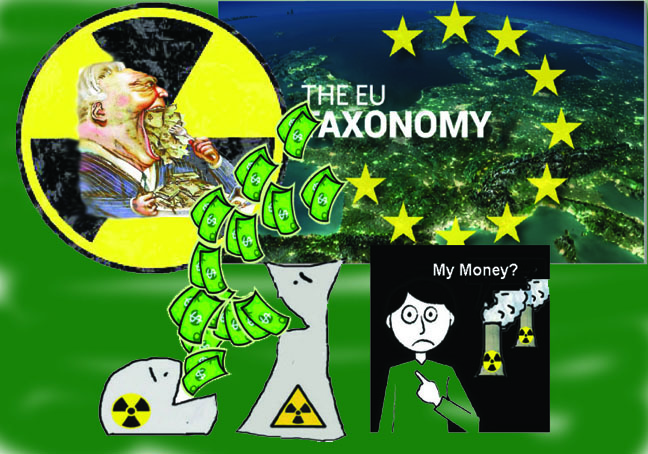
At the event, participants called on international financial institutions, regional development banks and organisations, including the EU, to finance nuclear power.
The joint statement calls on financial institutions to “classify nuclear energy with all other zero- or low-emission energy sources in financial taxonomies”.
By Paul Messad | EURACTIV France | translated by Daniel Eck 29 Sept 23 https://www.euractiv.com/section/energy-environment/news/france-builds-on-eus-pro-nuclear-momentum-to-host-global-talks/
France sought to build on the “momentum” behind nuclear energy in Europe by hosting world leaders on 28-29 September to accelerate nuclear financing and discuss long-term international cooperation that excludes Russia from the game.
The conference was attended by 21 countries, including 15 from Europe – Bulgaria, Romania, the Netherlands, Poland, Croatia, the Czech Republic, Estonia, Finland, France, Hungary, Slovakia, Slovenia, Sweden, Ukraine and the UK – as well as Turkey, South Korea, Japan, Ghana and the US.
“This is the first time in 13 years that so many ministers have come together for a Nuclear Energy Agency (NEA) event,” said French Energy Minister Agnès Pannier-Runacher, who co-chaired the event with William D. Magwood, director-general of the OECD’s Nuclear Energy Agency.
The timing is right, added Pannier-Runacher about the shift in attitude among EU member states like the Netherlands and Italy, who were until recently historically opposed to nuclear power.
Some 30 industry leaders also participated in the debates, with several signing a joint press release on Friday calling for redeveloping nuclear power.
On the agenda of the Paris event were topics like financing, supply chain and fuel issues, and coordination between governments and industry.
International financing
At the event, participants called on international financial institutions, regional development banks and organisations, including the EU, to finance nuclear power.
“We intend to explore innovative financing approaches, including public-private partnerships, to facilitate access to capital for refurbishment, long-term operation, spent fuel and waste long-term storage & disposal, and new nuclear build projects internationally while mitigating the economic costs of risk through public support mechanisms,” says a joint communiqué.
This means that the EU is also called upon to join the movement.
In this sense, Pannier-Runacher “welcomed” the statement made on Tuesday (26 September) by the President of the European Commission, Ursula von der Leyen, who, for the first time, envisaged EU subsidies for nuclear power.
“Nuclear energy needs public support in three areas: financing [including from the European Investment Bank], skills development and innovation,” the EU’s internal market Commissioner Thierry Breton said at the event’s start.
Asked about the possible reluctance of EU countries such as Germany to allow EU funds to be used for nuclear power, Pannier-Runacher said that “the problem lies in the different treatment of two energies that contribute to the same [decarbonisation] goals”, namely nuclear power and renewables, which are all low-carbon.
The joint statement calls on financial institutions to “classify nuclear energy with all other zero- or low-emission energy sources in financial taxonomies”.
The countries that signed the joint declaration have another powerful argument: nuclear capacity is set to triple worldwide by 2050 according to OECD scenarios, although a less optimistic IEA predicts that it will double.
Sharing the same values
The meeting was an opportunity for nuclear proponents to get together, but only from “democratic countries that share the same values”, Pannier-Runacher’s entourage explained on Wednesday.
While the talks did not directly address the dependence of some participating countries on Russia’s nuclear industry, “there is an implicit commitment by all OECD countries to condemn the Russian invasion,” Pannier-Runacher’s office said.
While Russia has been suspended from the OECD’s Nuclear Energy Agency, the Eastern European countries that attended the event are also members of the “Nuclear Alliance”, which is committed to “building partnerships to move away from this dependence [on Russia]”, the minister’s entourage added.
Their presence allowed EU countries present in Paris to hold informal talks on the ongoing reform of the EU electricity market, for which France advocates an approach favouring existing nuclear plants.
While the topic was not up for discussion, Pannier-Runacher’s office said ahead of the conference that “bilateral meetings with some of them [members of the nuclear alliance] will indeed take place”.
On the morning of the event, Pannier-Runacher was due to meet her Italian counterpart Gilberto Pichetto Fratin “to discuss cooperation on nuclear issues and the future of the European electricity market,” she said on X (formerly Twitter).
Italy did not take part in the OECD debates or sign the joint communiqué but was present as an observer.
German ambassador applauded Ukrainian Waffen SS Nazi – Berlin
Members of the Canadian parliament stood and gave long ovations for the 98-year-old Hunka when he was introduced during a visit by Ukrainian President Vladimir Zelensky on Friday. Zelensky and Canadian Prime Minister Justin Trudeau were among the enthusiastic participants in the cheers.
Ukrainian Nazi collaborators slaughtered thousands of Poles during World War II. Hunka was among thousands of Ukrainian fighters who were allowed to emigrate to the UK and Canada after World War II, despite their possible participation in war crimes.
https://www.rt.com/news/583676-germany-ambassador-nazi-ovations/ 29 Sept 23
The foreign ministry has claimed that its diplomat was not aware that Yaroslav Hunka fought with a notorious WWII Ukrainian-based battalion
Germany’s Foreign Office has shrugged off the participation of its ambassador to Canada in last week’s embarrassing standing ovations for a Ukrainian veteran of the Waffen SS, saying she was unaware that he was a Nazi when she joined with Ottawa lawmakers in applauding him.
Foreign Office spokesman Sebastian Fischer acknowledged the gaffe for the first time on Wednesday, when asked at a press briefing about Ambassador Sabine Sparwasser’s honoring of World War II Nazi collaborator Yaroslav Hunka.
Members of the Canadian parliament stood and gave long ovations for the 98-year-old Hunka when he was introduced during a visit by Ukrainian President Vladimir Zelensky on Friday. Zelensky and Canadian Prime Minister Justin Trudeau were among the enthusiastic participants in the cheers.
Sparwasser simply didn’t know about Hunka’s Nazi affiliation when she joined with others in applauding him, Fischer claimed. The spokesman conceded that the incident was unacceptable, but Hunka’s true identity was not known to the German diplomat or other members of the crowd because his attendance at the event was not announced beforehand.
However, when House Speaker Anthony Rota introduced his guest to the crowd, he noted that Hunka “fought for Ukrainian independence against the Russians,” which by definition suggested that he served on the side of the fascist Axis powers. “He’s a Ukrainian hero, a Canadian hero, and we thank him for all his service,” the speaker said.
Rota resigned from his position on Tuesday and apologized for his mistake in honoring Hunka. The war veteran was a volunteer in the 14th Waffen Grenadier Division of the SS, a Ukrainian unit, which committed atrocities against Jews and Poles on the Eastern Front.
Asked about how Sparwasser could fail to understand Hunka’s Nazi affiliation – despite being told that he fought against the Red Army – Fischer said there were other possible explanations for his role in the war. For instance, he theorized, Hunka could have been a fighter for the Polish Home Army, which fought against both German and Russian forces.
Ukrainian Nazi collaborators slaughtered thousands of Poles during World War II. Hunka was among thousands of Ukrainian fighters who were allowed to emigrate to the UK and Canada after World War II, despite their possible participation in war crimes.
Moscow called the incident a cynical abuse of the memory of the victims of Nazism and an example of blatant Russophobia, and said it may launch a probe into potential war crimes and request the extradition of Hunka. Poland, which has been among the top backers of modern-day Ukraine in its fight against Russia, has also urged a probe into potential war crimes committed by Hunka.
Chinese Balloon Was Not Spying, US Government Admits Months Later
by EDITORS, September 29, 2023 https://scheerpost.com/2023/09/29/chinese-balloon-was-not-spying-us-government-admits-months-later/
The Pentagon admitted that a Chinese balloon that crossed into US territory in February was not spying; it was likely blown off course by wind. But Washington and the media milked this manufactured scandal for new cold war propaganda.
By Ben Norton / Geopolitical Economy
The US government has admitted that severe accusations it made against China were just a lot of hot air.
The highest-ranking official in the US military has clarified that a Chinese balloon that crossed into US territory in February 2023 was not spying; it was likely blown off course by wind.
CBS News published an interview this September with the chairman of the Joint Chiefs of Staff, General Mark Milley, who stated, “The intelligence community, their assessment – and it’s a high-confidence assessment – [is] that there was no intelligence collection by that balloon”.
Milley conceded that the large rubber object was probably pushed off track by powerful wind.
This report, released seven months after the incident, has confirmed exactly what the Chinese government stated at the time: its balloon was not spying on the United States, and only accidentally entered its airspace.
The US government has still insisted that the Chinese balloon had technology that could have potentially been used to gather information – although it has not clarified if that technology was focused specifically on collecting data on weather patterns, which is what Beijing said it was doing.
Regardless, in another massive blow to Washington’s narrative, CBS News acknowledged in its report that, “After the Navy raised the wreckage from the bottom of the Atlantic, technical experts discovered the balloon’s sensors had never been activated while over the Continental United States“.
So even if the Chinese balloon had the technological capacity to spy on the United States, as Washington claims, the sensor was never turned on.
This is not the first time a senior US official has admitted that the Chinese balloon was not spying.
In June, Pentagon press secretary Brigadier General Pat Ryder made very similar comments.
“We’re aware that [the balloon] had intelligence collection capabilities, but it was our — and it has been our — assessment now that it did not collect while it was transiting the United States”, the Defense Department spokesman said, in remarks quoted by ABC News.
These statements confirm that Geopolitical Economy Report was accurate in its analysis in February, which synthesized existing evidence at the time and concluded that the Chinese balloon had likely been blown off course by unexpected weather.
Despite these bombshells proving the entire scandal to be manufactured, Washington and the US media turned this weather accident into a diplomatic crisis, milking the incident to demonize China and depict it as a grave “threat”.
The nationwide freakout was reminiscent of crude propaganda from the first cold war, when the US government produced “Duck and Cover” films instructing students to hide under their desks in the case of a sudden Soviet nuclear strike, or when Hollywood churned out blockbuster movies imploring North Americans to suspect their neighbors of being dastardly Russian communist spies.
Today, the United States is waging a new, second cold war. Moscow is still a target, but this time Washington’s main adversary is Beijing.
As CNN put it bluntly in February, “the Chinese balloon crisis could be a defining moment in the new Cold War”.
During the manufactured scandal, the US State Department claimed the “high altitude balloon’s equipment was clearly for intelligence surveillance”, and was “capable of conducting signals intelligence collection operations”.
The Pentagon referred to the rubber object as a “maneuverable Chinese surveillance balloon” that “violated U.S. airspace and international law, which is unacceptable”.
The White House accused Beijing of operating a “global” espionage program, stating, “We know that these [Chinese] surveillance balloons have crossed over dozens of countries on multiple continents around the world, including some of our closest allies and partners”.
Hawkish US politicians, like Republican Congressman Mike Gallagher, the chair of the House of Representatives’ Select Committee on the Chinese Communist Party, declared that the large rubber object “is a threat right here at home. It is a threat to American sovereignty, and it is a threat to the Midwest”.
Fox News brought on air neoconservative activists from think tanks funded by the weapons industry, who argued that Beijing was using the balloon to spy on the US to “prepare the battlefield” for war.
NATO Secretary General Jens Stoltenberg even claimed the rubber object was a threat to other Western governments.
While standing next to US Secretary of State Antony Blinken, Stoltenberg insisted, “The balloon over the United States confirms a pattern of Chinese behavior where we see that China has invested heavily in new capabilities, including different types of surveillance and intelligence platforms… We need to be aware of the constant risk of Chinese intelligence and step up what we do to protect ourselves and react in a prudent and responsible way”.
New Brunswick Indigenous communities and Canadians need facts about Small Modular Nuclear Reactors, not sales hype.

Until the government shares facts instead of sales pitches for small modular nuclear reactors, Indigenous nations must assume that representation is not connected to people, but to industry.
BY HUGH AKAGI AND SUSAN O’DONNELL | September 28, 2023
FREDERICTON, N.B.—Governments and other nuclear proponents are failing both Indigenous and settler communities by promoting sales and publicity material about small modular nuclear reactors (SMNRs) instead of sharing facts by independent researchers not tied to the industry.
For decades, nuclear proponents, including both the federal and New Brunswick governments, have focused on the ‘dream of plentiful power’ without highlighting the risks. The nuclear fuel chain—mining uranium, chemically processing the ore, fabricating the fuel, fissioning uranium in a reactor creating toxic radioactive waste remaining hazardous for tens of thousands of years—leaves a legacy of injustices disproportionately felt by Indigenous Peoples and all our relations.
Now the same is happening with the push for SMNRs. We are promised safer reactors by nuclear startup companies in New Brunswick using modifications of reactor designs—molten salt, sodium cooled—that have never operated successfully and safely on a grid anywhere despite billions of dollars of public funds spent in other countries.
Only one example of the misguided SMNR sales pitches for Indigenous and settler communities in New Brunswick is that used CANDU reactor fuel can be “recycled” to make new fuel. The technical name for this process is “reprocessing.” Calling it “recycling” is a buzzword meant to reassure people because the truth is impossible to accept. Less than one per cent of the used fuel at Point Lepreau is plutonium and other elements that could possibly be extracted and re-used for new fuel. The more than 99 per cent left over will be a toxic mess of new kinds of nuclear waste that nobody knows how to safely contain.
The reprocessing method planned for New Brunswick is based on a technology developed by the Idaho National Laboratory, which has spent hundreds of millions of dollars so far, over two decades, attempting to reprocess a small amount of used fuel.
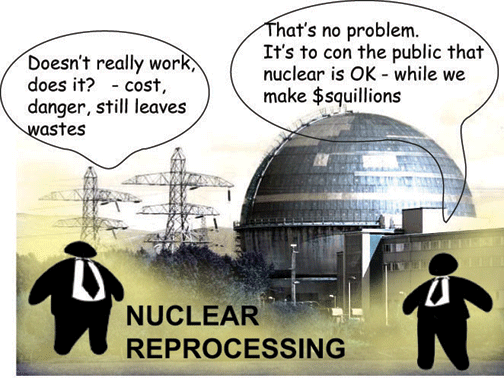
In different countries, commercial reprocessing has been an environmental and financial disaster. In just one example, a small commercial reprocessing plant in the United States operated for six years—heavily subsidized by the federal government and New York state—before shutting down for safety improvements. After the owner abandoned the project in the 1970s, the multi-billion-dollar cleanup continues today.
The research on reprocessing used fuel is clear: it’s an expensive nuclear experiment that could leave a multi-million-dollar mess affecting entire ecosystems and the health of people and other living beings. Why are governments sharing sales and promotional material about the project, and fantasies about ‘recycling’ instead of facts about reprocessing and the experiences in other countries? Why are New Brunswickers and First Nation leaders not demanding the evidence?
The lack of transparency by governments on the risks of SMNRs indicates that either they are not concerned with the risks, or they choose not to share them—the opposite of what is required under the United Nations Declaration of Rights of Indigenous Peoples.
Much of society’s standards for integrity have been lost. We accept circular references, we accept that no one is declaring a conflict of interest in conversations surrounding nuclear. When our integrity is lost, so is our quality of life. Words such as “protect” and “conservation” have no meaning anymore. Though we use the terms “transparency” and “accountability” more and more often, they have less and less meaning.
The Peskotomuhkati Nation in Canada and Wolastoq Grand Council cannot provide consent for any new nuclear developments in New Brunswick without considering the lessons they have learned in the past, the current relationships and communications they are experiencing, and the impacts of toxic wastes that remain dangerous forever. First Nations in New Brunswick cannot provide consent for toxic radioactive waste to be sent to Ontario, where Indigenous nations also do not want it on their territories.
The Wolastoq Grand Council, which issued a statement on nuclear energy and nuclear waste in 2021, opposes any destruction or harm to Wolastokuk which includes all “Flora and Fauna” in, on, and above their homeland. Nuclear is not a green source of energy, or solution to a healthier future for our children, grandchildren and the ones who are not born yet. Wolastoqewi-Elders define Nuclear in their language as ‘Askomiw Sanaqak,’ which translates as ‘forever dangerous.’
The Peskotomuhkatik ecosystem includes Point Lepreau. The Peskotomuhkati leadership in Canada has repeatedly tried to bring facts about both New Brunswick SMNR projects and their potential environmental implications to the attention of New Brunswickers and all Canadians, writing twice to Environment and Climate Change Minister Steven Guilbeault urging him to designate the SMNR projects in New Brunswick for a federal impact assessment, so that all the facts could be made public. Both attempts were denied, the most recent in August this year.
Peskotomuhkati leadership has participated, and continues to participate, in Canadian Nuclear Safety Commission and various provincial processes, and has firsthand experience that these past and current engagement and assessment tools do not provide a sufficient framework to address adverse effects and impacts to Indigenous rights.
The SMNR projects planned for Point Lepreau within Peskotomuhkatik homeland will have profound and lasting impacts on Indigenous rights as well as those of Indigenous communities in Ontario where the nuclear industry is proposing to build a deep geological repository for the used nuclear fuel and other sites for intermediate radioactive waste. The SMNR projects will also have profound and lasting impacts on the Bay of Fundy, the marine life the bay supports, and coastal communities.
Until the government begins to ask for and share facts about SMNRs instead of sales materials, Indigenous nations must assume that representation no longer means peoples’ representation, but rather representation of the industry.
Hugh Akagi is chief of the Peskotomuhkati Nation in Canada. Dr. Susan O’Donnell is the lead investigator of the CEDAR research project at St. Thomas University in Fredericton
Pentagon discloses military deal with Elon Musk

Musk’s aerospace firm is now competing for nearly $1 billion in Pentagon contracts extending into 2028, as the Space Force seeks to repurpose existing communications satellites for military use as part of its “Proliferated Low Earth Orbit” program.
The billionaire entrepreneur continues to insist that the Starlink network should not be a “participant to combat”
SpaceX has signed its first contract with the Pentagon to provide satellite services as part of its new ‘Starshield’ program. CEO Elon Musk described the effort as a military alternative to the “civilian” Starlink system, although it will apparently rely on the existing constellation of satellites.
In a post on X (formerly Twitter) on Wednesday, Musk weighed in on reports that SpaceX had reached a deal with the US Space Force, confirming that the Starshield project would be “owned by the US government and controlled by [the Department of Defense].”
“Starlink needs to be a civilian network, not a participant to combat,” he said, referring to the use of the satellites in Ukraine throughout the conflict with Russia, adding “This is the right order of things.”
However, despite Musk’s stated reluctance to be involved in the fighting, the new Space Force contract will see SpaceX effectively lease out part of its Starlink network to the Pentagon, providing service over the same satellites, according to Bloomberg.
With a $70 million price ceiling, the deal “provides for Starshield end-to-end service via the Starlink constellation, user terminals, ancillary equipment, network management and other related services,” Air Force spokeswoman Ann Stefanek told Bloomberg News.
The outlet noted that Musk’s aerospace firm is now competing for nearly $1 billion in Pentagon contracts extending into 2028, as the Space Force seeks to repurpose existing communications satellites for military use as part of its “Proliferated Low Earth Orbit” program.
Musk has come under fire from US officials for SpaceX’s decisions in Ukraine, after allegedly refusing Kiev’s demands to use the Starlink network to aid strikes on Russia’s Black Sea fleet last year. The billionaire’s biographer, Walter Isaacson, revealed earlier this month that Musk had developed a “military version of the Starlink” as a way to wash his hands of the project. more https://www.rt.com/news/583746-pentagon-musk-satellite-deal/
Greenpeace disrupts nuclear power meeting in Paris
MURIEL BOSELLI, Paris 28 Sept 2023
(Montel) Greenpeace disrupted early on Thursday the opening of a two-day international nuclear meeting in Paris to denounce the “promotion of nuclear power whatever the cost”, it said.
Anti-nuclear activists held up banners reading “Nuclear energy: cli…… (Subscribers only) https://www.montelnews.com/news/1524798/greenpeace-disrupts-nuclear-power-meeting-in-paris
Scottish independence would end the UK’s nuclear delusion.
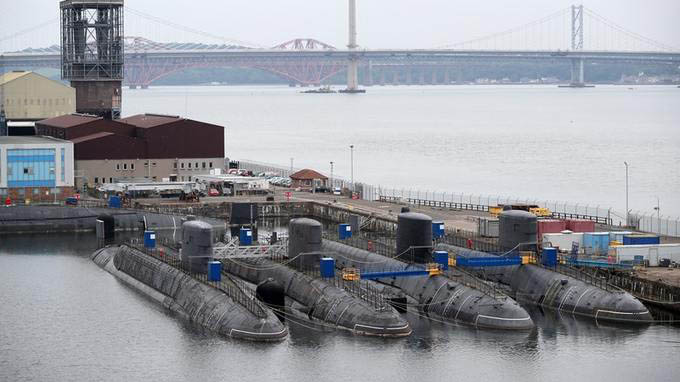
The oncoming submarine crisis is not the only threat to the UK’s ability to maintain its nuclear weapon capability. The recent upsurge in the aspiration for Scottish independence should remind us that we are in a unique position with the potential not only to rid ourselves of these horrific weapons, but also to undermine the ability of the UK to persist with them since there is no credible alternative to the Clyde bases elsewhere the UK.
29th September, By David Mackenzie
LAST week a UK nuclear weapon Vanguard-class submarine returned to its base in Faslane, covered in algae and barnacles, reportedly after a patrol that lasted more than six months.
This prompted the pro-navy (and pro-nuclear-weapon) magazine Navy Outlook to publish a long article discussing the increase in the length of patrols and suggesting that this is down to the difficulty, due to refits and maintenance problems arising from skill shortages, of maintaining the pattern of always having one boat on patrol at all times. The article acknowledges that there is now great pressure on the submariners and that risks are being taken to maintain the patrol pattern.
The four Vanguard-class boats are now more than 30 years old and the replacement Dreadnought- class is already well behind schedule, so the question arises as to whether the current submarines can be patched and crewed sufficiently to close the potential gap in availability.
The Dreadnought programme is seriously hampered by a shortage of assembly space at Barrow and delays to the Derby unit where the reactor cores will be built. The UK Government refuses to say when it expects the new boats to be ready. The stretching of the patrol length to six months and beyond suggests that the crisis point may not be far away and that in the interim more and more risks will be taken with material and personnel.
The oncoming submarine crisis is not the only threat to the UK’s ability to maintain its nuclear weapon capability. The recent upsurge in the aspiration for Scottish independence should remind us that we are in a unique position with the potential not only to rid ourselves of these horrific weapons, but also to undermine the ability of the UK to persist with them since there is no credible alternative to the Clyde bases elsewhere the UK.
When the UK was setting up Polaris, its first system for the submarine launching of nuclear weapons, the Ministry of Defence conducted a study to determine what sites would be suitable for two essential items – a port for berthing the submarines and a nearby but separate armaments depot for storing the warheads and loading them onto the missiles in the submarines.
The study rejected all the projected locations in England and Wales (including Falmouth, Milford Haven, Portland, Devonport, Barrow, and completely new “greenfield” sites). So we have the submarines based at Faslane and the warhead storage and management facility at Coulport. The Clyde sites offer deep water access and a ready route to the Atlantic. Two other locations outwith the UK have been raised – one is moving the bases to King’s Bay in Georgia, US.
This would rip away the last tissue of pretence that the UK system is an independent one. Also mooted has been the sharing of the French facilities on Île Longue near Brest but this is seen as politically beyond the pale. In short, there is no feasible alternative to the Clyde bases. This analysis is accepted by the UK defence establishment. This makes Scottish independence a critical threat to the UK’s nuclear weapons.
It has also been pointed out that the increasing fragility of the UK nuclear weapon system may have prompted the projected return of US nuclear weapons to the US base at Lakenheath in Suffolk. If the UK is seen as an increasingly wobbly part of the Nato nuclear fabric this may represent a belt-and-braces tactic.
The third shaky-nail factor is the growing worldwide movement for the complete elimination of nuclear weapons. The Treaty on the Prohibition of Nuclear Weapons (TPNW), which came into force as UN law in January 2021, has acquired huge worldwide support – to date 69 ratifications, 93 signatures and the regular support of around 130 states on the floor of the UN General Assembly, to say nothing of such strong supporters as Ireland, Austria, Pope Francis and The Elders. Meanwhile, financial institutions are disinvesting from nuclear weapons, frequently ascribing their stance to the TPNW.
The nuclear war threat is like an open petrol can that is kept close to an open fire on a shoogly table. This is a uniquely dangerous moment.
Yet there is an overwhelming desire for prohibition from the majority of UN member states, especially from those who would suffer the most from the climatic effects of an exchange of nuclear weapons.
We can hope that these three factors will enable a fundamental rethink of the UK’s nuclear posturing.
We can certainly hope that Scotland will take its own clear stance on the matter with worldwide support.
David Mackenzie is secretary of Secure Scotland
Japan to release second batch of wastewater from Fukushima nuclear plant next week
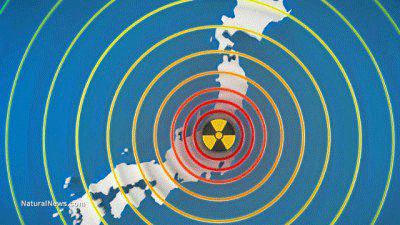
UN-approved release to go ahead despite China’s ban on all Japanese sea imports following first batch
Japan will begin releasing a second batch of wastewater from the crippled
Fukushima nuclear plant from next week, its operator has said, an exercise
that angered China and others when it began in August.
Guardian 29th Sept 2023
‘Unprecedented nuclear crisis’ at Russian-controlled power plant with 148 attacks
An alarming dossier compiled by Greenpeace is being sent to
Western governments warning international regulators are currently
incapable of properly monitoring safety at the Zaporizhzhia plant in
Ukraine.
Mirror 28th Sept 2023
https://www.mirror.co.uk/news/world-news/unprecedented-nuclear-crisis-russian-controlled-31050468
1 This Month
23-25 October – on Zoom – World BEYOND War’s annual global conferenc


Shut down the radiation-damaged Heysham nuclear reactors now
To see nuclear-related stories in greater depth and intensity – go to https://nuclearinformation.wordpress.com

Say No to NASA’s Reckless Nuclear Reactor on the Moon
Say No to NASA’s Reckless Nuclear Reactor on the Moon

-
Archives
- October 2026 (199)
- September 2026 (339)
- August 2026 (330)
- July 2026 (355)
- June 2026 (287)
- May 2026 (306)
- April 2026 (356)
- March 2026 (251)
- February 2026 (267)
- January 2026 (308)
- December 2025 (358)
- November 2025 (359)
-
Categories
- 1
- 1 NUCLEAR ISSUES
- business and costs
- climate change
- culture and arts
- ENERGY
- environment
- health
- history
- indigenous issues
- Legal
- marketing of nuclear
- media
- opposition to nuclear
- PERSONAL STORIES
- politics
- politics international
- Religion and ethics
- safety
- secrets,lies and civil liberties
- spinbuster
- technology
- Uranium
- wastes
- weapons and war
- Women
- 2 WORLD
- ACTION
- AFRICA
- Atrocities
- AUSTRALIA
- Christina's notes
- Christina's themes
- culture and arts
- Events
- Fuk 2022
- Fuk 2023
- Fukushima 2017
- Fukushima 2018
- fukushima 2019
- Fukushima 2020
- Fukushima 2021
- general
- global warming
- Humour (God we need it)
- Nuclear
- RARE EARTHS
- Reference
- resources – print
- Resources -audiovicual
- Weekly Newsletter
- World
- World Nuclear
- YouTube
-
RSS
Entries RSS
Comments RSS

