American Meddling Failed To Prevent Robert Fico’s Victory In The Latest Slovak Elections
ANDREW KORYBKO, OCT 2, 2023, https://korybko.substack.com/p/american-meddling-failed-to-prevent?utm_source=post-email-title&publication_id=835783&post_id=137585191&utm_campaign=email-post-title&isFreemail=true&r=ln98x&utm_medium=email
The reason why America meddled in this election is because it fears both the substance and symbolism of a hitherto stalwart NATO vassal defecting from the bloc’s anti-Russian proxy war coalition.
The “Direction-Social Democracy” (SMER) party of former Prime Minister Robert Fico emerged victorious after Slovakia’s latest elections on Saturday in spite of Russia’s Foreign Intelligence Service (SVR) warning before the vote that the US will go to any lengths to prevent that outcome. Nobody should have been surprised by that since CNN’s reporting made it obvious that Washington wanted him to lose. Here are three of their articles fearmongering about his democratically driven return to office:
* “A NATO country could soon have a pro-Russian leader”
* “With Kremlin apologist leading the polls, Slovakia vote threatens country’s support for Ukraine”
* “Pro-Russian politician wins Slovakia’s parliamentary election”
The reason why America meddled in this election is because it fears both the substance and symbolism of a hitherto stalwart NATO vassal defecting from the bloc’s anti-Russian proxy war coalition. Fico previously condemned the West’s role in provoking and perpetuating this conflict exactly as neighboring Hungarian leader Viktor Orban has done since the get-go. Just like him, Fico is also against arming Ukraine and could prevent others’ weapons from transiting across his country as well.
He’ll still need to form a governing coalition in order to make good on his promises, but few doubt that he’ll be able to. Assuming that’ll happen, then Slovakia will join Hungary in creating a center of anti-war gravity in the heart of both the EU and NATO, which complements Poland’s newly cautious stance towards this proxy conflict brought about by its dispute with Ukraine. These three could then form an influential force if the latter’s ruling “Law & Justice” (PiS) party wins re-election on 15 October.
Poland remains much more committed to this conflict than Hungary and post-election Slovakia, but there’s also no denying that the Polish people are incredibly offended at Ukraine’s ungratefulness. A critical mass of them might therefore vote for the anti-establishment Confederation party to protest PiS’ prior appeasement of Kiev up until recently despite that regime’s glorification of those who genocided Poles. If enough do so, then PiS might be compelled to form a coalition government with Confederation.
In that case, Poland might move closer towards Hungary and Slovakia’s position, which could inspire average Europeans to follow these countries’ lead during their own upcoming elections. The demonstration effect that was set into motion by Slovakia and which might soon manifest itself in Poland is therefore regarded by the US as a strategic challenge for good reason. That doesn’t justify its failed meddling in the latest Slovak elections, but simply places its motives into the appropriate context.
The fact that the CIA still failed to prevent Fico’s re-election dispels three popular myths, first and foremost that agency’s omnipotence. The second is foreign voters’ alleged inability to defy the American government’s will, the false perception of which has been exploited to suppress anti-establishment turnout. And finally, the Ukrainian Conflict is truly unpopular in some countries despite the media’s claims to the contrary and its crazed efforts to artificially manufacture support for this proxy war there.
With these symbolic outcomes in mind as well as the substantive changes to Slovak policy that are likely to follow its latest election, not to mention their possible impact on Poland in the coming future and the rest of Europe after that, the failure of America’s meddling campaign is a major development. It’s premature to describe it as a game-changer, but it still suggests a potentially impending inflection point in the Ukrainian Conflict, provided of course that the CIA doesn’t successfully sabotage related trends
The Mad Propaganda Push To Normalize War Profiteering In Ukraine.

Just the other day CNN anchor Erin Burnett ………. pausing to explain to her audience that this funding is actually good for Americans, because it goes straight into the US arms industry.
CAITLIN JOHNSTONE, OCT 1, 2023
There’s been an astonishingly brazen propaganda push to normalize war profiteering in Ukraine as Kyiv coordinates with the arms industry and western governments to convert the war-ravaged nation into a major domestic weapons manufacturer, thereby turning Ukrainians into proxies of the military industrial complex as well as the Pentagon.
At an event in Kyiv which hosted 250 “defense” industry corporations from 30 different countries on Friday, President Zelensky gave a speech urging war profiteers to open factories in Ukraine to cut out the middleman of securing and delivering so many weapons from abroad. This is an investment that the arms industry would ostensibly have plenty of time to set up, given that western officials are now going out of their way to communicate to the public that this war will stretch on for many more years to come.
Zelensky’s speech twice made use of the phrase “defense-industrial complex”, and used the phrase “arsenal of the free world” no fewer than three times.
“Ukraine is developing a special economic regime for the defense-industrial complex,” Zelensky said. “To give all the opportunities to realize their potential to every company that works for the sake of defense — in Ukraine and with Ukraine or that wants to come to Ukraine.”
“Right now, the most powerful military-industrial complexes are being determined, as are their priorities and the global standard of defense. All of this is being determined in Ukraine,” Zelensky tweeted with photos from the event.
This move has been accompanied in recent weeks by some of the most appalling mass media headlines that I have ever seen, all geared toward normalizing the military industrial complex in the eyes of the public.
In an amazingly awful Wall Street Journal op-ed titled titled “In Defense of the Defense Industry” and subtitled “Populists of the right and left attack U.S. companies that make weapons. Who do they think protects us?”, Future of Capitalism’s Ira Stoll argues that the military industrial complex is actually a wonderful thing we should all love and support.
“The weapons industry protects America and its allies, keeping us safe from ruthless enemies who would otherwise exterminate or enslave us,” Stoll writes. “Raytheon helps make weapons systems that defend Israeli civilians against attacks from Iran-backed terrorist groups. These include the Iron Dome, David’s Sling, SkyHunter interceptor systems and Tamir missiles. Raytheon also produces the Javelin antitank missile that Ukraine has used against Russian armor and the early-warning radars that would detect incoming missiles aimed at the U.S.”
Stoll does not name the alternate universe he is describing in which the US military is used to keep Americans safe rather than to advance imperial interests abroad.
Another recent Wall Street Journal article titled “The War in Ukraine Is Also a Giant Arms Fair” and subtitled “Arms makers are getting orders for weapons being put to the test on the battlefield” glorifies the way war machinery is being field tested on human bodies to the benefit of war profiteers.
“The Panzerhaubitze howitzer is part of an arsenal of weapons being put to the test in Ukraine in what has become the world’s largest arms fair,” writes WSJ’s Alistair MacDonald. “Companies that make the weapons being used in Ukraine have won orders and resurrected production lines. The deployment of billions of dollars worth of equipment in a major land war has also given manufacturers and militaries a unique opportunity to analyze the battlefield performance of weapons, and learn how best to use them.”
A Reuters article from two weeks ago titled “At London arms fair, global war fears are good for business” gushes over how much money is being raked in by arms manufacturers as a result of this war, with one unnamed arms industry executive telling Reuters, “War is good for business.”
Just the other day CNN anchor Erin Burnett followed up some clips of “far right lawmakers” voicing their opposition to funding for the Ukraine proxy war by pausing to explain to her audience that this funding is actually good for Americans, because it goes straight into the US arms industry.
“It’s worthwhile with all of this gaining some steam in public perception to be clear on some facts,” Burnett said. “First and foremost, the vast majority of this money is going to American companies and jobs, right, because those are the people that are making the Abrams tanks, the ammo and everything else. And you take Lockheed Martin, which makes the HIMARS, that have been core to Ukraine’s counteroffensive, the company announced it’s going to increase its workforce in Camden, Arkansas, by 20 percent, just because of this new demand.”

“That money is going to America,” Burnett added.
All this propaganda energy is going into normalizing the act of war profiteering because if you let the idea stand on its own, it would make people scream in horror. The fact that a deliberately-provoked war is being used as a giant field demo to show prospective buyers and investors how effective various weapons systems can be at ripping apart human bodies in order to profit from all this death and destruction is more nightmarish than anything any dystopian novelist has ever come up with.
Ukraine is a giant advertisement for weapons of mass slaughter, and the cost of that corporate ad is not money but human blood. If you look right at this thing it absolutely chills you to the bone. Which is why so much effort is being poured into making sure people don’t look at it.
Monuments to Ukrainian Nazis in Canada

W.O. Munce, https://www.thepostil.com/monuments-to-ukrainian-nazis-in-canada/
Given the fact that Ukraine and Nazis are again making news, it is important to point out that there are indeed commemorative monuments to Ukrainian Nazis in Canada, located where the Ukrainian populations are the greatest. The reasons for such monuments are known to the Ukrainian community alone, but so it is essential to make a record of them here, along with a hint at what those being commemorated did back in the days of World War Two.
“Ukrainian partisans and their allies burned homes, shot or forced back inside those who tried to flee, and used sickles and pitchforks to kill those they captured outside. Churches full of worshipers were burned to the ground. Partisans displayed beheaded, crucified, dismembered, or disemboweled bodies, to encourage remaining Poles to flee… It was this maimed OUN-Bandera, led by Mykola Lebed’ and then Roman Shukhevych, that cleansed the Polish population from Volhynia in 1943” (The Reconstruction of Nations).
The 14th Division of the Ukrainian SS surrounded the village Huta Pieniacka from three sides… The people were gathered in the church or shot in the houses. Those gathered in the church—men, women and children—were taken outside in groups, children killed in front of their parents. Some men and women were shot in the cemetery, others were gathered in barns where they were shot” (British archives).
“One of their major tasks as UPA partisans was the cleansing of the Polish presence from Volhynia. Poles tend to credit the UPA’s success in this operation to natural Ukrainian brutality; it was rather a result of recent experience. People learn to do what they are trained to do, and are good at doing what they have done many times. Ukrainian partisans who mass-murdered Poles in 1943 followed the tactics they learned as collaborators in the Holocaust in 1942: detailed advance planning and site selection; persuasive assurances to local populations prior to actions; sudden encirclements of settlements; and then physical elimination of human beings. Ukrainians learned the techniques of mass murder from Germans. This is why UPA ethnic cleansing was striking in its efficiency, and why Volhynian Poles in 1943 were nearly as helpless as Volhynian Jews in 1942. It is one reason why the campaign against Poles began in Volhynia rather than Galicia, since in Volhynia the Ukrainian police played a greater role in the Final Solution” (The Reconstruction of Nations).
“On that day, early in the morning, soldiers of this division, dressed in white, masking outfits, surrounded the village. The village was cross-fired by artillery. SS-men of the 14th Division of the SS ‘Galizien’ entered the village, shooting the civilians rounded up at a church. The civilians, mostly women and children, were divided and locked in barns that were set on fire. Those who tried to run away were killed. Witnesses interrogated by the prosecutors of the Head Commission described the morbid details of the act. The crime was committed against women, children, and newborn babies” (The Institute of National Remembrance. Commission for the Prosecution of Crimes against the Polish Nation).
Related Articles:
Canada’s Honoring of Nazi Vet Exposes Ottawa’s Longstanding Ukraine Policy
Following the war, Canada’s Liberal government classified thousands of Jewish refugees as “enemy aliens” and held them alongside former Nazis in a network of internment camps enclosed with barbed wire, fearing that they would infect their new country with communism. At the same time, Ottawa placed thousands of Ukrainian veterans of Hitler’s army on the fast-track to citizenship.
By celebrating a Waffen-SS volunteer as a “hero,” Canada’s Liberal Party highlighted a longstanding policy that has seen Ottawa train fascist militants in Ukraine while welcoming in thousands of post-war Nazi SS veterans. Canada’s second most powerful official, Chrystia Freeland, is the granddaughter of one of Nazi Germany’s top Ukrainian propagandists.
SCHEERPOST, By Max Blumenthal / The Grayzone 1 Oct 23
In the Spring of 1943, Yaroslav Hunka was a fresh-faced soldier in the 14th Grenadier Division of the Waffen-SS Galicia when his division received a visit from the architect of Nazi Germany’s genocidal policies, Heinrich Himmler. Having presided over the battalion’s formation, Himmler was visibly proud of the Ukrainians who had volunteered to support the Third Reich’s efforts.
80 years later, the Speaker of Canada’s parliament, Anthony Rota, also beamed with pride after inviting Hunka to a reception for Volodymyr Zelensky, where the Ukrainian president lobbied for more arms and financial assistance for his country’s war against Russia.
“We have in the chamber today Ukrainian war veteran from the Second World War who fought for Ukrainian independence against the Russians and continues to support the troops today even at his age of 98,” Rota declared during the September 22 parliamentary event in Ottawa.
“His name is Yaroslav Hunka but I am very proud to say he is from North Bay and from my riding of Nipissing-Timiskaming. He is a Ukrainian hero, a Canadian hero, and we thank him for all his service,” Rota continued.
Gales of applause erupted through the crowd, as Prime Minister Justin Trudeau, Zelensky, Deputy Prime Minister Chrystia Freeland, Canadian Chief of Defense Staff Gen. Wayne Eyre and leaders of all Canadian parties rose from their seats to applaud Hunka’s wartime service.
Since the exposure of Hunka’s record as a Nazi collaborator – which should have been obvious as soon as the Speaker announced him – Canadian leaders (with the notable exception of Eyre) have rushed to issue superficial, face-saving apologies as withering condemnations poured in from Canadian Jewish organizations.
The incident is now a major national scandal, occupying space on the cover of Canadian papers like the Toronto Sun, which quipped, “Did Nazi that coming.” Meanwhile, Poland’s Education Minister has announced plans to seek Hunka’s criminal extradition.
The Liberal Party has attempted to downplay the affair as an accidental blunder, with one Liberal MP urging her colleagues to “avoid politicizing this incident.” Melanie Joly, Canada’s Foreign Minister, has forced Rota’s resignation, seeking to turn the the Speaker into a scapegoat for her party’s collective actions.
Trudeau, meanwhile, pointed to the “deeply embarrassing” event as a reason to “push back against Russian propaganda,” as though the Kremlin somehow smuggled an nonagenarian Nazi collaborator into parliament, then hypnotized the Prime Minister and his colleagues, Manchurian Candidate-style, into celebrating him as a hero.
To be sure, the incident was no gaffe. Before Canada’s government and military brass celebrated Hunka in parliament, they had provided diplomatic support to fascist hooligans fighting to install a nationalist government in Kiev, and oversaw the training of contemporary Ukrainian military formations openly committed to the furtherance of Nazi ideology.
Ottawa’s celebration of Hunka has also lifted the cover on the country’s post-World War Two policy of naturalizing known Ukrainian Nazi collaborators and weaponizing them as domestic anti-communist shock troops. The post-war immigration wave included the grandfather of Deputy Prime Minister Chrystia Freeland, who functioned as one of Hitler’s top Ukrainain propagandists inside Nazi-occupied Poland.
Though Canadian officialdom has worked to suppress this sordid record, it has resurfaced in dramatic fashion through Hunka’s appearance in parliament and the unsettling contents of his online diaries.
“WE WELCOMED GERMAN SOLDIERS WITH JOY”
The March 2011 edition of the journal of the Association of Ukrainian Ex-Combatants in the US contains an unsettling diary entry which had gone unnoticed until recently.
Authored by Yaroslav Hunka, the journal consisted of proud reflections on volunteering for the 14th Grenadier Division of the Waffen-SS Galicia. Hunka decribed the Nazi Wehrmacht as “mystical German knights” when they first arrived in his hometown of Berezhany, and recalled his own service in the Waffen-SS as the happiest time in his life.
“In my sixth grade,” he wrote, “out of forty students, there were six Ukrainians, two Poles, and the rest were Jewish children of refugees from Poland. We wondered why they were running away from such a civilized Western nation as the Germans.”
The Jewish Virtual Library details the extermination of Berezhany’s Jewish population at the hands of the “civilized” Germans: “In 1941 at the end of Soviet occupation 12,000 Jews were living in Berezhany, most of them refugees fleeing the horrors of the Nazi war machine in Europe. During the Holocaust, on Oct. 1, 1941, 500–700 Jews were executed by the Germans in the nearby quarries. On Dec. 18, another 1,200, listed as poor by the Judenrat, were shot in the forest. On Yom Kippur 1942 (Sept. 21), 1,000–1,500 were deported to Belzec and hundreds murdered in the streets and in their homes. On Hanukkah (Dec. 4–5) hundreds more were sent to Belzec and on June 12, 1943, the last 1,700 Jews of the ghetto and labor camp were liquidated, with only a few individuals escaping. Less than 100 Berezhany Jews survived the war.”
When Soviet forces held control of Berezhany, Hunka said he and his neighbors longed for the arrival of Nazi Germany. “Every day,” he recalled, “we looked impatiently in the direction of the Pomoryany (Lvov) with the hope that those mystical German knights, who give bullets to the hated Lyakhs are about to appear.” (Lyakh is a derogatory Ukrainian term for Poles).
In July 1941, when the Nazi German army entered Berezhany, Hunka breathed a sigh of relief. “We welcomed the German soldiers with joy,” he wrote. “People felt a thaw, knowing that there would no longer be that dreaded knocking on the door in the middle of the night, and at least it would be possible to sleep peacefully now.”
Two years later, Hunka joined the First Division of the Galician SS 14th Grenadier Brigade – a unit formed under the personal orders of Heinrich Himmler. When Himmler inspected the Ukrainian volunteers in May 1943 (below), he was accompanied by Otto Von Wachter, the Nazi-appointed governor of Galicia who established the Jewish ghetto in Krakow.
“Your homeland has become so much more beautiful since you have lost – on our initiative, I must say – those residents who were so often a dirty blemish on Galicia’s good name, namely the Jews…” Himmler reportedly told the Ukrainian troops. “I know that if I ordered you to liquidate the Poles … I would be giving you permission to do what you are eager to do anyway.”
“HITLER’S ELITE TORTURERS AND MURDERERS HAVE BEEN PASSED ON RMCP ORDERS”
Following the war, Canada’s Liberal government classified thousands of Jewish refugees as “enemy aliens” and held them alongside former Nazis in a network of internment camps enclosed with barbed wire, fearing that they would infect their new country with communism. At the same time, Ottawa placed thousands of Ukrainian veterans of Hitler’s army on the fast-track to citizenship.
The Ukrainian Canadian newsletter lamented on April 1, 1948, “some [of the new citizens] are outright Nazis who served in the German army and police. It is reported that individuals tattoooed with the dread[ed] SS, Hitler’s elite torturers and murderers have been passed on RCMP orders and after being turned down by screening agencies in Europe.”
The journal described the unreformed Nazis as anticommunist shock troops whose “‘ideological leaders’ are already busy fomenting WWIII, propagating a new world holocaust in which Canada will perish.”
In 1997, the Canadian branch of the Simon Wiesenthal Center charged the Canadian government with having admitted over 2000 veterans of the 14th Volunteer Waffen-SS Grenadier Division.
That same year, 60 Minutes released a special, “Canada’s Dark Secret,” revealing that some 1000 Nazi SS veterans from Baltic states had been granted citizenship by Canada after the war. Irving Abella, a Canadian historian, told 60 Minutes that the easiest way to get into the country “was by showing the SS tattoo. This proved that you were an anti-Communist.”
Abella also alleged that Prime Minister Pierre Trudeau (Justin’s father) explained to him that his government kept silent about the Nazi immigrants “because they were afraid of exacerbating relationships between Jews and Eastern European ethnic communities.”
Yaroslav Hunka was among the post-war wave of Ukrainian Nazi veterans welcomed by Canada. According to the city council website of Berezhany, he arrived in Ontario in 1954 and promptly “became a member of the fraternity of soldiers of the 1st Division of the UNA, affiliated to the World Congress of Free Ukrainians.”
Also among the new generation of Ukrainian Canadians was Michael Chomiak, the grandfather of Canada’s second-most-powerful official, Chrystia Freeland. Throughout her career as a journalist and Canadian diplomat, Freeland has advanced her grandfather’s legacy of anti-Russian agitation, while repeatedly exalting wartime Nazi collaborators during public events.
CANADA WELCOMES HITLER’S TOP UKRAINIAN PROPAGANDISTS……………………………………………………………………………………………………………. more https://scheerpost.com/2023/10/01/canadas-honoring-of-nazi-vet-exposes-ottawas-longstanding-ukraine-policy/
Editorial: Japan city’s rejection of nuclear waste site probe casts doubt on gov’t stance.

Tsushima Mayor Naoki Hitakatsu announced on Sept. 27 that
the Nagasaki Prefecture city will not accept a reference material-based
preliminary survey for the construction of a final disposal facility for
nuclear waste, going against the local assembly’s initial adoption of a
petition calling for the survey’s approval.
The Japanese government must accept the reality that the search for a candidate site to dispose ofhighly radioactive nuclear waste, which will continue to accumulate as long
as nuclear power plants are in operation, is proving difficult.
Mainichi 30th Sept 2023
https://mainichi.jp/english/articles/20230930/p2a/00m/0op/009000c
Flagging Support: Zelenskyy Loses Favour in Washington

“With no end in sight, it looks increasingly likely that Ukraine will be yet another endless quagmire funded by the American taxpayer.”
In August, the Biden administration had requested a $24 billion package for Ukraine but was met with a significantly skimmed total of $6.1 billion. Of that amount $1.5 billion is earmarked for the Ukrainian Security Assistance Initiative, a measure that continues to delight US arms manufacturers by enabling the Pentagon to place contracts on their behalf to build weapons for Kyiv.
October 1, 2023, by: Dr Binoy Kampmark, https://theaimn.com/flagging-support-zelenskyy-loses-favour-in-washington/
Things did not go so well this time around. When the worn Ukrainian President Volodymyr Zelenskyy turned up banging on the doors of Washington’s powerful on September 21, he found fewer open hearts and an increasingly large number of closed wallets. The old ogre of national self-interest seemed to be presiding and was in no mood to look upon the desperate leader with sweet acceptance.
Last December, Zelensky and Ukrainian officials did not have to go far in hearing endorsements and encouragement in their efforts battling Moscow’s armies. The visit of the Ukrainian president, as White House Press Secretary Karine Jean-Pierre stated at the time, “will underscore the United States’ steadfast commitment to supporting Ukraine for as long as it takes, including through provision of economic, humanitarian and military assistance.”
Republican Senator from Utah, Mitt Romney, was bubbly with enthusiasm for the Ukrainian leader. “He’s a national and global hero – I’m delighted to be able to hear from him.” Media pack members such as the Associated Press scrambled for stretched parallels in history’s record, noting another mendicant who had previously appeared in Washington to seek backing. “The moment was Dec. 22, 1941, as British Prime Minister Winston Churchill landed near Washington to meet President Franklin D. Roosevelt just weeks after the attack on Pearl Harbor.”
Then House Speaker, the California Democrat Nancy Pelosi, also drew on the Churchillian theme with a fetishist’s relish. “Eighty-one years later this week, it is particularly poignant for me to be present when another heroic leader addresses the Congress in time of war – and with Democracy itself on the line,” she wrote colleagues in a letter.
Zelenskyy, not wishing to state the obvious, suggested a different approach to the question of aiding Ukraine. While not necessarily an attentive student of US history, any briefings given to him should have been mindful of a strand in US politics sympathetic to isolationism and suspicious of foreign leaders demanding largesse and aid in fighting wars.
How, then, to get around this problem? Focus on clumsy, if clear metaphors of free enterprise. “Your money is not charity,” he stated at the time, cleverly using the sort of corporate language that would find an audience among military-minded shareholders. “It’s an investment in global security and democracy that we handle in the most responsible way.” Certainly, Ukrainian aid has been a mighty boon for the US military-industrial complex, whose puppeteering strings continue to work their black magic on the Hill.
Despite such a show, the number of those believing in the wisdom of such an investment is shrinking. “In a US capital that has undergone an ideological shift since he was last here just before Christmas 2022,” remarked Stephen Collinson of CNN, “it now takes more than quoting President Franklin Roosevelt and drawing allusions to 9/11, to woo lawmakers.”
Among the investors, Republicans are shrinking more rapidly than the Democrats. An August CNN poll found a majority in the country – 55% – firmly against further funding for Ukraine. Along party lines, 71% of Republicans are steadfastly opposed, while 62% of Democrats would be satisfied with additional funding.
Kentucky Republican and Senate Minority leader Mitch McConnell continues to claim that funding Ukraine is a sensibly bloody strategy that preserves American lives while harming Russian interests. “Helping Ukraine retake its territory means weakening – weakening – one of America’s biggest strategic adversaries without firing a shot.”
The same cannot be said about the likes of Kentucky’s Republican Senator Rand Paul. While Zelenskyy was trying to make a good impression on the Hill, the senator was having none of it. “I will oppose any effort to hold the federal government hostage for Ukraine funding. I will not consent to expedited passage of any spending measure that provides any more US aid to Ukraine.”
In The American Conservative, Paul warned that, “With no end in sight, it looks increasingly likely that Ukraine will be yet another endless quagmire funded by the American taxpayer.” President Joe Biden’s administration had “failed to articulate a clear strategy or objective in this war, and Ukraine’s long-awaited counter-offensive has failed to make meaningful gains in the east.”
Such a quagmire was also proving jittering in its dangers. There was the prospect of miscalculation and bungling that could pit US forces directly against the Russian army. There were also no “effective oversight mechanisms” regarding the funding that has found its way into Kyiv’s pockets. “Unfortunately, corruption runs deep in Ukraine, and there’s plenty of evidence that it has run rampant since Russia’s invasion.” The Zelenskyy government, he also noted in a separate post, had “banned the political parties, they’ve invaded churches, they’ve arrested priests, so no, it isn’t a democracy, it’s a corrupt regime.”
Republicans such as Missouri Senator Josh Hawley are of the view that the US should be slaying different monsters of a more threatening variety. (Every imperium needs its formidable adversaries.) The administration, he argued, should “take the lead on China” and reassure its “European allies” that Washington would be providing “the nuclear umbrella in Europe.”
On September 30, with yet another government shutdown looming in Washington, the US House approved a bill for funding till mid-November by a 335-91 vote. But the measure did not include additional military or humanitarian aid to Ukraine. In August, the Biden administration had requested a $24 billion package for Ukraine but was met with a significantly skimmed total of $6.1 billion. Of that amount $1.5 billion is earmarked for the Ukrainian Security Assistance Initiative, a measure that continues to delight US arms manufacturers by enabling the Pentagon to place contracts on their behalf to build weapons for Kyiv.
The limited funding measure proved a source of extreme agitation to the clarion callers who have linked battering the Russian bear, if only through a flawed surrogate, with the cause of US freedom. “I am deeply disappointed that this continuing resolution did not include further aid for our ally, Ukraine,” huffed Maryland Democrat Rep. Steny Hoyer. “In September, the House held seven votes to approve that vital funding to Ukraine. Each time, more than 300 House Members voted in favor. This ought to be a nonpartisan issue and ought to have been addressed in the continuing resolution today.”
As Hoyer and those on his pro-war wing of politics are starting to realise, Ukraine, as an issue, is becoming problematically partisan and ripe. The filling in Zelenskyy’s cap is inexorably thinning and lightening.
Governments have unpopular decisions to make to achieve their nuclear aims.
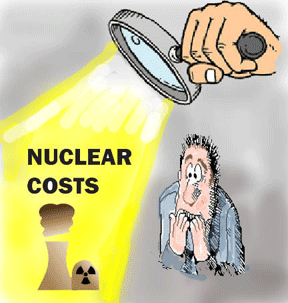
Global energy ministers met in Paris this week to discuss
how to kick-start a new age of atomic power. Installed capacity must triple
to 1,160 gigawatts by 2050, the Nuclear Energy Agency says. In the west,
many countries’ goals will hinge on attracting private capital to a
sector with a tarnished record.
Recent large projects in the US and Europehave run over budget and into delays. New, small reactors that can be built in factories by companies such as NuScale and Rolls-Royce to reduce risks are an exciting prospect. For larger projects in particular, governments
will have to offer incentives and guarantees that will not always sit
comfortably with taxpayers. ………..
France and the UK have ambitious targets. The UK is a test case for investor appetite
to fund new plants. It wants to secure funding for the 3.2GW Sizewell C
project, using a regulated asset base financing model. RAB …. offers
investors returns during construction. That avoids the accumulation of
interest on debt that would normally be paid off when projects open.
Households contribute to the financing via a surcharge on their energy
bills. For that reason, it is not popular with consumer groups. Opposition
will grow especially as investors will want the risk of any budget blow-ups
to be shared with bill-payers, at least 50-50. Governments have unpopular
decisions to make to achieve their nuclear aims.
FT 30th Sept 2023
https://www.ft.com/content/d3b6ca64-f93f-464f-96ab-ec479e7a933e
Byron Blake Critical assessment of nuclear energy in Jamaica’s future
October 1, 2023 https://jamaica-gleaner.com/article/focus/20231001/byron-blake-critical-assessment-nuclear-energy-jamaicas-future
In an article published in the Sunday Gleaner of July 30, titled ‘The Potential of Nuclear Energy as Part of the Future Energy Mix in Jamaica’, Oshane Hamilton explored the viability of integrating nuclear energy into Jamaica’s energy landscape. While his exposition on this nuclear prospect may be persuasive at first glance, a more critical evaluation is warranted.
Hamilton’s central argument for nuclear energy in Jamaica is predicated on the promise of Small Modular Reactors (SMRs), an emerging design stage technology. Approximately 85 per cent of the article is dedicated to extolling the merits of nuclear power as a low-greenhouse-gas-emissions, highly available energy source, and emphasising the advantages of SMRs over conventional nuclear power plants.
Positioned as an apt solution for a small island nation, SMRs are presented as a “burgeoning technology”. But, that burgeoning is all “on paper”, as it is still at the design stage. In that regard, it is important to note Hamilton’s concession in his article’s closing lines that the deployment and validation of SMRs are yet to be realised.
FALLS SHORT
One key advantage highlighted by Hamilton is the small spatial footprint of SMRs. However, the article falls short of clarifying the required number of units to establish a substantial power-generating facility. Procuring upwards of 35 acres of suitable, flat, remote, and uninhabited land, and possibly several pieces, in Jamaica, could be a formidable challenge, given the island’s limited available space and topography.
The article seems to dismiss concerns about nuclear plant safety by arguing that SMRs are safer than conventional nuclear plants, which, in turn, are supposedly safer than alternative energy sources. But, to be safer than the alternative does not make a technology safe. Further, this perspective sidesteps the perpetual challenge of nuclear waste disposal and management, radiation hazards, and the long-term implications. One significant apprehension in Jamaica and the Caribbean pertains to nuclear material usage and the required safe disposal of waste. Considering the region’s high dependence on tourism and the Caribbean Sea’s extensive traffic, coupled with the presence of geographical parts of nuclear-armed states, a nuclear-free stance has been advocated and rigorously pursued.
DEFICIENCY
We do well to remind ourselves that, while illogical, parts of the US, France, and UK are within the Caribbean. These realities have underpinned historical efforts to establish the Caribbean as a nuclear-free zone and the region’s consistent protests against the trans-shipment of nuclear waste through the Caribbean Sea. The unbroken collaboration within the Caribbean underlines the importance of thorough consultation before any action to alter this stance.
A notable deficiency in Hamilton’s article lies in its treatment of renewable energy sources. In the brief segment addressing renewables, he acknowledges Jamaica’s abundant renewable resources, which could substantially diminish reliance on costly, environmentally detrimental fossil fuels. However, the subsequent section titled ‘Problems with Renewable Energy’ focuses disproportionately on the limitations of solar and wind power. While it is true that these sources are subject to natural variability, entail high initial costs, and require extensive land, a comparative analysis should encompass both financial and economic costs and benefits. It is crucial to recognise that the costs of these technologies have been falling, economic costs escalate with global climate change, and many of the financial costs are localised, thus reducing foreign currency demands. Moreover, innovative placement of wind turbines at sea or in remote areas, as well as efficient land use in solar project spaces, have demonstrably enhanced their overall viability.
Curiously, Hamilton’s article omits any mention of biomass-based energy, which holds, perhaps, the greatest potential in the Caribbean’s humid tropical environment. Biomass offers the added advantage of capturing greenhouse gases from the atmosphere and sequestering them, while serving numerous other agricultural, economic, and environmental purposes. It is, for example, a means of enhancing the rediscovered importance of agriculture in national development.
In conclusion, the article has a discernible inclination to validate a preconceived notion. The exploration moved quickly to the advancement of viability. The rigour in interrogating an unproven technology and the consequent cautions are absent. The case of potential alternatives, in particular the alternative for which Jamaica is best endowed, is superficial. These shortcomings notwithstanding, Oshane Hamilton’s piece could serve as a valuable catalyst for serious deliberation on a subject with far-reaching policy implications for both Jamaica and the wider Caribbean. It is hoped that the opportunity will spark substantial discourse among stakeholders and policymakers before commitments are given and investments made which will bind Jamaican citizens and taxpayers.
Byron Blake is former assistant secretary general of the Caribbean Community (CARICOM), based in Kingston, Jamaica. Send feedback to ambassadorblake@gmail.com
US Pacific Security Deal With Marshall Islands at Risk Over #Nuclear Payments Description
VOA News, 1 Oct 23, #antinuclear #nuclear-free #NoNukes
The United States struck security agreements this week with Pacific Island nations seen as a key part of U.S. plans to counter China’s territorial expansion. But after three years of negotiations, one of those Pacific nations — the Marshall Islands — still has not reached a deal with Washington.
A member of the U.S. negotiating team blames the State Department’s legal team for the holdup, saying they object to how the agreement describes money for compensation from U.S. nuclear testing in the Marshall Islands some 60 years ago.
The agreement — known as the Compacts of Free Association — gives Washington exclusive access to large parts of the Pacific Ocean surrounding Micronesia, Palau and the Marshall Islands. Funding runs out on September 30.
“You would have to say that there was mission failure,” said Howard Hills in an exclusive interview with VOA.
Hills negotiated those compacts alongside presidential envoy Ambassador Joseph Yun but left his position September 7. Deals with Micronesia and Palau have been reached, while talks with the Marshall Islands have stalled.
In a speech before the United Nations General Assembly on September 20, President David Kabua laid out the Republic of the Marshall Island’s remaining demand.
“What the United States must realize is that Marshallese people require that the nuclear issue be addressed.”
Kabua was referring to the environmental and health impacts of the 67 atomic bomb tests conducted in the Marshall Islands between 1946 and 1958.
But Hills says the State Department won’t let Yun officially designate the funds as compensation for the effects of American nuclear tests in the Marshalls………………………………………………………………………………………. more https://www.voanews.com/a/7290553.html
 | |||
| |||
Nuclear Arms Control: U.S. May Face Challenges in Verifying Future Treaty Goals
GAO-23-105698P Sep 28, 2023. https://www.gao.gov/products/gao-23-105698 #nuclear #antinuclear #nuclear-free #NoNukes
Fast Facts. The U.S. has set goals for a new strategic U.S.-Russian nuclear arms control treaty when the current one expires in 2026.
The goals are to ensure that a new treaty addresses all nuclear weapons—including those in storage and shorter-range weapons—and certain weapon delivery vehicles. For the next treaty, officials largely expect to use current methods to verify that each country complies, such as on-site inspections and satellite imagery.
Beyond the next treaty, future treaties could include more extensive nuclear weapon limits. Verifying such treaties may require more advanced technology, which the U.S. is researching and developing.
What GAO Found
New START, a treaty that limits U.S. and Russian strategic nuclear forces, will expire in 2026. The U.S. has established three goals for a nuclear arms control treaty with Russia to follow New START:
- Retain limits on systems capable of delivering nuclear weapons at intercontinental ranges, or “strategic delivery vehicles”;
- Address all nuclear weapons, including nonstrategic nuclear weapons and weapons in storage; and
- Address new and novel Russian delivery vehicles, such as a nuclear-powered and nuclear-armed cruise missile.
According to U.S. officials, the measures for verifying compliance with a New START successor are likely to be similar to those employed for New START, including exchanges of data about deployed strategic delivery vehicles, inspections at relevant bases, and use of satellites. In the long term, the U.S. has aspirational goals—such as nuclear weapons reductions—that may require more extensive verification using more intrusive technologies.
The National Nuclear Security Administration (NNSA) has a plan for developing verification technologies that would support an array of possible treaty scenarios. NNSA’s plan groups these technologies into three “approaches” based on increasing levels of intrusiveness and confidence in compliance. Officials stated that technologies in the first, “baseline” approach are largely proven or already used under New START and are ready to support a potential successor treaty. More intrusive technologies—such as devices to measure weapons’ radiation signatures—would provide increased confidence in compliance and support longer-term treaty goals but may require 5 to 10 more years of development.
Stakeholders GAO interviewed and studies GAO reviewed noted likely challenges to verifying Russian compliance with future treaties that address U.S. nuclear arms control goals. For example, nuclear weapons are smaller than strategic delivery vehicles and would thus be harder to monitor using satellites. Verifying Russian compliance with limits on nonstrategic nuclear weapons may also be challenging, in part because many Russian nonstrategic delivery vehicles can carry nuclear or conventional weapons, making visual differentiation difficult.
Why GAO Did This Study
New START limits the number of U.S. and Russian strategic delivery vehicles—such as intercontinental ballistic missiles (ICBM)—and the total number of nuclear weapons that each party is allowed to deploy on those vehicles. New START also details a collection of verification measures—such as inspections and the use of satellites—intended to provide confidence that parties are complying with treaty limits. The U.S. has sought to negotiate a New START successor with Russia and aspires to pursue future arms control with China.
The Senate report accompanying a bill for the National Defense Authorization Act for Fiscal Year 2022 includes a provision for GAO to review technologies that could support verification of future nuclear arms control treaties. This report describes (1) U.S. goals and likely verification measures for future nuclear arms control treaties, including a successor to New START; (2) the extent NNSA has planned for or developed verification technologies to support future arms control goals; and (3) challenges stakeholders have identified to implementing verification measures to support future treaties.
GAO reviewed U.S. government plans and reports pertaining to nuclear arms control treaty verification, as well as relevant studies. GAO also interviewed 43 stakeholders, including U.S. government officials, representatives from the Department of Energy’s national laboratories, and nuclear arms control experts.
For more information, contact Allison Bawden at (202) 512-3841 or bawdena@gao.gov.
RFK Jr Will Run For President As An Independent: REPORT
JULIANNA FRIEMAN September 29, 2023 https://dailycaller.com/2023/09/29/robert-f-kennedy-rfk-independent-2024/
Democratic presidential candidate Robert F. Kennedy Jr. will reportedly announce on Oct. 9 that he is running as an independent
Kennedy is set to switch party affiliations after campaigning as a Democrat since April. His campaign plans to air “attack ads” against the Democratic National Committee to “pave the way” for his announcement, according to Mediate.
“Bobby feels that the DNC is changing the rules to exclude his candidacy, so an independent run is the only way to go,” a Kennedy campaign insider told the outlet. (RELATED: Biden World Wants The Media To Destroy Robert F. Kennedy Jr)
Kennedy has criticized President Joe Biden on various occasions during his campaign. He claimed to be “the first person censored by the Biden administration” in early 2021 when he was suspended from Instagram and Facebook for disinformation, and has accused the sitting president of living in a “bubble” and only talking to “donors.”
By switching his election bid to an independent campaign, Kennedy could serve as a “spoiler” candidate, though commentators were divided on whether he would pull more votes from Biden or former President Donald Trump.
Kennedy begged the Biden administration for Secret Service protection in September after a man impersonating a U.S. Marshal was arrested for bringing two loaded pistols and a spare ammunition magazine at one of Kennedy’s campaign events. The candidate’s father, New York Sen. Robert F. Kennedy, and his uncle, President John F. Kennedy, were both assassinated.
People Are Dying For Inches In Ukraine, The “World’s Largest Arms Fair”

CAITLIN JOHNSTONE, SEP 29, 2023 https://www.caitlinjohnst.one/p/people-are-dying-for-inches-in-ukraine?utm_source=post-email-title&publication_id=82124&post_id=137502350&utm_campaign=email-post-title&isFreemail=true&r=1ise1&utm_medium=email
There’s a heartbreaking graphic going around right now showing the almost microscopic changes that have occurred to the frontline of the war in Ukraine this year despite nonstop death and destruction of unfathomable horror the entire time.
The graphic comes from a New York Times article titled “Who’s Gaining Ground in Ukraine? This Year, No One.”, which eventually gets around to acknowledging that Russia has actually gained more ground than Ukraine in 2023 despite Kyiv’s much-hyped counteroffensive which began in June.
“When both sides’ gains are added up, Russia now controls nearly 200 square miles more territory in Ukraine compared with the start of the year,” the Times reports.
As Left I on the News noted on Twitter, this contradicts the titular claim in another New York Times article published last week under the headline “Ukraine Has Gained Ground. But It Has Much Further To Go.”
The reason the map of gains and losses is so heartbreaking is because so much has been given up for so very, very little. At least tens of thousands have died in this war with hundreds of thousands wounded, all for those teeny, tiny little blips on the map. Ukraine is now freckled with more landmines than anywhere else on earth, which experts say will take decades to clear. This giant deathtrap is exacerbated by the cluster munitions that are covering the land with greater and greater frequency, which will go on to detonate and kill civilians (mostly children) for years to come. The mines and artillery fire on the frontline of this war are reportedly creating tens of thousands of amputees, numbers comparable to what was seen in World War I.
And all for what? Essentially nothing. A few inches gained here, a few inches lost there. The meaninglessness of it all is probably one of the reasons why military-aged Ukrainian men have been fleeing and attempting to flee the nation in droves to avoid conscription.
War is the worst thing in the world. The suffering, trauma and loss of mass military violence is too much to comprehend, even for people who are right there experiencing it. And the only thing worse than a war where one side gets completely steamrolled by the other is one in which people keep killing each other and killing each other over tiny gains and losses on the battlefield without an end to the nightmare anywhere on the horizon.
And now we see western officials and media outlets telling us all to prepare for this war to drag on for years, potentially into the 2030s. This nonsensical violence, which even the head of NATO now admits could have been avoided by simply ceasing to amass a western military threat on Russia’s doorstep, is scheduled to drag on as long as possible for no grander reason than the advancement of US strategic interests.
This news from The New York Times comes out at the same time as a Wall Street Journal article titled “The War in Ukraine Is Also a Giant Arms Fair,” subtitled “Arms makers are getting orders for weapons being put to the test on the battlefield.”
“The Panzerhaubitze howitzer is part of an arsenal of weapons being put to the test in Ukraine in what has become the world’s largest arms fair,” writes WSJ’s Alistair MacDonald. “Companies that make the weapons being used in Ukraine have won orders and resurrected production lines. The deployment of billions of dollars worth of equipment in a major land war has also given manufacturers and militaries a unique opportunity to analyze the battlefield performance of weapons, and learn how best to use them.”
This is one of those things that just sounds a bit uncomfortable at first, but if you really sit with the words and deeply contemplate what’s being said here it will show up as so deeply evil it will give you nightmares. The fact that weapons systems are being tested on human bodies to the immense benefit of war profiteers over a completely avoidable and deliberately provoked war is one of the most depraved things you can possibly imagine, and is a clear sign that we are living in a profoundly sick society.
This is so, so ugly, and it’s slated to get even uglier — these freaks haven’t even gotten started on China yet. The sooner this monstrous power structure can be brought to its knees, the better it will be for everyone.
Nazigate: Canada’s top general won’t apologize for applauding Ukrainian Waffen-SS vet
WYATT REED, ·SEPTEMBER 28, 2023, https://thegrayzone.com/2023/09/28/nazigate-canadas-general-ukrainian-waffen-ss/—
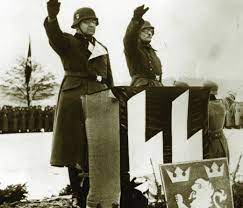
As Canada’s top officials express embarrassment for honoring a WWII Nazi collaborator in parliament, the leader of the country’s military, Gen. Wayne Eyre, refuses to apologize for his standing ovation. The Canadian military has trained Ukraine’s notorious neo-Nazi Azov Battalion for years.
Canadian politicians have been in frantic damage control mode since feting a former member of the Waffen-SS during a parliamentary reception for Ukrainian President Volodymyr Zelensky on September 22. The Speaker of Canada’s House of Commons, Anthony Rota, resigned following the incident, while Prime Minister Justin Trudeau lamented it as “extremely upsetting,” and opposition leader Pierre Poilievre branded the affair the “biggest single diplomatic embarrassment” in Canada’s history.
But amid the gratuitous public rites of contrition, one influential official has been conspicuously absent: Canada’s highest-ranking general. According to the Ottawa Citizen, Chief of the Defence Staff Gen. Wayne Eyre has “declined to apologize for his standing ovation” for Yaroslav Hunka, the now-notorious 98-year-old former member of the 14th Waffen Grenadier Division of the SS, whose members gained international infamy for hunting down anti-Nazi partisans, massacring thousands of civilians, and burning hundreds of Polish villagers alive.
The notion that the Nazi proclivities of figures like Hunka could have escaped Eyre’s notice now appears increasingly remote. In 2017, Ukraine’s Azov Battalion published photos on their website publicizing their meeting with high-level Canadian military officials, who had arrived in Ukraine to help train the notoriously neo-Nazi infested unit, which was officially incorporated into the Ukrainian National Guard.
A year later, Azov posted photos on its official social media channels showing Canadian military attaché Col. Brian Irwin meeting with its personnel. Responding to a query from journalist Asa Winstanley, a Canadian military spokesman justified training the fascist military on the grounds that the session “includes ongoing dialogue on the development of a diverse, and inclusive Ukraine.”
Just four months before Russia’s invasion of Ukraine, The Friends of Simon Wiesenthal Center for Holocaust Studies sent a letter to then-Acting Chief of the Defense Staff Gen. Wayne Eyre and Defense Minister Harjit Sajjan demanding an investigation into the decision to train Ukrainian neo-Nazis. The Jewish group urged them to ensure that such instruction did not continue.
“If Canada is going to be providing military training to foreign forces, then it is our responsibility to know we are not training neo-Nazis,” said Jaime Kirzner-Roberts, policy director of the Friends of Simon Wiesenthal Center. “It is our obligation to our Canadian veterans who sacrificed so much defeating fascism in Europe.”
But such warnings apparently went unheeded. The Canadian military not only declined to discontinue its Nazi-training policies, it escalated its program of coaching avowed fascists. Since Russian military operations in Ukraine kicked off in Feb. 2022, Canada has invested a further $1.6 billion USD in the arming and instructing of Kiev’s military.
On the sidelines of Zelensky’s now-infamous address to the Canadian Parliament, Ottawa authorized the further disbursement of another $483 million USD in aid and training on F-16 fighter jets.
Canada’s scheme of funneling weapons to Kiev and coaching Ukrainian forces officially began in 2014, just months after anti-Russian forces toppled the democratically-elected government of Viktor Yanukovych in a brutal US government-backed coup d’etat. Under the auspices of “Operation UNIFIER,” more than 33,000 Ukrainian troops received “advanced combat instruction by Canadian soldiers,” Canada’s state-affiliated CBC reported in 2022.
Ukraine’s ambassador in Ottawa, Yulia Kovaliv, heralded the training initiative as a “very important initiative.”
“It is also important to further provide Ukraine with heavy weapons,” she added.
In the UK, where Canadian forces frequently travel in order to school Zelensky’s army in the art of killing Russians, the program received a similarly warm welcome. An ebullient British Defense Secretary Ben Wallace said in a statement at the time that he was “delighted” that “the Canadian Armed Forces will be joining the growing international effort to support the training of Ukrainian soldiers in the UK.”
“Canada’s expertise will provide a further boost to the programme and ensure that the Ukrainian men and women, coming to the UK to train to defend their country, will get a wide pool of experience and skills from both UK forces and our international partners,” Wallace crowed.
Just what exactly the nationalist-leaning members of Ukrainian armed forces did with the training and tacit blessing of Canada has yet to be ascertained. But Azov members have been implicated in a number of war crimes. Despite the unit’s recent push to whitewash its Nazi tendencies, Azov — which has since expanded to a full-fledged brigade under Kiev’s official command — retains as its leader Andrey Biletsky, who once described Ukraine’s role on the global stage as helping to “lead the white races of the world in a final crusade … against Semite-led Untermenschen.”
Biletsky has taken pains to distance himself from the comment, but the unit has not undertaken similar efforts to distance itself from Biletsky. In September 2023, Biletsky was photographed proudly shaking hands with Zelensky during an intimate meeting with the Ukrainian President on the outskirts of Bakhmut. And Zelensky himself appears to have few problems with publicly associating with the group.
In a post commemorating the encounter with Ukraine’s most celebrated Nazi formation, Zelensky declared: “I am grateful to everyone who defends our country and people, who brings our victory closer.”
Fresh concerns over Zaporizhzhia nuclear power plant: Emerging Europe this week
Emerging Europe 29th Sept 2023 #nuclear #antinuclear #nuclear-free #NoNukes
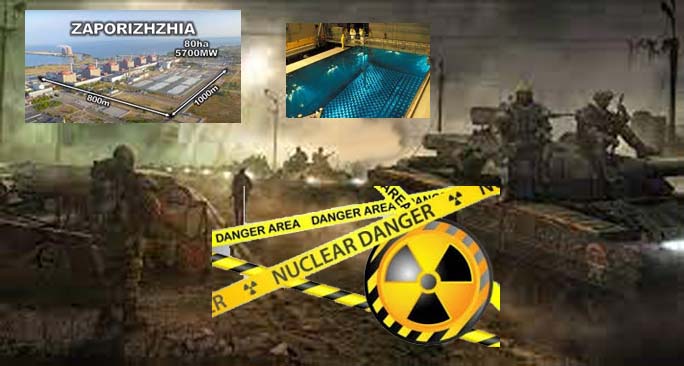
International regulators are incapable of properly monitoring safety at the Russian-occupied Zaporizhzhia nuclear power station, according to a critical dossier compiled by Greenpeace that is being sent to western governments on Thursday.
The environmental campaign group concludes the International Atomic Energy Agency has too few inspectors at Europe’s biggest nuclear plant—four—and that there are too many restrictions placed on their access.
It argues that the IAEA is “unable to meet its mandate requirements” but it is not prepared to admit as much in public, and as a result what it describes as Russian violations of safety principles are not being called out.
Shaun Burnie and Jan Vande Putte, nuclear specialists at Greenpeace, conclude: “The IAEA risks normalising what remains a dangerous nuclear crisis, unprecedented in the history of nuclear power, while exaggerating its actual influence on events on the ground.”
The vast Zaporizhzhia nuclear power plant, with six reactors on site, was captured by Russia in early March 2022 and has been on the frontline of the war ever since. It is sited on the Dnipro River in central Ukraine and Ukrainian forces occupy the riverbank opposite, leaving the plant in the sights of both sides’ militaries. https://emerging-europe.com/news/fresh-concerns-over-zaporizhzhia-nuclear-power-plant-emerging-europe-this-week/
Nuclear waste ship makes unprecedented port call at Novaya Zemlya
“I am deeply worried if Russia has started to move nuclear waste from the Kola Peninsula to the Arctic archipelago,” says Frederic Hauge with the Bellona foundation.
Much of the remaining uranium fuel elements in Andreeva Guba are damaged and pose special problems to handle. For that reason, the reprocessing plant in Mayak has been unwilling to receive.
Thomas Nilsen, September 29, 2023 https://thebarentsobserver.com/en/nuclear-safety/2023/09/nuclear-waste-ship-makes-port-call-novaya-zemlya
Last week, the “Rossita” could be seen on ship tracking services as it sailed outside Gremikha, a shutdown submarine base east on the Kola Peninsula. Now, the specially designed ship is moored at the pier in Severny, a military town on the shores of the Matochkin Strait diving the northern and southern islands of Novaya Zemlya
Severny is the settlement serving Russia’s nuclear weapons tests, nowadays in the form of sub-critical experiments taking place deep inside tunnels in the permafrost mountains. The last real detonation of a nuclear warhead was on October 24, 1990.
The “Rossita” was built in Italy with Italian taxpayers money. It was a helping hand from a European nation aimed to transport spent nuclear fuel from the run-down storage site in Andreeva Guba on the shores of the Litsa fjord, a short 60 km from the border with Norway.
Some 21,000 spent fuel elements from the Soviet Union’s fleet of Cold War submarines were stored. Italy’s contributions were part of a larger international cooperation to assist Russia in securing the lethal highly radioactive waste.
Other contributing nations were Norway, the United Kingdom and Sweden.
The “Rossita” shuttled between Andreeva Bay and Atomflot in Murmansk. From there, the containers with the fuel elements were sent by train to Mayak north of Chelyabinsk where Russia’s reprocessing plant is located.
With Moscow’s all-out war against Ukraine, the Western partners stopped all cooperation with Russia in regard to nuclear waste handling.
For the last 19 months, little information about what happens in Andreeva Bay has reached the public.
What is known is that two of the Northern Fleet’s most potent nuclear-powered submarines, the “Severodvinsk” and the “Kazan” of the Yasen class are moored across the bay at the piers in Nerpicha, part of Zapadnaya Litsa naval base.
“All reasons to monitor”
Frederic Hauge with the Bellona Foundation in Norway will not speculate too much about reasons Russia might have to move nuclear waste to the Arctic archipelago of Novaya Zemlya.
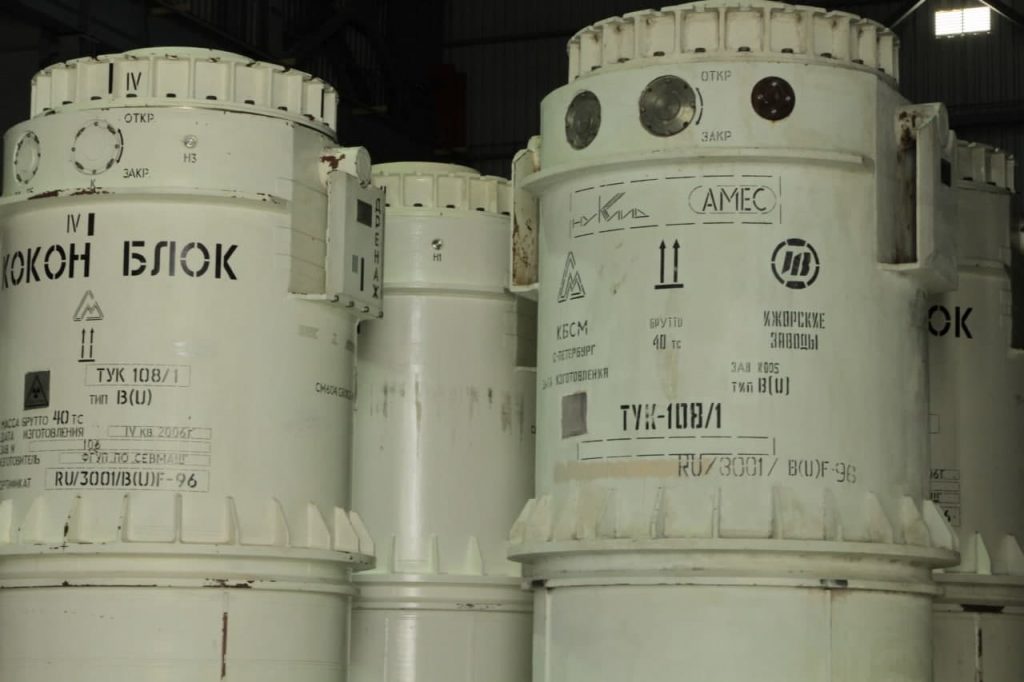
“What we do know is that “Rossita” is specially designed to carry TUK-18 containers modified to hold damaged spent nuclear fuel,” he says.
Much of the remaining uranium fuel elements in Andreeva Guba are damaged and pose special problems to handle. For that reason, the reprocessing plant in Mayak has been unwilling to receive.
“There are all reasons to monitor what now happens at Novaya Zemlya,” Hauge notes.
His team of nuclear experts in Oslo and Vilnius are now analyzing the limited available information with the hope of understanding what happens.
“A week ago, Rosatom’s larger carrier “Sevmorput” sailed to Novaya Zemlya. We are also told that there have been busy days at Severny and near the tunnels designed for nuclear weapons testing,” Hauge says in a phone interview with the Barents Observer.
“The big unanswered question is if what we now are witnessing is a Russia that brings dangerous nuclear waste to Novaya Zemlya for long-term storage in the permafrost.”
1 This Month
23-25 October – on Zoom – World BEYOND War’s annual global conferenc


Shut down the radiation-damaged Heysham nuclear reactors now
To see nuclear-related stories in greater depth and intensity – go to https://nuclearinformation.wordpress.com

Say No to NASA’s Reckless Nuclear Reactor on the Moon
Say No to NASA’s Reckless Nuclear Reactor on the Moon

-
Archives
- October 2026 (199)
- September 2026 (339)
- August 2026 (330)
- July 2026 (355)
- June 2026 (287)
- May 2026 (306)
- April 2026 (356)
- March 2026 (251)
- February 2026 (267)
- January 2026 (308)
- December 2025 (358)
- November 2025 (359)
-
Categories
- 1
- 1 NUCLEAR ISSUES
- business and costs
- climate change
- culture and arts
- ENERGY
- environment
- health
- history
- indigenous issues
- Legal
- marketing of nuclear
- media
- opposition to nuclear
- PERSONAL STORIES
- politics
- politics international
- Religion and ethics
- safety
- secrets,lies and civil liberties
- spinbuster
- technology
- Uranium
- wastes
- weapons and war
- Women
- 2 WORLD
- ACTION
- AFRICA
- Atrocities
- AUSTRALIA
- Christina's notes
- Christina's themes
- culture and arts
- Events
- Fuk 2022
- Fuk 2023
- Fukushima 2017
- Fukushima 2018
- fukushima 2019
- Fukushima 2020
- Fukushima 2021
- general
- global warming
- Humour (God we need it)
- Nuclear
- RARE EARTHS
- Reference
- resources – print
- Resources -audiovicual
- Weekly Newsletter
- World
- World Nuclear
- YouTube
-
RSS
Entries RSS
Comments RSS


