Loud Explosion Heard In Pakistan’s Dera Ghazi Khan City With Nuclear Facility; Officials Say ‘Sonic Boom’
The loud thud in the vicinity of Dera Ghazi Khan town in southern Punjab caused panic and soon it started trending on social media.
BQ Prime 6 Oct 23
Pakistan authorities on Friday said that the sound of a loud explosion in Punjab province could be due to a sonic boom as there was no information of a bombing incident or an act of sabotage. The loud thud in the vicinity of Dera Ghazi Khan town in southern Punjab caused panic and soon it started trending on social media. Videos circulating on X showed people vacating the area even as rescue teams and police personnel were moving around.
Pakistan’s nuclear research site is in the neighbourhood…………………….
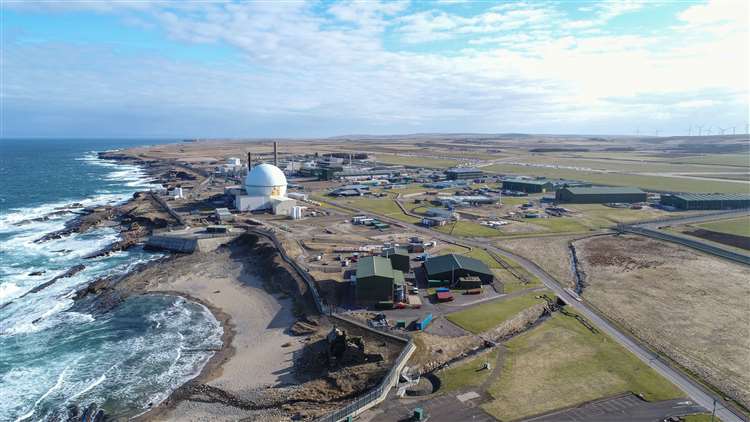
Residents closest to Dounreay and Vulcan to be excluded from the nuclear emergency planning zone.
By Iain Grant, 06 October 2023 https://www.johnogroat-journal.co.uk/news/nearby-homes-to-be-outside-of-dounreay-emergency-zone-for-fi-328741/ #nuclear #antinuclear #nuclear-free #NoNukes
Residents closest to Dounreay and Vulcan are for the first time to be excluded from the emergency planning zone around the redundant nuclear sites.
It is being shrunk to reflect the perceived reduction in risk to the public presented by the adjoining plants.
The zone would be the focus of the response to what is considered a worst-case scenario involving a radiation release.
Up until the plug was pulled on Dounreay’s fast reactor programme in the mid-1990s, its zone extended to five kilometres. The equivalent at Vulcan was two kilometres.
Dounreay’s limit was subsequently cut to 1.5km and reduced further in 2020 when a new linked zone taking in both sites was set at 700 metres.
US public support declines for arming Ukraine, Reuters/Ipsos poll shows
By Jason Lange and Patricia Zengerle. October 6, 2023 #nuclear #antinuclear #nuclear-free #NoNukes
WASHINGTON, Oct 5 (Reuters) – Support is falling among Americans of both major political parties for supplying Ukraine with weapons, a warning sign for Kyiv, which relies heavily on U.S. arms to fight against a Russian invasion, according to a new Reuters/Ipsos poll.
The two-day poll, which closed on Wednesday, showed only 41% of respondents agreed with a statement that Washington “should provide weapons to Ukraine,” compared to 35% who disagreed and the rest unsure.
Support for U.S. weapon shipments is down from May, when a Reuters/Ipsos poll showed 46% of Americans backed sending arms, while 29% were opposed and the rest unsure.
The poll was taken as U.S. congressional leaders debate Democratic President Joe Biden’s request for $24 billion in additional funding for Ukraine, of which about $17 billion would be defense aid………………………………………………………. https://www.reuters.com/world/us/us-public-support-declines-arming-ukraine-reutersipsos-2023-10-05/
France seeks European subsidies for its nuclear industry – fears “discrimination against nuclear”

France urges swift deal on EU power reform to counter US subsidies Energy minister says bloc will lose out to Biden’s IRA if Paris and Berlin fail to resolve differences over nuclear power.
The US will be the main winner if a Franco-German divide over nuclear power prevents a long-awaited reform of Europe’s electricity market being finalised, France’s energy minister has warned. Agnès Pannier-Runacher said in an interview with the Financial Times that the sweeping overhaul of EU rules was needed as soon as possible to give businesses visibility on power prices, at a time when the US was luring industry with President Joe Biden’s clean energy subsidy programme under the Inflation Reduction Act……………….
The call comes ahead of a bilateral conference in Hamburg, starting on Monday, between French president Emmanuel Macron and German chancellor Olaf Scholz, accompanied by their cabinet ministers. Energy issues will be high on the agenda because Paris and Berlin have been arguing for months over the EU electricity market reform, specifically over how nuclear energy will be priced and the extent to which it can be subsidised……………
Behind the scenes in recent days, Paris and Berlin have been exchanging duelling policy papers and rewritten clauses for the draft law, while marshalling support from other EU member states.
On this reform and others, France has mounted a pro-nuclear campaign now joined by other countries that use the technology, including Poland and Hungary, in an effort to ensure the sector will be treated favourably.
But its drive has hit roadblocks, particularly in Germany, over concerns France will end up riding roughshod over state aid rules and benefit from lower prices for consumers and industry that other countries cannot match………………………………………………………..
Whether France and Germany will be able to square their differences in time for the next meeting of EU energy ministers on October 17 is unclear. The risk is that the reform will not be done by the end of the year and only become harder as EU parliament elections approach……………………..
The main thing still to be ironed out in the reform is the use of a mechanism known as “contracts for difference” (CFDs) which guarantee a minimum price for energy produced, and whether they should be applied to existing nuclear plants or just new ones. The CFDs have typically been used to incentivise renewable energy projects by guaranteeing revenues for producers, and Berlin has argued they should only apply to new investments.
France’s Energy Minister Pannier-Runacher said French reactors built decades ago required billions of euros in new investments for maintenance and to extend their lifespan and therefore should not be penalised with heavy restrictions around the application of CFDs.
As well as a minimum price, the CFD mechanism allows governments to recover excess revenues if prices jump past a set threshold, raising more questions about how governments then use those funds, especially if they were to be directed at providing further energy subsidies.
France had been happy with an original proposal on market reform put forward by the European Commission in March. But subsequent amendments with more restrictions on the uses of CFDs in a version presented by the European parliament have sparked the pushback. “At a certain stage it amounts to a discrimination against nuclear. We would not be allowed to do in the French system what other countries can [with their energy assets],” Pannier-Runacher said.
How safe is the release of treated radioactive water from Fukushima plant
#nuclear #antinuclear #nuclear-free #NoNukes
5 Oct 2023Japan begins second discharge of treated nuclear water from Fukushima Japan has begun discharging a second batch of treated radioactive water from the crippled Fukushima plant into the ocean. It’s happening amid protest from countries like China, Russia and South Korea who are all concerned about the risks. Robert Jacobs from the Hiroshima Peace Institute explains with these worries are founded.
Class action launched against British Government over nuclear bomb tests in Australia

By A Current Affair Staff 7 Oct 23 https://9now.nine.com.au/a-current-affair/nuclear-bomb-testing-australia-class-action-british-government/199eafe9-c774-432e-99b2-f71a96ffb696—
It’s a scandal that has spanned decades as Australian and British servicemen sent to nuclear testing sites fight to be officially recognised for their service and suffering.
Between 1952 and 1963, Great Britain carried out nuclear bomb tests in Australia and the Pacific.
Doug Brooks was at the first one.
“The only thing we were told to do was turn our backs to the blast ground zero, cover our eyes with our hands and the blast x-rayed our hands we could see the bones,” he told A Current Affair.
Tony Spruzen was at the Maralinga test range in the remote outback of South Australia.
“The brightness was so much, it’s something like I never experienced before, I could see through my eyelids, I could see the bones of my fingers,” he said.
Doug and Tony are two of the rapidly diminishing number of veterans sent to the nuclear test sites.
In total 45 tests were conducted by Britain’s Ministry of Defence – 12 of those were in Australia at the blessing of the Menzies government.
There were 22,000 servicemen in the Pacific tests. 1500 are still alive.
Now there is a new class action against the British Government.
“Well, what’s prompted it is that we’ve discovered medical records do in fact exist for these servicemen,” lawyer Matthew Jury said.
“We have a copy of these records and what that tells us is the other medical records exist which the government has been concealing for 70 years so those surviving servicemen who want answers now know that those records exist so where and the government has been concealing them.”
Jury’s firm has launched the action class and he claims records reveal the radiation levels in the blood and urine of the servicemen.
“As they have grown older they have developed extreme and aggressive forms of cancer,” Jury said.
“There have been miscarriages and other birth defects which can’t be treated by their doctors because their doctors don’t have their full medical records.”
The British Ministry of Defence hasn’t responded to requests for an interview or statement.
Watch the full story in the video player above. [on original]
Senators worry about Saudi nuclear arms plans
Beyond Nuclear #nuclear #antinuclear #nuclear-free #NoNukes
US should reconsider helping Saudi Arabia develop domestic nuclear power, they wrote
Editor’s introduction: Brett Wilkins with Common Dreams has reported on an important step taken by a handful of US Senators who pushed back last week on selling commercial nuclear technology to Saudi Arabia. We republish the article below. (As always, any views expressed in the article are the writer’s own and do not necessarily reflect those of Beyond Nuclear.) But while the Senators’ letter to President Joe Biden voices concern that the Saudis could use a domestic reactor program to transition to nuclear weapons, it fails to recognize that this is an inevitable outcome of nuclear power technology no matter whose hands it is in.
By Brett Wilkins, Common Dreams
Amid reports that Saudi Arabia is seeking United States support for its nuclear energy program—whose capacities critics fear could be utilized to develop nuclear weapons—a group of 20 U.S. senators on Wednesday urged President Joe Biden to “seriously consider” whether such a move is in the national interest as the administration brokers a possible normalization deal between the kingdom and Israel.
In addition to concerns over the fundamentalist monarchy’s desire for a U.S. security guarantee as a condition for normalizing relations with apartheid Israel, as well as the future of a two-state solution in illegally occupied Palestine, the senators note in a letter to Biden that “the Saudi government is also reportedly seeking U.S. support to develop a civilian nuclear program, and to purchase more advanced U.S. weaponry.”
“While we should seriously consider whether it is in U.S. interests to help Saudi Arabia develop a domestic nuclear program, we should always maintain the high bar of the ‘gold standard’ 123 Agreement and insist on adherence to the Additional Protocol,” the senators wrote, referring to a provision of the Atomic Energy Act of 1954 requiring a country seeking a nuclear cooperation deal with the United States to commit to a set of nine nonproliferation criteria and expanded International Atomic Energy Agency (IAEA) inspections. The U.S. has entered into such agreements with more than two dozen countries, Taiwan, and the IAEA…………………………
The lawmakers’ letter was led by Democratic Sens. Chris Murphy (Conn.), Chris Van Hollen (Md.), Dick Durbin (Ill.), and Peter Welch (Vt.). Signatories include Sens. Bernie Sanders (I-Vt.), Elizabeth Warren (D-Mass.), John Fetterman (D-Pa.), Jeff Merkley (D-Ore.), Patty Murray (D-Wash.), and Ed Markey (D-Mass.)……………………………………………………………………………. more https://beyondnuclearinternational.org/2023/10/08/senators-worry-about-saudi-nuclear-arms-plans/
Why The US Canceled Project Pluto: The Super Weapon That Never Was
Slash Gear, BY QUINA BATERNA/OCT. 8, 2023 #nuclear #antinuclear #nuclear-free #NoNukes
With the role of nuclear powers in maintaining global order and its ongoing arms race, it’s unsurprising that the United States has its eyes on Russia’s ongoing development of nuclear-powered missiles. However, it’s also a little more personal, especially because the United States had canceled a similar project more than half a century earlier: Project Pluto.
……………………………………………………………………………………… What is Project Pluto?
……………………. In 1961, the United States successfully unveiled the revolutionary Tory IIA-I in the midst of the Cold War. Mounted on top of a railroad car, it marked the world’s first nuclear ramjet engine when it came to life for just a few seconds. Three years later, the U.S. tested the Tory II-C, which was able to run for five minutes at full power — generating 513 megawatts or 35,000 pounds of thrust.
In theory, this marked a game-changing innovation for nuclear-powered missiles. However, coming off the heels of the success from the Tory II-C testing, the U.S. Air Force and the Atomic Energy Commission canceled Project Pluto for good. So, what made the U.S. Air Force change its mind?
The beginning of the end for Project Pluto
Despite spending $260 million for its budget, Project Pluto’s sponsors cited fears that the project would be dangerous to even its allies, doing things such as “deafen, flatten, and irradiate people” en route to its target (even before the bomb drops).
SCIENCE
Why The US Canceled Project Pluto: The Super Weapon That Never Was
Romolotavani/Getty Images
BY QUINA BATERNA/OCT. 8, 2023 7:45 AM EST
With the role of nuclear powers in maintaining global order and its ongoing arms race, it’s unsurprising that the United States has its eyes on Russia’s ongoing development of nuclear-powered missiles. However, it’s also a little more personal, especially because the United States had canceled a similar project more than half a century earlier: Project Pluto.
In 2018, Russian President Vladimir Putin announced the development of several innovative nuclear weapons, including a nuclear-powered cruise missile. In his presidential address, Putin claimed that Russia’s innovations would make NATO missile defense systems “useless.” Citing the United States’ withdrawal from the 1972 Anti-Ballistic Missile (ABM) Treaty in 2002, Putin reiterates that its ongoing response is reactionary to the increasing range and proximity of the U.S. global missile defense systems to Russian borders.
A year later, The New York Times published an article stating U.S. officials suspected a nuclear blast from Russia’s Nenoksa Missile Test Site was one of the worst nuclear accidents in the region since Chernobyl. Reports claim that at least seven people were killed in the explosion, including five scientists (via The Bulletin). Here’s how it could have been inspired by the United States’ Project Pluto, and why it may cause problems.
What is Project Pluto?
Nevada National Security Site
For decades, the Nevada National Security Site (NNSS) has had an extensive history of supporting U.S. national security through nuclear testing. The base has served as a testing site for several types of new weapons, such as the Supersonic Low-Altitude Missile (SLAM) using nuclear ramjet power: codenamed Project Pluto.
In a 2013 brochure, the NNSS claimed that the principles behind the ramjet power used nuclear heat in combination with the force from the air in front of a vehicle to make it expand. Afterward, its exhaust provides the thrust necessary to fly and create impact.
In 1961, the United States successfully unveiled the revolutionary Tory IIA-I in the midst of the Cold War. Mounted on top of a railroad car, it marked the world’s first nuclear ramjet engine when it came to life for just a few seconds. Three years later, the U.S. tested the Tory II-C, which was able to run for five minutes at full power — generating 513 megawatts or 35,000 pounds of thrust.
In theory, this marked a game-changing innovation for nuclear-powered missiles. However, coming off the heels of the success from the Tory II-C testing, the U.S. Air Force and the Atomic Energy Commission canceled Project Pluto for good. So, what made the U.S. Air Force change its mind?
The beginning of the end for Project Pluto
Federal Government of the United States (via Wikimedia)
Despite spending $260 million for its budget, Project Pluto’s sponsors cited fears that the project would be dangerous to even its allies, doing things such as “deafen, flatten, and irradiate people” en route to its target (even before the bomb drops).
Aside from this, it’s possible that additional testing requirements and manufacturing risks may have also come into consideration. In an interview with Scientific American, Edwin Lyman, a senior scientist in the Union of Concerned Scientists’ Global Security Program shared, “They had a proof-of-principle reactor on the ground, but my impression is that at the time the project was canceled there was probably still a substantial amount of engineering work that needed to be done, not to mention flight testing.”
According to the NNSS brochure, one of the key challenges that scientists cited was the materials used for the reactor. While typically used at the time, concrete made it difficult for missiles to fly long trips towards targets. In addition, materials needed to be able to withstand incredible heat to avoid damaging the structural integrity of the missile.
To manage this, Coors Porcelain Company (now CoorsTek) — an offshoot of the famous American brewery and beer company — designed solutions with ceramics. According to a 1996 case filed with the U.S. Department of Labor, 18,681.5 kilograms of beryllium were used in Project Pluto to fabricate 500,000 beryllium and beryllium-uranium fuel elements. However, this didn’t come without risks, with its workers acquiring chronic beryllium disease (CBD) years later.
Is the nuclear dream still alive?
While there was a time in history when nuclear energy powering everything was the goal, there’s a reason why America doesn’t build more nuclear power plants. With issues in regulation, increasing manufacturing prices, and growing renewable energy alternatives, there are increasingly more effective options for powering our machines — as well as our weapons…………………….. https://www.slashgear.com/1410540/us-canceled-project-pluto-why/–
Repeated malfunctions reveal safety issues in Fukushima discharge

CGTN 6 Oct 23 #nuclear #antinuclear #nuclear-free #NoNukes
Japan started the second discharge of nuclear-contaminated wastewater from the crippled Fukushima Daiichi Nuclear Power Plant into the Pacific Ocean on Thursday, despite strong opposition from local fishermen as well as neighboring and Pacific island countries.
The plant’s operator, Tokyo Electric Power Company (TEPCO), said it plans to carry out the release over 17 days to discharge 7,800 tons of the radioactive wastewater, about the same amount as the first discharge which ended on September 11.
Currently, more than 1.3 million tons of nuclear-contaminated wastewater has been accumulated in storage tanks at Fukushima.
The company’s key facility for nuclear-contaminated water treatment, the Advanced Liquid Processing System (ALPS), is a multi-filter system that can remove radioactive materials through a series of chemical reactions. The international community has had doubts about the safety, effectiveness and sustainability of the system, due to its treatment capacity and incidents of malfunction.
When the amount of nuclear-contaminated water is too large, the chances to replace the filters are limited and the performance of the ALPS is significantly degraded, said Ryota Koyama, a professor at Fukushima University in Japan.
“If nuclear-contaminated water is discharged, I think there must be a problem. If the Japanese government or the TEPCO really wants to discharge the contaminated water into the sea, they need to explain in more detail,” Koyama told China Media Group (CMG) in an interview……………………………..
The ALPS has failed to remove isotopes adequately, with the adsorbents used to remove radioactive isotopes being replaced less often than they were supposed to be. As a result, 70 percent of the water in the storage tanks still contains non-tritium radionuclides at a concentration that exceeds the regulatory standards applicable for discharge into the environment.
Since its trial operation in 2013, the ALPS has frequently experienced malfunctions. Just before the first discharge in August, TEPCO found leaks in a hose used to transfer nuclear-contaminated water, according to Japanese broadcaster NHK………………..
In June, the government of Republic of Korea said that there have been eight confirmed cases of malfunction with the ALPS between 2013 and 2022, which concerned corrosion of facilities and issues with filters, after its experts conducted an on-site inspection, said the country’s public broadcaster KBS.
According to previous reports, TEPCO found that there were at least 10 breakages on the ALPS’ filters used to absorb nuclides in August 2021. In the process of replacing the broken filters, the company discovered that 24 filters were damaged. A month later, TEPCO announced that five more filters in the ALPS were found to have been damaged, and radioactive contamination had been detected near some of the filters.
Hikaru Amano, senior researcher of the Nuclear Science Research Institute, Japan Atomic Energy Agency, told CMG that another problem with the ALPS is that there is little room to store used filters.
Amid concerns of Japan’s discharge of nuclear-contaminated wastewater, the Republic of Korea (ROK) plans to raise the number of testing spots to nearly 250 next year, increasing from the 75 coastal locations where emergency radiation tests were conducted about a month ahead of Japan’s first release in August, Seoul-based Yonhap News reported…………… https://news.cgtn.com/news/2023-10-06/Repeated-malfunctions-reveal-safety-issues-in-Fukushima-discharge-1nFOJHDPdgQ/index.html
Depleted Ukrainium: What Comes After Failure?

public support for the war—and here and here official support—ever more visibly wobbles and wanes……… And those running the war in Ukraine are slowly but surely losing on this side of the conflict.
October 5, 2023, By Patrick Lawrence / Original to ScheerPost #Ukraine
ou cannot name the last time you read anything about a parliamentary election in Slovakia, so I won’t bother asking. But you are reading about one this week, assuming you still follow mainstream media—if only to understand what you are supposed to think about one or another event, as against what has actually occurred.
In results announced in Bratislava Sunday, a leftist party whose primary platform plank is opposition to the war in Ukraine won 23 percent of the vote. On Monday the Slovakian president, Zuzana Čaputová, formally asked Robert Fico, who leads the SMER party, to form a government. It looks like he will do so in a coalition with either Voice, a social-democratic party that took 15 percent of the vote, or with Progressive Slovakia, a liberal-centrist party that finished with 18 percent of the vote.
Fico is an interesting figure. He has served as prime minister twice over the course of a decade, during which time he proved sufficiently European to bring Slovakia into the euro. To one or another extent, his likely coalition partners favor keeping Slovakia as a card-carrying member of the Western coalition supporting Ukraine. But they did not win the election: Fico did.
And Fico is all business in his opposition to Slovakia’s support for the U.S. proxy war tearing Ukraine and its people to pieces.
SMER’s platform assigns the West and Ukraine equal responsibility for the war—a purposeful rip into the “unprovoked” charade—and promises an immediate end to all Slovakian arms shipments to the war effort. Speaking after the election results were announced, Fico pointedly pledged to press Kiev and its backers to begin peace talks with Moscow. “More killing is not going to help anyone,” he declared.
There are two things to say about Robert Fico’s return to the top of Slovakian politics. One, we find once again that the U.S. is a victim of its old, Manichean habit of dividing the whole of humanity into good guys and bad guys. The headline on CNN’s report on the elections reads, “Pro–Russian politician wins Slovakia’s parliamentary election.” The New York Times head is, “Unease in the West as Slovakia Appears Set to Join the Putin Sympathizers.”
Tell me, which of these is more pathetic? “Pro–Russian?” “Putin sympathizers?” This is infantile—apart from being false, I mean. Fico simply articulates an independent, perfectly sound position on the war. CNN and The Times are infantilizing their viewers and readers as they reduce this position to the simplistic binary of a Saturday-morning cartoon. The insidious thing here, and let us be ever vigilant on this point, is that these media are inserting into our brains the thought that any deviation from the Russophobic orthodoxy amounts to support for the Kremlin’s demonized occupant.
Two, “unease” is too mild a word for the reigning sentiment among the war-mongering elites in Washington and the European capitals. An incipient panic is closer to the reality as public support for the war—and here and here official support—ever more visibly wobbles and wanes. The first front in any war is the home front, where it is imperative the battle is won. And those running the war in Ukraine are slowly but surely losing on this side of the conflict.
They are losing it on the ground in Ukraine, too, it is now more or less obvious. Our question becomes: Where will the powers that instigated this war and invested heavily in it turn next? As I argued soon after the Russian intervention began in February 2022, this conflict was probably conceived as the Washington neoconservatives’ shoot-the-moon moment, its all-out play to take down the Russian Federation. What happens now, as the neocons lose this round of Hearts and the game as they have played it is over?
To my great relief, the blue-and-yellow flags that disfigured the American landscape in the early months of the war are now mostly gone. More than half of Americans polled agree with Robert Fico: No more military aid and weapons to Ukraine. This percentage is headed in only one direction from here on out.
Volodymyr Zelensky’s swing through North America beginning with his attendance at this year’s General Assembly last month, went pretty badly. At the GA, he did not make any headway persuading the global majority opposed to the war to come over to his side. His reception in Washington was… what is the best word?… muted? House Republicans, many of whom oppose more military aid, refused to meet him. When, over the weekend, Speaker Kevin McCarthy finally pushed through a bill to keep the government funded, he had to strip out a provision authorizing another tranche of weapons funding.
The mood elsewhere appears to be no brighter. That astonishing debacle in the Canadian Parliament—presenting an old SS man as a hero because he fought the Soviets?—cannot have done Zelensky’s constituency in Canada any good. Across the pond there are signs of impatience as roughly eight million Ukrainian refugees settle in Europe, displaying little interest—and who can blame them?—in going home when the war is over. War or no, solidarity or no, the Poles have blocked imports of cheap Ukrainian wheat. There are signs of buyer’s remorse among the Finns a matter of months after their impulsive decision to join NATO. And now the Slovakians and their new leader’s alarming display of political and intellectual independence.
However these matters may stand as you read this commentary, the trends here outlined are destined to accelerate in coming months. The Ukrainians’ long-touted counteroffensive, a major prop in the campaign to maintain public support for the war, is touted no more. It is well on the way to taking its place next to the 2007 “surge” in Iraq. Remember that? Of course you don’t. And you won’t remember the counteroffensive any more distinctly in, I would say, a year’s time.
Not even The New York Times pretends any longer that the front line in eastern Ukraine has budged more than a matter of meters the whole of this year. And this is before the harsh winter weather begins. At that point, stasis will be the best the Ukrainians can hope for. All this autumn and all winter, the Russians are likely to continue their rolling volleys of rockets, missiles, and artillery shells to the point most of Ukraine east of Kiev resembles Ypres or the Somme in 1918.
Let us look ahead to next spring, then. The Ukrainian front will have sustained another winter’s deterioration, and popular discontent among Europeans is likely to have sharpened. It will be considerably harder to pretend that the Kiev regime can win the war or, indeed, that it makes any sense to continue it. And Joe Biden will be looking at an election in seven or so months.
At that point, what? ………………………………………………………………………………………………………………………………. more https://scheerpost.com/2023/10/05/patrick-lawrence-depleted-ukrainium/
#Ukraine ‘very cheap way’ to fight Russia, NATO state claims

“It is very much in our interest to support Ukraine, because they are fighting this war, we are not fighting it,”
https://www.rt.com/news/584053-dutch-nato-ukraine-cheap/ 6 Oct 23
The Dutch defense minister made a case for funding Kiev at a conference in Poland
Arming Kiev is a cost-effective way of preventing Moscow from threatening NATO, Dutch Defense Minister Kajsa Ollongren said on Wednesday at the Warsaw Security Forum.
Ollongren was asked whether the US and its allies can continue supporting Ukraine “for as long as it takes,” given the political in-fighting in Washington.
“We cannot pretend that we’ll just wait and see how the American elections are going,” she said. “Because they have the same interest, in a way. Of course, supporting Ukraine is a very cheap way to make sure that Russia with this regime is not a threat to the NATO alliance. And it’s vital to continue that support.”
“It is very much in our interest to support Ukraine, because they are fighting this war, we are not fighting it,” Ollongren noted, while admitting that NATO has “skin in the game.”
Ollongren explained that she had recently visited the US and that political developments there are cause for concern, but that Western Europeans need to talk with their American colleagues and persuade them to stay the course.
“I think that we are capable of a lot, and we have proven that in the past year and a half, and the only thing we have to do is keep it up,” the minister said, adding that the scale of military assistance to Kiev has surprised Ukraine, Russia, and even NATO itself.
The US and its allies have channeled a large amount of money, weapons, ammunition, and supplies to Ukraine since the conflict with Russia escalated in February 2022.
EU foreign policy chief Josep Borrell revealed earlier this week that the bloc has sent Ukraine €85 billion ($89.8 billion) so far, of which more than €25 billion was military aid.
The most recent estimates of US spending were from the end of July, and amounted to $46.6 billion in military aid, $3.9 billion in humanitarian aid, and $26.4 billion in loans and cash payments to keep the government in Kiev going.
Moscow has repeatedly warned that the deliveries of heavy weapons and other aid are tantamount to direct involvement in the hostilities. Washington and Brussels, however, insist they are not actually a party to the conflict. Russia has said that foreign weapons will not change the course of the fighting and will not deter Moscow from achieving its goals in Ukraine.
Russian officials have cited NATO’s expansion eastward as one of the root causes of its conflict with Ukraine and the standoff with the West.
Groups Demand DOE Environmental Impact Statement Before Agency Bails Out Palisades Zombie Reactor Restart

Beyond Nuclear, September 20, 2023 #nuclear #antinuclear #nuclear-free #NoNukes
| NEPA Requires “Major Federal Project” Hard Look, Groups Assert |
| Covert Township, MI and Washington, DC, September 20, 2023– Legal counsel for Beyond Nuclear, Don’t Waste Michigan, and Michigan Safe Energy Future, have written the Energy Secretary and the Loan Programs Office director at the U.S. Department of Energy (DOE), demanding National Environmental Policy Act (NEPA) compliance before DOE awards Holtec International a requested $1 billion risk- and interest-free nuclear loan guarantee, backed by U.S. taxpayer dollars. The billion dollar federal loan, which Holtec does not have to pay back, is the linchpin in Holtec’s reactor restart scheme, also backed by Michigan’s governor, Gretchen Whitmer, as well as the state legislature. The State of Michigan has already gifted Holtec with $150 million towards the restart, although Holtec requested twice that. The state handout is contingent on the much larger federal bailout. A Power Purchase Agreement was just announced between Holtec and rural electric co-ops in Michigan (Wolverine) and Indiana (Hoosier), although how far above market rates the co-ops’ members will be forced to pay, and for how long, has not been publicly disclosed. Citing the largesse provided by the public (which most taxpayers and ratepayers are not even aware of, let alone consent to), Holtec is pressuring the U.S. Nuclear Regulatory Commission to simply reverse legally-binding, permanent shutdown filings from June 2022. |
A coalition of hundreds of environmental groups, including more than fifty groups in Michigan, have written Energy Secretary Jennifer Granholm — herself a former governor and attorney general of the State of Michigan — several times in the past year, urging Holtec’s requests for federal bailouts to restart Palisades be rejected.
Toledo, Ohio-based attorney Terry Lodge, and Cedar Rapids, Iowa-based attorney Wally Taylor, serve as legal co-counsel for the environmental groups. They provided DOE with a litany of pathways to catastrophic reactor core meltdown at Palisades, which Energy Secretary Granholm and Loan Programs Office Director Shah have been asked by Holtec to bankroll. The severe safety risks include: the most neutron radiation-embrittled reactor pressure vessel in the country, at risk of pressurized thermal shock through-wall fracture; a reactor vessel closure head in need of replacement for more than two decades; steam generators in need of replacement for more than two decades, as well; and the worst control rod drive mechanism seal leaks in industry.
There is no indication that, even with $1.15 billion, or more, in federal and state subsidies, Holtec will fix any of those severe safety problems before restarting the long problem-plagued reactor.
Lodge and Taylor also pointed out that restarting Palisades’ more than half-century old reactor would lead to the generation of another 20 metric tons per year of highly radioactive irradiated nuclear fuel. The high-level radioactive waste stored on-site since 1971 already poses its own severe risks, including violating NRC earthquake safety regulations. Palisades’ dry cask storage is perched on the very edge of Lake Michigan, a major headwaters of the entire Great Lakes, 84% of North America’s surface fresh water, and drinking water supply to 40 million people in eight U.S. states, two Canadian provinces, and a very large number of Indigenous Nations……………………………………………. more https://beyondnuclear.org/groups-demand-doe-eis-before-bailing-out-palisades-zombie-reactor-restart/?fbclid=IwAR1qlrC0heccGG150YGtyT3F1-38m4p2TVIz0ITiuFOK0Pi-qpjc6VNUrDM
Reconciling With Truth Requires Listening… what about nuclear waste?
September 30, 2023 https://mailchi.mp/preventcancernow/reconciling-with-truth-requires-listening?e=ba8ce79145 #nuclear #antinuclear #nuclear-free #NoNukes
As Canadians look back and Remember the Children who suffered at residential schools, we wish to highlight Algonquin First Nations’ important work to protect the health of children, and the Kitchi Sibi (Ottawa) River watershed from pollution.
The First Nations oppose a hillside nuclear waste Near-Surface Disposal Facility (NSDF) proposed on unceded Algonquin territory at the Chalk River Nuclear Laboratories. In a remarkable turn of events, rainfall during the final hearing on the NSDF demonstrated that the Canadian Nuclear Safety Commission (CNSC) is unlikely to meet its goal to keep nuclear waste secure for hundreds of years.
At Chalk River Nuclear Laboratories scientists first worked on the atomic bomb in the 1940s; ongoing nuclear research ever since has resulted in voluminous waste, that will remain toxic longer than planning horizons. People oppose transportation of nuclear waste through their communities, so the CNSC concluded that it had to deal with waste onsite. A federal Environmental Impact Statement (EIS) was published for a nuclear waste NSDF.
Disturbingly, assessment of the natural environment is absent from the federal EIS, so the Algonquin First Nations retained experts and published Assessment of the CNSC NSDF and Legacy Contamination in June 2023.
The federal assessment found that the top risk for stability of hillside waste disposal was severe rainfall. Too much rain could sweep the nuclear waste down the hill and into Perch Lake, polluting Perch Creek and the Kitchi Sibi River a kilometre away. This could pollute the ecosystem and food sources, as well as drinking water for millions of people downstream in smaller towns, Ottawa and cities.
On Aug. 10, 2023, at the sacred site where the Rideau, Kitchi Sibi and Gatineau rivers tumble together, Chiefs of Kebaowek, Kitigan Zibi Anishinabeg and Mitchibikonik Inik First Nations, Elders and other experts, made final submissions to the CNSC. As witnesses spoke, attendees heard a roar of rain drumming on the roof.
This rain flooded Ottawa streets and basements, stopped traffic, took out power, and backed up sewers. Five centimetres of rain fell in an hour, and more than 300 million litres of untreated water flowed into the Ottawa River.
The EIS vastly under-estimates future weather severity, defining “heavy rainfall” as over only 0.7 cm per hour. The EIS also cites a 2013 estimate of low tornado risks—an insult to fresh memories of catastrophic tornadoes and derechos in Eastern Ontario.
The acceleration of climate disasters is boggling Canada’s long-term predictions of the scale of extreme weather. The nuclear waste disposal facility was designed to withstand end-of-the-century estimates of less than five cm of precipitation in a day for Deep River, and over five cm in a day—not an hour—for Ottawa.
Ottawa’s not alone in breaking rainfall records and disproving future estimates. July 2023 brought rainfall disasters to Nova Scotia, with rainfall up to 50 cm per hour measured in one location. Much of the province experienced 20 cm in a day, causing widespread damage. Canadian federal climate predictions call for much less—up to 9 cm in a day by the end of the century.
If an Environmental Impact Assessment for a bridge was discovered to be this flawed—that the bridge would not withstand a storm as severe as what just occurred—it would be a good reason to reconsider the plans. The Canadian Nuclear Safety Commission should heed the warning from Mother Nature and deny the present proposal.
2
NRC Commissioners Fail to Take Action on Critical Safety Issue at Diablo Canyon
San Luis Obispo, CA, October 4, 2023 https://mothersforpeace.org/nrc-commissioners-fail-to-take-action-on-critical-safety-issue-at-diablo-canyon/?fbclid=IwAR1A_L1NhvPiZW4tMjfCTfu-4Ov7duSTtEOyamayx97DjaRb4fGQ7UGVjZI #nuclear #antinuclear #nuclear-free #NoNukes
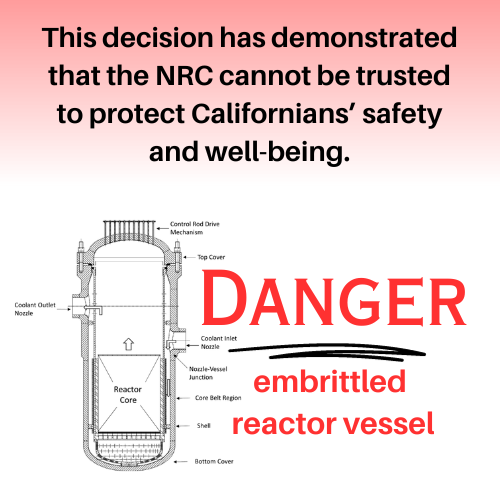
— San Luis Obispo Mothers for Peace (MFP) and Friends of the Earth (FoE) today deplored a decision of the Commissioners of the Nuclear Regulatory Commission (NRC) for demonstrating a complete lack of concern for the safety and security of the people living near the Diablo Canyon Nuclear Power Plant.
Disregarding expert evidence presented by MFP and FoE that the Diablo Canyon Unit 1 pressure vessel is at risk of dangerous embrittlement due to decades of neglect by Pacific Gas and Electric Co. (PG&E) and lax oversight by the NRC technical staff, the Commissioners refused to grant the groups’ hearing request or to order the immediate shutdown of the reactor for comprehensive testing of the reactor vessel’s condition.
Instead, the Commissioners bucked the groups’ shutdown request back to the agency’s technical staff to consider whether to take enforcement action against PG&E.
“We are appalled that the Commissioners are entrusting this important safety review to the same agency staff who for fifteen years has given PG&E repeated extensions of deadlines for essential tests and inspections,” said Diane Curran, attorney for MFP. Curran noted that the groups had intentionally petitioned the Commissioners, as the highest officers of the NRC, to exercise their legal responsibility for oversight of the technical staff.
Nevertheless, the groups vowed to persevere. Hallie Templeton, Legal Director for FoE, said, “We plan to continue our rigorous watchdogging of PG&E and the NRC.” She added, “The Commissioners’ decision has raised a red flag to all of us. Anyone, including California politicians, who thinks the safety of Diablo Canyon can be entrusted to the federal government unquestioningly has just received a big wakeup call.”
Linda Seeley, spokesperson for MFP, renewed the group’s call to the State of California to “go back to the original plan to close Diablo Canyon when it reaches its 40-year operating license limit in 2024 (Unit 1) and 2025 (Unit 2). Enough is enough.”
The CIA’s “Information War” is Now Globalized?
Global Research, 6 Oct 23
In 1967, the CIA’s covert use of the National Student Association to spread countermessages to communism was revealed by a college dropout named Michael Wood.2 The revelation sent shockwaves through the U.S., and as journalists started to pull at the strings, the the CIA’s covert propaganda operations unraveled.
Journalists discovered that the CIA had set up nonprofit foundations to funnel taxpayer money into philanthropic foundations that then sent the CIA’s “donations” to organizations that had joined the CIA’s payroll to promote government-sponsored propaganda
These included youth organizations and student groups, church groups, public radio and news organizations. Sen. Wayne Morse, D-Ore., slammed the CIA’s covert propaganda activities, arguing the agency had created a “credibility chasm” within public opinion — a gap that could not and would not be bridged unless the government made clear that it would “fill the chasm with the truth”
The CIA was never reined in and is more involved in propaganda activities today than ever before
While many still have not realized it, we are at war, and the aggressors are government intelligence and security agencies that have turned their weapon of choice — information — against their own citizens
The video above [on original https://www.youtube.com/watch?v=op0HMkcQhew&t=297s%5D features a 1967 CBS special report titled “In the Pay of the CIA: An American Dilemma,”1 hosted by Mike Wallace. It examines how the Central Intelligence Agency (CIA) was secretly paying students, labour organizations, broadcasting networks and other organizations to do their bidding…….
A Condensed History
The National Security Act of 1947, signed by President Truman, created the CIA, the National Security Council, the Office of Secretary of Defense and the U.S. Air Force.3 As explained by the Office of the Historian,4 the Act “was a major reorganization of the foreign policy and military establishments of the U.S. government.”
The CIA was an outgrowth of the World War II era Office of Strategic Services and several small post-war intelligence organizations, and as noted by Wallace:
“Since the beginning, the CIA has suffered a personality split, because in addition to intelligence, the Security Act of 1947 orders the CIA to ‘perform other functions and duties as directed by the President and his National Security Council.’ That phrase has become a sort of blank check, authorizing CIA excursions into everything from simple propaganda to the overthrow of unfriendly governments.”
Wallace goes on to explain how the CIA ended up with fingers in so many pies. First, it set up several nondescript nonprofit foundations, the function of which were to funnel taxpayer money from the CIA to other, real foundations involved in real-world philanthropy.
However, in return for CIA funds, these foundations “agreed to become conduits for central intelligence,” and funneled the exact dollar amounts received on to other organizations that, in the 1940s, ’50s and ’60s, joined the CIA’s payroll to promote government-sponsored propaganda………………………………………………………..
Operation Mockingbird Is Alive and Well
Unfortunately, the CIA was never reined in, and its propaganda activities have only expanded and become more sophisticated over time. The 1976 Church Committee investigation (chaired by Senator Frank Church) exposed how the CIA had corrupted the media by paying journalists to promote the agency’s narratives.
The program, called Operation Mockingbird, was officially dismantled, but while the operational name may have been retired, there’s plenty of evidence to suggest the CIA never discontinued its media influence.5
In fact, we have evidence the CIA is controlling mainstream media to this day, and it is doing so with unprecedented efficiency, as it can now push its narratives out through the three global news agencies, which are responsible for crafting and curating most of the news disseminated worldwide…………………………………………………
The FBI is also in on the action, as are most of the world’s intelligence agencies. They are all pushing the same Great Reset and Fourth Industrial Revolution narratives, the aim of which is the technocratic control of the global population. That is why we are seeing the same narratives playing all over the world including the Orwellian argument that we must censor to protect democracy.
A New Type of War
While many still have not realized it, we are at war. The aggressors are government intelligence and security agencies that have turned their weapon of choice — information — against their own citizens.
And, while the organizations doing the CIA’s dirty work may have changed, the basic organizational structure is the same as it was in 1967. Taxpayer money gets funneled through various federal departments and agencies into the hands of non-governmental agencies that carry out censorship activities as directed.
1 This Month
23-25 October – on Zoom – World BEYOND War’s annual global conferenc


Shut down the radiation-damaged Heysham nuclear reactors now
To see nuclear-related stories in greater depth and intensity – go to https://nuclearinformation.wordpress.com

Say No to NASA’s Reckless Nuclear Reactor on the Moon
Say No to NASA’s Reckless Nuclear Reactor on the Moon

-
Archives
- October 2026 (199)
- September 2026 (339)
- August 2026 (330)
- July 2026 (355)
- June 2026 (287)
- May 2026 (306)
- April 2026 (356)
- March 2026 (251)
- February 2026 (267)
- January 2026 (308)
- December 2025 (358)
- November 2025 (359)
-
Categories
- 1
- 1 NUCLEAR ISSUES
- business and costs
- climate change
- culture and arts
- ENERGY
- environment
- health
- history
- indigenous issues
- Legal
- marketing of nuclear
- media
- opposition to nuclear
- PERSONAL STORIES
- politics
- politics international
- Religion and ethics
- safety
- secrets,lies and civil liberties
- spinbuster
- technology
- Uranium
- wastes
- weapons and war
- Women
- 2 WORLD
- ACTION
- AFRICA
- Atrocities
- AUSTRALIA
- Christina's notes
- Christina's themes
- culture and arts
- Events
- Fuk 2022
- Fuk 2023
- Fukushima 2017
- Fukushima 2018
- fukushima 2019
- Fukushima 2020
- Fukushima 2021
- general
- global warming
- Humour (God we need it)
- Nuclear
- RARE EARTHS
- Reference
- resources – print
- Resources -audiovicual
- Weekly Newsletter
- World
- World Nuclear
- YouTube
-
RSS
Entries RSS
Comments RSS

