A robot resumes mission to retrieve a piece of melted fuel from inside a damaged Fukushima reactor

The goal of the operation is to bring back less than 3 grams (0.1 ounce) of an estimated 880 tons of fatally radioactive molten fuel that remain in three reactors.
An operation to send an extendable robot into one of three damaged reactors at Fukushima Daiichi nuclear power plant to bring back a tiny gravel of melted fuel debris has resumed, nearly three weeks after its earlier attempt was suspended due to a tech…
By MARI YAMAGUCHI Associated Press, September 10, 2024, https://abcnews.go.com/International/wireStory/robot-resumes-mission-retrieve-piece-melted-fuel-inside-113538057
An extendable robot on Tuesday resumed its entry into one of three damaged reactors at Fukushima Daiichi nuclear power plant to retrieve a fragment of melted fuel debris, nearly three weeks after its earlier attempt was suspended due to a technical issue.
The collection of a tiny sample of the spent fuel debris from inside of the Unit 2 reactor marks the start of the most challenging part of the decadeslong decommissioning of the plant where three reactors were destroyed in the March 11, 2011, magnitude 9.0 earthquake and tsunami disaster.
The sample-return mission, initially scheduled to begin on Aug. 22, was suspended when workers noticed that a set of five 1.5-meter (5-foot) add-on pipes to push in and maneuver the robot were in the wrong order and could not be corrected within the time limit for their radiation exposure, the plant operator Tokyo Electric Power Company Holdings said.
The pipes were to be used to push the robot inside and pull it back out when it finished. Once inside the vessel, the robot is operated remotely from a safer location.
The robot, nicknamed “telesco,” can extend up to about 22 meters (72 feet), including the pipes pushing it from behind, to reach its target area to collect a fragment from the surface of the melted fuel mound using a device equipped with tongs that hang from the of the robot.
The mission to obtain the fragment and return with it is to last about two weeks.
The mix-up, which TEPCO called a “basic mistake,” triggered disappointment and raised concerns from officials and local residents. Industry Minister Ken Saito ordered TEPCO President Tomoaki Kobayakawa a thorough investigation of the cause and preventive steps before resuming the mission.
The pipes were brought into the Unit 2 reactor building and pre-arranged at the end of July by workers from the robot’s prime contractor and its subsidiary, but their final status was never checked until the problem was found.
TEPCO concluded the mishap was caused by a lack of attention, checking and communication between the operator and workers on the ground. By Monday, the equipment was reassembled in the right order and ready for a retrial, the company said.
The goal of the operation is to bring back less than 3 grams (0.1 ounce) of an estimated 880 tons of fatally radioactive molten fuel that remain in three reactors. The small sample will provide key data to develop future decommissioning methods and necessary technology and robots, experts say.
The government and TEPCO are sticking to a 30 to 40-year cleanup target set soon after the meltdown, despite criticism it is unrealistic. No specific plans for the full removal of the melted fuel debris or its storage have been decided.
Project 2025’s stance on nuclear testing: A dangerous step back

By Tom Armbruster | September 6, 2024,
https://thebulletin.org/2024/09/project-2025s-stance-on-nuclear-testing-a-dangerous-step-back/
There are few places more peaceful than a Pacific island. At 6:45 am on a March morning in 1954, that peace was shattered by the largest nuclear test in American history: Operation Bravo.
The Bravo test was a thousand times more powerful than the Hiroshima bomb. Now, 70 years later, Project 2025 is proposing a resumption of testing. That should alarm every military service member, downwinder, Pacific Islander, and taxpayer.
As US Ambassador to the Republic of the Marshall Islands, I joined in the solemn observance of “Remembrance Day,” the Marshallese national holiday that pays tribute every March 1 to those who lost their homeland, fell victim to cancer, or were otherwise affected by the Bravo shockwave and fallout.
The shorthand for the 67 nuclear tests from 1946 to 1958, including two undersea tests that wiped out rich Pacific marine life, is the “Nuclear Legacy.” It would be more accurate to call it the “Nuclear Wound.” The tests on Bikini, Enewetak, and Kwajalein wounded the land and the ocean, the people—both Marshallese and American servicemen—and the relationship between our two countries. Healing is marked in decades, if not centuries.
We’ve had the nuclear tiger by the tail for a long time. No leader of any country would want their legacy to be the use of such indiscriminate and destructive weapons. When I joined the Foreign Service from Hawaii, Ronald Reagan was President. A chance for nuclear disarmament came and went with his summit with Soviet leader Mikhail Gorbachev in Reykjavik. Today, the Soviet Union is gone but nuclear weapons are still here. We’ve made progress, but Reagan’s vision of a nuclear-free world remains out of reach. Until we achieve that goal, maintaining a test ban is in everyone’s interest. It is part of the legacy we leave our children.
I’ve stood on the Runit Dome concrete cap that covers the nuclear scrap that was bulldozed into a pit. That is also part of the legacy. As Nuclear Affairs Officer at the US Embassy in Moscow, I also visited some of the vast Russian nuclear architecture. I joined the late Sen. Pete Domenici (R-New Mexico) on a trip to Arzamas-16, a once-secret Russian nuclear city now known as Sarov. We saw abandoned ballrooms with torn curtains and dusty grand pianos, a testament to the empty result of spending on nuclear weapons. A waste of millions of dollars, rubles, or whatever currency used by the nuclear actor.
On page 431, Project 2025 calls for the United States to “Reject ratification of the Comprehensive Test Ban Treaty and indicate a willingness to conduct nuclear tests in response to adversary nuclear developments if necessary. This will require that the National Nuclear Security Administration be directed to move to immediate test readiness… .”
The Project 2025 proposal is a tremendous step backwards. We should be negotiating further cuts in the world’s nuclear arsenals, a prohibition of weapons in outer space, and cleanup of the “legacy” test sites around the world. It would help if Russia were a responsible partner in denuclearization but sadly that is not the case. We could be working together to find ways to mend the planet, rather than inflict further damage that will last for thousands of years.
The planet is resilient. Even sharks have returned to Bikini, although the sons and daughters of those displaced by testing have not. Pacific Islanders would never allow a return to testing in the Pacific, but no one on Earth should ever wake up again to a test like Bravo.
Renewables beat nuclear – even with full balancing included

RENEW EXTRA WEEKLY, 9 Sept 24
A new Danish study comparing nuclear and renewable energy systems (RES) concludes that, although nuclear systems require less flexibility capacity than renewable-only systems, a renewable energy system is cheaper than a nuclear based system, even with full backup: it says ‘lower flexibility costs do not offset the high investment costs in nuclear energy’.
It’s based on a zero-carbon 2045 smart energy scenario for Denmark, although it says its conclusions are valid elsewhere given suitable adjustments for local conditions. ‘The high investment costs in nuclear power alongside cost for fuel and operation and maintenance more than tip the scale in favour of the Only Renewables scenario. The costs of investing in and operating the nuclear power plants are simply too high compared to Only Renewables scenario, even though more investment must be put into flexibility measures in the latter’.
In the Danish case, it says that ‘the scenario with high nuclear implementation is 1.2 billion EUR more expensive annually compared to a scenario only based on renewables, with all systems completely balancing supply and demand across all energy sectors in every hour.’ It goes on ‘to achieve a more cost-efficient system based predominantly on nuclear power- the investment costs would have to drop to 1.55 MEU/MW. This is significantly below any current or future cost projection for nuclear power. Such a high cost-margin indicates that a combination of low-cost RES and sector coupling presents a cost-effective energy transition making it very hard for nuclear power to deliver a competitive alternative’…………………………………………………………………………….
Interestingly, in the UK context, Lord Turner, Chair of the UK Energy Transitions Commission, has also said that costly new nuclear plants may not be needed for net zero, since there are cheaper, low-carbon alternatives that could back up intermittent renewables. Hydrogen fuel or gas power plants fitted with CCS could fill the gap when wind or solar was not enough to keep the lights on. ‘I don’t think it is the case that you need new nuclear to balance the system. The systems of the future don’t absolutely need a base load.’ The power system ‘can work on a combination of intermittent variable renewables, wind & solar plus some hydro. I think the challenge for new nuclear is that it is just expensive. Bluntly, new nuclear can play very little role in a 2030 target.’
Well maybe that’s why there seems to have been some second thoughts about the new EPR reactor proposed for Sizewell in the UK, with the final investment decision for the Sizewell C nuclear plant evidently facing delays. Initially, EDF, the project’s developer, aimed to secure funding by the end of this year, but the timeline may now extend into 2025.
The prospect for nuclear do seem a bit uncertain, with the case for it these day relying in part on the claim that it can back up renewables and help avoid climate change. But that also seems to be uncertain, as is argued in a new comprehensive review of nuclear issues by academics from Germany and Finland, arguing that it has no role to play in responding to climate change. It says that it is ‘not a sustainable and affordable source of energy for the low-carbon energy transformation’ given its ‘cost-intensive nature, coupled with safety considerations’. And crucially it says that it is ‘characterized by very long construction times, and even longer developments of new technical generations, too far away and uncertain to contribute to climate change mitigation anytime soon’.
In addition ‘from an energy system perspective, nuclear power is not compatible with a system based on renewables, but rather hinders its expansion. Last but not least, nuclear power is particularly unfavorable in a future with higher temperatures and weather extremes and more military threats’.
That sounds pretty damning, even leaving aside radioactive waste handing, and also weapons proliferation and terrorism-related issues, with, as Prof. Ramana discusses in his recent powerful overview book ‘Nuclear is not the solution’, in addition to its other problems, reliance on civil nuclear power making ‘catastrophic nuclear war more likely’. Even if, hopefully, we can avoid that, there are still concerns about nuclear blackmail. And all this just to generate expensive energy.
Yes, going for renewables does mean we have invest in flexible balancing technology and energy storage, but that is cheaper overall and it also getting even cheaper, with many new options emerging. As Ramana says, to balance the variability of renewables, ‘we must invest in a mix of renewable energy technologies across various regions, and in battery and other storage technologies to store excess energy. In addition, we need to shape electricity demand to more closely match supply.’ In common with the German and Finnish researchers, he too sees that as the way ahead. https://renewextraweekly.blogspot.com/2024/09/renewables-beat-nuclear-even-with-full.html
Will new UK nuclear power station plan be scrapped?
The Energy Secretary has reportedly directed officials to review the nation’s nuclear plans, including the proposed plant at Wylfa in Anglesey
Dimitris Mavrokefalidis, 09/08/2024, https://www.energylivenews.com/2024/09/08/will-new-uk-nuclear-power-station-plans-be-scrapped/
The government’s plan to build a new nuclear power station in Wales is reportedly under review.
According to The Telegraph, the Energy Secretary has asked officials to reassess future nuclear projects, which puts the planned plant at Wylfa, Anglesey, in question.
The review will also examine the previous target to reach 24 gigawatts of nuclear capacity by 2050, set under Boris Johnson.
There are concerns that these plans were rushed before the last general election.
Minister for Nuclear Lord Hunt wrote on X (formerly known as Twitter): “Great British Nuclear has recently acquired the Wylfa site in Anglesey along with the Oldbury site in Gloucestershire.
“No decisions have yet been taken on the projects and technologies to be deployed at sites and any decision will be made in due course.”
Energy Live News has contacted the Department for Energy Security and Net Zero for comment.
Earlier this week, Ynys Môn MP Llinos Medi urged the UK Government to give definitive commitments and timelines for the Wylfa site and Wales’ overall energy strategy.
During a debate on the Great British Energy Bill on 5th September, Ms Medi emphasised the region’s significant natural energy resources and expressed frustration with the continued political uncertainty around the Wylfa nuclear project.
Ed Miliband considers scrapping planned nuclear plant

Move will fuel concerns that Britain’s ambitions for industry are being scaled back
Telegraph UK, Matt Oliver, Industry Editor7 September 2024
Plans to build a large nuclear power station in Wales are at risk of being scrapped as Ed Miliband seeks to accelerate Britain’s switch to a net zero electricity grid.
The Energy Secretary has told officials to review future nuclear plans in a move that has thrown into doubt plans for a third new gigawatt-scale plant to be built at Wylfa, in Anglesey.
The review will also reconsider the official target, announced under Boris Johnson, to deploy at least 24 gigawatts of nuclear capacity by 2050, The Telegraph understands.
It comes amid concerns that the plans set out under the Conservatives were rushed out ahead of the general election and not properly thought through.
On Friday, Whitehall sources stressed no final decisions had been made and that Mr Miliband remained strongly supportive of expanding British nuclear capacity.
However, the move will fuel concerns that Britain’s ambitions are being scaled back, with the Conservatives accusing him of turning his back on the industry.
Wylfa was only confirmed in May by the previous Conservative government to follow similar projects at Hinkley Point, in Somerset, and Sizewell, in Suffolk.
The Welsh site is capable of hosting up to four large reactors and has attracted keen interest from major international firms including US-based Westinghouse and South Korea’s Kepco.
It is understood that ministers remain committed to making a final investment decision on the £20bn Sizewell C power plant before the end of this year, as well as to the programme to develop the first mini nuclear power stations known as small modular reactors (SMRs).
But sources said that the Government’s future commitments were being reviewed in the round as part of wider plans to transition to a net zero energy system.
Possible revisions could still include building multiple SMRs at Wylfa instead of a large power station. Another large plant could still also be built elsewhere.
Great British Nuclear (GBN), the government agency tasked with preparing nuclear sites, is carrying out the review for Mr Miliband and is said to favour building SMRs at Wylfa because officials believe they could be built and switched on more quickly, by the mid-2030s. They are also considering which option provides the best value for money.
Because preparatory work on any large plant would need to begin soon, Whitehall sources said the question of what to do at Wylfa must be resolved as part of the upcoming Easter spending review, which will see departments agree multi-year settlements with the Treasury.
GBN acquired both the Wylfa site and another in Oldbury-on-Severn, Gloucestershire, in a £160m deal in March. Both sites are seen as good options for the first generation of SMRs.
A government spokesman said: “No decisions have yet been taken on the projects and technologies to be deployed at sites and any decision will be made in due course.”
However, the revelation that ministers may scrap plans for a large plant at Wylfa – seen as one of the most promising undeveloped nuclear sites in Europe – will raise fresh concerns that Britain’s promised “nuclear renaissance” is being scaled back.
Claire Coutinho, the shadow energy secretary, said: “Ed Miliband is shutting down the North Sea and now it seems he’s turning his back on nuclear. …………………..
Industry insiders also warned that basing plans for future expansion after Sizewell on SMRs alone could be risky, with the technology still unproven commercially. This contrasts with existing, proven large reactor technologies.
Talks about the future of Wylfa come as GBN prepares for the final stages of the UK’s SMR design competition. The current shortlist of five companies – Rolls-Royce, GE-Hitachi, Westinghouse, Holtec and NuScale – is expected to be reduced to four later this month. …………………………………………………………………. https://www.telegraph.co.uk/business/2024/09/07/ed-miliband-considers-scrapping-planned-nuclear-plant/
Boris Johnson faces ‘serious questions’ over new business with uranium entrepreneur

Former prime minister also under fire for hiring ex-aide Charlotte Owen as VP despite her lack of energy sector experience
Guardian, Carole Cadwalladr, 8 Sept 24
Boris Johnson failed to disclose that he met a uranium lobbyist while prime minister before entering into a new business with a controversial Iranian-Canadian uranium entrepreneur, the Observer can reveal.
Johnson’s new company Better Earth Limited also employs Charlotte Owen, a junior aide with just a few years work experience whom he elevated to the House of Lords last year at the age of 29, sparking intense controversy.
Transparency campaigners say there appear to be “serious public interest questions to be answered” over the nature and timeline of Johnson’s relationship with his co-director, Amir Adnani, the founder, president and CEO of Uranium Energy Corp, a US-based mining and exploration company, championed by former Trump adviser Steve Bannon.
Amir Adnani, a Canadian citizen who is the director of a network of offshore companies based in the British Virgin Islands, incorporated Better Earth in December last year. On 1 May, Companies House filings reveal, “The Rt Hon Alexander Boris de Pfeffel Johnson” was added as a director and co-chairman. And this summer, Charlotte Owen – now Baroness Owen of Alderley Edge – joined the company to work alongside him as its vice-president.
The Advisory Committee on Business Appointments (Acoba), which oversees ex-ministerial appointments, explicitly warned Johnson in April 2024 that the “broad overlap” between his roles in office and at Better Earth may entail “unknown risks” because of the lack of transparency over the firm’s clients. A statement from the Cabinet Office noted the potential for a conflict of interests particularly because of “the unknown nature of Better Earth’s clients – specifically that there is a risk of a client engaging in lobbying the UK government.” The committee also told the former prime minister it feared “that you could offer Better Earth unfair access and influence across government”.
Acoba was reassured that Johnson “did not meet with, nor did you make any decisions specific to Better Earth during your time in office”. But the Observer can reveal that Johnson met Scott Melbye, the executive vice-president of Uranium Energy Corp – Adnani’s company – in the House of Commons in May 2022 when he was still prime minister.
Adnani’s social media post about the event claimed that Melbye and Johnson spoke about “nuclear power and uranium”.
Neither Johnson or Adnani have responded to press inquiries about this encounter or when they first met. The encounter was not recorded in the prime minister’s official diary.…………………………………………………………………………………………
Baroness Margaret Hodge, the former Labour MP who led parliament’s Public Accounts Committee from 2010-2015 said there were “at least four very serious public interest questions” to be answered about the appointment.skip past newsletter promotion
“What on earth is an ex-prime minister of the United Kingdom doing, working for a company with an opaque structure? In my experience those who choose to have a UK company owned by a foreign entity only do that because they may have something to hide. What is it in this case? Given the sensitivities around nuclear capabilities we should know who he is in business with, where the money is coming from and why he is using a financial structure that appears to hide the beneficial ownership of the company.”
Better Earth, Amir Adnani and Boris Johnson declined to respond to the Observer’s inquiries about Better Earth’s line of work, funding or any other matters…………………………………………………. https://www.theguardian.com/politics/article/2024/sep/07/boris-johnson-faces-questions-uranium-business-charlotte-owen-aide
New images raise concerns over state of UK nuclear submarines
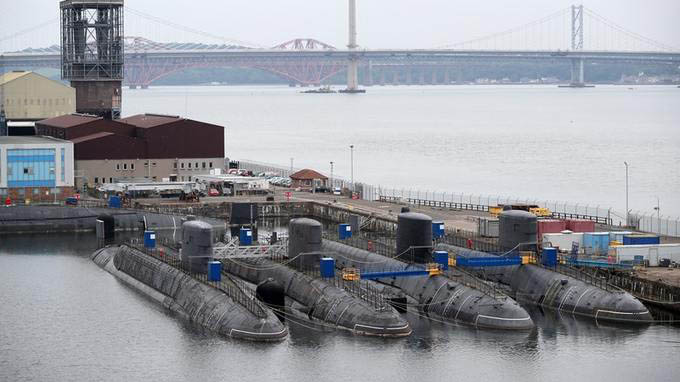
The National By Xander Elliards 8th September 24
CONCERNS have been raised that the deteriorating state of the UK’s nuclear submarines is “potentially putting the vessel and her crew at risk”.
Alarm bells were rung after the Ministry of Defence (MoD) announced last week that Defence Secretary John Healey had joined one of the UK’s four Vanguard-class submarines as it returned to dock at Faslane.
An image shared by the MoD showed Healey looking at the submarine, which appeared covered in algae, slime and rust along its entire length.
Further photos taken by locals living near the HM Naval Base Clyde showed the submarine was missing numerous patches of anechoic tiles – which line the exterior to help hide the submarine from sonar.
The submarine is thought to have been on patrol since mid-March, meaning it had spent around 160 days underwater.
In March, HMS Vengeance returned to Faslane after 201 days underwater – reported to be the second-longest patrol ever – directly following a mission which lasted 195 days. Patrols on the previous Polaris generation of nuclear submarines averaged 60-70 days, according to the Campaign for Nuclear Disarmament (CND)
HMS Vengeance is one of four Vanguard-class submarines, which were each built with a 25-year lifespan – a limit imposed by the lifespan of major components – and either commenced sea trials or saw their reactor go critical in 1992, 1994, 1996, and 1999. The UK Government noted in 2007 that it “should be possible” to extend these lifespans by five years to a total of 30.
At least one submarine is meant to be patrolling the oceans at any time in order to deliver a nuclear strike if the UK Government orders it. However, the ageing fleet meant that essential works had to be carried out to keep the submarines seaworthy, placing higher pressure on the remaining boats.
In January, alarm bells had been rung after Dominic Cummings, a key adviser during Boris Johnson’s time in Downing Street, said there was a hidden “scandal of nuclear weapons infrastructure” which he called a “dangerous disaster and a budget nightmare of hard-to-believe and highly classified proportions”.
Issues with ageing equipment nearly led to a major disaster in 2022 after a broken depth gauge meant one nuclear submarine was continuing to descend despite unknowingly approaching “crush depth”.
On Saturday, the Daily Mail reported that none of the UK’s attack submarines are currently at sea, and the majority (16 out of 25) of the country’s warships are broken down, being modified, or undergoing trials. Retired rear admiral Chris Parry called the situation “utterly dire”.
In May 2023, HMS Vanguard finally completed a seven-and-a-half-year refit, and in March 2024, work on HMS Victorious was also completed. The final boat in the fleet is called HMS Vigilant, but it is not clear which of the four were greeted by Defence Secretary Healey at Faslane last week.
Responding to the nuclear-armed submarine returning to Faslane, Chris McEleny, Alba Party’s general secretary and a former MoD employee, said: “The latest sight of a Vanguard-class submarine returning to base caked in algae is very concerning. And, yet again we see anechoic tiles are missing, potentially putting the vessel and her crew at risk.
“The lengthy patrols should also spark concerns as to whether or not subs are going out on patrol with increased payloads due to concern over the half-life.
“The MoD have, as usual, failed to provide basic guarantees in regards to the safety-critical implications of these prolonged patrols.”…………………………..
Lynn Jamieson, the chair of the Scottish CND, claimed that the “UK’s nuclear weapons system is a shambles but that does not capture the absurdity and seriousness of its dangers”.
“The longer at sea, the more mental and physical stress on the crew and the more chance of accidents,” she went on. “The older the submarine the more the risks of unplanned radioactive leaks and other such incidents.
“The cost of keeping the ageing nuclear weapon system going and simultaneously building a replacement grows while public services are drastically cut. In 2023 alone, it cost £6.5 billion [according to a report from the independent Nuclear Information Service] and it will be even more this year.”……….
Jamieson said the UK Government should show “true leadership [and] scrap the old system and its replacement rather than continuing to valorise a capacity for genocide that puts the world in peril, a target on our backs and risks in our backyard”.
SNP MSP Bill Kidd, the co-president of Parliamentarians for Nuclear Non-Proliferation and Disarmament (PNND), said Scotland was the “dumping ground for nuclear leaks and discharges into our waters and coasts and we are the target for any potential nukes an enemy would fire at”.
“Nothing is planned to change in all this as far as Westminster is concerned – and that means Labour every single bit as much as Tories”, he said……………………………….. https://www.thenational.scot/news/24568990.new-images-raise-concerns-state-uk-nuclear-submarines/
Ynys Môn MP calls for UK Government clarity on Wylfa site
Ynys Môn MP Llinos Medi has called on the UK Government to provide clear
commitments and timelines regarding the future of the Wylfa site and the
broader energy strategy for Wales.
Speaking during a debate on the Great
British Energy (GBE) Bill on Thursday (5 September), Ms Medi highlighted
the island’s rich natural energy potential and criticised the ongoing
political uncertainty surrounding the future of the Wylfa nuclear site.
She also accused the previous Conservative government of playing a “political
game” and offering local communities a “false dawn” regarding the
future of the site. In May, the Conservative Government had confirmed Wylfa
as the preferred site for a major new nuclear power development.
Nation Cymru 6th Sept 2024,
https://nation.cymru/news/ynys-mon-mp-calls-for-uk-government-clarity-on-wylfa-site/
White House pushes for AUKUS to move to ‘pillar two’ weapons focus
SMH, By Peter Hartcher, September 9, 2024
The US is pushing for the AUKUS partnership to launch some world-leading new military technology projects before Joe Biden’s presidency ends, amid signs of growing impatience with the initiative.
The US National Security Adviser, Jake Sullivan, revealed in an interview at the White House that he wanted to see “two or three signature projects launched and under way by the time the administration finishes” on January 20.

While he expressed satisfaction with progress on so-called pillar one of AUKUS, the submarine program, his timeline for pillar two’s cutting-edge tech scheme puts new pressure on the three countries’ military and scientific agencies to deliver in the next five months.
It is three years ago this month that the leaders of the US, UK and Australia announced the joint technology initiative. In the meantime, China has extended its advantage in critical technologies, according to a report last week by the Australian Strategic Policy Institute.
A former senior official in the Trump administration expressed frustration: “On the science and technology side, I think there are problems because we’re not moving fast enough,” said Nadia Schadlow, Deputy National Security Adviser to the former president.
“If AUKUS doesn’t perform, if it doesn’t do what it’s supposed to do and what we said it would do, we almost might be better off without it because if we can’t fulfil our objectives, we almost look weaker.”
Pillar two of AUKUS was assigned eight priority research fields: advanced cyber, artificial intelligence, quantum technologies, undersea capabilities, hypersonics, electronic warfare, innovation, and information sharing……………………
officials said privately that there were problems of co-ordination, that each of the country’s systems was different and moved at different speeds…………………………. https://www.smh.com.au/politics/federal/white-house-pushes-for-aukus-to-move-to-pillar-two-weapons-focus-20240908-p5k8s5.html
Nuclear Roulette: The U.S. Nuclear Employment Guideline

CounterPunch, by Mark Muhich, 6 Sept 24
The U.S. Nuclear Employment Guideline Report, according to Department of Defense websites, appears to be a detailed target menu in the event the president orders a nuclear attack. It is required of the executive by Congress, Section 491, when the president alters the nuclear weapons strategy of the U.S. As alluded to by top-ranking administration leaders and reported in the New York Times, the revised Nuclear Employment Guideline signed by President Biden reflects China’s expanding nuclear arsenal.
The president sets the nation’s nuclear strategy and the Joint Chiefs of Staff develop the tactical plans to achieve the president’s strategy, according to DOD literature.
As China, People’s Republic of China, has increased its manufacture of nuclear weapons in the past five years much faster than defense analysts had predicted, the U.S. has turned the focus of its nuclear guideline toward the PRC. China now possesses around 500 nuclear warheads. And while the U.S. and Russia each currently deploy around 1,700 nuclear warheads each, China is on pace to equal that number by 2035.
Similarly threatening to the U.S. is the prospect of China coordinating its nuclear capability with that of Russia, and even with North Korea, now harboring around 60 nuclear warheads and a growing fleet of intercontinental missiles to deliver them.
China has also made aggressive territorial claims to the South China Sea and vows to gain control of Taiwan by any means necessary, definitively by 2049. This July China suspended nuclear weapons control talks with the U.S. citing increased military arms sales to Taiwan by the U.S.
Yet, China has recently dissuaded Russia from threatening the use of nuclear weapons against Ukraine, or against western states that might deploy soldiers to Ukraine. And China repeated its call for the “denuclearization” of the Korean Peninsula in joint meetings with Japan and South Korea in May of this year.
Significantly, China maintains its posture of No First Use of nuclear weapons and repeated calls last week for the other leading nuclear-armed nations, Russia, France, U.K and the U.S. to adopt a No First Use nuclear policy. India and China are the only nuclear-armed nations to affirm NFU.
One of the architects of the revised U.S. Nuclear Employment Guidelines is Vipin Narang, Acting Assistant Director of Department of Defense Space Agency. During his retirement speech from DOD this August, Narang blamed China and Russia for failed arms control talks. Before returning to lecture at M.I.T. Narang said China’s expansion of its nuclear arsenal was threatening, and that moving its nuclear-armed missiles to “launch on warning” status was provocative.
Narang did not share that the U.S. possesses more than ten times the number of nuclear warheads, 5,580, as China has. Nor that the entire fleet of U.S. Air Force Minuteman missiles has been on “launch on alert” status for sixty years.
Failing arms control negotiations with Russia result from Russia’s invasion of Ukraine and Russia’s announced withdrawal from the NewSTART nuclear weapons treaty in 2026, according to Narang. NewSTART is the only remaining arms control treaty now in effect between Russia and the U.S. It successfully decommissioned thousands of nuclear warhead and missile launchers from each arsenal since its ratification in 2010. For the deteriorating state of U.S. Russia talks, Narang did not cite the failure of the U.S. to ratify the Comprehensive Nuclear Test Ban Treaty, 1996, the U.S. withdrawal from the Anti-Ballistic Missile Defense Treaty in 2001 or withdrawal from the Intermediate-Range Nuclear Forces Treaty, INF in 2019.
Narang’s bleak address to his DOD colleagues warned them to “prepare for a world where constraints on nuclear weapons arsenals disappear entirely”……………………………………………………………….
Missing from Narang’s calculus, is the decision many countries have already made to forgo nuclear arsenal all together. Indeed, the majority of nation-states, pursuant of their own security, have rejected the deployment of nuclear weapons on their soil. The majority of humankind regard nuclear weapons as inherently destabilizing and dangerous and of no military value.
When 193 countries voted for the Non-Proliferation of Nuclear Weapons Treaty, NPT, in 1970, they agreed not only to halt the spread of nuclear weapons but to reduce nuclear weapons stockpiles, and “cease the nuclear arms race”. The NPT places the onus on the nuclear powers to eliminate all nuclear weapons at an “early date”. All nuclear weapons would eventually come under the control of an international agency as agreed in the NPT’s Article VI.
The international control of military arms and especially nuclear weapons was the lifelong goal of Albert Einstein…………………………………………………………………………..
Even more consequential is the growing effort begun in the United Nations General Assembly to outlaw nuclear weapons, the Treaty on the Prohibition of Nuclear Weapons, TPNW. Endorsed by 122 countries in the United Nations General Assembly in 2017 is now ratified or acceded to by 70 countries, banning nuclear weapons from their jurisdictions.
As the U.S. and the other nuclear powers drift further and further from the goal of nuclear disarmament, they double down on their nuclear arsenals and invest in new platforms to deliver their nuclear payloads. Is it too late to build credible assurances that these awful weapons will never be used? It will never be too late to eschew these horrible weapons, unless or until some brilliant leader orders a nuclear attack.
……………………………………………………………………………………………… “Nuclear weapons are totally irrational”, said Ronald Reagan, they are “totally inhumane, good for nothing but killing people, possible destruction of life on Earth and civilization.” There is no theory that will change the brutal absurdity of nuclear weapons nor transform them into logical agents of peace and security.
In Thomas Schelling’s application of game theory to nuclear weapons the object of deterrence is to convince the adversary not to use their weapons and vice versa. If nuclear deterrence is the stated goal of the U.S. nuclear posture, then adopting a No First Use of nuclear weapon either by treaty or unilaterally is the clear choice. China and India have done so for decades. No First Use makes perfect sense. Repelling conventional assaults should not be part of the nuclear employment equation. Nuclear weapons are not just more powerful conventional weapons. If they are ever used in war again the consequences are unpredictable and beyond any risk assessment.
It is past time to end the U.S.’ “nuclear ambiguity”. Take the nuclear option off the table. Abide by the Non-Proliferation Treaty; refuse to renew the nuclear arms race. We cannot win security or freedom in a game of nuclear roulette. But we can and will lose everything if we continue to bet on nuclear weapons. What folly. https://www.counterpunch.org/2024/09/06/nuclear-roulette-the-u-s-nuclear-employment-guideline/
Seismic Showdown Coming at Diablo Canyon

Environmental groups have successfully petitioned for “enforcement action” by the US Nuclear Regulatory Commission (NRC) to conduct a review of the earthquake risks and the potential nuclear accident threat with the continued operation of California’s two-unit Diablo Canyon nuclear power plant near San Luis Obispo.
The March 4, 2024 petition was filed to the NRC Commissioners’ Office calling for the revocation of the nuke’s operating license by Mothers For Peace, the Environmental Working Group and Friends of the Earth. The May 15, 2024 initial assessment by an impaneled NRC Petition Review Board (under 10 CFR 2.206) was that the petition should be denied because it did not present significant new information. Enough information was provided however that the Board offered the Petitioners the opportunity for a pre-hearing meeting to supplement their request.
On July 17, 2024, the Petitioners’ presented their seismic expert, Dr. Peter Bird, Professor Emeritus of Geosciences at UCLA, who in testimony to the NRC argued that Pacific Gas & Electric’s (PG&E) most recent publicly-cited seismic risk analysis was seriously deficient. Dr. Bird’s testimony finds that PG&E’s 2018 Seismic Probabilistic Risk Assessment for Diablo Canyon’s “seismic core damage frequency” (SCDF) is currently estimated to be 3×10⁻⁵, when it should be 1.4×10⁻³ per year.
Dr. Bird warns that PG&E has significantly underestimated the earthquake-related nuclear accident frequency because of flawed assumptions that the Diablo Canyon meltdown risk chiefly comes from strike-slip earthquakes. Dr. Bird charges that PG&E’s analysis disregards the more recent January 1, 2024 earthquake in Japan. He asserts that the earthquake centered on the Noto Peninsula (7.5 Magnitude) is a dramatic demonstration and analogous to the significant risk contribution from the “thrust fault” earthquake potential underneath the Diablo Canyon reactor site and in the adjacent Irish Hills.
Based on Dr. Bird’s supplemental information and testimony, the NRC Petition Review Board announced on August 27, 2024 that it reconsidered its preliminary judgment and “As provided by 10 CFR 2.206, we will take action on your request within a reasonable time.”
Israel’s Plan for Gaza Comes Into View
The Unz Review Mike Whitney • August 28, 2024
Unit 601 of the IDF’s Combat Engineering Corps is clearing a vast swath of land across central Gaza splitting the 25-mile-long territory into two parts. The so-called Netzarim corridor (Highway 749)—which crosses Gaza from east to west—will provide faster transport for IDF troops operating in the area and will also function as vital part of Israel’s security cordon separating the north from the south. There is no doubt that military outposts will be established along the corridor as well as in locations along the western coast. The aim of these actions is to protect the development of new settlements that will be built north of the corridor. In short, the Israeli government is using its war on Hamas to divert attention from its real objective which is the expansion of the Jewish state on Palestinian land.
Not surprisingly, Israel’s activities in the north have resulted in mass evacuations that have intensified the suffering of the traumatized population. According to the Palestinian Chronicle:
The United Nations announced on Tuesday that Israel issued three fresh evacuation orders for over 19 neighborhoods in the north of Gaza and Deir Al-Balah, bringing the number of massive evacuation orders to 16 in August alone, which leaves only 11 percent of the Gaza Strip untouched by the evacuation orders.
Only 11% of Gaza Spared – 16 Israeli Evacuation Orders in August Alone, Palestinian Chronicle
As we noted earlier, the Palestinians are being driven from the north to make room for new settlements that will be built sometime in the near future. The Netzarim corridor serves as a critical buffer zone separating these new colonies from potential attack by Palestinian militants. Israel intends to maintain control over Gaza by putting restrictions on movement and by designating areas where Palestinians can gather. In other words, Palestinians will be refugees in their own country. This is an excerpt from an article at the World Socialist Web Site:
Gaza’s population, which stood at over 2 million before the start of the genocide, is now crammed into an area that is just 41 square kilometers, or 11 percent of Gaza’s total area, with the remaining 89 percent being placed on evacuation orders by the Israeli Defense Forces.
The United Nations warned, “The area is lacking critical infrastructure and basic services, while aid provision is limited due to access and security issues. The severe overcrowding, with a density of 30,000 to 34,000 individuals per square kilometer has exacerbated the dire shortage of essential resources such as water, sanitation and hygiene supplies, health services, protection and shelter.” UN forced to suspend food distribution as Israel places 89 percent of Gaza under evacuation orders, World Socialist Web Site
This is Netanyahu’s plan in a nutshell:
- Shrink the Gaza concentration camp to a mere 11 percent of its original size.
- Transfer the population to the designated location.
- Partition the territory to allow for settlement activity and the expropriation of gas reserves off the coast.
- Neutralize any opposition to Israeli expansion
Surprisingly, an article posted Wednesday at CNN confirms our analysis and admits that Israel’s postwar plans involve “cutting the strip in two” and maintaining a permanent “operational foothold in the area”. And while the author does not verify our theory on settlement development, readers can draw their own conclusions. Israel would never put so much money and effort into an operation that didn’t extend the borders of the Israeli state. Here’s CNN:…………………………………………………………………
Keep in mind, that these developments are taking place while Israeli diplomats are currently conducting ceasefire negotiations in Cairo. Why would Hamas agree to a deal with Israel when Israel is in the process of seizing more Palestinian land and tightening the occupation?
They won’t, which means the bloodbath will continue for the foreseeable future. Hamas has no other choice. Here’s an excerpt from a post by author Anthony Lowenstein:
…. Israel’s goal in Gaza is long-term occupation and the building of small settlements, slowly building into something far more substantial. The editor of @haaretzcom outlines the grim state of play:
“The public discourse in Israel is focused on the hostages and their fate, but Netanyahu considers them to be a media nuisance, a battering ram by his political opponents, and a distraction from the goal: A prolonged occupation of the Gaza Strip, or – as he has repeatedly declared since the outbreak of the war – “Israeli security control. “Control of the Philadephi route and the “security corridor” along the border allows Israel to surround Gaza’s land borders and isolate it from Egypt. Control of the Netzarim road route in practice divides northern Gaza, where few Palestinian remain with destroyed homes and infrastructures, from the southern part of the coastal enclave, overflowing with refugees from the entire Strip.
“In practice, a long-term arrangement for “the day after” is being drawn up. Israel will control the northern Gaza Strip and drive out the 300,000 Palestinian still there. Maj.-Gen. (res.) Giora Eiland, the war’s ideologue, proposes starving them to death, or exiling them, as a lever with which to defeat Hamas. The Israeli right envisions a Jewish settlement of the area, with vast real estate potential of convenient topography, a sea view, and proximity to central Israel.
“The 57-year experience of the occupation of the West Bank and East Jerusalem indicates that this is a long process that requires a lot of patience and diplomatic maneuvering capability. No large Jewish city will be built in Gaza tomorrow, but progress will be made acre by acre, mobile home by mobile home, outpost by outpost – just like in Hebron, Elon Moreh, and Gilad Farm. “The southern Gaza Strip will be left for Hamas, which will have to care for the destitute residents under Israeli siege, even after the international community loses interest in the story and moves on to other crises. Netanyahu believes with certainty that, after the U.S. elections, the influence of pro-Palestinian demonstrators on American politics will wane, even if Vice President Kamala Harris wins.” Haaretz
………………………………….. So, maybe, Netanyahu scrapped his original ethnic cleansing plan in order to avoid a full-blown conflagration with Egypt? We don’t know for sure. But what we do know is that Israel’s endgame for Gaza is now in full view. The area north of the corridor will be occupied by Israeli settlers committed to the Zionist ideal while the native population will be left to languish in grinding poverty in makeshift tent cities cut off from the outside world. https://www.unz.com/mwhitney/israels-plan-for-gaza-comes-into-view/
Indian nuclear weapons, 2024
By Hans M. Kristensen, Matt Korda, Eliana Johns, Mackenzie Knight | September 5, 2024
India continues to modernize its nuclear arsenal, with at least four new weapon systems and several new delivery platforms under development to complement or replace existing nuclear-capable aircraft, land-based delivery systems, and sea-based systems. Several of these systems are nearing completion and will soon be fielded.
We estimate that India may have produced enough military plutonium for 130 to 210 nuclear warheads but likely has produced only around 172, although the country’s warhead stockpile is likely growing. The Nuclear Notebook is researched and written by the staff of the Federation of American Scientists’ Nuclear Information Project: director Hans M. Kristensen, associate director Matt Korda, senior research associates Eliana Johns and Mackenzie Knight.
This article is freely available in PDF format in the Bulletin of the Atomic Scientists’ digital magazine (published by Taylor & Francis) at this link.
…………………..India continues to modernize its nuclear weapons arsenal and operationalize its nascent triad. We estimate that India currently operates eight different nuclear-capable systems: two aircraft, five land-based ballistic missiles, and one sea-based ballistic missile. At least five more systems are in development, most of which are thought to be nearing completion and to be fielded with the armed forces soon.
Research methodology and confidence
The Indian government does not publish numbers about the size of its nuclear weapon stockpile. The analyses and estimates made in the Nuclear Notebook are therefore derived from a combination of open sources: (1) state-originating data (e.g. government statements, declassified documents, budgetary information, military parades, and treaty disclosure data); (2) non-state-originating data (e.g. media reports, think tank analyses, and industry publications); and (3) commercial satellite imagery. …………………………………………………………….
…………Fissile material and warhead inventory estimates
India is one of only a handful of countries believed to be producing both highly enriched uranium (HEU) and weapons-grade plutonium, although its HEU production is largely assumed to be focused on producing fuel for its growing number of nuclear-powered vessels and submarines (Frieß et al. 2024).
………………..Nuclear doctrine
Tensions between India and Pakistan constitute one of the most concerning nuclear hotspots on the planet. These two nuclear-armed countries engaged in open hostilities as recently as November 2020, when Indian and Pakistani soldiers exchanged artillery and gunfire over the Line of Control, resulting in at least 22 deaths. ……………………………………………………………………………………………………………………………………………………………………………………………………………………………………………………. more https://thebulletin.org/premium/2024-09/indian-nuclear-weapons-2024/
Netanyahu to Biden…’We can’t complete the genocidal ethnic cleaning of Gaza without you’

Walt Zlotow, West Suburban Peace Coalition, Glen Ellyn IL 6 Sept 24
President Biden, with Democratic nominee Kamala Harris in total agreement, proclaims US support of Israeli defense is “ironclad.” What is truly ironclad is US enabling Israel’s genocidal ethnic cleansing that would collapse if Biden simply stopped the weapons gravy train.
That gravy train has sent Israel over 50,000 tons of weapons since the October 7th Hamas attack provoked Israel’s all out genocidal ethnic cleansing of Gaza. Biden recently signed a $17 billion gift of genocide weapons on top of the $3.8 billion Israel receives every year under a 10 year giveaway President Obama authorized 8 years ago this month.
An Israeli Air Force official just admitted Israel cannot keep up their genocidal offensive for more than a couple of months without US weapons. This is especially critical to Israel’s Air Force which gets all its planes and much of its bombs, missiles and intelligence equipment from Uncle Sam.
Based on that, Biden could have ended the genocide by last January if he’d only cut off all weapons once it was clear Netanyahu was using the October 7 Hamas attack to remove all Palestinians from Gaza. Such action by Biden might have returned over 100 Israeli hostages to their loved ones by early January, if not in time for a New Year’s Eve celebration.
Biden and Harris might as well campaign as the Genocide Twins instead of their disgusting posturing that they’re working for a ceasefire. They know Netanyahu must keep the genocide going to remain in office instead of prison, and complete the removal of 2,300,000 Palestinians from Gaza. Releasing Israeli hostages on only third on his to-do list.
Kamala is cursed by siding with her boss’s pact with the Genocide Devil in Gaza. Her feet are set in cement from 11 months of refusing to break with Biden on genocide support. Foreign policy will never pass her lips unless pressed by an increasingly dubious press. All she can mutter is ‘Our defense of Israel is ironclad and we will not change course.’
Kamala Harris would rather be president than end the worst genocide in this century. Nothing but her moral cowardice is preventing her from breaking with Biden and demanding an immediate halt to every US weapon racing to engulf Gaza in endless death and destruction. If she ever has trouble sleeping, she should count dead Palestinian moms and kids instead of sheep. She will never run out.
IAEA’s Grossi says Zaporizhzhia cooling tower likely to be demolished
WNN 05 September 2024
International Atomic Energy Agency Director General Rafael Mariano Grossi has inspected the cooling tower affected by fire last month at Zaporizhzhia Nuclear Power Plant and says it is “not usable in the future, so it will probably be demolished”.
Grossi, on his fifth visit to the six-unit nuclear plant which has been under Russian military control since early March 2022, said that the security situation remains “very fragile … so our work continues … we will be analysing, assessing what we saw today – until the conflict is over or it enters a phase where there is no more active military activity … the possibility of something serious cannot be excluded”.
The IAEA has had a team of experts stationed at Zaporizhzhia for two years – with 23 rotations of staff during that time. Their presence is intended to boost nuclear safety and security at the plant which is on the front line of Russian and Ukrainian forces.
Ukraine and Russia each blame the other side for putting nuclear safety and security at risk. After the fire at the cooling tower Russia accused Ukraine of causing it with drone attacks, while Ukraine accused Russia of causing it deliberately, or by negligence………………………………….. https://www.world-nuclear-news.org/Articles/IAEA-s-Grossi-says-Zaporizhzhia-cooling-tower-set
1 This Month


Read the Public Inquiry Report, the Commissioners’ report, Surrendering Australia: The AUKUS Deception is available to download for free at aukuspublicinquiry.com. Or just watch the replay of the National Press Club Luncheon.



19 November – Webinar – The Reality of Reprocessing
Time: 11:00 AM Pacific Time (US & Canada) / 2:00 PM Eastern / 7:00 PM UK / 8:00 PM CET
Register for the Zoom Event Here



Shut down the radiation-damaged Heysham nuclear reactors now
To see nuclear-related stories in greater depth and intensity – go to https://nuclearinformation.wordpress.com

Say No to NASA’s Reckless Nuclear Reactor on the Moon
Say No to NASA’s Reckless Nuclear Reactor on the Moon
-
Archives
- November 2026 (119)
- October 2026 (302)
- September 2026 (339)
- August 2026 (330)
- July 2026 (355)
- June 2026 (287)
- May 2026 (306)
- April 2026 (356)
- March 2026 (251)
- February 2026 (267)
- January 2026 (308)
- December 2025 (358)
-
Categories
- 1
- 1 NUCLEAR ISSUES
- business and costs
- climate change
- culture and arts
- ENERGY
- environment
- health
- history
- indigenous issues
- Legal
- marketing of nuclear
- media
- opposition to nuclear
- PERSONAL STORIES
- politics
- politics international
- Religion and ethics
- safety
- secrets,lies and civil liberties
- spinbuster
- technology
- Uranium
- wastes
- weapons and war
- Women
- 2 WORLD
- ACTION
- AFRICA
- Atrocities
- AUSTRALIA
- Christina's notes
- Christina's themes
- culture and arts
- Events
- Fuk 2022
- Fuk 2023
- Fukushima 2017
- Fukushima 2018
- fukushima 2019
- Fukushima 2020
- Fukushima 2021
- general
- global warming
- Humour (God we need it)
- Nuclear
- RARE EARTHS
- Reference
- resources – print
- Resources -audiovicual
- Weekly Newsletter
- World
- World Nuclear
- YouTube
-
RSS
Entries RSS
Comments RSS

