South Korea’s Yoon seeks dialogue with North, path to unification
Reuters, By Hyonhee Shin, August 16, 2024
Summary
- Yoon unveils blueprint for unification in Liberation Day speech
- Offers to form consultative body for inter-Korean cooperation
- Yoon says to keep offering humanitarian aid to the North
- South Korean opposition boycotts speech over Japan outreach
SEOUL, Aug 15 (Reuters) – South Korean President Yoon Suk Yeol offered on Thursday to establish a working-level consultative body with North Korea to discuss ways to ease tension and resume economic cooperation, as he laid out his vision on unification of the neighbours.
In a National Liberation Day speech marking the 79th anniversary of independence from Japan’s 1910-45 colonial rule after World War Two, Yoon said he was ready to begin political and economic cooperation if North Korea “takes just one step” toward denuclearisation……………………………………………………………………………………more https://www.reuters.com/world/asia-pacific/south-koreas-yoon-offers-working-level-talks-with-north-korea-2024-08-15/
The Nuclear Regulatory Commission’s Antiques Roadshow

As new U.S. nuclear construction grinds to a halt, one company aims to restart a Michigan reactor that violated fifty codes—in just one year.
The Progressive Magazine, by Roger Rapoport , August 6, 2024
This summer marks the first time since 1954 that not a single large light water nuclear reactor will be under construction in the United States. As dozens of reactors have closed coast to coast—and countries like Germany and Japan have trimmed or shut down their nuclear fleets—the exorbitant price of building this power source has forced industry giants like Westinghouse Electric Company into bankruptcy.
Business is so bad that the industry’s last-ditch attempt to rebrand itself by launching so-called small modular reactors (SMRs) has run aground. The first American attempt to open one in Idaho was abandoned in November 2023 due to soaring costs. As it turns out, these SMRs are neither small nor modular. Another in Wyoming that might come online in six years will produce energy that costs three times the cost of readily available wind power.
The last two nuclear power plants to open in the United States, at the Vogtle plant in Georgia, have come in at $21 billion over the original $14 billion cost estimate—seven years late. Georgia Power customers are being hit with a 10 percent rate increase to cover these astounding Vogtle cost overruns.
Even worse, in New York, Illinois, New Jersey, and Connecticut, a group of obsolete older reactors are on life support, thanks to more than $14 billion in bailouts. In 2021, Republican Ohio Governor Mike DeWine signed a bill repealing a $1.1 billion bailout for two reactors cratered by a $60 million bribery scandal. One defendant, the former speaker of the state’s House of Representatives, was sentenced to twenty years in federal prison for his role in this scandal. At the same time all this was going on, Ohio’s legislature blocked a $4.2 billion investment in wind power.
Stanford University professor and climate expert Mark Z. Jacobson, whose research is central to the Green New Deal, pointed out on my podcast that electricity from Vogtle comes in at $16 per watt vs. $1 per watt for wind and $0.8 for solar. Wind, water, and solar power sources can be up and running in one to five years, he said, compared to a ten- to twenty-two-year wait for new nuclear power sources in the United States and Europe.
Despite all these obstacles, industry cheerleaders fall back on the lie that nuclear power is central to reversing climate change.
“The clean nuclear power argument from the Nuclear Regulatory Commission and the Department of Energy is nonsense,” Jacobson told me. “Mined uranium does not show up in perfect form. It must be refined, which takes a lot of energy and causes pollution. Nuclear reactors are belching huge amounts of water vapor and heat, contributing to local and global warming. Evaporated water from the giant steam generators is a greenhouse gas.
“New nuclear power plants cost 2.3 to 7.4 times those of onshore wind or utility solar [photovoltaic panels] per [kilowatt-hour] of electricity, take five to seventeen years longer between planning and operation, and produce nine to thirty-seven times the emissions per [kilowatt-hour] as wind.”
In Michigan, where I live, wind, water, and solar investments can pay for themselves, cutting annual energy cost rates by more than 60 percent, eliminating potential blackouts, and creating 242,000 jobs in the process.
In view of these undeniable facts, the always-optimistic nuclear power industry has come up with a new strategy, attempting, for the first time, to resuscitate the closed Palisades nuclear reactor on Lake Michigan, sold for decommissioning just two years ago. For decades, Consumers Energy operated this nuclear power plant that did not meet more than fifty standard Nuclear Regulatory Commission (NRC) codes.
After buying the plant for scrap and decommissioning it in 2022, Holtec, a company that has never built or operated a nuclear reactor, is now trying to reopen Palisades. Thanks to an estimated $8.3 billion in state and federal subsidies, Holtec optimistically plans to put the plant back into service by the end of 2025. This timeline seems even more unrealistic considering that operating Canadian reactors take a to refurbish.
If this controversial company successfully reopens Palisades, other abandoned reactors could potentially be brought back to life. Should Holtec fail, the industry may lose out to vastly less expensive carbon-free energy, including wind, solar, and water. One thing we have learned in this business is that the industry is only as strong as its weakest player,” said Blind in an interview on my podcast. A former vice president for nuclear at Consolidated Edison, he served as Palisades design engineering manager for six years after the Entergy takeover in 2007. “If this first-time nuclear power plant operator fails at Palisades, it will reflect poorly on the entire nuclear industry and will result in the waste of many millions in taxpayer and rate payer dollars.”
Considering this possibility, it’s hard to understand why state and federal legislators want to prop up a nuclear industry plagued by the vast unresolved nuclear waste problem. After all, carbon-free renewables coupled with enhanced battery storage eliminate the risk of another Three Mile Island, Fermi 1, Chernobyl, or Fukushima disaster. Equally troubling, said Jacobson, is the fact that 1.5 percent of nuclear reactors have experienced meltdown………………………………
“I know this plant,” said Blind, “and I can assure you that a combination of aging equipment and the lack of spare parts from suppliers that are out of business will create endless challenges. Failure to comply with standard Nuclear Regulatory Commission code has led to many failures, a culture of accepting problems, and spills of radioactive tritium into Lake Michigan.”
“Past accidents with nuclear fuel rods have left behind so much radiation inside the reactor containment vessel that it will be very difficult and extremely expensive to make long overdue mandatory repairs,” Blind added. “There are also ethical questions surrounding the need to subject workers to all this harmful radiation. I seriously question whether this plant will ever be able to safely reopen.” https://progressive.org/magazine/the-nuclear-regulatory-commissions-antiques-roadshow-rapoport-20240806/?fbclid=IwY2xjawEraPxleHRuA2FlbQIxMAABHWLSDQTizLHXHGoX_UASX3rKairLXOXRJQWiSfvCZf99bZwCXQapfZiQNQ_aem_raWHaFTGWtBkrU7RIO3ONQ
The Price of the Sentinel Nuclear Weapons Program Keeps Going Up—But the True Costs Are Even Higher

analysis of the root cause of the Sentinel’s ballooning cost estimates has not been released to the public.
policymakers have not made a compelling or coherent argument about how silo-based ICBMs make the country more secure.
Because of their vulnerability, silo-based missiles can be destabilizing in a crisis.
August 14, 2024 Jennifer Knox, https://blog.ucsusa.org/jknox/the-price-of-the-sentinel-nuclear-weapons-program-keeps-going-up-but-the-true-costs-are-even-higher/
Early this year, the Air Force notified Congress that the proposed Sentinel program—which would replace every single US nuclear intercontinental ballistic missile (ICBM) and update related infrastructure—would be at least 37% more expensive than the previous estimate in September 2020. After another round of review, the program’s estimated costs have further ballooned to $140.9 billion, an 81% increase from the 2020 estimate.
The staggering growth in price triggered the Nunn-McCurdy Act, which was passed to give Congress and the public more oversight of out-of-control defense spending. Once a defense program exceeds its initial cost estimates by a certain percentage, the Department of Defense is required to notify Congress and provide information about the cost overruns.
The most severe cases, however, also require the Department of Defense to conduct an investigation into the factors driving cost growth. The program in question will be automatically terminated unless the department certifies that:
the program is essential to national security,
the increased costs are reasonable,
the program is more important than other programs that will need to be cut to cover cost increases, andprogram managers will be able to control additional costs.
On July 8, the Department of Defense certified that the Sentinel program met all relevant criteria to continue. Unfortunately, its analysis of the root cause of the Sentinel’s ballooning cost estimates has not been released to the public. This leaves several outstanding questions for the public, which limits the ability of the Nunn-McCurdy Act to achieve its goal of effective oversight.
What are driving cost increases in the Sentinel program?
During a press conference, Undersecretary of Defense William A. LaPlante said there were “reasons, but no excuses” for the cost growth of the Sentinel program, but provided few details. The majority of cost growth has been attributed to the program’s “command-and-launch segment, which includes extensive communications and control infrastructure” that allow US ICBMs to be launched within minutes of an order.
But there is evidence that mismanagement contributed a great deal to the Sentinel’s explosive costs. Aerospace and defense company Northrup Grumman was awarded a sole-source contract for the program in 2020. Since then, the company has experienced staffing problems, delays with clearance processing, information technology infrastructure challenges, and supply chain disruptions, according to a 2023 report from the Government Accountability Office.
Relying on a single contractor has obvious risks, and the Pentagon failed to intervene when Northrup Grumman’s performance fell below standards. Representative Adam Smith, the ranking member of the House Armed Services Committee, said, “There’s gross malfeasance here both by the people who oversee the project and the contractor.”
What defense programs will be cut to make room for the Sentinel program?
One of the requirements of the Nunn-McCurdy act is for the Department of Defense to evaluate which programs will be reduced to cover the increased costs of the Sentinel program. As part of its review, the department certified that the Sentinel program is a higher priority than those that would need to be cut as a result.
Yet there is no indication of what programs will be cut—or even if the Department of Defense made concrete assessments about such trade-offs in the first place. While the overall budget for the program has exploded, the Associated Press reports that, “The majority of the cost increases to the Sentinel program will take place outside of the next five fiscal years of budget planning, meaning no difficult choices on program cuts will need to be made immediately.”
This attitude of kicking the can down the road is not unusual in defense planning, but it means that the consequences of the Sentinel’s cost overruns on national security remain to be seen.
What alternative solutions were considered?
Part of the root-cause analysis required by the Nunn-McCurdy Act is an evaluation of “reasonable alternatives to the program.” Without access to the report, the public cannot know which, if any, alternatives were considered because of the Sentinel program’s cost overruns.
In 2014, the Air Force completed an Analysis of Alternatives to the Sentinel program, which included the possibility of extending the life of the current fleet of US ICBMs rather than replacing them entirely. This report has not been released publicly either, so we cannot know exactly what metrics or assumptions were involved. But based on its analysis, the Air Force concluded that a full replacement of US ICBMs was the “’most cost-effective option’ for nuclear modernization.”
When its Analysis of Alternatives was conducted, the Air Force estimated that replacing US ICBMS would cost $60 billion. Since then, the price tag has increased by more than 134% to the current estimate of $140.9 billion. This certainly warrants a re-investigation of alternatives, especially since the justification for the Sentinel program was its supposed cost advantage.
Is the Sentinel program actually essential to national security?
The biggest unresolved question is the most important—and demands the full attention of our leaders. Whether the Sentinel program has been mismanaged or whether there are cheaper alternatives, policymakers have not made a compelling or coherent argument about how silo-based ICBMs make the country more secure.
The United States traditionally maintains three different ways to deliver nuclear weapons to a target: by air from bombers carrying cruise missiles or gravity bombs, by sea from submarines carrying ballistic missiles, and by land from silos containing ICBMs. This three-pronged structure is referred to as the nuclear triad, and proponents argue that each “leg” of the triad brings different characteristics to the table.
In the case of the Sentinel and its predecessors, what distinguishes it from other options is its fragility. Compared to aircraft and submarines, the silos that house these missiles are sitting ducks, easy to target and destroy by an adversary’s nuclear forces.
Because of their vulnerability, silo-based missiles can be destabilizing in a crisis. Since they are such obvious, fixed targets, a decisionmaker has very little time to decide whether to use these weapons in a conflict—or during a false alarm. This pressure shortens decisionmaking time and requires the missiles to be on high alert at all times.
Advocates for the land-based leg of the nuclear triad often rebrand this weakness as “responsiveness,” but a hair trigger is a liability that increases the risk of accidental use and escalation.
The Pentagon’s policymakers have failed to offer the public their vision for how silo-based nuclear missiles improve US security, instead repeating the same empty platitudes about nuclear deterrence. Because it offers no strategic value and introduces unacceptable risks, the Sentinel program should be cancelled, regardless of its cost. One penny is too much to spend on weapons that are unsafe and unnecessary.
Fans of peace call for nuclear-free Northeast Asia

https://cathnews.com/2024/08/14/fans-of-peace-call-for-nuclear-free-northeast-asia/
A three-nation Catholic peace meeting in Japan has appealed for an end to militarisation and nuclear arms race in Northeast Asia. Source: UCA News.
In a joint press statement on August 10, the participants of the Catholic Peace Forum at Nagasaki also released the “Nagasaki Appeal for Peace”, seeking peace and reconciliation in the region.
In his keynote address, Bishop Emeritus Peter Kang U-il of Jeju, co-president of Pax Christi Korea, recalled the atomic bombings of Hiroshima and Nagasaki during World War II and urged Christians to denounce militarisation.
“Political leaders who believe in and promote security through nuclear weapons in the face of such human tragedies can only be seen as prisoners of madness, incapable of normal thinking,” Bishop Kang said.
“It is up to Christians, who know and practice the peace of Christ, to constantly criticise and call attention to such illusions and beliefs so that they may be awakened.”
This year’s forum, themed “Nagasaki Catholic Peace Forum for a Nuclear Weapon-Free World,” was attended by more than 40 participants from Japan, South Korea, and the US.
Bishops of Nagasaki, Hiroshima, and Santa Fe dioceses were among the forum participants.
The forum was held as part of the 79th anniversary of the atomic bombings in Japan and the first anniversary of the Partnership for a World Without Nuclear Weapons, which was launched on August 9, 2002.
The forum’s appeal consisted of five “Key Asks” that were aimed at reducing militarisation and nuclear weaponry and promoting reconciliation in the region.
The forum urged to stop and reject militarisation and the arms race, a peace treaty among parties to the conflicts on the Korean peninsula, and ratify and implement the Treaty on the Prohibition of Nuclear Weapons, among others.
The forum also called for the promotion of a Common Security Framework and the Northeast Asia Nuclear Weapons Free Zone and reconciliation among the nations and peoples of the countries of past conflicts.
FULL STORY
EDF cuts nuclear production in reaction to soaring temperatures
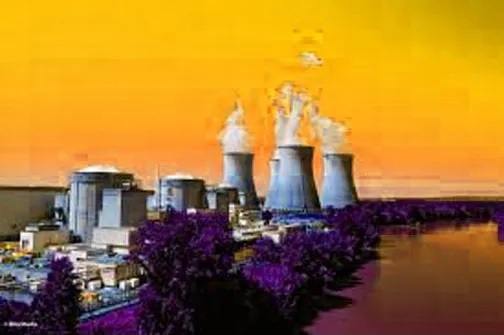
euro news, By Eleanor Butler, 14/08/2024
The energy provider insists there are no looming safety risks as three French regions face heatwave warnings.
EDF has reduced its electricity production at nuclear sites in France in response to soaring temperatures.
Three reactors are currently affected, although the energy provider has said “there is no safety risk”.
A reactor located at the Bugey nuclear power plant, a site near Lyon, has been closed since 12 August.
Also near Lyon, the Saint-Alban nuclear plant has experienced production cuts since 11 August, and similar measures are being taken at the Tricastin site. This is located in the South East of France, north of Avignon.
Heat-related incidents aren’t a new complication for EDF but rather a recurring problem, as exemplified when the firm published a climate change action plan last month……
High temperatures can interfere with nuclear processes as reactors are heavily reliant on water.
Heat from nuclear reactions is used to transform water into steam, which then drives turbines to produce electricity.
Another current of water, outside of the closed loop system, is then drawn from surrounding rivers to cool the reactor…..
During periods of extreme heat, this can produce a number of complications.
If surrounding water sources are warmer than usual, reactors cannot be cooled as efficiently.
French regulations also prevent sites from discharging water that is too hot back into rivers and lakes, to avoid the accidental killing of fish and other wildlife.
EDF told Euronews that it had temporarily reduced production to “respect regulations relating to thermal discharges”.
The firm explained that “discharge limits are established individually for each plant” by the French Nuclear Safety Authority (ASN).
Three departments in France are currently affected by heatwave warnings, with storms now replacing hot weather in some areas. https://www.euronews.com/business/2024/08/14/edf-cuts-nuclear-production-in-reaction-to-soaring-temperatures
Iran’s future FM says nuclear deal broken, favors military-diplomatic path
Niloufar Goudarzi, Iran International, 14 Aug 24
Iran’s foreign minister-designate has dismissed the 2015 JCPOA nuclear deal as irreparable, advocating instead for a strategy that blends military force with diplomacy, according to an Iranian MP.
Abbas Araghchi, who has openly aligned himself with IRGC values, firmly rooted in anti-Western and anti-Israel stances, is currently defending his proposed action plan in parliament, where he seeks approval as the nominated minister.
Speaking after Araghchi’s parliamentary session, MP Mohsen Fathi quoted him as stating, “The JCPOA is beyond revival. In the new government, our focus is not on restoring the nuclear deal but on lifting the sanctions. We are dedicated to a strategy integrating diplomatic efforts with military strength.”
It is not clear how Tehran wants to have the sanctions lifted without a nuclear agreement, unless Araghchi was referring to using diplomatic-military pressure on the United States.
In 2015, Iran and global powers signed the Joint Comprehensive Plan of Action (JCPOA) to limit Iran’s nuclear activities for sanctions relief. In 2018, then-president Donald Trump withdrew, claiming it failed to address Iran’s missile program. Since then, efforts to revive the JCPOA have involved indirect talks, with European diplomats mediating between US and Iranian officials.
Araghchi’s remarks mirrored those of the outgoing Acting Foreign Minister Ali Bagheri-Kani who asserted in July that the primary objective of the JCPOA was lifting sanctions………………………………https://www.iranintl.com/en/202408142991
Latest leak accident in Fukushima ‘once again exposes management chaos of TEPCO’
By Liu Xin Aug 14, 2024 https://www.globaltimes.cn/page/202408/1318029.shtml
The recent report of 25 tons of radioactive water leaking from Tokyo Electric Power Company (TEPCO)’s troubled Fukushima Daiichi Nuclear Power Plant once again exposes TEPCO’s internal management chaos. It also highlights the unreliability and risks associated with Japan’s moves to dump nuclear-contaminated wastewater into the sea, analysts said.
Approximately 25 tons of water containing radioactive materials leaked into the spent fuel cooling pool of Reactor Unit 2 in the Fukushima plant. TEPCO has stopped water injection into the pool and is investigating the cause of the leak. To ascertain the precise location of the leak and its underlying cause, TEPCO plans to deploy robotic equipment for an inspection scheduled for this week, Japanese media NHK reported on Tuesday.
Although TEPCO claims that there has been no discharge into the outside environment, the report raises concerns about Japan’s current practice of dumping nuclear-contaminated wastewater into the sea given TEPCO’s notorious history of cover-ups related to the Fukushima disaster, analysts said.
This incident exposes TEPCO’s internal management chaos and disorganization. Lü Chao, a research fellow at the Liaoning Academy of Social Sciences said that both TEPCO and the Japanese government bear major responsibility for handling the Fukushima nuclear-contaminated wastewater and should be transparent about any incident that has occurred in Fukushima.
Despite using the International Atomic Energy Agency (IAEA)’s report as a shield, Japan continues to dump nuclear-contaminated wastewater into the ocean, disregarding objections from neighboring countries and calls for international oversight. If this attitude continues, it could lead to further catastrophic incidents, causing severe and irreversible damage to the ocean and the environment, Lü told the Global Times on Wednesday.
As of press time on Wednesday, IAEA has not responded to Global Times’ inquiries on the incident.
This is not the first time this has happened in the Fukushima plant. In February, approximately 5.5 tons of wastewater, which may contain 22 billion becquerels of radioactive materials such as cesium and strontium have leaked from equipment at the nuclear power plant. Also, in October, 2023, five workers were accidentally splashed with liquid containing radioactive materials while cleaning at the Fukushima No. 1 nuclear power plant, according to Japanese media.
On August 7, despite persistent opposition at home and abroad, Japan started its eighth round of dumping of nuclear-contaminated wastewater into the Pacific Ocean. In response, the spokesperson for the Chinese Embassy in Japan said in a statement that Japan is irresponsibly shifting potential pollution risks onto the entire world. It is continuously discharging nuclear-contaminated wastewater into the ocean without addressing international concerns about the safety of the discharge, the long-term reliability of the purification equipment and the effectiveness of monitoring arrangements.
The spokesperson urged Japan to fully cooperate in establishing a comprehensive, independent and effective long-term international monitoring arrangement involving relevant stakeholders, including neighboring countries.
Peace Is Not On The USA Ballot In November
Caitlin Johnstone, Aug 15, 2024, https://www.caitlinjohnst.one/p/peace-is-not-on-the-ballot-in-november?utm_source=post-email-title&publication_id=82124&post_id=147730515&utm_campaign=email-post-title&isFreemail=true&r=1ise1&triedRedirect=true&utm_medium=email
I keep seeing liberal commentators like George Takei trying to frame Kamala Harris as the best candidate to bring peace to the middle east, despite her coming directly out of the administration which has been lighting the region on fire with its insane warmongering.
So let’s be clear here: Peace is not on the ballot in November. Americans are voting for Red War or Blue War. That’s it. Those are the choices.
I repeat: Peace. Is. Not. On. The. Ballot. Nobody who stands an actual chance at winning is going to bring about peace, because the US president is a manager of the US empire, and the US empire depends on constant warmongering.
Any debates over whether Trump or Harris are the one to bring about peace are nonsensical, because neither of them are. It’s like arguing over which car salesman might start handing out free cars — that’s not the job. It’s not what the people who have that job do.
Americans don’t get to vote on changes to US foreign policy; that can only come by way of mass-scale direct action. These elections are here to give Americans the illusion of democratic control and to let them feel okay about their political systems so they don’t start thinking about revolution. It’s all about feelings, so if you want to vote then vote in whatever way makes your feelings feel nice. That’s all this performative spectacle is ever about.
All this murderousness will only come to an end when enough people use the power of their numbers to force it to end, and people will only use the power of their numbers to force it to end when enough of them have awakened from their propaganda-induced coma to get a real revolutionary movement happening.
So that’s where the focus needs to be. Not on which empire manager you should vote for, but on sowing the seeds of revolution by showing as many people as you can that everything they’ve been trained to believe about their nation, their government and their world is a lie. Showing them how depraved their rulers are and how badly they’re being screwed over by exploitative status quo systems, and letting them know that a better world is possible.
There’s always something you can do every day to help accomplish this. Attending demonstrations. Participating in activist organizations. Distributing literature, online and offline. Making videos. Making memes. Having conversations. Today I saw a video of a young woman on a train giving a short speech about the genocide in Gaza and distributing flyers. Anything you can do to spread awareness of what’s really going on and how the media and politicians are lying about it all.
So the bad news is that not until a critical mass of people have reached a sufficient level of awareness will there be a real chance at meaningful change. But the good news is that you absolutely have the power to work towards expanding that awareness.
NATO Countries Think Ukraine Won’t Be Able To Hold Territory in Russia’s Kursk
Biden called Ukraine’s ground invasion in Kursk a ‘real dilemma’ for Putin
by Dave DeCamp August 13, 2024 https://news.antiwar.com/2024/08/13/nato-countries-think-ukraine-wont-be-able-to-hold-territory-in-russias-kursk/
NATO countries think it’s unlikely Ukraine will be able to hold territory in Russia’s Kursk Oblast even if it takes weeks for Russian forces to drive the Ukrainians out, Bloomberg reported Tuesday, citing a Western intelligence official.
Despite that assessment, the report said NATO doesn’t “harbor reservations” about Ukraine’s invasion of Russian territory, which the US and NATO claim they were unaware of until the attack started. Another NATO official told Bloomberg that the incursion shows Ukraine can challenge Russia.
Heavy fighting has been raging in Kursk since over 1,000 Ukrainian soldiers and dozens of armored vehicles, including many provided by the US, entered Russian territory last Tuesday. While Ukrainian forces have captured dozens of villages, they are also taking heavy losses.
The Russian Defense Ministry said Tuesday that in the past day, Ukraine lost 420 soldiers and said it had lost over 2,000 since the invasion started, although the numbers are not confirmed since Kyiv doesn’t release information on its casualties.
The invasion is seen as an attempt by Ukraine to gain leverage in future negotiations. Ukrainian Foreign Ministry spokesman Georgiy Tykhy said Tuesday that Ukraine was not interested in “taking over” Russian territory. “The sooner Russia agrees to restore a just peace… the sooner the raids by the Ukrainian defenses forces into Russia will stop,” he said.
While the US claims it was unaware of Ukraine’s plans to invade Kursk, it is also strongly backing the invasion by allowing Ukrainian forces to use US weapons. President Biden was asked about the offensive on Tuesday and said it was a “real dilemma” for Russian president Vladimir Putin.
The US-backed operation, which is the largest invasion of Russia since World War II, marks a significant escalation of the proxy war and risks a major Russian response. Putin has said he views the incursion as the West using Ukrainians to attack Russia.
NFLA’s send ‘very best of luck’ to Peace Museum on reopening in historic Salts Mill

13th August 2024
https://www.nuclearpolicy.info/news/nflas-send-very-best-of-luck-to-peace-museum-on-reopening-in-historic-salts-mill/
Saltaire is a village in West Yorkshire that has much to commend it to visitors. It is a World Heritage Site, four miles north of Bradford, which was built by enlightened industrialist Sir Titus Salt in the 19th century. Now the village has one more attraction for the curious to experience – the UK’s only dedicated Peace Museum.
NFLA and Mayors for Peace Secretary Richard Outram was quick to send a note to the trustees, staff, and volunteers to wish them ‘the very best of luck for your reopening today (10 August) and for a successful future in your new premises…The Peace Museum does an incredible job in educating the public about the history of the peace movement and in raising their awareness of the importance of peace in their lives, in their communities, and between nations. That importance has become even more self-evident in recent days with race riots in many of our major towns and cities.’
The Peace Museum is unique in the UK in covering peace history, non-violence, and conflict resolution.
After a four year gap, the Peace Museum has moved from central Bradford to the third floor of the historic Salts Mill, eponymously named after the village’s employer and benefactor. The new home of the Peace Museum is fully-accessible and it can be reached by regular trains which stop at Saltaire Railway Station.
The renovated space will include a newly developed permanent exhibition which explores the often-untold stories of peace, peacemakers, social reform and peace movements. Visitors will be able to see objects from the Museum’s unique collection of 16,000 items, including banners that were originally used at Greenham Common Peace Camp and the Campaign for Nuclear Disarmament’s original drawings of the now well recognized peace symbol. It will also share personal stories of people’s motivations to campaign for peace and the impacts of conflict.
The new Museum will also have temporary exhibitions, an education space, research facilities and a shop.
This development, move, and re-opening have been made possible through the support of various funders, grants, and donations from supporters. The National Lottery Heritage Fund has enabled the creation of a new engaging and accessible exhibition and educational programmes. Generous capital funding has been received from Bradford 2025 and Bradford City Council, and other financial backers include the Key Fund, Art Fund, Association of Independent Museums, Pilgrim Trust, Museum Development North and Arts Council England.
The Peace Museum has a presence on Facebook – peacemuseum.org.uk – where it is possible to subscribe for a regular newsletter.
The Peace Museum is open Wednesday to Sunday, 10am to 4pm. Entry is free, but donations are gratefully received and encouraged.
Hinkley Point B: What happens after a nuclear power station stops making electricity?
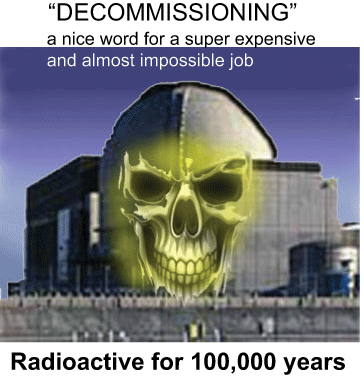
After shutting down in 2022, the job now is to carefully
remove tonnes of nuclear waste to be transported for storage at Sellafield
in Cumbria. The team is halfway through that task with one reactor empty
and one more to go.
I was given exclusive access to the power station,
getting the chance to travel deep within the bowels of the building and see
something few people outside EDF Energy get to – the cooling ponds, where
spent fuel is cooled down before being sealed for transport and storage.
there will be another couple of years to finish defuelling operations, then
EDF hands this place over to the Nuclear Decommissioning Authority as the
painstaking job of decommissioning will continue for many years.
ITV 13th Aug 2024
Nato fighter jets intercept Russian nuclear bombers
msn by Gergana Krasteva, 14 Aug 24
Vladimir Putin deployed two Tu-95MS strategic nuclear missile carriers over Nato waters after accusing Britain of coordinating the incursion into Russia with Ukraine, it has been reported.
MiG-31 combat warplanes belonging to the Alliance escorted the Kremlin’s jets, which buzzed over the Norwegian Sea.
Separately, two Tu-22M3 long-range bombers flew over the neutral waters of the Baltic Sea.
Both the Tu-95MS and Tu-22M3 bombers – key parts of Russia’s nuclear arsenal – were escorted by Nato planes during their ‘scheduled’ flights.
This is the latest of the Kremlin’s reconnaissance flights as part of its ongoing attempts to taunt the bloc.
It comes after it accused the UK of involvement in Ukraine’s attack on the border region – now in its second week and forcing Putin to move reserves on a massive scale to Kursk.
Assault troops have pushed about a mile farther into Russia on Wednesday, the commander of the Ukrainian military, General Oleksandr Syrskyi, said in a video posted on president Volodymyr Zelensky’s Telegram channel.
In addition, more than 100 Russian soldiers have been taken prisoner, Syrskyi added…………………………………………………….
Russian authorities have evacuated about 132,000 people from the Kursk and Belgorod regions and have plans to evacuate another 59,000 [could this be related to fears about Kursk’s nuclear power plant?] …….. https://www.msn.com/en-au/news/other/nato-fighter-jets-intercept-russian-nuclear-bombers/ar-AA1oNL0R?ocid=hpmsn—
Sweden Considers Borrowing $28.5 Billion to Finance Nuclear

By Lars Paulsson and Niclas Rolander, August 12, 2024
(Bloomberg) — Sweden could borrow 300 billion Swedish kronor ($28.5 billion) to help finance a new fleet of nuclear reactors in the coming decades.
A government study released Monday in Stockholm highlighted several features of its preferred model in order provide certainty for investors. Funding instruments include government borrowing to support construction, and 40 years of guaranteed revenues through a so-called contract-for-difference or CfD. ……….
Financing is one of the biggest hurdles for nuclear energy, with reactors costing multiple billions of dollars and taking years to build — often compounding the price. The model presented on Monday is focused on financing a program of as much as 6,000 megawatts, or four large-scale reactors, and has taken inspiration from the Czech Republic’s plans for financing new units at the Dukovany complex. ……..
The proposals will be sent for consultation to various institutions, companies and government agencies before they may be adopted by the government.
One feature is the CfD model, used for both Electricite de France SA’s Hinkley Point C in the UK and Dukovany. Under this mechanism, developers and the government agree a fixed price for electricity for a certain period of time, providing certainty of future revenue. If market prices fall too low, the generator receives a top-up from the state. On the flip side, the plant operator must pay back the difference if the market rate is higher.
In contrast with the financing scheme for Hinkley Point, which has a total cost estimate of about £47.9 billion ($61.2 billion) in today’s prices, the suggested model for Sweden also involves public borrowing to finance construction. According to the proposal, the government would borrow as much as 75% of investment costs, which Dillen expects could increase public debt by some 300 billion Swedish kronor ($28.5 billion).
Swedish state-owned Vattenfall AB and Finland’s Fortum are among the utilities studying new reactors……
In a comment on its website, Vattenfall said it agreed with a lot of the points made by Dillen, but that it was unclear how the state will ensure that the first wave of new reactors actually will be built.
Sweden has had a love-hate relationship with atomic energy since the first commercial reactor began operations in 1972. Mounting grassroots opposition in subsequent years culminated in a 1980 referendum calling for the dismantling of all reactors — an effort that ultimately failed. The winning center-right coalition in the 2022 election made a nuclear renaissance a pillar of its election campaign. ………. https://www.bnnbloomberg.ca/investing/2024/08/12/sweden-leans-toward-czech-style-funding-for-new-nuclear-reactors/
The Fajr massacre: Every 70 kg bag of human remains is considered a martyr
The bodies of Palestinians killed in the latest Israeli massacre in Gaza were destroyed so far beyond recognition that doctors have only been able to give grieving families an anonymous bag of human remains to bury.
Mondoweiss, By Tareq S. Hajjaj August 11, 2024
Zainab al-Jaabari, 79, sits a few dozen meters in front of the scene of the massacre. She is waiting for her family members to return from checking for her seven sons and grandchildren, who were in the prayer hall praying Fajr at the time it took place.
Her family members arrived to see the reality of the massacre with their own eyes: more than a hundred people were killed, and their bodies were now scattered and mixed in the prayer hall in the Daraj neighborhood in Gaza City. It is possible their delay in returning now is due to their horror at what they found, or perhaps because they can’t imagine how to tell Zainab that her seven sons and grandchildren have been killed.
At dawn on Saturday, August 10, the Israeli army bombed a mosque while dozens of displaced people were praying the Fajr prayer, the daily Islamic prayer offered in the early morning. The bombing killed more than a hundred people, most of whom were dismembered or destroyed beyond recognition. For this reason the identification of the bodies has so far been incomplete……………………………………………………………………………………………………….
Every 70 kilograms of remains is considered a martyr
In the mosque, people stand in a row close to each other as they pray, and after the bombing, the worshipers remained intermingled as well, as remains and corpses. Large numbers of martyrs were not able to be identified, and entire families were wiped out.
Survivors of this massacre are describing a new and horrifying experience they are being forced to endure in aftermath of Israeli bombing in the Gaza Strip: they cannot even identify the remains of their loved ones.
Because the rescue teams couldn’t identify many of the human remains collected due to the intensity of the bombing, the doctors at Baptist Hospital were not able to identify each martyr individually. Instead, the doctors have started collecting body parts in plastic bags and giving 70 kilos of remains to the family of a martyr who has gone missing.
Hassan Ahmad told Mondoweiss that he searched extensively for the body of his 6-year-old son Ali, and after hours of searching, he did not find a trace of him. He then went to the Baptist Hospital to ask about his son, or to find any part of his body so I could identify him and bury him. After a long search that did not yield any results, the doctors at the Baptist Hospital gave him a plastic bag containing 18 kilograms of human remains and told him, “This is your son; go and bury him.”………………………………………………………..
I saw my father’s carnage
Muhammad Hamida, 12, recounted to Mondoweiss how he found his father, who had been torn apart in the Israeli attack. He says that he went with his older brother to the prayer hall after the bombing to rescue their father, who was praying at the time.
When we arrived, we couldn’t enter because of the intensity of the fire, blood, and body parts, but we wanted to check on my father. Moments later, we could enter the prayer hall but we couldn’t bear the scene.”
“People were cut up, there was a lot of blood on the ground, and body parts and small pieces of worshipers’ bodies were scattered everywhere. We found my father lying on the ground there. We recognized him, and our relatives helped us drag him out of the prayer hall. We found a human head stuck between his feet when we took him out. I was stunned with fear. I have never seen scenes like this in my life. I hope I never see them again.”
“They will kill us all; we are here alone; no one cares about us. They killed my father, and a month ago, they killed my two uncles, and they will kill everyone who remains in Gaza.”
Fatima Hassona conducted the interviews for this report from Gaza. https://mondoweiss.net/2024/08/the-fajr-massacre-every-70-kg-bag-of-human-remains-is-considered-a-martyr/?ml_recipient=129461487750088454&ml_link=129461453864305971&utm_source=newsletter&utm_medium=email&utm_term=2024-08-12&utm_campaign=Daily+Headlines+RSS+Automation
How NATO Went Rogue
By Tomasz Pierscionek, Morning Star, August 9, 2024, https://worldbeyondwar.org/how-nato-went-rogue/
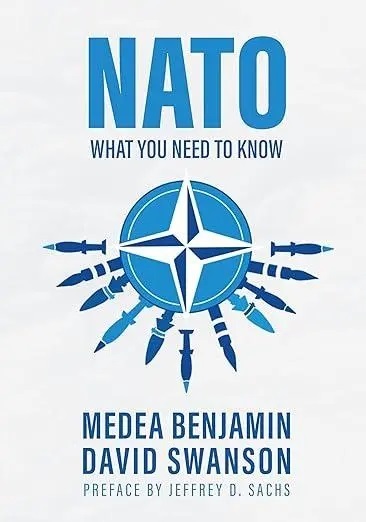
NATO: What You Need to Know by Medea Benjamin and David Swanson, OR books, £12.99
To mark the 75th anniversary of Nato’s creation, veteran anti-war activists Medea Benjamin and David Swanson have published a book that explores the alliance’s origins and critiques its role in global affairs over the past several decades.
The authors produce a much needed antidote to the pervasive propaganda that claims Nato makes the world a safer place.
Benjamin and Swanson duly set the record straight and offer a powerful riposte to the arguments upon which Nato’s proponents rely in order to justify the military collective’s long overdue existence.
Nato’s first secretary-general allegedly declared that the organisation, originally comprising 12 members when founded in 1949, aimed “to keep the Soviet Union out, the Americans in, and the Germans down.” Notwithstanding this comment’s facetiousness, the words hold a darker meaning and provide an insight into what Nato would become.
Taking Nato’s founding document (the Washington Treaty) at face value, its original members sought collectively to preserve stability within the north Atlantic region while adhering to the principles of the United Nations Charter, desiring to live in peace with all nations, and seeking to resolve any disputes peacefully.
We learn that in the ensuing decades Nato would expand its influence far beyond the north Atlantic area, incorporate countries which were dictatorships at the time (such as Greece and Turkey), support colonialism in Africa, seek to thwart democracy by stifling popular communist and left-wing movements across Europe, and support numerous unsavoury groups such as Kosovan criminals and Islamic terrorists.
Benjamin and Swanson thus show how Nato’s future actions would violate the intentions expressed in its founding document.
We learn too how the USSR, fearful of West German rearmament and having recently lost 27 million of its people, asked to join Nato in the mid-1950s with the intention of being part of the post-war security architecture in Europe. The request was rebuffed, leading to the USSR forming its own defensive Warsaw Pact the following year.
The reader is left to ponder how different history could have been and which future conflicts may have been avoided had Nato’s founders accepted this offer of detente during the cold war’s early years. Perhaps it is not coincidental that Nato’s first military operation only occurred after the USSR’s collapse, when it became engaged in shooting down Serbian planes during the Bosnian war of the mid-1990s.
Subsequent chapters reveal how Nato became a vehicle for the US to pursue its dreams of global dominance without the shackles of international treaties or the constitution. For example, whereas the president of the United States requires Congressional approval to undertake military action, this constraint is not required for the US-led Nato alliance to go to war.
Benjamin and Swanson discuss the role Nato has played in the Yugoslav, Afghan, Iraq and Libyan conflicts to demonstrate how the military bloc leaves a trail of destruction and chaos in its wake, a far cry from the stability and democracy it claims to uphold.
The alliance has also morphed into an excuse to oblige member nations as well as non-member countries (the latter referred to as Nato’s “global partners”) to purchase US-made weapons under the guise of promoting “inter-operability.”
Voicing the opinion that Ukraine joining Nato is a ludicrous idea that will provoke an aggressive response from Russia may nowadays get you demonised as promoting pro-Kremlin propaganda. Yet Benjamin and Swanson tell us that such a view was considered sensible in the upper echelons of US politics not too long ago.
For example, former US ambassador to Moscow William Burns reportedly once sent a communique back home explaining that Ukraine joining Nato would be “the brightest of all red lines for the Russian elite (not just Putin),” adding that this was a view shared by President Putin’s harshest critics and that “I have yet to find anyone who views Ukraine in Nato as anything other than a direct challenge to Russian interests.”
Ironically, as the authors describe, Russia’s invasion of Ukraine gave Nato a new lease of life at a time when some politicians were beginning to question the organisation’s purpose. While rightly condemning the invasion, Benjamin and Swanson explain how relentless expansion and provocation from a US-led Nato over the preceding two decades set the scene for a war that could have been avoided.
I was left wondering how Western nations would have reacted to Russian encroachment after the cold war had roles been reversed. Relabelling the acronym Nato as Not A Tenable Option, Benjamin and Swanson finish by describing alternatives to the alliance that could de-escalate tensions around the globe while providing countries with a sense of security.
The authors present their case in a clear and straightforward manner that makes their analysis easy to comprehend. Despite being less than 150 pages long, Nato: What You Need to Know contains a plethora of vital wisdom for readers across the political spectrum.
Its publication comes at a time when many, including some on the left or those once considered as anti-war, have been seduced into swallowing militarist propaganda that advocates arming Ukraine to fight Russia regardless of what consequences may transpire.
The world is closer to witnessing a conflict between nuclear-armed powers than it has been for decades. Now is the time to change direction before it is too late.
-
Archives
- October 2026 (129)
- September 2026 (339)
- August 2026 (330)
- July 2026 (355)
- June 2026 (287)
- May 2026 (306)
- April 2026 (356)
- March 2026 (251)
- February 2026 (267)
- January 2026 (308)
- December 2025 (358)
- November 2025 (359)
-
Categories
- 1
- 1 NUCLEAR ISSUES
- business and costs
- climate change
- culture and arts
- ENERGY
- environment
- health
- history
- indigenous issues
- Legal
- marketing of nuclear
- media
- opposition to nuclear
- PERSONAL STORIES
- politics
- politics international
- Religion and ethics
- safety
- secrets,lies and civil liberties
- spinbuster
- technology
- Uranium
- wastes
- weapons and war
- Women
- 2 WORLD
- ACTION
- AFRICA
- Atrocities
- AUSTRALIA
- Christina's notes
- Christina's themes
- culture and arts
- Events
- Fuk 2022
- Fuk 2023
- Fukushima 2017
- Fukushima 2018
- fukushima 2019
- Fukushima 2020
- Fukushima 2021
- general
- global warming
- Humour (God we need it)
- Nuclear
- RARE EARTHS
- Reference
- resources – print
- Resources -audiovicual
- Weekly Newsletter
- World
- World Nuclear
- YouTube
-
RSS
Entries RSS
Comments RSS

