Congress will hold a hearing about the Sentinel missile’s exploding budget, but is it too little, too late?
Bulletin. By Chloe Shrager | June 14, 2024
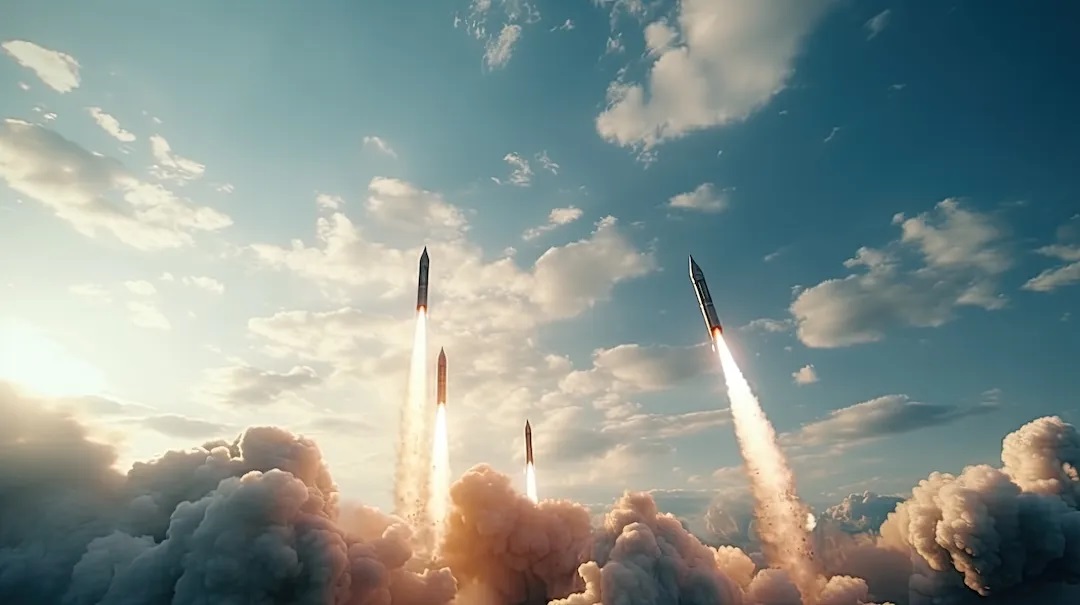
The Pentagon’s new multibillion-dollar intercontinental ballistic missile (ICBM) program has come under fire as a continual offender of overspending, but there has been little reaction on the issue from Congress. The most recent cost overrun for the Sentinel ICBM (previously known as the Ground Based Strategic Deterrent or GBSD) put the program’s budget an unprecedented 37 percent higher than previous estimates and extended its operational schedule by at least two years. As a result, the Pentagon is critically reviewing the program to determine if it will continue or be canceled.
Critics have called the land-based missile modernization project “wasteful and dangerous.” But much to the dismay of Sentinel’s many naysayers, the costly program is expected to be recertified.
While experts and activists have long called for a thorough reevaluation of the program, most of Congress has been silent on the issue. It is only last month that the chairs of a congressional working group on nuclear arms called for an oversight hearing on the controversial program. The hearing, set for July 24, seeks to “raise the alarm about our unsustainable, reckless nuclear posture,” working group co-chair Don Beyer, a Democrat of Virginia, said of the current US nuclear policy.
The upcoming hearing will be the first—and maybe only—opportunity for lawmakers to critically reevaluate US spending on modernization of its ICBM force. But it will come after the program is poised to be recertified by the Defense Secretary on July 10. This raises the question of whether Congress truly has any oversight on the US nuclear modernization program, or if the hearing is merely a performance.
Sentinel’s history of budget breaches. The Sentinel program is meant to completely replace the 400 deployed Minuteman III missiles that constitute the land-based leg of the US nuclear triad, producing 400 new ICBMs and refurbishing the 450 launch silos capable of holding them. The program also includes the acquisition of more than 250 additional ICBMs and the modernization of over 600 command and control facilities. Of the 659 total ICBMs that Sentinel will produce, 400 will be actively deployed in silos and 50 will be kept “warm,” leaving 209 extras for testing and other purposes. However, the US Air Force has yet to publicly justify why it needs these 259 warm and extra missiles not included in the current generation of Minuteman III missiles or how they increase national security
The Sentinel was chosen in large part for its supposed cost-effectiveness, but its price has skyrocketed since initial cost analyses: It nearly doubled in size from its original projections of $62.3 billion back in 2015 to over $130 billion today. That total is almost as much as what is planned to be spent on Medicaid health services for low income families over the next 10 years. A new report from government watchdog group Taxpayers for Common Sense projects the price tag might reach $315 billion by 2075.
The most recent cost overrun happened when the production cost per unit jumped from $118 million to $162 million, a 37-percent increase that set off alarms in the Pentagon…………………………………………………………………………………………………………………………………………….
The July 24 hearing is a first step in the direction of more public accountability in government spending for nuclear weapons programs. But, unless representatives advocate for a full and candid review of Sentinel, the hearing will merely blow hot air at a decision already made. When announcing the oversight meeting on June 4, Garamendi remembered that “historically, nations have collapsed by overspending on outdated defense strategies, and I fear the United States is repeating these mistakes.” https://thebulletin.org/2024/06/congress-will-hold-a-hearing-about-the-sentinel-missiles-exploding-budget-but-is-it-too-little-too-late/?utm_source=Newsletter&utm_medium=Email&utm_campaign=ThursdayNewsletter06132024&utm_content=NuclearRisk_SentinelBudget_06142024
Guam’s fight for radiation exposure compensation ‘far from over’
RNZ, By Mar-Vic Cagurangan, Pacific Island Times, 17 June 24
Despite nearly two decades of relentless lobbying, Guam’s hopes to finally be included in the Radiation Exposure Compensation Act (RECA) crumbled anew when the US House Republican leadership let the program expire without extension or expansion.
While the RECA extension and expansion proposal received bipartisan support in the US Senate, House Speaker Mike Johnson shunned its inclusion in the 2025 National Defense Authorization Act.
Guam Delegate James Moylan said the House Rules Committee ruled his amendment to incorporate the RECA expansion language into the defense spending policy bill “out of order”. As a result, the language didn’t make it to the floor for the House vote.
“The primary reason was that offset costs were not provided, which were estimated at around US$50 billion,” Moylan said in a statement.
“This mirrors the message from House leadership when referencing the RECA measure passed by the Senate, and many in the House, including myself, have been requesting for a vote to take place on the floor.”
RECA, the 1990 legislation that provided financial compensation for atomic test downwinders in three states and pre-1971 uranium miners, expired on June 10.
The expanded version would have added Guam, Colorado, Idaho, Missouri, Montana and New Mexico to the list of areas currently included in RECA, namely Nevada, Arizona and Utah.
“The Republican leadership’s policy is that any new spending measure must have an offset provided, to prevent uncontrolled spending or an unfunded mandate,” Moylan said.
“There are others who believe the measure should be passed regardless, and thus allow the executive branch to identify the funds. We believe a combination of both is needed.”
The Pacific Association of Radiation Survivors led by Robert Celestial has been fighting for Guam’s inclusion in RECA, backed by the National Research Council’s 2005 report declaring the territory’s eligibility for compensation under the program.
“Guam did receive measurable fallout from atmospheric testing of nuclear weapons in the Pacific between 1946 and 1958,” read the council’s report, which recommended that people living on island during that period be compensated under RECA “in a way similar to that of persons considered to be downwinders.”
Despite the latest defeat, Moylan said the advocacy “is far from over” and “building more support along the way”.
He is banking on the Senate to include the language in its version of the NDAA in the coming weeks………………………………………… more https://www.rnz.co.nz/international/pacific-news/519741/guam-s-fight-for-radiation-exposure-compensation-far-from-over
UN: Israel killed own citizens on October 7 under ‘Hannibal Directive’

SOTT, Nicola Smith, The Telegraph, Sat, 15 Jun 2024
The Israeli military likely killed more than a dozen of its own citizens during the October 7 attacks, a United Nations investigation has alleged.
Comment: Bearing in mind the UN is extremely conservative (and even biased in favor of Israel-the West) in its verdicts, this is rather damning; and one would expect that further, even more incriminating, revelations of Israel’s role in Oct 7, its incitement of the attack, and stand down order, are still to come.
The report by the UN commission investigating the attack on Israel and the subsequent war in Gaza documented “strong indications” that the “Hannibal Directive” was used in several instances that day, “harming Israelis at the same time as striking Palestinian militants.”
The directive – officially revoked in 2016 – was put in place to prevent the capture of Israeli soldiers by enemy forces who may use them as bargaining chips, allowing troops to open fire even if it caused the death of a comrade.
UN investigators, led by Navi Pillay, a former UN human rights chief, concluded that at least 14 Israeli civilians, including 12-year-old twins and a 68-year-old grandmother, “were likely killed as a result of Israeli security forces fire.”
These specific accusations have not yet been addressed by Israel, but the government angrily rejected the overall report, which accused both Palestinian groups and Israel of committing war crimes. The UN panel also claimed Israel’s conduct of the war included crimes against humanity.
The Israeli government said the report was “reflective of the systematic anti-Israel discrimination of this commission of inquiry“, noting that it had ignored Hamas’s use of civilians as “human shields”.
It has also criticised the commission for “outrageously and repugnantly” drawing a false equivalence between Hamas and the Israeli military in relation to sexual violence.
Comment: Thus far it seems Israel is guilty of using sexual violence as a weapon of war, not Hamas. Moreover, with Israel it’s institutional and systematic: ‘Extermination, torture, starvation, sexual violence’: UN finds Israel guilty of numerous crimes against humanity
The report examines both Hamas’s actions on October 7 and Israel’s military response in Gaza and provides legal analysis that could be used in future criminal proceedings.
The UN commission was denied access to Israel, Gaza and the West Bank and said Israel did not respond to six requests for information. It based its conclusions on remote interviews with survivors and witnesses, satellite imagery, forensic medical records, and open source data.
Buried in the detail are several examples when Israeli civilians may have been intentionally targeted by their own armed forces on the day thousands of armed Hamas terrorists violently attacked the Nova music festival and Kibbutz settlements near the Gaza border.
The investigation’s conclusions on this question, much of which is derived from local media, refer to a video statement by an IDF tank crew which “confirms that at least one individual tank team knowingly applied the ‘Hannibal Directive‘ that day.”
It adds: “In a statement given to an Israeli news channel, a tank driver and commander stated that they targeted two Toyota vehicles with militants and Israelis. This occurred at point 179, close to Kibbutz Nir Oz.”
The commander, who believed his troops could be on the vehicles, was quoted as saying: “I prefer stopping the abduction so they won’t be taken,” although he adds that, to his knowledge, he did not kill any soldiers.
Much of the information at the centre of the “Hannibal Directive” accusation stems from the death of Efrat Katz, 68, some 150m from the Gaza border, and another 13 Israelis who were “likely” killed either by tank shelling or caught in the crossfire after being trapped by terrorists in the house of Pessi Cohen in Kibbutz Be’eri.
In their account of the Be’eri incident, investigators say that about 40 terrorists brought 15 civilians, including twins Liel and Yannai Hetzroni, aged 12, into the house of local resident Pessi Cohen, leading to a standoff with the Yamam police counter-terrorism unit and the IDF.
At 3pm, Hasan Hamduna, the terrorists’ leader, called the Yamam through one of the female hostages, threatening to execute all the abductees unless they were given safe passage to Gaza.
At 4pm, the first large IDF contingency, led by Brig Gen Barak Hiram, arrived at the site.
According to the testimony of a surviving hostage, the Yamam commandos opened fire on the terrorists while seven hostages were in the yard, trapped between them, the report says………………………………………………………………………………………………………………………………..
the Israeli government has discussed far-reaching measures against UN agencies operating in Israel and the Palestinian territories, including the possible expulsion of staff, reported the Financial Times.
Bubbling tensions spiked last week after António Guterres, the UN secretary-general, added Israel’s military to a list of countries and organisations that fail to protect children in conflict – a move the Israeli ambassador to the UN described as “shameful.” https://www.sott.net/article/492277-UN-Israel-killed-own-citizens-on-October-7-under-Hannibal-Directive
NATO chief says members considering deployment of more nuclear weapons, Kremlin warns it’s an ‘escalation of tension’
Reuters, Mon, 17 Jun 2024
The Kremlin said on Monday a remark by NATO chief Jens Stoltenberg that the military alliance was holding talks on deploying more nuclear weapons was an “escalation of tension”.
Stoltenberg told Britain’s Telegraph newspaper that NATO members were consulting about deploying more nuclear weapons, taking them out of storage and placing them on standby in the face of a growing threat from Russia and China.
Kremlin spokesman Dmitry Peskov said Stoltenberg’s comments appeared to contradict a communique issued at a weekend conference in Switzerland that said any threat or use of nuclear weapons in the Ukraine context was inadmissible.
The talks, held at the behest of Ukrainian President Volodymyr Zelenskiy, were billed as a “peace summit” although Moscow was not invited.
“This is nothing but another escalation of tension,” Peskov said of the NATO secretary general’s remarks………………………………………………………… https://www.reuters.com/world/europe/kremlin-says-nato-chiefs-nuclear-weapons-remarks-are-an-escalation-2024-06-17
Judges Named for Assange Appeal

By Joe Lauria / Consortium News June 14, 2024, https://consortiumnews.com/2024/06/14/judges-named-for-assange-appeal/
Consortium News will be back inside the courtroom in London July 9-10 to cover Julian Assange’s appeal against extradition
The judges in Julian Assange’s two-day appeal hearing on July 9-10 are the same who granted Assange a rare victory last month: his right to appeal the Home Office’s extradition order to the United States.
Justices Jeremy Johnson and Victoria Sharp granted Assange the right to appeal on only two of nine requested grounds, but they are significant:
1). his extradition was incompatible with his free speech rights enshrined in the European Convention on Human Rights; and 2.) that he might be prejudiced because of his nationality (not being given 1st Amendment protection as a non-American).
However the denial of his rights in an American courtroom would go beyond the First Amendment to all of his U.S. constitutional rights, according to the 2020 U.S. Supreme Court ruling in USAID v. Alliance for Open Society International Inc., which says that a non-U.S. citizen acting outside the U.S. has no constitutional protections at all.
The United States was unable to provide assurances that the European equivalent of his constitutional rights would be protected, required under British extradition law. That raises hopes for Assange in his appeal.
Assange has been imprisoned in London’s notorious Belmarsh Prison for more than five years on remand pending the outcome of his extradition. He has been charged in the United States for publishing classified documents that revealed prima facie evidence of U.S. state crimes.
CN has received an award and many accolades for our coverage of the Julian Assange case. We will be inside the courtroom and outside the Royal Courts of Justice in London for both days of the hearing, bringing you the latest news, analysis and commentary.
Tensions with First Nations threaten to delay nuclear waste facility

MATTHEW MCCLEARN, 16 June 24 https://www.theglobeandmail.com/business/article-tensions-with-first-nations-threaten-to-delay-nuclear-waste-facility/#:~:text=Prof.%20Leiss%20said%20even%20if,this%20issue%2C%E2%80%9D%20he%20said.
The eight-reactor Bruce Nuclear Generating Station, on the eastern shore of Lake Huron, ranks among the world’s largest nuclear power plants. With four more in the early planning stages, it might become larger still. But for the Saugeen Ojibway Nation (SON), behind its engineering grandeur lies a painful history – which it has described as one “of exclusion.”
Its people were not consulted before the plant’s construction during the 1970s and 80s, which resulted in quantities of radioactive waste stored within what they regard as their traditional territory. Nor did they see many of the economic benefits that flowed to neighbours.
These unresolved tensions threaten to derail – or at least significantly delay – efforts to find a permanent solution for Canada’s nuclear waste, which dates back to the 1970s. As of June, 2023, Canada had accumulated approximately 3.3 million used fuel bundles that were stored temporarily at operating or retired nuclear power plants in Ontario, Quebec and New Brunswick. But there’s nowhere to send them for permanent disposal – a potential stumbling block as the nuclear industry seeks public acceptance for a proposed major expansion.
The Nuclear Waste Management Organization (NWMO), an industry-controlled organization to which the federal government delegated responsibility for nuclear waste management, wants to select a site this year for a proposed, $26-billion underground nuclear waste disposal facility, known as a deep geological repository. The two remaining candidates are the Municipality of South Bruce (about 45 kilometres southeast of Bruce station, and also within SON’s traditional territory) and a site more than 40 kilometres from Ignace, a town of 1,200 northwest of Thunder Bay.
One of the NWMO’s guiding principles is that the repository’s host “must be informed and willing to accept the project.” Ignace’s council will decide that through a resolution; it has agreed to notify the NWMO of its decision by July 30. (It hired a consultant, With Chela Inc., to engage with residents and maintains its decision will be based on public input.) In South Bruce, citizens will vote in a by-election in late October. Both signed hosting agreements with the NWMO this year, under which South Bruce would receive $418-million over nearly a century and a half; Ignace would get $170-million.
Yet all that might well prove a sideshow. The NWMO also seeks consent from Indigenous peoples: Wabigoon Lake Ojibway Nation, in the case of Ignace. SON, which is composed of the Chippewas of Nawash First Nation and Chippewas of Saugeen First Nation, will decide regarding the South Bruce site. NWMO spokesperson Fred Kuntz said the organization is negotiating hosting agreements with both First Nations.
Success is far from assured.
SON’s grievances with the nuclear industry date back to the 1960s, when Ontario Hydro (the predecessor of Ontario Power Generation) began constructing Canada’s first commercial nuclear power plant. For SON, the commissioning of the Douglas Point Nuclear Generating Station marked the beginning of “the nuclear industrialization” of its territory. Douglas Point was followed by the much-larger Bruce station, built immediately next door.
SON ruefully watched its neighbours benefit as tax revenues rolled into local municipalities, while its members were largely shut out. In 2013 SON secured an undertaking from Ontario Power Generation that the utility wouldn’t establish an intermediate-level waste repository (proposed for construction at Bruce station) on its territory without its consent.
That undertaking had far-reaching consequences. It led to a 2020 plebiscite in which SON’s membership overwhelmingly rejected that repository. And it set an important precedent: In 2016, the NWMO granted SON the same ability to veto the South Bruce repository. SON plans to hold a referendum of its members, once it has received all the information it seeks from the NWMO.
“I’d say we’re at least halfway halfway home to having our questions satisfied,” said Gregory Nadjiwon, chief of the Chippewas of Nawash Unceded First Nation, one of SON’s two member nations.
But reaching an agreement this year – or at all – could prove challenging. The NWMO has accepted responsibility for disposing of all Canadian spent fuel, whether from the Point Lepreau station in New Brunswick, or from long-defunct research reactors at Chalk River, or even wastes from reactors yet to be constructed. SON’s leadership, though, is focused on the wastes in its own territory.
“If the [repository] is going to be in the SON territory, why should we be accepting waste that comes from Pickering, Darlington, Chalk River or Point Lepreau?” Chief Nadjiwon said.
“I mean, that’s ludicrous.”
As part of any agreement with NWMO, SON’s leadership seeks resolution to its long-standing concerns, such as the fact that wastes have been stored in its territory for decades without compensation.
“When I go in my truck to a garage in Toronto, I’m charged a cost” to park it, he said. “It’s no different than when you park waste in an Indigenous territory or homeland. We expect an agreement for the cost of doing business.”
William Leiss, an emeritus professor at Queen’s University’s School of Policy Studies, worked as a paid consultant for the NWMO between 2002 and 2011. He wrote a book, Deep Disposal, about the site selection process; the book is scheduled for publication in September. Prof. Leiss said SON’s opposition is so firm that it’s hard to fathom why South Bruce is still in the running.
“Its negatives are so pronounced that one wonders if it is being kept alive solely as a negotiating card so that Ignace does not regard itself as the only viable option,” he wrote.
“It has all the markings of an elaborate charade.”
But Prof. Leiss said the Ignace site is a long shot, too.
The Wabigoon Lake Ojibway Nation has roughly 1,000 members, 200 of which live on a reserve 20 kilometres from the Ignace area site. Its chief, Clayton Wetelainen, said the community has been negotiating a hosting agreement with the NWMO for roughly eight months.
The community has had far less interaction with the nuclear industry than SON has, so its historical baggage is perhaps lighter. Whereas the Ignace and South Bruce agreements would prevent future councils from backing out of the project, Wabigoon Lake’s leadership does not regard the agreement it’s negotiating as irrevocable – in part because there’s insufficient information available on many aspects of the project.
“The current vote that we’re talking about is just to go down to one site,” Chief Wetelainen said.
“This has to go through regulatory approvals, and our own approval, when we get more information about the detailed site.”
Some, he added, have misconstrued the vote as final and binding, “but that’s not the case.”
Prof. Leiss said even if Wabigoon Lake voted in favour of the project, other First Nations throughout the region might launch lawsuits to block the project. “There’s intense fighting among the First Nations in the Treaty 3 area over this issue,” he said.
Chief Wetelainen said his goal is to set a date in the fall for his 1,000 members to vote. Some community members began informing themselves about the project a decade ago, but others are only now beginning to ask the same questions. Getting all members up to speed is proving a challenge, he said – and as with SON, his community does not regard itself as bound by the NWMO’s timetable.
This position is admired by some of the repository’s non-Indigenous opponents. Bill Noll is vice-president of Protect Our Waterways, an opposition group in South Bruce. He said municipal officials have followed the NWMO’s timeline “blindly,” whereas SON is on its own schedule.
“They have a veto capability for the project, which is really an important dimension,” Mr. Noll said.
Prof. Leiss said Ontario is the only logical province for the repository – that’s where the bulk of Canada’s nuclear waste is already stored temporarily. But it’s home to 133 First Nations, whose often-overlapping traditional territories span nearly the entire province. It’s “entirely possible” that no First Nation will agree to accept a repository, he said.
But there’s another wrinkle: The NWMO’s willingness principle is not a legal requirement. OPG’s earlier proposed repository received regulatory approval of its environmental assessment without one. The NWMO’s promise to First Nations, he said, is “not worth the paper it’s written on.”
Prof. Leiss said the NWMO from the outset should have focused on First Nations, which he regards as the repository’s true hosts.
He wrote: “A sardonic take on this siting strategy might go something like this: entice a municipality with a dream of economic riches beyond its wildest imaginings, give it a phone book and tell it to place some calls to the nearest Indigenous communities, and then hope for the best.”
Surging Renewables Push French Energy Prices Negative, Shutting Down Nuclear Plants

by Rahul Kumar, June 15, 2024, in Business and Finance, https://theubj.com/business/surging-renewables-push-french-energy-prices-negative-shutting-down-nuclear-plants/
French energy prices recently plunged into negative territory, reaching a four-year low of -€5.76 per megawatt-hour in an Epex Spot auction, Bloomberg reported. This unusual occurrence was driven by an excess of renewable energy production combined with reduced demand, particularly over the weekend. The surplus in renewable power led to some French nuclear plants going offline.
Renewable Energy Surge and Market Impact
The drop in day-ahead energy prices underscores the profound impact that renewable energy, particularly wind and solar power, is having on the European energy market. As renewable energy production surged, especially during periods of low demand, it created an oversupply that forced prices down. This imbalance pressured Electricité de France (EDF), the state-owned utility company, to temporarily shut down several nuclear reactors to avoid generating excess power that could not be sold profitably. Initially, three nuclear plants were halted, with plans to take three more offline.
A Pan-European Issue
This phenomenon is not isolated to France. Other European countries, including Spain and those in the Scandinavian region, also experience similar shutdowns of nuclear reactors due to excess renewable energy generation. The continent’s push to decarbonize energy grids has accelerated the deployment of renewable infrastructure. However, the lack of adequate battery technology and investment to store surplus energy has created pricing inefficiencies, leading to occurrences of negative prices.
Germany’s Experience
Germany, a leader in renewable energy adoption, has also faced negative energy prices. SEB Research reported in May that solar power generation in Germany had outpaced demand, leading to similar pricing challenges. Despite these issues, Germany has been more aggressive in its rollout of renewable energy compared to France. This aggressive approach has helped Germany mitigate some of the market inefficiencies seen in France.
France’s Renewable Energy Rollout
In contrast, France’s rollout of renewable energy has been slower. Paris has installed around 45 gigawatts of wind and solar capacity, which is behind the targets set by the European Commission. The slower adoption rate has contributed to the country’s struggle to balance its energy supply and demand efficiently.
Political and Economic Implications
The political landscape in France could further impact the renewable energy sector. The far-right National Rally party, which is poised to make significant gains in upcoming domestic elections, has pledged to slash renewable subsidies and halt the expansion of the wind power industry. Such political developments could slow down the already modest pace of France’s renewable energy rollout, potentially leading to more significant market inefficiencies and continued reliance on traditional energy sources.
Broader Challenges
The situation in France highlights the broader challenges associated with transitioning to renewable energy. While the shift towards cleaner energy is essential for reducing carbon emissions and combating climate change, it also necessitates advancements in energy storage solutions and a more balanced energy mix to ensure market stability and efficiency. Without these advancements, countries may continue to experience negative pricing and the associated operational challenges.
Conclusion
The recent plunge into negative energy prices in France due to an oversupply of renewable energy underscores the complex dynamics of the modern energy market. As Europe continues to push towards decarbonization, the need for robust energy storage solutions and strategic market management becomes increasingly critical. The experiences of France and other European countries serve as a reminder of the growing pains associated with the global shift towards sustainable energy.
French-Chinese nuclear power plant could put 200m UK fish at risk

By Freddie Sandford | 14 06 2024https://www.anglingtimes.co.uk/news/stories/french-chinese-power-plant-could-put-200m-uk-fish-at-risk/
Builders of a new nuclear power plant are applying to remove fish protection measures, putting the lives of nearly 200 million fish at risk.
Earlier this year, concerns grew around the new power plant at Hinkley Point, in Somerset, as it was revealed that an incredible 178 tonnes of fish would be sucked into its pipes every year.
Initially, an acoustic fish deterrent was to be added, but the plant’s builders, NNB Generation Company Limited, co-owned by French and Chinese energy giants EDF and CDN, are applying to remove this safeguarding measure.
Fish Legal questioned the company’s plans, but they were rejected, as NNB claimed it wasn’t subject to UK laws.
“It is extremely concerning that a French and Chinese-owned company believes itself to be above our laws,” says Fish Legal’s Penny Gane.
“The British public have a right to know the impact this nuclear power plant will have. This fight is not over yet.”
Unveiling Cosmic Secrets: Black Budget Tech and UFOs with Aerospace Expert Michael Schratt
The U.S. military and intelligence agencies have billions of dollars’ worth of secret projects they don’t want you to know about. These billions have funded a secret world of advanced science, technology, weapons, and various covert activities, which have always been shielded from congressional oversight and public scrutiny. Back in the 90s, Members of the House Armed Services Committee once said that 70 percent of the black budget could be declassified at no risk to national security. Our taxpayer dollars are funding these black budget programs, and we have a right to know what we’re paying for. So why the secrecy? What is being kept hidden from the public?
To investigate this further, we recently interviewed private pilot and military aerospace historian Michael Schratt, who’s studied top secret advanced technologies buried deep within the military-intelligence complex for over 25 years. He alleges to have first-hand experience with classified government black budget programs, with access to former US Air Force pilots, retired Naval personnel and former aerospace engineers with top-secret clearance. He’s one of the leading authority voices in investigating government programs involving the recovery and study of off-world technology, also known as UAP/UFO crash retrieval programs. He’s author of DARK FILES, which brings to life historically significant and credible UFO cases obtained from university archives, research centers, and private collections using carefully re-constructed illustrations of the events. Whether it’s advanced military aircraft or serious signs of extraterrestrial life, the implications are too profound to ignore. Michael is suggesting that publicly known technology and weapons programs might be fronts for black budget operations dealing with technologies way more advanced than the public is aware of.
Join us in this fascinating 38-min video interview, with many images and videos throughout to verify and illustrate the points being discussed.
- 00:00:00 Introduction to the military-industrial complex and the black budget world 00:03:54 Interview begins
- 00:06:00 What drew Michael Schratt to studying advanced black budget technologies and UFO phenomena
- 00:07:22 If you could declassify one technology developed under a black budget program, what would it be and why?
- 00:10:20 Out of all the advanced technologies in use on Earth, how much has ET influence?
- 00:11:39 UFO/UAP crash retrieval programs
- 00:18:05 Top secret technologies 101 00:22:32 The infamous Tic Tac video: a UFO, reverse-engineered craft, experimental military tech, or all of the above
- 00:26:32 The military bases that are purported to study ET tech and house advanced technologies
- 00:29:25 How can the most powerful technologies help humanity instead of harm?
- 00:30:37 How to balance disclosure with national security obligations
- 00:33:01 Michael’s thoughts on the UAP Disclosure Act
- 00:36:32 What keeps Michael inspired and hopeful
Uncle Sam cool with arming, training Neo-Nazi Azov Brigade in Ukraine.

Walt Zlotow, West Suburban Peace Coalition, Glen Ellyn IL 16 June 24
Back in 2018, the US banned military assistance to the Azov Brigade due to its neonazi and white supremacist ideology.
Azov was founded by Andriy Biletsky in 2014 to assist Kyiv’s destruction of Ukraine’s breakaway Donbas region, Biletsky also led related group Social National Assembly whose goal was “to prepare Ukraine for further expansion and to struggle for the liberation of the entire White Race from the domination of the internationalist speculative capital…and to punish severely sexual perversions and any interracial contacts that lead to the extinction of the white man.” Ouch.
But with Ukraine near collapse from America’s proxy war against Russia, the Biden administration decided that Azov wasn’t that bad after all. Doesn’t matter that current head Denis Prokopenko has been associated with its neonazi idology since its founding, not that Azov still uses the Wolfsangel neonazi symbol
When the US initially banned Azov, Rep. Ro Khanna (D-CA) praised the decision: “I am very pleased that the recently passed omnibus prevents the US from providing arms and training assistance to the neonazi Azov Battalion fighting in Ukraine.”
But that was before the US provoked an unnecessary war in Ukraine, spiraling it into a failed state. Desperate to achieve victory without shedding any US blood, the Biden administration, with not of peep of protest from Khanna, has suddenly turned neonazi Azov into the Sons of Liberty
German MPs snub Zelensky
Sat, 15 Jun 2024 https://www.sott.net/article/492290-German-MPs-snub-Zelensky—
Lawmakers from two German opposition parties, the right-wing Alternative for Germany (AfD) and the new left-wing populist Sahra Wagenknecht Alliance (BSW), refused to attend a speech by Ukraine’s Vladimir Zelensky in the Bundestag on Tuesday. Both parties have expressed opposition to Kiev’s policies, warning they will only lead to further bloodshed.
Zelensky’s speech was the second he has delivered to the German parliament since the start of the conflict with Russia, although it was the first address he has made in person, rather than via video link. The Ukrainian leader thanked Berlin for its support and called on the country to ensure Russian President Vladimir Putin “loses this war.” The outcome of the conflict should leave no doubt about “who had won,” he insisted.
The event, however, was boycotted by all BSW MPs and most AfD lawmakers. Four members of the right-wing party, which placed second with 16% of the vote in last week’s EU parliamentary elections, did attend Zelensky’s speech, calling it “basic courtesy,” though party leaders sharply criticized the Ukrainian leader ahead of the session.
“We refuse to listen to a speaker in a camouflage suit,”Alice Weidel and Tino Chrupalla said, referring to Zelensky’s habit of wearing the military-style clothes. The two politicians also stated that his term has “expired” and that he now only remains “a president of war and beggary.” Ukraine was due to hold presidential elections in March, but Zelensky cancelled the vote, citing martial law. His term formally expired in May.
Ukraine doesn’t need a “president of war” but a “president of peace, [who] is ready to negotiate,” the AfD parliamentary leaders said. The BSW, a party formed by the German left-wing icon Sahra Wagenknecht, also issued a statement ahead of the event, in which it announced a boycott of the speech.
Zelensky is promoting “very dangerous” escalation, the document warned, arguing that the Ukrainian leader was ready to risk a nuclear conflict to achieve his goals. Such policies “should not be honored with a special event in the German Bundestag,” the statement said. The BSW maintained that it condemned Moscow’s military operation against Kiev but still pointed to Russia’s readiness for peace negotiations.
The parliamentary snub drew strong criticism from the German political establishment. Chancellor Olaf Scholz’s office condemned it as a “lack of respect,” adding that the Social Democrat was “very disturbed but not surprised” by the development.
A member of the parliament’s defense committee, Marie-Agnes Strack-Zimmermann, was quick to accuse both parties of doing Moscow’s bidding.
Russia has repeatedly stated that it is ready to engage in peace talks, as long as the situation on the ground is taken into account. In autumn 2022, four former Ukrainian regions joined Russia following a series of referendums. Kiev never recognized the vote, and continues to demand that Moscow withdraw its troops from all the territories Ukraine claims as its own, including Crimea, before any talks start.
Comment: The level of “disobedience” shown by most of the AfD and all of the BSW lawmakers is unthinkable in most other European parliaments who in few cases do not have even a single elected member that dare to deviate from the much touted support for the western war efforts in Ukraine. The two German parties gained 22.1 % (15.9 % and 6.2 % respectively) of the votes at the recent European elections and had their best results in area of the former East Germany. For Germany as a whole this leaves Zelensky with the backing of more than 75 %, so for now he has little to worry about when it comes to milking more aid money out of Germany.
World leaders to gather in Swiss resort in attempt to forge Ukraine peace plan
More than 100 leaders at two-day conference to discuss Kyiv’s proposals to end war – but Russia and China absent
Comment: Two thumbs down. Without Russia and China, the rest is back patting and re-convincing the pre-convinced.
Lisa O’Carroll, The Guardian, Sat, 15 Jun 2024, https://www.theguardian.com/world/article/2024/jun/15/world-leaders-to-gather-in-swiss-resort-in-attempt-to-forge-ukraine-peace-plan
More than 100 leaders, including the US vice-president, Kamala Harris, and the presidents or heads of the EU, South American, Middle East and Asian countries, will gather in Switzerland on Saturday for one of the most ambitious attempts yet to forge a peace plan for Ukraine.
The summit comes as G7 leaders gathering in Italy clinch a new deal for a €50bn loan for Ukraine, securitised through use of the windfall profits from the interest on Russian central bank assets frozen by the EU and other western nations after the 2022 invasion of Ukraine.
The two-day peace conference, which will take place at the luxury Bürgenstock resort outside Lucerne, will discuss Kyiv’s proposed 10-point plan to end the war along with three other themes: the nuclear threat, food security and humanitarian needs in Ukraine.
It follows the Russian president, Vladimir Putin, on Friday demanding that Kyiv cede more land, withdraw troops deeper inside its own country and drop its Nato bid in order for him to end his war in Ukraine – proposals that were rejected by Ukraine, the US and Nato.
A joint communique on Sunday is expected to centre on the importance of the UN principles on maintaining and respecting “sovereignty and territorial integrity”.
While this is not seen as advancing peace in itself, it is designed to “reduce the space for any unhelpful initiatives”, say those with knowledge of the conference.
This will be seen as a success for Volodymyr Zelenskiy who is aiming to build international support for his peace plan that includes a full withdrawal of Russian troops from Ukraine and return to its 1991 post-Soviet borders.
Organisers of the peace summit played down China’s decision not to attend, a move that prompted Zelenskiy to accuse Beijing of helping Moscow undermine the meeting, which China’s foreign ministry denied.
Kyiv had been pushing hard for a Chinese delegation to attend the summit to give the conference further legitimacy and drive a wedge between Moscow and Beijing.
There were also hopes that Saudi Arabia may attend after what Zelenskiy described as “productive and energetic” talks with the Saudi crown prince Mohammed bin Salman on Wednesday.
Moscow has dismissed the meeting as futile.
China, which has close ties to Russia, said it would not attend because the conference did not meet its requirements, including the participation of Russia.
That dozens of leaders will be in Switzerland at a time when Ukraine is on the back foot militarily, and with talk of war fatigue growing, is an impressive feat, senior US figures said.
“It’s rather remarkable that there’s 100 countries showing up to a peace summit at which the main instigator of that conflict is not participating,” said Max Bergmann, a former US state department official.
“It’s a diplomatic masterstroke,” said Bergmann, who now heads the Europe, Russia and Eurasia Program at the Center for Strategic and International Studies.
William Courtney, a former US diplomat, called the Swiss outreach a “huge success”.
The summit follows several previous gatherings, including one in Saudi Arabia attended by 40 countries including China, which has been trying to enlist support for its own six-point peace plan.
As the summit approaches, China has intensified its outreach through meetings with visiting foreign dignitaries, phone calls and messages to foreign missions on China’s WeChat platform, diplomats told Reuters reporters.
But sources said organisers were not concerned, as there had been “no concretisation” of any Chinese diplomatic manoeuvres, with many global south countries, including Colombia, Chile, Argentina and Ecuador, attending on Saturday.
Others attending include Thailand, Singapore, the Philippines and Japan, while Malaysia and Cambodia, which have close ties to China, are not thought to be going.
G7 Leaders Agree To Provide Ukraine With $50 Billion Using Frozen Russian Assets
The step will mark a significant escalation in the economic war against Russia
by Dave DeCamp June 13, 2024
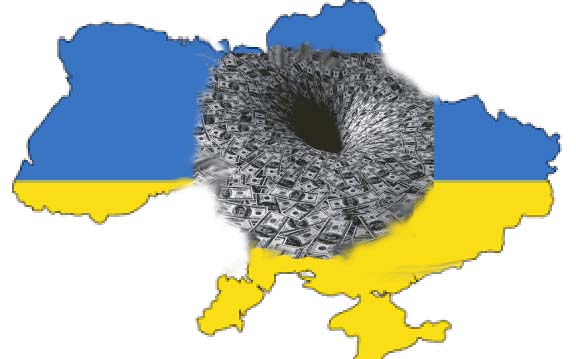
Group of Seven leaders agreed at a summit in Italy on Thursday to give Ukraine $50 billion using frozen Russian Central Bank assets, a step that marks a significant escalation in the economic war against Russia.
The plan is to provide the $50 billion to Ukraine by the end of the year in the form of a loan, which will be paid back using profits from the approximately $280 billion in frozen Russian assets held by the US and its allies.
The idea is seen as a compromise between the US and Europe, as President Biden wanted to steal all of the frozen Russian funds to give to Ukraine. But the vast majority of the money is held in Europe, and EU leaders were hesitant to do that.
Instead, the EU devised a separate plan to provide Ukraine with about $3 billion per year using the interest made by the Russian assets. Ukraine said that amount wasn’t enough, and the US proposed the $50 billion loan.

“This has been something that the United States has put a lot of energy and effort into,” National Security Advisor Jake Sullivan told reporters. “We see proceeds from these assets as a valuable source of resources for Ukraine at a moment when Russia continues to brutalize the country, not just through military action on the front but through the attempted destruction of its energy grid and its economic vitality.”
Russia has made clear it would view either plan as the theft of its sovereign funds and is preparing to retaliate. Stealing the money makes reconciliation between Russia and the West even less likely since lifting sanctions would mean having to give assets back to Moscow that have already been spent. The move will also reduce faith in the Western banking system and speed up global de-dollarization.
Proliferation warnings over enriched nuclear fuel for advanced reactors

BY JULIA ROBINSON, 13 JUNE 2024, https://www.chemistryworld.com/news/proliferation-warnings-over-enriched-nuclear-fuel-for-advanced-reactors/4019621.article—
Governments and others promoting the use of high-assay low-enriched uranium (HALEU) for nuclear power have not considered the potential terrorism risk that widespread adoption of this fuel creates, nuclear scientists have warned.
HALEU is a nuclear reactor fuel enriched with uranium-235 to between 5 and 20%. At 20% uranium-235 and above, the mixture is called highly-enriched uranium (HEU) and it is internationally recognised that it can be employed in nuclear weapons.
Historically, HALEU use has been limited to research reactors, where it is used in small quantities, while commercial reactors typically use fuels with low enrichments, in the range of 3 to 5% uranium-235, which cannot sustain an explosive chain reaction.
However, new advanced reactors are being designed to run on HALEU – most favouring 19.75% uranium-235 HALEU – in the hope that these reactors will be smaller, more flexible and less expensive.
In the US, the Department of Energy (DOE) and US Department of Defense are providing funds for more than 10 reactor concepts, while the UK’s Civil Nuclear Roadmap, announced on 11 January, promised up to £300 million of investment specifically to develop HALEU fuel production.
However, in a policy forum in Science, experts in nuclear science and global security highlight that in many of the designs, the amount of HALEU needed is ‘hundreds to thousands of kilograms’, which may mean that a single reactor contains enough HALEU to make a nuclear weapon.
The authors said that estimates indicate that quantities ranging from several hundred kilograms to about a tonne of 19.75% HALEU could produce explosive yields similar to or greater than that of the Little Boy bomb dropped on Hiroshima.
If this is the case, they said, commercialising HALEU fuels without ensuring that the material is ‘appropriately protected against diversion by national governments or theft by terrorists would pose a serious threat to security’.
‘The time has come to review policies governing the use of this material,’ the authors write. ‘We recommend that the US Congress direct the DOE’s National Nuclear Security Administration to commission a fresh review of HALEU proliferation and security risks by US weapons laboratory experts.’
They also suggested that, according to the information available, a reasonable balance of the risks and benefits could be struck if enrichment of uranium-235 was restricted to 12% or less.
UK Labour and Conservatives commit to nuclear power in manifesto
14th June, By Isaac Cooper @isaaccoopernews, https://www.newsandstar.co.uk/news/24386336.labour-conservatives-commit-nuclear-power-manifesto/
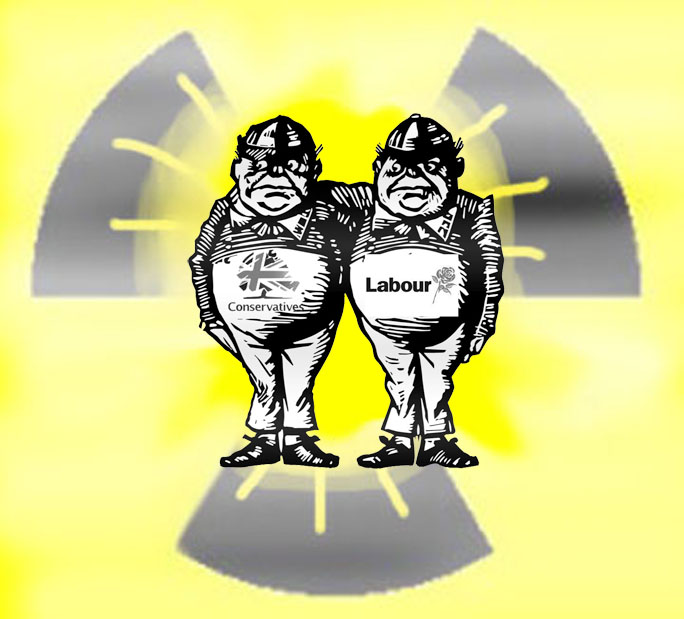
The Labour Party have pledged to ‘ensure the long-term security’ of the nuclear industry as part of their manifesto.
The party set out their plan for government in their manifesto launch on Thursday, June 13 which said that a Labour government would back nuclear power.
The manifesto also said that small modular reactors (SMRs), will play ‘an important role’ in helping the UK achieve ‘energy security’ and ‘clean power’ while securing ‘thousands of good, skilled jobs.’
An SMR in West Cumbria has been mooted for some time and has the support of Cumberland Council leader, Mark Fryer, but the official green light has yet to be light by national government.
The Conservatives have also backed nuclear power and the Tory candidate for Penrith and the Solway, Mark Jenkinson, said he ‘welcomed’ the party’s commitment to nuclear power.
The Green Party have pledged to ‘phase out’ nuclear power which they say is ‘unsafe’ and much more expensive than renewables.
1 This Month

22 June – Virtual Event –Climate Change: New Data, New Debate

Monday, June 22, 2026 2:30 p.m. – 3:15 p.m. CT
YouTube. Register here

Protect Sazan Island from the Trump family! https://secure.avaaz.org/campaign/en/protect_sazan_island_from_the_trump_family_loc/?bqFCVab&v=174511&cl=22707147157&_checksum=5e9dde668860e8231c33699735e16a1fbf22ab2cb01da50c999fe8732b9775ef&utm_source=email&utm_medium=blast_email&utm_campaign=174511

25 June- THE PUKE ON NUKES
Thursday, June 25, 2026
7pm Central Time (8pm ET, 6pm MT, 5pm PT) UTC – 5
From NRC & DOE Deregulation to Techno-Fascist Billionaires Going Nuclear, Plus a Few Songs from Atomic Cabaret REGISTER
26 June – Radiation Trainwreck at the NRC / Join the Protect Better Campaign – https://us02web.zoom.us/meeting/register/4ZlZ5_qLSHGiLSCg8FF6Bg#/registration


Cuba Is Not a Failed State – It Is a Besieged State
PETITION: “Global Appeal to Endorse Palestinian Right of Return of Refugees”
To see nuclear-related stories in greater depth and intensity – go to https://nuclearinformation.wordpress.com
-
Archives
- June 2026 (211)
- May 2026 (306)
- April 2026 (356)
- March 2026 (251)
- February 2026 (268)
- January 2026 (308)
- December 2025 (358)
- November 2025 (359)
- October 2025 (376)
- September 2025 (257)
- August 2025 (319)
- July 2025 (230)
-
Categories
- 1
- 1 NUCLEAR ISSUES
- business and costs
- climate change
- culture and arts
- ENERGY
- environment
- health
- history
- indigenous issues
- Legal
- marketing of nuclear
- media
- opposition to nuclear
- PERSONAL STORIES
- politics
- politics international
- Religion and ethics
- safety
- secrets,lies and civil liberties
- spinbuster
- technology
- Uranium
- wastes
- weapons and war
- Women
- 2 WORLD
- ACTION
- AFRICA
- Atrocities
- AUSTRALIA
- Christina's notes
- Christina's themes
- culture and arts
- Events
- Fuk 2022
- Fuk 2023
- Fukushima 2017
- Fukushima 2018
- fukushima 2019
- Fukushima 2020
- Fukushima 2021
- general
- global warming
- Humour (God we need it)
- Nuclear
- RARE EARTHS
- Reference
- resources – print
- Resources -audiovicual
- Weekly Newsletter
- World
- World Nuclear
- YouTube
-
RSS
Entries RSS
Comments RSS
 nuclear-news