Civil and military nuclear programmes: will they be derailed by skills shortages?

Because of the continuing problems, efforts are increasing to share resources and costs between the civilian and military nuclear programmes [11]. Rolls Royce is promoting ‘modular’ nuclear power stations with reactors similar to those used in submarines. Also the new industry recruitment website ‘DestinationNuclear.com’ abandons the old pretence that civil nuclear power is separate from the production of nuclear weapons:
It is time for a nuclear reality check.
it looks likely that in future the contribution of nuclear power to UK energy supplies will be small.
Scientists for Global Responsibility 27th Nov 2024, https://www.sgr.org.uk/resources/civil-and-military-nuclear-programmes-will-they-be-derailed-skills-shortages
Alasdair Beal takes a look at the UK nuclear industry – and finds that the proposed expansion has a workforce problem.
The incoming Labour government has inherited two major nuclear programmes – new power stations and new Trident missile submarines. Both are behind schedule and over-budget but the government says it wants them to continue. This article looks at the difficulties mobilising the skilled workforces required.
Nuclear programmes off-track
In 2010, the Conservative-led government announced its aim for work to be started on eight new nuclear power stations by 2025 [1]. Plans and timetables have been repeatedly revised since then but, currently, only one is actually under construction – Hinkley Point C (HPC) in Somerset. The 2024 ‘Civil Nuclear: Roadmap to 2050’ [2] stated that the aim is now to “secure investment decisions to deliver 3-7GW [gigawatts] every five years from 2030 to 2044, to meet our ambition to deploy up to 24GW of nuclear power by 2050.” This would amount to up to eight more plants the size of HPC. Even this appears unrealistic, given the serious problems building current reactor designs [3].
The military nuclear programme is also in trouble. Recently, Vanguard class submarines – armed with Trident nuclear missiles – have three times operated sea patrols lasting over 6 months, setting new Royal Navy records [4]. These occurred because two submarines were out of service for repairs, leaving only two in seaworthy condition. Numerous other problems have also been reported, including a faulty depth gauge leading to a nuclear-armed submarine taking a potentially catastrophic “unplanned dive” [5], and a major fire in the building used to assemble new submarines [6].
Construction of the Vanguard class submarines started in 1986 and they entered service between 1993 and 1999 with a design life of 25 years, later extended by 5 years. Construction of the replacement Dreadnought class began in 2016, with the first planned to enter service in 2028. However, this has now been delayed to “the early 2030s”, [7] which will require the existing submarines to operate until they are 40 years old, i.e. 15 years longer than their original design life and 10 years beyond their extended design life.
Major skills shortages
Skills shortages could also be a problem for both projects. In 2015, a government document [8] stated that to construct five or more new power stations by 2030, decommission existing power stations, and develop new nuclear missile submarines, “the workforce must grow by 4,700 people a year over the next 6 years. Over the same period 3,900 people are expected to leave the sector, mostly due to retirement. This means that the sector must recruit 8,600 people every year.”
Since then the schedule for new power stations has been delayed but there is now also a contract to construct new SSN-AUKUS nuclear-propelled ‘attack’ submarines. According to a House of Commons Science, Innovation and Technology Committee 2023 report [9]:
“If the UK is to achieve a contribution of 24GW of nuclear power by 2050 it will need to plan for, and achieve, a massive increase in the nuclear workforce … 50,000 full time equivalent employees would need to be recruited by 2040, even without an expansion of nuclear power … Under a scenario which envisages 19GW of nuclear capacity by 2050 … 180,000 workers will need to be recruited by 2050 – including an average of 7,234 recruits each year until 2028, compared to the current inflow of around 3,000 a year. Recently, vacancies in the nuclear sector are running at twice the rate of the general engineering and construction sector.”
With existing vacancies unfilled and recruitment insufficient to maintain present staff numbers, let alone those required for government expansion plans, the potential shortage of skilled staff is serious.
However, the situation is actually worse than the bare numbers suggest: those retiring will include many knowledgeable people with experience of designing and constructing previous nuclear submarines or power stations, or else of working with those who did. New recruits can fill the vacant seats but they cannot replace the loss of knowledge. Books, training courses and videos can help but in advanced engineering work nothing beats the passing on of accumulated knowledge and experience directly between generations of engineers.
Experience counts
I am a professional civil and structural engineer and after graduation I worked on long-span bridge design with the engineers who had designed and supervised construction of some of the biggest bridges in the world. I learned a lot from them – not only about stress calculations but also about the thinking required to produce a successful design. Much of this could not have been learned from courses or books.
The case of Rolls Royce in 1971 illustrates why this is important. Problems with their new RB211 jet engine had forced the company into liquidation and it had to be nationalised. To rescue the situation , the new directors had to persuade retired former senior engineers to return to work to lead the process of redesigning the engine to overcome the problems.
This issue may also be contributing to current problems at HPC. Existing UK nuclear engineers have only limited experience of Pressurised Water Reactor (PWR) construction and in any case they are likely to be fully occupied decommissioning the UK’s old AGR reactors and dealing with historic nuclear waste. Therefore construction of HPC depends heavily on French expertise.
French companies have constructed 58 nuclear power stations based on the Westinghouse PWR design, the last of these being ordered in 1990. No more were ordered for 15 years until Finland ordered a power station based on the new European Pressurised Water Reactor (EPR) design in 2005. By then many of the engineers and other workers who constructed France’s PWRs are likely to have retired or changed occupations, making it difficult to assemble teams with the necessary knowledge and experience to build a new power station to a new design. Maybe we should not be surprised that major problems have been encountered constructing the EPRs at Olkiluoto in Finland, at Flamanville in France – each of which has taken 17 years to build [10] – and at HPC.
Similar problems may also be affecting construction of the new Dreadnought submarines. By the time these were ordered in 2016, many of the engineers with experience of designing and constructing their predecessors would have retired or be close to retirement, taking their knowledge and experience with them.
Because of the continuing problems, efforts are increasing to share resources and costs between the civilian and military nuclear programmes [11]. Rolls Royce is promoting ‘modular’ nuclear power stations with reactors similar to those used in submarines. Also the new industry recruitment website ‘DestinationNuclear.com’ abandons the old pretence that civil nuclear power is separate from the production of nuclear weapons:
“Nuclear plays a vital role in shaping the UK’s future in broader ways. Nuclear power produces carbon-free electricity that lights homes, fuels businesses, and keeps the economy moving.
The impact of nuclear goes beyond power grids. The expertise within the sector plays a crucial role in ensuring the strength and effectiveness of the UK’s nuclear deterrent, contributing to global peace and security. Nuclear is not just an energy source; it’s a critical part in building a secure future for the UK.”
While the claims made in this statement can be criticised on many grounds, most relevant for this article is the apparent assumption that people who are concerned about climate change are also likely to be enthusiastic about nuclear weapons – which could trigger a catastrophic ‘nuclear winter’ if used [12]. If they are, then public acknowledgement of the link between the civil and military nuclear programmes is a clever move and will boost recruitment. However, if they are not, this strategy could backfire badly.
Time for a rethink
It is time for a nuclear reality check.
In 1994, the UK had 16 functioning nuclear power stations (total capacity 12.7GW) but in 2024 there were only 5 (total capacity 5.9GW) and by the end of 2028 there will be just one: Sizewell B (1.2GW) [13]. Completion of the HPC first unit (1.6GW) is now expected between 2029 and 2031, with its second unit following some years later [14]. When the effects of potential skills shortages are considered alongside the problems of current nuclear reactor designs, the idea of achieving anything like 24GW capacity by 2050 seems like a fantasy. Given the rapid growth of renewable energy and related technologies – which is set to continue – it looks likely that in future the contribution of nuclear power to UK energy supplies will be small.
Meanwhile, the programme for new Trident nuclear missile-armed submarines is a gamble based on two risky assumptions: (i) despite industry skills shortages, there will be no further delays in completing the new submarines; and (ii) the existing submarines will be able to continue operating for at least 10 years after the end of their design life. If either assumption proves incorrect then, after all the arguments over ‘unilateral’ or ‘multilateral’ nuclear disarmament, we could end up instead with a rather British outcome: ‘Unintentional Nuclear Disarmament’. At that point, the government would finally have to face up to the dangerous flaws in the idea of ‘nuclear deterrence’ and plan instead for a nuclear-free future.
The conclusion is clear: current plans for new nuclear power stations and new nuclear missile-carrying submarines should both be cancelled and the resources diverted to:
(a) reducing energy consumption and accelerating the development and deployment of alternative renewable energy supplies; and
(b) supporting international arms control and disarmament initiatives, such as the United Nations Treaty on the Prohibition of Nuclear Weapons.
Alasdair Beal BSc CEng FICE FIStructE is a chartered civil engineer, based in Leeds, and a former member of SGR’s National Co-ordinating Committee.
References : …………………………………………………………………………………………..
The Nuclear Waste Management Organization (NWMO) Siting Process Fails to Achieve its Goal.

Nuclear Company Announces Site Selection Despite Major Missing Piece: a Willing Host
WE THE NUCLEAR FREE NORTH. November 29, 2024
| Wabigoon, Ontario – First Nations and opposition groups are denouncing the Nuclear Waste Management Organization’s announcement that they have selected the Revell site in northwestern Ontario as their preferred location for a deep geological repository for all of Canada’s high-level nuclear fuel waste. “The NWMO announcement demonstrates the fickleness of the NWMO’s site selection process. It has allowed the NWMO to manufacture something they are calling consent, without actually gaining consent”, commented Charles Faust, a volunteer with We the Nuclear Free North and spokesperson for Nuclear Free Thunder Bay. “They were looking for consent for their project – the transportation, processing and burial of all of Canada’s high-level waste in the heart of Treaty 3 Territory. The closest they could get from Wabigoon Lake Ojibway Nation was consent to continue in the site characterization process. It’s a small victory which they are going to play big.” |
NWMO announced Thursday that they had selected Wabigoon Lake Ojibway Nation (WLON) and the Township of Ignace as the host communities for the future site for Canada’s deep geological repository for used nuclear fuel.
The two communities had been courted by the NWMO for over a decade as the nuclear waste company sought a declaration of “willingness” to have the Revell site used as a processing and burial site for the highly radioactive waste generated by nuclear power reactors. The Revell site is approximately equidistant between Ignace and Dryden and 20 km upstream from Wabigoon Lake Ojibway Nation, in the headwaters of both the Wabigoon and the Turtle-Rainy River watersheds.
NWMO has repeatedly said they would only proceed with an “informed and willing host”, which would have to make a “compelling demonstration of willingness”. In a statement released by Wabigoon Lake Ojibway Nation on November 18th following a community vote, WLON stated clearly that the referendum was to determine if WLON would progress into a site characterization process for NWMO’s project, and that “the yes vote does not signify approval of the project”.
Broad opposition to the project has been expressed by First Nations, municipalities and community organizations, including in a resolution passed by Grand Council Treaty #3 in October which affirmed an earlier declaration that made clear that a deep geological repository for nuclear waste would not be developed at any point in Treaty #3 Territory.
Opposition is expected to continue to grow following yesterday’s announcement, leading up to the start of a federal impact assessment process, which the NWMO says will get underway in 2028.
White House Pressing Ukraine To Draft 18-Year-Olds for War

National Security Advisor Jake Sullivan recently hinted that the US was pressuring Ukraine to expand conscription, saying Ukraine’s biggest problem in the war was the lack of manpower.
The pressure from the US comes as polling shows the majority of Ukrainians want peace talks to end the war,
by Dave DeCamp November 27, 2024 , https://news.antiwar.com/2024/11/27/white-house-pressing-ukraine-to-draft-18-year-olds-for-war/
The White House is pressuring Ukraine to increase the size of its military by lowering the minimum age of conscription from 25 to 18, The Associated Press reported on Wednesday.
A senior Biden administration official said the outgoing administration wants Ukraine to start drafting 18-year-olds to expand the current pool of fighting-age males. The pressure from the US comes as polling shows the majority of Ukrainians want peace talks with Russia to end the war.
National Security Advisor Jake Sullivan recently hinted that the US was pressuring Ukraine to expand conscription, saying Ukraine’s biggest problem in the war was the lack of manpower.
“Our view has been that there’s not one weapon system that makes a difference in this battle. It’s about manpower, and Ukraine needs to do more, in our view, to firm up its lines in terms of the number of forces it has on the front lines,” Sullivan said on PBS News Hour last week.
Last month, Serhiy Leshchenko, an aide to Ukrainian President Volodymyr Zelensky, said Ukraine was under pressure from US politicians to lower the conscription age. “American politicians from both parties are putting pressure on President Zelensky to explain why there is no mobilization of those aged 18 to 25 in Ukraine,” he said.
Zelensky signed a mobilization bill into law back in April that lowered the conscription age from 27 to 25. A few weeks before the mobilization bill became law, Zelensky received a visit from US Sen. Lindsey Graham (R-SC), who complained that not enough young Ukrainian med were being sent to the frontline.
“I would hope that those eligible to serve in the Ukrainian military would join. I can’t believe it’s at 27,” Graham said. “You’re in a fight for your life, so you should be serving — not at 25 or 27. We need more people in the line.”
The Biden administration’s push for Ukraine to draft younger men comes as it is doing everything it can to escalate the proxy war before President-elect Donald Trump is inaugurated on January 20. President Biden is seeking another $24 billion to spend on the conflict even though it’s clear there’s no path to a Ukrainian military victory.
Tepco eyes second test removal of Fukushima nuclear fuel debris
Japan Times 29th Nov 2024, https://www.japantimes.co.jp/news/2024/11/29/japan/tepco-debris-removal-plan/
Tokyo Electric Power Company Holdings is considering conducting a second test to remove nuclear fuel debris from one of the three meltdown-hit reactors at its Fukushima No. 1 nuclear power plant, company officials said Thursday.
As in the previous test, Tepco plans to use a fishing rod-shaped device to remove the debris from the plant’s No. 2 reactor.
Tepco collected 0.7 gram of debris in the first test, which started in September and ended on Nov. 7. The debris is currently under analysis at the Japan Atomic Energy Agency.
Nuclear Regulation Authority Chairperson Shinsuke Yamanaka has asked the company to collect more debris to gather more data.
Some 880 tons of nuclear debris, a mixture of melted fuel and reactor parts, is estimated to remain in the No. 1, No. 2 and No. 3 reactors at the plant, which was crippled by the March 2011 Great East Japan Earthquake and tsunami.
Biden administration advancing $680m arms sale to Israel, source says

November 27, 2024, https://www.middleeastmonitor.com/20241127-biden-administration-advancing-680m-arms-sale-to-israel-source-says/
The Biden administration is pushing ahead with a $680 million arms sales package to Israel, a US official familiar with the plan said on Wednesday, even as a US-brokered ceasefire in Lebanon between Israel and Hezbollah has come into effect, Reuters reports.
The package, which was first reported by the Financial Times, includes thousands of joint direct attack munition kits (JDAM) and hundreds of small-diameter bombs, according to the official, speaking on condition of anonymity.
The news comes less than a day after the ceasefire agreement ended the deadliest confrontation in years between Israel and the Hezbollah group, but Israel is still fighting its other arch foe, the Palestinian group, Hamas, in the Gaza Strip.
However, the package has been in the works for several months. It was first previewed to the congressional committees in September then submitted for review in October, the official said.
The package follows a $20 billion sale in August of fighter jets and other military equipment to Israel.
Reuters reported in June that Washington, Israel’s biggest ally and weapons supplier, has sent Israel more than 10,000 highly destructive 2,000-pound bombs and thousands of Hellfire missiles since the start of the Gaza war in October 2023.
The conversations about the latest arms package had been going on even as a group of progressive US senators, including Bernie Sanders introduced resolutions to block the sale of some US weapons to Israel over concerns about the human rights catastrophe faced by Palestinians in Gaza.
The legislation was shot down in the Senate.
Biden, whose term ends in January, has strongly backed Israel since Hamas-led gunmen attacked in October 2023, killing 1,200 people and taking more than 250 hostages, according to Israeli tallies.
However, since then, it has been revealed by Haaretz that helicopters and tanks of the Israeli army had, in fact, killed many of the 1,139 soldiers and civilians claimed by Israel to have been killed by the Palestinian Resistance.
Most of Gaza’s population of 2.3 million people has been displaced and the enclave is at risk of famine, more than a year into Israel’s war against Hamas in the Palestinian enclave. Gaza health officials say more than 43,922 Palestinians have been killed in Israel’s offensive.
Plans to turn land in Somerset into a saltmarsh should be scrapped.
Plans to flood 1500 acres of farmland along the Severn Estuary to create
saltmarsh won’t be effective in saving fish affected by a nuclear power
station – that’s according to ecosystems expert Dr Mark Everard of the
University of the West of England. EDF is building the station at Hinkley
Point in Somerset and had agreed to install and maintain an acoustic fish
deterrent to prevent fish being sucked into the site’s cooling systems. But
they now say it’s dangerous to build and the technology is untested, and
want to flood farmland instead to create saltmarsh habitats. Dr Everard
says most fish – including migrating salmon – won’t benefit from this, and
the deterrent system is already used effectively worldwide.
BBC Farming Today 25th Nov 2024, https://www.bbc.co.uk/sounds/play/m0025cyx
France is weighing zero-interest loan for 6 nuclear reactors, sources say

- Summary
- EDF faces financing challenges due to high debt and project delays
- French government faces no-confidence vote over budget with spending cuts
- EU approval needed for state aid in nuclear projects
PARIS, Nov 27(Reuters) Reporting by Benjamin Mallet; additional reporting by Leigh Thomas; writing by Dominique Patton; editing by Nina Chestney and Tomasz Janowski- https://www.reuters.com/business/energy/france-is-weighing-zero-interest-loan-6-nuclear-reactors-sources-say-2024-11-27/
French officials are drawing up plans to provide an interest-free loan to state-owned power utility EDF to finance a significant portion of the construction of six new nuclear reactors, two people familiar with the matter said.
The financing would clear a major hurdle for one of the country’s biggest public projects in years.
The plans are similar to financing agreed recently for a single reactor in the Czech Republic, and although the size of the loan is not yet known, it shows the growing need for state support in financing new nuclear projects in Europe.
The plans also include a long-term guaranteed price for the power generated, known as a contract for difference (CfD), said the people, who declined to be identified because they are not authorised to speak with media.
The Ministry of Finance and EDF declined to comment.
The discussions on financing the projects that could cost well over 50 billion euros ($52.60 billion) come as the French government faces a potential no-confidence vote over a proposed budget that contains measures to cut spending and raise taxes to contain the country’s soaring debt.
President Emmanuel Macron announced plans in early 2022 for six new reactors with a total production capacity of about 10 gigawatts to partly replace an ageing nuclear fleet and secure future energy supplies.
Construction of the first reactor is due to start in 2027 but Macron has never said who would pay for the project, which at the time was estimated to cost around 52 billion euros. Recent media reports suggest costs may be higher, reaching as much as 67 billion euros.
France’s current 57 nuclear reactors in operation were largely financed by EDF, which was a publicly-listed company until it was fully nationalised last year.
But the company is unlikely to be able to secure private financing for new projects, given its already high debt, and there have been multiple delays and cost overruns at recent projects like Flamanville in France and Hinkley Point in England.
CZECH MODEL
While there is general agreement to provide a zero-interest loan to EDF during the construction phase, the amount is not yet decided and there are still “intense discussions” on matters such as the sharing of risk between the utility and the state from any additional costs and delays, one of the sources said.
The plan also needs approval from the finance minister once EDF submits a final costing for the projects, expected early next year.
As a form of state aid, it also needs to be cleared by the European Commission.
French officials have been encouraged, however, by Brussels’ approval for a similar financing structure for one 1 gigawatt Czech unit at Dukovany, the sources said.
Under the Czech arrangement, interest on a state loan increases to at least 2% after the plant begins operating.
Europe is seeing a resurgence of interest in nuclear power projects, with nations including Poland and the UK planning new plants to shore up their energy self-sufficiency after a major energy crisis in the region.
Financing remains a huge challenge, with construction risks weighing on utilities’ balance sheets and credit ratings.
The British government recently pledged more than 5.5 billion pounds ($6.93 billion) to help fund early development of the 3.2 GW Sizewell C project.
Another project in Britain, EDF’s 3.2 GW Hinkley Point C plant, which is expected to cost between 31 billion pounds and 34 billion pounds based on 2015 values, is also backed by a contract for difference scheme.
($1 = 0.9506 euros)
($1 = 0.7931 pounds)
“Israel Wants Wars”: Gideon Levy on Lebanon Ceasefire, Gaza & Gov’t Sanctions Against Haaretz
Democracy Now, 27 Nov 24
Gideon LevyIsraeli journalist and author. Lina MounzerLebanese writer and editor.
We’re joined by Israeli journalist Gideon Levy as we continue our conversation on the Israeli-Lebanon ceasefire. We take a look at the mood within Israel, where Levy characterizes the Israeli public as “sour” about what is seen as a premature deal. “They would like to see more blood, more destruction in Lebanon,” says Levy. “Israel wants wars.” This retributive stance is still being felt in Lebanon, adds writer Lina Mounzer, who says Lebanese people are “very terrified of the day after” and do not feel that they have been awarded peace, despite the terms of the ceasefire.
Meanwhile, the Israeli government has unanimously voted to sanction the Israeli newspaper Haaretz, claiming that its editorials “have hurt the legitimacy of the state of Israel and its right to self defense.” Haaretz has criticized the move, which comes just months after Israel banned the international media outlet Al Jazeera, as anti-democratic. Levy, a columnist for Haaretz, says the sanction makes it clear that Israelis cannot take the freedom of speech “for granted anymore.”
Media Options
Transcript……………………………………………………………………………………….. more https://www.democracynow.org/2024/11/27/israel_lebanon_ceasefire_haaretz
Ceasefire Falters as Israel Launches Airstrikes, Artillery Shelling on Southern Lebanon
Israel says ‘suspects’ in vehicles violate ceasefire by trying to return home
by Jason Ditz November 28, 2024, https://news.antiwar.com/2024/11/28/ceasefire-falters-as-israel-launches-airstrikes-artillery-shelling-on-southern-lebanon/
The Israel-Lebanon ceasefire began Wednesday morning. Less than two days later, it seems to be faltering, with multiple reports of Israeli attacks across southern Lebanon, and claims of violations by both sides.
Israel carried out an airstrike against the outskirts of Baysariyeh, which is near Tyre. They confirmed the attack, saying they were targeting a Hezbollah storage facility after seeing “terrorist activity.” They added in their statement that they were “acting to enforce violations of the ceasefire.”
Though the claims of violations are coming from both sides, so far it is only Israeli forces whose violations actually involve firing. Lebanese people continue to try to return to their homes in the south, despite Israel’s military forbidding them to do so.
There are multiple reports of Israel carrying out artillery shelling against towns and villages across southern Lebanon this afternoon. Strikes were reported against the towns of Halta, Taybeh, Khiam, and Rmeish. In Rmeish the attack damaged a supermarket and a home. Three were injured in Taybeh.
There were also reported Israeli tank shellings in several places, including the village of Markaba. In that incident, a car was attacked and multiple civilians were wounded. Israeli ground troops also opened fire on vehicles multiple times across southern Lebanon, incidents which happened both on Wednesday and Thursday.
Israel presented the people they were shooting at as a “number of suspects,” and said that any vehicles in southern Lebanon amount to a ceasefire violation. There is no indication vehicles are actually forbidden by the terms of the ceasefire. Shooting at people, as Israel has been throughout the day, is plainly a violation, however.
Transfer of nukes to Kiev would be viewed as attack on Russia – Medvedev
Rt.com 26 Nov 24
The former president’s warning follows reports that discussions have been held in the US about Ukraine obtaining a nuclear arsenal .
Moscow will consider any threat of nuclear arms being supplied to Ukraine by the US as preparation for a direct war with Russia, former president Dmitry Medvedev has warned. The actual transfer of nuclear weapons would be tantamount to an attack on the country under Russia’s new nuclear doctrine, he added.
In a Telegram post on Tuesday, Medvedev referenced a recent report in the New York Times. In a piece bylined by four of its journalists, the NYT claimed that US and EU officials are “discussing deterrence as a security guarantee” for Ukraine, claiming a conversation is underway to consider giving Ukraine nuclear weapons.
US politicians and journalists are seriously discussing the consequences of providing Kiev with nuclear weapons, said Medvedev, who serves as the deputy chair of the Russian Security Council…………………………………………………………………………………………………… more https://www.rt.com/russia/608212-medvedev-nukes-transfer-ukraine/
The Antisemitism Awareness Act Is the Death Knell for Free Speech
Mike Whitney • November 21, 2024, The Unz Review
Freedom of speech is the principal pillar of a free government; when this support is taken away, the constitution of a free society is dissolved, and tyranny is erected on its ruins….Ben Franklin.
The Antisemitism Awareness Act is a wrecking ball designed to pulverize the First Amendment. While the alleged intention of the bill is to make Jewish students feel safer on campus, the real purpose is to put an end to the anti-genocide demonstrations that have broken out across the country and to prevent the criticism of Israel. The proposed bill invokes a dodgy legal mechanism to derail the protests and to silence Israel’s critics. By using a broad and ambiguous definition of antisemitism, the bill compels university administrators to crackdown on free speech invoking sketchy claims of discrimination. Political analyst Paul Craig Roberts summed it up like this: “if universities …don’t suppress student protests against Israel’s massacre of civilians in Gaza and Lebanon they will lose their accreditation and federal financial support.” In short, universities are being encouraged to quash the free expression of political ideas to preserve their federal funding. This helps to illustrate how Zionist lobbyists are now engaged in a full-throated assault on constitutionally protected civil liberties, namely free speech.
The bill—which already passed the House with a sizable majority—shows how the charge of antisemitism can be used as a coercive political tool to silence Israel’s critics. That is why civil liberties organizations—like the ACLU, PEN America, the Alliance Defending Freedom and even Jewish groups like Bend the Arc and T’ruah—strongly oppose the bill based on free speech grounds. Even so, this attack on constitutionally protected rights has a good chance of passing the senate due to the arm twisting of powerful interest groups that have their tentacles wrapped tightly around both houses of congress. Here’s a brief summary from political analyst Guy Christensen:
The House just passed the Antisemitism Awareness Act which will shut down college protests against Israel and silence all future criticism of the state of Israel. The law literally redefines antisemitism as criticizing the state of Israel and makes it a violation of Title 6 to do so. The purpose of this is to allow politicians to pull federal funding from colleges who don’t stop these college protests and let their students continue to criticize Israel.
We must speak out against the Antisemitism Awareness Act. This is insanity. These people are full-on Zionists trying to silence free speech here in America, trying to silence criticism of the oppression of the Palestinians, criticism of the state of Israel that murdered 14,000 children.
Like I said, the guy who wrote the bill, Mike Lawler, is funded by AIPAC $180,000 (he said to NBC News when talking about this bill.) When you hear “River to the sea, Palestine will be free” that is calling for the eradication of the Jews in the state of Israel. (They are) Literally trying to make it illegal to criticize Israel.
If you don’t know how Title 6 works, all federally funded programs and institutions must follow it or they won’t receive any more federal funding. This includes US colleges and K through 12 schools who are very strict about following Title 6 because they need that funding. They can’t go without it. So, if we let this become law, it would force US colleges to shut down all these protests immediately.
This contends for the most outrageous bill for Israel the government has ever tried to pass. I will not vote or say a kind word about any politician who voted in favor of this bill…. (your representative ) care more about Israel than they care about your free speech. What they are doing is incredibly dangerous. Zionists are scared because American public opinion is changing. Students across the country are protesting against Israel. You know they’re scared because this is one of the boldest things they’ve ever tried to do…..AIPAC and the pro-Israel lobby is behind all of this. Ban AIPAC Stop the Antisemitism Awareness Act. We have to protect our free speech and our right to protest against evil. YourFavoriteGuy@guychristensen_
Not surprisingly, President Donald Trump—whose campaign was given $100 million by a strident Zionist donor—confirmed that he will aggressively implement the blatantly unconstitutional law by cancelling the funding of any college that tolerates the anti-genocide protests. He further stated that he will prosecute the universities for, what he calls, “violations of the civil rights law.” In other words, it is not the tens of thousands of Palestinian civilians that have been killed by Israel who are the victims, but the Jewish university students who feel “unsafe.” (Note—Trump refers to the protestors views as “antisemitic propaganda”)…………………………………………………………………………………………………………………………………………………more https://www.unz.com/mwhitney/the-antisemitism-awareness-act-is-the-death-knell-for-free-speech/
Hinkley Point C: Hundreds down tools over concerns
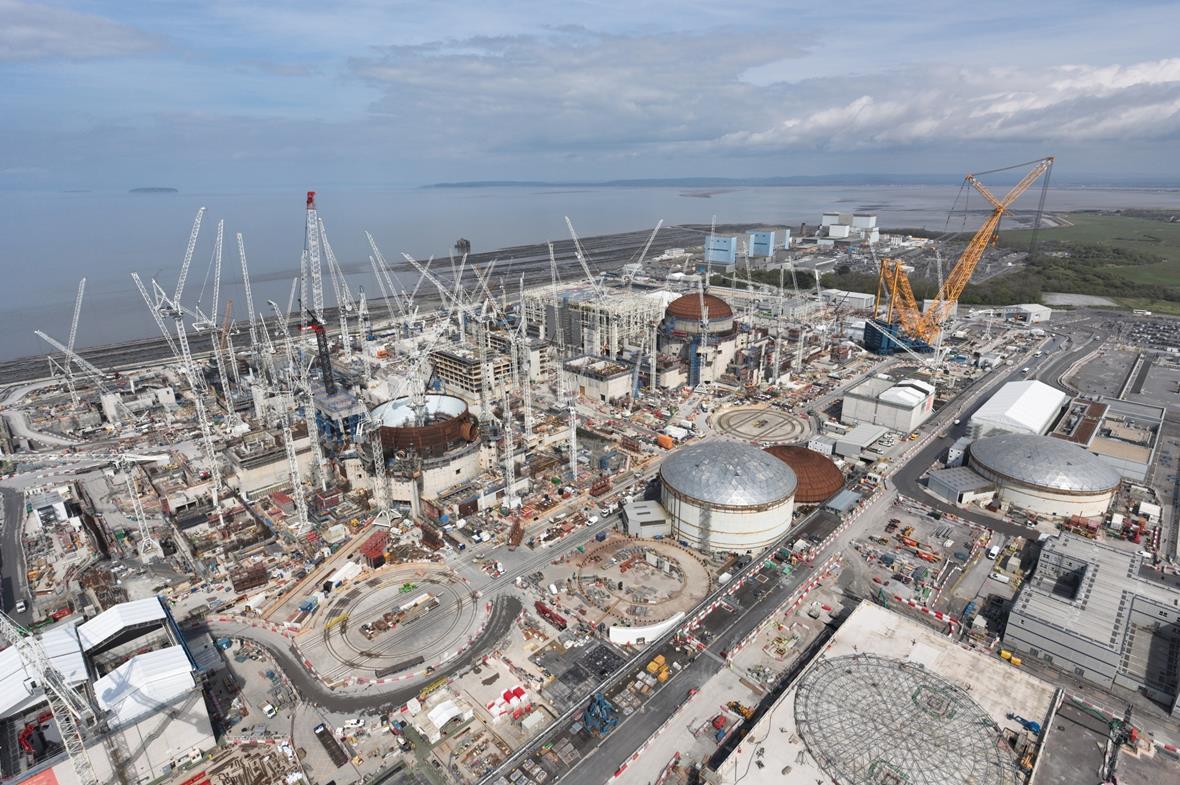
By Seth Dellow, Bridgwater Mercury 28th Nov 2024
HUNDREDS of workers at Hinkley Point C have stood down today over unresolved concerns.
The action short of strike began at 9am this morning with workers claiming it concerns fingerprint scanners in a small area on site. They have claimed there are only five scanners serving 13,000 workers on site but this is strongly denied by EDF which runs the Hinkley Point site. Electricians, pipe fitters and welders are all said to have walked out.
The number of affected workers could be up to 1,600 as the action only involves some of the MEH workers on site. MEH has contracted staff doing work on the Hinkley Point site.
Earlier, workers claimed between 2,000 and 6,000 workers had walked out.
One electrician, who spoke anonymously to the Bridgwater Mercury, said that workers were “being taken advantage of.”
The nuclear power station is already behind schedule and is expected to be operational between 2029 to 2031.
Workers are planning on taking full strike action on Monday, December 2, 2024, as they say they will be blocked from entering the site because of their actions today.
It follows recent strike action which saw EDF workers walk out over pay concerns. ………………
https://www.bridgwatermercury.co.uk/news/24757425.hinkley-point-c-6-000-workers-walk-concerns/
Donald Trump’s quick trip to absolute dictatorship

November 27, 2024: The AIM Network. Noel Wauchope, https://theaimn.com/donald-trumps-quick-trip-to-absolute-dictatorship/
Comparisons are odious, particularly between Donald Trump and Adolf Hitler. I must be plain from the start, that these individuals have had completely different aims and ideology.
The comparisons I’m making here are just about methods of gaining absolute power. And here, I think, there are parallels. And we can learn, from Hitler, how Trump could well go about attaining dictatorship status – way faster than people realise.
Trump and Hitler do have this in common – a reckless ruthlessness about destroying institutions and crossing boundaries. And both had earlier associations with street violence – Hitler with his Brown Shirts, and the Beer Hall Putsch, and Trump, less obviously, with the Proud Boys and the Capitol attack on January 6th 2021.
Hitler became dictator by very quickly using legitimate political mechanisms, and Trump will be able to do the same.
Hitler, moving towards purging his movement of the Brown Shirts, gained much public support, and business interests saw him as a force to stop street violence, and a protector and support of property and business. Meanwhile, largely thanks to the genius of Joseph Goebbels, Hitler’s propaganda machine flourished, exploiting the latest technology, – radio, and aircraft – “Hitler over Germany”. By 1933 the German economy was recovering, and Hitler’s success in elections did in fact drop, but his National Socialist Party still held a third of the seats in the Reichstag.
Here’s where it got interesting, and it all took just 7 and a half weeks.
30 January 1933 – Hitler was appointed Chancellor. The role of the Chancellor, while being symbolically like the role of the British Prime Minister, was in fact, quite limited. The real power was in the President. President von Hindenburg, bowing to pressure, was persuaded that Hitler could indeed be controlled, by giving him the status of Chancellor.
-Advertisement-
27 February 1933 – the German parliament (Reichstag) building burned down. Without going into the discussion on who caused the fire – it was the trigger for Hitler to persuade von Hindenburg to issue the Reichstag Fire Decree – Emergency Decree for the Protection of the German People, on 28 February, declaring a state of emergency, and abolishing most civil liberties, including the rights to speak, assemble, protest, and due process.
23 March 1933, Hitler proposed the Enabling Law to the Reichstag. This new law, passed on 24 March, gave Chancellor Hitler the power to rule by decree rather than passing laws through the Reichstag and the President. He was now effectively the dictator.
We could go on from there – listing Hitler’s dictatorial actions – National Socialists the only party permitted, trade unions disbanded. Any autonomous states lost those powers – officials appointed as state governors – and much, much more.
July 1934 – Hitler becomes “Fuehrer” – the finishing touch. With the death of President von Hindenburg, Hitler abolishes the now powerless position of “President”.
What has all this got to do with Trump?
Admittedly, the burning down of the Reichstag was a key factor, and we’re not expecting Capitol Hill to burn down. But the thing is that Hitler was at least a super-opportunist, even if the Nazis did not purposely cause this event. If it hadn’t been this event, probably something else could be triggered for a “state of emergency”. So, it would also be very beneficial to Trump- and save a lot of time, if some suitable “event” were to justify Trump, (also a super-opportunist) to declare emergency powers.
In the meantime, Trump is already working on removing the powers of the Department of Justice, and has various avenues open for him to take quick executive action. The President can issue executive orders. There are checks and balances, but these rely on the Supreme Court, and the Congress. So, Trump, with a majority in Congress has freedom – ‘I have an Article 2 where I have the right to do whatever I want as president’.
Trump’s plan for a radical reorganization of the executive branch starts with ending “the post-Watergate norm of Justice Department independence from White House political control.”
Trump will be very careful about which officials he appoints – due to constitutional “checks and balances”. He’d need to pick a compliant Acting Attorney General. The obstacles to be eliminated include an independent Justice Department, independent leadership in administrative agencies and an independent civil service. Trump’s plan would substitute loyalty to him for loyalty to the Constitution.” In 2020 Trump called for the “termination of … the Constitution.”
In the USA, theoretically, there are constraints on the President’s power. But, as in Germany in the 1930s, the leader has already arranged for the administration and every government department to be run by his sycophants.
Also, as in Hitler’s Germany, Trump has extraordinary influence over media, especially social media. Hitler had the brilliance of Goebbels to swamp the public with his lies and spin. Trump is almost one better – he does it all himself.
So – there are similarities between Hitler and Trump in the way to gain absolute power. There’s the opportunism, the clique of dedicated sycophants, the inspired exploitation of new technology, of new media, the reckless crossing of normal boundaries, and the background of violence, (with the potential for violence again).
The differences between them are striking. Hitler had a coherent almost mystical theory – involving war – to gain world domination for the master “Aryan” race, and to eliminate the Jews and other “Untermenschen”. To a large extent, Hitler’s close associates shared that dream, even if jostling for power between each other– Goebbels, Hess, Himmler, Goering, Speer, von Ribbentrop, Heydrich, Bormann. They more or less held to Hitler’s philosophy, and feared Hitler if they stepped out of line. Quite a few, though not all, stayed with Hitler until the very bitter end.
I can’t see Trump’s associates having that kind of dedication. From his previous presidency, there is a long list of former allies who turned against him.
Donald Trump seems to have no coherent theory or aim – other than to be super-powerful and rich, and take revenge on his opponents. He admires dictators, hates China, doesn’t like war, and fears nuclear bombs. If Trump has any philosophy at all, apart from him being at the top, it would be for a world economy dominated by American business. War is not Trump’s chosen method to win, but building up weaponry, and the threat of war – a sort of global bullying is his favoured method.
Trump’s top associates are currently dedicated to him – but are closely connected to billionaires, and not necessarily sharing philosophies. There’s Elon Musk, obsessed with the control of space, and the colonisation of Mars, John Bauer who devised the case for presidential absolute immunity from prosecution, Stephen Miller determinedly anti-immigrant, Fox News employee Pete Hegseth, Robert F. Kennedy Jr. sceptic of public health, Dave Weldon, anti-abortion doctor. What they do seem to have in common is big egos, and rather questionable qualifications for the jobs that they’ll be getting.
So, unlike Hitler, Trump doesn’t seem to have a team dedicated to a single-minded cause. In the short run, things might look good for the new Republican administration, and even for the American public. Dictatorships can do that, for a bit – as the workers found, in the early years of the Hitler administration, and of the Mussolini one in Italy. But it’s anybody’s guess how the new Trump dictatorship will finally work out.
What Project 2025 Would Do to the Environment – and How We Will Respond

The policy playbook from the Heritage Foundation would strip away our rights to clean air, clean water, and a healthy planet.
By Earthjustice November 12, 2024, https://earthjustice.org/article/what-project-2025-would-do-to-the-environment-and-how-we-will-respond
When Donald Trump takes office for the second time in January, we expect his administration to dramatically dismantle environmental protections. We see the shape of what’s coming not just from battling his first administration, but because of the blueprint laid out in Project 2025.
Project 2025 is 900 pages, and 150 of them are about how to destroy the environment. This deregulatory agenda, written by former Trump government officials and Heritage Foundation staff, would strip away our rights to clean air, clean water, and a healthy planet.
Earthjustice is built for moments like this. We’re the legal arm of the environmental movement, with more than 200 attorneys wielding the power of the law to defend the planet and its people. We filed more lawsuits on behalf of clients against the last Trump administration to protect the environment than any other organization – and we won 85% of our cases.
We’ve shown that we can take on the Trump administration’s worst ideas and win.
We’ve studied the proposed tactics in Project 2025, including undermining government staff who are charged with safeguarding health and environmental protections. We are prepared to defend the environment and communities from what comes next, no matter how long it takes. Here are some of the Project 2025 recommendations we’re most concerned about:
Taking a hatchet to bedrock environmental laws
What Project 2025 says:
- Gut the Endangered Species Act (ESA): Project 2025 would rewrite the most successful legal tool we have for protecting wildlife in ways that would harm imperiled species. It specifically calls for removing protections from gray wolves and Yellowstone grizzlies.
- No need for national monuments: Another proposal would repeal the Antiquities Act, which would strip the president of the ability to protect priceless public lands and waters as national monuments.
- Weaken the Clean Air Act: Project 2025 would nix the part of the law that requires the Environmental Protection Agency (EPA) to set health-based air quality standards.
- Less say for communities in environmental decisions: The plan would undermine key portions of the National Environmental Policy Act (NEPA), which ensures you have a voice in major projects built near you.
Why we’re prepared:
- Defending endangered species: The Trump administration went after both Yellowstone grizzlies and the Endangered Species Act itself. Both times, Earthjustice went straight to court. One of our cases spared the grizzlies from planned trophy hunts, and the Biden administration subsequently reversed some damaging changes to the ESA.
- Defending national monuments: When the Trump administration gutted Bears Ears and Grand Staircase-Escalante National Monuments in Utah, Earthjustice immediately sued. Protections for the monuments have now been restored. We also helped defend the monuments from a later legal challenge by the state of Utah that attacked the Antiquities Act itself.
- Defending NEPA: This summer, when 21 state attorneys-general sued to block important updates to NEPA, we intervened to fight back. The updates will ensure that critical infrastructure needed for the clean energy transition is built quickly and equitably and is resilient to climate change.
More mining and fossil fuel development on public lands
What Project 2025 says:
- Prioritize oil and gas: Project 2025 tells the agencies that manage federal lands and waters to maximize corporate oil and gas extraction. It calls for approving more pipelines like Keystone XL and Dakota Access.
- Willow? Make it bigger: The agenda explicitly aims to expand the Willow Project, which is already the largest proposed oil and gas undertaking on U.S. public lands.
- Target iconic landscapes: The project also calls for drilling in Alaska’s Arctic National Wildlife Refuge and mining in Minnesota’s Boundary Waters wilderness, among other irreplaceable natural treasure
Why we’re prepared:
- Fighting on all fronts: Under the Trump administration, Earthjustice challenged an aggressive extractive agenda at every turn. Our victories included winning protections for 128 million acres of ocean and hundreds of thousands of acres of sage-grouse habitat threatened by oil and gas development.
- We’ve defended many of the places Project 2025 targets:
- We have been defending the Arctic National Wildlife Refuge from fossil fuel development since the 1980s, and we celebrated last year when the government canceled a set of illegal oil leases
- Our litigation and advocacy has helped secure a 20-year mining ban in the Boundary Waters.
- Currently, we are fighting the Willow Project in court.
- Undermining science and the regulation of toxic chemicals
- What Project 2025 says:
- Trust the chemical companies: Project 2025 tells the EPA to be more open to industry science and to stop funding major research into toxic chemical exposure.
- Make it harder to regulate chemicals: The plan calls for the EPA to meet an absurdly high standard of proof that a chemical is hazardous before deciding to regulate it. This would give chemical companies greater freedom to put toxic substances into our air, water, and products.
- Forever chemicals are fine: Project 2025 would walk back the determination that PFAS — the “forever chemicals” linked to reproductive harms, developmental delays, and increased risk of cancer — are a hazardous substance.
Why we’re prepared:
- Fighting for the full use of the law: The government has the authority to protect us from harmful chemicals under a critical law called the Toxic Substances Control Act, or TSCA. Earthjustice is fighting to force the Biden administration to use this law more effectively.
- Pushing for transparency: When the Trump administration EPA understated the risks of deadly chemicals, Earthjustice sued under TSCA.
- Taking on PFAS: Earthjustice has fought for an array of protections against PFAS. We have helped protect communities from PFAS incineration, defended the public’s right to know about PFAS releases, pushed for stronger state laws regulating PFAS in water, and more.
Ending government efforts to address the climate crisis
What Project 2025 says:
- The plan’s authors are climate skeptics: The document refers pointedly to “the perceived threat of climate change.”
- Climate solutions? Don’t need ‘em: Project 2025 calls for undoing many of the clean energy investments in the Inflation Reduction Act, the largest climate solutions bill in history. It also supports Congressional efforts to repeal the law entirely.
- Shut down climate research: The plan would get rid of more than a dozen government offices and agencies that study climate change.
Why we’re prepared:
- Confronting government with climate reality: We have fought every administration in recent decades to include climate change impacts in various decisions. Earlier this century, we joined in a suit that became a landmark Supreme Court ruling, Massachusetts v. EPA, which found that carbon emissions are air pollutants and consequently the EPA must set limits on such pollution. We will defend the necessity to combat climate change — but further delays will hurt us all. An analysis from Energy Innovation found that enacting Project 2025 would increase carbon emissions by 2.7 billion tons by 2030 — equivalent to the annual emissions of India. These policies would cost households $32 billion in higher energy costs, result in 1.7 million lost jobs, and decrease the U.S. GDP $320 billion per year by 2030.
- Fighting for science: Earthjustice has previously defended the critical role of scientific experts within the government. In 2020, we won a lawsuit challenging the Trump administration’s illegal decision to remove independent science advisors from the EPA.
Eliminating environmental justice programs
What Project 2025 says:
- Environmental justice is not the government’s problem: Project 2025 questions whether the government should address the ways that communities of color and low-income communities are disproportionately exposed to dangerous pollution.
- Get rid of staff who work on these issues: The plan calls for disbanding offices with the Department of Justice and the EPA that focus on environmental justice.
Why we’re prepared:
- An environmental justice first: In 2021, after years of pushing by Earthjustice and our partners, the Justice Department opened its first-ever environmental justice investigation, looking into whether an Alabama county was managing sewage in a way that disproportionately harmed Black communities.
- Raising our voice: We helped advocate for billions of dollars of funding from the Inflation Reduction Act to go to the communities that need it most.
What You Can Do
- Take action: Join Earthjustice to fight back against Project 2025
From Genocide Joe to Omnicide Joe

Instead of fulfilling his 2020 campaign promise to adopt a U.S. policy of no-first-use of nuclear weapons, two years ago Biden signed off on the Nuclear Posture Review policy document that explicitly declares the opposite. Last year, under the euphemism of “modernization,” the U.S. government spent $51 billion — more than every other nuclear-armed country combined — updating and sustaining its nuclear arsenal, gaining profligate momentum in a process that’s set to continue for decades to come.
the Biden administration has said it did not want to cross its own red lines—and then has repeatedly proceeded to do so.
Biden’s recent green light for Ukraine to launch longer-range missiles into Russia is another jump toward nuclear warfare.
Norman Solomon 25 Nov 24, https://www.commondreams.org/opinion/genocide-joe
Whether heralded or reviled, Biden’s supposed restraint during the Ukraine war has steadily faded, with more and more dangerous escalation in its place.
President Biden has never wavered from approving huge arms shipments to Israel during more than 13 months of mass murder and deliberate starvation of Palestinian civilians in Gaza. Biden’s crucial role earned him the name “Genocide Joe.”
That nickname might seem shrill, but it’s valid. Although Biden will not be brought to justice for serving as a key accomplice to the horrific crimes against humanity that continue in Gaza, the label sticks—and candid historians will condemn him as a direct enabler of genocide.
Biden could also qualify for another nickname, which according to Google was never published before this article: “Omnicide Joe.”
In contrast to the Genocide Joe sobriquet, which events have already proven apt, Omnicide Joe is a bit anticipatory. That’s inevitable, because if the cascading effects of his foreign policy end up as key factors in nuclear annihilation, historians will not be around to assess his culpability for omnicide—defined as “the destruction of all life or all human life.”
That definition scarcely overstates what scientists tell us would result from an exchange of nuclear weapons. Researchers have discovered that “nuclear winter” would quickly set in across the globe, blotting out sunlight and wiping out agriculture, with a human survival rate of perhaps 1 or 2 percent.
With everything—literally everything—at stake, you might think that averting thermonuclear war between the world’s two nuclear superpowers, Russia and the United States, would be high on a president’s to-do list. But that hardly has been the case with Joe Biden since he first pulled up a chair at the Oval Office desk.
In fact, Biden has done a lot during the first years of this decade to inflame the realistic fears of nuclear war. His immediate predecessor Donald Trump pulled the U.S. out of two vital treaties — Intermediate-Range Nuclear Forces and Open Skies — and Biden did nothing to reinstate them. Likewise, Trump killed the Iran nuclear deal negotiated during the Obama administration, and Biden let it stay dead.
Instead of fulfilling his 2020 campaign promise to adopt a U.S. policy of no-first-use of nuclear weapons, two years ago Biden signed off on the Nuclear Posture Review policy document that explicitly declares the opposite. Last year, under the euphemism of “modernization,” the U.S. government spent $51 billion — more than every other nuclear-armed country combined — updating and sustaining its nuclear arsenal, gaining profligate momentum in a process that’s set to continue for decades to come.
Before and after Russia’s invasion of Ukraine in late February 2022, Biden showed a distinct lack of interest in actual diplomacy to prevent the war or to end it. Three days before the invasion, writing in the Financial Times, Jeffrey Sachs pointed out: “Biden has said repeatedly that the U.S. is open to diplomacy with Russia, but on the issue that Moscow has most emphasized—NATO enlargement—there has been no American diplomacy at all. [Russian President Vladimir] Putin has repeatedly demanded that the U.S. forswear NATO’s enlargement into Ukraine, while Biden has repeatedly asserted that membership of the alliance is Ukraine’s choice.”
While Russia’s invasion and horrible war in Ukraine should be condemned, Biden has compounded Putin’s crimes by giving much higher priority to Washington’s cold-war mania than to negotiation for peace—or to mitigation of escalating risks of nuclear war.
From the outset, Biden scarcely acknowledged that the survival of humanity was put at higher risk by the Ukraine war. In his first State of the Union speech, a week after the invasion, Biden devoted much of his oratory to the Ukraine conflict without saying a word about the heightened danger that it might trigger the use of nuclear weapons.
During the next three months, the White House posted more than 60 presidential statements, documents and communiques about the war in Ukraine. They all shared with his State of the Union address a stunning characteristic — the complete absence of any mention of nuclear weapons or nuclear war dangers—even though many experts gauged those dangers as being the worst they’d been since the 1962 Cuban Missile Crisis.
With occasional muted references to not wanting a U.S. military clash with nuclear-armed Russia, during the last 33 months the Biden administration has said it did not want to cross its own red lines—and then has repeatedly proceeded to do so.
A week ago superhawk John Bolton, a former national security advisor to President Trump, summarized the process on CNN while bemoaning that Biden’s reckless escalation hasn’t been even more reckless: “It’s been one long public debate after another, going back to ‘Shall we supply ATACMS [ballistic missiles] to the Ukrainians at all?’ First it’s no, then there’s a debate, then there’s yes. ‘Should we supply the Ukrainians Abrams tanks?’ First it’s no, then there’s a long debate, then it’s yes. ‘Should we supply the Ukrainians with F-16s?’ First it’s no, then there’s a long debate, and it’s yes. Now, ‘Can we allow the Ukrainians to use ATACMS inside Russia?’ After a long debate, now it’s yes.”
Whether heralded or reviled, Biden’s supposed restraint during the Ukraine war has steadily faded, with more and more dangerous escalation in its place.
Biden’s recent green light for Ukraine to launch longer-range missiles into Russia is another jump toward nuclear warfare. As a Quincy Institute analyst wrote, “the stakes, and escalatory risks, have steadily crept up.” In an ominous direction, “this needlessly escalatory step has put Russia and NATO one step closer to a direct confrontation—the window to avert catastrophic miscalculation is now that much narrower.”
Like Biden and Secretary of State Antony Blinken as well as the Democratic and Republican phalanx of Ukraine war cheerleaders on Capitol Hill, Bolton doesn’t mention that recent polling shows strong support among Ukrainian people for negotiations to put a stop to the war. “An average of 52 percent of Ukrainians would like to see their country negotiate an end to the war as soon as possible,” Gallup reported last week, compared to only 38 percent who say “their country should keep fighting until victory.”
Biden and other war boosters have continued to scorn, as capitulation and accommodation to aggression, what so much of the Ukrainian population now says it wants—a negotiated settlement. Instead, top administration officials and laptop-warrior pundits in the press corps are eager to tout their own mettle by insisting that Ukrainians and Russians must keep killing and dying.
Elites in Washington continue to posture as courageous defenders of freedom with military escalation in Ukraine, where hundreds of thousands have already died. Meanwhile, dangers of nuclear war increase.
Last week, Putin “lowered the threshold for a nuclear strike in response to a broader range of conventional attacks,” Reuters reported, “and Moscow said Ukraine had struck deep inside Russia with U.S.-made ATACMS missiles…. Russia had been warning the West for months that if Washington allowed Ukraine to fire U.S., British and French missiles deep into Russia, Moscow would consider those NATO members to be directly involved in the war in Ukraine.”
For President Biden, the verdict of Genocide Joe is already in. But if, despite pleas for sanity, he turns out to fully deserve the name Omnicide Joe, none of us will be around to read about it.
1 This Month


Read the Public Inquiry Report, the Commissioners’ report, Surrendering Australia: The AUKUS Deception is available to download for free at aukuspublicinquiry.com. Or just watch the replay of the National Press Club Luncheon.



19 November – Webinar – The Reality of Reprocessing
Time: 11:00 AM Pacific Time (US & Canada) / 2:00 PM Eastern / 7:00 PM UK / 8:00 PM CET
Register for the Zoom Event Here



Shut down the radiation-damaged Heysham nuclear reactors now
To see nuclear-related stories in greater depth and intensity – go to https://nuclearinformation.wordpress.com

Say No to NASA’s Reckless Nuclear Reactor on the Moon
Say No to NASA’s Reckless Nuclear Reactor on the Moon
-
Archives
- November 2026 (109)
- October 2026 (302)
- September 2026 (339)
- August 2026 (330)
- July 2026 (355)
- June 2026 (287)
- May 2026 (306)
- April 2026 (356)
- March 2026 (251)
- February 2026 (267)
- January 2026 (308)
- December 2025 (358)
-
Categories
- 1
- 1 NUCLEAR ISSUES
- business and costs
- climate change
- culture and arts
- ENERGY
- environment
- health
- history
- indigenous issues
- Legal
- marketing of nuclear
- media
- opposition to nuclear
- PERSONAL STORIES
- politics
- politics international
- Religion and ethics
- safety
- secrets,lies and civil liberties
- spinbuster
- technology
- Uranium
- wastes
- weapons and war
- Women
- 2 WORLD
- ACTION
- AFRICA
- Atrocities
- AUSTRALIA
- Christina's notes
- Christina's themes
- culture and arts
- Events
- Fuk 2022
- Fuk 2023
- Fukushima 2017
- Fukushima 2018
- fukushima 2019
- Fukushima 2020
- Fukushima 2021
- general
- global warming
- Humour (God we need it)
- Nuclear
- RARE EARTHS
- Reference
- resources – print
- Resources -audiovicual
- Weekly Newsletter
- World
- World Nuclear
- YouTube
-
RSS
Entries RSS
Comments RSS

