These Are The Six Times The USA Lost Nuclear Weapons
The US military has had at least 32 “Broken Arrow” incidents.
Tom Hale, Senior Journalist, FL Science 17th Jan 2025, https://www.iflscience.com/these-are-the-six-times-the-usa-lost-nuclear-weapons-77661
Keys, phones, headphones, socks, thermonuclear weapons – some things just always seem to go missing. Believe it or not, there were at least six instances when the US lost atomic bombs or weapons-grade nuclear material during the Cold War.
Not only that, but the US is responsible for at least 32 documented instances of a nuclear weapons accident, known as a “Broken Arrow” in military lingo. These atomic-grade mishaps can involve an accidental launching or detonation, theft, or loss – yep loss – of a nuclear weapon.
February 13, 1950
The first of these unlikely instances occurred in 1950, less than five years after the first atomic bomb was detonated. In a mock nuclear strike against the Soviet Union, a US B-36 bomber en route from Alaska to Texas began to experience engine trouble. An icy landing and stuttering engine meant the landing was going to be near-impossible, so the crew jettisoned the plane’s Mark 4 nuclear bomb over the Pacific. The crew witnessed a flash, a bang, and a sound wave.
The military claims the mock-up bomb was filled with “just” uranium and TNT but no plutonium core, meaning it wasn’t capable of a conventional nuclear explosion. Nevertheless, the uranium and the weapon have reportedly never been recovered.
March 10, 1956
On March 10, a Boeing B-47 Stratojet set off from MacDill Air Force Base Florida for a non-stop flight to Morocco with “two nuclear capsules” onboard. The jet was scheduled for its second mid-flight refueling over the Mediterranean Sea, but it never made contact. No trace of the jet was ever found.
February 5, 1958
In the early hours of February 5, 1958, a B-47 bomber with a 3,400-kilogram (7,500-pound) Mark 15 nuclear bomb on board accidentally collided with an F-86 aircraft during a simulated combat mission. The battered and bruised bomber attempted to land numerous times, but to no avail. Eventually, they made the decision to jettison the bomb into the mouth of the Savannah River near Savannah, Georgia, to make the landing possible. Luckily for them, the plane successfully landed and the bomb did not detonate. However, it has remained “irretrievably lost” to this day.
January 24, 1961
On January 24, 1961, the wing of a B-52 bomber split apart while on an alert mission above Goldsboro, North Carolina. Onboard were two nuclear bombs. One of these successfully deployed its emergency parachute, while the other fell and crashed to the ground. It’s believed the unexploded bomb smashed into farmland around the town, but it has never been recovered. In 2012, North Carolina put up a sign near the supposed crash site to commemorate the incident
December 5, 1965
An A-4E Skyhawk aircraft loaded with a nuclear weapon rolled off the back of an aircraft carrier, USS Ticonderoga, stationed in the Philippine Sea near Japan. The plane, pilot, and nuclear bomb have never been found.
In 1989, the US eventually admitted their bomb was still sitting on the seabed around 128 kilometers (80 miles) from a small Japanese island. Needless to say, the Japanese government and environmental groups were pretty annoyed about it.
Spring, 1968
At some point during the Spring of 1968, the US military lost some kind of nuclear weapon. The Pentagon still keeps information about the incident tightly under wraps. However, some have speculated that the incident refers to the nuclear-powered Scorpion submarine. In May 1968, the attack submarine went missing along with its 99-strong crew in the Atlantic Ocean after being sent on a secret mission to spy on the Soviet Navy. This, however, remains conjecture.
EDF Energy Juggles Maintenance Amid UK’s Nuclear Energy Challenges
EDF Energy is ensuring Britain stays powered while handling scheduled
outages at several key nuclear reactors, including Heysham and Hartlepool,
all while preparing for future decommissioning.
With key nuclear capacities
offline for maintenance, the UK’s energy market faces uncertainties.
Investors should monitor energy stock dynamics and a possible shift towards
renewables, as EDF Energy’s planned outages may cause temporary price
swings.
Finimize 16th Jan 2025
https://finimize.com/content/edf-energy-juggles-maintenance-amid-uks-nuclear-energy-challenges
California wildfires: a warning to Nuclear Regulatory Commission on climate change

January 16, 2025, https://beyondnuclear.org/ca-wildfires-are-a-warning-to-nrc-on-climate-change/
US Government Accountability Office warnings to Nuclear Regulatory Commission go unheeded
For nuclear power plants, fire is considered a very significant contributor to the overall reactor core damage frequency (CDF), or the risk of a meltdown. Fire at a nuclear power station can be initiated by both external and/or internal events. It can start with the most vulnerable external link to the safe operation of nuclear power plants; the Loss Of Offsite Power (LOOP) from the electric grid. It is considered a serious initiating event to nuclear accident frequency. Because of that risk, US reactors won’t operate without external offsite power from the electric grid.
The still largely uncontained wildfires burning in and around Los Angeles and Ventura Counties in southern California “are sure to rank among America’s most expensive.” The ongoing firestorms have now extended into a fourth period of “extremely critical fire weather” conditions and burned for more than a week an area the size of Washington, D.C., nearly 63 square miles. The estimated number is still being tallied for the thousands of homes and structures destroyed, the loss of life, the evacuation of communities indefinitely dislocated and the threats to and impacts on critical infrastructure including electrical power .
There is no scientific doubt that global warming is primarily caused by the unquenchable burning of fossil fuels though politically motivated denial is entrenched in the US Congress. The increased frequency and severity of these wildfires—leading to suburban and even urban firestorms— are but one consequence of a climate crisis along with a range of other global natural disasters including sea level rise, hurricanes, more severe storms generally, extreme precipitation events, floods and droughts. This more broadly adversely impacts natural resources and critical infrastructures to include inherently dangerous nuclear power stations.
At this particular time, it is important to reflect upon the April 2, 2024, report to Congress issued by its investigative arm, the United States Government Accountability Office (GAO), “Nuclear Power Plants: NRC Should Take Actions to Fully Consider the Potential Effects of Climate Change,” (GAO 24-106326).
The GAO warns that the US Nuclear Regulatory Commission (NRC) needs to start taking actions to address the increased risk of severe nuclear power plant accidents attributable to human caused climate change.
The NRC’s actions to address the risks from natural hazards do not fully consider potential climate change effects on severe nuclear accident risks. “For example, NRC primarily uses historical data in its licensing and oversight processes rather than climate projections data,” the GAO report said.
Beyond Nuclear has uncovered similar findings during our challenges to the NRC’s extreme relicensing process for extending reactor operating licenses, now out to the extreme of 60 to 80 years and talk of 100 years. We found that the agency’s staff believes and stubbornly insists that an environmental review for climate change impacts (sea level rise, increasingly severe hurricanes, extreme flooding, etc.) on reactor safety and reliability is “out of scope” for the license extensions hearing process.
The GAO report points out to the NRC that wildfires, specifically, can dangerously impact US nuclear power stations operations and public safety with potential consequences that extend far beyond the initiating natural disaster. These consequences can include loss of life, large scale and indefinite population dislocation and uninsurable economic damage from the radiological
consequences:
“Wildfire. According to the NCA (National Climate Assessment), increased heat and drought contribute to increases in wildfire frequency, and climate change has contributed to unprecedented wildfire events in the Southwest. The NCA projects increased heatwaves, drought risk, and more frequent and larger wildfires. Wildfires pose several risks to nuclear power plants, including increasing the potential for onsite fires that could damage plant infrastructure, damaging transmission lines that deliver electricity to plants, and causing a loss of power that could require plants to shut down. Wildfires and the smoke they produce could also hinder or prevent nuclear power plant personnel and supplies from getting to a plant.”
Loss of offsite electrical power (LOOP) to nuclear power stations is a leading contributor to increasing the risk of a severe nuclear power accident. The availability of alternating current (AC) power is essential for safe operation and accident recovery at commercial nuclear power plants. Offsite fires destroying electrical power transmission lines to commercial reactors therefore increase the probability and severity of nuclear accidents.
For US nuclear power plants, 100% of the electrical power supply to all reactor safety systems is initially provided through the offsite power grid. If the offsite electrical grid is disturbed or destroyed, the reactors are designed to automatically shut down or “SCRAM”. Onsite emergency backup power generators are then expected to automatically or manually start up to provide
power to designated high priority reactor safety systems needed to safely shut the reactors down and provide continuous reactor cooling, pressure monitoring, but to a diminished number of the reactors’ credited safety systems. Reliable offsite power is therefore a key factor to minimizing the probability of severe nuclear accidents.
The GAO identifies a number of US nuclear power plant sites that are vulnerable to the possible outbreak of wildfires where they are located. “According to our analysis of U.S. Forest Service and NRC data, about 20 percent of nuclear power plants (16 of 75) are located in areas with a high or very high potential for wildfire,” the GAO report states. “More specifically, more than
one-third of nuclear power plants in the South (nine of 25) and West (three of eight) are located in areas with a high or very high potential for wildfire.” The GAO goes on to identify “Of the 16 plants with high or very high potential for wildfire, 12 are operating and four are shutdown.”
To analyze exposure to the wildfire hazard potential, the GAO used 2023 data from the U.S. Forest Service’s Wildfire Hazard Potential Map. “High/very high” refers to plants in areas with high or very high wildfire hazard potential. Those nuclear power stations described by GAO as “high / very high” exposure to wildfires and their locations are excerpted from GAO Appendix III: Nuclear Power Plant Exposure to Selected Natural Hazards.
Table 1: Potential High Exposure to “Wildfires” at Operating Nuclear Power Plants
–AZ / SAFER, one of two mobile nuclear emergency equipment supply units in the nation, “HIGH / VERY HIGH”
–CA / Diablo Canyon Units 1 & 2 nuclear power station, “HIGH / VERY HIGH”
–FL / Turkey Point Units 3 & 4 nuclear power station, “HIGH / VERY HIGH”
–GA / Edwin I. Hatch Units 1 & 2 nuclear power station, “HIGH / VERY HIGH”
–GA / Vogtle Units Units 1, 2, 3 & 4, nuclear power station, “HIGH / VERY HIGH”
–NC / Brunswick Units 1 & 2 nuclear power station, “HIGH / VERY HIGH”
–NC / McGuire Units 1 & 2 nuclear power station, “HIGH / VERY HIGH”
–NC / Shearon Harris Units 1 & 2 nuclear power station, “HIGH /VERY HIGH”
–NB / Cooper nuclear power station, “HIGH / VERY HIGH”
–SC / Catawba Units 1 & 2 nuclear power station, “HIGH / VERY HIGH”
–SC / H. B. Robinson Units 1 & 2 nuclear power station, “HIGH / VERY HIGH”
–WA / Columbia nuclear power station, “HIGH / VERY HIGH”
Table 2: Potential High Exposure to “Wildfires” at Shutdown Nuclear Power Plants
–CA / San Onofre Units 1 & 2, “HIGH / VERY HIGH”
–FL / Crystal River, “HIGH / VERY HIGH”
–NJ / Oyster Creek, “HIGH / VERY HIGH”
–NY / Indian Point Units 1, 2 & 3, “HIGH / VERY HIGH”
Wildfires can transport radioactive contamination from nuclear facilities
A historical review of wildfires that occur around nuclear facilities (research, military and commercial power) identifies that these events are also a very effective transport mechanism of radioactivity previously generated at these sites and subsequently released into the environment by accident, spills and leaks, and careless dumping. The radioactivity is resuspended by wildfires that occur years, even decades later. The fires carry the radioactivity on smoke particles downwind, thus expanding the zone of contamination further and further with each succeeding fire. The dispersed radionuclides can have very long half-lives meaning they remain biologically hazardous in the environment for decades, centuries and longer.
Here are a few examples of how wildfires increasing in frequency and intensity are also threatening to spread radioactive contamination farther away the original source of generation.
The Chornobyl nuclear catastrophe and recurring wildfires
The Chornobyl nuclear disaster that originally occurred on April 26,1986, initially spread harmful levels of radioactive fallout concentrated around the destroyed Chornobyl Unit 4 in northern Ukraine. The radioactive fallout was transported high into the atmosphere by the accidental reactor explosion. The days long fire and smoke transported extreme radioactivity from the expelled
burning nuclear fuel and its graphite moderator. Radioactive fallout then spread far afield in shifting winds, precipitated with rainfall and was terrestrially deposited in its highest concentrations largely in northern Ukraine, Belarus and Southern Russia.
Additional atmospheric distributions of radioactive contamination fell across much of Europe, persisting in numerous hot spots, including in Scandinavia, and the United Kingdom, where it remains as a persistent toxin.
The Chornobyl ‘Exclusion Zone’ to restrict long term human habitation was established in the immediate aftermath in 1986 as an arbitrary 1,ooo square miles within an 18 mile radius around the exploded reactor in Ukraine and remains in place today nearly 39 years later. The Bulletin of Atomic Scientists reports that seasonal wildfires continue to occur within the Chornobyl Exclusion Zone, routinely burning across already contaminated land and resuspending radioactivity via the smoke into the atmosphere. The radioactive smoke is borne on the wind, carrying the radioactive fallout farther out and increasing the size of what can be measured as potentially an expanding Exclusion Zone.
Contrary to claims, wildfires can threaten US nuclear facilities
The Los Angeles Times headlined in May 2024 “Sites with radioactive material more vulnerable as climate change increases wildfire, flood risks.”
The LA Times did a look back at several wildfires surrounding the government radiological laboratories and government nuclear weapons manufacturing sites including the 2018 Woolsey wildfire at the old Santa Susana Field Laboratory (SSFL). This facility specifically housed 10 nuclear reactors and plutonium and uranium fuel fabrication facilities located in the Los Angeles suburbs. SSFL was used for early testing of rockets and nuclear reactors for energy. But decades of carelessness during experiments resulted in one of the first nuclear reactor meltdowns in 1959, leaving acres of soil, burn pits and water radioactively and chemically contaminated. Boeing is the current operator of SSFL now obligated to conduct the cleanup of the SSFL site.
“A 2018 fire in California started at the Santa Susana Field Laboratory, a former nuclear research and rocket-engine testing site, and burned within several hundred feet of contaminated buildings and soil, and near where a nuclear reactor core partially melted down 65 years ago,” reported the LA Times.
Over the years, NBC news has broadcast continuing coverage of the massive 2018 Woolsey fire at SSFL and the radioactive contamination from this event, found in several Los Angeles suburbs miles away.
Despite these events, federal authorities continue to issue vapid safety assurances that climate changes, including more frequent wildfires, will not increase the risks to public health and safety from contaminated commercial, military and national laboratory facilities and that there is no need to include environmental reviews that account for the impacts of climate change in the
regulatory environmental review process.
A recent example of the NRC resistance to factor in reasonable assurance for protecting the public’s health and safety from climate change risk and its potential impacts that increase the risk of a severe nuclear accident, including wildfire, into its oversight and environmental reviews for licensing and relicensing is Chairman Christopher Hanson’s September 27, 2024 response to the GAO report:
“…the NRC does not agree with the [GAO] conclusion that the agency does not address the impacts of climate change. In effect, the layers of conservatism, safety margins, and defense in depth incorporated into the NRC’s regulations and processes provide reasonable assurance of adequate protection of public health and safety, to promote the common defense and security, and to protect the environment.”
Commission Chairman Hanson’s outright dismissal of the GAO report and its finding that the agency needs to take action runs contrary to one of agency’s own, Atomic Safety Licensing Board Judge Michael Gibson’s dissenting opinion to the similar blanket dismissal by the NRC to take a “hard look” climate change impacts under the National Environmental Policy Act (NEPA) on extreme reactor relicensing. In this case, the Judge Gibson supported Beyond Nuclear’s legal challenge to the Commission’s second 20 year license extension of its operating license of its commercially reactors and dissented from the licensing board’s majority denial of our hearing request on climate change’s contribution to the risk and consequences of severe nuclear accidents.
In Judge Gibson’s 23 page dissent of his colleagues’ decision to extend the nuclear plant’s operating license out to 2060 without a pubic hearing on climate change impacts on nuclear power plants, he went on the record,
“That is hardly the reception climate change should be given. As CEQ (the President’s Council on Environmental Quality), the federal government’s chief source for assessing the importance of climate change in environmental analyses under NEPA, has made clear, ‘The United States faces a profound climate crisis and there is little time left to avoid a dangerous—potentially catastrophic—climate trajectory. Climate change is a fundamental environmental issue, and its effects on the human environment fall squarely within NEPA’s purview.’ Sadly, the majority and the NRC Staff have failed to heed this warning.”
Chris Hedges: The Ceasefire Charade

By Chris Hedges ScheerPost, January 16, 2025 m https://scheerpost.com/2025/01/16/chris-hedges-the-ceasefire-charade/
Israel, going back decades, has played a duplicitous game. It signs a deal with the Palestinians that is to be implemented in phases. The first phase gives Israel what it wants — in this case the release of the Israeli hostages in Gaza — but Israel habitually fails to implement subsequent phases that would lead to a just and equitable peace. It eventually provokes the Palestinians with indiscriminate armed assaults to retaliate, defines a Palestinian response as a provocation and abrogates the ceasefire deal to reignite the slaughter.
If this latest three-phase ceasefire deal is ratified — and there is no certainty that it will be by Israel — it will, I expect, be little more than a presidential inauguration bombing pause. Israel has no intention of halting its merry-go-round of death.
The Israeli cabinet has delayed a vote on the ceasefire proposal while it continues to pound Gaza. At least 81 Palestinians have been killed in the last 24 hours.
The morning after a ceasefire agreement was announced, Israeli Prime Minister Benjamin Netanyahu accused Hamas of reneging on part of the deal “in an effort to extort last minute concessions.” He warned that his cabinet will not meet “until the mediators notify Israel that Hamas has accepted all elements of the agreement.”
Hamas dismissed Netanyahu’s claims and repeated their commitment to the ceasefire as agreed with the mediators.
The deal includes three phases. The first phase, lasting 42 days, will see a cessation of hostilities. Hamas will release some Israeli hostages – 33 Israelis who were captured on Oct. 7, 2023, including all of the remaining five women, those aged above 50, and those with illnesses – in exchange for up to 1,000 Palestinians imprisoned by Israel.
The Israeli army will pull back from the populated areas of the Gaza Strip on the first day of the ceasefire. On the 7th day, displaced Palestinians will be permitted to return to northern Gaza. Israel will allow 600 aid trucks with food and medical supplies to enter Gaza daily.
The second phase, which begins on the 16th day of the ceasefire, will see the release of the remaining Israeli hostages. Israel will complete its withdrawal from Gaza during the second phase, maintaining a presence in some parts of the Philadelphi corridor, which stretches along the eight-mile border between Gaza and Egypt. It will surrender its control of the Rafah border crossing into Egypt.
The third phase will see negotiations for a permanent end of the war.
But it is Netanyahu’s office that appears to have already reneged on the agreement. It released a statement rejecting Israeli troop withdrawal from the Philadelphi Corridor during the first 42-day phase of the ceasefire. “In practical terms, Israel will remain in the Philadelphi Corridor until further notice,” while claiming the Palestinians are attempting to violate the agreement. Palestinians throughout the numerous ceasefire negotiations have demanded Israeli troops withdraw from Gaza. Egypt has condemned the seizure of its border crossings by Israel.
The deep fissures between Israel and Hamas, even if the Israelis finally accept the agreement, threaten to implode it. Hamas is seeking a permanent ceasefire. But Israeli policy is unequivocal about its “right” to re-engage militarily. There is no consensus about who will govern Gaza. Israel has made it clear the continuance of Hamas in power is unacceptable. There is no mention of the status of the United Nations Relief and Works Agency for Palestine Refugees in the Near East (UNRWA), the U.N. agency that Israel has outlawed and that provides the bulk of the humanitarian aid given to the Palestinians, 95 percent of whom have been displaced. There is no agreement on the reconstruction of Gaza, which lies in rubble. And, of course, there is no route in the agreement to an independent and sovereign Palestinian state.
Israeli mendacity and manipulation is pitifully predictable.
The Camp David Accords, signed in 1979 by Egyptian president Anwar Sadat and Israeli prime minister Menachem Begin, without the participation of the Palestine Liberation Organization (PLO), normalized diplomatic relations between Israel and Egypt. But the subsequent phases, which included a promise by Israel to resolve the Palestinian question along with Jordan and Egypt, permit Palestinian self-governance in the West Bank and Gaza within five years, and end the building of Israeli colonies in the West Bank, including East Jerusalem, were never honored.
Or take the 1993 Oslo Accords. The agreement, signed in 1993, which saw the PLO recognize Israel’s right to exist and Israel recognize the PLO as the legitimate representatives of the Palestinian people, and Oslo II, signed in 1995, which detailed the process towards peace and a Palestinian state, was stillborn. It stipulated that any discussion of illegal Jewish “settlements” was to be delayed until “final’ status talks, by which time Israeli military withdrawals from the occupied West Bank were to have been completed. Governing authority was to be transferred from Israel to the supposedly temporary Palestinian Authority. The West Bank was carved up into Areas A, B and C. The Palestinian Authority has limited authority in Areas A and B. Israel controls all of Area C, over 60 percent of the West Bank.
The right of Palestinian refugees to return to the historic lands seized from them in 1948 when Israel was created — a right enshrined in international law — was given up by the PLO leader Yasser Arafat, instantly alienating many Palestinians, especially those in Gaza where 75 percent are refugees or the descendants of refugees. Edward Said called the Oslo agreement “an instrument of Palestinian surrender, a Palestinian Versailles” and lambasted Arafat as “the Pétain of the Palestinians.”
The scheduled Israeli military withdrawals under Oslo never took place. There was no provision in the interim agreement to end Jewish colonization, only a prohibition of “unilateral steps.” There were around 250,000 Jewish colonists in the West Bank at the time of the Oslo agreement. They have increased to at least 700,000. No final treaty was ever concluded.
The journalist Robert Fisk called Oslo “a sham, a lie, a trick to entangle Arafat and the PLO into abandonment of all that they had sought and struggled for over a quarter of a century, a method of creating false hope in order to emasculate the aspiration of statehood.”
Israeli prime minister Yitzhak Rabin, who signed the Oslo agreement, was assassinated on Nov. 4, 1995 following a rally in support of the agreement, by Yigal Amir, a far-right Jewish law student. Itamar Ben-Gvir, now Israel’s National Security Minister, was one of many rightwing politicians who issued threats against Rabin. Rabin’s widow, Leah, blamed Netanyahu and his supporters — who distributed leaflets at political rallies depicting Rabin in a Nazi uniform — for her husband’s murder.
Israel has carried out a series of murderous assaults on Gaza ever since, cynically calling the bombardment “mowing the lawn.” These attacks, which leave scores of dead and wounded and further degrade Gaza’s fragile infrastructure, have names such as Operation Rainbow (2004), Operation Days of Penitence (2004), Operation Summer Rains (2006), Operation Autumn Clouds (2006) and Operation Hot Winter (2008).
Israel violated the June 2008 ceasefire agreement with Hamas, brokered by Egypt, by launching a border raid that killed six Hamas members. The raid provoked, as Israel intended, a retaliatory strike by Hamas, which fired crude rockets and mortar shells into Israel. The Hamas barrage provided the pretext for a massive Israeli attack. Israel, as it always does, justified its military strike on the right to defend itself.
Operation Cast Lead (2008-2009), which saw Israel carry out a ground and aerial assault over 22 days, with the Israeli air force dropping over 1,000 tons of explosives on Gaza, killed 1,385 — according to the Israeli human rights group B’Tselem — of whom at least 762 were civilians, including 300 children. Four Israelis were killed over the same period by Hamas rockets and nine Israeli soldiers died in Gaza, four of whom were victims of “friendly fire.” The Israeli newspaper Haaretz would later report that “Operation Cast Lead” had been prepared over the previous six months.
Israeli historian Avi Shlaim, who served in the Israeli military, wrote that:
the brutality of Israel’s soldiers is fully matched by the mendacity of its spokesman…their propaganda is a pack of lies…It was not Hamas but the IDF that broke the ceasefire. It did so by a raid into Gaza on 4 November that killed six Hamas men. Israel’s objective is not just the defense of its population, but the eventual overthrow of the Hamas government in Gaza by turning the people against their rulers.
These series of attacks on Gaza were followed by Israeli assaults in November 2012, known as Operation Pillar of Defense and in July and August 2014 in Operation Protective Edge, a seven week campaign that left 2,251 Palestinians dead, along with 73 Israelis, including 67 soldiers.
These assaults by the Israeli military were followed in 2018 by largely peaceful protests by Palestinians, known as The Great March of Return, along Gaza’s fenced-in barrier. Over 266 Palestinians were gunned down by Israeli soldiers and 30,000 more were injured. In May 2021, Israel killed over 256 Palestinians in Gaza following attacks by Israeli police on Palestinian worshippers at the Al-Aqsa Mosque compound in Jerusalem. Further attacks on worshippers at Al-Aqsa mosque took place in April 2023.
And then the breaching of the security barriers on Oct. 7, 2023 that enclose Gaza, where Palestinians had languished under a blockade for over 16 years in an open air prison. The attacks by Palestinian gunmen left some 1,200 Israeli dead — including some killed by Israel itself — and gave Israel the excuse it had long sought to lay waste to Gaza, in its Swords of Iron War.
This horrific saga is not over. Israel’s goals remain unchanged – the erasure of Palestinians from their land. This proposed ceasefire is one more cynical chapter. There are many ways it can and, I suspect, will fall apart.
But let us pray, at least for the moment, that the mass slaughter will stop.
Ukraine’s parliament has given the go-ahead for the purchase of two old Russian nuclear reactors.
Reviving a Soviet-era project, the Ukrainian parliament has authorised the purchase of two Russian nuclear reactors from Bulgaria.
On Thursday, the energy committee of the Ukrainian parliament voted in favour of a law which ostensibly aims to improve the business environment in the country – but which also contained a last-minute amendment greenlighting the purchase of two old Russian nuclear reactors, to expand the Khmelnytskyi nuclear power plant.
“The Cabinet of Ministers of Ukraine and/or … ‘Energoatom’ … are granted permission to negotiate, finalize the text, sign, pay for, accept, and store the equipment,” the amendment, seen by Euractiv, reads.
The Khmelnytskyi plant in the south-west of Ukraine was first dreamt up in the early 1970s during the days of Leonid Brezhnev. Due to the Chernobyl disaster, it only ever operated at half capacity.
In 2023, negotiations began to buy two Russian reactors, originally bought for the unfinished Belene nuclear power plant in Bulgaria. The planned purchase has a floated price of at least €600 million.
US company Westinghouse is also planning to build two reactors at the Ukrainian site.
In June 2024, Ukrainian Energy Minister German Galushchenko, the initiative’s biggest promoter, said that he was betting on foreign loans to finance the purchase. However, in December, the EU’s representative in Kyiv ruled out support for the project.
Euractiv 16th Jan 2025
https://www.euractiv.com/section/eet/news/kyiv-pushes-ahead-controversial-e600m-purchase-of-russian-junk-nuclear-reactors/
Jan 16, 2025
Are AI defense firms about to eat the Pentagon?

Competitors are becoming collaborators in the industry’s hottest segment.
Defense One, Patrick Tucker, 15 Dec 24
In an unprecedented wave of collaboration, leading AI firms are teaming up—sometimes with rivals—to serve a Pentagon and Congress determined to put AI to military use. Their growing alignment may herald an era in which software firms seize the influence now held by old-line defense contractors.
“There’s an old saying that software eats the world,” Byron Callan, managing director at Capital Alpha Partners, told Investors Business Daily on Wednesday. “It’s going to eat the military too.”
Over the last week, Palantir, Anduril, Shield AI, OpenAI, Booz Allen, and Oracle announced various partnerships to develop products tailored to defense needs. Meanwhile, the House passed the 2025 National Defense Authorization Act with provisions that push the Defense Department to work more closely with tech firms on AI, and DOD announced yet another office intended to foster AI adoption.
Perhaps the most significant partnership is between Palantir and Anduril, two companies that offer somewhat competing capabilities related to battlefield data integration. Palantir holds the contract for the Maven program, the seminal Defense Department AI effort to derive intelligence from vast amounts of data provided by satellites, drones, and other sensors. Anduril offers a mesh-networking product called Lattice for rapid collection and analysis of battlefield data for drone swarming and other operations. …………………………………………………………………
Congress gets behind AI firms
On Wednesday, the House approved a 2025 defense authorization bill that includes several provisions intended to spur military adoption of AI. The bill puts a big emphasis on building out data and cloud computing resources to enable much faster adoption of AI and AI-enabled weapons, areas where companies like Anduril, Palantir, Booz Allen, and Shield AI excel.
One of the most ambitious is Section 1532, which mandates the expansion of secure, high-performance computing infrastructure to support AI training and development.
This infrastructure, which will include partnerships with commercial and hybrid cloud providers, is critical for developing scalable AI models capable of adapting to evolving mission requirements………………………………………………………………………………………………………… more https://www.defenseone.com/technology/2024/12/are-ai-defense-firms-about-eat-pentagon/401673/?oref=d1-author-river
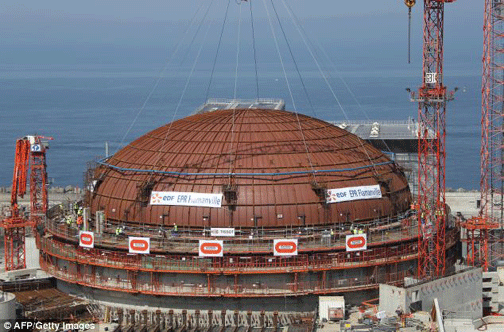
In Flamanville, EPR vibrations weigh down EDF
Blast 15th Jan 2025
https://www.blast-info.fr/articles/2025/a-flamanville-les-vibrations-de-lepr-plombent-edf-27fa5zyHQ6mpDzOKgti6kw
Last week, Luc Rémont, CEO of EDF received a worrying report from the engineers working on the Flamanville EPR. It reveals a recurring problem of excessive vibrations. And indicates that he does not know whether the EPR will be able to operate at full power. Revelations.
At EDF, troubles are flying in squadrons. This Tuesday, January 14, the Court of Auditors published a new report on the Flamanville EPR . The venerable institution on Rue Cambon (Paris) now estimates the final cost of the project at 23.7 billion euros. An amount that is significantly higher than the previous assessment made by the Court in 2020: 19.1 billion.
Kicking the donkey, the report specifies that “the calculations made by the Court result in a mediocre profitability for Flamanville 3” : the tiny margin that EDF could generate will not be enough to repay the cost of the loans! For that to happen, the EPR must one day operate at full power. And of that, even the EDF teams are no longer really convinced.
The scene takes place at a dinner party in Paris late last week. “We were in a meeting in the CEO’s office and everything was going well. But then he received a report from Flamanville and the atmosphere suddenly cooled,” says a senior executive of the electrician present at the meeting. If Luc Rémont, the CEO, did not fall off his seat when he read the report, he came close.
The cause? The engineers working on the reactor’s start-up have a doubt. And a big one. “They don’t know if the EPR will be able to operate at full power,” says this senior executive.
This question, which exists among many employees who worked on the nightmarish reactor construction site (twelve years behind schedule), is now shared by the teams who took charge of the reactor. And it is based on an observation: contrary to what EDF’s communication claims, the vibration problems affecting the primary circuit of the reactor are far from being resolved. “The report confirms that there are still problems with excessive vibrations,” says the decidedly very talkative manager.
At the meeting of the local information committee for the Flamanville nuclear power plant in April 2014, held a few days before the ASN authorised EDF to install nuclear fuel in the tank, the electrician had nevertheless brushed aside the issue of vibrations, stating, clearly a little too quickly, that everything was sorted .
But already in the floors of the general management in Paris, the knives are sharpening and the hunt for the culprit is open. Who will wear the hat? One name is on everyone’s mind: that of Alain Morvan , the director of the EPR project until last October, accused in veiled terms of having hidden too much dust under the carpet.
Contacted by email on Tuesday 14 January late in the morning, EDF indicated that it was sticking to its construction cost of 13.2 billion (excluding interim interest). But it refused to comment on our information on the vibrations. Questioned the same day also by email, the Nuclear Safety and Radiation Protection Authority (ASNR), resulting from the merger of the ASN with the IRSN, did not respond to us.
Dunfermline MP Graeme Downie calls for MoD commitment to dismantle dead nuclear submarines

ONE boat is being dismantled in Rosyth but there’s no commitment and no funding to deal with another 25 nuclear subs – with the total cost estimated to be around £300
million. That’s the concern of Dunfermline and Dollar MP Graeme Downie who
said a pledge to break up the other vessels would “guarantee decades of
work” at the dockyard. More than 200 people at Rosyth are already working
on HMS Swiftsure, it is being cut up and her radioactive waste removed as
part of a demonstrator project, and he said the site could become a
“worldwide centre of excellence for submarine dismantling”.
Dunfermline Press 15th Jan 2025,
https://www.dunfermlinepress.com/news/24860540.dunfermline-mp-graeme-downie-calls-mod-commitment/
Ask the locals: NFLA Chair says it is ‘prudent and proper’ for Nuclear Waste Services to consult residents over South Copeland flooding risk
The UK/Ireland Nuclear Free Local Authorities have urged Nuclear Waste
Services and the South Copeland GDF Community Partnership to ask the
residents of Millom and Haverigg for help in identifying local sites which
have been flooded.
As part of its ongoing effort to locate a potential site
for a Geological Disposal Facility, a repository into which Britain’s
legacy and future high-level radioactive waste will be dumped, NWS intends
to identity ‘Areas of Focus’ in the South Copeland Search Area which
incorporates the communities of Drigg, Haverigg, Kirksanton, and Millom.
These ‘Areas of Focus’ will be subject to more intensive geological
investigations and in the guidance published by NWS those sites ‘with
known flood risks’ will be excluded.
Report: Israel and Hamas Agree ‘in Principle’ to Ceasefire and Hostage Deal

According to media reports, the deal on the table doesn’t commit Israel to a permanent ceasefire
by Dave DeCamp January 14, 2025, https://news.antiwar.com/2025/01/14/report-israel-and-hamas-agree-in-principle-to-ceasefire-and-hostage-deal/
CBS News reported Tuesday that both Israel and Hamas have agreed “in principle” to a draft hostage and ceasefire deal that could be finalized this week.
The report, which cited US, Arab, and Israeli officials, said if the final details are worked out and the Israeli government approves it, the deal could be implemented as soon as this weekend, before the January 20 inauguration of President-elect Donald Trump.
The Associated Press had a similar report that said Hamas had accepted a draft deal and that details were still being finalized before Israeli approval. The deal is largely based on a proposal President Biden put forward in May 2024, which Hamas accepted months ago.
According to Israeli media reports, pressure on Netanyahu from Trump’s incoming Middle East envoy, Steve Witkoff, is the reason why there’s been progress in recent days.
The deal involves three phases, but according to AP, it would not commit Israel to a permanent ceasefire or full withdrawal from Gaza.
The AP report reads: “Details of the second phase still must be negotiated during the first. Those details remain difficult to resolve — and the deal does not include written guarantees that the ceasefire will continue until a deal is reached. That means Israel could resume its military campaign after the first phase ends.”
According to media reports, the first phase involves a 42-day ceasefire, and during that time, Hamas would release 33 Israeli hostages, including women, children, the elderly, and five female IDF soldiers. Some of the hostages released in the first phase may be dead, but Israeli officials said they believe most are still alive. In exchange, Israel is expected to release hundreds of Palestinian prisoners.
During the first phase, Israeli troops will withdraw from population centers in Gaza, and Palestinians will be able to return to north Gaza, although there is nothing for them to return to since IDF has destroyed nearly every building in sight. Aid deliveries will also be surged, with 600 trucks per day expected to enter the Strip.
The second phase of the deal would involve the release of all male Israeli hostages from Gaza and a full IDF withdrawal, with many details still needing to be worked out. The third phase would involve the exchange of bodies and the start of the reconstruction of Gaza.
Virginia, we have a problem

14 Jan 2025, |Peter Briggs, https://www.aspistrategist.org.au/virginia-we-have-a-problem/
Australia’s plan to acquire Virginia-class submarines from the United State is looking increasingly improbable. The US building program is slipping too badly.
This heightens the need for Australia to begin looking at other options, including acquiring Suffren-class nuclear attack submarines (SSNs) from France.
The Covid-19 pandemic dramatically disrupted work at the two shipyards that build Virginias, General Dynamics Electric Boat at Groton, Connecticut, and Huntington Ingalls Industries’ yard at Newport News, Virginia. It badly hindered output at many companies in the supply chain, too. With too few workers, the industry has built up a backlog, and yards are filling with incomplete submarines.
Within six years, the US must decide whether to proceed with sale of the first of at least three and possibly five Virginias to Australia, a boat that will be transferred from the US Navy’s fleet.
Nine months before the transfer goes ahead, the president of the day must certify that it will not diminish USN undersea capability. This certification is unlikely if the industry has not by then cleared its backlog and achieved a production rate of 2.3 a year—the long-term building rate of two a year for the USN plus about one every three years to cover Australia’s requirement.
The chance of meeting that condition is vanishingly small.
The situation in the shipyards is stark. The industry laid down only one SSN in 2021. It delivered none from April 2020 to May 2022. The USN has requested funding for only one Virginia in fiscal year 2025, breaking the two-a-year drumbeat, ‘due to limits on Navy’s budget topline and the growing Virginia class production backlog’.
As of January 2025, five of 10 Block IV Virginias ordered are in the yards, as are five of 12 Block Vs for which acquisition has been announced. (Work has not begun on the other seven Block Vs.)
The building time from laying down until delivery has increased from between 3 and 3.5 years before the pandemic to more than 5 years. The tempo is still slowing: the next Virginia, USS Iowa, is due to be delivered on 5 April 2025, 5.8 years after it was laid down.
On the original, pre-pandemic schedule, all the Block IVs could probably have been delivered to the USN by now. This is a gap that cannot be recovered in a few years, despite all the expensive manpower training and retention programs in hand.
Exacerbating the problem for the yards, the Block V submarines are 30 percent larger, and more complex to build, making a return to shorter build times unlikely. Speaking to their shareholders in October, the chief executives of Huntington Ingalls and General Dynamics blamed their slowing delivery tempo on supply chain and workforce issues. HII says it is renegotiating contracts for 17 Block IV and Block V Virginias.
Furthermore, Electric Boat has diverted its most experienced workers to avoid further slippage in building the first two ballistic missile submarines of the Columbia class, the USN’s highest priority shipbuilding program, in which the Newport News yard also participates.
It gets worse. Many USN SSNs that have joined the US fleet over the past few decades are unavailable for service, awaiting maintenance. The pandemic similarly disrupted shipyards that maintain the SSNs of the Los Angeles and Virginia classes. In September 2022, 18 of the 50 SSNs in commission were awaiting maintenance. The Congressional Budget Office reports lack of spending on spare parts is also forcing cannibalisation and impacting the availability of Virginia class SSNs.
Australia’s SSN plan must worsen the US’s challenge in recovering from this situation, adding to the congestion in shipyards and further over loading supply chains already struggling to deliver SSNs to the USN.
A US decision not to sell SSNs to Australia is inevitable, and on current planning we will have no stopgap to cover withdrawal of our six diesel submarines of the Collins class, the oldest of which has already served for 28 years.
In the end, Australia’s unwise reliance on the US will have weakened the combined capability of the alliance. And Australia’s independent capacity for deterrence will be weakened, too.
As I wrote in December, it is time to look for another solution. One is ordering SSNs of the French Suffren class. The design is in production, with three of six planned boats delivered. It is optimised for anti-submarine warfare, with good anti-surface, land-strike, special-forces and mining capability. It is a smaller design, less capable than the Virginia, but should be cheaper and is a better fit for Australia’s requirements.
Importantly, it requires only half the crew of a Virginia, and we should be able to afford and crew the minimum viable force of 12 SSNs.
Let’s build on the good progress in training, industry and facility preparations for supporting US and British SSNs in Australia, all of which should continue, and find a way to add to the alliance’s overall submarine capability, not reduce it.
Sizewell C’s future in doubt as EDF told to prioritise French nuclear power
Auditor warns against costly foreign projects as energy giant considers investment decision into the plant
The future of Sizewell C has been thrown into doubt after EDF, the company
behind the project, was told to prioritise supporting nuclear power in
France. In a rare intervention, the French state auditor warned the
state-owned energy giant against backing risky new projects abroad, which
include plans to build a new nuclear power station in Suffolk.
Instead, the Cour de Comptes said EDF should focus on making a success of
multibillion-euro projects at home, ensuring they were profitable and built
on time. It comes as EDF prepares to make a final investment decision on
Sizewell C, which will increase its exposure in the UK given it is already
building Hinkley Point C in Somerset.
However, that project has been hit by
surging costs and delays, with the most recent forecasts saying it will
open after 2030 and cost around £45bn. Industry sources are also predicting
Sizewell C will cost £40bn to build, double EDF’s initial estimates in
2020.
EDF is working alongside the Government on Sizewell C, with £4bn of
taxpayer cash already spent on the project. However, the French auditor has
released a report saying EDF should not make a final investment decision on
the Sizewell project before cutting its financial exposure to Hinkley.
Telegraph 14th Jan 2025,
https://www.telegraph.co.uk/business/2025/01/14/sizewell-c-future-doubt-edf-told-prioritise-french-nuclear/
Outgoing CIA director says ‘no sign’ Iran developing nuclear weapons
William Burns stated that the Islamic Republic made a decision in 2003 not to pursure nuclear weapons and has not changed its policy
The Cradle, News Desk, JAN 12, 2025
Outgoing CIA director William Burns stated in an interview on 10 January that Iran does not have a nuclear weapons program, following a decision it made in 2003, and that the US is concerned about the revival of ISIS.
In an interview with state broadcaster National Public Radio (NPR) to discuss his time as director of the notorious spy agency under President Joe Biden, Burns was asked whether Iran may accelerate its efforts to obtain nuclear weapons given the setbacks the Islamic Republic and its allies in the regional Axis of Resistance have sustained over the past year.
Burns answered that “the Iranian regime could decide in the face of that weakness that it needs to restore its deterrence as it sees it and, you know, reverse the decision made at the end of 2003 (an oral fatwa issued by Supreme Leader Ali Khamenei) to suspend their weaponization program.”
However, Burns clarified, “We do not see any sign today that any such decision has been made, but we obviously watch it intently. “
He added that Iran’s weakness could instead lead to negotiations for a nuclear deal similar to the one signed by Iran and the United States under President Obama in 2014. President Trump later withdrew from the deal following intense lobbying by Israeli Prime Minister Benjamin Netanyahu.
“You know that that sense of weakness could also theoretically create a possibility for serious negotiations, too. And, you know, that’s something the new administration is going to have to sort through. I mean, it’s something I have a lot of experience in with the secret talks a decade ago, a little more than a decade ago with the Iranians. So, you know, that’s that’s also a possibility,” Burns stated.
Regarding the negotiations for a possible ceasefire and prisoner exchange between Israel and Hamas in Gaza, Burns said he believes there is a chance for an agreement.
“I think the gaps between the parties have narrowed. There’s an Israeli delegation in Doha right now working through proximity talks managed by the Qataris, with the support of the Egyptians and with our support. So, I think there’s a chance.”……………………………………………………. https://thecradle.co/articles/outgoing-cia-director-says-no-sign-iran-developing-nuclear-weapons
The EPR nuclear sector: new dynamics show persistent risks -La cour des comptes .

As recommended by the Court, the use of feedback and risk analysis has been
developed.
In addition to the excesses of the Flamanville 3 construction
site, the EPR reactors in operation in China (Taishan 1 and 2) and in
Finland (Olkiluoto 3) have experienced technical malfunctions in recent
years, with significant financial impacts, the consequences of which have
been damaging to the credibility of the EPR 2 programme.
In Great Britain, on the Hinkley Point construction site, EDF is facing a sharp increase in
costs accompanied by a further two-year delay, as well as a heavy
additional financing constraint caused by the withdrawal of the Chinese
co-shareholder.
As regards the new EPR project at Sizewell, delays are
already accumulating, with initial negative consequences in organisational
and financial terms. The Court recommends that a final investment decision
on this project should not be approved until a significant reduction in
EDF’s financial exposure to the Hinkley Point project has been achieved.
The Court also recommends ensuring that any new international nuclear
project generates quantified gains and does not delay the timetable for the
EPR 2 programme in France.
Cour des Comptes 14th Jan 2025, https://www.ccomptes.fr/fr/publications/la-filiere-epr-une-dynamique-nouvelle-des-risques-persistants
Cost of Sizewell C nuclear project expected to reach close to £40bn

“Nuclear is too expensive, too slow — and very expensive to contain at the end of its life.”
Final price tag for building new power plant is likely to be double 2020 estimate
Jim Pickard, Rachel Millard and Gill Plimmer , January 14 2025
The final price tag for building the planned Sizewell C nuclear power station in Suffolk is likely to reach close to £40bn, according to people close to the negotiations over the flagship energy scheme.
The sum is double the £20bn estimate given by developer EDF and the UK government for the project in 2020, reflecting surging construction costs as well as the implications of delays and cost overruns at sister site Hinkley Point C.
The higher estimate is likely to raise questions over the government’s strategy for a nuclear power revival, at a time of stretched government finances and cost of living concerns.
EDF says that once up and running, Sizewell C should be able to supply low carbon electricity to the equivalent of about 6mn homes for 60 years.
The Treasury is due to decide whether to go ahead with the project in this year’s multiyear spending review, according to officials.
The UK government and French energy group EDF were the initial backers of Sizewell C, but they are trying to raise billions of pounds from new investors, a process that is dragging on longer than planned.
Earlier this month the Department for Energy Security and Net Zero (Desnz) said it could not reveal the current cost estimate for the project as it was “commercially sensitive”. …………………
Alison Downes, executive director of campaign group Stop Sizewell C, urged the government to “come clean” on the “massive true cost” of the project given that households would be paying upfront for its construction via a levy on energy bills. “This secrecy around Sizewell C is inexcusable.”
Dale Vince, a big Labour party donor and founder of green energy company Ecotricity, has written to the government’s new Office for Value for Money warning that the construction of Sizewell “will saddle consumers with higher bills long before it delivers a single unit of electricity”.
But one senior government figure and two well-placed industry sources said a reasonable assumption for the cost of building Sizewell C would be about £40bn in 2025 prices.
The government has already awarded £3.7bn of state funding to the project. Ministers had planned to reach a final investment decision by the end of 2024 but were forced to delay this until spring 2025. Now there is industry speculation that any deal could slip beyond the autumn.
Speaking to the Financial Times, he added: “Nuclear is too expensive, too slow — and very expensive to contain at the end of its life”…………………………….
all but one of Britain’s current ageing fleet of plants is due to close by March 2030, potentially sooner if planned life extensions cannot go ahead.
Only one new nuclear power station, Hinkley Point C in Somerset, is at present being built in the UK but it is delayed and over budget.
The project is due to start generating in 2029 at the earliest, and cost up to £46bn. That compares with initial expectations from 2016 that it would start at the end of 2025 and cost £18bn. …………………….
there is scepticism inside government about how much lower Sizewell C’s price tag would be compared with Hinkley Point C………………………………
-
Archives
- October 2026 (91)
- September 2026 (339)
- August 2026 (330)
- July 2026 (355)
- June 2026 (287)
- May 2026 (306)
- April 2026 (356)
- March 2026 (251)
- February 2026 (267)
- January 2026 (308)
- December 2025 (358)
- November 2025 (359)
-
Categories
- 1
- 1 NUCLEAR ISSUES
- business and costs
- climate change
- culture and arts
- ENERGY
- environment
- health
- history
- indigenous issues
- Legal
- marketing of nuclear
- media
- opposition to nuclear
- PERSONAL STORIES
- politics
- politics international
- Religion and ethics
- safety
- secrets,lies and civil liberties
- spinbuster
- technology
- Uranium
- wastes
- weapons and war
- Women
- 2 WORLD
- ACTION
- AFRICA
- Atrocities
- AUSTRALIA
- Christina's notes
- Christina's themes
- culture and arts
- Events
- Fuk 2022
- Fuk 2023
- Fukushima 2017
- Fukushima 2018
- fukushima 2019
- Fukushima 2020
- Fukushima 2021
- general
- global warming
- Humour (God we need it)
- Nuclear
- RARE EARTHS
- Reference
- resources – print
- Resources -audiovicual
- Weekly Newsletter
- World
- World Nuclear
- YouTube
-
RSS
Entries RSS
Comments RSS

