Trump’s got a radioactive time bomb under Greenland’s ice
The U.S. would inherit an environmental dilemma of its own making if it lays claim to the massive Arctic island.
January 17, 2025 , By Seb Starcevic, https://www.politico.eu/article/trumps-got-a-radioactive-time-bomb-under-greenlands-ice/
Deep in Greenland’s frozen wilderness, a radioactive secret sleeps beneath the ice — and it could be a headache for Donald Trump if the U.S. president-elect follows through on his threat to take control of the vast Arctic island.
Its name is Camp Century, an American military base built in 1959 during the Cold War in an attempt to develop nuclear launch sites that could survive a Russian strike.
The project, which involved carving a network of tunnels through Greenland’s ice sheet and was powered by a small nuclear reactor, was deemed unfeasible due to the constantly shifting ice and abandoned in 1967.
Although the Americans dismantled the reactor and took its nuclear reaction chamber with them when they departed in ’67, they left behind thousands of tonnes of waste and debris — including radioactive residue — to be buried under the icecap forever.
But thanks to climate change, forever might come sooner than planned.
As the world warms, Camp Century — which is located in one of the most remote spots on Earth, about 1,500 kilometers north of Nuuk, Greenland’s capital city — has been the focus of renewed interest and anxiety about just how long it will remain entombed. A landmark study published in 2016 found the remains of the abandoned base could be exposed by melting ice and snow toward the end of the 21st century.
“Our study highlights that Camp Century now possesses unanticipated political significance in light of anthropogenic climate change,” the researchers wrote (though they later revised their findings in 2021 to rule out the base reemerging from the ice until at least 2100).
The revelation caused a political storm in Greenland, a Danish territory which has been self-ruling since 1979.
Greenlandic Foreign Minister Vittus Qujaukitsoq demanded Denmark take responsibility for cleaning up the debris from abandoned U.S. military installations in Greenland, of which there are 20 to 30 mainly disused sites. Greenland, formerly a colony of Denmark, never consented to hosting them.
Nuuk and Copenhagen signed a deal in 2017 earmarking about $30 million to clean up the debris and waste — but Camp Century was not included in the agreement.
Greenlanders are “concerned that [Camp Century] will pollute as the ice melts down,” said Pipaluk Lynge, an MP from Greenland’s largest party and chair of the parliamentary foreign policy committee.
But it’s not just Camp Century, she added, referring to the other abandoned bases. “There are many places where [they] have left tons of dump,” she told POLITICO. “The U.S. has military waste all over the Arctic.”
‘Don’t poke it’
There have so far been “no attempts” to clean up Camp Century’s radioactive and toxic waste, said William Colgan, professor of glaciology and climate at the Geological Survey of Denmark who led the 2016 study into the ice surrounding Camp Century.
While Colgan did once drill deep into the site to test its radioactivity at the Danish health ministry’s request, “There is actually a conscious effort not to drill into the debris field,” he told POLITICO. “We don’t actually know the full nature of what’s down there.”
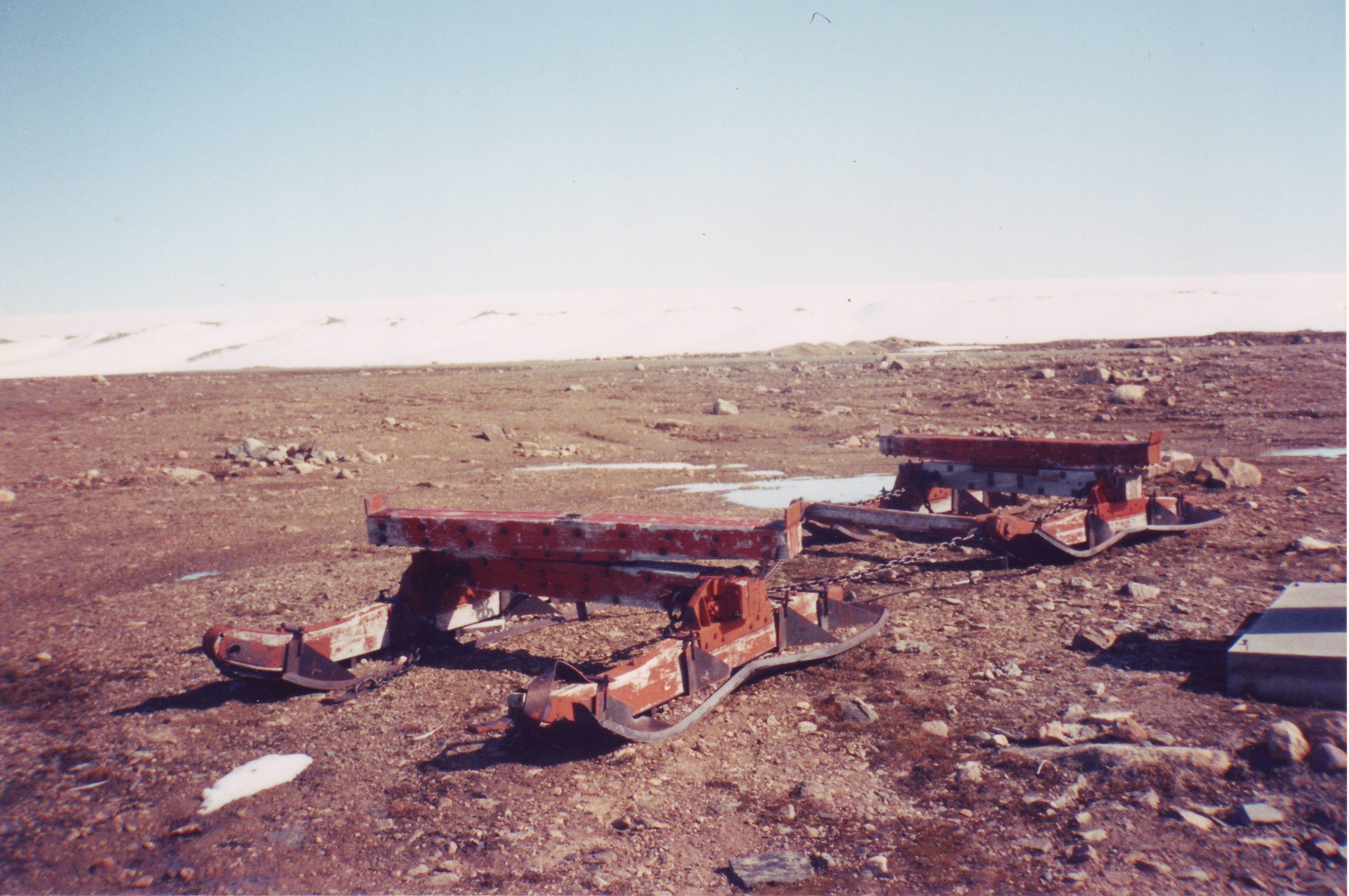
Camp Century has been described as a subterranean city, complete with a chapel, a barbershop and dormitories that once housed hundreds of people. To construct it, equipment and supplies were transported across the ice on sleds and tractor-trailers from nearby Pituffik Space Base, the northernmost U.S. military installation in the world, which is still active today.
In a 1961 report on American broadcaster CBS, TV legend Walter Cronkite visited the military base. His program filmed Camp Century’s massive ice tunnels being dug and showed U.S. army engineers relaxing in their underground, nuclear-powered barracks, reading and listening to records.
All that is now buried under thick layers of ice. Colgan said he and his team of researchers had been unable to find parts of Camp Century, such as its fuel depot, and feared disturbing it too much. “It’s cold, it’s deep, don’t poke it,” he said.
There are different ways Camp Century could contaminate the environment. One is if melting ice and snow carry toxic waste — such as the 200,000 liters of diesel fuel beneath the ice, according to Colgan — out into the ocean. Another is if the ice containing the base breaks off and forms an iceberg. Neither are likely anytime this century; while the latter would likely take thousands of years.
But the timeline shifts a little depending on how much the world warms in the coming decades. While there are different projections, a United Nations report published last October found the planet will heat up by 2.6 to 3.1 degrees Celsius this century, with no chance of limiting the temperature increase to the totemic 1.5 C target agreed in Paris in 2015.
“It’s a game of just a couple of degrees,” Colgan said. “2 or 3 C is the difference between Camp Century staying under ice or melting out.”
Climate change in microcosm
Camp Century itself was pivotal to scientists’ understanding of climate change. In the 1960s, scientists extracted an ice core there, a frozen soil sample that is still studied to this day for insights into climate patterns hundreds of thousands of years ago. The base remains a scientific “supersite,” said Colgan, who visits it annually along with many other climate researchers.
If the U.S. were to lay claim to the island — as Trump has repeatedly said it should do, calling American control of Greenland an “absolute necessity” and even threatening to use military force — it would also inherit the legacy of its own Cold War-era polluting activities at Camp Century.
“Camp Century is a microcosm of climate change,” Colgan argued. “People today are left picking up and trying to understand the climate impacts of decisions made 50 years ago, 60 years ago.”
And with the U.S. currently the second-biggest emitter of planet-warming emissions in the world, Camp Century and its “shifting fate” aren’t just a fascinating slice of Cold War trivia, but a story of climate action and responsibility today, he added.
“It is the decisions being made in the next decade or two that will put us on these trajectories that have multi-century implications,” Colgan warned.
UK Nuclear Power Ambitions Hampered by Delays and Soaring Costs
The construction of Hinkley Point C and Sizewell C nuclear power plants is
facing significant delays and cost overruns, jeopardizing the UK’s energy
security. Sellafield Ltd’s cybersecurity failings have raised concerns
about the safety and security of the UK’s nuclear industry.
The UK government’s ambitious plans to expand nuclear power are facing criticism
due to the high costs and potential impact on taxpayers. As the U.K.
government doubles down on plans to develop the country’s nuclear power
industry following decades of neglect, severe delays and cost increases are
hampering progress. Delays and rising costs at the Sizewell C and Hinkley C
nuclear projects have drawn public criticism, while concerns over public
safety have been brought into question due to cybersecurity failings by
Sellafield Ltd. While public support for nuclear power is at its highest
level in decades, these failings could hinder the development of a strong
nuclear power industry in the U.K.
Oil Price 19th Jan 2025, https://oilprice.com/Alternative-Energy/Nuclear-Power/UK-Nuclear-Power-Ambitions-Hampered-by-Delays-and-Soaring-Costs.html
Northwestern Ontario nuclear waste site selection raises concerns.

The selection process has overlooked the broader impact on local and Indigenous populations near highways that could be used to transport nuclear waste north.
The Hill Times: Canada’s Politics and Government News Source, BY ERIKA SIMPSON | December 12, 2024
The Nuclear Waste Management Organization selection of two northwestern Ontario communities—Wabigoon Lake Ojibway Nation and Ignace—as host communities for Canada’s proposed Deep Geological Repository raises concerns and controversy. Located approximately 1,500 km from Toronto, the distance highlights the geographical separation between the selected communities and Toronto, home to the Darlington and Pickering nuclear power plants that will eventually be decommissioned.
On Nov. 28—the same day of Nuclear Waste Management Organization’s (NWMO) announcement—the Municipality of South Bruce took many by surprise by announcing it was exiting the site selection process for the proposed Deep Geological Repository (DGR). Despite South Bruce’s proximity—just 46 km from the Bruce reactor, the world’s largest-operating nuclear facility on Lake Huron’s shores—the NWMO decided to pursue the Ignace location. This raises questions about why the NWMO chose to bypass South Bruce, which, due to its location, appeared to be a more logical choice for Canada’s first DGR.
Despite being presented as a “community-driven, consent-based” process, the selection process launched in 2010 sought to narrow 22 potential sites down to just one willing community. The process has thus far overlooked the broader impact on local and Indigenous populations near highways that could be used to transport nuclear waste northward.
Media outlets like The Globe and Mail and The Hill Times report that the NWMO’s DGR plan involves transporting nuclear waste by truck for over four decades, from all Canada’s reactor sites to the nuclear facility, where the waste could be stored underground. More than 90 per cent of the waste is currently at Pickering, Darlington, and Bruce nuclear stations in Ontario, with the rest located in Point Lepreau, N.B., Quebec, Manitoba, and Ottawa.
With the NWMO selecting the Ignace site and an all-road transportation method, the trucks are expected to travel a total of 84 million km on Canadian roads. There is always the risk that radioactive material will leak while in transit or short-term storage, something that has happened in Germany and New Mexico over the past two decades.
The NWMO’s claims of a rigorous and independent process are undermined by a lack of public dialogue and transparency. Few have been aware of the proposal to build a national underground nuclear waste site. Northwatch and We The Nuclear Free North raised concerns about the NWMO’s decision involving Wabigoon Lake Ojibway Nation (WLON) in the project.
WLON’s Nov. 28 statement clarifies that the First Nation has not approved the project but has agreed to proceed with the next phase of site characterization and regulatory processes. Their “yes” vote reflects a commitment to assess the project’s feasibility through environmental and technical evaluations, not an endorsement of the DGR itself.
South Bruce, the other potential willing community, held a referendum on Oct. 28, which revealed deep divisions. The final tally was 1,604 votes in favor (51.2 per cent) and 1,526 against (48.8 per cent), with a total of 3,130 votes cast. A margin of just 78 votes decided a by-election with far-reaching implications for millions of people across multiple generations.
The decision to allow a local municipality to oversee the referendum on the nuclear waste disposal site has been met with significant controversy. Critics argue that the arrangement posed a conflict of interest, as municipal staff—partially funded by the NWMO—actively promoted the project, casting doubt on their impartiality and raising concerns about financial influence on the referendum’s outcome. The council’s firm opposition to allowing a paper ballot raised further suspicions. Why reject a voting method that could be physically verified?
Located about 19 km southeast of Dryden, WLON faces similar concerns regarding the fairness of the online voting process and voter eligibility. These issues could erode public confidence in municipal referendum processes, and the handling of decisions by councils.
The nuclear waste storage site selection marks an early shift to the regulatory phase, raising concerns about whether the process is premature. Over the coming year, the effectiveness of the Canadian Nuclear Safety Commission and its regulation of all steps in the management of radioactive waste will come under scrutiny, particularly as Ontario’s new energy minister, Stephen Lecce, emphasizes the need to invest in energy infrastructure to meet rising electricity demand over the next 25 years.
Critics argue that despite evaluations with long-term implications, ethical and environmental concerns surrounding nuclear waste disposal remain long unaddressed. Ontario Power Generation’s initial 2005 proposal to the safety commission for a DGR near the Bruce reactor was rejected in 2020 following a Saugeen Ojibway Nation vote.
While many acknowledge the potential benefits of nuclear energy and DGR technology, the NWMO’s approach to the project over the past two decades has drawn significant scrutiny. Questions centre on the decision to place untested DGR technology in populated farmland near the Great Lakes, the world’s largest source of freshwater. The risks of radiation leakage into Hudson’s Bay and the Arctic over thousands of years are particularly troubling, especially as the technology remains unproven in such a critical and sensitive location.
Despite objections, the NWMO pressed forward, with its process viewed as federally approved bribery through financial incentives. South Bruce has already received millions and will receive $4-million more for its involvement, with another $4-million due in 2025. Mayor Mark Goetz has announced plans for alternative development, but critics like W.J. Noll from Protect Our Waterways question why such options weren’t considered earlier, given the risks to farmland, water sources, and the divisions left in the local farming community.
The growing influence of the nuclear industry on international and local governance has left many feeling powerless, fearing that war-torn regions, Indigenous lands, and rural communities are being sacrificed, threatening ecosystems from Ukraine and Russia to the Great Lakes and Arctic rivers.
If no Canadian community agrees to host a permanent nuclear waste depository, it may be necessary to reconsider nuclear energy expansion, halt new plant construction, and scale back capacity at existing reactors. In the interim, managing waste at above-ground sites could offer a safer alternative until technology ensures long-term environmental protection.
Erika Simpson is an associate professor of international politics at Western University, the author of Nuclear Waste Burial in Canada? The Political Controversy over the Proposal to Construct a Deep Geologic Repository, and Nuclear waste: Solution or problem? and NATO and the Bomb. She is also the president of the Canadian Peace Research Association.
Allied Groups Reach Historic Settlement on New Nuclear Bomb Part Production

Gender and Radiation Impact project celebrates the historic victory of radiation impacted communities across the nation standing together in clear conscience in a legal challenge that has successfully required the National Nuclear Security Administration (NNSA) to obey the National Environmental Policy Act and include the public in big decisions it is making! NNSA is owner of the US nuclear arsenal, which it intends to greatly expand, which would have our taxes cover trillions of dollars paid to defense contractors.
South Carolina Environmental Law Project
Gullah/Geechee Sea Island Coalition
Nuclear Watch New Mexico
Savannah River Site Watch
Tri-Valley CAREs January 18, 2025
Ben Cunningham, Esquire, SCELP,
Tom Clements, Savannah River Site Watch,
Jay Coghlan, Nuclear Watch New Mexico,
Scott Yundt, Tri-Valley CAREs
AIKEN, S.C. — Nonprofit public interest groups have reached an historic settlement agreement with the Department of Energy’s semi-autonomous nuclear weapons agency, the National Nuclear Security Administration (NNSA). This is the successful result of a lawsuit against NNSA over its failure to complete a programmatic environmental impact statement on the expanded production of plutonium “pit” bomb cores, as required by the National Environmental Policy Act (NEPA). This agreement and a joint motion to dismiss have been submitted to Judge Mary Lewis Geiger of the Federal District of South Carolina. Should the Court enter the dismissal and retain jurisdiction to enforce the settlement, the agreement will go into effect.
…………………….. In September 2024, Judge Lewis ruled that DOE and NNSA had violated NEPA by failing to properly consider alternatives before proceeding with their plan to produce plutonium pits, a critical component of nuclear weapons, at the Los Alamos National Laboratory (LANL) in New Mexico and, for the first time ever, at the Savannah River Site (SRS) in South Carolina. The Court found that the plan’s purpose had fundamentally changed from NNSA’s earlier analyses which had not considered simultaneous pit production at two sites. Judge Lewis directed the Defendants and Plaintiffs to prepare a joint proposal for an appropriate remedy which fostered additional negotiations
In sum, the just released settlement agreement requires the National Nuclear Security Administration to:
• Complete a nation-wide programmatic environmental impact statement (PEIS) on expanded plutonium “pit” bomb core production within 2.5 years.
• Hold two successive rounds of public hearings, first on the scope of the PEIS and then on the draft PEIS before it is finalized. Hearings will be held in Livermore, CA; Santa Fe or Los Alamos, NM; Kansas City, MO; Aiken, SC; and Washington, DC (dates to be determined).
• Citizens will have 45 days to submit scoping comments and 90 days to comment on the draft PEIS. The last PEIS in 2008 generated more than 100,000 public comments.
• Until it issues a formal Record of Decision on the final PEIS, NNSA is enjoined from:
– Installing classified equipment at the Savannah River Plutonium Processing Facility’s Main Processing Facility;
– Introducing any nuclear materials into the Main Processing Facility; and
– Starting construction on a related Waste Characterization Lab, Construction Maintenance Building and Vehicle Entry Building.
………………………………………. Of added significance, the PEIS will have to assess the impacts of disposal of large quantities of radioactive plutonium wastes from pit production at the Waste Isolation Pilot Plant (WIPP) in southern New Mexico, located 2,000 feet underground in a salt deposit. Disposal of “transuranic” (TRU) wastes will challenge the congressionally mandated volume cap for WIPP, which the National Academy of Sciences has projected will be substantially exceeded. Nevertheless, NNSA expects to be able to dump TRU wastes at WIPP until at least 2050, fundamentally changing its mission from cleanup to direct support of expanded nuclear weapons production…………………………
The Settlement Agreement with plaintiffs’ and defendants’ declarations is available at https://nukewatch.org/settlement-agreement-and-exhibits (20.9 MB) more https://nukewatch.org/wp-content/uploads/2025/01/Settlement-Reached-in-Historic-NEPA-Lawsuit-Over-Plutonium-Pit-Bomb-Core-Production.pdf
Canada’s Nuclear Waste Management Organization’s (NWMO) proposed DGR is a speculative unproven concept.
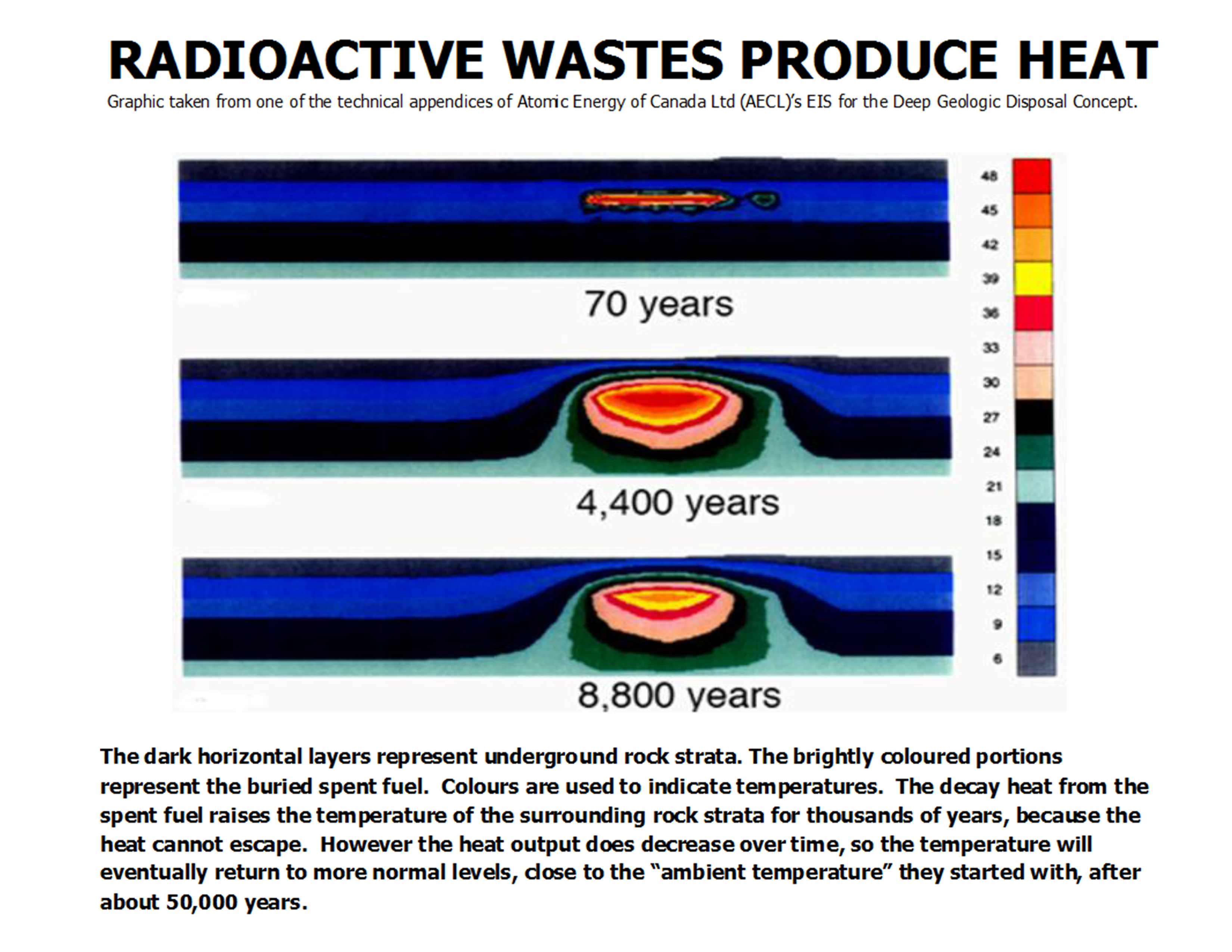
The most worrying aspect is an expected long-term “thermal pulse” from the entombed heat-producing radioactive waste. According to an Atomic Energy of Canada environmental study,1994, the DGR temperature could reach 230 degrees C. That intense heat would cause distortion and fracturing of host rock, impacting the structure of metallic containment casks.
David Geary, 19 Jan 25
In Geology 101 we learned that geology is a descriptive science, not a predictive science. Hydrology of rock is especially unpredictable. Science can not foresee what happens to a stable rock formation once disturbed by human activity. Thus, any Deep Geological Repository (DGR) cannot be counted on to maintain the required long-term stability to contain Canada’s high-level nuclear waste.
Because leaks do happen.
Canada’s Nuclear Waste Management Organization’s (NWMO) proposed DGR is a speculative unproven concept. A study of NWMO’s literature and conceptual renderings reveals numerous unresolved scientific, engineering, and modelling challenges.
Also troublesome is that Canada’s engineered ‘vertical shaft’ design vs. the European ‘inclined ramp’ approach was flagged as potentially dangerous by NWMO’s own expert international Independent Technical Review Group (ITRG), a body composed of European scientists and engineers. Vertical shafts relying on powered lift systems frequently fail.
Geologists at previous DGR hearings noted numerous NWMO deficiencies in the hydro-geological realm. For example, the integrity of host rock would be severely compromised by underground blasting required to create the extensive lattice-work of tunnels, chambers, and vertical shafts. There’d likely be rapid and unpredictable geo-hydrological changes, including water ingress, from the fracturing that ensues.
The most worrying aspect is an expected long-term “thermal pulse” from the entombed heat-producing radioactive waste. According to an Atomic Energy of Canada environmental study,1994, the DGR temperature could reach 230 degrees C. That intense heat would cause distortion and fracturing of host rock, impacting the structure of metallic containment casks.
Depicted in NWMO’s diagrams is a DGR air vent to the surface. It would carry the heat upwards while easing underground air pressure buildup. However, should nuclear waste casks become damaged or crushed by rock pressures, carcinogenic fission & activation products would leak out of them. Those radionuclides would be carried via the air vent to the surface, to the biosphere, to nearby communities, to people.
In fact, that is precisely how, in 2014, several workers near a vent far above a nuclear waste DGR in New Mexico were contaminated with radioactive plutonium.
Because geology is unpredictable.
Leaks happened and people were affected.
Former nuclear energy executives face federal charges in massive Ohio bribery scheme

Two former executives are charged in a racketeering scheme and turned themselves into federal authorities on Friday. The pair are charged in connection with the biggest bribery scandal in Ohio.
Laura A. Bischoff, Jessie Balmert, Michael Loria, https://www.usatoday.com/story/news/nation/2025/01/17/former-firstenergy-executives-charged-in-ohio-bribery-scheme-householder/77783516007/
Two former energy company executives turned themselves into authorities Friday for their suspected role in facilitating the biggest corruption scandal in Ohio state history.
The scheme involved over $60 million in bribes to secure a $1 billion bailout of FirstEnergy’s faltering nuclear plants and eliminate regulatory hurdles. The scandal has already landed one of Ohio’s most powerful politicians in federal prison.
Prosecutors indicted former FirstEnergy CEO Chuck Jones, 69, and ex-Senior Vice President of External Affairs Michael Dowling, 60, under the Racketeer Influenced and Corrupt Organizations Act, a charge created to prevent organized crime and fight against drug kingpins.
“This alleged $60 million racketeering conspiracy defrauded Ohioans to enrich the defendants,” FBI Cincinnati Special Agent in Charge Elena Iatarola said. “The FBI will continue to pursue political corruption and corporate fraud to protect taxpayers and hold white-collar criminals responsible for their actions.”
The charging of the pair of executives is the latest in a case that’s racked the state since the U.S. Attorney’s Office for the Southern District of Ohio first indicted former Ohio House Speaker Larry Householder and four others linked to the scheme in 2020. Householder was dealt a 20-year sentence in 2023 for orchestrating the scheme. Others tied to scheme are in prison, awaiting sentencing or have committed suicide.
Ohio Gov. Mike DeWine would not comment on the indictments during a press conference on Friday.
Prosecutors allege that Jones and Dowling participated in bribery, money laundering and obstruction to increase the company stock price and enrich themselves. FirstEnergy fired the two men in October 2020.
The Akron-based company previously pleaded guilty to bribing Householder and former Public Utilities Commission of Ohio Chairman Sam Randazzo − two public officials in powerful positions to help the company. The company paid a $230 million fine and agreed to cooperate with federal investigators……
Householder’s role in the scheme involved recruiting Republicans to win control of the House and passing the controversial House Bill 6, which included a $1 billion bailout for two nuclear plants then-owned by a FirstEnergy subsidiary. Former Ohio Republican Party chairman Matt Borges received a five-year prison sentence for his role.
Randazzo was accused of accepting a $4.3 million bribe to help pass that law and ease regulatory hurdles for the company. He had pleaded not guilty. The case was dismissed after he died by suicide last April.
A statehouse scandal fueled by dark money
Even before Friday’s announcement, the case has had a huge impact: Householder and Borges are convicted and imprisoned, two co-conspirators Jeff Longstreth and Juan Cespedes pleaded guilty and are awaiting sentencing, lobbyist Neil Clark and Randazzo both died by suicide, and FirstEnergy changed its leadership and board.
The latest development marks the first time federal authorities have charged the bribers instead of the bribe recipients.
The indictment paints a picture of how FirstEnergy executives used money and influence to their own advantage at the Ohio Statehouse. After House Bill 6 passed, Jones sent a photoshopped version of Mount Rushmore, featuring Randazzo’s and others’ faces on it. The caption read: “HB 6 F*** ANYBODY WHO AINT US.”
In October 2016, the executives pledged to the FirstEnergy board that the company value would be increased by 27%. But at the same time, the utility faced a weak energy market and hundreds of millions of dollars in losses, especially from FirstEnergy Solutions, its nuclear power subsidiary. To turn the company around, Jones and his team pursued bailouts from federal and state officials.
In 2018, FirstEnergy Solutions filed for bankruptcy and said it would close its nuclear power plants absent a government bailout.
The latest development marks the first time federal authorities have charged the bribers instead of the bribe recipients.
The indictment paints a picture of how FirstEnergy executives used money and influence to their own advantage at the Ohio Statehouse. After House Bill 6 passed, Jones sent a photoshopped version of Mount Rushmore, featuring Randazzo’s and others’ faces on it. The caption read: “HB 6 F*** ANYBODY WHO AINT US.”
In October 2016, the executives pledged to the FirstEnergy board that the company value would be increased by 27%. But at the same time, the utility faced a weak energy market and hundreds of millions of dollars in losses, especially from FirstEnergy Solutions, its nuclear power subsidiary. To turn the company around, Jones and his team pursued bailouts from federal and state officials.
In 2018, FirstEnergy Solutions filed for bankruptcy and said it would close its nuclear power plants absent a government bailout.
FirstEnergy used dark money groups to help Householder amass political power and become Ohio House speaker. In April 2019, Householder unveiled House Bill 6, which would require 4.5 million Ohio consumers to pay fees on their monthly electric bills to help keep the nuclear plants open.
‘An expensive friend’: Gleeful texts show fruits of bribery
Text messages Jones and Dowling included in the indictment show the glee the pair shared as their scheme to save the company on the backs of Ohio taxpayers took shape.
“Huge bet and we played it all right on the (state) budget and HB6, so we can go back for more!” Dowling said in a text to Jones the day that Ohio’s governor signed the bailout into law.
The pair followed the success of the bailout bill with a new goal: “Win the National Championship” − a reference to getting favorable action in the state budget that would guarantee the company millions of dollars per year as well as other favorable treatment.
“Tell LH to put on his big boy pants. Ha,” Dowling told Jones as they continued the scheme.
As FirstEnergy’s stock climbed Jones texted Randazzo – the state utilities commissioner accused of accepting bribes who committed suicide: “Those guys are good but it wouldn’t happen without you,” he wrote. “My Mom taught me to say Thank you.”
How Canada supplied uranium for the Manhattan Project
Peter C. van Wyck · CBC, Jan 10, 2025
In the past couple of years, the public imagination has been taken up with all things nuclear — the bomb, energy and waste. The film Oppenheimer recasts the story of the bomb as a Promethean and largely American narrative, while the series Fallout depicts a post-nuclear world. Russia has repeatedly emphasized its readiness for nuclear conflict. Nuclear energy has been regaining popularity as a hedge against climate change.
And yet, the story of Canada’s nuclear legacy — and our connection to the bombs that the U.S. military dropped on the Japanese cities of Hiroshima and Nagasaki, killing tens of thousands in an instant — is rarely told.
The documentary Atomic Reaction examines the impact of the radioactive materials mined in a Dene community in the Northwest Territories in the 1930s and ’40s. That radioactive ore was transported thousands of kilometres south, via Canada’s “Atomic Highway,” to be refined in Port Hope, Ont. And the uranium was used in the Manhattan Project, which developed those atomic bombs.
A mineral with immense power
This Canadian story began in 1930. Gilbert LaBine, a co-founder of Eldorado Gold Mines, discovered a rich deposit of radioactive pitchblende ore — containing radium, uranium and polonium — as well as silver, on the eastern shores of Great Bear Lake in the Northwest Territories. The site, on the traditional lands of the Sahtúgot’įnę Dene, came to be known as Port Radium. In a stroke, the country had entered the atomic age. ………………………………….
Port Hope: ‘The town that radiates friendliness’
In 1932, Eldorado constructed a radium-processing plant in Port Hope, the only such refinery in North America. Eldorado secured an abandoned waterfront factory and hired Marcel Pochon, a former student of radioactivity pioneers Marie and Pierre Curie, to mass-produce radium.
By 1936, the first grams of radium salts had been produced. (More than six tonnes of pitchblende are needed to produce a gram of radium.) However, by the late 1930s, Eldorado’s radium business was in decline. Competition with Belgium’s mine in the Congo was fierce, and global radium prices had fallen. In 1940, the Port Radium mine closed.
But soon, Eldorado’s and Port Hope’s fortunes radically changed. Uranium, previously considered waste from the processing of radium, became a strategic commodity. In 1942, LaBine’s Eldorado signed contracts with the U.S. military to supply uranium to the fledgling Manhattan Project, and the mine at Port Radium quietly reopened. In 1943, the company changed its name to Eldorado Mining and Refining, and in early 1944 the Canadian government took over the company and made it a Crown corporation.
The Port Hope refinery processed both Canadian and Congolese ores for the Manhattan Project. Eldorado continued to refine military-grade uranium for the Americans until 1965. The facility currently converts nuclear-grade uranium trioxide into uranium hexafluoride or uranium dioxide, used in nuclear reactors around the world. In the 1970s, a billboard leading into town even read, “Beautiful old Port Hope. The town that radiates friendliness.” Today, the plant is owned by Cameco, one of the world’s largest publicly traded uranium companies.
A lasting legacy and a massive cleanup
In Délı̨nę, a Dene community near Port Radium, a dark shadow remains after so many residents worked in the mine without being told they were involved in the Manhattan Project. And later, Dene miners started dying of lung cancer, earning the community of Délı̨nę the grim nickname the “Village of Widows.”
In 2005, a national report examining the health and environmental effects of the mine concluded there was no scientific link between cancer rates in Délı̨nę and mining activities in the area. But another study by the Canadian Nuclear Safety Commission the following year found increased rates of lung cancer in mine workers. People in the community still feel fear and anxiety about Port Radium’s impact on their health.
But the story of Eldorado and Port Hope also includes radioactive and chemical contamination.
Today, the municipalities of Port Hope and neighbouring Clarington are the sites of the largest volume of historic low-level radioactive waste in Canada — a result of spillage, leakage and widespread disposal of contaminated fill and other materials.
Major radioactive contamination in the area first came to light in the late 1960s, but little was done.
It wasn’t until 1975 that the public started to become aware of the problem, when St. Mary’s elementary school was abruptly closed. Eldorado had detected gamma radiation in the school’s parking lot and dangerously high levels of radon gas in the school; the building had unknowingly been built on contaminated fill from Eldorado’s operations some 15 years earlier.
The school closure set in motion a flurry of activity. It came to light that radioactive and chemical waste — estimated at roughly two million cubic metres — had been dumped directly into the harbour beside the plant and in ravines around town and used in the construction of homes, basements, driveways, businesses, roads, schools and other public buildings. Properties were surveyed for radiation levels; several hundred of them were remediated; and some 100,000 tonnes of contaminated soil and materials were relocated to a site at Chalk River, operated by Atomic Energy of Canada Ltd. (AECL). Still, the scope and severity of the contamination was not fully understood.
In 2001, the Port Hope Area Initiative (PHAI) began — a government plan to ensure the safe long-term management of historic low-level radioactive waste.
In 2012, the minister of natural resources announced an investment of $1.28 billion over 10 years for the PHAI. A radiological survey of approximately 4,800 public and private properties began, along with project design, an environmental assessment and community engagement.
Today, many sites await cleanup, and waste is still produced and stored at the Port Hope facility. https://www.cbc.ca/documentaries/how-canada-supplied-uranium-for-the-manhattan-project-1.7402051
Is ‘Israel’ using small nuclear weapons in Gaza and South Lebanon?

Robert Daly, Christopher Busby, Source: Al Mayadeen English, 6 Sep 2024, https://english.almayadeen.net/articles/analysis/is–israel–using-small-nuclear-weapons-in-gaza-and-south-le
Dr. Christopher Busby is part a mixed crew of investigative reporters and commentators from Lebanon and some film-makers investigating “Israel’s” use of enriched uranium in strikes on Gaza on Lebanon, and aim to follow up on the strange illnesses that are appearing on the battlefield.
The American Peace Information Council (APIC) and Green Audit (UK) are conducting an investigation of “Israel’s” possible use of small nuclear weapons in Gaza and South Lebanon. Dr. Christopher Busby—Scientific Secretary, European Committee on Radiation Risk; once Member, UK Committee Examining Radiation Risk from Internal Emitters; once Member, UK Ministry of Defence Depleted Uranium Oversight Board—presents the scientific and social background of the case below.
APIC and Green Audit ask people who drive ambulances down in the South, or live there, to come forward with engine air filters from ambulances driven in bombed areas, samples of long hair (at least 10 cm in length) if they live in bombed areas, and Geiger counter readings and soil samples from bomb craters. Please send these samples and evidence to Al Mayadeen who will forward them to us. One would think that the easiest way to obtain ambulance air filters would be from the Lebanese Red Cross, but its General Secretary, Mr. Georges Kitanneh, refuses to assist this investigation.
‘Israel’ in Gaza: Red Mercury.
Dr. Christopher Busby
In 2021, a scientific report in the prestigious journal Nature confirmed what I had been saying since 2006. “Israel” has, since its attacks on Lebanon in 2006 and those on Gaza in 2008 and 2014, used a new nuclear weapon, one which kills with a high temperature radiation flash and with neutrons. This weapon, which leaves an identification footprint, but no fission products like Caesium-137, we now know was also employed by the USA in Fallujah, Iraq in 2003, and previously in Kosovo also.
The residues, inhalable Uranium aerosol dust, together with the neutron damage to tissues, cause a range of serious and often fatal health effects that puzzle doctors and defy treatment. Without knowing what caused such effects, which often mimic other illnesses or result in fungal infections that kill, doctors are powerless to help and just watch the exposed individuals die.
In the cases of direct exposures to the flash, parts of the body, arms, legs, places that were not behind significant shielding are burned to blackened sticks. The aerosol Uranium dust is inhaled, destroys the lungs through fibrosis, is translocated to the lymphatic system, and later causes cancers, not only lymphomas and leukemias, but pretty much any cancer as a result of localisation of the Uranium particle in the organ, for example the breast, which has extensive lymphatic vessels. If the particle is coughed up and swallowed, it can end up immobilised in the colon and cause cancer there.
Downstream results in exposed populations include genetic effects, unexplained infant mortality, congenital malformations, miscarriages, sex ratio perturbations at birth, and fertility loss, all of which were found in epidemiological studies I helped carry out in Fallujah from 2010-2011.
This is not science fiction or arm-waving. I have acted as an expert witness in two successful legal cases, one in England and one in Australia, where the judge and coroner court concluded that the particles caused colon cancer. I am helping a US DU veteran at the moment in his case against the military. He has a pituitary tumour (the small gland is located behind the nose where the particles lodge).
I began this investigation in 2006 when an article appeared in a Lebanese newspaper reporting that an Israeli bomb crater in Khiam was radioactive. A Dr. Ali Khobeisi had taken a Geiger counter to the crater and found a 20-times background radiation level in the crater relative to nearby. By 2006, I had become something of an alternative authority on Depleted Uranium weapons (DU). I had given evidence to the US Congressional Committee on Veterans Affairs on the effects of DU and Gulf War syndrome, I had visited Iraq and also Kosovo, and I was a member of the UK government Depleted Uranium Oversight Board (DUOB); I had written articles, including for the United Nations, I had given evidence to the Royal Society.
I asked a colleague to go to Lebanon and get samples from the crater, and also an ambulance air filter. When they were analysed, using two separate methods, they showed the presence not of Depleted Uranium, but of Enriched Uranium (EU). Now this is impossible, unless the weapon was made from EU or created EU from neutron irradiation of U-234 and U-238.
To follow the explanation of the problem, you need some science. Natural Uranium, as mined, has three isotopes, U-238 U-234 and U-235. Most of this Uranium by mass is U-238 (99.7%). The 0.3% of U-235 is important for nuclear bombs and nuclear energy and is extracted in various ways to make EU. What is left behind is less radioactive U-238, and this is what is termed Depleted Uranium (DU).
When U-238 decays, it changes into Thorium-234, which rapidly changes into Protoactinium-234 and this turns into Uranium-234. Then you get a long list of progeny, but these do not concern us. All this happens quite quickly, and the process releases some gamma rays which make DU a gamma radiation hazard, contrary to the statements of the military that DU is not a handling hazard. It is. But this is not important in this story.
The main issue here is this. Was the enriched Uranium in the Lebanon bomb a real finding? Could it have been a laboratory error? The answer is No. We used two different laboratories and two different Uranium analysis methods, ICPMS and alpha spectrometry.
What we found was picked up by the reporter Robert Fisk, who put the story into The Independent in October 2006: The Mystery of “Israel’s” Secret Uranium Bomb.
Until we found EU, I had focused on the health effects of DU. Everyone did. But in 2006 I was contacted by an eminent Italian nuclear physicist, Emilio Del Guidice. I met him in London, where he told me that the source of the EU was a new weapon which used Hydrogen or heavy hydrogen, Deuterium dissolved in Uranium and when this warhead, as small as a baseball, was fired at a solid object, the hydrogen suffered Cold Fusion to form Helium with the emission of a powerful gamma ray which cause the U238 to convert to an unstable U-239 which decayed to U-235 and a neutron.
I am not a nuclear physicist, though I have my own ideas about this explanation but at that time I accepted that he knew what he was talking about. At least it explained the source of the enrichment.
In 2008 I was approached by some doctors in Egypt who wondered if the Israelis were bombing Gaza with DU. With some difficulty, I obtained samples from Gaza, again soil samples and an air filter, and analysis showed the presence of EU. In 2010, as part of our study of the congenital malformations in Fallujah, we analysed the hair of the mothers for 52 elements to try and identify the cause of the birth defects. We found EU in the mothers’ hair.
Further support for the existence of an EU-containing or EU-producing weapon came from a study of a Kosovo war Veteran whose mysterious illnesses were investigated thoroughly by some doctors in Liverpool and Manchester. The man’s kidneys contained Enriched Uranium.
Emilio del Guidice had not stood still in this Sherlock Holmes investigation. Together with reporters from Italian TV (Rai News) he had visited the father of Cold Fusion, Prof Martin Fleischmann, whom I had also previously worked with when I was at the University of Kent in 1980. Fleishmann added to the intriguing scientific puzzle, but was unwilling to get involved. It seemed that scientists looking at cold fusion were dying under suspicious circumstances. Fleischmann himself had seemingly been poisoned with something that caused multi-site cancer and passed away on August 3, 2012. A cold fusion colleague developed the same multi-site cancer and didn’t survive.
Del Guidice and the Rai News producer following up the story wrote a book: The Secret of the Three Bullets, published in 2014. It is still in print and contains their side of the story. I am in the book under various names. But a few months before its publication, del Guidice unexpectedly died when alone in his house.
I am told that the Rai News co-author editor of the book, Maurizio Torrealta has gone into hiding after having been posted three real bullets in an envelope.
Fast forward to 2021. The Nature paper gave the results of analyses of 65 samples of soil, sand, cement, and building materials from Gaza. Using gamma spectrometry (where you use the whole sample and look at the identifiable peaks from U-235 and Th-234 = U238) the authors identified some significantly high levels of Enriched Uranium in all the samples, but mostly in the soil samples. The levels of enrichment had become greater than those that we found in our earlier studies. The natural isotope mass ratio in nature (U238/U235) is 138. In Lebanon we found 116. In Gaza 108. The 2021 paper found about 85. Since this was before the recent bombing, this contamination must date to the 2014 Israeli bombing. What should we expect to find now?
In March of this year, I wrote to the International Atomic Energy Agency (IAEA), the official UN watchdogs for the use of nuclear weapons. My colleague from Fallujah, Dr. Mohamad Al-Darraji also sent my letter under his name. Nothing happened. No reply. He was to organise a Press Conference in Vienna to draw attention to the use of this weapon in Fallujah, and the cover up of the residual high levels of radiation by the Iraqi Ministry of Science. I made a video to be presented at this conference (it is online). But he couldn’t get a venue.
I followed the letter up with a second version in July, demanding that the IAEA respond. I wrote a paper about the issue and submitted it to two journals, putting the pre-print online. It was rejected on the basis that the reviewers didn’t believe the Nature analysis results. Eventually, Al-Darraji got a reply from the IAEA (naturally, I didn’t). The IAEA didn’t believe the Nature results. Nothing to investigate. No problem.
The UK Green Party House of Lords member, Baroness Jenny Jones (who I know) asked a question in UK Parliament. The government said they didn’t have anything to say about it. About the high level of Enriched Uranium in Gaza.
So that’s it. What can we do? “Israel” and the USA (at least) have developed what is almost certainly a mini-neutron bomb. “Israel” is using it in Gaza. And may be using it in Lebanon (again). In fact, there is evidence for the development of such a bomb having been tested as long ago as October 1962, in the final US atmospheric test in the Dominic series in the Pacific. This was the test named “Housatonic” which achieved 9.96Mt yield but reportedly had zero fallout. That means it had no fission primer in the first stage, a necessary requirement for all the hydrogen bombs before it.
The significance of this appears to have been overlooked, but, astonishingly, you can find details on Wikipedia. The UK government put all that stuff under the Official Secrets Act and when I was representing the Test Veterans in the Royal Courts of Justice from 2010 to 2016, I was refused access to these details. The new bomb was successfully detonated just before the Kennedy Kruschev test ban, and just before Kennedy was assassinated. Could there be a link?
I have joined a mixed crew of investigative reporters and commentators from Lebanon and some film-makers to seek out the solution to this conundrum. We aim to follow up on the strange illnesses that are appearing on the battlefield. We aim to look for Enriched Uranium and also neutron activation products like Cobalt-60, Tritium and Carbon-14. In a new development, the laboratories that I used to examine the earlier samples have all suddenly closed their doors. One of them was shut down altogether after the first Gaza analysis. One of them was threatened. But we can do a lot with what we have.
What we want is for people to obtain Geiger Counters to check out the impact sites soon after the explosion, and if it is radioactive to get us samples of dust and dirt. We want women’s hair samples, especially long hair, cut from the nape of the neck, from women who were near or lived in areas that were bombed. You can buy a simple Geiger Counter now for about 60 euros. You can even get a low-resolution portable gamma spectrometer for about 350 euros.
We would like anyone with comments or information to contact us. This is a big deal.
The weapon will certainly be used in future exchanges, and will make local nuclear war possible, since the scary scenarios involving fallout may not materialise. I have named the device Red Mercury because that is what it probably is (remember the red mercury story: written off officially by science (haha) as a fraud, as a phony). Red Mercury was Stalin’s code for Enriched Uranium. Clearly, from the Dominic Housatonic test, the USA also developed the weapon. Since it kills without leaving fission products, it is invisible to the global nuclear explosion detection systems and the IAEA watchdogs.
But there is no doubt the IAEA know about it. Their latest report on Uranium in the Environment completely ignores Enriched Uranium. When I asked one of the report authors why, I was told they were short of money. They only had enough to look at Depleted Uranium. Can you believe this stuff?
‘I was exposed to evil in British nuclear tests’

Kirsteen O’Sullivan & Marcus White, 15 Jan 25, https://www.bbc.com/news/articles/cvgpp5ze28ro?fbclid=IwY2xjawH5E-JleHRuA2FlbQIxMQABHegxfVRLO66gQNKipt3Y5f9BWzRPbu0h6QWkys9CWH2yBTjZhE1YRCwhmA_aem_E7q8FCNDKoWD6DMMToVaoQ
A nuclear test veteran who witnessed the detonation of several British atomic bombs in the 1950s has said he was “exposed to evil”.
Robert James, 87, was an RAF firefighter stationed in Maralinga in Australia, where seven major UK tests took place.
Mr James, from Fordingbridge, Hampshire, said many service personnel had suffered fatal illnesses as a result and he was angry that the UK government had still not offered compensation.
The Ministry of Defence (MoD) said ministers were continuing to discuss issues with families.
Veterans’ campaign groups have said British service personnel were lined up and deliberately exposed to bomb tests to see what effect they would have.
Mr James said many of his comrades had died as a result of cancers and diseases associated with radiation exposure.
He said: “A lot of the guys suffered a lot. There’s lads dying every day… and after having long illness.
“We were exposed to evil, we were exposed to radiation. That’s pretty serious and I think that warrants compensation.
“Not only for people that are surviving like myself but the families that have suffered where their husbands or fathers died.”
In 2019, the Labour Party, then led by Jeremy Corbyn, pledged £50,000 for each surviving British nuclear test veteran.
Sir Keir Starmer met veterans in 2021, before becoming Prime Minister, but made no promises – and the 2019 offer was not in the 2024 manifesto.
However, the current Defence Secretary John Healey posted on his website in 2021: “UK remains the only nuclear power that refuses them recognition or compensation, unlike the US, France, Canada and Australia.”
Mr James said: “Don’t go back on your word, Mr Starmer… You promised us full compensation and recognition. Keep to your word.”
Nuclear resister Susan Crane released after 7.5 month prison term in Germany
from Nukewatch by John LaForge, https://www.nukeresister.org/2025/01/17/nuclear-resister-susan-crane-released-after-7-5-month-prison-term-in-germany/?fbclid=IwY2xjawH5EthleHRuA2FlbQIxMQABHTVW2eZGE2IE-W3LPf6iXXpESUr8kt2y7UvRgz2O8GmIutozT9gN37brag_aem_KHyUNaUTEixZQ46JaMNVpQ
U.S. Activist Ends 7.5-Month Prison Term in Germany;
Jailed for Protests Against U.S. “Nuclear Sharing”
Susan Crane of Redwood City, California was released from prison in Koblenz, Germany on Friday, January 17, 2025, after spending 7.5 months incarcerated for trespass convictions and refusing to pay fines stemming from a string of nonviolent protests against U.S. nuclear weapons stationed at the Büchel air force base, southeast of Cologne.
On June 4, 2024, Crane began serving a 230-day sentence at the Wöllstein-Rohrbach prison in Rhineland-Palatinate, the longest term yet imposed in the decades-long campaign of protests against the American-made free-fall, gravity bombs known as B61s at the base. Dutch peace activist Susan van der Hijden from Amsterdam served 115-days along with Crane for similar convictions. After ten days at Wöllstein, the two were transferred to the Offener Vollzug or the “open prison” in Koblenz, a less severe system that permits daytime work release. Crane was welcomed by the Martin Luther Evangelical Church community of Koblenz and did light work around the church grounds for many weeks.
Crane, 81, a life-long peace activist who has endured lengthy prison sentences in the United States for anti-war actions, was convicted of several trespass charges in Germany after joining six “go-in” demonstrations at Büchel. During the actions on the German base, Crane and others warned personnel that stationing the U.S. nuclear weapons there, and NATO’s ongoing threat to use them known quaintly as “nuclear sharing,” are both unlawful. Tornado fighter jet pilots of the German air force’s 33rdTactical Air Wing at Büchel routinely train to drop the U.S. H-bombs on targets in Russia [1], most recently in operation “Steadfast Defender 24” [2] — provocatively staged in the midst of NATO-armed war in Ukraine.
In one action, Crane and others unfurled a banner that read, “Büchel Air Base is a Crime Scene.” According to legal scholars, the transfer of nuclear weapons from the U.S. to Germany violates the Nonproliferation Treaty (NPT) which explicitly forbids any “transfer to any recipient whatsoever [of] nuclear weapons.” [3] According to the Bulletin of the Atomic Scientists, the U.S. hydrogen bombs at Büchel are the 170-kiloton B61-3, and the 50-kiloton B61-4.[4] The U.S. atomic bomb that incinerated Hiroshima in 1945 was a 15-kiloton device.
Crane said in a statement before entering prison, “I thought the German courts would listen to the reasons we went onto the base, and understand that our peaceful actions were justified as acts of crime prevention. But international law was not respected or enforced.”
Crane, who has two adult children and four grandchildren, has devoted her life in California to serving the poor and homeless as a member of the of Redwood City Catholic Worker community. In a statement last March Crane said, “I see people living in camps, living in cars, and I see working people who don’t have enough income for basic needs like rent, food, or medical care. Then, I think of the money wasted on war-making by the U.S. and NATO nations, and that 3% of the U.S. military budget alone could end starvation around the world.”
At least 29 Germans, as well as two other U.S. citizens and two Dutch nationals have been jailed in Germany for related protest actions against the U.S. nuclear weapons. [5] Crane is the first U.S. women to be imprisoned in Germany in the campaign. Brian Terrell of Maloy, Iowa, was recently ordered by the court in Koblenz, Germany to report to the Wittlich prison on February 26, 2025 to serve a 15-day sentence for a related go-in action in July 2019.
Over time, over budget… will our new nuclear plants ever be built?

A damning report on EDF, the French company aiming to construct Sizewell C,
has thrown the project into doubt, while Hinkley Point C faces soaring
costs and delays.
The cost of nuclear power in the UK came roaring back
into the headlines last week after reports that the final bill for Sizewell
C, the planned new power station on the Suffolk coast, would be £40
billion — twice what was initially expected. This was followed by a
damning report on EDF, the French state-backed company that is proposing to
build Sizewell, which laid bare its financing problems, raising questions
about whether the plant will be built at all.
Hinkley is running years late and is massively over budget, prompting critics to wonder whether this is a model we should be copying. EDF had originally envisaged that [Hinkley]
would be in operation by this year; its most optimistic scenario now puts
the start date for the first of its two reactors at 2029. Meanwhile,
Hinkley’s original £18 billion cost on the eve of its construction has
ballooned to up to £35 billion in 2015 prices — or £46 billion in
today’s money.
Unfortunately, the financing for both plants is far from
settled. It is estimated that cost overruns at Hinkley mean it needs to
find another £5 billion to finish the work. This shortfall has been
exacerbated by EDF’s partner in the project, China General Nuclear Power,
refusing to put in more money after being excluded from Sizewell on
national security grounds.
Alison Downes of the Stop Sizewell C campaign
said: “We’ve no faith this project is being looked at objectively, so
it’s vital that the Office for Value for Money [the new government
agency] launches an immediate inquiry before ministers sleepwalk into a
disastrous decision.”
Having allocated £5.5 billion to Sizewell in the
budget, most observers expect Labour to give the green light at the
spending review. Some argue that the “sunk-cost fallacy” — a
reluctance to abandon projects in which a lot of money has been invested,
even if that would ultimately be a more cost-effective option — has
kicked in, and that cancelling it now would trigger a large and galling
write-down for the government. Nor are there obvious alternative vendors of
large nuclear projects — at least not yet. Bull, of Manchester
University, said axing Sizewell would send a terrible signal: “I think
the real cost of not doing Sizewell C is that we end up with another failed
project, and investors start to think we are just not serious.”
Times 19th Jan 2025 https://www.thetimes.com/business-money/companies/article/whats-happening-with-britains-nuclear-plants-and-when-will-they-be-built-tr6v0986f
Memo to Trump: Address the new threat of drone-vulnerable nuclear reactors

By Henry Sokolski | January 17, 2025,
https://thebulletin.org/2025/01/memo-to-trump-address-the-new-threat-of-drone-vulnerable-nuclear-reactors/
Mr. President, in the closing days of your first administration, you issued an executive order spotlighting the growing dangers of drone attacks against America’s critical energy infrastructure. Your order asked the Federal Aviation Administration to propose regulations restricting overflights of critical infrastructure. Four years later, large drones overflying nuclear plants both here and abroad demonstrate your request was spot on.
Our government, however, continues to discount the dangers such overflights pose. As for the threats facing the most frightening of civilian targets—nuclear power plants—Washington has been all too silent. While there are many other infrastructure nodes drones can hit, the effects of striking nuclear plants exceed that of almost any other civilian target set. Your second administration urgently needs to address this new threat.
Background
Your January 2021 order followed an October 2020 Nuclear Regulatory Commission (NRC) report that downplayed the dangers posed by nearly 60 previous drone overflights of US nuclear plants. The commission based its conclusion on a Sandia Laboratory technical analysis that focused on “commercially available” drones. The NRC insisted that attacks against reactors with such aircraft posed no risk of inducing a major radiological release.
Since then, drones—far larger than those commercially available to hobbyists—have overflown US dams, power lines, and nuclear reactors. Recently, the NRC itself has observed a sharp increase in the number of drone sightings over nuclear plants, with drone reports nearly doubling in just one week in December. This led the 10th largest electrical utility company in the United States to urge the Federal Aviation Administration to ban all air traffic over its two nuclear plants after drones were sighted flying over its reactors. Now, Republican governors, including Jeff Landry of Louisiana, are asking you to do something about drones overflying reactors in Louisiana and other states. Overseas, Russian military drones overflew a German nuclear plant in August, prompting the German government to announce a formal investigation.
Security implications
All of this comes as the United States, South Korea, and Russia are pushing the export and construction of scores of large and small reactors in Eastern Europe, Africa, the Middle East, and East Asia. You and your cabinet should understand that new and existing nuclear plants are potential military targets—now and in the future. Certainly, Russia’s targeting of Ukrainian nuclear reactors and their critical electrical supply systems demonstrates a willingness to attack these dangerous targets.
Meanwhile, several recent war games graphically detailed how China, North Korea, and Russia could use such attacks against Taiwan, Europe, and South Korea to disrupt US military operations and force the evacuation of millions to help achieve their military objectives.
Recommendations
If nuclear power is to have the promising future that you and previous administrations have pledged to promote, your administration needs to address the vulnerability of its reactors to drone attacks.
Your administration should start by refocusing on the concerns you rightly raised in 2021. In specific, within your first 100 days in office, you and your cabinet should:
- Again ask the Federal Aviation Administration to update its regulations under the FAA Extension, Safety, and Security Act of 2016 (Public Law 114-190). At the very least, the United States needs clearer protocols restricting and countering the use of drones on or over critical infrastructure and other sensitive sites, including nuclear plants, which, if hit, risk a significant release of harmful radiation. Currently, shooting suspect drones down is all but prohibited.
- Have the Secretary of Defense, the Secretary of Homeland Security, and the Director of National Intelligence assess within 90 days the threat that drone and missile attacks pose to US and allied electrical supply systems, nuclear plants, and other key infrastructure nodes. This report should be published both in classified form—to you, key members of your cabinet, and the national security leadership in the House and Senate—and in unclassified form to the public.
- Ask the Defense Department, National Nuclear Security Administration, and the Department of Homeland Security to explain how they will either require or provide active and passive defenses for existing and planned US civilian and military nuclear plants here and abroad. This report should also describe how the US government should respond to drone and missile attacks on such plants which, if hit, could release harmful amounts of radiation.
- Direct the Energy Department and the Federal Aviation Administration to contract JASON (the government’s scientific advisory group), to explore what technologies might better detect and counter hostile drone and missile attacks and mitigate the effects of such attacks. These technologies could include hardening nuclear reactors, active and passive defenses, and research on nuclear fuels that might be able to survive advanced conventional attacks with thermobaric and other advanced conventional explosives.
- Direct the Energy Department, the Department of Homeland Security, and the Defense Department to devise a program of realistic testing to clarify the military vulnerabilities and safety thresholds of reactors and other nuclear plants against missile and drone attacks.
Told you so: Financial Times follows NFLAs lead on Sizewell C cost estimate.

16 Jan 25 – https://www.nuclearpolicy.info/news/told-you-so-ft-follows-nflas-lead-on-sizewell-c-cost-estimate/
It is always nice when a media cornerstone of the finance world follows your lead in doing its sums – but that is what the Financial Times did yesterday in publishing an article indicating that the estimated cost of completing the new nuclear plant at Sizewell C will be £40 billion, something the NFLAs have been saying for ages.
One rule in nuclear is that the construction cost for new plants will always be far higher than the first estimate. And there has been no better example of this truism than that of Sizewell C’s sister plant, Hinkley Point C in Somerset, where an initial estimate of £18 billion for completion has now doubled to £34 billion (at 2015 prices).
It was hardly surprising that the FT reported that the final bill is more likely to be nearer £40 billion after speaking to ‘people close to negotiations over flagship energy scheme’; which are understood to be ‘one senior government figure and two well-placed industry sources.’ This figure is double that made in 2020 reflecting the recent surge in construction costs, and the inevitable delays and cost overruns will inevitably add to the eventual total.
The Sizewell C site presents its own costly challenges, namely a need for considerable expenditure on coastal defences as the East Coast will be increasingly subject to inundation and storm surges because of climate change and the need to provide in this water-stressed region for the provision of potable water with the likely installation of a dedicated desalination plant.
The British Government has already spent, or pledged, up to £8 billion in public funds to carry out preparatory groundwork around the site. Although private investors are being sought to finance the cost of construction, under the Regulated Asset Base being adopted by the British Government for the construction of any new nuclear plants, British electricity customers will ultimately have to bear the cost as the developer will be reimbursed these construction costs in stages through applying a nuclear levy to bills.
However, the Final Investment Decision to give the project the go-ahead has yet to be made. This is only expected in the late Spring after the completion of a Spending Review of overall government spending so there is still time for the Chancellor Rachel Reeves to stop it.
Local campaign group Stop Sizewell C is asking supporters to sign a petition to do so. The link to the petition is https://action.stopsizewellc.org/save-billions-cancel-sizewellc
Stop Sizewell C’s message to the Chancellor, via the Treasury, is: “As you carry out your multi-year spending review, I am reminded of your statement to Parliament during your mini-budget last year – “If we cannot afford it, we cannot do it”. I appreciate that you face many difficult choices, but with the Financial Times reporting that Sizewell C will cost at least £40 billion, I urge you not to throw more taxpayers’ money at this expensive, risky project that will raise energy bills during its lengthy and unpredictable construction. For alternative strategies that will help meet the UK’s 2030 target and create many thousands of jobs, I urge you to focus on renewables and energy efficiency.”
The NFLAs endorse this petition as it mirrors our position.
At present, the British Government is the majority stakeholder, but long-term only wishes to retain 20% as Ministers intend to offload much of their stake to private investors. So far however, no one is definitively biting, with mixed messages about interest from Centrica, British Gas’s parent, and Gulf States’ sovereignty funds.
As a second whammy to government hopes that more private sector partners will become involved, yesterday, the French State Auditor, the Cour des Comptes, criticised the expenditure already made by French state owned EDF on Hinkley Point C in a published report which suggested this could compromise investment in domestic nuclear power expansion plans and that “EDF should not take a final investment decision on Sizewell C before achieving a significant reduction in its financial exposure to Hinkley Point C.”
Stop Sizewell C is asking supporters to write to prospective investors asking them not to do so. The relevant links to take this action are shown below:
Amber Infrastructure: action.stopsizewellc.org/amber
Equitix: action.stopsizewellc.org/equitix
Schroders Greencoat: action.stopsizewellc.org/greencoat
Emirates Nuclear Energy Corporation: action.stopsizewellc.org/emirates
Centrica: action.stopsizewellc.org/centrica
The NFLAs has previously written to these prospective investors and endorse this action.
Finally Stop Sizewell C is petitioning the new Office of Value for Money’s independent Chair, David Goldstone, to call in the Sizewell C project for urgent scrutiny. Initial feedback from the Treasury indicated that Sizewell C would be examined, but more recent correspondence with officials has been less committal.
Supporters are asked to follow the NFLA’s example and sign the petition at https://action.stopsizewellc.org/valueformoney
Ends://..For further information, please contact NFLA Secretary Richard Outram by email to richard.outram@manchester.gov.uk
French energy giant EDF launches search for Hinkley Point finance after damning audit report

EDF Group’s chief executive Luc Rémont has hit
back at the national French auditor’s claims that the energy company
should delay its investment in UK nuclear power project Sizewell C.
He said the regulated asset base (RAB) model for financing the Suffolk nuclear
power station, where the cost of development is shared with the consumer,
should not be correlated with the refinancing of the Hinkley Point C
project in Somerset.
The French state-owned energy company has started a
search for financiers to help refinance the delayed project at Hinkley
Point C, following the French state auditor’s findings yesterday,
according to Rémont.
In October, the energy company issued £500m of
senior bonds to help finance investments in two nuclear reactors at the
site. Rémont said that the funding model for the Sizewell C nuclear power
project on the Suffolk coast “limits” EDF’s capital exposure.
The auditor’s report come a week after a letter was sent to the national
auditor in the UK, the National Audit Office, calling for a review of the
government’s spending assessment for Sizewell C. The campaign group
behind the letter raised concerns of rising costs at Hinkley Point C,
another nuclear power station being built by EDF, now estimated to be in
the region of £46 billion. The letter from Together Against Sizewell C
(TASC) followed a plea by Ecotricity founder Dale Vince, a Labour donor,
for the Treasury’s new Office for Value for Money to review plans to
develop the new nuclear power project in Suffolk.
Energy Voice 15th Jan 2025 https://www.energyvoice.com/renewables-energy-transition/565569/french-energy-giant-edf-launches-search-for-hinkley-point-finance-after-damning-audit-report/
‘National scandal’: The BBC’s Gaza cover-up

Britain’s ‘public service broadcaster’ is keeping the public in the dark about UK support for Israel’s assault on Gaza, new research finds.
MARK CURTIS, DECLASSIFIED.UK, 15 January 2025
- Declassified researched the BBC’s online coverage of 16 aspects of UK policy towards Israel and the pro-Israel lobby.
- “It is high time for the corporation to be truly held to account and be reformed in the public interest”, leading media professor says.
The BBC is failing to report the various ways in which the UK government has supported Israel’s brutal war on Gaza, Declassified’s new analysis finds.
Our research into the BBC’s written outputs since October 2023 finds the corporation has mainly not reported at all the major ways the UK government has been working with Israel.
It found that the BBC has reported just four times in 15 months that the Royal Air Force (RAF) has been conducting surveillance flights over Gaza.
Only one BBC report on the subject has been written since December 2023, despite the fact that hundreds of such spy missions have been conducted, almost daily, in aid of Israeli intelligence.
The Ministry of Defence (MoD) says these flights are solely to aid the rescue of hostages held by Hamas. Only one BBC online report mentions the UK may be providing targeting information to Israel or flying weapons to the country.
None of the articles otherwise raise concerns about the UK being willing to collaborate militarily with Israel at a time it is devastating Gaza.
Omitting the news
When Israel’s chief of staff, General Herzi Halevi, was allowed to attend a British military meeting in London last November, this also went unreported by the BBC in its written outputs.
Halevi’s visit was highly controversial, given he has led Israeli military operations throughout its destruction of Gaza. Prime minister Benjamin Netanyahu and former defence minister Yoav Gallant are wanted for crimes against humanity by the International Criminal Court.
Our research also finds that the BBC has never reported that the British military has been training Israeli armed forces personnel in the UK during the Gaza war. ……………………………………………………………………………………….
Arms exports
In sharp contrast to other UK government policies concerning Israel, the BBC has published many articles mentioning British arms exports to Israel.
In these reports, the BBC has occasionally cited concerns by human rights groups and MPs about the possible use by Israel of these arms, at the same time as citing pro-Israel figures.
However, article headlines have rarely been critical of these weapons sales.
………………………………………. many headlines are conciliatory towards Israel. These include:
‘Deputy PM: It’s still legal for the UK to sell arms to Israel’
‘UK defends partial Israel arms ban as Netanyahu calls it “shameful”’
‘UK ban on selling arms to Israel would benefit Hamas, says Cameron’
‘Boris Johnson: Shameful to call for UK to end arms sales to Israel’
There are no headlines about the possible use of UK arms by Israel in Gaza, or any directly reflecting the repeated calls by groups such as Human Rights Watch and Amnesty International, to halt all UK arms exports and military assistance to Israel.
The prominent legal action against the government for arming Israel brought by the International Centre of Justice for Palestinians (ICJP), the Global Legal Action Network and Al-Haq, has been ignored by the BBC. Declassified could find no BBC written coverage of this at all.
The most prominent group challenging British arms exports, the Campaign Against Arms Trade, has been mentioned six times on the BBC website in 15 months.
Declassified has uncovered three other disturbing aspects of Britain’s arming of Israel, none of which appears to have been covered by the BBC.
Voluntary censorship
Neither has the BBC covered the possible role of UK spy agency GCHQ or the army’s special forces, the SAS, in facilitating Israeli military operations.
These are live issues given that GCHQ operates an extensive intelligence operation on Cyprus, from where the RAF planes are flown over Gaza.
GCHQ is known to have aided past Israeli combat operations in Gaza. Yet Declassified could find no reports on the BBC website mentioning GCHQ in the context of Gaza.
Reporting on the SAS was subject by the government to a D-Notice – a voluntary gagging order not to publish ‘sensitive’ information concerning ‘national security’- in October 2023.
It followed reporting by the Mail that an SAS team was positioned on Cyprus, reportedly to help rescue British hostages held by Hamas.
Since then, it appears the entire UK national media, including the BBC, has complied with this. The BBC has no articles covering or speculating on an SAS role in Israel or Gaza.
Unreported collusion
There are other ways in which the British government is in effect colluding with Israel which have gone unreported by the BBC.
Perhaps incredibly, the BBC has not reported in its written outputs since October 2023 that the UK is engaged in negotiations with Israel to secure a free trade agreement.
Conservative and Labour ministers have since 2022 held five rounds of talks with the Israeli government, whose economy minister, Nir Barkat, is an outspoken supporter of its attacks on Palestinians.
Jonathan Reynolds, the current trade minister pursuing the prospective new deal, is a recipient of funding from Britain’s Israel lobby.
Neither has the BBC reported on the arrests by the UK authorities of pro-Palestinian journalists in Britain. ……………………..
Lobby, what lobby?
Neither has any effort been made by BBC journalists to highlight the influence in the UK parliament exercised by the Israel lobby, notably Conservative Friends of Israel (CFI) and Labour Friends of Israel (LFI).
This is a major gap in reporting since these are among the largest lobbying forces in British politics, funding dozens of MPs to go on “fact-finding” visits to Israel………………………………………………………
‘National scandal’
Des Freedman, professor of media and communications at Goldsmiths, University of London, said: “The BBC is clearly utterly failing to inform the public about how the UK military and government is complicit in the horrors of Gaza. This is a national scandal, showing how far away the corporation is from being a public service broadcaster.”
He added: “The BBC’s failure to accurately report on Israel’s genocide in Gaza is as much to do with what it refuses to report as with what it does report. It is high time for the corporation to be truly held to account and be reformed in the public interest”…………………………………………… more https://www.declassifieduk.org/national-scandal-the-bbcs-gaza-cover-up/
-
Archives
- October 2026 (91)
- September 2026 (339)
- August 2026 (330)
- July 2026 (355)
- June 2026 (287)
- May 2026 (306)
- April 2026 (356)
- March 2026 (251)
- February 2026 (267)
- January 2026 (308)
- December 2025 (358)
- November 2025 (359)
-
Categories
- 1
- 1 NUCLEAR ISSUES
- business and costs
- climate change
- culture and arts
- ENERGY
- environment
- health
- history
- indigenous issues
- Legal
- marketing of nuclear
- media
- opposition to nuclear
- PERSONAL STORIES
- politics
- politics international
- Religion and ethics
- safety
- secrets,lies and civil liberties
- spinbuster
- technology
- Uranium
- wastes
- weapons and war
- Women
- 2 WORLD
- ACTION
- AFRICA
- Atrocities
- AUSTRALIA
- Christina's notes
- Christina's themes
- culture and arts
- Events
- Fuk 2022
- Fuk 2023
- Fukushima 2017
- Fukushima 2018
- fukushima 2019
- Fukushima 2020
- Fukushima 2021
- general
- global warming
- Humour (God we need it)
- Nuclear
- RARE EARTHS
- Reference
- resources – print
- Resources -audiovicual
- Weekly Newsletter
- World
- World Nuclear
- YouTube
-
RSS
Entries RSS
Comments RSS

