The Pentagon and Starlink Satellites

it is only the existence of a credible deterrent that tempers Washington’s actions around the world. Since the end of the Second World War, the United States has only attacked relatively defenseless countries. The reason the North Korean government remains in place, but those of Libya, Iraq, Syria, and others do not, is the existence of the former’s large-scale conventional and nuclear forces. Developing an American Iron Dome could upset this delicate balance and usher in a new age of U.S. military dominance.
The stakes are high. If successful, the US could again intimidate the world through nuclear blackmail
Bruce Gagnon, Feb 28, 2025
Donald Trump has announced his intention to build a gigantic anti-ballistic missile system to counter Chinese and Russian nuclear weapons, and he is recruiting Elon Musk to help him. The Pentagon has long dreamed of constructing an American “Iron Dome.” The technology is couched in the defense language – i.e., to make America safe again. But like its Israeli counterpart, it would function as an offensive weapon, giving the United States the ability to launch nuclear attacks anywhere in the world without having to worry about the consequences of a similar response. This power could upend the fragile peace maintained by decades of mutually assured destruction, a doctrine that has underpinned global stability since the 1940s.
A NEW GLOBAL ARMS RACE
Washington’s war planners have long salivated at the thought of winning a nuclear confrontation and have sought the ability to do so for decades. Some believe that they have found a solution and a savior in the South African-born billionaire and his technology.
Neoconservative think tank the Heritage Foundation published a video last year stating that Musk might have “solved the nuclear threat coming from China.” It claimed that Starlink satellites from his SpaceX company could be easily modified to carry weapons that could shoot down incoming rockets. As they explain:
Elon Musk has proven that you can put microsatellites into orbit, for $1 million apiece. Using that same technology, we can put 1,000 microsatellites in continuous orbit around the Earth, that can track, engage and shoot down, using tungsten slugs, missiles that are launched from North Korea, Iran, Russia, and China.”
Although the Heritage Foundation advises using tungsten slugs (i.e., bullets) as interceptors, hypersonic missiles have been opted for instead. To this end, a new organization, the Castelion Company, was established in 2023.
Castelion is a SpaceX cutout; six of the seven members of its leadership team and two of its four senior advisorsare ex-senior SpaceX employees. The other two advisors are former high officials from the Central Intelligence Agency, including Mike Griffin, Musk’s longtime friend, mentor, and partner.
Castelion’s advisors and leadership team are extensively connected to SpaceX and the CIA
Castelion’s mission, in its own words, is to be at the cutting edge of a new global arms race. As the company explains:
Despite the U.S. annual defense budget exceeding those of the next ten biggest spenders combined, there’s irrefutable evidence that authoritarian regimes are taking the lead in key military technologies like hypersonic weapons. Simply put – this cannot be allowed to happen.”
The company has already secured gigantic contracts with the U.S. military, and reports suggest that it has made significant strides toward its hypersonic missile goals.
WAR AND PEACE
Castelion’s slogan is “Peace Through Deterrence.” But in reality, the U.S. achieving a breakthrough in hypersonic missile technology would rupture the fragile nuclear peace that has existed for over 70 years and usher in a new era where Washington would have the ability to use whatever weapons it wished, anywhere in the world at any time, safe in the knowledge that it would be impervious to a nuclear response from any other nation.
In short, the fear of a nuclear retaliation from Russia or China has been one of the few forces moderating U.S. aggression throughout the world. If this is lost, the United States would have free rein to turn entire countries – or even regions of the planet – into vapor. This would, in turn, hand it the power to terrorize the world and impose whatever economic and political system anywhere it wishes.
If this sounds fanciful, this “Nuclear Blackmail” was a more-or-less official policy of successive American administrations in the 1940s and 1950s. The United States remains the only country ever to drop an atomic bomb in anger, doing so twice in 1945 against a Japanese foe that was already defeated and was attempting to surrender.
President Truman ordered the destruction of Hiroshima and Nagasaki as a show of force, primarily to the Soviet Union. Many in the U.S. government wished to use the atomic bomb on the U.S.S.R. President Truman immediately, however, reasoned that if America nuked Moscow, the Red Army would invade Europe as a response…………………………………………………………………………………………………………………………………………………..
In the end, the Soviet Union was able to successfully develop a nuclear weapon before the U.S. was able to produce hundreds. Thus, the idea of wiping the U.S.S.R. from the face of the Earth was shelved. Incidentally, it is now understood that the effects of dropping hundreds of nuclear weapons simultaneously would likely have sparked vast firestorms across Russia, resulting in the emission of enough smoke to choke the Earth’s atmosphere, block out the sun’s rays for a decade, and end organized human life on the planet.
With the Russian nuclear window closing by 1949, the U.S. turned its nuclear arsenal on the nascent People’s Republic of China.
The U.S. invaded China in 1945, occupying parts of it for four years until Communist forces under Mao Zedong forced both them and their Nationalist KMT allies from the country. During the Korean War, some of the most powerful voices in Washington advocated dropping nuclear weapons on the 12 largest Chinese cities in response to China entering the fray. Indeed, both Truman and his successor, Dwight D. Eisenhower, publicly used the threat of the atomic bomb as a negotiating tactic.
Routed on the mainland, the U.S.-backed KMT fled to Taiwan, establishing a one-party state. In 1958, the U.S. also came close to dropping the bomb on China to protect its ally’s new regime over control of the disputed island – an episode of history that resonates with the present-day conflict over Taiwan.
However, by 1964, China had developed its own nuclear warhead, effectively ending U.S. pretensions and helping to usher in the détente era of good relations between the two powers—an epoch that lasted well into the 21st century.
In short, then, it is only the existence of a credible deterrent that tempers Washington’s actions around the world. Since the end of the Second World War, the United States has only attacked relatively defenseless countries. The reason the North Korean government remains in place, but those of Libya, Iraq, Syria, and others do not, is the existence of the former’s large-scale conventional and nuclear forces. Developing an American Iron Dome could upset this delicate balance and usher in a new age of U.S. military dominance.
NUKING JAPAN? OK. NUKING MARS? EVEN BETTER!
Musk, however, has downplayed both the probability and the consequences of nuclear war. On The Lex Friedman Podcast, he described the likelihood of a terminal confrontation as “quite low.” And while speaking with Trump last year, he claimed that nuclear holocaust is “not as scary as people think,” noting that “Hiroshima and Nagasaki were bombed, but now they are full cities again.” President Trump agreed.
According to the International Campaign to Abolish Nuclear Weapons, there are over 12,000 warheads in the world, the vast majority of them owned by Russia and the United States. While many consider them a blight on humanity and favor their complete eradication, Musk advocates building thousands more, sending them into space, and firing them at Mars.
Musk’s quixotic plan is to terraform the Red Planet by firing at least 10,000 nuclear missiles at it. The heat generated by the bombs would melt its polar ice caps, releasing carbon dioxide into the atmosphere. The rapid greenhouse effect triggered, the theory goes, would raise Mars’ temperatures (and air pressure) to the point of supporting human life.
Few scientists have endorsed this idea. Indeed, Dmitry Rogozin, then-head of Russian state space agency Roscosmos, labeled the theory completely absurd and nothing more than a cover for filling space with American nuclear weapons aimed at Russia, China, and other nations, drawing Washington’s ire.
“We understand that one thing is hidden behind this demagogy: This is a cover for the launch of nuclear weapons into space,” he said. “We see such attempts, we consider them unacceptable, and we will hinder this to the greatest extent possible,” he added.
The first Trump administration’s actions, including withdrawing from multiple international anti-ballistic missile treaties, have made this process more difficult.
ELON AND THE MILITARY-INDUSTRIAL-COMPLEX……………………………………………………………. more https://brucegagnon177089.substack.com/p/the-pentagon-and-starlink-satellites?utm_source=post-email-title&publication_id=3720343&post_id=158057576&utm_campaign=email-post-title&isFreemail=false&r=c9zhh&triedRedirect=true&utm_medium=email
Tonnes of nuclear waste to be sent back to Europe
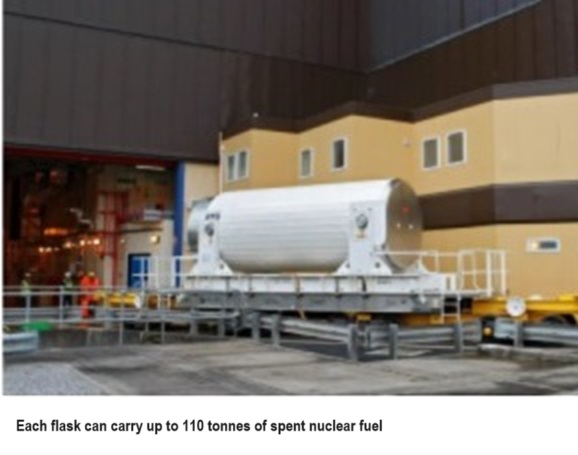
Federica Bedendo, BBC News, North East and Cumbria, 27th Feb 2025,
https://www.bbc.co.uk/news/articles/cpwddyg7e4do
More than 700 tonnes of nuclear waste is due to be shipped to Europe as part of a project to send back spent fuel to the countries that produced it.
The Sellafield nuclear plant in West Cumbria was tasked with reprocessing the nuclear material used to produce electricity in Germany.
Seven cylindric containers, each carrying up to 110 tonnes of recycled nuclear waste, are due to make the journey to the Isar Federal storage facility by sea on a specialist vessel.
A Sellafield spokesman said the move was a “key component” of the strategy to “repatriate high level waste from the UK”.
This will be the second of three shipments from the UK to the European country.
The first shipment of six containers – known as flasks – to Biblis, was completed in 2020.
Each flask is about 20ft (6m) long, with a 8ft (2.5m) diameter.
The waste will be transported by sea on a specialist vessel to a German port, then onwards by rail to its final destination.
Letter: Hinkley Point C will be a Sellafield waste dump
By Jo Smoldon,
Burnham & Highbridge Weekly News 25th Feb 2025, https://www.burnhamandhighbridgeweeklynews.co.uk/news/24957412.letter-hinkley-point-c-will-sellafield-waste-dump/
In response to your Hinkley article around all the jobs created at Hinkley Point C, yes, of course it is good that the nuclear industry is training people to understand the nuclear sites and maybe later the nuclear process.
Nuclear, due to its very, very long-term footprint, has to be understood for thousands of years to come when the radioactive waste will need managing at high costs and high risk on this Hinkley location.
Trying to attract young people into a subject that is very antiquated in its science has been something that government and business will have to invest in forever.
Nuclear power for electricity is made by the last century science of steam driving turbines to condense to hot water.
Two-thirds of the energy produced from the reactors is thrown out in the form of hot water to be discharged into the Severn Estuary, hardly a ‘low-carbon energy’ if looked at in real terms!
What hasn’t been mentioned with all this bigging up the Hinkley site is that it will be the big Sellafield waste dump of the south, as after B station waste has been transferred to Sellafield, no more nuclear waste will move from Somerset.
Radioactive waste will remain on the North Somerset coast forever, how does that fit with the predicted sea level rise, extreme coastal events and Somerset’s regular flooding events?
IAEA Director General Statement on fire Situation in Chernobyl nuclear station

IAEA, 27 Feb 25
Two weeks after it was hit by a drone, Ukrainian firefighters are still trying to extinguish smouldering fires within the large structure built over the reactor destroyed in the 1986 Chornobyl nuclear accident, Director General Rafael Mariano Grossi of the International Atomic Energy Agency (IAEA) said today.
With unrestricted access, the IAEA team based at the site has been closely monitoring the situation following the strike early in the morning on 14 February that pierced a big hole in the New Safe Confinement (NSC), designed to prevent any potential release into the atmosphere of radioactive material from the Shelter Object covering the damaged reactor, and to protect it from external hazards………………………….
Working in shifts, more than 400 emergency response personnel have been participating in the site’s efforts to manage the aftermath of the drone strike.
“The firefighters and other responders are working very hard in difficult circumstances to manage the impact and consequences of the drone strike. It was clearly a serious incident in terms of nuclear safety, even though it could have been much worse. As I have stated repeatedly during this devastating war, attacking a nuclear facility must never happen,” Director General Grossi said……………………………………………………………………. https://www.iaea.org/newscenter/pressreleases/update-278-iaea-director-general-statement-on-situation-in-ukraine
‘Fish disco’ row risks fresh delays to Hinkley Point nuclear plant
EDF has been urged by campaigners to stick with plans to install underwater
loudspeakers to deter fish in the Bristol Channel, as the energy company
grapples with delays to construction of its Hinkley Point C nuclear
reactor.
The row over the “fish disco” deterrent, as it is known in
Whitehall circles, marks the latest salvo in the UK’s long-running battle
to balance growth with environmental protections. Mark Lloyd, chief
executive of The Rivers Trust charity, said France’s state-owned energy
company should keep its commitment to the acoustic fish deterrent, as part
of its Hinkley Point C project.
His comments follow warnings that wrangling
over fish protection risks further delaying completion of the Somerset
power plant, which is already several years behind schedule and billions of
pounds over budget. Plans for the deterrent system involve 288 underwater
speakers that would produce underwater noise louder than a jumbo jet all
day, every day for six decades, according to EDF.
Despite previously
agreeing to build an “acoustic fish deterrent”, EDF is now trying to
scrap those plans, saying they would endanger divers, and is instead
proposing salt marshes to shelter fish. But Lloyd argued that, unless the
acoustic deterrent was installed, “there are likely to be local
extinctions and a very significant impact on marine species throughout the
South West and the Irish Sea”. EDF rejects this characterisation,
pointing out that regulators estimate the amount of fish that will be
harmed without the deterrent is 44 tonnes per year, equivalent to an annual
catch of one small fishing vessel.
FT 26th Feb 2025,
https://www.ft.com/content/28c4cade-d477-4df5-a4b4-cf5ea8dfac95
Nuclear Decommissioning Authority budget raises Sellafield safety concerns
Wednesday 26 February 2025,
https://www.unitetheunion.org/news-events/news/2025/february/nuclear-decommissioning-authority-budget-raises-sellafield-safety-concerns
Safety could also be impacted at 16 other Nuclear Decommissioning Authority sites
Safety concerns over the Nuclear Decommissioning Authority (NDA) budget, which includes Sellafield as well as UK-wide services for nuclear waste and restoration, have been raised by Unite, the UK’s leading union.
The NDA group is responsible for decommissioning and cleaning up 17 nuclear sites. The group’s key operating companies include Sellafield, Nuclear Restoration Services (NRS) and Nuclear Waste Services (NWS).
The CEOs of all the operating companies have all stated that their current budgets are not enough to provide full services.
Unite general secretary Sharon Graham said: “Unite is extremely concerned that UK’s workers at Sellafield, NRS and NWS could be put at risk through efforts to cut costs. If the NDA budget isn’t fit for purpose, the government needs to increase it. Unite will not tolerate attacks on our members’ jobs or any changes that could jeopardise their health and safety.”
Unite national officer Simon Coop said: “Sellafield, NRS and NWS must fully consult with Unite before taking any steps that could endanger workers or impact their jobs, pay or conditions. We will not hesitate to defend our members if actions are taken that put them at risk.”
Ontario’s outdated nuclear vision poses serious safety and financial risks

Intervenors also raised safety concerns about OPG’s plans for the BWRX-300 high-level spent fuel waste. Edwards said an above-ground spent fuel pool, unprotected by a containment structure, is vulnerable
there’s nothing there. There’s really nothing. There are no safety systems to speak of.”
rabble,ca, by Ole Hendrickson, February 26, 2025
As Ontario seeks to build a small modular nuclear reactor, the standards and safety of Canada’s nuclear industry leave something to be desired.
In October 2022, the federal infrastructure bank committed $970 million towards Canada’s first small modular nuclear reactor. Ontario Power Generation (OPG) has applied to construct a 20-story tall, half underground, BWRX-300 boiling water reactor at the Darlington nuclear site near Toronto.
Independent nuclear experts say the reactor poses significant risks. They brought them to the attention of the Canadian Nuclear Safety Commission (CNSC) during a five-day public hearing in January 2025.
On January 8, the first day of the hearing, Ontario Premier Doug Ford issued a press release about Fortress Am-Can, his plan for “economic prosperity in Canada and the United States.” Ford said “With our fleet of nuclear power plants and the first small modular nuclear reactors in the G7, Ontario is uniquely positioned to power the future of Fortress Am-Can.”
Independent experts say that nuclear plants are far costlier than a combination of renewables with energy storage systems and conservation measures. They create intractable waste problems. They are slow to deploy, delaying climate action.
Furthermore, the design of Ontario’s “first small modular nuclear reactor” raises major safety concerns.
The BWRX-300 is a slimmed-down, 300-megawatt version of an earlier 1600-megawatt boiling water reactor design from the American company GE-Hitachi. The U.S. Nuclear Regulatory Commission (NRC) licensed the design, but investors never materialized. General Electric (GE) also designed the boiling water reactors that melted down at the Fukushima Daiichi plant in Japan.
At the CNSC hearing, Dr. Gordon Edwards, a leading independent nuclear expert with the Canadian Coalition for Nuclear Responsibility, disputed claims that the BWRX-300 design is “inherently safe.” He noted that the U.S. NRC has not approved the design. A single system, the Isolation Condenser System, would replace multiple safety systems of its larger predecessor. Edwards suggested that “the eagerness of OPG and CNSC staff to proceed with construction before the design is finalized is based on political, technological, and marketing considerations.”
Sarah Eaton, CSNC’s Director General for Advanced Reactor Technologies, responded for CNSC staff. She said staff use a “trust but verify approach.” CNSC Executive Vice President Ramzi Jammal confirmed that Canada differs from the U.S., where the NRC must certify a design before a license is issued.
Another CNSC staffer, Melanie Rickard, said “We’re talking about hundreds of hours, maybe thousands of hours, to be honest, so that we’re certain that this is going to be acceptable. And we are not certain. There is more work to be done.”
Intervenors also raised safety concerns about OPG’s plans for the BWRX-300 high-level spent fuel waste. Edwards said an above-ground spent fuel pool, unprotected by a containment structure, is vulnerable in a conflict. He added, “look at what’s happening in the Ukraine with the Zaporizhzhia plant with the conflict going on there.”
Dr. Sunil Nijhawan, who followed him, warned that an aircraft impact on a pool with a thousand spent fuel assemblies “can create a radiation disaster affecting Lake Ontario and about five million residences and businesses of southern Ontario.”
Nijhawan said “I’ve been in the industry for a long time. The first time I looked at a boiling water reactor design manual was 50 years ago, 1974, and I’ve kept in touch with development of all sorts of reactor designs… Right now what I see
Intervenors also raised safety concerns about OPG’s plans for the BWRX-300 high-level spent fuel waste. Edwards said an above-ground spent fuel pool, unprotected by a containment structure, is vulnerable in a conflict. He added, “look at what’s happening in the Ukraine with the Zaporizhzhia plant with the conflict going on there.”
Dr. Sunil Nijhawan, who followed him, warned that an aircraft impact on a pool with a thousand spent fuel assemblies “can create a radiation disaster affecting Lake Ontario and about five million residences and businesses of southern Ontario.”
Nijhawan said “I’ve been in the industry for a long time. The first time I looked at a boiling water reactor design manual was 50 years ago, 1974, and I’ve kept in touch with development of all sorts of reactor designs… Right now what I see in this design, to me there’s nothing there. There’s really nothing. There are no safety systems to speak of.”
Nijhawan warned about a loss of “safety culture” throughout Canada’s nuclear industry…………………………….. https://rabble.ca/columnists/ontarios-outdated-nuclear-vision-poses-serious-safety-and-financial-risks/
Starmer drags Britain deeper into war drive

February 25, 2025, Sophie Bolt, CND General Secretary,
https://cnduk.org/starmer-drags-britain-deeper-into-war-drive/?link_id=2&can_id=0a448bf4278898648e02a8f6dea4650f&source=email-starmer-drags-britain-deeper-into-war-drive&email_referrer=email_2633766&email_subject=starmer-drags-britain-deeper-into-war-drive
Starmer’s announcement to increase military spending to 2.5% by 2027 – an additional £13.4 billion annually – at the expense of overseas aid, reflects a Trump-style of international priorities: driving war and militarism whilst abandoning international obligations to halt global hunger and climate devastation. It represents a much more dangerous and damaging role for Britain in the world.
The spending announcement has clearly been rapidly organised ahead of Starmer’s meeting with Trump on Thursday. Nailing his colours very firmly to the Trump mast, Starmer reasserted Britain’s special relationship with the US, and pledged to increase military spending to 3% of GDP after the next election.
These increases are to fund a reckless war drive that risks plunging Europe into decades-long confrontation with Russia, whilst ratcheting up nuclear tensions globally.
Presenting Britain as the European leadership in NATO, Starmer reiterated his so-called peace-keeping operation in a post-settlement Ukraine. In it, 30,000 European troops would be deployed to Ukraine, underwritten by US military might should the ceasefire collapse. The plan has failed to win unity across Europe.
Meanwhile Friedrich Merz, the newly elected Germany Chancellor, has called for France and Britain to share their nuclear weapons to ‘defend’ Europe against Russia. This has also renewed the debate about the use of tactical or ‘battlefield’ nuclear weapons – and whether Britain should develop them on behalf of Europe.
These reckless and terrifying debates around greater nuclear armament for Europe fail to note that Trump has made no statement that US nuclear weapons will be withdrawn from Europe. Or that new ‘battlefield’ nuclear bombs won’t be deployed in Britain. They also fail to acknowledge that, as Britain is totally dependent on the US for its nuclear weapons system, Starmer would have to get permission from Trump if he were to offer them to Europe.
But, of course, whether US, French or British, nuclear weapons deployed in Europe are a disaster. Far from offering protection, the weapons are a constant threat – from the risk of nuclear accidents to nuclear confrontation.
This obscene spending spree on weapons of war won’t bring peace to Ukraine. On the contrary, the £205bn that Europe has pledged to Ukraine since 2022 has contributed to prolonging this terrible conflict, sustaining the huge death toll and pushing the region to the brink of nuclear war. And the impact of the conflict has driven the worsening economic crisis in Britain, across Europe and globally. And if Trump gets his way, the majority of Ukraine’s vast mineral wealth will be siphoned off to the US.
Whilst it is presented as defending Ukraine, this NATO war drive is global. We know that Trump’s ‘America First’ policies are still about maintaining US dominance over the rest of the world. From calls to seize Greenland, Canada and Panama, to ethnically cleanse Palestinians from Gaza, Trump has no respect for sovereignty, human rights and international law. His plans to expand the US Missile Defence System, or ‘the Iron Dome for America’, would enable the Trump administration to use its nuclear weapons without fear of a retaliatory strike. British bases already play a central role in this ‘Iron Dome for America’, making us a target in any global confrontation, yet offering no protection.
This is a very chilling prospect.
Instead of vying for Trump’s approval over which NATO state can increase its military spending highest, Britain and Europe should instead be using this opportunity to reshape the region’s security approach, towards one that is genuinely sustainable and secure. This means Britain ending its military and nuclear alliance with the US. A first step in this would be to scrap the replacement of Britain’s nuclear weapons system. With the government’s own watchdog concluding that the replacement is ‘unachievable’, Rachel Reeves should cut her losses and direct the hundreds of billions into rebuilding crumbling public services and investing in sustainable energy sources.
UK construction and engineering firm Costain has secured a multi-millionpound contract to support the construction of the Sizewell C nuclear powerplant
Costain said under the ten-year framework agreement, the company
will provide support in areas such as delivery integration, health and
safety and quality control. French state-owned energy firm EDF is
developing the 3.2 GW nuclear power station, which could provide up to 7%
of UK energy needs over its 60-year lifetime.
The UK government holds a
76.1% stake in Sizewell C, with EDF holding the remaining 23.9%. Costain
defence and nuclear energy sector director Bob Anstey said the Sizewell C
project is a “vital part of creating a sustainable future”. The
Sizewell C project has attracted significant criticism amid concerns over
its ballooning costs. Earlier this year, campaign group Together Against
Sizewell C (TASC) wrote to the National Audit Office calling for a review
of the government’s value assessment for the controversial nuclear power
station.
The UK Labour government has committed to delivering Sizewell C,
as well as the delayed Hinkley Point C, alongside small modular reactors.
But with Sizewell C investors including Centrica prepared to “walk
away” from investing in the project, there are concerns costs could rise
to more than £40bn.
Energy Voice 25th Feb 2025, https://www.energyvoice.com/renewables-energy-transition/nuclear/567502/costain-secures-multi-million-pound-sizewell-c-contract/
US correct to vote against UN resolution solely condemning Russia for Ukraine war
Walt Zlotow, West Suburban Peace Coalition, Glen Ellyn IL, 26 Feb 25
Less than half of the UN’s 193 member states voted for the Ukrainian resolution in the General Assembly solely condemning Russia for invading Ukraine on the third anniversary of the war.
The vote on the non-binding resolution was 93 to 18 with 65 members abstaining.
In an astonishing reversal of previous US policy at the UN on Ukraine, the US joined Russia and 16 other states in opposing the resolution.
Why?
US Ambassador to the UN Dorothy Shea argued that the Ukrainian resolution ignored that the war actually started 11 years earlier with the Russian Ukraine war that ignited after the 2014 coup that toppled democratically elected Ukraine president Victor Yanukovych.
Shea didn’t mention that the US was heavily involved in supporting the coup in order to prevent Ukraine from partnering economically with Russia. Nor did she mention that after the coup the US heavily armed Ukraine to complete the destruction of the Ukrainian separatist movement seeking freedom from Kyiv’s policy of destroying Ukrainian Russian culture in the Donbas. Shea also omitted that 14 years of US efforts to bring Ukraine into NATO crossed a red line for Russia that would inevitably provoke a Russian invasion.
But all of these critical omissions were implicit in the Trump administration’s refusal to continue the Biden administration’s fantasy that President Putin woke up one day in February, 2022 and decided to attack Ukraine unproved.
This was a welcome dose of reality sorely missing from the Biden administration for all two years, eleven months of their proxy war to weaken Russia using Ukrainian proxies to do all the dying.
President Trump is telling the world that this war must end with a settlement based on reality. Ukraine will not join NATO. Ukraine will not get back the oblasts containing Russian cultured Ukrainians seeking relief from endless destruction by their own government. Ukraine will refrain from being a US/NATO Trojan Horse to keep Russia out of the Western Europe political economy. Most importantly, the US and Russia can normalize diplomatic relations and end three years of risking nuclear annihilation from America’s zero sum game approach to the war.
Based on the vote of Ukraine’s one sided resolution putting all the blame on Russia, a majority of UN members agree with the Trump path to peace.
Iran on ‘high alert’ amid fears of attack on nuclear sites
Officials say measures are in response to growing concerns of potential joint military action by Israel and US
Iran has put its defence systems around its nuclear sites on high alert amid fears of an attack by Israel and the US, The Telegraph has learnt…
According to two high-level government sources, the Islamic Republic has
also been bolstering defences around key nuclear and missile sites, which
include the deployment of additional air defence system launchers.
Officials say the measures are in response to growing concerns of potential
joint military action by Israel and the United States.
Telegraph 25th Feb 2025, https://www.telegraph.co.uk/world-news/2025/02/25/iran-missile-defences-high-alert-attack-fears-us-israel/
EDF appears to consider reduced final stake in Sizewell C nuclear to as low as 10%

New Civil Engineer, 24 Feb, 2025 By Tom Pashby
French state-owned energy giant EDF which is the sole operator of nuclear power plants in the UK has said it will consider becoming a 10-19.99% owner of Sizewell C, having previously committed up to 20%.
EDF previously confirmed in its 2024 half year results that Sizewell C is owned 76.1% by the UK Government and 23.9% by EDF.
Despite the final investment decision (FID) still not having been made, approximately £5.5bn of taxpayer money has been committed to the scheme, and contractors have been awarded £2.5bn of works which are underway ahead of main construction.
Speculation about the ownership of Sizewell C abounds because of the secrecy around the process, the potential for much of the £40bn investment to be stumped up by the taxpayer, and Centrica’s recent comments which weakened confidence in the scheme.
Centrica CEO Chris O’Shea said the energy company’s stake in Sizewell C could be “between 1% or 2% and 50%”.
“I’m not going to commit Centrica money for something that won’t give us the returns we need.”
EDF previously said it would own maximum 20% stake
In a press release from EDF on 20 December 2022, the company said: “EDF will only retain a minority stake of a maximum of 20% at final investment decision”.
Since the 20% figure was announced, French public spending watchdog Cour des comptes said EDF should scale back involvement in UK nuclear projects.
The auditor said “a final investment decision on [Sizewell C] should not be approved until a significant reduction in EDF’s financial exposure to the Hinkley Point project has been achieved.
………………….Ownership stake scaled back to 10-19.99%
EDF’s 2024 Annual results document laid out its contribution to the power plant which is “subject to some conditions, including … a share in ownership of the project of 10 to 19.99%, including a cap on financial exposure in value.”
It also requires “A return on capital expected by EDF as an investor in line with market return for this type of assets, risk allocation profile and its investment policy.”
It is understood that the reason for selecting 19.99% rather than 20% is because a company buying 20% would have to set up a subsidiary entity to take the ownership.
Another aspect of any ownership stake is a requirement to take on debt.
A UBS spokesperson told NCE: “The project would have something like £4bn of debt for every £2bn equity.”
Anti-Sizewell C groups say EDF appears to be attempting to ‘wriggle out’ of ownership
Stop Sizewell C executive director Alison Downes said: “The mention of this lower percentage stake (10%) in EDF’s results is significant.
“EDF’s leadership is clearly strapped for cash and doesn’t seem to buy its own rhetoric that replication could result in Sizewell C being built on time, significantly cheaper than Hinkley C – and neither do we.
“A reduction in EDF’s stake would leave the UK government with an even bigger costly void to fill.”
Downes also pointed out that regardless of EDF’s ownership status, the company would still likely get a construction contract since no other company has the relevant expertise.
Together Against Sizewell C spokesperson Chris Wilson said it was no surprise that “EDF hope to wriggle out of their financial commitment to the Sizewell project by suggesting a cap on their exposure and a reduction in their investment down to 10%”.
Wilson said this was not surprising given that EDF is “struggling to find investors to plug the £8bn- £13bn gap in the funding they need to finish the Hinkley Point C (HPC) build and the French state auditor’s advice to not take a final investment decision in Sizewell C until their exposure at HPC is reduced.”
“As the UK govt scrabble around for the likely £40 billion for the Sizewell C development, it’s hardly a good advert to potential investors that we now have EDF, the original promoter, hoping to reduce their exposure to as low as 10%”, Wilson said…………………………………………….. https://www.newcivilengineer.com/latest/edf-appears-to-consider-reduced-final-stake-in-sizewell-c-to-as-low-as-10-24-02-2025/
We can’t afford Doug Ford’s nuclear fantasy

When it comes to energy, any economic strategy for Ontario has to focus on controlling energy costs and improving energy productivity, not energy production.
Feb. 26, 2025, By Mark Winfield. Mark Winfield is a professor of environmental and urban change at York University, co-chair of the faculty’s Sustainable Energy Initiative, and co-editor of Sustainable Energy Transitions in Canada (UBC Press 2023). https://www.thespec.com/opinion/contributors/we-cant-afford-doug-ford-s-nuclear-fantasy/article_818e4f2d-0f80-50bf-a4c4-7abaf277ebb1.html
Doug Ford’s proposal to bury Highway 401 lanes from Brampton or Mississauga in the west to Scarborough or Markham in the east, with an estimated price tag of at least $100 billion, has been described as being a “fantasy that would bankrupt” the province.
Although the 401 proposal has drawn the most attention among the Ford government’s increasingly grandiose infrastructure proposals, it actually isn’t the largest.
That status goes to the government’s plans to dramatically expand the province’s now aging fleet of nuclear reactors. A 10,000-megawatt (MW) facility proposed just before the election call for Wesleyville, Ont., between Coburg and Kingston, could break the $200-billion mark in capital costs alone.
That estimate is based on the actual costs of the most recently completed nuclear construction project in North American, the Vogtle plant in Georgia. That facility, completed last summer, came in at $50 billion (Canadian) for 2,200 MW capacity. A simple extrapolation of those costs to the Wesleyville project would give a figure of over $200 billion.
But there is even more to the Ford government’s nuclear plan.
A proposed new 4,800-MW facility at the Bruce nuclear site, would come in around $100 billion on the same basis. New estimates by the U.S. Tennessee Valley Authority on the costs of the type of the four 300-MW reactors proposed for the Darlington site suggests costs in the range of $25 billion.
To this has to be added the costs of the refurbishments of the existing reactors at Bruce, Darlington and potentially, the Pickering B site, with potential costs of between $35 billion and $50 billion.
For context, the scale of Ontario’s nuclear proposals, relative to provincial GDP, would be comparable to that of the Muskrat Falls hydro project in Labrador. That project really did push the Province of Newfoundland and Labrador to the brink of bankruptcy, save for a massive federal bailout.
At least the Muskrat Falls project was subject to external economic and environmental reviews. Unfortunately, the warnings flowing from those reviews about the project’s risks were ignored. In contrast, none of Ontario’s proposals have been subject to any form of meaningful external review in terms of their economic, technological or environmental rationality.
The Ford government’s nuclear heavy strategy appears to be premised on an assumption that a massive nuclear expansion program will turn Ontario into an electricity production and export “superpower.”
The fundamental problem with strategy is that Ontario has no comparative advantage in electricity production.
Comparative advantage in energy tends to be a product of accidents of geography. Ontario was the beneficiary of such an accident through the first half of the 20th century, where hydro-electricity, principally from Niagara Falls, provided the foundation of the industrial base that was built through the Golden Horseshoe around the western end of Lake Ontario, from Niagara to Oshawa.
But that advantage was lost from the early 1960s onward when the province ceased to be a hydro-dominated system, turning first to the construction of coal-fired plants, and then a massive nuclear construction program from the 1960s to the 1990s.
Ontario turned out to be no better at building and operating these types of plants than anyone else in North America.
The province therefore lost its comparative advantage in electricity production. The recent experience with attempts at constructing new nuclear facilities in the U.S. and Europe, like the Vogtle project, suggest such advantage cannot be restored through a nuclear expansion program. Renewable energy sources, combined with energy storage offer much more cost-effective, lower-impact and lower-risk options.
Instead, when it comes to energy, any economic strategy for Ontario has to focus on controlling energy costs and improving energy productivity, not energy production. The province is already taking $7.3 billion a year from general revenues, funds that otherwise would be spent, for example, on schools and hospitals, to artificially lower hydro costs for industrial and residential consumers.
The Ford government has given no indication of what its nuclear expansion program will cost or how it will be financed. Past experience tells us it will be Ontario electricity ratepayers and taxpayers who are likely to be ultimately stuck with the bills.
Ontario needs to engage in a serious debate about the future of its energy systems. But it needs to look to pathways to decarbonize the province without risking bankrupting it in the process.
Election candidates should face nuclear waste questions: group

THE CHRONICLE-JOURNAL, Feb 25, 2025, https://www.chroniclejournal.com/news/local/election-candidates-should-face-nuclear-waste-questions-group/article_e5e12318-f322-11ef-aede-0bca88dc7589.htm
With just two days to go before the provincial election, two citizen watchdog groups are urging voters to grill candidates over where they stand regarding alternatives to nuclear power, and what to do with the nuclear waste that exists now.
In particular, the We The Nuclear Free North and Northwatch groups want candidates to commit to giving first responders notice before nuclear waste is transported through areas in which they provide emergency services.
The groups maintain that question is crucial in the Thunder Bay district, since the Nuclear Waste Management Organization is proposing to build an underground storage site for spent nuclear fuel rods at a remote location between Ignace and Dryden.
The two groups have set up an online tool that can be used to put questions to provincial-election candidates about the project and request a response. The link to the tool is: tinyurl.com/2x9uct7a.
Radioactive fuel rods are to be shipped to the storage site by truck or rail in specialized containers designed to withstand fiery crashes, hard impacts and immersion in water, according to the Nuclear Waste Management Organization.
The storage site is expected to take 20 years to build once all approvals have been obtained.
SCOTUS goes nuclear: Justices’ decision could seal spent fuel storage options for decades.

Ultimately, the Supreme Court will not be hearing technical, economic, or social arguments in this case; the matters of interest are purely legal. These legal interpretations, however, will have profound implications for how commercial spent nuclear fuel is handled until plans for permanent repositories are developed.
Bulleting of Atomic Scientists, By Riley Fisher, Muhammad Abdussami, Aditi Verma | February 20, 2025
US nuclear waste policy is at a critical turning point. Mired in decades of disappointments and shortcomings, the monkey on nuclear power’s back is just weeks away from being freed—or being strapped in place. The issue at hand: whether the Nuclear Regulatory Commission (NRC) had the legal authority to grant a permit for the construction and operation of a privately-owned temporary spent nuclear fuel storage facility in Texas.
On March 5, 2025, representatives from the NRC and the state of Texas will convene in Washington, D.C., to argue this issue in front of the United States Supreme Court. The NRC v. Texas case will end a battle of nearly three and a half years over the legality of privately-owned interim nuclear waste storage in the United States. However, while the Supreme Court’s ruling will settle the battle, it will resolve only one aspect of the US nuclear waste management problem.
A ruling favoring the NRC would help the nuclear waste problem in the short term but might harm the long-term management situation, allowing the consolidation of spent nuclear fuel at interim storage facilities—a state of affairs that could place new constraints on the permanent solution of geological disposal. Conversely, a ruling against the NRC would hurt the waste problem short-term by halting interim storage plans—including those of Interim Storage Partners in Texas and Holtec International in New Mexico—but it would leave future permanent storage options unconstrained.
Temporary storage. For more than 40 years, temporary, consolidated nuclear waste storage has been a hot-button issue. The Nuclear Waste Policy Act of 1982 tasked the president and the Energy Department with identifying, constructing, and operating nuclear waste storage facilities in underground repositories. With this act, Congress intended to create a program that permanently stowed away the hazardous waste produced by nuclear power operations.
The original provisions of the Nuclear Waste Policy Act gave the president four years to start the construction of a geologic repository site following congressional approval. During this process, nuclear power plants were still operating and producing spent nuclear fuel, and Congress clarified that plant operators were primarily responsible for waste management while the executive branch did their repository siting and construction work. Under exceptional circumstances, however, the federal government was allowed to provide a limited amount of “interim” storage before the waste was transferred to a permanent facility. The federal interim storage program would temporarily consolidate spent fuel away from reactor sites that have limited capacity.
But when efforts for a permanent repository at Yucca Mountain in Nevada stalled, the role of consolidated interim storage was put in a precarious position. Spent fuel continued to accumulate at nuclear power plants across the country, the federal government could not provide more temporary storage because it would violate the Nuclear Waste Policy Act, and the NRC did not have explicit authority to license an external body to create temporary storage. This tension is the impetus for NRC v. Texas case now at the Supreme Court.
There are a variety of arguments both for and against temporary storage of commercial spent nuclear fuel in the United States. Proponents cite that reactor host communities should not be subjected to living near radioactive waste for more time than they initially consented; interim storage, they say, would increase safety and economic efficiency through consolidation. Critics, in contrast, argue that a community near an interim facility risks the same fate of non-consent in the event of further delay in creating a permanent waste repository and that the safety risks from additional transportation and shuffling outweigh the benefits of consolidation.
Ultimately, the Supreme Court will not be hearing technical, economic, or social arguments in this case; the matters of interest are purely legal. These legal interpretations, however, will have profound implications for how commercial spent nuclear fuel is handled until plans for permanent repositories are developed.
Lower court’s contradictory ruling. Two main questions will be argued in NRC v. Texas. The first is a matter of administrative process and pertains to whether Texas had the legal right to challenge the NRC in the first place. Texas first challenged the commission under the 1950 Hobbs Act (which is not the Hobbs Act used in criminal prosecutions of organized crime), an administrative law statute that gives “aggrieved parties” the right to challenge federal agency actions. The NRC claims Texas did not follow proper procedure to be considered an aggrieved party and, therefore, did not have authority to challenge the license.
The second question is a matter of the function and authority of the NRC and is rooted in the language of the Atomic Energy Act of 1954. Texas argues that the NRC only has authority to grant temporary spent nuclear fuel storage licenses on the site of the reactor from which the waste originated. Therefore, Texas claims, the commission had no right to grant the license for a temporary storage facility in the state. The NRC, however, cites multiple previous court decisions that uphold this authorization. These federal-state disputes make a case like this ripe for Supreme Court intervention.
Like most other Supreme Court cases, NRC v. Texas is an appeal of a previously decided case in a lower court: Texas v. NRC. …………………………………………………………………………………………………………
NRC’s appeal. The Supreme Court may decide in a variety of ways concerning Texas’ authority under the Hobbs Act and the NRC’s authority under the Atomic Energy Act and the Nuclear Waste Policy Act. While clarification as to whether Texas was a proper “party aggrieved” is certainly important, it is likely the Supreme Court will take the opportunity to define the scope of the NRC’s abilities regardless of the interpretation of the Hobbs Act. Even if the Supreme Court finds that Texas was not a proper “party aggrieved,” the Court will still have the ability to hold the issued license void despite improper administrative procedures taken by Texas.
………………………………………………………. Because there is no explicit authorization in either act, the Supreme Court will likely rule that the NRC lacks clear congressional approval. If this is the case, then the Supreme Court will have to decide whether private, off-reactor spent fuel storage is a matter of major national significance— also known as a “major question.” While the Supreme Court has yet to hear arguments on this specific issue, there are reasonable explanations for either ruling.
……………………………………Some legal experts argue that private off-reactor waste is not a major question. Because on-site storage is exorbitantly expensive, a consolidated interim facility operated by a private entity will likely alleviate taxpayers’ burden. The West Virginia case was decided partially on its nationwide economic implications, but such implications are not present in this case. Another argument is that the NRC issued its regulations for private off-reactor storage two years before the Nuclear Waste Policy Act was passed. The fact that Congress did not revoke this authority from the NRC when passing the act could be interpreted as implicit approval. If the Supreme Court agrees with this perspective, it will likely allow Interim Storage Partners’ license to stand, even if the NRC did not have the explicit authority to issue that license.
Other arguments exist for this issue being a major question……………………………………
No perfect ruling. Either ruling will no doubt have vast consequences on the US nuclear waste management problem. A ruling in favor of the NRC would provide support for the nuclear industry’s ability to manage spent fuel, particularly during the continuous delays in permanent repository development. This result could also encourage private investment in nuclear energy by providing clearer pathways for managing waste, potentially revitalizing confidence in the industry’s long-term viability. However, a decision in NRC’s favor would not resolve all concerns with nuclear waste management. Many communities oppose the siting of temporary storage facilities, citing safety risks and the lack of a permanent solution. Resistance will continue to grow at local and state levels if these broader concerns go unaddressed. Congress will need to continue developing directives that strengthen and complement private solutions to waste management. A ruling in favor of the NRC would undoubtedly be a win for the nuclear industry, the federal government, and reactor host communities, as short-term pressures caused by on-site waste storage can finally be addressed. In the long term, this ruling will do little to permanently solve the waste problem and may place the nuclear industry into a false sense of security amidst concerns of interim facilities becoming de facto repositories.
If the Supreme Court rules against the NRC, it will create substantial uncertainty for the nuclear industry by rejecting the NRC’s authority to license private off-site storage facilities. Other corporations that currently plan to construct such facilities, such as Holtec International in New Mexico, will risk the revocation of their licenses. Decommissioned reactors with on-site storage may face danger to their storage license renewals, which will force active reactor sites to take in external waste while still generating their own. Situations like these can heighten safety and security risks, as many sites lack the infrastructure or oversight necessary for long-term storage and management.
However, a ruling against the NRC may bring increased attention to the issue and compel Congress to act decisively. ……………………………………… . A ruling against the NRC will likely be to the immediate detriment of the nuclear industry, the federal government, and reactor host communities. These pressures, however, may urge lawmakers to develop a new, permanent solution once and for all.
In the context of the nuclear waste problem, a ruling in favor of the NRC will be a short-term benefit but bring long-term risks. A ruling against the NRC will be a short-term detriment but may spur renewed action for long-term solutions. Regardless of the Supreme Court’s decision, Congress must dictate a permanent solution, which will be less likely to occur if short-term pressures are alleviated by ruling in favor of the NRC. In the absence of immediate Congressional intervention, the nuclear industry and the Energy Department must still work closely and in good faith with host communities. Anything else will result in complete failure of fair and democratic planning—as has been observed time and time again.
Editor’s note: Arguments on the NRC v. Texas case will be held before the Supreme Court on March 5, 2025. Summaries, audio files, and opinions will be accessible here after the hearing. The Supreme Court will issue its opinion before recess in late June 2025. Proceedings and orders will be made available as they come here. https://thebulletin.org/2025/02/scotus-goes-nuclear-justices-decision-could-seal-spent-fuel-storage-options-for-decades/
1 This Month





PLEASE OPPOSE HR 8255 AND S.3639 – bills would accelerate satellite deployment, with no environmental review or safeguards – https://ncstd5li.quorum.us/campaign/169331/
To see nuclear-related stories in greater depth and intensity – go to https://nuclearinformation.wordpress.com
-
Archives
- October 2026 (74)
- September 2026 (339)
- August 2026 (330)
- July 2026 (355)
- June 2026 (287)
- May 2026 (306)
- April 2026 (356)
- March 2026 (251)
- February 2026 (267)
- January 2026 (308)
- December 2025 (358)
- November 2025 (359)
-
Categories
- 1
- 1 NUCLEAR ISSUES
- business and costs
- climate change
- culture and arts
- ENERGY
- environment
- health
- history
- indigenous issues
- Legal
- marketing of nuclear
- media
- opposition to nuclear
- PERSONAL STORIES
- politics
- politics international
- Religion and ethics
- safety
- secrets,lies and civil liberties
- spinbuster
- technology
- Uranium
- wastes
- weapons and war
- Women
- 2 WORLD
- ACTION
- AFRICA
- Atrocities
- AUSTRALIA
- Christina's notes
- Christina's themes
- culture and arts
- Events
- Fuk 2022
- Fuk 2023
- Fukushima 2017
- Fukushima 2018
- fukushima 2019
- Fukushima 2020
- Fukushima 2021
- general
- global warming
- Humour (God we need it)
- Nuclear
- RARE EARTHS
- Reference
- resources – print
- Resources -audiovicual
- Weekly Newsletter
- World
- World Nuclear
- YouTube
-
RSS
Entries RSS
Comments RSS

