93% say NO: latest polls in Lincolnshire condemn nuke dump plan

In yet another demonstration that the people of East Lincolnshire are a far from ‘willing community’, recent polling at public events hosted by Nuclear Waste Services and amongst the parishioners of Gayton-le-Marsh have delivered a resounding NO vote to any plans to bring a nuclear waste dump to the area.
Nuclear Waste Service have recently resolved to move its Area of Focus in the Theddlethorpe GDF Search Area from the former Conoco gas terminal inland to 1,000 acres of prime farmland between the villages of Great Carlton and Gayton-le-Marsh.
NWS has held a series of information meetings to explain their decision. Theddlethorpe and Withern Councillor Travis Hesketh and activists from the Guardians of the East Coast established a polling booth outside events held in Gayton-le-Marsh, Strubby, Beesby, Maltby-le-Marsh, Great Carlton, Little Carlton, Withern, Theddlethorpe, Legbourne, Grimoldby, Manby and Saltfleetby, and invited members of the public to cast their secret ballot on the latest iteration of NWS’s plans to bring a Geological Disposal Facility to the area.
Of the 535 residents attending the events, 93% voted in the secret ballot; of these 93% voted for the process to be ended or for a Test of Public Support to be held now.
24th February 2025
93% say NO: latest polls in Lincolnshire condemn nuke dump plan
In yet another demonstration that the people of East Lincolnshire are a far from ‘willing community’, recent polling at public events hosted by Nuclear Waste Services and amongst the parishioners of Gayton-le-Marsh have delivered a resounding NO vote to any plans to bring a nuclear waste dump to the area.
Nuclear Waste Service have recently resolved to move its Area of Focus in the Theddlethorpe GDF Search Area from the former Conoco gas terminal inland to 1,000 acres of prime farmland between the villages of Great Carlton and Gayton-le-Marsh.
NWS has held a series of information meetings to explain their decision. Theddlethorpe and Withern Councillor Travis Hesketh and activists from the Guardians of the East Coast established a polling booth outside events held in Gayton-le-Marsh, Strubby, Beesby, Maltby-le-Marsh, Great Carlton, Little Carlton, Withern, Theddlethorpe, Legbourne, Grimoldby, Manby and Saltfleetby, and invited members of the public to cast their secret ballot on the latest iteration of NWS’s plans to bring a Geological Disposal Facility to the area.
Of the 535 residents attending the events, 93% voted in the secret ballot; of these 93% voted for the process to be ended or for a Test of Public Support to be held now.
Carlton Parish Council has previously passed a resolution calling for an immediate Test of Public Support, and the villagers of Gayton-le-Marsh made a similar resolution in a parish poll. 80% of parishioners participated, with 106 residents or 91% calling for the proposal to be withdrawn and 108 or 93% seeking a Test of Public Support.
These are the two latest blows in a whole series showered on Nuclear Waste Services, who must by now be punch-drunk, with most local Parish and Town Councils also passing resolutions calling for an immediate withdrawal or Test of Public Support.
In the last local elections held in 2023, a slate of anti-dump candidates was elected in wards within the Theddlethorpe GDF Search Area to East Lindsey District Council, Mablethorpe and Sutton Town Council, and local parish councils.
Surveys carried out by Guardians of the East Coast have previously indicated at least 85% are opposed to the nuclear waste dump plan.
The local Conservative MP for Louth and Horncastle Victoria Atkins has expressed her opposition to the plan and even the Leader of East Lindsey District Council Councillor Craig Leyland has had a change of heart indicating that he shall now be recommending to his Executive that the Council withdraw from the process.
To the NFLAs, Nuclear Waste Services continued efforts to pursue a GDF in East Lincolnshire represents the ultimate exercise in futility, for there are NO conceivable circumstances in which this will ever be a ‘willing community’.
Public concern increasing about nuclear waste shipments west of Sudbury

Northern Ontario News, By Ian Campbell, February 24, 2025
Officials in Nairn & Hyman Township say they are encouraged by the turnout at last week’s public information meeting as they continue to oppose the shipment of nuclear materials near Agnew Lake.
The Township of Nairn and Hyman and the Township of Baldwin held a joint emergency council meeting this week to discuss a plan to move radioactive material from the former Beaucage Mine. (Photo from video)
The township, along with the neighbouring community of Baldwin, has been vocal in its opposition to plans that would see nuclear waste transported to a nearby tailings management area west of Sudbury.
While the shipment plan is currently on hold, concerns remain about the potential environmental and health impacts of the proposal.
Nairn & Hyman Mayor Amy Mazey said the municipalities have been told not to expect answers to their questions until March 15.
In the meantime, Mazey and the township’s chief administrative officer said studies conducted by the municipality suggest the shipments could pose a risk to the local drinking water supply.
“When we get answers to our questions, we’re hoping to do another town hall meeting and show the town residents what we have received,” Mazey said.
“I’m pretty sure they’ll still be pretty negative towards it, but [we’ll] give them that update and then go to council and make a decision on how to move forward from there.”
The townships have garnered support from several political figures, including Nickel Belt’s Member of Parliament, a former Member of Provincial Parliament and the current candidate for the Algoma-Manitoulin riding.
Neighbouring communities along the North Shore have also joined the effort to oppose the shipments.The issue has sparked significant public interest, with residents expressing concerns about the long-term implications of storing nuclear materials in the area.
Mazey emphasized the importance of keeping the community informed and involved as the situation develops, when speaking with CTV News.
For now, the townships await further information and continue to prepare for next steps, including potential council decisions and further public engagement.
A Lawsuit Against Greenpeace Is Meant to Bankrupt It and Deter Public Protests, Environmental Groups Warn

.“This case and its outcome should be
the concern of every American,” a legal expert says as the Dakota Access
Pipeline trial is set to begin. Next week, not far from where thousands of
Indigenous and environmental activists gathered in North Dakota nine years
ago in opposition to the Dakota Access Pipeline, one of the most
consequential trials to emerge from that conflict is set to begin. The
case, filed by pipeline developer Energy Transfer, accuses Greenpeace of
defaming the company while funding and supporting some protesters who
damaged its property. On its face, the trial is an attempt to seek millions
of dollars in damages from an environmental group for campaigning against a
pipeline project. At its heart, however, many activists, legal experts and
even the company’s chief executive say the case is about much more.
“It’s about really the silencing of the Greenpeace entities,” said
Sushma Raman, interim executive director of Greenpeace USA, during a press
call Thursday, referring to how both the organization’s U.S. arm and its
international parent are named. “It’s about trying to bankrupt some of
the entities, and more importantly it’s silencing and sending a message
to broader civil society.”
Inside Climate News 21st Feb 2025, https://insideclimatenews.org/news/21022025/greenpeace-lawsuit-meant-to-deter-public-protests/
German election results tilt EU back toward nuclear energy

Pro-atomic countries are optimistic that center-right winner Friedrich Merz can help ease the EU’s never-ending nuclear spat.
They might not know it yet, but
Germans helped put one of the European Union’s oldest and most polarizing
debates to bed when they voted this past weekend. At least that’s the
hope from the EU’s pro-nuclear countries. That cabal of around a dozen
capitals is looking expectantly at Friedrich Merz, the center-right leader
who has vowed to ease the taboo on atomic power. Merz is in line to become
chancellor after his party won the most votes in Sunday’s election. That
could, in turn, ease a perpetual Brussels logjam blocking pro-nuclear
policy.
Politico 24th Feb 2025 https://www.politico.eu/article/germany-election-eu-nuclear-power-energy/
Nuclear site warns £2.8bn budget is ‘not enough’

BBC 24th Feb 2025
Planned work to decommission the UK’s largest nuclear site could have to be slowed down or paused due to insufficient funding, managers have warned.
Sellafield Ltd, which manages the site near Seascale in Cumbria, said its £2.8bn funding for the 2025-26 financial year would “not be enough” for the planned operations.
The GMB union urged Sellafield to be transparent about the impact of the budget restraints on workers.
The Department for Energy Security and Net Zero said Sellafield’s safety and security was their “top priority”.
In October the spending watchdog, the National Audit Office, said the site was not “value for money” and it had spent £1.9bn more than it earned in 2023-2024.
It is understood that while the funding for the 2025-26 financial year is similar to the one for the 2024-25, it does not take into account inflation and rise in energy prices.
Employee fears
The funding is indicative and is expected to be confirmed soon, but Sellafield said the forecast budget would impact its supply chain.
A spokesman added: “Critical work will continue but some projects will need to be slowed down, paused, or stopped.”…………………………..
https://www.bbc.co.uk/news/articles/cm2yvpx8xp1o
Sellafield nuclear site plans cuts as chief says £2.8bn funding ‘not enough’
Union concerned over safety as site’s bosses say budget does not cover work planned.
Alex Lawson and Anna Isaac, Guardian, 25 Feb 25
Sellafield has said nearly £3bn in new funding is “not enough” and bosses are now examining swingeing cuts, prompting fears over jobs and safety at the vast nuclear waste dump.
The Cumbrian nuclear site, which is home to the world’s largest store of plutonium, was last week awarded £2.8bn for the next financial year, the bulk of the total of just over £4bn funds allotted to the Nuclear Decommissioning Authority, a taxpayer-owned and funded quango.
Sellafield’s chief executive, Euan Hutton, has told staff that the funding was “not enough” to carry out planned works, leaving bosses to make “difficult decisions” over spending, sources told the Guardian.
A spokesperson for Sellafield said: “While this is significant funding, it will not be enough for all our planned activities. Critical work will continue but some projects will need to be slowed down, paused, or stopped. This will impact parts of our supply chain.”
Hutton told employees at the site – which employs more than 10,000 people – that all areas of the business will be affected and spending reviewed.
It is understood that internal calculations had forecast that at least £3.1bn would be needed to meet Sellafield’s spending requirements next year, when accounting for rising costs. The site was awarded £2.8bn for the current financial year.
The public spending watchdog has said the ultimate cost of cleaning up Sellafield is expected to rise to £136bn, causing tensions with the Treasury as the chancellor, Rachel Reeves, attempts to tighten public spending and spur growth.
In 2023, the Guardian’s Nuclear Leaks investigation revealed a string of safety concerns at the site – from issues with alarm systems to problems staffing safety roles at its toxic ponds – as well as cybersecurity failings, radioactive contamination and allegations of a toxic workplace culture.
Hutton has not told staff which projects could be paused or stopped at the site, which covers two square miles and hundreds of buildings. Staff carry out a range of work from painstakingly emptying the toxic ponds to building new facilities to house nuclear waste.
Hutton said that safety and security would be prioritised and the site would adhere to legal and regulatory rules, sources said.
However, staff at the hazardous toxic site in north-west England remain concerned that cuts to spending could affect safety and jobs.
Dan Gow, a senior organiser at the GMB union, said: “GMB calls on Sellafield to be fully transparent about any cost-saving measures and to engage with us to ensure the workforce is protected.
“No worker should ever have to fear that budget cuts will put their safety at risk.
“GMB is urging all workers to stand together, stay informed, and ensure their voices are heard. Now more than ever, being part of a strong, organised union is the best way to protect jobs, rights and safety.”
The Office for Nuclear Regulation last week took Sellafield out of special measures for its physical security – but said concerns remained over its cybersecurity……………………………https://www.theguardian.com/environment/2025/feb/24/sellafield-nuclear-site-cuts-funding-union-spending
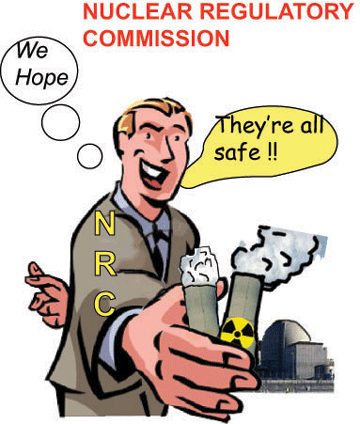
United States: White House Threatens Nuclear Regulatory Commission’s Independence
Energy Intelligence Group, Jessica Sondgeroth, Washington, 21 Feb 25,
The Trump administration’s expansive assertion of presidential power now threatens the independence of the US Nuclear Regulatory Commission (NRC) after the White House this week issued an executive order (EO) claiming control over federal agencies that were established to be independent of politics. The Feb. 18 EO tasks the White House’s Office of Management and Budget (OMB) with the authority to manage independent agencies’ obligations and spending to ensure they align with “the President’s policies and priorities.” These agencies will also have to submit for review to an OMB office “all proposed and final significant regulatory actions.” The extent to which this erodes the NRC’s independence may vary depending on how NRC responds and on OMB actions taken, but nuclear energy sector veterans, critics and advocates are nonetheless waving red flags.
The White House decision “to meddle in safety regulation” is “devastating,” former NRC chair Allison Macfarlane, now a policy professor at the University of British Columbia, told Energy Intelligence. “The US NRC used to be referred to as the ‘gold standard’ for nuclear regulators. No longer. Now other countries can take that mantle.” Macfarlane said that as NRC chair, she spent years championing regulatory independence “to ensure national security and economic security. A nuclear accident, as happened in Japan, can devastate a country’s economy, not to mention its nuclear industry. I guess the folks at the White House have never learned this lesson?”
The EO, titled “Ensuring Accountability for All Agencies”, is only the latest White House challenge to the independence of various executive agencies and to Congressional lawmaking, from science and health research to environmental oversight to public education. This particular EO seeks to broaden the White House’s authority over independent regulatory agencies, including the Federal Trade Commission, Federal Energy Regulatory Commission, Federal Communications Commission and Securities and Exchange Commission. The EO does make some exceptions, but the NRC is not among them.
……………………………………………Given “the blatant and unmitigated conflicts of interest in the White House, and the newfound love among Trump and Elon [Musk]’s tech bro friends for nuclear power,” Ed Lyman, a nuclear regulatory watchdog at the Union of Concerned Scientists, warned in an email that the agency “could be turned into a mere rubber stamp for whatever projects are favored by the President at the moment.” This could override the NRC’s “public health and safety mandate in the name of ‘consistency with the President’s policies and priorities.'”
The NRC was established as an independent agency by Congress in the Energy Reorganization Act of 1974. That law took the NRC’s predecessor, the Atomic Energy Commission, and split its regulatory and promotional roles into the NRC and what is today the US Department of Energy (DOE), respectively. “The NRC was explicitly created to be independent of energy system policy goals under the Atomic Energy Commission that Congress perceived as too political and influenced by the industry,” Adam Stein, nuclear energy innovation director, noted. “Shifting from an independent agency to an agency under direct control of one party under the President creates the same problem from a different influence.”
……………………The nuclear industry lobbies Congress for favorable policies but also communicates directly with the NRC through filings and public meetings to advocate for its interpretation of Congressionally-mandated regulatory reforms.
…………………….For agencies as specialized as the NRC, mass layoffs or buyouts threaten to undermine core competencies and training activities — particularly given the recent hiring of 600 staff, a growing workload of new reactor licensing activities and concerns over the aging workforce.
https://www.energyintel.com/00000195-25b1-ddbd-a9dd-3ff520010000
Opposition to new small nuclear power plants in south Wales

There are plans for four “micro” nuclear reactors in the Llynfi Valley, Bridgend.
WalesLOnline, By Lewis Smith, Local Democracy Reporter, 21 FEB 2025Green Party members in Bridgend have said they are opposed to plans for a nuclear power plant project in the Llynfi Valley describing it as “unnecessary, unwanted and unsafe”.
The multi-million proposals could eventually see the creation of a facility with four micro modular nuclear power plants on the site of the former coal-powered Llynfi Power Station, if given the go-ahead……………
the Bridgend branch of the Green Party have now issued a statement opposing the potential power station, raising concerns over safety with what they say is an “untested” design planned for the site.
……………… Part of the statement added: “This is a new design which if built will be the first of its kind. So the design is untested in the real world. Locals, including local Green Party members have several credible reasons for concern.
“The Green Party questions the need for a nuclear power plant, when Wales has the natural resources required to produce all its energy from a mixture of solar power, onshore and off-shore wind generation.”
“The risk of nuclear leaks, from the on-site nuclear waste storage is not acceptable. Who will pay for future nuclear waste storage? There is a risk that no other region of the UK will be willing to store the nuclear waste, and that this area will become a long term nuclear waste storage site. The consequences of accidental leakage and terrorist targeting has not been fully considered………………… https://www.walesonline.co.uk/news/wales-news/opposition-new-small-nuclear-power-31047639
Technogarchy Goes to Washington
The “Muskification” of Meta and the Free Speech, Fact-Checking Charade
Billionaire tech owners who align themselves with whatever administration occupies the White House undermine democracy by threatening a dangerous consolidation of private and public power.
Project Censured, By Mischa Geracoulis and Mickey Huff, February 20, 2025
On January 7, 2025, Meta CEO Mark Zuckerberg announced on “Fox & Friends” that the recent US elections point toward the need to prioritize free speech, proclaiming that Meta’s fact-checkers have been too politically biased.
Meta’s new global policy chief, former deputy chief-of-staff in the George W. Bush White House and energy lobbyist, Joel Kaplan, lauded Meta for returning to its free expression roots. No stranger to Meta, during Trump’s first reign, the GOP operative oversaw changes to Facebook’s algorithm to promote right-wing content and advocated against restricting racially incendiary and conservative content.
The Biden Administration also had influence over Meta’s algorithms, as Zuckerberg revealed to Joe Rogan and the House Judiciary Committee. According to Zuckerberg, under the guise of fact-checking, Facebook was pressured to “moderate” (ie. censor) certain information, too, especially around issues like the Hunter Biden laptop story and COVID-19 origin, and pandemic policies (including satire and humorous posts). In a recent letter to the Judiciary Committee, Zuckerberg lamented, “I believe the government was wrong, and I regret that we were not more outspoken about it.” He also noted that tech companies should not cave to political pressures in either direction.
Zuckerberg’s statements and revelations to Rogan, however, contradict that Meta—and other social media platforms, as documented by the Twitter Files—actually do fall in line with the reigning political party. This is deeply problematic in both aforementioned examples as it acts to further erode public trust. Time will tell, but if past is prologue, it appears the opposite has been the trend with Big Tech kowtowing to the political establishment.
Angie Drobnic Holan, director of the International Fact-Checking Network and former PolitiFact editor-in-chief, who also served on Facebook’s original fact-checking team, told Poynter that Meta’s 180-degree turn on fact-checking appears as though Zuckerberg is seeking to please Trump and, once again, to conform with the goals of the right………………………………..
Following in the footsteps of Elon Musk, slated to co-chair the Trump administration’s new Department of Government Efficiency (DOGE), Zuckerberg and other Big Tech CEOs made pre-inauguration pilgrimages to Mar-a-Lago, seeking to curry favor with the Trump administration. Taking a cue from the Silicon Valley CEOs, even New York City mayor Eric Adams turned up at Mar-a-Lago just days before the inauguration, presumably hoping to dodge 2024 corruption charges for accepting bribes from and conspiring with the Turkish government.
The Billionaire Row Big Tech CEOs who attended Trump’s inauguration, including Musk, Zuckerberg, Amazon/Washington Post’s Jeff Bezos, Apple’s Tim Cook, Google’s Sundar Pichai, and TikTok’s Shou Zi Chew, had “better seats than most of the cabinet members.” The opulent optics of that inaugural spectacle did not come about by accident. They were crafted to convey a clear message about who was lining up to support the new Trump administration, with Big Tech’s oligarchs and the digital information interests they represent positioned at the forefront. The role these entities play moving forward should be carefully scrutinized, especially around issues of narrative control, agenda setting, and censorship in service of Trump and the MAGA GOP……………………………………………………………………………………….
The end of DEI could lead to real-life harms
Meta joins the growing list of companies—including Target, McDonald’s, Walmart, Boeing, Molson Coors, Ford, Harley-Davidson, John Deere, and Amazon—that are ending or scaling back their diversity, equity, and inclusion (DEI) programs.
Zuckerberg told Joe Rogan that the corporate world is “culturally neutered” and could do with more masculine energy and aggression. Statistics show, nevertheless, that women comprise just 25 to 35 percent of tech jobs in the US, and only 11 percent hold executive positions. Juliet A. Williams, gender studies professor and Social Science Interdepartmental Program chair at UCLA, asserts that the term “neutered” is gendered dog whistling that promotes gender traditionalism and anti-LGBTQ+ rhetoric.
St. John’s University law professor Kate Klonick told The Intercept, “To pretend these new rules are any more ‘neutral’ than the old rules is a farce and a lie.”
Reporters Without Borders (RSF) Director General Thibaut Bruttin has stated the “‘Muskification’ of the Meta group’s platforms obeys a political strategy that allows private sector interests to prevail over the need for a public conversation based on facts.” Signaling hostility toward journalism, Meta is accentuating its disengagement from the universal right to access reliable news and information, “reinforcing a model based on virality, at the risk of amplifying hate speech, manipulation and false information,” Bruttin wrote.
……………………………………………………………..The Technogarchy displaces democracy and journalism
The new changes will also permit users to post more acerbic criticism of ethnicity and nationality, which has been at issue in places such as the Philippines and Myanmar and that RSF finds troubling. At present, Meta’s changes only apply to its users in the United States, but RSF warned that new US policies might foreshadow “a global strategy of marginalizing journalism and its actors in the name of a freedom of expression perverted to serve ideological interests.”
Amnesty International reported that in 2017, Facebook’s algorithms “substantially contributed to the atrocities perpetrated by the Myanmar military against the Rohingya people.” How to Stand Up to a Dictator, Philippine journalist and Nobel laureate Maria Ressa’s 2022 book, documents Facebook’s role in disseminating dangerous disinformation during Rodrigo Duterte’s presidential campaign and election, which was “accomplished with a loyal ‘troll army’ that boosted pro-Duterte narratives on social media, while smashing down opposition.”
Ressa warns that Meta’s end to fact-checking and DEI policies come down to safety issues. A “world without facts” becomes “a world that’s right for a dictator.” Ressa is right to be concerned. However, there is an elitist assumption at play here, based on tacit faith in those fact-checkers as infallible, unbiased judges of complex, charged issues such as DEI policy or Russiagate. Ascribing to any individual or group a monopoly on the truth stifles legitimate debate about such controversial issues. Despite its best intentions, a protectionist approach to fact-checking may inadvertently undermine public trust when members of the public discover that fact-checking organizations have stifled fact-based perspectives deemed to be unpalatable. More broadly, as suggested previously, this furthers the erosion of public trust especially in government institutions and the Fourth Estate, both of which are near or at record-low approval ratings, according to the Pew Research Center.
Marc Owen Jones, associate professor of media analytics at Northwestern University in Qatar and author of Digital Authoritarianism in the Middle East (2022), views Zuckerberg’s changes as indicative of the U.S’s move toward authoritarianism, which thrives in an environment of disinformation and a manufactured “war against reality.” Getting rid of fact-checkers, Jones told Democracy Now!, signals acquiesce to Trump’s demands, perpetuates the right-wing notion that the United States suffers from a crisis of censorship, and promotes what Jones has elsewhere called “institutionalized violence by algorithm.”
Vaidhyanathan sees it differently because, according to him, in the United States, the government worships corporations. Zuckerberg is not bowing to Trump, but the other way around, Vaidhyanathan told Democracy Now!. “Zuckerberg always gets what he wants out of the United States government,” Vaidhyanathan asserted, adding that, now, Zuckerberg “sees an opportunity to get even more of what he wants out of the Trump administration.”…………………………………………………….
The evergreen need for independent journalism and critical media literacy
Meta’s changes ultimately point to a more productive solution—the evergreen necessity of independent media and critical media literacy. Crowdsourced content, pundit-driven infotainment, and AI can never replace research, investigative journalism founded on ethical reporting practices, and critical thinking skills. It’s only been since 2016 that fact-checking, under the purview of Big Tech, became an entity separate from the job of journalism, MSNBC’s Ali Velshi has noted. That’s a problem best addressed by educators and journalists, not outsourced to Big Tech.
Social media, even in the presence of fact-checkers, was never, and can never, serve as a replacement for the work of an independent free press— one that not only checks facts, but checks the power of Big Tech, government, and the corporate media, holding them accountable to the public. https://www.projectcensored.org/technogarchy-washington-muskification-meta/
NWMO closing Teeswater office, to dispose of DGR site lands
The Post Rob Gowan, Feb 21, 2025
The Nuclear Waste Management Organization’s offices in Teeswater was to close to the public on Feb. 14 and the organization plans to dispose of the lands it had secured for a potential underground used nuclear fuel vault in South Bruce.
The more than 1,800 acres of land the organization had secured in South Bruce through a series of option and purchase agreements between 2019 and 2021 will be disposed of “in a manner respectful of the original commercial agreements and considerate to market conditions and appropriate timing,” an NWMO spokesperson said via email on Feb. 12.
“We cannot disclose any specific details regarding the agreements, as these are private commercial transactions,” NWMO’s regional communications manager for South Bruce, Carolyn Fell, said via email.
Bill Noll of the Protect Our Waterways – No Nuclear Waste group opposed to the DGR, said they are hopeful that NWMO does dispose of the land, as there continues to be some nervousness about the ultimate plans in the area.
“We know the NWMO is considering another DGR, the intermediate-level and non-fuel high level waste,” Noll said. “We have always been concerned about getting the last chapter done.”
In December, the NWMO announced that it had selected the Township of Ignace and Wabigoon Lake Ojibway Nation in northern Ontario as the future site for its deep geological repository. South Bruce was the only other site under consideration. ………………………………………………………………
the NWMO announced in late November it had selected the northern Ontario site.
Fell said on Feb. 12 that as part of the NWMO’s site investigations, several boreholes were drilled in the potential siting area in South Bruce, used to advance the understanding of the subsurface geology in the area.
With the site selected, the deep boreholes and shallow groundwater monitoring wells in South Bruce will be decommissioned, Fell said.
“This means the monitoring equipment will be removed and the boreholes then sealed in compliance with the applicable Ontario regulations (Ontario Water Resources Act/Oil Gas and Salt Resources Act),” Fell wrote. “This work is anticipated to be completed by the end of 2025.” ………………………………………………………………..
“While communities engaged in the used fuel DGR process may choose to participate, there is no requirement for them to do so,” Fell noted.
One potential impediment to a DGR being cited in the area could be SON’s willingness. For the used-fuel DGR process, the NWMO was insistent a project would not move ahead without the support of the local First Nation whose traditional territory the site falls within.
SON announced in late January that it would issue a moratorium on future nuclear intensification and waste projects if substantial progress is not made on nuclear legacy issues in its territory within six months. https://www.thepost.on.ca/news/local-news/nwmo-closing-teeswater-office-to-dispose-of-dgr-site-lands
The IAEA comments on the state of Ukraine’s Nuclear Power Plants

The Zaporizhzhya Nuclear Power Plant has been relying on a single off-site power line for more than a week now after the other 9 have been taken offline due to the war – this single power line is critical to prevent massive radioactive releases at the site.
At the Chornobyl plant, firefighters are continuing to put out small fires that keep smouldering and spreading on the roof of the reactor shield hit by a Russian drone.
Ukraine’s other nuclear plants have continued to report frequent air raid alarms over the past week due to the presence of drones around the sites.
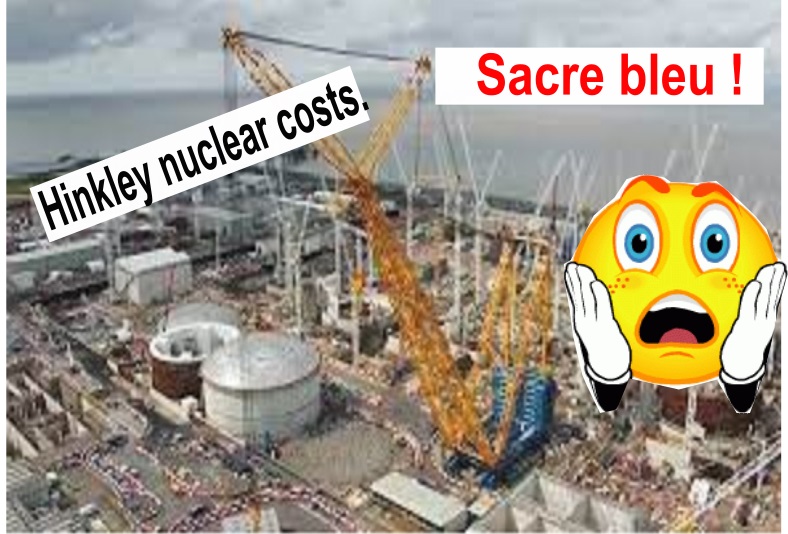
UK’s Hinkley Point C nuclear plant yet to attract new investors, says EDF boss .
French energy group EDF has not yet found alternative investors for the
flagship Hinkley Point C nuclear project as a freeze in funding from its
Chinese partner places an “extra weight” on the debt-laden company.
Luc Rémont, chief executive of France’s state-owned electricity company,
said it had held talks during 2024 with “lots” of potential funders for
the Hinkley Point C project in Somerset, but was not yet able to proceed
with any of them. EDF was continuing to meet the financing costs but was
working to find alternative investors for the project with the support of
the British government, Rémont said, as the company reported its annual
results on Friday.
“In the current circumstances, the fact that our
partner CGN is not injecting any more capital into Hinkley Point
is . . . an extra weight for EDF,” he said, but added that the
project remained a potentially profitable investment.
His comments raise further questions for the future of Hinkley Point C, the first new nuclear
power station being built in the UK in a generation and a vital part of the
government’s plan to decarbonise power supplies. Hinkley Point C was
initially set to cost £18bn and to be completed in 2025, but the estimated
cost has since swelled to roughly £46bn in 2024 terms while the start date
has been pushed back to 2029 at the earliest, because of construction
delays.
EDF is developing the project with Chinese state-owned CGN as a
junior investment partner, which agreed to finance 33.5 per cent of the
original costs. However, CGN has balked at making further contributions to
help meet cost overruns after the UK government in November 2022 bought it
out of a sister project, Sizewell C in Suffolk, amid concerns about
China’s involvement in critical national infrastructure. Asked on
Thursday whether he was also interested in investing in Hinkley Point C,
Centrica’s chief executive Chris O’Shea said: “We clearly like
nuclear power. And I am open to any kind of conversation. “My focus at
the moment is on hopefully getting to a good place with Sizewell C.”
FT 21st Feb 2025 https://www.ft.com/content/c546117d-1fbc-47c8-93a8-dd823311d2ac
Debris extracted from Fukushima nuclear plant revealed to media
Friday, Feb. 21, https://www3.nhk.or.jp/nhkworld/en/news/20250221_08/?fbclid=IwY2xjawInSAlleHRuA2FlbQIxMQABHSRSw2PSosgQ6p28ndBqzler46N1Sr9mAHZH_X5SQL5hfjsJ5Tr3M48JTg_aem_xXho8cY6EkFQUvxp6aOcZQNuclear fuel debris that was extracted from the damaged Fukushima Daiichi nuclear power plant last year has been revealed to reporters for the first time.
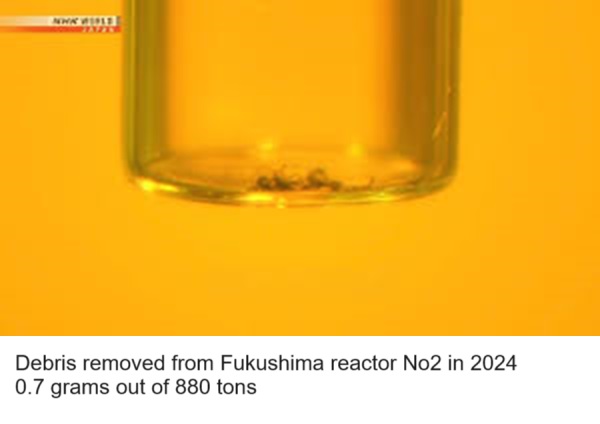
The debris taken from the plant’s No.2 reactor consists of molten fuel mixed with surrounding structural components. The operator, Tokyo Electric Power Company, successfully retrieved 0.7 grams of the material in its first test extraction operation through November last year.
The debris was first transferred to a research facility of the Japan Atomic Energy Agency in Oarai Town, Ibaraki Prefecture, for the initial analysis, including surface observation.
The researchers then split the debris into smaller pieces to be examined at five research facilities, including a large one in Hyogo Prefecture.
Reporters were given the opportunity to observe the samples, which were placed in two separate transparent containers at a facility in Ibaraki Prefecture. One container held a particle about 2 millimeters in size that appeared silver, while the other had multiple dark fragments.
So far, the researchers have detected uranium, which is contained in nuclear fuel, on the surface of the debris, as well as metals such as iron, which are believed to have come from the reactor’s structure.
The researchers plan to examine the characteristics of the debris, including its hardness and adhesiveness. They will also expose the samples to lasers to determine whether the uranium inside is prone to triggering a nuclear fission reaction.
The agency says it will use these analyses to evaluate potential methods for full-scale extraction of the debris, and to determine the risk of a renewed criticality event, in which a self-sustaining chain reaction could occur.
The agency plans to release the findings of the major analyses in the middle of this year.
Ogino Hideki, the chief engineer at the agency’s Collaborative Laboratories for Advanced Decommissioning Science, spoke to the reporters.
He said it is difficult to fully grasp the overall characteristics of the debris based on the ongoing analyses alone. But he expressed his commitment to contributing to the decommissioning efforts through analyzing the samples using the technology that he and his fellow researchers have developed.
It is estimated that there is a total of around 880 tons of fuel debris in the No. 1, 2 and 3 reactors.
5.0-magnitude quake strikes off Japan’s Fukushima: JMA
TOKYO, Feb. 21 (Xinhua) https://english.news.cn/20250221/1a62306993674102b4bf547c66308416/c.html?fbclid=IwY2xjawInSGJleHRuA2FlbQIxMQABHaLmlIJlO8LIDD4_tC9mDYzpZnPQTSalQEzW0hj-j5vNUxWQ8hVw_Wrelw_aem_JSAQL14AGKbnrwbZ10cXPA
— An earthquake with a preliminary magnitude of 5.0 struck off the northeastern Japanese prefecture of Fukushima on Friday, the country’s weather agency said.
The temblor occurred at around 10:01 p.m. local time at a depth of 50 km, measuring 4 on the Japanese seismic intensity scale of 7, according to the Japan Meteorological Agency (JMA).
The epicenter was located at a latitude of 37.5 degrees north and a longitude of 141.5 degrees east.
There was no tsunami warning, the JMA added
Hating Trump no reason to oppose Trump Ukraine peace initiative.
Walt Zlotow, West Suburban Peace Coalition, Glen Ellyn IL , 23 Feb 25
Some of my progressive comrades are bombarding social media in opposition to Trump’s peace plan to end the Russo Ukraine war. For the first 2 years, 11 months of America’s proxy war against Russia using Ukrainian cannon fodder, they were largely silent. They were loath to criticize President Biden and Vice President Harris, particularly during a presidential campaign. Their focus was laser like on domestic issues to prevent a return of the despised Trump to the presidency.
Trump not only won, he immediately pivoted to peace in Ukraine. He totally overturned the Biden war playbook. He announced Ukraine (really the US) had lost, must never join NATO, and not get back the Russian leaning Eastern Ukraine Russia annexed.
More. Trump announced a complete reset of the US Russia relationship to include diplomatic engagement and friendly relations with Russia that Biden had jettisoned during his entire term.
More again. Ending the war and reestablishing diplomatic relations will reduce the risk of nuclear war present for every one of the 1,095 days of this senseless war. It makes possible renewing the three nuclear treaties the US abandoned this century, two of them by Trump.
But instead of supporting this astonishing breakthrough, progressives have gone ballistic. They charge dictator wannabe Trump is selling out Ukrainian sovereignty, like Chamberlain did to Czechoslovakia at Munich in 1938. They claim this will allow Russia to recreate the Soviet Union, then march into Western Europe. Preposterous.
In doing so they ignore this war was provoked by Biden to weaken Russia. It would never have resulted in war had Biden honored Russia’s security concerns regarding no Ukraine NATO on Russia’s border.
Worse yet, progressives are blind to the fact that the war was lost on Day One when Biden announced the US would not participate with US military. Why? He wisely advised that would result in WWIII.
The result? Ukraine is on the brink of defeat, having upwards of a million dead or wounded. Over ten million have fled Ukraine for safer climes. Potential draftees are deserting en mass. The economy is on life support. President Zelensky cancelled elections, banned free press, outlawed the Russian Orthodox Church on his march to becoming dictator for the war’s duration. Once it’s over…so is Zelensky.
None of this made a dent in progressives till Trump demanded this madness end and followed thru arranging lightning fast negotiations with Russian leaders to end it. Then progressives surfaced to demonize Trump and his peace initiative. They have joined the most virulent pro war advocates in the Republican Party, the military, the media determined to sabotage the most hopeful development to end further destruction of Ukraine and depletion of US treasure.
Every progressive opposing Trump’s peace initiative enables another 500,000 dead Ukrainians, another $175 billion in squandered US treasure, and no end to Biden’s catastrophic and failed proxy war to weaken Russia.
Ponder that progressives.
1 This Month





PLEASE OPPOSE HR 8255 AND S.3639 – bills would accelerate satellite deployment, with no environmental review or safeguards – https://ncstd5li.quorum.us/campaign/169331/
To see nuclear-related stories in greater depth and intensity – go to https://nuclearinformation.wordpress.com
-
Archives
- October 2026 (74)
- September 2026 (339)
- August 2026 (330)
- July 2026 (355)
- June 2026 (287)
- May 2026 (306)
- April 2026 (356)
- March 2026 (251)
- February 2026 (267)
- January 2026 (308)
- December 2025 (358)
- November 2025 (359)
-
Categories
- 1
- 1 NUCLEAR ISSUES
- business and costs
- climate change
- culture and arts
- ENERGY
- environment
- health
- history
- indigenous issues
- Legal
- marketing of nuclear
- media
- opposition to nuclear
- PERSONAL STORIES
- politics
- politics international
- Religion and ethics
- safety
- secrets,lies and civil liberties
- spinbuster
- technology
- Uranium
- wastes
- weapons and war
- Women
- 2 WORLD
- ACTION
- AFRICA
- Atrocities
- AUSTRALIA
- Christina's notes
- Christina's themes
- culture and arts
- Events
- Fuk 2022
- Fuk 2023
- Fukushima 2017
- Fukushima 2018
- fukushima 2019
- Fukushima 2020
- Fukushima 2021
- general
- global warming
- Humour (God we need it)
- Nuclear
- RARE EARTHS
- Reference
- resources – print
- Resources -audiovicual
- Weekly Newsletter
- World
- World Nuclear
- YouTube
-
RSS
Entries RSS
Comments RSS


