Europe’s Face-Saving Theater on Ukraine
That Ukraine would lose was obvious two years ago to Macron and German Chancellor Olaf Scholz when they both gently broke that news to Zelensky privately in Paris in February 2023.
It seems that U.S. and European leaders kept an unwinnable war going until now to save their own careers. They could never admit defeat. But it did not save Biden or Harris or Blinken or Scholz or Trudeau, and Macron is in trouble too as voters saw through them all.
Britain’s prime minister called an “emergency” summit in London following the Oval Office Fiasco to try to convince the world it will not be Europe’s fault, but America’s (Read: Donald Trump’s) when Ukraine collapses, writes Joe Lauria.
By Joe Lauria, Consortium News, https://consortiumnews.com/2025/03/05/europes-facing-saving-theater-on-ukraine/
In his speech following the emergency European summit he called in London on Sunday, British Prime Minister Keir Starmer said Britain was prepared to send “boots on the ground” and “planes in the air” to defend Ukraine against the evil madman, Vladimir Putin.
Then Starmer added: but only if the United States joins us.
He said:
“We will go further to develop a ‘coalition of the willing’ to defend a deal in Ukraine…
And to guarantee the peace.
Not every nation will feel able to contribute.
But that can’t mean we sit back.
Instead, those willing will intensify planning now – with real urgency.
The UK is prepared to back this…
With boots on the ground, and planes in the air…
Together with others.
Europe must do the heavy lifting…
But to support peace on our continent.
And to succeed, this effort must have strong US backing
Donald Trump has made it clear he is not going to commit U.S. troops to Ukraine, however. And Russia has said it would never accept Western troops there.
What Starmer is really saying is: Europe stands ready to fight and die as peacekeepers to save Ukraine if necessary, but only with the Americans. So when they refuse to come and the disastrous Project Ukraine at last comes crashing on our heads, don’t blame us, blame the U.S.A.
The theater piece directed by Starmer at Lancaster House with an assembly of 15 European heads of government (and Justin Trudeau of Canada) was not really choreographed to try to convince Trump to reverse course, which appears unlikely, but as an elaborate presentation to save the hides of politicians who invested so much of their own political capital and wasted so much of their citizens’ money in the inevitable and humiliating defeat of Ukraine.
The summit was called by Starmer within two days of what he and the other Europeans saw transpire in the Oval Office on Friday. [See: Trump, Vance School Zelinsky on Reality of His War]. That occured at the end of a week in which both Starmer and French President Emmanuel Macron had paid a visit to the same Oval Office where they learned first hand Trump’s determination to end the war even if it means Ukraine’s defeat.
That Ukraine would lose was obvious two years ago to Macron and German Chancellor Olaf Scholz when they both gently broke that news to Zelensky privately in Paris in February 2023.
Trump will become even easier to blame now that he has cut off military aid and intelligence to Ukraine.
[The theater continued on Thursday at another European summit in Brussels, dubbed a “War Summit” by Politico, in which French President Emmanuel Macron, and still German Foreign Minister Alena Baerbock said Europe needed to get ready for war with Russia.]
The private remarks clashed with public statements from European leaders who had routinely said then, and still say today, that they will continue to support Ukraine for as long as it takes to achieve victory on the battlefield. That was Joe Biden’s line too.
The Wall Street Journal, which reported on the private remarks to Zelenksy two years ago, wrote:
“The public rhetoric masks deepening private doubts among politicians in the U.K., France and Germany that Ukraine will be able to expel the Russians from eastern Ukraine and Crimea, which Russia has controlled since 2014, and a belief that the West can only help sustain the war effort for so long, especially if the conflict settles into a stalemate, officials from the three countries say.
‘We keep repeating that Russia mustn’t win, but what does that mean? If the war goes on for long enough with this intensity, Ukraine’s losses will become unbearable,’ a senior French official said. ‘And no one believes they will be able to retrieve Crimea.’”
Indeed Ukraine’s losses have become unbearable. Macron and Scholz tried to tell Zelensky at that Élysée Palace dinner in February 2023 that he must consider peace talks with Moscow, the Journal reported.
According to its source, the newspaper quoted Macron as telling Zelensky that “even mortal enemies like France and Germany had to make peace after World War II.”
Macron told Zelensky “he had been a great war leader, but that he would eventually have to shift into political statesmanship and make difficult decisions,” the newspaper reported.
One wonders then why Scholz and Macron and the rest of Europe have persisted in fueling a lost cause that has since chewed up tens of thousands of additional Ukrainian lives. Could they be so corrupt that the survival of their political careers was worth the carnage of another nation’s men?
Could they have been as corrupted as Antony Blinken, who insisted to the end of his time as U.S. secretary of state that Ukraine lower the conscription age to 18, even though he knew these youth would be sent to certain death? Have Western leaders not understood that the only chance Ukraine had to win the war was with NATO’S direct participation, risking a nuclear holocaust ?
It seems that U.S. and European leaders kept an unwinnable war going until now to save their own careers. They could never admit defeat. But it did not save Biden or Harris or Blinken or Scholz or Trudeau, and Macron is in trouble too as voters saw through them all.
They’d all staked too much on the outcome of the war. They allowed their economies to fall. They pushed government censorship of social and alternative media to hide criticism that they were allowing men to die so that they would not be accused of “losing Ukraine.”
It’s been a cornerstone of history from ancient emperors to Lyndon Johnson and Richard Nixon in Vietnam, and now Biden and Starmer in Ukraine: Let them die so that we may stay in office.
With defeat staring them in the face, who better to blame it on than the ogre, Donald Trump, who has dared to inject realism into the twisted dream of using Ukraine to weaken and defeat Russia.
It’s a failed policy that the European and Ukrainian leaders desperately need to keep going. One way to attempt this, as Chicago University professor John Mearsheimer said, is for the British, French and Ukrainians to “trap” the United States into giving a “security guarantee” to Ukraine.
Language in the mineral deal Zelensky had gone to the U.S. on Friday to sign calls for “common protection of critical resources.” Mearsheimer told a TV network in India that that is “the way they are trying to trap Trump and Co., and Trump won’t be trapped.”
This became evident in the Oval Office dust up last Friday when Trump angrily rejected Zelensky’s insistence on a U.S. “security guarantee” before he’d agree to a ceasefire and sign the mineral agreement. [See: Trump, Vance School Zelensky on Reality of His War]
The only way to keep their war going is to cajole Trump into getting the U.S. deeper into the morass, rather than wisely pulling out and pushing for a deal to end it.
As much as they might despise Trump, Starmer’s Sunday performance was designed to suck up to him. And an ungrateful Zelensky, reconsidering his public feud with Trump, is trying to make up with a man that seems susceptible to flattery.
In his address to the U.S. Congress Tuesday night, Trump said:
“Earlier today I received an important letter from President Zelensky of Ukraine. The letter reads: ‘Ukraine is ready to come to the negotiating table as soon as possible to bring lasting peace closer.’
‘Nobody wants peace more than the Ukrainians,’ he said. ‘My team and I stand ready to work under President Trump strong leadership to get a peace that lasts. … We do really value how much America has done to help Ukraine, maintain its sovereignty and independence. … Regarding the agreement on minerals and security, Ukraine is ready to sign it at any time.’
That is convenient for you. I appreciate that he sent this letter. I just got it a little while ago. Simultaneously we’ve had serious discussions with Russia. Then I’ve received strong signals that they are ready for peace. Wouldn’t that be beautiful? Wouldn’t that be beautiful?
Wouldn’t that be beautiful?
It’s time to stop this madness. It’s time to halt the killing. It’s time to end the senseless war. If you want to end wars, you have to talk to both sides.”
Desperate Europeans and Ukrainians need Trump to keep their war and thus their careers going, perhaps none more so than Zelensky.
Will Trump stand firm, or will he succumb to a trap?
Supreme Court wrestles with nation’s frustrating search for nuclear waste storage

Justice Sonia Sotomayor, looking ahead to the United States’ 250th anniversary next year, said, “I hope that we make it another 250, but if it takes 40 or 80 years for a solution to come, it would still be temporary, correct?”
By ASSOCIATED PRESS, 6 March 2025 ,
https://www.dailymail.co.uk/wires/ap/article-14464455/The-Supreme-Court-confronts-national-headache-What-growing-pile-nuclear-waste.html
WASHINGTON (AP) – The Supreme Court on Wednesday wrestled with whether to restart plans to temporarily store nuclear waste at sites in rural Texas and New Mexico even as some justices worried about safety issues and the lack of progress toward a permanent solution.
The justices heard arguments in a case that reflects the complicated politics of the nation´s so far futile quest for a permanent underground storage facility. A plan to build a national storage facility northwest of Las Vegas at Yucca Mountain has been mothballed because of staunch opposition from most Nevada residents and officials.
The court took up a challenge by the Nuclear Regulatory Commission and a private company with a license for the Texas facility to an appellate ruling that found the commission had no authority to grant the license. The outcome of the case will affect plans for a similar facility in New Mexico roughly 40 miles (65 kilometers) away.
The licenses would allow the companies to operate the facilities for 40 years, with the possibility of a 40-year renewal.
“That doesn’t sound very interim to me,” Justice Neil Gorsuch said, while also questioning the advisability of storing spent nuclear fuel “on a concrete platform in the Permian Basis, where we get all our oil and gas from.”
Justices Samuel Alito and Clarence Thomas joined Gorsuch in asking questions suggesting they were the most likely to uphold the ruling from the 5th U.S. Circuit Court of Appeals.
Roughly 100,000 tons (90,000 metric tons) of spent fuel, some of it dating from the 1980s, is piling up at current and former nuclear plant sites nationwide and growing by more than 2,000 tons (1,800 metric tons) a year. The waste was meant to be kept there temporarily before being deposited deep underground.
The NRC has said that the temporary storage sites are needed because existing nuclear plants are running out of room. The presence of the spent fuel also complicates plans to decommission some plants, the Justice Department said in court papers.
Justice Sonia Sotomayor, looking ahead to the United States’ 250th anniversary next year, said, “I hope that we make it another 250, but if it takes 40 or 80 years for a solution to come, it would still be temporary, correct?”
Justice Department lawyer Malcolm Stewart agreed, noting that the spent fuel has to be kept somewhere, whether at operating and decommissioned plants or elsewhere.
Security also is cheaper with the waste in one or two locations, Stewart said, relying on arguments made by Interim Storage Partners LLC, the company with the Texas license.
Sotomayor, along with Justices Ketanji Brown Jackson, Elena Kagan and Brett Kavanaugh, seemed most inclined to reverse the 5th circuit. Chief Justice John Roberts and Justice Amy Coney Barrett said little or nothing to reveal where they stand.
The NRC’s appeal was filed by the Biden administration and maintained by the new Trump administration. Texas Gov. Greg Abbott,. a Republican, and New Mexico Gov. Michelle Lujan Grisham, a Democrat, are leading bipartisan opposition to the facilities in their states.
The justices will consider whether, as the NRC and Interim Storage Partners argues, the states and a private energy company forfeited their right to object to the licensing decisions because they declined to join in the commission´s proceedings.
Two other federal appeals courts, in Denver and Washington, that weighed the same issue ruled for the agency. Only the 5th Circuit allowed the cases to proceed.
The second issue is whether federal law allows the commission to license temporary storage sites. Opponents are relying on a 2022 Supreme Court decision that held that Congress must act with specificity when it wants to give an agency the authority to regulate on an issue of major national significance. In ruling for Texas, the 5th Circuit agreed that what to do with the nation´s nuclear waste is the sort of “major question” that Congress must speak to directly.
But the Justice Department has argued that the commission has long-standing authority to deal with nuclear waste reaching back to the 1954 Atomic Energy Act.
The NRC granted the Texas license to Interim Storage for a facility that could take up to 5,000 metric tons of spent nuclear fuel rods from power plants and 231 million tons of other radioactive waste. The facility would be built next to an existing dump site in Andrews County for low-level waste such as protective clothing and other material that has been exposed to radioactivity. The Andrews County site is about 350 miles (560 kilometers) west of Dallas, near the Texas-New Mexico state line.
The New Mexico facility would be in Lea County, in the southeastern part of the state near Carlsbad. The NRC gave a license for the site to Holtec International.
Alito, who said the interim sites could remove the incentive to find a permanent solution, asked Brad Fagg, a lawyer for Interim Storage Partners, for a prediction of when a permanent site would open.
“I’ve been in this stew for a lot of years,” Fagg said. “I would be kidding myself and this court if I said I had a date.”
A decision is expected by late June.
UK urged to prepare for Donald Trump halting Trident partnership.
After tensions over a failed nuclear missile test last year, experts say the
White House withdrawing assistance would cost billions.
When a Trident II D5 missile misfired and crashed into the sea off the coast of Florida
during a rare test launch by the Royal Navy in January last year, American
sailors were on board the submarine to witness it. US ships monitored the
event nearby. In the days that followed, US and UK officials wrangled over
how much information the Ministry of Defence in London could share with the
public about what went wrong.
The British government wanted to be as open
as possible in the hope that it would restore some faith in the nuclear
deterrent — which costs about £3 billion a year to run — eight years
after another misfire in 2016. The Americans won the argument and officials
were limited to saying that an “anomaly occurred”.
What actually happened was a failure caused by test equipment strapped to the missile;
had it been fired in anger without such a device, it would have worked.
“There was deep frustration at the US for blocking a full explanation,”
said a defence source privy to the discussions with the Americans. The UK
has total operational control over its Trident missiles once they are
loaded on to its four Vanguard-class submarines.
However, such revelations
expose how intertwined the US and UK are when it comes to the nuclear
deterrent, Britain’s ultimate insurance policy. Should the UK want to
untangle the relationship — or a pro-Russian White House end its
co-operation — it would cost taxpayers tens of billions, experts warn.
Times 5th March 2025, https://www.thetimes.com/uk/defence/article/uk-urged-to-prepare-for-donald-trump-halting-trident-partnership-cj8rdjw0w
East Lindsey overwhelmingly backs GDF withdrawal call to Lincolnshire County Council
At their March meeting, East Lindsey District Councillors backed a motion calling on their colleagues at County Hall to join them in withdrawing from the nuke dump plan.
Leader Councillor Craig Leyland confirmed that he shall recommend to his Executive that East Lindsey District Council withdraws from the process when it next meets on 23 April.
Were Lincolnshire to follow suit that would draw a line upon the issue; Nuclear Waste Services would no longer be able to investigate potential sites for the Geological Disposal Facility within the Theddlethorpe Search Area, or indeed any area within the East Lindsey District, as there would no longer be any Relevant Principal Local Authority backing the plan…………………….
NFLA 6th March 2025,
https://www.nuclearpolicy.info/news/east-lindsey-overwhelmingly-backs-gdf-withdrawal-call-to-lincolnshire-county-council/
Doug Ford: Rip up the GE-Hitachi US nuclear contract

Ontario Clean Air Alliance 6 Mar 25
Premier Ford says he will tear up Ontario’s expensive contract for Elon Musk’s Starlink satellite service in the wake of Donald Trump’s unhinged attacks on our economy. And thanks to Doug Ford, American wine and bourbon is gone from our liquor stores.
He has also ordered the Ontario Public Service to go through the province’s contracts “with a fine tooth comb” to find other U.S. contracts that can be axed. According to Premier Ford: “We won’t award contracts to people who enable and encourage economic attacks on our province and our country.”
That’s why it’s time for the Ford Government to tell Ontario Power Generation to rip up its contract with GE-Hitachi for 4 new nuclear reactors at Darlington, east of Oshawa. These expensive and first-of-their-kind proposed new U.S. reactors would come with a lot of energy security and financial risks, including the need to import enriched uranium from the U.S.
As Bob Walker, National Director of the Canadian Nuclear Workers’ Council told the Globe and Mail: “Developing a dependence on another country for our nuclear fuel has always been a concern and recent events have proven those concerns are justified.”
A much lower cost and more secure way to keep our lights on is to invest in Made-in-Canada wind and solar energy plus storage.
It is time for Doug Ford to lift his political moratorium on Great Lakes offshore wind power and work with Premier Legault to expand our east-west electricity grid. As a first step the Ontario-Quebec electricity interconnection capability at Ottawa should be increased by 2,000 megawatts.
Please tell Premier Ford that to Protect Ontario we need to invest in Made-in-Canada wind and solar energy and storage, and work with Quebec to expand our east-west electricity grid.
9-year lawsuit fails to stop Ikata nuclear plant operations

By KAI NEMOTO/ Staff Writer, March 5, 2025, https://www.asahi.com/ajw/articles/15655918
HIROSHIMA—The district court here rejected a request on March 5 by plaintiffs to stop operations at the Ikata nuclear power plant in Ehime Prefecture on the main island of Shikoku.
The Hiroshima District Court ended a nine-year lawsuit brought by 337 plaintiffs, including some who survived the Aug. 6, 1945, atomic bombing of Hiroshima, by rejecting the injunction request.
Although Hiroshima is located about 100 kilometers north of the Ikata plant, operated by Shikoku Electric Power Co., the plaintiffs argued that a serious accident would send radioactive materials spewing into the air and waters of the Seto Inland Sea that lies between Hiroshima and Ehime prefectures.
The main points of contention in the lawsuit filed in March 2016 were the safety of the Ikata plant against earthquakes and volcanic eruptions in Kyushu.
During the course of the trial, atomic bomb survivors testified about what they went through after Hiroshima was leveled 80 years ago.
The Ikata nuclear plant began operations in 1977, but only the No. 3 reactor is currently operating. The other two reactors are in the process of being decommissioned.
Similar lawsuits to stop operations have been filed in other district courts in the region, but in March 2024 the Oita District Court rejected the request by plaintiffs, who appealed to the Fukuoka High Court.
UK’s richest can boost climate action but need to cut outsized emissions – study

Better-off Britons are well placed to accelerate the transition towards
low-carbon technologies, but only if they are prepared to curb their
excessive consumption to lower their outsized carbon footprints, a study
has found.
Researchers found people from the richest 10% in the UK were
more likely to invest in electric vehicles, heat pumps and other clean
energy alternatives, and were more likely to support green policies. But
they also found wealthier people used far more energy at home, were more
likely to fly for leisure, were more reluctant to sacrifice luxuries, and
were likely to underestimate the carbon impact of their own behaviour.
As a result, many wealthy people were caught in a contradiction: vocally
supporting climate action and, in many cases, making climate-conscious
consumer choices, while at the same time materially exacerbating climate
breakdown.
Guardian 5th March 2025, https://www.theguardian.com/environment/2025/mar/05/uks-richest-can-boost-climate-action-but-need-to-cut-outsized-emissions-study
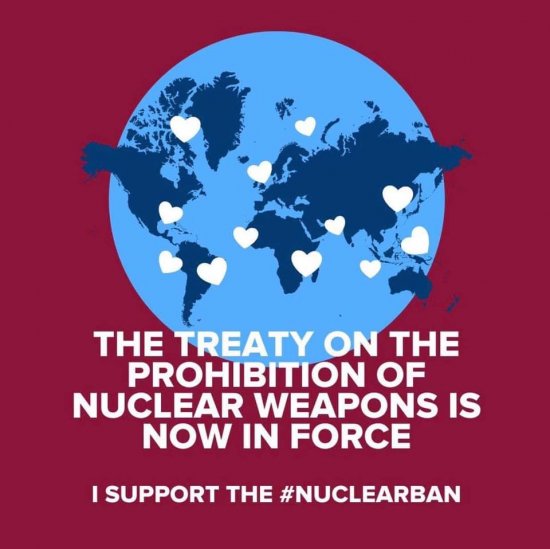
UK Government ignoring international law on nuclear weapons – experts.
By Xander Elliards
THE UK Government is flouting the international laws it has subscribed to
by refusing to discuss banning nuclear weaponry, leading experts have said.
It comes after the Labour Government dismissed a UN summit on the Treaty on
the Prohibition of Nuclear Weapons (TPNW) out of hand, saying they would
not attend even as an observer.
However, the majority of the world’s
countries are present at the TPNW meeting in New York, where a total ban on
nuclear weapon testing, development, or use is being discussed. The UK
Government is not a signatory to the TPNW – but like the US, France,
Russia, and China it is signed up to the earlier Nuclear Non-Proliferation
Treaty (NPT). This obliges states to prevent new countries from acquiring
nuclear weapons – but also obliges signatories to work towards complete
disarmament.
The National 5th March 2025, https://www.thenational.scot/news/24985203.uk-government-ignoring-international-law-nuclear-weapons—experts/
Uranium’s Poison Power in Leafy Cheshire
Remembering the 14th anniversary of Fukushima, campaigners will be
gathering and invite people to join them, outside the URENCO plant at
Capenhurst in Cheshire on March 11th at 2pm. The continuing nuclear
disaster at Fukushima caused by the 2011 tsunami underlines the constant
danger that nuclear presents due to events totally beyond the control of
power station operators.
Radiation Free Lakeland 5th March 2025 https://mariannewildart.wordpress.com/2025/03/05/uraniums-poison-power-in-leafy-cheshire/
‘Fish disco’ plan revived to protect salmon from Hinkley Point C.
Energy company EDF has proposed an acoustic fish deterrent to stop fish in
the Severn Estuary being sucked into the nuclear power station. EDF
previously ditched plans for an acoustic fish deterrent, a device designed
to keep Atlantic salmon, eel and other species away from a cooling water
intake pipe for Hinkley Point C in Somerset, due to fears that maintaining
it for 60 years would put divers at risk.
The former minister Michael Gove
mockingly called the measure, a condition of the plant’s planning
permission, a “fish disco”. Now it’s returning, but as a mobile
disco. Instead of the originally proposed 280 loudspeakers permanently
attached to concrete structures, ceramic transducers will be installed that
can be lifted up and down in lobster pot-style containers, negating the
need for divers.
The devices will produce a sound which can be tuned to
precise frequencies to deter specific species. Engineers will be able to
maintain them by raising them to the water’s surface. However, it also
means the axe for EDF’s interim plan to build salt marshes along the
River Severn as a compensatory measure. Mark Lloyd, the CEO of The Rivers
Trust charity, welcomed the firm’s about-turn to honour its commitment on
fish protections. But he said the company should still create salt marsh
habitat or passages to help salmon, as some will still be sucked to their
death despite the deterrent.
Times 5th March 2025
https://www.thetimes.com/uk/environment/article/fish-disco-plan-edf-hinkley-point-c-j303w9rdk
Surface tension: could the promised Aukus nuclear submarines simply never be handed over to Australia?

Guardian, Ben Dohert, 7 Mar 25
The multi-billion dollar deal was heralded as ensuring the security of the Indo-Pacific. But with America an increasingly unreliable ally, doubts are rising above the waves.
Maybe Australia’s boats just never turn up.
To fanfare and flags, the Aukus deal was presented as a sure bet, papering over an uncertainty that such an ambitious deal could ever be delivered.
It was assured, three publics across two oceans were told – signed, sealed and to-be-delivered: Australia would buy from its great ally, the US, its own conventionally armed nuclear-powered attack submarines before it began building its own.
But there is an emerging disquiet on the promise of Aukus pillar one: it may be the promised US-built nuclear-powered submarines simply never arrive under Australian sovereign control.
Instead, those nuclear submarines, stationed in Australia, could bear US flags, carry US weapons, commanded and crewed by American officers and sailors.
Australia, unswerving ally, reduced instead to a forward operating garrison – in the words of the chair of US Congress’s house foreign affairs committee, nothing more than “a central base of operations from which to project power”.
Reliable ally no longer
Officially at least, Aukus remains on course, centrepiece of a storied security alliance.
Pillar one of the Australia-UK-US agreement involves, first, Australia buying between three and five Virginia-Class nuclear-powered submarines from the US – the first of these in 2032.
Then, by the “late 2030s”, according to Australia’s submarine industry strategy, the UK will deliver the first specifically designed and built Aukus submarine. The first Australian-built version will be in the water “in the early 2040s”. Aukus is forecast to cost up to $368bn to the mid-2050s.
But in both Washington and Canberra, there is growing concern over the very first step: America’s capacity to build the boats it has promised Australia, and – even if it had the wherewithal to build the subs – whether it would relinquish them into Australian control.
The gnawing anxiety over Aukus sits within a broader context of a rewritten rulebook for relations between America and its allies. Amid the Sturm und Drang of the first weeks of Trump’s second administration, there is growing concern that the reliable ally is no longer that…………………….
‘The cheque did clear’
On 8 February, Australia paid $US500m ($AUD790m) to the US, the first instalment in a total of $US3bn pledged in order to support America’s shipbuilding industry. Aukus was, Australia’s defence minister Richard Marles said, “a powerful symbol of our two countries working together in the Indo-Pacific”.

“It represents a very significant increase of the American footprint on the Australian continent … it represents an increase in Australian capability, through the acquisition of a nuclear‑powered submarine capability … it also represents an increase in Australian defence spending”.
………….. just three days after Australia’s cheque cleared, the Congressional Research Service quietly issued a paper saying while the nuclear-powered attack submarines (known as SSNs) intended for Australia might be built, the US could decide to never hand them over.
It said the post-pandemic shipbuilding rate in the US was so anaemic that it could not service the needs of the US Navy alone, let alone build submarines for another country’s navy…………………………………………………………………………………………………..
‘Almost inevitable’
Clinton Fernandes, professor of international and political Studies at the University of New South Wales and a former Australian Army intelligence analyst, says the Aukus deal only makes sense when the “real” goal of the agreement is sorted from the “declared”.
“The real rather than declared goal is to demonstrate Australia’s relevance to US global supremacy,” he tells the Guardian.
“The ‘declared goal’ is that we’re going to become a nuclear navy. The ‘real goal’ is we are going to assist the United States and demonstrate our relevance to it as it tries to preserve an American-dominated east Asia.”
Fernandes, author of Sub-Imperial Power, says Australia will join South Korea and Japan as the US’s “sentinel states in order to hold Chinese naval assets at risk in its own semi-enclosed seas”.
“That’s the real goal. We are demonstrating our relevance to American global dominance. The government is understandably uneasy about telling the public this, but in fact, it has been Australia’s goal all along to preserve a great power that is friendly to us in our region.”
Fernandes says the Aukus pillar one agreement “was always an article of faith” based on a premise that the US could produce enough submarines for itself, as well as for Australia.
“And the Congressional Research Service study argues that … they will not have enough capacity to build boats for both themselves and us.”
He argues the rotation of US nuclear-powered submarines through Australian bases – particularly HMAS Stirling in Perth – needs to be understood as unrelated to Aukus and to Australia developing its own nuclear-powered submarine capability.
“Submarine Rotational Force-West (SRF-W) is presented by the spin doctors as an ‘optimal pathway’ for Aukus. In fact, it is the forward operational deployment of the United States Navy, completely independent of Aukus. It has no connection to Aukus.”
The retired rear admiral and past president of the Submarine Institute of Australia, Peter Briggs, argues the US refusing to sell Virginia-class submarines to Australia was “almost inevitable”, because the US’s boat-building program was slipping too far behind.
“It’s a flawed plan, and it’s heading in the wrong direction,” he tells the Guardian.
Before any boat can be sold to Australia, the US commander-in-chief – the president of the day – must certify that America relinquishing a submarine will not diminish the US Navy’s undersea capability.
“The chance of meeting that condition is vanishingly small,” Briggs says.
It now takes the US more than five years to build a single submarine (it was between three and 3.5 years before the pandemic devastated the workforce). By 2031, when the US is set to sell its first submarine to Australia, it could be facing a shortfall of up to 40% of the expected fleet size, Briggs says.
Australia, he argues, will be left with no submarines to cover the retirement from service of the current Collins-class fleet, weakened by an unwise reliance on the US.
The nuclear-powered submarines Australia wants to buy and then build “are both too big, too expensive to own and we can’t afford enough of them to make a difference”.
He argues Australia must be clear-eyed about the systemic challenges facing Aukus and should look elsewhere. He nominates going back to France to contemplate ordering Suffren-class boats – a design currently in production, smaller and requiring fewer crew, “a better fit for Australia’s requirements”……. https://www.theguardian.com/world/2025/mar/07/surface-tension-could-the-promised-aukus-nuclear-submarines-simply-never-be-handed-over-to-australia
One empty seat. UK fails again to send representation to UN nuke conference

NFLA 5th March 2025,
https://www.nuclearpolicy.info/news/one-empty-seat-uk-fails-again-to-send-representation-to-un-nuke-conference/
The UK/Ireland Nuclear Free Local Authorities laments that a joint appeal made to the Prime Minister and Foreign Secretary to send a British representative to an important nuclear disarmament conference being held at the United Nations this week has fallen on deaf ears.
Alongside academics and other peace campaigners, NFLA Chair Councillor Lawrence O’Neill and NFLA Secretary Richard Outram were two of the co-signatories to a letter drafted by the United Nations Association UK (UNA-UK) that was sent to the two senior British politicians asking the UK Government to send an observer to the 3rd Meeting of States Parties (3MSP) to the Treaty on the Prohibition of Nuclear Weapons (TPNW) which is being held in New York until 7 March.
The invitation was not taken up as the meeting has been boycotted by Britain and the other eight nuclear weapons states, which continue to refuse to engage with the treaty despite around half of the UN’s membership – 94 states – having become signatories to it, with 73 also having completed formal ratification.
The NFLAs will be especially interested to see the progress made in establishing an international trust fund to support the victims, usually Indigenous Peoples, of the use and testing of nuclear weapons and the remediation of their natural environment. This represents a clear commitment of the signatories to help satisfy their undertakings under Article 6 and 7 of the TPNW. Establishing such a fund was seen as a key priority at the preceding MSP2.
NFLA Secretary Richard Outram, in speaking recently on a webinar to mark the sixty fifth anniversary of the first French nuclear weapon test in Algeria, referenced the fact that the UK should contribute on a voluntary basis to such a fund despite not being a formal party to the treaty.
Britain tested forty five atomic and nuclear weapons in Australia, the Pacific, and latterly in the USA in a period from 1952 to 1991, and has a responsibility for the damage caused to the health and environment of Indigenous People in these places, as well as to the British atomic and nuclear test veterans community and their family members who continue to suffer as a direct result of exposure to radiation in the tests.
The NFLAs will continue to campaign for justice and financial compensation for both the civilian and military victims of nuclear weapons use and testing, and, as a member of the Nobel Peace Prize winning International Campaign to Abolish Nuclear Weapons (ICAN) and a partner of Mayors for Peace, for the universal adoption of the TPNW and the total abolition of nuclear weapons.
Nuclear waste at Chalk River: opponents defeated in court.
By Nelly Albérola, Radio-Canada, ICI Ottawa-Gatineau, March 6, 2025
https://ici.radio-canada.ca/nouvelle/2145786/rejet-decision-nucleaire-chalk-river-dechet [en français]
The Federal Court has dismissed an application for judicial review by citizens’ groups and scientists opposed to the Chalk River radioactive waste disposal site in Deep River, Ontario.
The ruling has gone almost unnoticed. In the wake of the Kebaowek First Nation’s victory over Canadian Nuclear Laboratories (CNL), the Federal Court has handed down another decision concerning the proposed Chalk River nuclear waste disposal site.
Please note: This victory will require the CCNS to have meaningful consultations with the Algonquins on whose traditional lands the radioactive waste dump is intended to be built. Neither the Algonquins nor the citizens of Ontario or Quebec were ever consulted about the choice of site for the dump, located one kilometre from the Ottawa River which borders Quebec and flows into the St. Lawrence River at Montreal. – G. Edwards
On February 20, the federal judge dismissed the application for judicial review brought before the court by three citizens’ groups: Concerned Citizens of Renfrew County and Area, the Canadian Coalition for Nuclear Responsibility, and the Ralliement contre la pollution radioactive.
A justified decision, according to the court
These groups include a number of retired scientists. They consider the decision of the
Canadian Nuclear Safety Commission (CNSC) to be unreasonable. authorize, in January 2024, the construction of a near-surface disposal facility (NSDF) for about one million tons of “low-level” radioactive waste.
“When read as a whole and taking into account the experience and technical expertise of the Commission, the decision is justified, intelligible and transparent. Consequently, the present application will be rejected,” reads the Federal Court’s decision.
“We’re certainly disappointed,” says Ginette Charbonneau, spokesperson for the Ralliement contre la pollution radioactive. “We’ve been working for six years and more to tighten up this project, to make it better.”
“Our chances of success were virtually nil,” admits another spokesman for the Ralliement, Gilles Provost. “The judge couldn’t change the Commission’s decision, but had to judge whether the decision was unreasonable: that’s an extremely heavy burden of proof.”
A view shared by the three groups’ lawyer, Nicholas Pope. “In the end, the court did not say that the decision was correct, only that it did not meet the high standard of unreasonableness,” he points out in a written response.
Murky administrative law, say opponents
Beyond their disappointment, the groups deplore the fact that the court took into account only the CNSC’s opinion, without considering the observations of other professionals who are nevertheless recognized in the nuclear industry.
“We rely heavily on scientific experts such as James R. Walker. Unfortunately, both the CNSC and the judge rejected his arguments,” laments Ole Hendrickson, a researcher and member of the Concerned Citizens group. “I was surprised that the judge said that the Commission can choose whatever it wants, rather than paying attention to all the arguments.”
For the president of the Canadian Coalition for Nuclear Responsibility, Gordon Edwards, the legal system is simply not well equipped to deal with these situations.
“Administrative law is murky: magistrates are in a difficult position when they have to judge these cases,” says the former nuclear consultant for governmental and non-governmental agencies. “The law gives the CNSC the power to make decisions on nuclear matters. The judge therefore does not feel empowered to overturn the decision of the agency that has been given the authority to make that decision.”
An unprecedented project
The physicist reminds us that the permanent installation of a nuclear waste disposal site is unprecedented in Canadian history.
“We’ll never take it away again. This is where it will go and stay forever,” he insists.
“That’s why it’s so important to do it right, to make sure that all the safety measures have been taken and that they can be sustained over time,” he adds.
“The waste is going to stay in the landfill until it’s disintegrated. And that can take anywhere from a few years to millions of years, so you see the problem,” worries physicist by training Ginette Charbonneau. “You can [wear] a mask and say that legally, everything’s okay, but when you’re talking about radioactive waste, that’s not good enough.”
Campaigners attend East Lindsey District Council meeting to call on Lincolnshire County Council to withdraw from Geological Disposal Facility process

By James Turner, Local Democracy Reporter, Lincs Online 6th March 2025, https://www.lincsonline.co.uk/louth/weve-had-enough-now-the-threat-of-this-nuclear-waste-dump-9407343/
Dozens of protesters have called on Lincolnshire County Council to withdraw from the process that could lead to the construction of a nuclear waste site in the county.
Campaigners from across the district gathered outside East Lindsey District Council’s offices in Horncastle ahead of a full council meeting on Wednesday to support a motion from Coun Travis Hesketh (Independent) urging the leader to actively oppose the establishment of a Geological Disposal Facility (GDF) – and calling on the county council to withdraw from the community partnership in the hopes of stopping the plans altogether.
Nuclear Waste Services (NWS) identified three ‘areas of focus’ for its facility in January. These include sites in Mid Copeland and South Copeland in Cumbria, as well as land between Gayton le Marsh and Great Carlton, near Louth.
East Lindsey District Council has pledged to leave the working group it joined with the organisation formerly known as Radioactive Waste Management in 2021, due to the new location being prime agricultural land and completely different from the former gas terminal site in Theddlethorpe, which it had been considering previously.
“I am the district councillor for Withern and Theddlethorpe, I represent the area where the nuclear dump was originally going to be placed, but now it’s moved,” Coun Hesketh told the Local Democracy Reporting Service.
“We’re here today because East Lindsey has said they are going to pull out, which is a terrific thing, but they need to go further. They need to say we oppose this and we want Lincolnshire County Council to do the same.
“We’ve had five years since Lincolnshire County Council met with Radioactive Waste Management – this thing has been going on for so long they’ve changed the name of the company. We’ve had enough now. They have ruined two communities, house values have been decimated – nobody can sell their house in the Carlton or Gayton area, they’re stuck. It’s time to make a decision.”
As councillors began arriving for the meeting, campaigners sang chants such as “We say, we say, no GDF, no GDF,” to the beat of Queen’s We Will Rock You and other lines such as “We are gentle, angry people and we’re singing for our lives.”
Nigel, 64, from Theddlethorpe, was just one of many campaigners and said he had been fighting the plans since ‘day one’.
“Now the area of focus has shifted, I feel I need to support the people affected in that area as well. We’re just trying to force the council’s hand now.”
Cybersecurity in the Nuclear Industry: US and UK Regulation and the Sellafield Case
Key Points:
With both the U.S. and U.K. strengthening their regulatory frameworks and increasing enforcement powers, nuclear facilities should take steps now to review and upgrade cybersecurity measures. This includes not just updating technical controls, but also ensuring compliance with security plans, auditing systems, and maintaining proper documentation.
Real-world examples from both the U.S. and U.K. demonstrate that nuclear facilities are being targeted by sophisticated cyber attackers, including state actors. This isn’t just a theoretical risk—it’s happening now, and facilities must take it seriously.
The successful prosecution of Sellafield with significant fines (£332,500) shows that regulators are now willing to take strong enforcement action, even when no actual breach has occurred. Nuclear facilities cannot afford wait for an incident before improving their cybersecurity—they must be proactive……………………………………………..
JD Supra 6th March 2025,
https://www.jdsupra.com/legalnews/cybersecurity-in-the-nuclear-industry-2447724/
1 This Month





PLEASE OPPOSE HR 8255 AND S.3639 – bills would accelerate satellite deployment, with no environmental review or safeguards – https://ncstd5li.quorum.us/campaign/169331/
To see nuclear-related stories in greater depth and intensity – go to https://nuclearinformation.wordpress.com
-
Archives
- October 2026 (74)
- September 2026 (339)
- August 2026 (330)
- July 2026 (355)
- June 2026 (287)
- May 2026 (306)
- April 2026 (356)
- March 2026 (251)
- February 2026 (267)
- January 2026 (308)
- December 2025 (358)
- November 2025 (359)
-
Categories
- 1
- 1 NUCLEAR ISSUES
- business and costs
- climate change
- culture and arts
- ENERGY
- environment
- health
- history
- indigenous issues
- Legal
- marketing of nuclear
- media
- opposition to nuclear
- PERSONAL STORIES
- politics
- politics international
- Religion and ethics
- safety
- secrets,lies and civil liberties
- spinbuster
- technology
- Uranium
- wastes
- weapons and war
- Women
- 2 WORLD
- ACTION
- AFRICA
- Atrocities
- AUSTRALIA
- Christina's notes
- Christina's themes
- culture and arts
- Events
- Fuk 2022
- Fuk 2023
- Fukushima 2017
- Fukushima 2018
- fukushima 2019
- Fukushima 2020
- Fukushima 2021
- general
- global warming
- Humour (God we need it)
- Nuclear
- RARE EARTHS
- Reference
- resources – print
- Resources -audiovicual
- Weekly Newsletter
- World
- World Nuclear
- YouTube
-
RSS
Entries RSS
Comments RSS

