Supreme Court steps into debate over where to store nuclear waste

CBS, By Melissa Quin, March 5, 2025
Washington — The Supreme Court on Wednesday jumped into the decades-long dispute over what to do with thousands of metric tons of nuclear waste, as it considered a plan to store it above one of the world’s most productive oil fields, the Permian Basin in Texas.
The U.S. Nuclear Regulatory Commission and the company Interim Storage Partners are facing off against the state of Texas and Fasken Land and Minerals Ltd., which owns land in the Permian Basin, in the fight over what to do with the spent fuel generated at nuclear reactor sites. The waste can remain radioactive and pose health risks for thousands of years, according to the U.S. Energy Information Administration.
How to address the problem of nuclear waste has been complicated by politics since the advent of nuclear power last century. In 1982, Congress enacted a federal law that required the government to establish a permanent facility to house spent fuel, later determined to be Yucca Mountain in Nevada. But the site has yet to be established amid pushback from the state, and funding from Congress dried up years ago. The project was halted during the Obama administration.
The issue of where to store the growing amount of spent fuel remains. Roughly 91,000 metric tons of nuclear waste from commercial power plants are currently in private storage, both at or away from nuclear reactor sites, according to the U.S. government. And with nearly 20% of the nation’s electricity supplied by nuclear energy, plants are generating an additional 2,000 metric tons of spent fuel each year, the Energy Department estimates.
The Supreme Court agreed to take up the case in October and is considering two issues. The first is whether Texas and the landowners could challenge the commission’s decision to issue the license to Interim Storage Partners. The second is whether federal law allows the Nuclear Regulatory Commission to license private companies to temporarily house spent fuel away from nuclear-reactor sites.
Oral arguments
During arguments at the court on Wednesday, three liberal justices appeared the most skeptical of the argument from Texas that it could seek review of the commission’s licensing decision in a federal appeals court……………………………
The legal fight
The legal battle before the justices Wednesday involves a license the Nuclear Regulatory Commission issued in September 2021 to a company called Interim Storage Partners allowing it to house 5,000 metric tons — and up to 40,000 metric tons — of spent fuel in dry-cask, above-ground storage for up to 40 years. ………………………………………………………………………………………….
https://www.cbsnews.com/news/supreme-court-nuclear-waste-disposal-yucca-mountain/
Delays in Trident renewal put our deterrent in peril
In 2016 the House of Commons voted overwhelmingly in favour of renewing
the UK’s nuclear deterrent. Then hardly a second thought was given to
undertaking the upgrade programme without the full involvement of the US
military.
Ever since the British government first opted to introduce the
Continuous at Sea Deterrent (CASD) model to deliver our nuclear weapons
capability – replacing the Royal Air Force’s airborne Vulcan system –
it has been an article of faith that the project should be a joint US-UK
undertaking.
The tumult caused by US President Donald Trump’s return to
the White House has inevitably raised concerns both about the wisdom of
relying so heavily on US support for our own nuclear deterrent, especially
in the wake of Trump’s less-than-friendly treatment of Ukrainian
president Volodymyr Zelensky when he visited the White House last week. If
the leader of the free world can treat someone like Zelensky, who is
supposed to be one of Washington’s key allies, with such studied
contempt, then why not other allies, such as the UK?
Telegraph 5th March 2025
https://www.telegraph.co.uk/news/2025/03/05/delays-in-trident-renewal-put-our-deterrent-in-peril/
‘Vote out!’: Protestors win motion at ELDC full council to urge county council to withdraw from nuclear dump talks
East Lindsey District Council
is to urge Lincolnshire County Council to follow the authority’s lead and
withdraw from the process exploring proposals for a nuclear dump site in
the district.
This follows a debate lasting more than one hour on a motion
presented to full council by Coun Travis Hesketh – a district councillor
representing communities that would be affected. Ahead of the meeting,
‘Vote Out’ protestors gathered outside the offices in Horncastle to
show their opposition to the dump and support the councillors fighting for
them.
Coun Hesketh’s motion urged the Executive and Leader of East
Lindsey District Council “to issue a statement opposing the Geological
Disposal Facility for nuclear waste in Lincolnshire and urge Lincolnshire
County Council to withdraw from the project.
Lincolnshire World 5th March 2025, https://www.lincolnshireworld.com/news/people/vote-out-protestors-win-motion-at-eldc-full-council-to-urge-county-council-to-withdraw-from-nuclear-dump-talks-5019541
Bank Head Estate residents attend public meeting over nuke dump blight
The UK/Ireland Nuclear Free Local Authorities wish to congratulate our
friends in Millom and District Against the GDF for organising a successful
meeting last month at which the residents of the Bank Head Estate, Millom
met with local Councillors to raise their concerns that in the future a
nuclear waste dump might become their unwanted neighbour.
Although for
several years, Nuclear Waste Services has been working, first with a local
Working Group and then through a Community Partnership, on plans to bring a
Geological Disposal Facility, or GDF, to the South Copeland Search Area it
was at the end of January that NWS revealed the Area of Focus in which more
detailed investigations will be conducted to determine its potential as the
eventual site for a waste receiving centre. Nuclear Waste Services have
previously revealed that the surface site will approximately one kilometre
square; once built the facility would from the 2050s, receive regular
shipments of radioactive waste which would be transported underground and
through access tunnels out under the seabed.
NFLA 5th March 2025 https://www.nuclearpolicy.info/news/bank-head-estate-residents-attend-public-meeting-over-nuke-dump-blight/
Has common sense finally prevailed at Hinkley Point C?

NFLA 5th March 2025 https://www.nuclearpolicy.info/news/has-common-sense-finally-prevailed-at-hinkley-point-c/
In what appears to be a welcome change of heart, EDF Energy has just announced that at Hinkley Point C it will pause its unpopular saltmarsh plan and will instead pursue the possibility of installing a new version of an Acoustic Fish Deterrent.
The Nuclear Free Local Authorities have been consistent in its support for the demand made by our friends at Stop Hinkley that the French company honour the obligation placed upon it to install such a device to prevent millions of fish being sucked to their death into the huge intake pipes, each the size of six double decker buses.
The new station will suck in the equivalent of three Olympic swimming pools of cooling water per minute from the Severn Estuary, and with it the fish. The estuary is one of the UK’s most highly designated nature conservation sites.
A Public Inquiry and the Secretary of State upheld the importance of the AFD, and scientists and experts in the field are convinced that it remains necessary and practical.
Without the AFD, EDF have estimated that almost 3 million fish will die annually, while other studies put the number of fish lost at up to 182 million per year.
EDF Energy has previously been wholly resistant to installing an AFD citing the supposed threat by its operation to divers, but, in its announcement, the company has described its recent discovery of ‘a new type of acoustic fish deterrent system’. This provides an ‘innovative solution’ and can installed in a way that is ‘safe and effective’.
EDF Energy also says that ‘we are pausing all design and development work on saltmarsh creation’, which will come as a considerable relief to local people, including Lily Hewlett who wrote recently to the company with a plea to refrain from taking, and flooding, 340 acres of the farming family’s grazing land.
Ten-year-old Lily made plain what she thought of the proposed action: ‘You would not just be taking over our land, but you will be hurting nature, and you can’t just use other people’s land for the mistake that you have done. You need to stop it; it is cruel and just because you have lots of money does not mean you can do what you like.’
Who knows maybe this letter touched a heartstring amongst one of the big-wigs in the Hinkley Point C senior management team, but, whatever the catalyst, if this is indeed a genuine attempt by EDF Energy at seeking to establish a new Entente Cordiale with campaigners and the local community then the Nuclear Free Local Authorities welcome it.
For our part we shall suspect disbelief and keep a watching brief. Let’s see what happens.
Most Contaminated U.S. Nuclear Site Is Set to Be the Largest Solar Farm.
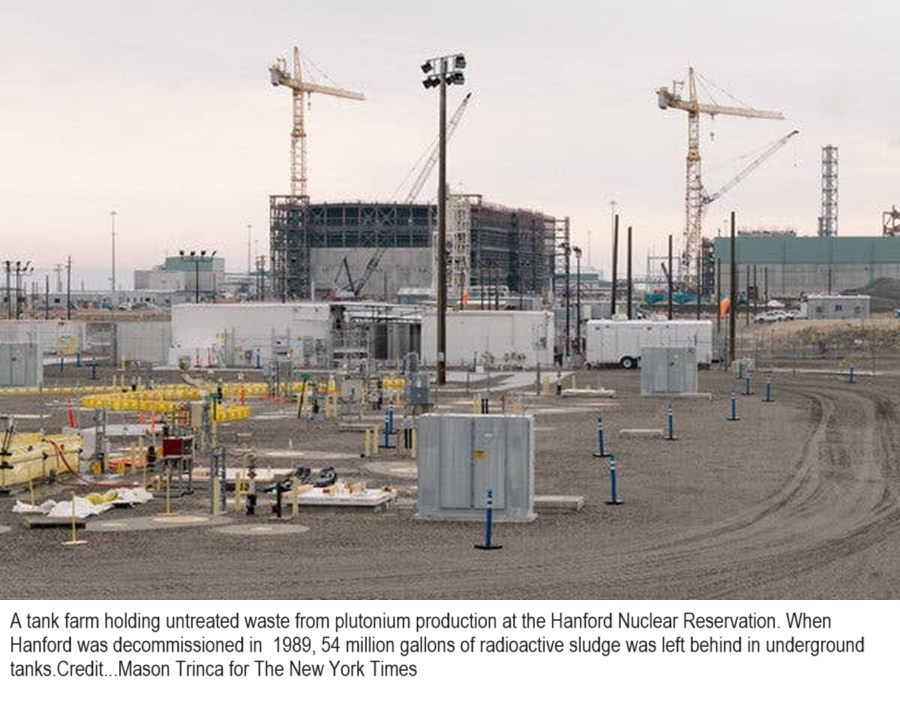
Plans to transform Hanford, which was integral to the nation’s nuclear arsenal after World War II, had just begun inching forward when President Trump started his second term.
New York Times, By Keith Schneider, Reporting from Richland, Wash, March 5, 2025,
In the weeks since President Trump has taken office, he has pushed to unleash oil and gas production and has signed executive orders halting the country’s transition to renewable energy.
But in Washington State, a government-led effort has just started to build what is expected to be the country’s largest solar generating station. The project is finally inching forward, after decades of cleaning up radioactive and chemical waste in fits and starts, at the Hanford Nuclear Reservation, a sweep of desert that was pivotal to the nation’s weapons arsenal from 1943 until it was shut down in 1989. A developer, Hecate, was brought on last year to turn big stretches of the site into solar farms.
Hecate will have access to 10,300 acres that the government has determined sufficiently safe to redevelop. The company has already started site evaluation on 8,000 acres, an area nearly 10 times the size of Central Park in New York and enough space for 3.45 million photovoltaic panels. (Hanford’s site is nearly 400,000 acres.)
If all goes according to plan, the Hecate project, which is expected to be completed in 2030, will be by far the largest site the government has cleaned up and converted from land that had been used for nuclear research, weapons and waste storage. It is expected to generate up to 2,000 megawatts of electricity — enough roughly to supply all the homes in Seattle, San Francisco, and Denver — and store 2,000 more in a large battery installation at a total cost of $4 billion. The photovoltaic panels and batteries will provide twice as much energy as a conventional nuclear power plant. The nation’s current biggest solar plant, the Copper Mountain Solar Facility in Nevada, can generate up to 802 megawatts of energy.
The big unknown still hanging over the plan is whether the Trump administration will thwart efforts that the Biden administration put in place to develop more clean electricity generation………………………………………….
While a clean energy project may clash with Mr. Trump’s policies, there’s a reason the administration may allow Hecate’s solar development to move forward: the revenue the government will get for the land lease. Hecate and the Energy Department declined to discuss the land’s market value, but private solar developers in the region said such easements typically paid landowners $300 an acre annually.
Two officials at the Energy Department, who asked not to be named for fear of retaliation, said that neither the president nor the leaders of the administration’s effort to reshape federal agencies had yet to intervene in the solar project, but that the future of the initiative was uncertain. One of the officials said the new energy secretary, Chris Wright, a former oil executive, had not yet reviewed the project as of late February.
Alex Pugh, Hecate’s director of development, said the company was moving ahead despite shifting political winds. “The fundamentals of the project are strong regardless of policy direction,” he said. “The region needs the project. There is a huge demand for electricity here.”
…………………….Hecate identified the large expanse of open ground alongside high-voltage transmission lines at Hanford as a potential site for its plant several years ago, Mr. Pugh said — long before the Energy Department solicited proposals. The potential benefits, he said, were plainly apparent.
………………….What they also have, however, is risk. The site where Hecate plans to build its photovoltaic panels is near an area where groundwater and soil were decontaminated and alongside an experimental 400-megawatt nuclear reactor complex that was decommissioned in 2001. It’s also about 20 miles south of B Reactor, the world’s first full-scale nuclear reactor, which produced the plutonium for the atomic
UK Government slaps down Ian Murray over UN nuclear weapons summit.
By Xander Elliards
IAN Murray has seen his efforts to lobby the Labour leadership over nuclear weaponry slapped down – with the UK dismissing any engagement with a global summit on the weapons out of hand.
The Scottish Secretary is one of a handful of Labour MPs to have signed a pledge to work towards worldwide nuclear disarmament, which was drawn up by the International
Campaign to Abolish Nuclear Weapons (ICAN) and also backed by almost all
SNP parliamentarians.
The National 4th March 2025, https://www.thenational.scot/news/24981383.uk-government-slaps-ian-murray-un-nuclear-weapons-summit/
Nuclear energy has no role in Scotland’s green future

Scottish Greens 4th March 2025, https://greens.scot/news/nuclear-energy-has-no-role-in-scotland-s-green-future
Nuclear energy is costly and toxic and will do nothing to cut bills.
New nuclear power would cost Scottish households while diverting funding and resources from real climate action, says Scottish Green Co-leader Patrick Harvie.
Speaking ahead of a Scottish Government debate on Scotland’s renewable future, Mr Harvie warned that Labour’s focus on nuclear power would risk increasing household bills and would be a gift to a toxic industry that is not offering the solutions we need.
The UK Labour government has proposed building new nuclear power plants across the UK touting so-called ‘small modular reactors’, despite one never having been built and the long-running record of the nuclear power industry running over schedule and budget.
The first nuclear power plant to be built in the UK for over 30 years, at Hinkley Point, is nearing £28 billion over budget and despite the construction phase beginning in 2016, it will likely not generate any electricity until at least 2029 but possibly 2031.
Mr Harvie said:
“This cold war era obsession with nuclear power shows just how out of touch Labour are with the real crisis we face. It is costly, takes years to go online and will leave a long and toxic legacy for future generations.
“New nuclear power would cost billions of pounds at a time when Labour are telling the public that there is no money to tackle poverty or keep pensioners warm. These new reactors would do nothing to reduce the bills that Labour promised to cut during the election.
“Hinkley Point is the perfect example of everything wrong with nuclear power. Its construction has been a disaster for the environment, requiring masses more concrete and steel than initially thought and it is now running significantly over budget and behind schedule. Does Keir Starmer really think the people want more of this?
“It is a distraction from doing the real work that is so important in terms of investing in clean, green renewable energy that will make a big difference for people and planet.
“Keir Starmer seems to have been sold up the river by his friends in the nuclear power industry who promise modular reactors, which have never been built to any kind of scale and don’t remove the major problem of highly toxic nuclear waste that will still scar our landscape for centuries to come.
“Scotland can have a positive and prosperous green future, but nuclear energy has no part in it. We have the resources for a renewables revolution but we need all governments to commit to it rather than taking a big backwards step with nuclear.”
Nuclear Policy in Scotland

The following motion was passed in the Scottish Parliament on 4th March:
That the Parliament rejects the creation of new nuclear power plants in
Scotland and the risk that they bring;
believes that Scotland’s future is as a renewables powerhouse;
further believes that the expansion ofrenewables should have a positive impact on household energy bills;
notes the challenges and dangers of producing and managing hazardous radioactive
nuclear waste products, and the potentially catastrophic consequences of
the failure of a nuclear power plant;
recognises that the development and operation of renewable power generation is faster, cheaper and safer than that of nuclear power, and welcomes that renewables would deliver higher employment than nuclear power for the development and production of
equivalent levels of generated power.
A Labour motion, proposed by Energy Spokesperson, Sarah Boyack was defeated….
Scottish Parliament 4th March 2025,
https://www.parliament.scot/chamber-and-committees/votes-and-motions/S6M-16657
Fearing toxic waste, Greenland ended uranium mining. Now, they could be forced to restart – or pay $11bn

Fearing toxic waste, Greenland ended uranium mining. Now, they could be
forced to restart – or pay $11bn. The island is being sued by a mining
company over its decision, and faces paying nine times its annual budget in
damages if it loses.
From the iceberg-filled bay, the mountains above the
town of Narsaq, in south-west Greenland, appear unremarkable. In the
September warmth, clumps of grass cling to the smooth, grey peaks shaped
over centuries by an enormous ice cap that lurks behind the fjords on the
horizon. Brightly coloured homes are scattered around the shoreline below,
home to a community of just over 1,300 people.
Were it not for a mining
outhouse on the edge of town, there would be little indication of the
potential riches in the rock. The range is home to one of the largest
undeveloped deposits of rare-earth minerals and uranium in the world: the
Kvanefjeld site, or Kuannersuit in Greenlandic. It contains high
concentrations of metals such as terbium and neodymium, which are used to
manufacture permanent magnets in wind turbines and electric cars. Every
major power in the world is scrambling to get access to these minerals for
carbon-free energy and transport.
A proposed open-pit mine would be worth
about $7.5bn (£6bn) if it went ahead, according to the site operator,
generating income for the island’s economy. But when the mining company
acquired the site in 2007, the impact of potentially radioactive waste
contaminating drinking water and nearby sheep farms alarmed local people.
They feared that the “tailings” – a slurry of ground-up waste from
mining – would be laced with radioactive waste and could contaminate
waterways or spread as dust in the air.
Guardian 5th March 2025, https://www.theguardian.com/environment/2025/mar/05/greenland-mining-energy-transition-minerals-environmental-laws-uranium-rare-earth-toxic-waste-investor-state-dispute-settlement-isds-aoe
British journalists are celebrating the lack of opposition to war in parliament.

US Rep. Eric Swalwell let the cat out of the bag when he admitted on CNN that Ukraine was the “greatest return on investment for any military expenditure ever” because it bled the Russian economy and military and didn’t cost a single American life.
We are told this is healthy, but it’s anything but…
Ricky Hale and Council Estate Media, Mar 06, 2025, [Excellent tweet excerpts , references and graphics] https://www.councilestatemedia.uk/p/british-journalists-are-celebrating?utm_source=post-email-title&publication_id=1336368&post_id=158430860&utm_campaign=email-post-title&isFreemail=true&r=ln98x&triedRedirect=true&utm_medium=email
We are seeing consent for World War III being manufactured before our eyes, and even if you think war is unavoidable, even if you’re convinced that Russia is so dangerous, war is the only way to stop it from conquering Europe, you should listen to anti-war voices.
Now more than ever, you should listen to the other side of the argument because if we’re right, it could help avert nuclear catastrophe, and if we’re wrong, well, war happens anyway. The approach of the warmongers guarantees war whereas the approach of the peacemakers is the only way to avoid war. Shouldn’t we at least give peace a try?
We have violated peace agreement after peace agreement with Russia since the fall of the Soviet Union, and make no mistake, those violations were not moments of recklessness, they were deliberate provocations. We were seeing what we could get away with.
I’ve seen viral memes bragging about how we expanded NATO to Russia’s doorstep and broke red line after red line and Putin didn’t retaliate so we should bring Ukraine into NATO. This overlooks that NATO expansion was one of the key factors that led to war.
After 30-odd years of inaction from Russia, our encroachment eventually provoked a massive retaliation. So here’s a thought, could we just make a peace deal and honour it and see what happens? Could we try that? What’s the worst that could happen? The deal fails and we end up fighting Russia? We’re fighting Russia anyway!
While Sir Keir Starmer is doing his war is peace thing, mainstream media propagandists are falling over themselves to cheer him on. One of the worst culprits yesterday was Lewis Goodall who couldn’t hide his delight that anti-war voices are being ignored.
For those who don’t know, Goodall is one of the hosts of the News Agents, which I’m told is the number one podcast in the UK. Prior to that, Goodall was political correspondent at Sky News and policy editor of BBC Newsnight. Goodall came out with one of the worst political takes I’ve seen in quite some time, a take that received a huge online backlash.
Goodall was celebrating that there is almost no divergence of thought in our politics on a matter as serious as war. He was celebrating the groupthink and lack of dissenting voices as healthy. He seemed to think only other countries have tyrants while our tyrant has actively participated in the Gaza genocide and stamped out dissent at home.
Goodall’s simplistic takes on Russia and Ukraine explain why he was so successful in the mainstream media: he blindly parrots establishment narratives with no attempt at nuance. If someone like him ever attempted nuance, they would never make it into those positions. Only loyal servants of the empire rise to prominence in the mainstream media, and those who dissent are rarely given the platform to speak.
One of the absurd aspects of Goodall’s post is that clearly not everyone wants to see peace. Sir Keir Starmer could have simply issued a statement pushing for a peace deal, yet he chose to invoke the Iraq war, talk of boots on the ground, and planes in the air, and use the most provocative language possible. Starmer and European leaders were openly hostile to peace negotiations from the start and we’re now pretending they want peace?
Starmer’s supporters say a peace deal would mean the “capitulation” of Ukraine and then they demand the capitulation of Russia! They argue that it’s perfectly reasonable to put boots on the ground in Ukraine, but NATO encroaching on Moscow’s doorstep was precisely why the war started!
A neoliberal’s idea of peace is demanding that Russia surrenders to NATO. They are not remotely interested in compromise because if they wanted a settlement, they would have honoured the Minsk Agreements.
There is no way Starmer’s advisors would not have told him boots on the ground would mean war with Russia. This was not a clumsy use of words, it was a deliberate provocation. The only question is does he intend to go through with it? War with Russia isn’t realistic at present because we don’t have the numbers or the equipment to put up any serious fight.
It is for this reason I don’t expect World War III to happen in the immediate future. As I said in my last article, I think Europe’s neoliberals might wait until the end of Trump’s term and hope for an anti-Russia president. Hopefully, things will have fizzled out by then, but for now, the ruling class does not want us talking World War III down. They want us ready to be their foot soldiers in case they decide to do something crazy.
Have you noticed how we’re not seeing a word of caution from mainstream journalists, not even a “maybe World War III is not such a good idea” or “perhaps our approach is not the best way to avoid it”? There is no caution, simply the narrative that Starmer is looking statesman-like and anyone outside the groupthink is basically a traitor. How is this healthy?
Not only did we see Starmer invoking the illegal invasion of Iraq that killed over a million people, we saw a Tory MP invoking World War 1.
We are not supposed to hear the counter-arguments to Starmer’s position because those arguments would make the public think twice. People have to be convinced there is no alternative to war with Russia before they will go along with it. They have to be convinced that Russia is a supreme evil and Ukraine is noble and pure. This explains the following response from Lewis Goodall: [on original]
This dumbing down of the conversation is very deliberate. Lewis Goodall is far too intelligent to think this is all there is to it, but he talks this way anyway. Putin is ready to negotiate a settlement and it is European leaders who are unwilling. Zelensky knows that if he agrees to peace, the neo-Nazis will probably hang him from a tree.
US Rep. Eric Swalwell let the cat out of the bag when he admitted on CNN that Ukraine was the “greatest return on investment for any military expenditure ever” because it bled the Russian economy and military and didn’t cost a single American life. Who cares that hundreds of thousands of Ukrainians have died? If this was simply a fight for Ukrainian liberation, Swalwell would not have used this framing. Make no mistake, this was always about leading Russia into a trap and Ukrainians were simply our pawns.
John Pilger wrote for the Guardian in 2014 about how our backing of neo-Nazis in Ukraine was leading to war with Russia. Many western officials echoed the sentiments. If anyone echoes those sentiments today, they will be dismissed as a Putin puppet, sacked from their jobs and driven out of public life.
We are not allowed to talk about how concerned the media used to be that we were arming and training the Ukrainian far right. We are not allowed to talk about how they pressured Zelensky into taking a more hostile stance towards Russia. We are not allowed to talk about the things the media used to talk about like the neo-Nazi problem in the Ukrainian military, or the fact Ukraine is Europe’s most corrupt country, or how Kyiv bombed eastern Ukraine for eight years and received widespread criticism for all of these things. We are now told Ukraine is a beacon of “liberal democracy” and ironically it is.
None of this is to say that Russia’s invasion of Ukraine was deserved: provoked and deserved are two very different things. The Ukrainian people don’t deserve to be caught in the middle of a conflict between two superpowers that we have deliberately kept going.
We are not allowed any dissenting opinions on war, any acknowledgement of where we might have gone wrong, or any criticism of Ukraine or Zelensky. If you think that NATO and Ukraine and Zelensky have been perfect all the way, you are not a thinking adult. Real life doesn’t work like that and aside from anything else, NATO’s track record of intervention is abysmal. There is no reason to think another intervention would be any better.
If you can’t accept that NATO has been imperfect (to say the least), you must ask why debate is shut down and why those who attempt debate are labelled as Putin puppets and worse. What does the establishment have to fear from debate if it has the correct arguments?
I’m old enough enough to remember when politicians pretended to respect the importance of debate, when it was acknowledged that it was essential to the healthy functioning of society, but propagandists like Goodall are now telling us that lack of debate is actually healthy!
History tells us that whenever there is a lack of debate in our politics, whenever the parties agree on something, it rarely ends well for the working class and often a lot of people end up dying. Everyone should understand that the people who committed a genocide are demanding your blind obedience on their other war. Does this sound like a good idea to you?
Keir Starmer tells SNP to reverse nuclear weapons opposition

NOW is the time to reaffirm the UK Government’s commitment to nuclear
weaponry, the Prime Minister has said – on the day that international
efforts to promote a global ban on the technology step up.
Speaking in the Commons on Monday, Keir Starmer took issue with the SNP’s opposition to
nuclear weapons – apparently in response to comments from First Minister
John Swinney last week. The SNP leader suggested that a focus on nuclear
weapons was an “inhibitor” to combating current military challenges due
to the “resources they command” – and called for the funding
allocated for renewing Trident should instead be invested in
“conventional weaponry”.
The National 3rd March 2025 https://www.thenational.scot/news/24978206.keir-starmer-tells-snp-reverse-nuclear-weapons-opposition/
EDF considers plans to revive ‘fish disco’ at Hinkley Point plant.
Move marks latest step in long-running debate over project’s wildlife
protection measures. EDF is considering reviving plans to install a
so-called fish disco in the Bristol Channel to ward off marine life
approaching its nuclear plant Hinkley Point C.
The French state-owned
company has written to communities around the project, being built in
Somerset, saying new technology could make its planned “acoustic
deterrent” system “safe and effective”. The move marks the latest
step in a long-running saga over the plant’s fish protection measures,
which has become emblematic of a wider national debate between development
and environmental protection measures.
EDF proposed an “acoustic
deterrent” as part of its original plans for the 3.2-gigawatt power
station. The system was devised to protect fish at risk of being sucked
into the plant’s machinery as it draws in water for cooling. But the
company has for several years been trying to ditch the proposal, arguing it
would endanger divers having to install and maintain the system, and may
not be effective.
It proposed to instead develop salt marshes to shelter
shoals. In their letter to local communities, sent last week and seen by
the FT, Andrew Cockcroft, head of stakeholder relations at Hinkley Point C,
said it had “recently become aware” of innovation that meant a new type
of deterrent could be installed. “The technology, pioneered in the
south-west, is proven and deployed internationally [ . . . ] We are
now working with experts to provide the scientific data to underpin the
case for using it at Hinkley Point C,” he said. EDF will “pause all
design and development work on salt marsh creation” in the meantime, he
added.
FT 4th March 2025. https://www.ft.com/content/b282d3f9-22f3-4075-9fce-6458a6c053af
Air Force picks remote Pacific atoll as site for cargo rocket trials.

COMMENT. Dressed up as “humanitarian aid” blah blah. They never give up until they’ve wrecked every beautiful indigenous home.
By SETH ROBSON STARS AND STRIPES • March 4, 2025
The Department of the Air Force has tagged an isolated Pacific island as a test site for landing rockets capable of delivering tons of cargo anywhere on the planet at lightning speed. The department signaled its intent Monday to build two rocket landing pads on Johnston Island within Johnston Atoll, an unincorporated U.S. territory 717 nautical miles southwest of Honolulu, according to a notice in the Federal Register.
……………………………………………………………In October 2020, Army Gen. Stephen Lyons, at the time the head of the U.S. Transportation Command, told the National Defense Transportation Association that officials were working with Elon Musk’s Space X on rocket cargo deliveries. The Federal Register notice does not mention Space X participation in the trial.
………………..U.S. forces are preparing to disperse across the Indo-Pacific in the expectation of missile attacks on established bases in a conflict with China over Taiwan or in the South China Sea.
To sustain forces across a vast swathe of territory the Air Force has been renovating World War II-era airfields from Micronesia to the Philippines.
………………………..Officials also considered Kwajalein Atoll, Midway Island and Wake Island as rocket landing sites, according to the Federal Register notice states. March 4, 2025
Israeli technician accused of offering country’s nuclear secrets to Iranian regime
All Israel News Staff March 3, 2025
Twenty-nine-year-old Israeli chemical technician, Doron Bokobza, is facing
charges for offering to sell sensitive information about Israel’s secret
Dimona nuclear reactor to Iranian intelligence. Bokobza, who resides in the
southern Israeli city of Beersheva, reportedly initiated the contact with
Iran, claiming that he had “access to the Nuclear Research Center.” He was
arrested last month by the Israeli intelligence agency, Shin Bet, and the
Israel Police serious crime unit.
All Israel 3rd March 2025,
https://allisrael.com/israeli-technician-accused-of-offering-countrys-nuclear-secrets-to-iranian-regime
1 This Month





PLEASE OPPOSE HR 8255 AND S.3639 – bills would accelerate satellite deployment, with no environmental review or safeguards – https://ncstd5li.quorum.us/campaign/169331/
To see nuclear-related stories in greater depth and intensity – go to https://nuclearinformation.wordpress.com
-
Archives
- October 2026 (74)
- September 2026 (339)
- August 2026 (330)
- July 2026 (355)
- June 2026 (287)
- May 2026 (306)
- April 2026 (356)
- March 2026 (251)
- February 2026 (267)
- January 2026 (308)
- December 2025 (358)
- November 2025 (359)
-
Categories
- 1
- 1 NUCLEAR ISSUES
- business and costs
- climate change
- culture and arts
- ENERGY
- environment
- health
- history
- indigenous issues
- Legal
- marketing of nuclear
- media
- opposition to nuclear
- PERSONAL STORIES
- politics
- politics international
- Religion and ethics
- safety
- secrets,lies and civil liberties
- spinbuster
- technology
- Uranium
- wastes
- weapons and war
- Women
- 2 WORLD
- ACTION
- AFRICA
- Atrocities
- AUSTRALIA
- Christina's notes
- Christina's themes
- culture and arts
- Events
- Fuk 2022
- Fuk 2023
- Fukushima 2017
- Fukushima 2018
- fukushima 2019
- Fukushima 2020
- Fukushima 2021
- general
- global warming
- Humour (God we need it)
- Nuclear
- RARE EARTHS
- Reference
- resources – print
- Resources -audiovicual
- Weekly Newsletter
- World
- World Nuclear
- YouTube
-
RSS
Entries RSS
Comments RSS

