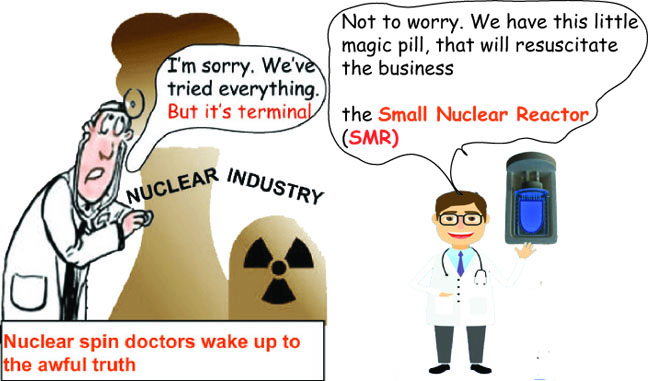
Great British Nuclear explains how it will mitigate risks to SMR programme.
13 Mar, 2025 By Tom Pashby
Great British Nuclear (GBN) has explained how it plans to overcome the key risks to the small modular reactor (SMR) programme is it running and that it plans to establish of SMR development companies (DevCos) to take the projects forward.
The updates were shared in its inaugural 2024 Annual
report and accounts for the 2023/2024 financial year.
It is assumed that GBN will select two vendors to deliver one SMR each, but this was recently
called into question by sources speaking to the Telegraph who said the
chancellor may cut spending at GBN as part of the Spending Review which is
due on 11 June 2025. GBN chief executive officer Gwen Parry-Jones said:
“The UK’s nuclear sector has had some well-documented challenges, ones
that GBN has been set up to navigate.” She did not spell out the
challenges.
“SMRs have not yet been deployed anywhere at scale and their
first-of-a-kind (FOAK) nature presents unique considerations and complex
challenges for us to overcome.” She reassured, however, that she is
“committed to ensure that GBN is an adaptable and resilient organisation
that is flexible and evolves as conditions change, but with our eyes always
firmly fixed on the future to deliver our long-term mission and value for
the UK”.
The report lays out the “principal risks” which GBN believes
the SMR programme faces, along with “key mitigation measures”. The
risks are centred around technology maturity, the ambitious programme
timeline, resourcing, funding and financing, stakeholder alignment,
‘contractual and procurement complexity’, site readiness and cyber
threat.
On technology maturity, it said: “Due to the first of a kind
(FOAK) nature of the technology, providers may not be able to meet
strategic objectives, including timely delivery, value for money and
obtaining regulatory approval. “This may delay approval timelines, affect
project milestones or cause an SMR project to fail.” It says that the SMR
competition that it is running will assess the technologies and mitigate
this risk. However, it also reveals that it will retain the option of, in
addition to the SMR competition winners, selecting a “reserve contractor,
to provide contingency against one provider failing to meet agreed
standards”.
GBN lists four other mitigations, including stating it could
or would provide “predetermined exit points” from projects “should a
project exceed cost estimates or timelines stretch beyond acceptable
parameters”. Regarding risk relating to “funding and financing”, it
says: “GBN’s available funding may be insufficient to resource and
deliver the programme to the planned timetable, e.g. should a change arise
from any change in government policy or in its budgetary priorities.
“A reduction in funding could also be triggered by market conditions or
external events such as an external nuclear event affecting public
sentiment towards nuclear safety.
New Civil Engineer 13th March 2025, https://www.newcivilengineer.com/latest/great-british-nuclear-explains-how-it-will-mitigate-risks-to-smr-programme-13-03-2025/
Eight Reasons Why Nuclear Power is Not the Answer for Hawaii

by Sherry Pollack, 14 Mar 25
Nuclear power isn’t “zero emission.” The nuclear industry has conducted a propaganda campaign rife with factually inaccurate information, including that nuclear power is “carbon-free electricity.” However, this could not be further from the truth. To be clear, there is no such thing as a zero- or close-to-zero emission nuclear reactor. Even existing reactors emit due to the continuous mining and refining of uranium needed for the reactor.
Transporting nuclear fuel is a hazard. As an isolated island chain, Hawaii faces unique and significant risks in transporting nuclear fuel over vast ocean distances. Any accidents during transport, be it from bringing fuel here or shipping waste back, could have catastrophic consequences for Hawaii’s pristine marine environment and tourism-dependent economy.
Nuclear waste. The waste generated by nuclear reactors remains radioactive for thousands of years and needs to be kept contained throughout that time. Currently, there are no long-term storage solutions for radioactive waste, and most is stored in temporary, above-ground facilities.
Hawaii’s geological instability, including frequent earthquakes, volcanic activity, and tsunami risks, makes it an unsafe location for storing nuclear waste. There are no viable long-term solutions for safely containing radioactive materials in such a volatile environment.
Accidents. Human error and natural disasters can lead to dangerous and immensely costly accidents. Think Red Hill but multiply that exponentially. Direct costs would include cleanup operations, property damage, and evacuation efforts, as well as significant indirect costs including long-term health consequences, economic disruption due to lost productivity and tourism, and severe psychological impacts on affected populations, often lasting for generations. According to the Nuclear Regulatory Commission (NRC), the emergency planning zone around a nuclear power plant typically extends to a 10-mile radius for immediate radiation exposure concerns, while a broader “ingestion pathway” zone reaches out to a 50-mile radius where food and water contamination could occur in the event of an incident. This would make safely siting a power plant, particularly on Oahu, impossible.
Impacts on Local Communities and Ecosystems. In addition to the significant risk of cancer associated with fallout from nuclear disasters, studies also show increased risk for those who reside near a nuclear power plant, especially for childhood cancers such as leukemia. Workers in the nuclear industry are also exposed to higher-than-normal levels of radiation, and as a result are at a higher risk of death from cancer.
Nuclear energy is too expensive. To protect the climate, we must reduce the most carbon at the least cost and in the least time. Nuclear power does none of this. A report by the Institute for Energy Economics and Financial Analysis found that even small modular reactors (SMRs) are expensive, too slow to build, and too risky to play a significant role in transitioning from fossil fuels in the coming 10-15 years.
Integral Fast Reactors, Pebble Bed Modular Reactors, Thorium Fueled Reactors, Molten Salt Reactors, and Small Modular Reactors (SMRs) are not viable. Nuclear power advocates promote small modular nuclear reactors (SMRs) and other “advanced” nuclear technologies as the only real solution for the climate crisis. However, proponents of SMRs and these other so called “new” types of reactors fail to address their unproven nature, unresolved safety risks, and economic inefficiency. Moreover, SMRs cannot be counted on to provide ‘firm’ power as has been touted. Just like today’s nuclear plants, SMRs will be vulnerable to extreme weather events or other disasters that could cause a loss of offsite power and force them to shut down. Additionally, the push for SMRs often serves the private interests of billionaires looking to power AI data centers rather than benefiting the people of Hawaii. Bottom line, SMRs are wishful thinking rooted in misinformation.
Nuclear power is an expensive distraction undermining our ability to achieve our clean energy goals. Investment in nuclear power, including SMRs, will take resources away from carbon-free and lower-cost renewable technologies that are available today and can push the transition from fossil fuels forward significantly in the coming decade. Hawaii is already on the path to achieving 100% renewable energy by 2045. Nuclear power is not renewable, requires costly infrastructure, and pursuing it would divert attention and resources from proven, sustainable solutions like solar, and wind.
Nuclear power has NO place in Hawaii’s clean energy future. Nuclear power is too dirty, too dangerous, and too expensive. It is environmentally harmful and produces waste that will be a burden on future generations. Accordingly, we urge the legislature to commit to uphold Hawaii’s constitution, a sustainable future, prioritize investing our resources in a clean renewable energy future, and honor the voices of its people by opposing the use of nuclear power in Hawaii.
Alarmed by Trump, South Korea mulls Japan-style nuclear option
Prominent voices seek capacity to reprocess spent nuclear fuel or enrich uranium and be able potentially to make bombs.
ASIA TIMES, by Daniel SneiderMarch 15, 2025
……………………………………………………………………………………………………………………………………………… The most striking evidence of South Korean alarm over the treatment of allies is the widening discussion of the need to have an independent nuclear arms capability. Conservatives have long advocated that option, but the debate has now moved into progressive circles where prominent voices are calling for South Korea to develop nuclear latency – the capacity to reprocess spent nuclear fuel or enrich uranium to be able to potentially possess fissile material for making bombs.
The Japanese model?
For now, South Korea hopes it can follow the path set by Japanese Prime Minister Shigeru Ishiba and offer Trump concessions ranging from trade, supply chain investment, and cooperation on shipbuilding to promoting South Korea’s role as an asset in a confrontation against China.
At the moment, South Korea does not have an effective government, pending the imminent decision of the Constitutional Court on the impeachment of South Korean President Yoon Suk Yeol. But whatever follows, the South Korean president will have to deal with Trump.
Assemblyman Wi believes the best they can hope for is a smooth and non-confrontational meeting modeled on that of Ishiba, which yielded a joint statement that reaffirmed the US-Japan alliance along the lines of previous statements with the Joe Biden administration.
………………………………………………………………………………….. I think President Trump thinks North Korea is unfinished business left over from the first Trump administration. We have to prepare for the worst.”
Nuclear latency
“The worst” includes the withdrawal of United States Forces Korea (USFK) from South Korea and a withholding of the US nuclear umbrella.
Regardless of how important the U.S.-ROK alliance is now, “there may come a time when it is difficult to rely on the US for our security,” former Minister of Foreign Affairs Yoon Young-kwan wrote in an op-ed published this month. “In preparation for that time, we should strengthen our national defense capabilities, including potential nuclear capabilities, and prepare to handle the deterrence of North Korea with our own strength.”
Progressives are more reticent to endorse nuclear weapons outright, but some have thrown their weight behind nuclear latency – a conscious imitation of the model pursued by Japan to have a full fuel cycle capability. South Korea could, theoretically, reprocess the spent fuel from its power reactors to extract bomb-grade plutonium or, alternatively, have the capacity to enrich uranium, potentially up to bomb-grade levels.
South Korea has long sought to revise the so-called 123 agreement for nuclear cooperation with the United States, which has restricted its ability to have a full fuel cycle. The agreement was only recently reaffirmed, in January at the close of the Biden administration.
In an important column published on March 4 in the progressive newspaper Kyunghyang Shinmun, former Minister of Unification Lee Jong-seok, another close advisor to presidential aspirant Lee Jae-myung, argued that nuclear latency can be achieved within the framework of the Nuclear Non-Proliferation Treaty and with the consent of the United States.
“China, Russia and North Korea, our neighboring countries, are nuclear weapon states, and Japan has already demonstrated its potential,” Lee wrote. “In this situation, it is rather unnatural that South Korea, a nuclear power, cannot reprocess or enrich uranium due to the restrictions of the Korea-US Nuclear Energy Agreement.”
Others in Seoul advocate defecting from the 123 agreement if the United States reduces USFK forces on the peninsula, says Kim Joon-hyung, a Rebuilding Korea Party lawmaker and former senior diplomat.
Kim is a critic of the U.S. alliance but is personally opposed to nuclear latency. “I don’t agree with nuclear proliferation,” he said. “Even if we have nuclear weapons, I don’t think we have security. Small conflicts may become more common. The Korean Peninsula is too small – high tech conventional weapons are enough. Japan will go nuclear and relations with China and Russia will worsen.”
Others are concerned about the isolation that South Korea could experience if it goes down this road. Cho Hyun, a former senior diplomat and progressive foreign policy advisor, helped negotiate the 123 agreement during the Bill Clinton administration. “The right wing thinks we should have our own nuclear development,” Cho told me in Seoul. “We don’t think it is realistic. Some progressives want to request the US for full fuel cycle like Japan. I am against this.”
As the nuclear latency argument rapidly gains support among progressive circles, revising the 123 agreement may become a bargaining chip for South Korea in negotiations with the Trump administration.
At least some inside the administration, though likely not Trump-appointed officials, have become aware of this, prompting media reports that the U.S. Department of Energy is considering labeling South Korea a “sensitive country,” a designation for countries who might be considering going nuclear.
For South Korea, this may only be the start of many shocks to come.
Daniel C. Sneider is a non-resident distinguished fellow at the Korea Economic Institute of America and a lecturer in East Asian studies at Stanford University. https://asiatimes.com/2025/03/alarmed-by-trump-south-korea-mulls-japan-style-nuclear-latency/#
Chinese nuclear weapons, 2025
Bulletin, By Hans M. Kristensen, Matt Korda, Eliana Johns, Mackenzie Knight | March 12, 2025
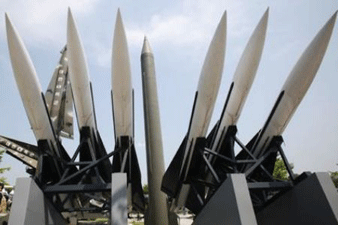
The modernization of China’s nuclear arsenal has both accelerated and expanded in recent years. In this issue of the Nuclear Notebook, we estimate that China now possesses approximately 600 nuclear warheads, with more in production to arm future delivery systems. China is believed to have the fastest-growing nuclear arsenal among the nine nuclear-armed states; it is the only Party to the Treaty on the Non-Proliferation of Nuclear Weapons that is significantly increasing its nuclear arsenal. The Nuclear Notebook is researched and written by the staff of the Federation of American Scientists’ Nuclear Information Project: director Hans M. Kristensen, associate director Matt Korda, and senior research associates Eliana Johns and Mackenzie Knight.
………………………………………………………………………………………………………………………………………………………………………… more https://thebulletin.org/premium/2025-03/chinese-nuclear-weapons-2025/
NATO-Russia Ukrainian War Ceasefire: To Be Or Not To Be?
RUSSIAN and EURASIAN POLITICS, by Gordonhahn, March 14, 2025
On March 13th Russian President Vladimir Putin stated Moscow is open to a ceasefire leading to peace treaty talks, generally speaking. However, he stressed tghat there are “nuances” that need to be addressed before any ceasefire agreement could be concluded. The ‘nuances’ were really counteroffers made for practical reasons but also having the effect of returning the ball to the US-Ukrainian court, paraphrasing US Secretary of State Marco Rubio’s assertion after the Ukrainians’ agreement to a ceasefire that ‘the ball is now in Moscow’s court.’
Highlighting what is or was missing from the American proposal to his knowledge at the time he was speaking (before meeting with US envoy Steven Witkoff, Putin said the issues in need of resolution are: (1) the remaining Ukrainian troops in Kursk, Russia; (2) Ukraine’s military mobilization and training of those mobilized; (3) arms sales to Ukraine; and (4) verification of any ceasefire covering the long ‘line of contact’ or frontlines needed to be resolved (http://kremlin.ru/events/president/news/76450). The first issue is being resolved by the Russian army which has re-taken Sudzha and probably will have killed, captured, or pushed all Ukrainian troops out of Kursk Oblast within a week or so.
…………………………………………………..Putin’s public statements probably reflect what were communicated to U.S. negotiator Steven Witkoff more as requirements or conditions before any Russian agreement to a ceasefire. Pressing Kiev to halt mobilization and training, puts Zelenskiy in a difficult position, and Washington and or Kiev will likely respond that if Kiev is required to halt these activities, then Moscow must halt them or something analagous. This will highlight the coercive, violent aspect of what Ukrainians call ‘Ze-mobilization’—‘Ze’ referring to Zelenskiy.
…………………………….At the same time, the U.S. weapons to be supplied to Kiev are numbered. The Ameerican-Ukrainian statement on the ceaefire agreement declares that the U.S. “will immediately lift the pause on intelligence sharing and resume security assistance to Ukraine” (www.state.gov/joint-statement-on-the-united-states-ukraine-meeting-in-jeddah/).
……………………..Trump has not and may not use PDA to support in Ukraine in future, perhaps depending on Kiev’s willingess to negotiate, despite the inherent contradiction in demanding peace talks while supplying weapons. For Ukraine, this is a contradiction with an opportunity: to drag out talks while it rearms its forces along the contact line.
Not surprisingly then, Russian officials have repeatedly stated they will not accept a ceasefire agreement and will continue fighting until a full-fledged peace agreement is reached. Their previous rejections of any ceasefire were precisely based on Russians’ suspicion that any pause in the fighting will be used to halt Russia’s mounting offensives, rearm Ukraine, and then resume the war with Kiev’s forces in a more robust state.
……………………… Putin may find his political position weakened in comparison with more hardline elements if seen as having fallen again for a another Western deception. This means he cannot accept continued arms supplies to Ukraine during a ceasefire.
……………………………………………………………………..Putin understands negotiating the details and mechanisms for implementing the ceasefire likely will take months. Meanwhile Russian troops can complete the process of expelling Ukrainian troops from the areas which the latter hold in at least two (Luhansk and Donetsk) of the four Donbass regions claimed by Russia and extending areas it holds in other Ukrainian regions. While these and Crimea are settled issues militarily and in terms of sovereignty—they are Russian; Kiev will not win them back for decades, a century, if ever.
The situation with regard to the other two Russia-annexed but still not fully taken regions – Kherson and Zaporozhe’ – is more fluid. Russian forces control less than half of each’s territory and will have an extraordinarly difficult time seizing their capitol cities of the same name. Thus, the negotiations on territories, which, accordoing to Trump was under discussion at Riyadh with the Ukrainians, is likely to center around a possible trade with Moscow withdrawing its troops from areas it occupies in regions outside the four regions it claims for the remainder of the territory of the claimed regions still not held by Russian troops most likely in Kherson and Zaporozhe. All of this will be incredibly difficult to navigate politically, particularly for Zelenskiy and Ukraine. Moreover, it is unlikely that Kiev has more than half a year before the collapse begins of one or more of the following: the entire front, army, oligarch-neofascist Maidan regime, and Ukrainian state.
Now we get to the most disconcerting fact hanging over the ceasefire endeavor. It was hinted at by Putin’s raising the vexing issue of verifying and monitoring the ceasefire……………………………………………………….. it will be a long, rocky road before any agreement is achieved, and failure could lead to an explosive doubling down on the disastrous NATO-Russia Ukrainian War and the destructive chaos of our new multipolar world. https://gordonhahn.com/2025/03/14/nato-russia-ukrainian-war-ceasefire-to-be-or-not-to-be/
Labour’s arms exports to Israel exposed Labour allowed dozens of arms exports to Israel after weapons sanctions
Keir Starmer’s government has continued to approve arms exports to Israel even after some licences were suspended in September
UK trade department approved 34 military export licences to Israel in the two months since David Lammy announced a partial arms embargo, new data shows.
DECLASSIFIED UK, JOHN McEVOY, 12 December 2024
Labour government hasn’t completed a review on Israel’s compliance with international humanitarian law since July
Foreign Office has not asked to see footage from RAF spy flights over Gaza, which could provide evidence of Israeli war crimes
“No particular appetite” to restrict exports of F-35 components to Israel, even as minister admits US government can track whether British-made spare parts are being sent to Israel
Trade committee chairman warned ministers he was “not convinced” that F-35 carve-out complied with UN arms trade treaty.
Keir Starmer’s government has continued to approve arms exports to Israel even after some licences were suspended in September, it can be revealed.
31 “standard” and three “open” licences for military goods have been issued to Israel since 2 September, when UK foreign secretary David Lammy announced partial restrictions on arms sales to Israel.
Those items included “components for trainer aircraft” and “commercial aircraft” which were “not assessed to be used in relation to current military operations in Gaza”.
However, training aircraft can still be used to instruct Israeli pilots on how to conduct offensive operations in Gaza.
35 “standard” and six “open” licences were also approved for items classed as “non-military” such as telecommunications equipment and imaging cameras.
The UK government refused to issue a further 18 licences to Israel for “components for combat aircraft and naval vessels, as well as components for targeting and radar equipment”.
The information is contained in new data released this week on an “ad hoc” basis by Britain’s trade department in response to “significant parliamentary and public interest” in the issue.
The data was evaluated at parliament’s trade committee on Tuesday, during which ministers admitted that the UK government has still not determined whether Israel’s bombing of Gaza amounts to a violation of International Humanitarian Law (IHL).
The committee was told that the UK government has not updated its assessment on Israel’s compliance with IHL since 31 July, some four and a half months ago. Previous assessments have taken less than half that time to finalise.
One minister further confirmed that there was “no appetite” for stopping the export of F-35 fighter jet components for use by Israel, despite concerns that this breaches Britain’s legal obligations.
It comes days after Amnesty International accused Israel of committing a genocide in Gaza and warned the UK to “immediately suspend the direct and indirect supply, sale or transfer, to Israel of all weapons” in order to “stop fuelling violations of international law”………………………………………………………………………………………….
more https://www.declassifieduk.org/labour-allowed-dozens-of-arms-exports-to-israel-after-weapons-sanctions/
Movements across the world call for an end to all US military exercises on the Korean peninsula
The call to cancel the military exercises takes on increased urgency given the military accident last week when South Korean jets bombed their own citizens in the region bordering North Korea during the preparation of yet another joint military exercise with the US.
March 12, 2025 by Abdul Rahman, people’s dispatch
Pressure continues to grow against the ongoing Freedom Shield 25, a joint military exercise between the US and South Korea.
The International People’s Assembly (IPA) and International League of Peoples Struggle (ILPS) joined Nodutdol, an anti-imperialist Korean diaspora group, in launching a joint statement calling for the Freedom Shield military exercises to be cancelled, claiming it is drumming up threats of war on the Korean peninsula. The anti-imperialist and anti-war platforms bring together hundreds of people’s movements and organizations across the world.
“Freedom Shield 25 has dire implications for regional and global peace and stability. As part of Washington’s New Cold War against China, the NATO bloc and its Asian and Oceanian partners are escalating in East Asia, using the Korean peninsula as a staging ground. Freedom Shield poses a most immediate threat to the stability of the region, but its effects also extend far beyond,” the statement reads……………………………………………………………………………………………………………………………………. more https://peoplesdispatch.org/2025/03/12/movements-across-the-world-call-for-an-end-to-all-us-military-exercises-on-the-korean-peninsula/
The nuclear industry continues to infiltrate education.

COMMENT. Well, there will always be a need for workers to shut down this poisonous industry, and deal with the radioactive trash
1 Future innovators with the ‘Evolve’ work experience programme. Sellafield Ltd invites Year 10 learners with an interest in robotics and
artificial intelligence (AI) to participate in the ‘Evolve’ work
experience programme. So far, more than 100 students have been involved in
Evolve, with participants currently coming from 11 different schools in
West Cumbria, as well as home-educated learners. This 5-day programme takes
place on selected weeks throughout the year and aims to equip students with
essential skills for their future careers.
Sellafield Ltd, 13th March 2025,
https://www.gov.uk/government/news/future-innovators-with-the-evolve-work-experience-programme
Governor urges contaminated soil be disposed of outside Fukushima by 2045

Soil from radiation decontamination work after the 2011 nuclear reactor
meltdowns in Fukushima Prefecture should be disposed of outside the
prefecture by the deadline set by law, Fukushima Gov. Masao Uchibori said
in a recent interview. A law stipulates that all such soil must be disposed
of outside Fukushima by March 2045.
“The final disposal must be completed
within 20 years, no matter whether the soil is reused (within Fukushima) or
not,” the governor said. However, Shiro Izawa, the mayor of Futaba — one
of the towns hosting Tokyo Electric Power Company Holdings’ crippled
Fukushima No. 1 plant — said lasts month that soil from radiation
decontamination work should be reused in Fukushima. The mayor said this was
his personal opinion. Uchibori pointed out the heavy burden placed on
Futaba and the neighboring town of Okuma for accepting interim storage
facilities for soil from decontamination work.
Japan Times 11th March 2025. https://www.japantimes.co.jp/news/2025/03/11/japan/fukushima-gov-soil-disposal/
WSJ’s Chief Foreign Correspondent Declares It’s Over For Ukraine In Kursk
by Tyler Durden, Thursday, Mar 13, 2025, https://www.zerohedge.com/geopolitical/ukraine-losing-its-trump-card-key-kursk-town-liberated-russian-troops
It’s a major turning point in the conflict when the Chief Foreign-Affairs Correspondent for The Wall Street Journal declares that Ukrainian forces are now in a full-on withdrawal from Russia’s Kursk amid rapid Russian gains…
Reuters too is reporting that Ukrainian forces are losing in Kursk:
Ukrainian troops appeared on the point of losing their hard-won foothold inside Russia’s Kursk region on Wednesday as Moscow claimed further advances there and military bloggers on both sides said Kyiv’s forces were withdrawing.
Ukraine sprang one of the biggest shocks of the war on August 6 last year by storming across the border and grabbing a chunk of land inside Russia, boosting citizens’ morale and gaining a potential bargaining chip.
There are no more cards to play, as Trump put it last month while hosting Zelensky at the White House, and now this assessment proves truer than ever.
Ukraine is losing the little bit of leverage it might have had left amid discussions toward preparing negotiations with Moscow. Russia’s Kursk is now fast being retaken, and Ukrainian forces are folding, as on Wednesday Russian troops raised their flags over the key town of Sudzha .
The central square of the town in the southwestern Kursk region was scene of where Russia’s Airborne Troops published a short aerial video showing soldiers unfurling a Russian flag as well as military unit banners. Other state media outlets subsequently featured the footage. Newsweek has underscored that Ukraine is fast “losing its trump card.”
Moscow has been focusing its forces on to regaining control around Sudzha in recent days, having retaken 12 settlements in the border region earlier this week.
Fighting is said to still be ongoing, but Moscow forces have asserted control over the center. Ukrainian media also acknowledges the following:
Russian troops have launched an offensive on the Ukrainian-controlled town of Sudzha in Russia’s Kursk Oblast, entering the settlement, the DeepState monitoring group, the Institute for the Study of War (ISW), and the Russian state news agency TASS claimed on March 12. Fighting in the town is reportedly ongoing.
…According to DeepState, Russian forces have entered the eastern part of Sudzha and are entrenching their positions. TASS published purported drone footage claiming that Russian troops had entered the town center and raised a Russian flag.
War bloggers have been closely monitoring the fight for control of Sudzha, with Ruslan Leviev of the war monitor Conflict Intelligence Team describing that Ukrainian troops have been in steady retreat from the entire region.
“We’ve seen that all the areas coming under Russian control have been taken with little to no resistance. The same goes for Sudzha,” Leviev said. “Today, we’re seeing them on the opposite side [of the town]. And again, there are no images of any fighting.”
“At this point, it’s fair to say that the entire city of Sudzha is now under Russian control,” he described of the ground situation.
While months ago Ukrainian forces occupied several hundred square kilometers of Russian territory in Kursk region, as of Wednesday that control has shrunk to less than 200 square kilometers (77 square miles), according to the Ukraine-military linked DeepState war tracker.
Video said to be from on the ground in Russia’s Sudzha, including interviews with elderly Russians that stayed the whole time:
Recall that in the late last month famous Oval Office blow-up involving Trump, Zelensky, and J.D. Vance – Trump told the Ukrainian leader: “You don’t have the cards right now.”
That now appears truer than ever, at a moment the Russians are studying the new US-Ukraine proposal for a 30-day truce in order to jump-start direct negotiations to end the war.
EDF’s salt marsh plans pause met with ‘great relief’ on either side of the Severn
By Carmelo Garcia – Local Democracy Reporter, Gloucester News Centre 11th March 2025
Villagers on both sides of the Severn are relieved EDF has shelved their controversial plans to create salt marshes which were linked to the construction of nuclear power plant Hinkley Point C.
EDF had drawn up the environmental schemes as an alternative to their plan to install an acoustic fish deterrent system at Hinkley Point C in Somerset to scare fish away from the site as the Bristol Channel is home to numerous species such as eels, herring, salmon and sprats.
However, the plans to create salt marshes were met with strong opposition at Arlingham, Rodley near Westbury-on-Severn in Gloucestershire and at Littleton-upon-Severn in South Gloucestershire and Kingston Seymour in Somerset.
And now the energy firm says he plan to install an acoustic fish deterrent system is back on thanks to new innovative technology.
This has been met with relief in communities on both side of the Severn. Councillor Richard Maisey (L, Severn), who represents Arlingham on Stroud District Council said the residents are happy with the outcome.
He attended the public meeting held in the village regarding the proposals last year and said the news has been met with “great reliel”.
“The general feeling is happiness that it doesn’t appear to be going ahead,” he said.
“They haven’t totally written it off but they have indicated it is not their intention to proceed.”………………………………………………………. https://gloucesternewscentre.co.uk/edfs-salt-marsh-plans-pause-met-with-great-relief-on-either-side-of-the-severn/
Fukushima Remembered At URENCO’s Uranium Enrichment Plant Today in Cheshire
Campaigners gathered today at the UK’s uranium enrichment plant to
remember Fukushima and hand over a letter of concern about uranium
enrichment. Today marks the 14th anniversary of the Fukushima catastrophe.
On March 11, 2011, a record 9.0-magnitude quake struck off the coast of
Japan’s Tohoku region, triggering a tsunami with waves that reached a
maximum height of 40.5 meters and causing a triple nuclear meltdown at the
Fukushima No.1 nuclear plant.
Radiation Free Lakeland 11th March 2025, https://mariannewildart.wordpress.com/2025/03/11/fukushima-remembered-at-urencos-uranium-enrichment-plant-today-in-cheshire/
‘Nervous and rushed’: Massive Fukushima plant cleanup work involves high radiation and stress
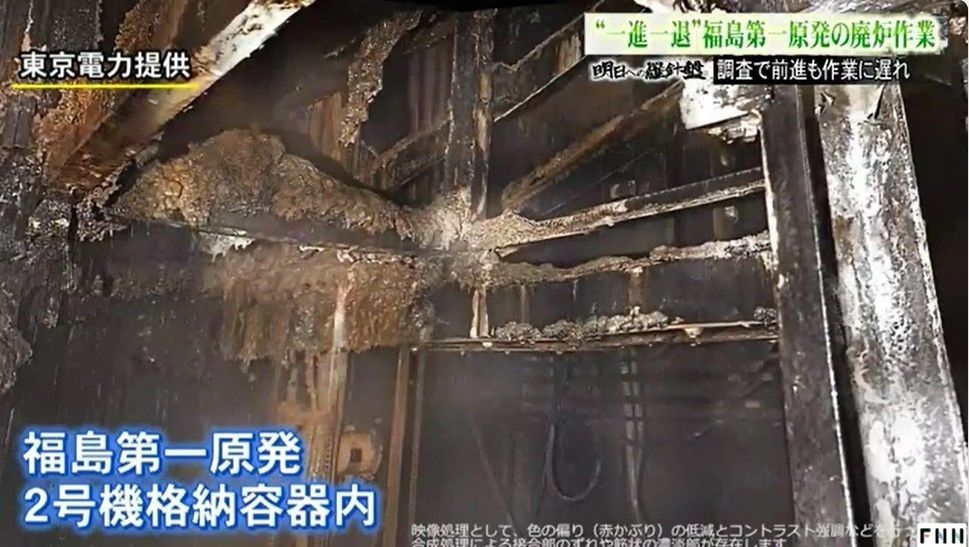
Experts say the hard work and huge challenges of decommissioning the plant are just beginning. There are estimations that the work could take more than a century. The government and TEPCO have an initial completion target of 2051, but the retrieval of melted fuel debris is already three years behind, and many big issues remain undecided.
By ASSOCIATED PRESS, 12 March 2025
OKUMA, Japan (AP) – The Fukushima Daiichi nuclear power plant’s radiation levels have significantly dropped since the cataclysmic meltdown in Japan 14 years ago. Workers walk around in many areas wearing only surgical masks and regular clothes.
It’s a different story for those who enter the reactor buildings, including the three damaged in the 2011 earthquake and tsunami. They must use maximum protection – full facemasks with filters, multi-layered gloves and socks, shoe covers, hooded hazmat coveralls and a waterproof jacket, and a helmet.
As workers remove melted fuel debris from the reactors in a monumental nuclear cleanup effort that could take more than a century, they are facing both huge amounts of psychological stress and dangerous levels of radiation.
The Associated Press, which recently visited the plant for a tour and interviews, takes a closer look.
A remote-controlled extendable robot with a tong had several mishaps including equipment failures before returning in November with a tiny piece of melted fuel from inside the damaged No. 2 reactor.
That first successful test run is a crucial step in what will be a daunting, decades-long decommissioning that must deal with at least 880 tons of melted nuclear fuel that has mixed with broken parts of internal structures and other debris inside the three ruined reactors…………………………………………………
Radiation levels are still dangerously high inside the No. 2 reactor building, where the melted fuel debris is behind a thick concrete containment wall. Earlier decontamination work reduced those radiation levels to a fraction of what they used to be.
In late August, small groups took turns doing their work helping the robot in 15- to 30-minute shifts to minimize radiation exposure. They have a remotely controlled robot, but it has to be manually pushed in and out.
“Working under high levels of radiation (during a short) time limit made us feel nervous and rushed,” said Yasunobu Yokokawa, a team leader for the mission. “It was a difficult assignment.”
Full-face masks reduced visibility and made breathing difficult, an extra waterproof jacket made it sweaty and hard to move, and triple-layered gloves made their fingers clumsy, Yokokawa said.
To eliminate unnecessary exposure, they taped around gloves and socks and carried a personal dosimeter to measure radiation. Workers also rehearsed the tasks they’d perform to minimize exposure…………………………………………………..
a growing number of workers are concerned about safety and radiation at the plant, said Ono, the decommissioning chief, citing an annual survey of about 5,5,00 workers……
Yokokawa and a plant colleague, Hiroshi Ide, helped in the 2011 emergency and are team leaders today. They say they want to make the job safer as workers face high radiation in parts of the plant.
On the top floor of the No. 2 reactor, workers are setting up equipment to remove spent fuel units from the cooling pool. That’s set to begin within two to three years.
At the No. 1 reactor, workers are putting up a giant roof to contain radioactive dust from decontamination work on the top floor ahead of the removal of spent fuel.
To minimize exposure and increase efficiency, workers use a remote-controlled crane to attach pre-assembled parts, according to TEPCO. The No. 1 reactor and its surroundings are among the most contaminated parts of the plant.
Workers are also removing treated radioactive wastewater. They recently started dismantling the emptied water tanks to make room to build facilities needed for the research and storage of melted fuel debris.
After a series of small missions by robots to gather samples, experts will determine a larger-scale method for removing melted fuel, first at the No. 3 reactor.
Experts say the hard work and huge challenges of decommissioning the plant are just beginning. There are estimations that the work could take more than a century. The government and TEPCO have an initial completion target of 2051, but the retrieval of melted fuel debris is already three years behind, and many big issues remain undecided.
Ide, whose home in Namie town, northwest of the plant, is in a no-go zone because of nuclear contamination, still has to put on a hazmat suit, even for brief visits home…….
https://www.dailymail.co.uk/wires/ap/article-14484347/Nervous-rushed-Massive-Fukushima-plant-cleanup-exposes-workers-high-radiation-stress.html
At Haverigg Today – the Nuclear LIE of a “Safe” and “Secure” Sub-Sea Nuclear Dump.
The sub-sea area involved would be 26 to 50 km square. The “smaller” area proposed would be the size of Tuvalu at 26 km square. There are hundreds (if not thousands) of ongoing research projects into, for example, the release of radioactive gases, how the heat generated would impact the geology, the steel containments and the bentonite backfill.
These ongoing research projects throw up more questions regarding the safety of long term containment. Nuclear Waste Services are asking locals who are now in reciept of nuclear dump community funds, to express support for an experiment. An experiment which will impact their health and the environment for generations to come. Those who are not “local” who would also be impacted are deliberately excluded from “having a say.”
Chris Hedges: Trump’s Christian Fascists and the War on Palestine
the usual absurdity that the Hebrew Bible, written 4,000 years ago, can be used to draw contemporary national borders.
March 11, 2025, By Chris Hedges / ScheerPost
Christian Nationalists who form the bedrock of support for Donald Trump — 80 percent voted for Trump in the last election according to a voter survey by the Associated Press — have mounted a concerted campaign calling on the White House to back Israel’s annexation of the West Bank and Gaza.
This campaign includes visits to Israel by prominent leaders, including Ralph Reed, Tony Perkins and Mario Bramnick, petitioning the White House, lobbying Congress and calls for annexation at Christian conferences, including a resolution of support for Israeli sovereignty over the West Bank adopted at the most recent Conservative Political Action Conference. The National Religious Broadcasters (NRB) Convention in Dallas, in March, gathered over 200 signatures from pastors and right-wing religious leaders from across the United States calling for the annexation of “Judea and Samaria” — the purported biblical name for the West Bank —and declaring the two state solution “a failed experiment.”
American Christian Leaders for Israel, which says it represents a network of “over 3,000 organizational leaders from across the nation, including the National Religious Broadcasters,” endorsed the NRB resolution and sent it to Trump. Congresswoman Claudia Tenney and five other members of the congressional “Friends of Judea and Samaria Caucus,” sent a letter to Trump asking to “recognize the right of Israel” to declare sovereignty over the occupied Palestinian territories, arguing that it will advance “the Judeo-Christian heritage on which our nation was founded.”
Trump, who rescinded a Biden administration executive order that sanctioned Jewish colonists in the West Bank for human rights violations, promised, on Feb. 4, to make an announcement in the “next four weeks,” about possible annexation of the West Bank. This follows Trump’s call for the ethnic cleansing of Gaza and death threats to the Palestinians unless they release Israeli hostages. “You’re talking about probably a million and a half people, and we just clean out that whole thing,” Trump said of Gaza while speaking to reporters aboard Air Force One.
The agenda of Zionist extremists and Christian fascists, who hold senior positions throughout the Trump administration, have long converged. The language, iconography and symbolism used by the Christian and Jewish fascists is biblical. But the bonds are political, not religious.
I detail the history and ideology of our homegrown fascism and its kinship with Jewish fascism in my book, “American Fascists: The Christian Right and the War on America.”
Mike Huckabee, the former governor of Arkansas and a Baptist minister, has been nominated by Trump to be the U.S. ambassador to Israel. Huckabee has said there is “no such thing as a Palestinian” and asserted that Palestinian identity is “a political tool to try and force land away from Israel.” He proposes that any Palestinian state should be created outside of Israel in neighboring countries such as Egypt, Syria or Jordan. He dismisses the two-state solution as “irrational and unworkable.”
“I believe the scripture. Genesis 12: Those who bless Israel will be blessed; those who curse Israel will be cursed. I want to be on the blessing side, not the curse side,” Huckabee says.
John Ratcliffe, appointed by Trump to run the Central Intelligence Agency, advocates assisting Israel in what he described as its “foot-on-their-throat” approach against Iran.
Trump’s Defense Secretary Pete Hegseth — who argues that “Zionism and Americanism are the front-lines of Western civilization and freedom in our world today” — pedals the usual absurdity that the Hebrew Bible, written 4,000 years ago, can be used to draw contemporary national borders…………………………………………………………………………………….
Jewish supremacy, like the supremacy of the Christian fascists, is, these fanatics claim, sanctified by God. The slaughter of the Palestinians, who Benjamin Netanyahu compared to the biblical Amalekites, are the incarnate of evil and deserve to be massacred. Euro-Americans in the American colonies used the same biblical passage to justify the genocide of Native Americans. Violence and the threat of violence are the only forms of communication those inside the magical circle of Jewish nationalism or Christian nationalism speak…………………………………………………………………………….. more https://scheerpost.com/2025/03/11/chris-hedges-trumps-christian-fascists-and-the-war-on-palestine/
1 This Month





PLEASE OPPOSE HR 8255 AND S.3639 – bills would accelerate satellite deployment, with no environmental review or safeguards – https://ncstd5li.quorum.us/campaign/169331/
To see nuclear-related stories in greater depth and intensity – go to https://nuclearinformation.wordpress.com
-
Archives
- October 2026 (74)
- September 2026 (339)
- August 2026 (330)
- July 2026 (355)
- June 2026 (287)
- May 2026 (306)
- April 2026 (356)
- March 2026 (251)
- February 2026 (267)
- January 2026 (308)
- December 2025 (358)
- November 2025 (359)
-
Categories
- 1
- 1 NUCLEAR ISSUES
- business and costs
- climate change
- culture and arts
- ENERGY
- environment
- health
- history
- indigenous issues
- Legal
- marketing of nuclear
- media
- opposition to nuclear
- PERSONAL STORIES
- politics
- politics international
- Religion and ethics
- safety
- secrets,lies and civil liberties
- spinbuster
- technology
- Uranium
- wastes
- weapons and war
- Women
- 2 WORLD
- ACTION
- AFRICA
- Atrocities
- AUSTRALIA
- Christina's notes
- Christina's themes
- culture and arts
- Events
- Fuk 2022
- Fuk 2023
- Fukushima 2017
- Fukushima 2018
- fukushima 2019
- Fukushima 2020
- Fukushima 2021
- general
- global warming
- Humour (God we need it)
- Nuclear
- RARE EARTHS
- Reference
- resources – print
- Resources -audiovicual
- Weekly Newsletter
- World
- World Nuclear
- YouTube
-
RSS
Entries RSS
Comments RSS

