USA Congress Democrats and Republicans want strict controls on any nuclear deal with Saudi Arabia

Lawmakers Want a Greater Say as U.S. Seeks a Saudi Nuclear Deal, Members of Congress from both parties demand that an agreement to sell Riyadh civilian nuclear technology be based on stringent controls, WSJ . By Michael R. Gordon, Dec. 16, 2018
The Trump administration’s push to sell civilian nuclear technology to Saudi Arabia is emerging as the next battleground in the struggle between the White House and Congress over U.S. policy toward Riyadh following the killing of journalist Jamal Khashoggi.
The debate over Riyadh’s nuclear ambitions intensified last week after Energy Secretary Rick Perry brushed aside congressional appeals that nuclear talks be suspended because of Mr. Khashoggi’s killing and traveled to Saudi Arabia, where he accentuated the role American companies could play in helping the country establish a nuclear energy program.
…….But the CIA assessment that Saudi Crown Prince Mohammed bin Salman likely ordered Mr. Khashoggi’s killing has fueled concerns in Congress that the Saudi leader is too ruthless to be entrusted with nuclear technology. Saudi Arabia has repeatedly said the crown prince had no knowledge of the operation.
Lawmakers of both parties are demanding a deal be based on the most stringent nonproliferation controls. And some are now pushing legislation that would give Congress more of a say by requiring that a nuclear accord with Saudi Arabia be approved by the Senate and the House of Representatives.
“Before Khashoggi, I would say our chances were quite modest,” said Rep. Brad Sherman, a California Democrat, referring to prospects of House legislation he is drafting. “Now I would have to say our chances are better than 50-50.”
An identical measure is being prepared in the Senate by Sens. Ed Markey (D., Mass.) and Marco Rubio (R., Fla.), though the prospects for winning approval are likely to be more challenging.
The prospective nuclear deal comes amid a broader debate over Saudi policy, including a Senate vote last week to halt U.S. support for the Saudi-led coalition that is fighting in Yemen.
Even since the Trump administration signaled its interest in a nuclear agreement with Saudi Arabia last year, there has been debate about proliferation controls that should be imposed under an accord authorizing the transfer of U.S. nuclear technology, known as a 123 agreement.
……..Nuclear experts have also said that it would be important for Saudi Arabia to agree to the “Additional Protocol,” a formal arrangement with the International Atomic Energy Agency that provides for far-reaching inspections. The Saudis have been resisting that step, former officials who have been tracking the talks say. A spokeswoman for the Saudi embassy didn’t respond to a request for comment..
……..Under current law, a nuclear cooperation agreement with Saudi Arabia would go forward unless congressional opponents backed a joint resolution against it. That means that two-thirds of the lawmakers would need to oppose the accord so Congress could overcome a potential veto.
Mr. Sherman’s new bill aims to put nuclear accord skeptics in a more favorable position by requiring the administration to win approval from both the Senate and the House. That means a simple majority in one legislative chamber would be enough to block the agreement…….https://www.wsj.com/articles/lawmakers-want-a-greater-say-as-u-s-seeks-a-saudi-nuclear-deal-11544990606
USA government will appease murderous Saudi Arabia regime – or maybe not?
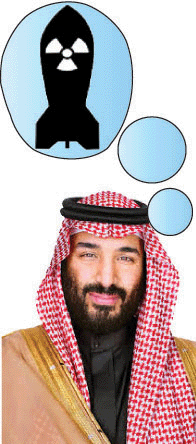 US Nuclear Energy Policy & Khashoggi Murder: Appeasement Or Threat? Clean Technica, December 12th, 2018 by Tina Casey
The horrific murder of journalist Jamal Khashoggi last October continues to fester, and some of the blowback has been falling on the shoulders of the US tech sector. Rightfully so, considering the connection between Saudi wealth, Japan-based SoftBank, and Silicon Valley A-listers. Meanwhile, US President* Donald Trump has dismissed evidence that Saudi Crown Prince Mohammed bin Salman was directly responsible for the crime, but a recent nuclear energy announcement could indicate that someone in Trump’s cabinet is stirring the pot.
Khashoggi Or Not, Trump Administration Still Sharing Nuclear Energy Love With Saudi Arabia…
There is also a nuclear weapons angle to the story, but for now lets focus on the nuclear energy angle.
Despite its vast solar and wind resources, Saudi Arabia has expressed a growing interest in building a fleet of power plants fueled by nuclear energy.
CleanTechnica has been among those taking note, though not in any particular depth — until earlier this week, when the US Department of Energy released a readout of Energy Secretary Rick Perry’s recent visit with the Saudi Minister of Energy, as well as the CEO of Saudi Aramco and other officials.
The readout hit the Intertubes just about the time word leaked out that there is now a written transcript of the audiotape that recorded the last minutes of Khashoggi’s life.
Anyone — even those who do not speak Arabic — can now read and understand the last words that Khashoggi screamed out in the course of his murder.
So, was the readout yet another example of Secretary Perry tone deafness? Or was it yet another one of his curiously timed missives that undercut White House policy even while seeming to affirm it.
Here, you do the math. This is where the readout deals with the visit to Saudi Arabia (Perry also went to Qatar on the same trip):
…the Secretary expressed that the United States continues to view Saudi Arabia as an important ally, particularly in the energy space. Perry and Al-Falih spoke about last week’s OPEC announcement of production cuts and Perry reiterated the need for stable supply and market values. They also discussed the 2018 increase in Saudi oil production and the impact it has had on world markets in the wake of the Iran sanctions.
And, here’s the summary message (emphasis added):
Secretary Perry underscored the message that he carries all over the world: any nation seeking to develop a truly safe, clean, and secure nuclear energy program should turn to American companies who have the ability to provide the technology, knowledge, and experience that are essential to achieving that goal.
The US nuclear energy industry is in a state of near collapse, domestically speaking. As with coal power, the only hope for growth is to export the technology elsewhere…but the readout makes it clear there are standards to be met.
Or Not
The readout is not particularly startling in and of itself, though there is a lot to chew on between the lines.
What really sticks out is the summary message. It could be read in two different ways.
Number one, Secretary Perry was blithely pitching the US nuclear energy industry to the Saudi government, ignoring — as per White House policy — the latest revelations about the Khashoggi murder.
That would be consistent with the Rick Perry, who toes the Trump line on a whole host of other issues, inside and outside of the energy space.
Number two relates to the other Rick Perry — the one who has consistently pushed for the Department of Energy’s scientific and renewable energy missions, even when (or perhaps especially when) those missions clash with Trump’s anti-science, pro-coal rhetoric.
In this scenario, the nuclear message is not a pitch. It’s practically the opposite: a reminder that the US holds the nuclear energy cards.
To be clear, the US doesn’t hold all the nuclear energy cards, but it does hold enough of them to make trouble. Earlier this fall, for example, the Trump administration announced new restrictions on nuclear technology exports to China. Though some have downplayed the impact, that’s gotta hurt.
As applied to the Saudi government, Perry could wield the authority of his agency under its nonproliferation mission as a stick, not a carrot.
Or, maybe not. If you apply Occam’s razor to the readout, it is just what it is: a message that, Khashoggi or not, it’s business as usual between Saudi Arabia and the US.
What do you think? Drop us a note in the comment thread! ………… https://cleantechnica.com/2018/12/12/us-nuclear-energy-policy-khashoggi-murder-appeasement-or-threat/
Hitachi having trouble financing new nuclear reactors in Wales – may pull the plug on Wylfa project

Hitachi may freeze British nuclear project due to swelling costs, https://www.japantimes.co.jp/news/2018/12/16/business/corporate-business/hitachi-may-freeze-british-nuclear-project-due-swelling-costs/#.XBawLdIzbGg
KYODO 17 Dec 18, Hitachi Ltd. is considering freezing its plan to build nuclear reactors in Wales after facing difficulties in finding investors to finance the project’s ballooning costs, sources close to the matter said Sunday.
If the Japanese conglomerate freezes the ¥3 trillion Wylfa Newydd plant construction, all of the overseas nuclear projects promoted by the government of Prime Minister Shinzo Abe as part of his growth strategy would have faltered.
Mitsubishi Heavy Industries Ltd. is mulling withdrawing from a nuclear project in Turkey amid swelling safety-related costs following the 2011 Fukushima nuclear accident, while Toshiba Corp. has decided to exit from the nuclear plant business outside Japan after incurring huge losses in the United States.
Hitachi has said it wants to lower its stake in Horizon Nuclear Power Ltd., a wholly owned unit it acquired in 2012 from two German electric utilities to take over the nuclear project, to below 50 percent to limit the impact on the Hitachi group of the construction of two advanced boiling water reactors on the Isle of Anglesey in Wales.
Hitachi is likely to have told the British and Japanese governments of its plan to freeze the project, the sources said. The issue will likely be discussed at the planned meeting between Abe and British Prime Minister Theresa May in January, they said.
The company has been contacting prospective investors in the project, including Japanese utilities, but little progress has been made amid concerns that costs will further swell, they said.
Hitachi also remains at odds with the British government over the purchase price of electricity to be generated by the plant, a key factor in determining the project’s profitability for the company and potential investors.
Given the current turmoil in British politics over May’s proposed deal with the European Union on the United Kingdom’s departure from the bloc, price-setting talks are at a “deadlock,” a senior Hitachi official said.
Cost of Chinese-designed and largely Chinese-owned nuclear reactor for Bradwell UK will probably blow out hugely

 Dave Toke’s Blog 16th Dec 2018 The UK’s Office for Nuclear Regulation (ONR) has requested a long series of safety improvements to the proposed design of the Chinese HPR1000 (‘Hualong’) reactor proposed to be built at Bradwell in Essex. Previous experience suggests this could presage a big increase in costs for the plant which is likely to cost a lot more than similar plant built in China. The HPR100 design Bradwell, UKis based on one being built in China at by China General Nuclear Power Group (CGN). CGN will own around two-thirds of the project, with EDF owning the remaining share.
‘follow up’ point materials must severely question any financial estimates of the plant’s costs that have been based on the plant being built in
China.
https://realfeed-intariffs.blogspot.com/2018/12/office-for-nuclear-reactor-demands.html
Hitachi calling on Britain to further subsidise new nuclear reactors for Wales
 Hitachi to ask UK for further funding as nuclear project stalls https://asia.nikkei.com/Business/Companies/Hitachi-to-ask-UK-for-further-funding-as-nuclear-project-stalls
Company struggles to find other Japanese parties willing to invest TAKAFUMI HOTTA and SHINICHIRO IBUSUKI, Nikkei staff writers, DECEMBER 18, 2018
TOKYO — Hitachi will ask the British government for additional support for a nuclear power project in Wales as it struggles to recruit other Japanese investors amid international headwinds for atomic energy.
The company will consider scrapping the project, worth more than 3 trillion yen ($26.6 billion), should negotiations with London fail to reach a conclusion by January.
Aborting Japan’s last active proposal to build an overseas nuclear power plant would deal a blow to the government’s plan to expand exports of energy-related infrastructure, as similar projects face setbacks around the world.
“It is a fact that it is facing a difficult situation,” Hitachi Chairman Hiroaki Nakanishi said at a news conference Monday. “I told the British government that we are already reaching the limit.”
Nakanishi was speaking in his capacity as chairman of the Japan Business Federation, the nation’s top business lobby, better known as Keidanren. The news conference was held after reports emerged that Hitachi is considering scrapping the project altogether due to the difficulty of securing funding from Japanese companies.
With aid from the British government, Hitachi’s nuclear power segment intends to build two reactors on the Welsh island of Anglesey through British subsidiary Horizon Nuclear Power. It was scheduled to make a decision on the project’s economic feasibility sometime in 2019 but will probably push that decision forward by more than six months as the business environment worsens.
Nuclear power is losing its competitiveness as the price of renewable energy falls. The U.K. government also plans to buy electricity from the Wales plant for lower prices than those charged by other nuclear power facilities.
The Japanese government has promoted overseas nuclear power plant construction as a pillar of its strategy to boost infrastructure exports. Since the 2011 Fukushima disaster, no new reactors have been approved inside Japan. To maintain nuclear expertise and talent, Japan’s public and private sectors have teamed up to sell the technology abroad.
But ground has not broken on any project to date. A Japanese public-private consortium led by Mitsubishi Heavy Industries is planning to scrap a nuclear power plant in Turkey, for instance. Should the nuclear industry lose its legs, it could affect the restating and decommissioning of existing plants.
Hitachi has said it will move forward with the project if it can limit its exposure by reducing its 100% stake in Horizon Nuclear to around 30%. The U.K. has pledged more than 2 trillion yen in loans for the project, with the remaining cost of about 900 billion yen to be split among investments from Hitachi, the British government and business as well as the Japanese government and businesses.
Lining up Japanese investors, however, has proved to be a challenge. Tokyo Electric Power Co. Holdings, also known as Tepco, is reluctant to provide funding. Chubu Electric Power and other Japanese companies probably will follow its lead. Without other investors on the horizon, Hitachi is asking the British to share more of the burden.
Aside from Tepco and Chubu Electric, Hitachi also solicited investments from Japan Atomic Power, the Japan Bank for International Cooperation, the Development Bank of Japan and other parties. But the industrial conglomerate is having trouble gathering the necessary 300 billion yen.
The British government is no position to acquiesce to these demands. Having already pledged around $18 billion in loans, it risks backlash from the public by providing further financial support. Prime Minister Theresa May can ill afford another fight as her government risks collapse over negotiations to leave the European Union.
At a separate news conference held by Hitachi, Toshiaki Higashihara, the company’s president and CEO, did not attempt to downplay the situation. “Hitachi is a private company,” he said, “and there is a limit to how much risk it can take. If the project is not economically rational, it is possible that the project will be halted.”
Higashihara added that the final investment decision will be made by the end of 2019.
Hitachi Executive Vice President and Executive Officer Toshikazu Nishino also spoke, saying the company “has not given up yet,” though it recognizes “the negotiations are not easy.”
Comprehensive and Progressive Agreement for Trans-Pacific Partnership (CFTPP) held over Taiwan , because of its referendum rejecting food from Fukushima
 FOOD IMPORTS FROM FUKUSHIMA-AFFECTED AREAS BECOME WEDGE ISSUE WITH JAPAN https://newbloommag.net/2018/12/17/fukushima-food-cftpp/18DECEMBER 2018 by Brian Hioe
I T IS UNSURPRISING that Taiwan will not be admitted to the Comprehensive and Progressive Agreement for Trans-Pacific Partnership (CFTPP) because of the referendum vote against food imports from Fukushima-affected areas held in late November concurrent with nine-in-one elections. Namely, the issue of food imports is one upon which Taiwan has long been pushed around by larger, more powerful countries, who dangle the threat of being denied admittance to international free trade agreements if Taiwan does not allow food imports.
The Abe administration has in the past made allowing food imports from Fukushima-affected areas a condition for stronger diplomatic relations with Japan. This would be part of a more general effort by the Abe administration to promote the prefecture of Fukushima as safe, with concerns that lingering radiation may still cause harmful effects in the region after the 2011 Fukushima disaster. The Abe administration has thus attempted to promote food exports from the area, as well as to encourage tourism to the area.
Concerns over whether food from Fukushima is safe are valid, seeing as this is an issue of contention in Japan itself. Abe’s Liberal Democratic Party (LDP) is deeply wedded to the Japanese nuclear industry, with an unusual willingness to push for nuclear energy in spite of outbreaks of large-scale public protest. Concerns have also been longstanding that the LDP has been unwilling to provide accurate nuclear assessments for the Fukushima area, or sought to mislead through official statistics.
After the results of the referendum in late November, in which 7,791,856 voted against allowing food imports from Fukushima, the Japanese government initially expressed understanding regarding the results of the referendum, suggesting that not allowing food imports from Fukushima would not be an obstacle for Japan-Taiwan relations going forward. However, this appears to have not entirely been the truth.
Indeed, as the KMT was a powerful force behind the push for the referendum, it is likely that the KMT sought to use the issue of food imports from Fukushima-affected areas as a means to not only to attack the DPP with the accusation that it was endangering public safety but also sabotage closer relations between Japan and Taiwan. Apart from that the KMT’s Chinese nationalism has a strong anti-Japanese element, the KMT is pro-unification and so opposes closer ties between Japan and Taiwan, seeing as Japan could be a powerful regional ally that interceded on behalf of Taiwan against Chinese incursion.
The CFTPP is a regional free trade agreement that is the form that the Trans-Pacific Partnership (TPP) took on after America withdrew from the trade agreement under Donald Trump. Despite the fact that the TPP was orchestrated under American auspices as a means to counter growing Chinese influence in the Asia-Pacific region, the Trump administration favored protectionism instead of free trade, seeing free trade as overextending American resources rather than expanding its economic reach.
This would not be the first time that food imports have been used as a condition of Taiwan’s admittance to or denial from the TPP framework. America previously made allowing American beef imports into Taiwan to be a condition of Taiwan’s possibly entering into the TPP, seeing as there were in concerns in Taiwan that the use of the hormone ractopamine—banned in most of the world’s countries but not in America—was unsafe. This, too, was a valid concern regarding food safety, but the KMT was interested in the issue because it hoped to use this as a wedge issue to sabotage relations between Taiwan and the US.
Now that Japan is the primary driving force behind the CFTPP, as the renewed version of the TPP, food imports from Fukushima-affected areas have taken priority as the issue which would determine Taiwan’s admittance or non-admittance to the CFTPP. As free trade agreements are more generally a way for large, powerful countries to coerce smaller, weaker countries into relations of economic subordination, this would be nothing surprising.
More generally, free trade agreements have also long been held over the heads of Taiwanese voters in order to influence how they vote, as observed in the examples of the Economic Cooperation Framework Agreement or the Cross-Strait Services Trade Agreement under the Ma administration. But in light of the issue of food imports from Fukushima-affected areas being a contested issue in Taiwan, it remains to be seen whether the CFTPP will become a significant wedge issue in Taiwanese politics going forward.
High Iodine distribution, low intake among children after Fukushima nuclear accident
https://www.healio.com/endocrinology/thyroid/news/in-the-journals/%7B33ecf315-c68e-474b-aeda-81c5271d2371%7D/high-iodine-distribution-low-intake-among-children-after-fukushima-nuclear-accident Despite a high distribution rate of stable iodine after the 2011 Fukushima nuclear accident in Japan, only 63.5% of parents reported children took the tablets, with many citing safety concerns in questionnaires, according to findings published in The Journal of Clinical Endocrinology & Metabolism.
The intake of stable iodine after a nuclear emergency is a key strategy for preventing childhood thyroid cancer, along with evacuation and other measures, Yoshitaka Nishikawa, MD, a physician and medical researcher in the department of internal medicine at Hirata Central Hospital in Fukushima, Japan, and colleagues wrote in the study background. The timing of iodine administration is optimally between 24 hours before and up to 2 hours after the expected onset of exposure, they noted; however, iodine is still reasonably effective when taken up to 8 hours later. To date, there is limited information about the acceptability and feasibility of implementation of iodine distribution in actual cases, they wrote.
“To prepare for future nuclear emergencies, investigations of the operational issues in an actual case are needed,” the researchers wrote.
In a retrospective, observational study, Nishikawa and colleagues analyzed data from 961 children from Miharu, a town in Fukushima prefecture, who underwent biennial thyroid screenings at Hirata Central Hospital between August and November 2017 (median age at time of accident, 5 years). In addition to the Fukushima Health Management Survey, Miharu has continued thyroid screenings for all primary and secondary school students.
In Miharu, health care professionals distributed stable iodine to 3,134 households (94.9% distribution rate) after explosions at the Fukushima nuclear plant caused by the 2011 earthquake in eastern Japan, along with instructions provided by the local government. Screening and questionnaire records included age of participants at the time of the nuclear accident, sex, region of residence before the accident, whether the participant was evacuated, whether the child and parents took stable iodine orally after the accident and dietary habits, including iodine intake. Researchers used logistic regression models to identify factors associated with stable iodine intake.
Within the cohort, 610 children (63.5%) had taken stable iodine, according to questionnaire data.
Researchers found that children were more likely to take stable iodine provided after the accident if their parents took stable iodine (OR = 61; 95% CI, 37.9-102.9). Compared with preschool and school-aged children, infants (aged 2 years or younger) were less likely to take stable iodine (OR = 0.21; 95% CI, 0.11-0.36).
In assessing questionnaire data from parents who reported children did not take stable iodine (n = 351), concern about safety was the most frequent reason provided (n = 164; 46.2%), followed by evacuation to other areas, no national or prefectural instruction and iodine not being delivered.
“Qualitative analysis revealed that concern about safety was the major reason for avoiding intake,” the researchers wrote. “Other issues related to distribution methods, information about the effects and adverse events and instruction about intake. In future nuclear disasters, it would be important to explain to both children and parents the effects and adverse effects of iodine intake and to provide detailed instructions about the intake of iodine by infants.” – by Regina Schaffer
Disclosures: The authors report no relevant financial disclosures.
Britain’s nuclear nightmare -the Thermal Oxide Reprocessing Plant
 UK’s dream is now its nuclear nightmare https://climatenewsnetwork.net/uks-dream-is-now-its-nuclear-nightmare/?fbclid=IwAR3CEunSXXOxdK_-N8Ka9kwpCMzvHFXNkZf23VGjd6oFuDecember 14, 2018, by Paul Brown
Nobody knows what to do with a vast uranium and plutonium stockpile built up in the UK by reprocessing spent fuel. It is now a nuclear nightmare.
LONDON, 14 December, 2018 − Thirty years ago it seemed like a dream: now it is a nuclear nightmare. A project presented to the world in the 1990s by the UK government as a £2.85 billion triumph of British engineering, capable of recycling thousands of tons of spent nuclear fuel into reusable uranium and plutonium is shutting down – with its role still controversial.
Launched amid fears of future uranium shortages and plans to use the plutonium produced from the plant to feed a generation of fast breeder reactors, the Thermal Oxide Reprocessing Plant, known as THORP, was thought to herald a rapid expansion of the industry.
In the event there were no uranium shortages, fast breeder reactors could not be made to work, and nuclear new build of all kinds stalled. Despite this THORP continued as if nothing had happened, recycling thousands of tons of uranium and producing 56 tons of plutonium that no one wants. The plutonium, once the world’s most valuable commodity, is now classed in Britain as “an asset of zero value.” Continue reading
Amazon planning to run a “global brain” for the Pentagon.
To understand the implications of JEDI, we must realize that the information being gathered and sorted will inevitably be used for the targeting and killing of not only opposing government-based military forces, but also nongovernmental individuals and groups who are viewed as political or potential military threats by the US.
The transfer of a massive amount of military information into a privately owned and built cloud, as will happen with the creation of JEDI, raises the possibility that the owner or owners of that cloud will — because of their knowledge of the cloud structure, capabilities and content — become more powerful than military and elected officials.
 “Alexa, Drop a Bomb”: Amazon Wants in on US Warfare, Nick Mottern, Truthout https://truthout.org/articles/alexa-drop-a-bomb-amazon-wants-in-on-us-warfare/December 16, 2018
Amazon is seeking to build a global “brain” for the Pentagon called JEDI, a weapon of unprecedented surveillance and killing power, a profoundly aggressive weapon that should not be allowed to be created.
Founded in 1994 as an online book seller, Amazon is now the world’s largest online retailer, with more than 300 million customers worldwide, and net sales of $178 billion in 2017.
Amazon has built a vast, globally distributed data storage capacity and sophisticated artificial intelligence programs to propel its retail business that it hopes to use to win a $10 billion Pentagon contract to create the aforementioned “brain” that goes by the project name Joint Enterprise Defense Infrastructure, a moniker obviously concocted to yield the Star Wars acronym — JEDI.
As of the October 12, 2018, deadline for submitting proposals for JEDI, Amazon is the betting favorite for the contract, which will go to just one bidder, in spite of protests by competitors, chief among them Microsoft and IBM. The Pentagon appears likely to select a winner for the contract in 2019.
Jedi Powers? Continue reading
UK’s Sellafield nuclear reprocessing – a financial black hole for the Nuclear Decommissioning Authority
 Sellafield boss warns on nuclear clean-up, Guardian, Adam Vaughan@adamvaughan_uk, 16 Dec 2018
Falling revenues from waste reprocessing have led to a financial black hole for the Nuclear Decommissioning Authority The government body given the job of cleaning up Britain’s old nuclear power stations has warned that taxpayers will have to help plug a looming multimillion-pound gap in its finances left by shrinking revenues.
David Peattie, chief executive of the Nuclear Decommissioning Authority, said revenues would fall more than 10% annually in coming years due to the end of an era of nuclear waste reprocessing. One plant ceased operations in November and another will stop in two years.
The group has a £3bn annual budget to clean up 17 old nuclear sites around the UK, but earns £1bn a year from services including repurposing spent nuclear fuel. “I don’t think we can fill the hole completely,” Peattie said.
He hopes to offset some of the losses by making better use of the NDA’s fleet of four ships that operate out of Barrow-in-Furness, Cumbria. The ships were used to bring spent fuel from as far afield as Japan back to the UK for reprocessing.
Peattie also hopes to secure more non-nuclear work such as the non-food cargo it handles for Tesco using its rail business, which runs around 100 locomotives. The rail unit transports waste from nuclear power stations to be stored at the NDA’s biggest and most costly site, Sellafield in Cumbria.
The final bill could also be reduced, said Peattie if the public accepted that not all old nuclear facilities would be returned to a pristine field of “buttercups and daisies”.
The legacy of the industrial revolution means people already tolerate “industrial clutter” in parts of the countryside, he said……. https://www.theguardian.com/environment/2018/dec/16/taxpayers-face-extra-nuclear-cleanup-cost
Radioactive reindeer in Finland and Norway
Rudolph the radioactive reindeer https://beyondnuclearinternational.org/2018/12/16/rudolph-the-radioactive-reindeer/ December 16, 2018
Reindeer carry heavy radioactive doses, mainly of cesium-137, because they devour lichen, moss and fungi, which bioaccumulate radioactive deposits from fallout. Norway’s radioactive contamination is primarily from Chernobyl, made worse because it was snowing heavily at the time of the April 26 accident.
The Sami story is beautifully explained in this stunning photo essay by Amos Chapple and Wojtek Grojec for Radio Free Europe/Radio Liberty.
As the essay describes it, despite the length of time since the Chernobyl disaster, the fallout is a nasty gift that keeps on giving. “In 2014, there was a huge spike in radiation levels that scientists put down to a bumper season for mushrooms. Hundreds of Norwegian reindeer intended for slaughter had to be released back into the wild.” Levels apparently shot from 1,500 becquerels per kilogram to 8,200.
A video of Chapple and Grojec’s work, on Tech Insider, also explains the impact of cesium-137 fallout on reindeer and their herders. [0n originall]
Unfortunately, Norway’s “allowable” radiation standards are far higher than in other parts of Europe, at 3,000 becquerels per kilogram of food compared to the EU standard of 600 becquerels. When Chapple and Grojec were compiling their story, the herd they visited was testing at 2,100 becquerels, passing the Norwegian test for “safe”. The authors say that the higher levels were established by the Norwegian government in “response to radiation levels in reindeer that threatened the very existence of the Sami herders.”
This practice of simply moving the radiation goalposts to make dangerous levels safe still goes on today, of course, most notably in Japan. As was pointed out in an earlier story on our site, the Japanese government, eager to show the world that the Fukushima region could quickly be made safe for habitation, simply raised the “allowable” annual exposure rate from 1 millisievert to 20, an entirely unacceptable dose for most people, especially women and children.
In Finland, most of the persistent radiation levels are due to atomic testing during the Cold War. Measurements continue to be taken among the Lapland reindeer herders where cesium levels are ten times higher than in the rest of Finland. Although cesium levels in humans were a shocking 45,000 becquerels per kilo in the 1960s according to one report, they still hover at over 1,000 today.
The reduction in slaughter of reindeer comes with other side effects as well. As far back as 1997, it was already being observed that the increase in reindeer population, leading to “Over-grazing and trampling, is causing more damage to the fragile tundra than some of the world’s most seriously polluting factories,” wrote Geoffrey Lean in The Independent.
Now, as Russia begins using floating nuclear reactors to plunder the Arctic Ocean for oil, the region has been placed under threat of a radioactive catastrophe again. From both an economic and health perspective, neither the reindeer nor their indigenous herders can afford a second assault.
The mad plan to store nuclear waste on the beach
 https://beyondnuclearinternational.org/2018/12/16/the-mad-plan-to-store-nuclear-waste-on-the-beach/, December 16, 2018
An accident at the California storage site would leave residents nowhere to run, By Diane RayOn August 9, 2018, standing tall and looking the part of the hero, David Fritch stepped up to the lectern at a Community Engagement Panel meeting between the owner of a now shuttered nuclear power plant and local residents concerned about the beachfront disposal of nuclear waste. “I may not have a job tomorrow,” he began, “But that’s fine. I made a promise to my daughter.”
Fritch introduced himself as an experienced nuclear power plant safety worker, sent around the country to oversee safety at various sites. He then reported what the Nuclear Regulatory Commission (NRC) called a “near miss” incident at the radioactive waste storage facility of the local nuclear power plant.
On August 3, 2018, a 100,000 pound thin-wall cask filled with deadly irradiated nuclear fuel got caught on a flange while being lowered into the steel-lined concrete vault of the waste storage site, known as an ISFSI (independent spent fuel storage installation). The cask got stuck on a ¼” guide ring for about an hour over an 18-foot drop.
“It was a bad day…. And you haven’t heard about it,” said Fritch. “And that’s not right.”
It was “a bad day” at a place where close to 3.6 million pounds of high level irradiated commercial nuclear fuel are being rushed into the sands of a fragile bluff, one and a half feet above the mean high tide, 108 feet from the sea, near an active earthquake fault, in a tsunami inundation zone, behind an inadequate sea wall.
It was another “bad day” at the long troubled and now closed San Onofre Nuclear Generating Station (SONGS) and its radioactive waste burial site on San Onofre State Beach, the iconic birthplace of California surf culture.
Coastal scientist and engineer, Rick Wilson of the Surfrider Foundation called it the worst waste site possible. Charles Langley, Director of Public Watchdogs and co-author of Radiological Regulatory Failure, called it insane: “Due to the danger from corrosion,” said Langley, “you never put nuclear waste next to salt and water.”
The ISFSI opened on January 31, 2018 to public opposition from Orange County citizens groups concerned about nuclear safety, including San Onofre Safety, Public Watchdogs, and Residents Organized for a Safe Environment (ROSE).
Fritch explained to a stunned audience that the two-man loading team handling the incident did not know that this was the second serious cask loading incident. “Public safety should be first and it is not,” Fritch said. “Behind the gate, it is not.”
Mandated by the NRC to report a nuclear incident in writing within an hour, Southern California Edison waited 42 days to issue their report, having informed the NRC three days after the incident via a “courtesy phone call.” Forced to issue a response, the NRC subsequently concurred with Fritch’s account, admitting to the possibility of: “a load drop event,…[in which the cask] could have fallen 18 feet into the storage vault if it had slipped off the inner ring assembly.”
How serious would the potential outcome have been had that nuclear waste cask fallen? Tom English, environmental engineer and former Presidential nuclear waste policy advisor, and local colleagues at UCSD and at the Samuel Lawrence Foundation, concluded that a cask could have “hit the concrete floor with the explosive energy larger than two sticks of dynamite.” They noted that based on the NRC’s own analysis of a similar dropped cask of slightly different dimensions, there was a 28 percent chance following a drop event that local residents would have needed to evacuate.
How can such a rate be acceptable in a highly populated area, they wondered? In a failure scenario caused by a steep drop of a cask, the air ducts could be damaged: “Water,” warned English, “would have to pour into the hole to cool the reaction and prevent or control a meltdown….As at Fukushima…the enveloping water would instantly become radioactive steam and require the evacuation of millions of people.”
Who would coordinate evacuation? Not the Marines standing guard across the freeway from SONGS nor any part of the federal government, which has opted out of any emergency or evacuation planning now that the nuclear plant is closed. Not by the state of California which has not come through with any comprehensive plan.
But even if there were government plans in place, nuclear emergency plans on paper are unlikely to be workable in real life. A serious accident could compromise the abutting rail line and freeway, the adjacent Marine Corps Base Camp Pendleton, the Pacific Ocean, vast treasures of land and wildlife, and a state that is ranked as the world’s fifth largest economy.
By the end of 2019, Edison plans to house 73 radioactive waste casks on the shoreline site. Along with an older ISFSI on site housing 51 thin-wall casks about 100 feet further up the beach, SONGS will become the largest commercial irradiated fuel burial site in the nation. Each thin-wall cask weighs about 100,000 pounds, bolted shut and loaded with pez like pellets of uranium. “The amount of radioactive isotope, cesium 137, contained within each cask is equivalent to one Chernobyl accident worth of escaped radiation in the event of a through leak into the atmosphere,” English told me.
Fritch’s allegation of an earlier cover-up of a loading event at the ISFSI was verified by Nina Babiarz of Public Watchdogs in a sworn affidavit, and confirmed by the NRC in a Webinar on November 8, 2018, according to Langley.
n the Ripley’s Believe It Or Not of the story, there was yet another near-miss at the ISFSI. Edison disclosed at a Community Engagement Meeting on March 21, 2018 that a four-inch bolt, used to secure a shim needed to circulate cooling helium within the nuclear waste cask, had fallen off, discovered right before the cask was to be filled and buried. Loading had been halted for 10 days but was once more underway.
Local nuclear safety advocates were horrified. What about the first four casks of the same model, already in the vault? Did they share the flaw, which could lead to overheating of the irradiated waste? The NRC declared it had made its inspection and found everything in order. However, no technology presently exists to inspect the interior of this model of thin-wall cask entombed in concrete.
Why would anyone rush to bury high-level radioactive waste on a state beach with high seismic and corrosion risks? In the opinion of Langley, there are two reasons: First, that Edison chose the old footprint of SONGS former Unit I to sidestep superfund cleanup costs and accelerate NRC approval (claiming the NRC suggested the beachfront site); Second, by dumping the waste onto public land, Edison sprints to the finish line, potentially also dumping liability for any future nuclear accident in a legal maneuver called “bona vacantia,” or legally ownerless. Public land equals public liability.
Fritch has since left the nuclear industry. SONGS’ Chief Nuclear Officer responsible for managing the ISFSI, Tom Palmisano, has stepped down. The NRC writes that it suspects that all thin-wall casks “in the storage vaults may have had metal to metal contact” between the cask being lowered and the storage vault. There is only ½” of clearance between the cask walls and the vault lining. The NRC acknowledged: The thin-wall casks “ tend to bump against the shelf while being loaded into the vault…”.
This raises the probability that all 29 thin-wall casks in the vault sustained damage to their exteriors, potentially accelerating cracking and leaking. At the time of the near drop incident last August, a 30th filled cask turned up locked in limbo, unable to be returned to the spent fuel pool or to be buried in the damaged vault. It remains stranded in a building, stored within a transfer cask. However, transfer casks are not intended to provide an indefinite radiation barrier for thin-wall casks but are only approved by the NRC for brief usage, protecting workers during transfer operations.
Neither Edison, the subcontractor, Holtec, nor the NRC will release information about how they can maintain a safe temperature for the stranded cask. The NRC states only that the cask is being kept sufficiently cool. Nuclear safety advocates are not reassured, particularly since the NRC is leaving it up to Edison as to whether they choose to resume loading operations into the clearly defective model of vault, the Holtec Hi-Storm UMAX.
Safety advocates consider this example, as well as the NRC’s pervasive pattern of lax oversight in all the near miss incidents cited in this article, as the very definition of a “captured agency,” a proverbial fox minding a hen house. Donna Gilmore, Director of San Onofre Safety and frequent intercessor with the NRC, concludes: “Congress and the President should mandate the NRC enforce safety standards…and force the NRC to stop misleading them about the safety of systems they approve.”
Public Watchdogs and San Onofre Safety advocate for immediate closure of the beachfront ISFSI. They propose loading the irradiated fuel into thick-wall casks that are 10 to 19.75 inches thick and stored in hardened buildings. This variant of cask, most commonly used around the world and which withstood the earthquake and tsunami at Fukushima, can be inspected and repaired to prevent leaks and explosions. These two groups then propose moving the sturdier casks across the freeway onto higher and drier ground at Camp Pendleton. Bonus: the marines stand guard.
Nuclear safety advocates recognize, however, that the plan suggested above is a “least worst” option, by no means 100% safe. At San Onofre, as elsewhere, the problem of safely, securely, and permanently storing high-level radioactive waste is yet to be solved. Without vigilant citizen oversight and advocacy, in the hands of the nuclear industry, the “least worst” option will never be achieved.
“For nuclear disaster at San Onofre,” concludes Langley, “you don’t even need an earthquake or a tsunami, you just need the nuclear industry.” And its lapdog regulator, too.
Diane Ray became an anti-nuclear activist in the late 1970s, working with Safe ‘n Sound against nuclear plant construction at Shoreham, Long Island, NY. Shoreham never opened. Ray is a member of Public Watchdogs.
Headline photo is a Google Earth shot of the SONGS ISFSI just steps from the shoreline.
Editor’s Note: Beyond Nuclear supports moving the SONGS radioactive waste off the shoreline and onto Camp Pendleton. We also support HOSS — Hardened On-Site Storage. HOSS mandates that: Irradiated fuel must be stored as safely as possible as close to the site of generation as possible; HOSS facilities must not be regarded as a permanent waste solution, and thus should not be constructed underground and the waste must be retrievable; The facility must have real-time radiation and heat monitoring for early detection of problems with containers; The overall objective of HOSS should be that the amount of releases projected in even severe attacks should be low enough that the storage system would be unattractive as a terrorist target; Placement of individual canisters that makes detection difficult from outside the site boundary. Read more about HOSS.
Iranian hackers take aim at foreign nuclear experts and US official
s Tehran-backed group called ‘Charming Kitten’ increased cyber attacks following Trump sanctions, The National ,Associated Press
December 16, 2018 Government-backed Iranian hackers scrambled to break into the personal emails of US Treasury officials after harsh economic sanctions were reimposed on Tehran last month, a cybersecurity group said.
The hacking group, nicknamed Charming Kitten, also took aim at foreign nuclear experts in data tracked by Certfa analysts in the UK.
In another sign of how deeply cyber espionage is woven into the fabric of US-Iranian relations, nuclear deal defenders and detractors, Arab atomic scientists, Iranian civil society figures and Washington think-tank employees were on the hackers’ hit list.
US President Donald Trump placed sanctions on Iran’s energy, shipping, shipbuilding and financial sectors on November 4.
“Presumably, some of this is about figuring out what is going on with sanctions,” Frederick Kagan, a scholar at the American Enterprise Institute, said………https://www.thenational.ae/world/mena/iranian-hackers-take-aim-at-foreign-nuclear-experts-and-us-officials-1.803259
Some good news in the climate battle – over 1000 institutions to divest from fossil fuels
 Climate change: More than 1000 institutions pledge to withdraw investment from fossil fuels https://www.independent.co.uk/environment/fossil-fuels-divest-climate-change-global-warming-emissions-campaign-a8681931.html ‘This is a moral movement as well as a financial one,’ campaigners say Josh Gabbatiss Science Correspondent @josh_gabbatiss 14 Dec 18, Governments, universities and banks have quit fossil fuels in their hundreds after a global campaign to convince institutions to pull their investments.
1 This Month
Tell Congress: Prevent Nuclear Catastrophe in Iran

Tell Congress: Prevent Nuclear Catastrophe in Iran

Read the Public Inquiry Report, the Commissioners’ report, Surrendering Australia: The AUKUS Deception is available to download for free at aukuspublicinquiry.com. Or just watch the replay of the National Press Club Luncheon.


Shut down the radiation-damaged Heysham nuclear reactors now
To see nuclear-related stories in greater depth and intensity – go to https://nuclearinformation.wordpress.com

Say No to NASA’s Reckless Nuclear Reactor on the Moon
Say No to NASA’s Reckless Nuclear Reactor on the Moon
-
Archives
- November 2026 (246)
- October 2026 (302)
- September 2026 (339)
- August 2026 (330)
- July 2026 (355)
- June 2026 (287)
- May 2026 (306)
- April 2026 (356)
- March 2026 (251)
- February 2026 (267)
- January 2026 (308)
- December 2025 (358)
-
Categories
- 1
- 1 NUCLEAR ISSUES
- business and costs
- climate change
- culture and arts
- ENERGY
- environment
- health
- history
- indigenous issues
- Legal
- marketing of nuclear
- media
- opposition to nuclear
- PERSONAL STORIES
- politics
- politics international
- Religion and ethics
- safety
- secrets,lies and civil liberties
- spinbuster
- technology
- Uranium
- wastes
- weapons and war
- Women
- 2 WORLD
- ACTION
- AFRICA
- Atrocities
- AUSTRALIA
- Christina's notes
- Christina's themes
- culture and arts
- Events
- Fuk 2022
- Fuk 2023
- Fukushima 2017
- Fukushima 2018
- fukushima 2019
- Fukushima 2020
- Fukushima 2021
- general
- global warming
- Humour (God we need it)
- Nuclear
- RARE EARTHS
- Reference
- resources – print
- Resources -audiovicual
- Weekly Newsletter
- World
- World Nuclear
- YouTube
-
RSS
Entries RSS
Comments RSS

