 Dr. Gregory Jaczko served as Chairman of the U.S. Nuclear Regulatory Commission from 2009-2012, and as a commissioner from 2005-2009. As Chairman, he played a lead role in the American government’s response to the Fukushima nuclear accident in Japan. Dr. Jaczko is now an adjunct professor at Princeton University and Georgetown University, and an entrepreneur with a clean energy development company. He is the author of Confessions of a Rogue Nuclear Regulator.
‘Ionising radiation’ not so bad’ – subtle cover-up of the dangers, by Japan’s Centre for Environmental Creation
Teaching about radiation after Fukushima, Bulletin of the Atomic Scientists, By Maxime Polleri, February 26, 
 2019 ……..In the aftermath of the Fukushima meltdowns, which triggered a released of radioactive pollutants, the Japanese state initially decided to increase the mandatory evacuation trigger from 1 millisievert of radiation exposure per year to 20 millisieverts per year. In other words, the public was forced to accept a new threshold of safety. While this policy caused much scientific and public controversy, 20 millisieverts per year remains the benchmark for what is considered safe in Fukushima. Places like the Centre for Environmental Creation downplay the controversy of a raised threshold of exposure.
Situated in the town of Miharu and opened in July 2016, the center was established by the prefecture of Fukushima, with the financial support of the Japanese government, to conduct research and provide education on radioactive contamination. The center is one of several government-sponsored revitalization projects aimed at rebuilding the trust of people living in Fukushima. Mostly visited by young families, it represents a new approach to risk communication. As a technical advisor explained to me, this approach aims to “deepen the understanding of children about radiation” by allowing visitors to experience information firsthand through interactive games, fun activities, and cute presentations.
Our Friend the Atom (Tomorrow Land) – Walt Disney Treasures
Past efforts to present nuclear science in appealing ways have often blended education with propaganda. The 1957 Disney TV episode Our Friend the Atomis a perfect example of this. What are the dangers of resorting to such forms of explanations in the aftermath of a nuclear disaster? In 2015 and 2017, I spent a total of 14 months in Japan examining the public’s interactive experience at state-sponsored centers and public activities that explain radiation. I found that while the information on radiation is easy to understand, many aspects of its hazards are carefully concealed. In particular, the government’s educational approach shifts the post-Fukushima Japanese public’s attention away from manmade danger and toward a vision of naturalness, technological amusement, and scientific amazement. In doing so, this approach downplays the risk inherent to residual radioactivity in Fukushima.
The naturalness of radiation. One way to neutralize the perceived harmfulness of radiation is to make the phenomenon appear as natural as possible, by emphasizing the radioactivity coming from natural sources. At the Centre for Environmental Creation, one of the most popular attractions is an enormous spherical theater, where visitors are bombarded with sounds and images in a 360-degree multisensory experience that describes radiation as a natural part of daily life. “It can be found everywhere! From the sun’s ray to the mineral in the earth,” claims the theater’s narrator. “Without radiation, no life would exist on Earth!” After these explanations, an enormous Boeing passes above theatergoers’ heads in the cinematic sky, and the amount of radiation exposure received during an intercontinental flight is said to be higher than the level of radiation found in Fukushima. Their necks strained upward, visitors mumble words of apparent relief.
What the theater fails to explain, however, is that there is nothing natural about the radioactive isotopes released during the Fukushima nuclear disaster, and that background radiation has little to do with the hazards of breathing or swallowing fission products—which are not rays, but dust-like particles. For instance, strontium 90, if inhaled or ingested, mimics calcium to enter an individual’s bone marrow and cause lifelong radiation exposure. This exposure can cause mutations in living cells—a permanent alteration that can lead to cancers, genetic problems, or immune disorders.
It’s all fun and games. Information about radiation is often promoted through an enjoyable experience that conceals disturbing aspects of the phenomenon. In front of a giant interactive screen, for example, children can move their bodies to “block” radiation. By selecting the proper material, they can block either radioactive alpha particles, beta particles, or gamma rays. They pretend that their bodies are thick metal plates used to hamper harmful external exposure. By doing so, they collect points, and at the end of the game, the child with the highest score wins.
By transforming radiation protection into a game that focuses on blocking external radiation, children do not learn of the risk of internal contamination from radioactive particles such as cesium 137, which was released in significant amounts by the Fukushima disaster. If internalized, cesium 137 gets distributed throughout the body, irradiating soft tissues such as muscles and ovaries. And because the children’s game blocks radiation in “real time,” there is no mention of any delayed health effects of radiation exposure, such as potential harmful genetic changes.
At the Decontamination Info Plaza, the government promotes similar activities. Situated in the city of Fukushima, the Plaza was established in January 2012 as a joint program between the prefecture of Fukushima and Japan’s Ministry of the Environment. The Plaza’s purpose is to provide information about radiation in general, as well as explanations about monitoring methods, workshops on decontamination, and advice on contaminated sites. Basic information about radiation is presented to the public in a very accessible, visual, and interactive form…….
Radiation is our friend! A third way to downplay the perception of radiation danger is to link radiation with the wonders of science and technology. This was particularly apparent during an April 2016 open house organized by the National Institute of Radiological Sciences, Japan’s leading radiological institute, which is situated in Chiba, east of Tokyo. Titled “I Want to Know More! What Can You Do with Radiation?” the public fair was a popular event at which visitors could see the institute’s research facilities, the latest PET scan technology for medical imaging, and the cyclotrons used in nuclear medicine to produce radioisotopes. A special elevator led down to the Heavy Ion Medical Accelerator, situated in an impressive subterranean facility.
……..At this institute, manmade radiation was effectively linked to technologies that sustain life. For instance, the open house showed how the radiation-related devices at the institute produce particle therapies to treat cancer.
While there was nothing inaccurate about the center’s explanations of radiation as a medical treatment, the information presented was unrelated to the dangers faced during a nuclear disaster. If visitors wanted to hear more about such risks, they had to visit the station called “Impact of Fukushima.” The small station was, however, much less appealing than the other venues. It consisted of four small posters that focused on the decontamination process without explaining the adverse health effects of exposure to manmade radioisotopes.
… Radiation was emphasized as a useful agent that could penetrate the body and kill harmful tumors, as was demonstrated on medical dummies during the event. In the end, by heavily framing radiation information around a beacon of technological wonder, the public opening day glossed over the danger of radioactive contamination and selectively amplified the beneficial aspects of radiation.
Education vs. propaganda. In interviews that I conducted with officials and technical advisors employed at the aforementioned places, I was told that Fukushima is afflicted by “harmful rumors” surrounding the real extent of radiation harm and that this misunderstanding stems from public ignorance of radiological science. It is in this context that government-sanctioned approaches aim to provide “basic information” that will help citizens fear radiation in an “appropriate way,” thereby creating an environment in which people feel they can safely return to Fukushima. While this is a worthy endeavor, the government’s approach emphasizes specific understandings of radioactivity that overshadow the particular risks introduced by manmade radioactive pollutants resulting from a nuclear accident……….. https://thebulletin.org/2019/02/teaching-about-radiation-after-fukushima/
Fukushima’s mountains of radioactive soil – community opposition to recycling it

Fierce opposition to recycling radioactive soil from Fukushima http://www.asahi.com/ajw/articles/AJ201902260058.html, THE ASAHI SHIMBUN, February 26, 2019 How to dispose of mountains of soil contaminated by radiation from the 2011 Fukushima nuclear disaster poses a massive headache for the central government.
Officials had long insisted that contaminated surface soil removed after the triple meltdown at the Fukushima No. 1 nuclear power plant would eventually be stored outside of Fukushima Prefecture.
According to one estimate, the total volume of such soil will reach 14 million cubic meters by fiscal 2021. Local entities outside of Fukushima are understandably hesitant about serving as host to such vast quantities of possibly hazardous dirt.
Officials in Tokyo are now hoping to sway local governments to act as hosts by proposing reuse of the contaminated soil for public works projects under certain conditions.
One requirement would be that soil radiation levels below 8,000 becquerels per kilogram, the standard used by the government in classifying whether the waste material requires special treatment, could be used for various construction projects.
This poses a dilemma for Fukushima Prefecture, which fears local residents will be stuck with the problem despite repeated pledges by the government to move all contaminated soil from the prefecture.
Work got under way four years ago to move contaminated soil to intermediate storage facilities in Fukushima Prefecture. As of Feb. 19, the volume of soil transported to those facilities totaled 2.35 million cubic meters.
Initially, the government set a target date of March 2045 for moving all of the contaminated soil outside of Fukushima to a permanent storage facility.
However, discussions have yet to begin on where to build the structure.
Koji Yamada, an Environment Ministry official who has been involved in the issue, conceded it will not be easy to find a candidate municipality for the facility.
“We are now at the stage of trying to obtain understanding from a national perspective,” he said.
Ministry officials say that reusing contaminated soil to reduce the volume that eventually will have to be moved to the final storage facility could win favor from some municipalities.
A panel of experts set up by the Environment Ministry agreed in June 2016 that moving the entire volume of contaminated soil to a final storage facility is unrealistic.
The panel suggested that reducing the volume of contaminated soil by reusing portions deemed safe under radiation standards now in place seemed to offer the best option in finding a candidate site for the final storage facility.
It also proposed ways in which the soil could be reused; for example, in public works projects where the commissioning authority was clearly a responsible body.
The panel also proposed using the soil for the foundations of roads and embankments. It said sufficient quantities were available to ensure stable maintenance over many years.
When the panel met again last December, the members were briefed on the best-case scenario for the development of technology to reduce radiation levels in the soil. The most optimistic forecast was that as much as 99 percent of the debris could eventually be reused.
Under that scenario, only 30,000 cubic meters, or about 0.2 percent of the total volume, would have to be moved to the final storage facility to be buried there.
While Environment Ministry officials say that reusable treated soil would be considered for locations both within and outside Fukushima Prefecture, the only specific proposals made to date have been limited to three municipalities in Fukushima.
Local residents in two of those municipalities, one of which is Nihonmatsu, have mounted petition drives and other activities to block the reuse of contaminated soil in their areas. They contend that allowing such plans to go ahead would be at odds with government promises to store the soil outside of the prefecture.
The fact remains that the bulk of the contaminated soil is stored in Fukushima Prefecture. However, seven other prefectures also have a combined 330,000 cubic meters stored at various locations, such as parks and farmland.
Since August 2018, the Environment Ministry has been trying to determine whether using contaminated soil for land reclamation projects would prove detrimental to the health of local residents.
It has conducted field trials in Nasu, Tochigi Prefecture, and on the grounds of a facility operated by the Japan Atomic Energy Agency in Tokai, Ibaraki Prefecture.
But Nasu resident Masato Tashiro, who has been following the issue, was highly critical of the six-month period authorized to confirm the safety of such soil.
“That is way too short to make such a judgment, considering the fact the soil will be buried for such a long time,” Tashiro said. “Residents fear their health may be impaired over the long-term.”
(This article was written by Teru Okumura and Shintaro Egawa.)
Japanese Govt Olympic Games campaign to “showcase” Fukushima’s recovery is not really working

Reconstruction Olympics’ theme said not to have gathered momentum https://www.japantimes.co.jp/news/2019/02/27/national/reconstruction-olympics-theme-said-not-gathered-momentum/#.XHcN_IkzbGg KYODO AOMORI – Half of 42 municipalities in northeastern Japan hit by a massive earthquake in 2011 said the public is not fully aware of the government’s efforts to showcase the region’s recovery from the disaster through the 2020 Tokyo Olympics, a Kyodo News survey showed Wednesday.
The heads of 21 local governments in Fukushima, Iwate and Miyagi prefectures said in the survey that the “reconstruction Olympics” theme has yet to fully catch on among the public.
Asked whether the slogan has gained public attention, two mayors said “it has not” while 19 mayors said “it mostly has not.” Eighteen said “it has a little” and two said “it has.” The remaining municipality — the Fukushima city of Soma — did not answer.
“The phrase ‘reconstruction Olympics’ was thought up but no substantial progress has been made and the affected areas feel left behind,” said an official of the town of Minamisanriku in Miyagi Prefecture. “We have limited manpower and cannot spare personnel for Olympic events.”
“The sporting event will be held under the banner of the ‘reconstruction Olympics’ but venues are centered on Tokyo,” said an official of Otsuchi, Iwate Prefecture.
The Tokyo Organising Committee has promoted projects involving the disaster-stricken areas, such as holding baseball and softball games in Fukushima and starting the Japan leg of the Olympic torch relay in the prefecture, which was hit by a nuclear crisis in the wake of the earthquake and subsequent tsunami.
Before the relay, the flame will be displayed in the three northeastern prefectures. The Fukushima city of Iwaki expressed appreciation over the move to highlight the recovery of the affected areas in the Summer Olympics. “Fukushima will be hosting some games and the torch relay will start here. We have been given certain roles to play,” a city official said.
Asked what they expect from the Tokyo Games in a multiple-choice question, the biggest group, of 36 mayors, picked “promoting our progress toward recovery,” while 20 mayors, mainly from Fukushima, chose “overcoming reputational damage.”
“We want to use the Olympics as a chance to regain sales channels for our farm products,” said an official of the Fukushima town of Namie.
Hisashi Sanada, a professor of the anthropology of sport and Olympic history at the University of Tsukuba, said efforts by the central government and the organizing committee to promote reconstruction through the sporting event were “not enough.”
“The state needs to explain in detail to municipalities what kind of support it can offer, and the local governments should also rack their brains about how to link (the Olympics) to regional development,” Sanada said.
Oxygen in oceans declining – climate change brings this threat to marine life
 The Ocean Is Running Out of Breath, Scientists Warn
Widespread and sometimes drastic marine oxygen declines are stressing sensitive species—a trend that will continue with climate change, Scientific American , By Laura Poppick on February 25, 2019 Escaping predators, digestion and other animal activities—including those of humans—require oxygen. But that essential ingredient is no longer so easy for marine life to obtain, several new studies reveal.
In the past decade ocean oxygen levels have taken a dive—an alarming trend that is linked to climate change, says Andreas Oschlies, an oceanographer at the Helmholtz Center for Ocean Research Kiel in Germany, whose team tracks ocean oxygen levels worldwide. “We were surprised by the intensity of the changes we saw, how rapidly oxygen is going down in the ocean and how large the effects on marine ecosystems are,” he says.
It is no surprise to scientists that warming oceans are losing oxygen, but the scale of the dip calls for urgent attention, Oschlies says. Oxygen levels in some tropical regions have dropped by a startling 40 percent in the last 50 years, some recent studies reveal. Levels have dropped more subtly elsewhere, with an average loss of 2 percent globally.
Ocean animals large and small, however, respond to even slight changes in oxygen by seeking refuge in higher oxygen zones or by adjusting behavior, Oschlies and others in his field have found. These adjustments can expose animals to new predators or force them into food-scarce regions. Climate change already poses serious problems for marine life, such as ocean acidification, but deoxygenation is the most pressing issue facing sea animals today, Oschlies says. After all, he says, “they all have to breathe.”
A warming ocean loses oxygen for two reasons: First, the warmer a liquid becomes, the less gas it can hold. …… https://www.scientificamerican.com/article/the-ocean-is-running-out-of-breath-scientists-warn/
Arctic ice – summers without it could happen sooner than predicted
 Ice-free Arctic summers could happen on earlier side of predictions
A new study in AGU’s journal Geophysical Research Letters predicts the Arctic Ocean will be ice-free in summer by mid-century.EurekAlert, AMERICAN GEOPHYSICAL UNION, 27 Feb 19
WASHINGTON — The Arctic Ocean could become ice-free in the summer in the next 20 years due to a natural, long-term warming phase in the tropical Pacific that adds to human-caused warming, according to a new study.
Computer models predict climate change will cause the Arctic to be nearly free of sea ice during the summer by the middle of this century, unless human greenhouse gas emissions are greatly reduced.
But a closer examination of long-term temperature cycles in the tropical Pacific points towards an ice-free Arctic in September, the month with the least sea ice, on the earlier side of forecasts, according to a new study in the AGU journal Geophysical Research Letters.
“The trajectory is towards becoming ice-free in the summer but there is uncertainty as to when that’s going to occur,” said James Screen, an associate professor in climate science at the University of Exeter in the U.K. and the lead author of the new study………https://www.eurekalert.org/pub_releases/2019-02/agu-ias022719.php
Northern Japan likely to experience a magnitude 7 or 8 earthquake in the next 30 years.
Japan earthquake risk: MAGNITUDE 8 earthquake predicted to strike RING OF FIRE near Japan
A MAGNITUDE 8 or 7 earthquake will likely hit Japan along the so-called Ring of Fire in the next 30 years, Japanese geologists have warned. By SEBASTIAN KETTLEY, Express UK , Wed, Feb 27, 2019 A Japanese Government panel said on Tuesday, February 26, the risk of a major earthquake in the near future is high. A magnitude 7 or 8 quake is expected to strike the Japan Trench just off the northeast coast of Japan. The oceanic trench forms part of the Pacific Ring of Fire – a hotspot of volcanic activity and earthquakes along the basin of the Pacific Ocean. Japan’s Earthquake Research Committee said there is at least a 50 percent chance of magnitude 7 to 7.5 earthquake in the Fukushima Prefecture……..
Chances of another earthquake in the region are now up by 10 percent on the last Earthquake forecast released in March 2011. ……
What is the Ring of Fire?The Ring of Fire is a major hotbed of seismic and volcanic activity stretching along the horseshoe-like basin of the Pacific Ocean.
Approximately 90 percent of the world’s earthquakes strike along the Ring of Fire.
And about 75 percent of the world’s active and dormant volcanoes are found in this part of the world.
The incredible activity in Ring of Fire is the result of tectonic plate movements deep beneath the waves of the Pacific Ocean.https://www.express.co.uk/news/science/1093212/Japan-earthquake-magnitude-8-earthquake-ring-of-fire-japan-trench
Subtle “education” in Japan, to downplay the risks of ionising radiation
Disney Educational Video Our Friend, the Atom (1957)
Teaching about radiation after Fukushima, Bulletin of the Atomic Scientists, By Maxime Polleri, February 26, 2019  “…………..Ultimately, I have doubts about these education programs – [ Centre for Environmental Creation, Japan] . They are selective in their nature, making only certain aspects of radiation tangible through their public activities, while rarely explaining in detail the dangers of adverse health effects linked with residual radioactivity. From my viewpoint, their purpose seems to be dual: While they aim to shed light on the phenomenon of radiation, they are also covertly looking to defuse the threat of widespread societal unrest, to reclaim political control and economic stability, and to pacify a fearful public—and in ways that are perhaps more beneficial to the state than to affected individuals.
In a community where dangerous residual radioactivity has become a public everyday concern, coming to grips with serious contamination requires more education than ever before. The important word here is education. Not state propaganda disguised as education. There is a fine line between these two, but it is a line that needs to be clearly drawn. While Japanese state approaches are innovative in their interactivity and freedom from jargon, they are less so in their content.
I strongly agree that the existence of state-sponsored educational programs is better than to simply ignore radioactive risk. But mobilizing specific explanations that downplay the real risk faced by citizens is not sustainable. Doing so will reproduce the ignorance, secrecy, and values that led to this disaster. Public well-being, democracy, and science cannot thrive in such context. An unbiased effort to educate people about the specific hazards of radioactive contamination, and correct misunderstandings about the risk of radiation exposure, does not have to be delivered in a dry and clinical manner. It can be as fun and engaging as anything the Japanese centers, exhibits, and public days are already doing.
There is one scene from my time in Japan that I cannot forget: the unadulterated smile of the happy child who had won the contest of blocking radiation. While the kid had learned much about radiation, he had learned little about the complexity of radiation hazards. I could not help thinking of Major Kong straddling the bomb in the film Dr. Strangelove, enjoying the nuclear ride without thinking about it too much, shouting “Yee Haw!” at the top of his lungs. https://thebulletin.org/2019/02/teaching-about-radiation-after-fukushima/
How quickly we ‘normalise’ rising temperatures

Just by the way- Scientists found that frogs DO jump out of the water as it gets hot. They are smarter than we are. 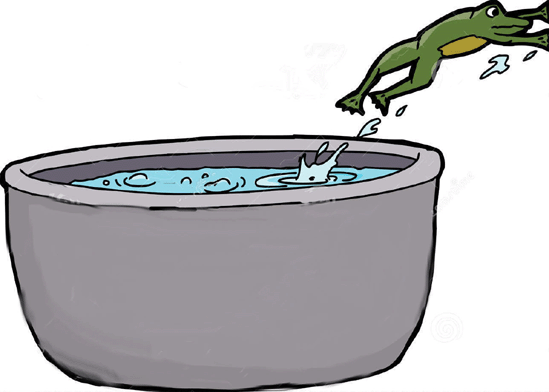 https://tinyurl.com/y3wgyqc7
New research finds that we normalize rising temperatures remarkably quickly. https://psmag.com/environment/as-the-climate-changes-are-we-all-boiling-frogs,TOM JACOBS, FEB 26, 2019
Banned from covering Trump-Kim dinner are reporters from the Associated Press, Bloomberg News, the Los Angeles Times and Reuters
 White House bans four journalists from covering Trump-Kim dinner, SMH, By Philip Rucker
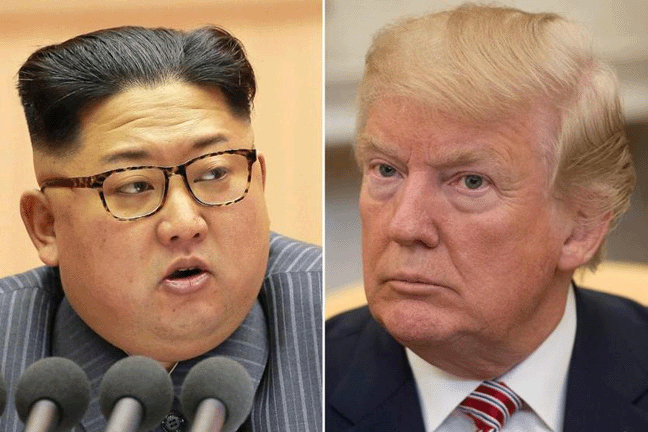 and Josh Dawsey
February 28, 2019 Hanoi, The White House abruptly banned four US journalists from covering President Donald Trump’s dinner on Wednesday with North Korean dictator Kim Jong-un after some of them shouted questions at the leaders during their earlier meetings.Reporters from the Associated Press, Bloomberg News, the Los Angeles Times and Reuters were excluded from covering the dinner because of what White House press secretary Sarah Huckabee Sanders said were “sensitivities over shouted questions in the previous sprays”. Among the questions asked of Trump was one about the congressional testimony of his former lawyer, Michael Cohen.
The White House’s move to restrict press access was an extraordinary act of retaliation by the US government, which historically has upheld the rights of journalists while a president travels overseas. It was especially remarkable because it came during Trump’s meeting with the leader of a totalitarian state that does not have a free press.
Trump’s exchanges with Kim were being covered by the standard 13-member travelling White House press pool, but ahead of the dinner Sanders sought to exclude all reporters from the pool and permit only the photographers and television crew, citing “sensitivities over shouted questions in the previous sprays”.
After loud pushback, including from photojournalists who protested, Sanders allowed a single reporter in the pool for the dinner: Vivian Salama of the Wall Street Journal, who was serving as the print pooler and did not ask a question at the dinner. In addition, at least two members of the North Korean media contingent, a photographer and cameraman, were seen covering the dinner.
Reporters for the three wire services, as well as a second print pooler, were excluded. They included two journalists who had asked Trump questions in the earlier appearances: Jonathan Lemire of the AP and Jeff Mason of Reuters. Also excluded were Justin Sink of Bloomberg and Eli Stokols of the Los Angeles Times………..
Lauren Easton, a spokeswoman for the AP, said in a statement: “The Associated Press decries such efforts by the White House to restrict access to the president. It is critically important that any president uphold American press freedom standards, not only at home but especially while abroad.” .
…… Trump has long complained about reporters asking him questions at photo opportunities, especially when he is in the presence of foreign leaders, which aides have said he views as disrespectful and lacking in decorum. The White House occasionally has punished reporters for their questioning, including CNN’s Jim Acosta and Kaitlan Collins……https://www.smh.com.au/world/asia/white-house-bans-four-journalists-from-covering-trump-kim-dinner-20190228-p510qg.html
South Korea offers hope that the Trump-Kim nuclear summit could bring an end to the Korean War
Korean War could be declared over at Trump-Kim summit, says South Korea There’s an upbeat tone that a formal declaration ending the Korean War could be made at the Hanoi summit this week. SBS News 25 Feb 19, Hopes that US President Donald Trump and North Korean leader Kim Jong-un will formally declare an end to the 1950-53 Korean War at the Hanoi summit rose Monday, after South Korea said the two leaders could reach an agreement.The devastating conflict between communist North Korea, backed by China, and the capitalist South, aided by the United States, ended with an armistice rather than a peace treaty, leaving Pyongyang and Washington still technically at war.
“I believe that the possibility is there,” the South’s presidential Blue House spokesman Kim Eui-kyeom told reporters about a formal declaration.
“There is no way of knowing what kind of declaration it might be, but I believe the US and North Korea may reach an agreement.”
President Moon Jae-in said in October “it was only a matter of time” before Washington and Pyongyang declared an end to the war.
The US has also struck an upbeat tone. Stephen Biegun, the US special envoy for North Korea, said earlier this month that Trump was “ready to end this war”, fuelling speculation that the formal end of the conflict may be near.
Kim, the leader of North Korea, is due to meet the US president in the Vietnamese capital on Wednesday and Thursday, where it is hoped the pair will make progress in talks on denuclearisation, and a possible peace treaty……..
President Trump says he would be happy as long as North Korea maintains its pause on weapons testing, and he is in no rush to strike a nuclear deal with Kim Jong-un. …..https://www.sbs.com.au/news/korean-war-could-be-declared-over-at-trump-kim-summit-says-south-korea
Tensions in Kashmir: Pakistan readies for war
 Pakistan readies military, hospitals for war with its nuclear rival India after Pulwama terror attack, Business Insider
U.N. Secretary-General Antonio Guterres urges the United States and Russia to save nuclear arms safeguards
 U.N. chief wants INF nuclear treaty saved, concrete steps in Hanoi https://www.euronews.com/2019/02/25/un-chief-wants-inf-nuclear-treaty-saved-concrete-steps-in-hanoi
Russia flexes nuclear muscles , warns on its ability to strike nuclear targets in USA
 After Putin’s warning, Russian TV lists nuclear targets in U.S. Andrew Osborn, MOSCOW (Reuters) 25 Feb 19, – Russian state television has listed U.S. military facilities that Moscow would target in the event of a nuclear strike, and said that a hypersonic missile Russia is developing would be able to hit them in less than five minutes.
The targets included the Pentagon and the presidential retreat in Camp David, Maryland.
The report, unusual even by the sometimes bellicose standards of Russian state TV, was broadcast on Sunday evening, days after President Vladimir Putin said Moscow was militarily ready for a “Cuban Missile”-style crisis if the United States wanted one.
With tensions rising over Russian fears that the United States might deploy intermediate-range nuclear missiles in Europe as a Cold War-era arms-control treaty unravels, Putin has said Russia would be forced to respond by placing hypersonic nuclear missiles on submarines near U.S. waters.
……..The targets, which Kiselyov described as U.S. presidential or military command centers, also included Fort Ritchie, a military training center in Maryland closed in 1998, McClellan, a U.S. Air Force base in California closed in 2001, and Jim Creek, a naval communications base in Washington state.
Kiselyov, who is close to the Kremlin, said the “Tsirkon” (‘Zircon’) hypersonic missile that Russia is developing could hit the targets in less than five minutes if launched from Russian submarines.
Hypersonic flight is generally taken to mean traveling through the atmosphere at more than five times the speed of sound……. https://www.reuters.com/article/us-usa-nuclear-russia/after-putins-warning-russian-tv-lists-nuclear-targets-in-us-idUSKCN1QE1DM
Indian and Pakistan relations have again reached a dangerous level.
If Pakistan Attacks With One Nuclear Bomb, India Can Finish Us With 20, Says Pervez Musharraf
Addressing a press conference in UAE, Pakistan’s former president said that Indian and Pakistan relations have again reached a dangerous level. News18.com February 25, 2019, New Delhi: India could “finish” Pakistan with 20 bombs if Islamabad decides to launch even a single nuclear attack on the neighbouring country, former Pakistan president Pervez Musharraf has said.
Addressing a press conference in UAE, Pakistan’s former president further said that if India launched any attack in Kashmir, Pakistan could respond in other areas in Sindh and Punjab and “could teach them a lesson”.
His comment comes over a week after the terror attack that killed 40 CRPF personnel in Jammu and Kashmir’s Pulwama, claimed by Pakistan-based terror group Jaish-e-Mohammed. ……….https://www.news18.com/news/india/if-pakistan-attacks-with-one-nuclear-bomb-india-can-finish-us-with-20-pervez-musharraf-2047265.html
Nuclear power is no solution to the climate crisis
 Nukes Are No Answer To Climate Crisis RALPH NADER RADIO HOUR https://ralphnaderradiohour.com/nukes-are-no-answer-to-climate-crisis/?fbclid=IwAR1WWrHrMbT0bflR2p7fJDw89KeS_qb1fMSRcAX6ESDXanFL6A2hDNbM8To
1 This Month
Tell Congress: Prevent Nuclear Catastrophe in Iran

Tell Congress: Prevent Nuclear Catastrophe in Iran

Read the Public Inquiry Report, the Commissioners’ report, Surrendering Australia: The AUKUS Deception is available to download for free at aukuspublicinquiry.com. Or just watch the replay of the National Press Club Luncheon.


Shut down the radiation-damaged Heysham nuclear reactors now
To see nuclear-related stories in greater depth and intensity – go to https://nuclearinformation.wordpress.com

Say No to NASA’s Reckless Nuclear Reactor on the Moon
Say No to NASA’s Reckless Nuclear Reactor on the Moon
-
Archives
- November 2026 (238)
- October 2026 (302)
- September 2026 (339)
- August 2026 (330)
- July 2026 (355)
- June 2026 (287)
- May 2026 (306)
- April 2026 (356)
- March 2026 (251)
- February 2026 (267)
- January 2026 (308)
- December 2025 (358)
-
Categories
- 1
- 1 NUCLEAR ISSUES
- business and costs
- climate change
- culture and arts
- ENERGY
- environment
- health
- history
- indigenous issues
- Legal
- marketing of nuclear
- media
- opposition to nuclear
- PERSONAL STORIES
- politics
- politics international
- Religion and ethics
- safety
- secrets,lies and civil liberties
- spinbuster
- technology
- Uranium
- wastes
- weapons and war
- Women
- 2 WORLD
- ACTION
- AFRICA
- Atrocities
- AUSTRALIA
- Christina's notes
- Christina's themes
- culture and arts
- Events
- Fuk 2022
- Fuk 2023
- Fukushima 2017
- Fukushima 2018
- fukushima 2019
- Fukushima 2020
- Fukushima 2021
- general
- global warming
- Humour (God we need it)
- Nuclear
- RARE EARTHS
- Reference
- resources – print
- Resources -audiovicual
- Weekly Newsletter
- World
- World Nuclear
- YouTube
-
RSS
Entries RSS
Comments RSS

