The sorry history of small nuclear power reactors
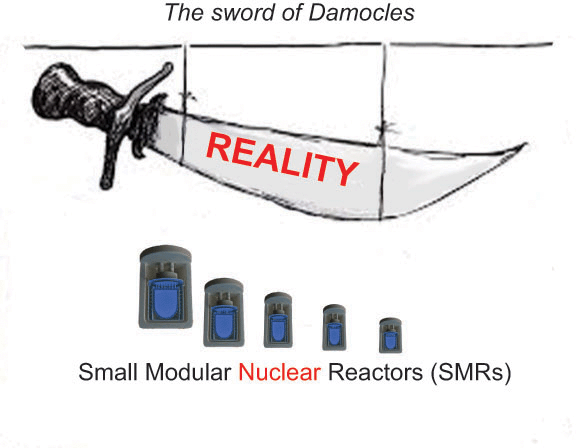
Many of the expenses associated with constructing and operating a reactor do not change in linear proportion to the power generated. For instance, a 400 MW reactor requires less than twice the quantity of concrete and steel to construct as a 200 MW reactor, and it can be operated with fewer than twice as many people.
In the face of this prevailing wisdom, proponents of small reactors pinned their hopes on yet another popular commercial principle: “economies of mass production.”
In 1968, the same year Elk River shut down, the last of the AEC’s small reactors was connected to the grid: the 50 MW La Crosse boiling water reactor.19 That plant operated for 18 years; by the end, its electricity cost three times as much as that from the coal plant next door, according to a 2012 news account about the disposal of the plant’s spent fuel. Dealing with the irradiated uranium-thorium fuel proved difficult too. Eventually, the spent fuel was shipped to a reprocessing plant in southern Italy.
Since then, not a single small reactor has been commissioned in the United States.
Without exception, small reactors cost too much for the little electricity they produced, the result of both their low output and their poor performance.
The forgotten history of small nuclear reactors Nuclear Monitor Issue: #872-873 4775 07/03/2019 M.V. Ramana ‒ Simons Chair in Disarmament, Global and Human Security at the School of Public Policy and Global Affairs at the University of British Columbia
the technology remains in stasis or decline throughout the Americas and Europe. …..
A fundamental reason for this decline is indeed economic. Compared with other types of electricity generation, nuclear power is expensive. Continue reading
Power firms agree on route to close Spain’s oldest nuclear plant
MADRID, March 22 (Reuters) – Spain’s main electricity providers have reached an agreement to renew the life of the country’s oldest nuclear plant until its planned closure, the company that operates the site said on Friday.
The Almaraz plant in Western Spain is the first nuclear reactor slated for closure in a calendar which foresees all seven in the country going offline between 2027 and 2035.
Phasing out nuclear power, which provides around a fifth of Spain’s electricity, is part of a package of energy market proposals that was one of the last gambits of the Socialist government before parliament was dissolved ahead of a general election next month.
A disagreement between Almaraz’s owners, Iberdrola, Endesa and Naturgy, over how much to invest to keep the plant running rumbled on close to a March 31 licence renewal deadline, putting the plant at risk of an earlier closure.
The firms will now apply to keep the site’s two reactors running until 2027 and 2028 respectively, on condition they will spend no more than 600 million euros on them, three sources with knowledge of the talks said.
Endesa had resisted adding any spending limits to a protocol signed last week setting out the closure dates, but a spokesman for the company said it was pleased with the deal.
We are very satisfied with the agreement because it fulfils the protocol signed last week which allows the plants to keep operating,” the spokesman said.
The spokesman added that the agreement also applied to two other nuclear power stations in which it holds majority stakes, whose licences likewise need renewing.
Iberdrola and Naturgy declined to comment.
UN raps Israel’s use of ‘unlawful force’ against Gazans
Press TV, 23 Mar 19, The United Nations (UN)’s Human Rights Council has denounced Israel’s use of “unlawful lethal and other excessive force” against unarmed Palestinian protesters in the besieged Gaza Strip.
Gazans started protesting along a fence that separates the Gaza Strip from the Israeli-occupied territories on March 30, 2018 demanding the right to return for those Palestinians driven out of their homeland by Israeli aggression and calling for a halt to Israel’s inhumane blockade of the enclave.
Israeli forces deployed to the area have used force from across the fence against the protesters, killing over 260 Palestinians and injuring thousands since the protests started.
On Friday, the Humans Rights Council adopted a resolution on accountability tabled by Pakistan on behalf of the Organization of Islamic Cooperation (OIC).
The resolution was adopted with 23 votes in favor, eight against, and 15 abstentions. The delegation of one member state was absent.
The text also called for cooperation by the Israeli regime with a preliminary examination that was launched by the International Criminal Court (ICC) in 2015 into Israeli human rights violations.
The resolution was based on a UN Independent Commission of Inquiry report that found that Israeli forces had committed violations of international human rights and humanitarian law that “may constitute war crimes or crimes against humanity” in killing 189 Palestinians and injuring thousands between March 30 and December 31, 2018……..https://www.presstv.com/Detail/2019/03/22/591676/UN-Human-Rights-Council-Israel-lethal-excessive-force-Gaza
Bradwell B nuclear project – a risk to UK’s national security?
 Is Bradwell B a risk to nationalsecurity? Blackwater Against New Nuclear Group (BANNG)21 March 2019
Andy Blowers considers whether the ‘golden relationship’ with China might be a Trojan Horse in the BANNG Column for Regional Life March 2019. The state visit of the Chinese President Xi Jinping, in October 2015 proclaimed the beginning of a ‘golden era’ in Sino-British relations. The deal was sealed with the promise that China would be offered the opportunity to construct a new nuclear power station at Bradwell with a state-owned company, CGN, using its own technology. In return the Chinese would provide the lion’s share (two-thirds) of investment in the project, with its partner the French state backed-company EDF finding the rest.
The jubilation of the Cameron Government turned to scepticism when his successor’s Joint Chief of Staff, Nick Timothy, declared, ‘The Government is selling our national security to China’. Fears that a critical part of sensitive infrastructure could be open to control by a potentially hostile power have continued to cloud the project. The fact that China, like the UK, is a military as well as civil nuclear power makes the issue of security and control especially worrying.
Bradwell B – a Trojan Horse?
Concerns about security threats are not without foundation. There is the broad charge that China plays by its own rules and the United States has long claimed that China has stolen American atomic secrets…….
Fears of Chinese infiltration in national security have led the United States to ban foreign ownership or control of nuclear power plants (see Box). No such injunction has been proclaimed in the UK; rather, at this very moment, the UK’s Office for Nuclear Regulation is deeply engaged in the process which may lead to approval for the Chinese Hualong One reactor design, thereby paving the way for overseas expansion of Chinese nuclear technology and the inevitable proliferation of security concerns. Bradwell B could be the Trojan Horse that leads into the heart of our national security …..
nothing is said at all about what will be a deteriorating nuclear complex with stores of highly radioactive nuclear wastes strewn on a disappearing coast for the indefinite future. And will the Chinese still be around when the risks increase?
The Chinese are intent on accelerating the Bradwell B programme to begin construction before the end of the next decade. That is a tall order but they have the resources and apparent determination. But, the risks to national and local security and safety from a nuclear power station constructed and controlled by a foreign power cannot easily be allayed. Despite all the soothing words and promises of energy security, Bradwell B, if it materialises, may be a dangerous and unpredictable cuckoo in the nest. https://www.banng.info/news/is-bradwell-b-a-risk-to-national-security/
Dangers of nuclear weapons convoys travelling through Northampton

Northampton Chronicle 21st March 2019 , Campaigners have raised concerns about nuclear warheads travelling through
Northampton after a convoy passed an accident-prone stretch of motorway.
Nuclear warheads are regularly driven from Burghfield Atomic Weapons
Establishment (AWE) near Reading to Coulport, Scotland, for loading onto
the Trident missile submarines.
Veterans Demand Congress End the Forever Wars
“In 2003, the idea of being in Afghanistan even five more years would have sounded unlikely; 15 years would have been madness,” O’Brien said in an interview with Truthout.
Nowdays, O’Brien is a political organizer with Common Defense, a nationwide group of progressive veterans that grew out of protests against President Trump’s racist remarks on the 2016 campaign trail. Conservative political forces have long held a monopoly on the public image of military service and patriotism, O’Brien said, but the nationwide community of progressive veterans is actually “enormous.”
“We didn’t want to be props for Trump’s campaign for hate,” O’Brien said. “We were outraged by his remarks about Muslims and immigrants, and the whole platform and were, you know, angry with … how he wraps himself in the flag and the symbols of service even though he has never served anything other than himself.”
Common Defense organizes and trains veterans to advocate on issues ranging from racial and economic justice to opposing the Trump administration’s ban transgender troops, but after nearly two decades of seemingly endless war, O’Brien and other vets want to make it glaringly clear to policymakers that supporting U.S. military intervention has nothing to do with supporting the troops.
“There is a mistaken view that the military community wants you to show your support for the troops by being pro-intervention,” O’Brien said. “Nothing could be further from the truth in terms of what the military community really wants.”
Congress Debates U.S. Militarism Under TrumpCommon Defense is one of several veterans’ groups on both the left and the right that are putting mounting pressure on Congress to bring a clear end to the “forever wars.” Now that the war on terror has come to 80 countries, directly caused nearly half-a-million deaths and cost taxpayers more than $5.9 trillion since 2011, momentum among lawmakers to reassert their constitutional war-making authority is gaining steam after years of inaction and failed bipartisan attempts to rein in the White House and Pentagon.
Both the House and Senate have approved resolutions to end U.S. support for the Saudi-led coalition fighting in Yemen’s bloody civil war, a clear rebuke of both the Saudi royal government and its cozy relationship with President Trump. Lawmakers in both chambers, particularly Democrats, have warned against U.S. military intervention in Venezuela, where hawks in the Trump administration are actively supporting a right-wing opposition leader as the country suffers an ongoing political and humanitarian crisis. …… https://truthout.org/articles/veterans-demand-congress-end-the-forever-wars/
Trump administration plans to cut spending on Hanford nuclear waste clean-up

Trump administration calls for sharp drop in Hanford nuclear reservation spending , https://www.tri-cityherald.com/news/local/hanford/article228065049.html#storylink=cpy Tri City Herald, BY ANNETTE CARY,  18 Mar 19,
-The Trump administration is proposing cutting Hanford nuclear reservation spending for fiscal 2020 by $416 million.
The nuclear reservation’s annual budget would drop from about $2.5 billion this fiscal year to $2.1 billion next year under the budget request submitted to Congress by the administration.
The biggest hit would be to the Richland Operations Office.
Its budget would drop by almost 25 percent. Current spending of about $954 million would drop by about $236 million to $718 million under the administration’s proposal.
The budget for the Office of River Protection would drop by almost 12 percent, or about $181 million. Spending would be reduced from almost $1.6 billion to about $1.4 billion.
Money proposed for the Office of River Protection included $715 million for the vitrification plant and $677 million for the tank farms.
A further breakdown of how the money is proposed to be spent on individual projects had not been released on Monday.
The Office of River Protection is responsible for 56 million gallons of radioactive waste in underground tanks and the $17 billion vitrification plant being built to treat much of the tank waste for disposal.
The Richland Operations Office is responsible for general operations of the site, including roads and utilities, and all other environmental cleanup, including polluted groundwater, unneeded buildings, old dump sites and contaminated soil.
CONGRESS SETS HANFORD BUDGET
The 580-square-mile site is contaminated from the past production of plutonium for the nation’s nuclear weapons program.
The administration proposes a spending amount for Hanford annually to Congress, which then sets the spending amount for the next fiscal year.
“Unfortunately, presidents on both sides of the aisle have proposed funding cuts that would slow down Hanford cleanup,” said Rep. Dan Newhouse, R-Wash. “And just as I have worked before with my colleagues through the appropriations process to restore funding, I will do so again.”
The federal government created the waste at Hanford and has a moral and legal obligation to finish cleaning up the site, he said.
In 2018 Washington’s congressional delegation was able to increase the administration’s spending proposal for the current fiscal year by about $342 million more than proposed by the Trump administration.
The proposed spending cut comes as a new estimate of remaining cleanup at Hanford at least triples the estimated cost released three years ago.
The Lifecycle Scope, Schedule and Cost Report released at the end of January puts the remaining cleanup costs for Hanford at $323 billion under a best case scenario. At worst it could be $677 billion.
The estimate before the current one put the remaining costs as of 2016 at $108 billion.
All life on Earth threatened – the rapid loss of biodiversity

The Rapid Decline Of The Natural World Is A Crisis Even Bigger Than Climate Change
A three-year UN-backed study from the Intergovernmental Science-Policy Platform On Biodiversity and Ecosystem Services has grim implications for the future of humanity. By John Vidal, HuffPost US 16 Mar 19, Nature is in freefall and the planet’s support systems are so stretched that we face widespread species extinctions and mass human migration unless urgent action is taken. That’s the warning hundreds of scientists are preparing to give, and it’s stark.
The last year has seen a slew of brutal and terrifying warnings about the threat climate change poses to life. Far less talked about but just as dangerous, if not more so, is the rapid decline of the natural world. The felling of forests, the over-exploitation of seas and soils, and the pollution of air and water are together driving the living world to the brink, according to a huge three-year, U.N.-backed landmark study to be published in May.
The study from the Intergovernmental Science-Policy Platform On Biodiversity and Ecosystem Services (IPBES), expected to run to over 8,000 pages, is being compiled by more than 500 experts in 50 countries. It is the greatest attempt yet to assess the state of life on Earth and will show how tens of thousands of species are at high risk of extinction, how countries are using nature at a rate that far exceeds its ability to renew itself, and how nature’s ability to contribute food and fresh water to a growing human population is being compromised in every region on earth.
Nature underpins all economies with the “free” services it provides in the form of clean water, air and the pollination of all major human food crops by bees and insects. In the Americas, this is said to total more than $24 trillion a year. The pollination of crops globally by bees and other animals alone is worth up to $577 billion.
The final report will be handed to world leaders not just to help politicians, businesses and the public become more aware of the trends shaping life on Earth, but also to show them how to better protect nature……….
An obsession with economic growth as well as spiraling human populations is also driving this destruction, particularly in the Americas where GDP is expected to nearly double by 2050 and the population is expected to increase 20 percent to 1.2 billion over the same period. …….
Insects, vital to the diets of other animals, as well as the pollinators of our food, are facing a bleak future as populations appear to be collapsing. Land use changes and increased pesticide use are destroying habitats and vastly reducing numbers. In Europe, up to 37 percent of bees and 31 percent of butterflies are in decline, with major losses also recorded in southern Africa, according to the pollinators section of the report…..
This destruction is also driving mass human migration and increased conflict. Decreasing land productivity makes societies more vulnerable to social instability, says the report, which estimates that in around 30 years’ time land degradation, together with the closely related problems of climate change, will have forced 50 to 700 million people to migrate………
The study will also recognize that much of the remaining wealth of nature depends on indigenous people, who mostly live in the world’s remote areas and are on the frontline of the damage caused by destructive logging and industrial farming. According to IPBES, indigenous communities often know best how to conserve nature and are better placed than scientists to provide detailed information on environmental change……..
Saving nature will require a major rethink of how we live and how we think about nature, but that it is possible to turn this dire situation around if governments want it to happen.
“There are no magic bullets or one-size-fits-all answers. The best options are found in better governance, putting biodiversity concerns into the heart of farming and energy policies, the application of scientific knowledge and technology, and increased awareness and behavioral changes,” Watson said. “The evidence shows that we do know how to protect and at least partially restore our vital natural assets. We know what we have to do.”
For more content and to be part of the ‘This New World’ community, follow our Facebook page.
USA committed to dominating the world – heading for space weapons

COUNTDOWN TO FULL SPECTRUM DOMINANCE This is what it’s really all about MARCH 20, 2019
Countdown to “Full Spectrum Dominance” by T.J. COLES, CounterPunch
The US is formally committed to dominating the world by the year 2020. With President Trump’s new Space Directive-4, the production of laser-armed fighter jets as possible precursors to space weapons, and the possibility of nuclear warheads being put into orbit, the clock is ticking…
Back in 1997, the now-re-established US Space Command announced its commitment to “full spectrum dominance.” The Vision for 2020 explains that “full spectrum dominance” means military control over land, sea, air, and space (the so-called fourth dimension of warfare) “to protect US interests and investment.” “Protect” means guarantee operational freedom. “US interest and investment” means corporate profits.
The glossy brochure explains that, in the past, the Army evolved to protect US settlers who stole land from Native Americans in the genocidal birth of the nation. Like the Vision for 2020, a report by the National Defense University acknowledges that by the 19th century, the Navy had evolved to protect the US’s newly-formulated “grand strategy.” In addition to supposedly protecting citizens and the constitution, “The overriding principle was, and remains, the protection of American territory … and our economic well-being.” By the 20th century, the Air Force had been established, in the words of the Air Force Study Strategy Guide, to protect “vital interests,” including: “commerce; secure energy supplies; [and] freedom of action.” In the 21stcentury, these pillars of power are bolstered by the Cyber Command and the coming Space Force.
The use of the Army, Navy, and Air Force—the three dimensions of power—means that the US is already close to achieving “full spectrum dominance.” Brown University’s Cost of War project documents current US military involvement in 80 countries—or 40% of the world’s nations. This includes 65 so-called counterterrorism training operations and 40 military bases (though others think the number of bases is much higher). By this measure, “full spectrum dominance” is nearly half way complete. But the map leaves out US and NATO bases, training programs, and operations in Estonia, Latvia, Poland, and Ukraine.
As the US expands its space operations—the fourth dimension of warfare—the race towards “full spectrum dominance” quickens. Space has long been militarized in the sense that the US uses satellites to guide missiles and aircraft. But the new doctrine seeks to weaponize space by, for instance, blurring the boundaries between high-altitude military aircraft and space itself. Today’s space power will be harnessed by the US to ensure dominance over the satellite infrastructure that allows for the modern world of internet, e-commerce, GPS, telecommunications, surveillance, and war-fighting.
Since the 1950s, the United Nations has introduced various treaties to prohibit the militarization and weaponization of space—the most famous being the Outer Space Treaty (1967). These treaties aim to preserve space as a commons for all humanity. The creation of the US Space Force is a blatant violation of the spirit, if not the letter, of those treaties. In more recent decades, successive US governments have unilaterally rejected treaties to reinforce and expand the existing space-for-peace agreements. In 2002, the US withdrew from the Anti-Ballistic Missile Treaty (1972), allowing it to expand its long-range missile systems. In 2008, China and Russia submitted to the UN Conference on Disarmament the proposed Treaty on the Prevention of the Placement of Weapons in Outer Space, the Threat or Use of Force Against Outer Space Objects. This would have preserved the space-as-a-commons principle and answered US claims that “enemies” would use space as a battleground against US satellites.
But peace is not the goal. The goal is “full spectrum dominance,” so the US rejected the offer. China and Russia introduced the proposed the treaty again in 2014—and again the US rejected it. Earlier this year, the US withdrew from the Intermediate-Range Nuclear Forces (INF) treaty. Last month, President Trump sent an unclassified memo on the new Space Directive-4 to the Vice President, Joint Chiefs of Staff, NASA, and the Secretaries of Defense and State.
The document makes for chilling and vital reading. It recommends legislating for the training of US forces “to ensure unfettered access to, and freedom to operate in, space, and to provide vital capabilities to joint and coalition forces.” Crucially, this doctrine includes “peacetime and across the spectrum of conflict.” As well as integrating space forces with the intelligence community, the memo recommends establishing a Chief of Staff of the Space Force, who will to join the Joint Chiefs of Staff. The memo also says that US space operations will abide by “international law.” But given that the US has rejected anti-space weapons treaties, it is barely constrained by international law.
In late-2017, Space.com reported on a $26.3m Department of Defense contract with Lockheed Martin to build lasers for fighter jets under the Laser Advancements for Next-generation Compact Environments program. The report says that the lasers will be ready by 2021. The article links to Doug Graham, the Vice President of Missile Systems and Advanced Programs at Lockheed Martin Space Systems. In the original link Graham reveals that the Air Force laser “is an example of how Lockheed Martin is using a variety of innovative technologies to transform laser devices into integrated weapon systems.”
As if all this wasn’t bad enough, the British Ministry of Defence (MoD) states in a projection out to the year 2050: “Economies are becoming increasingly dependent upon space-based systems … By 2050, space-based weapon systems may also be deployed, which could include nuclear weapons.” But this is extremely reckless. Discussing technologies, including the artificial intelligence on which weapons systems are increasingly based, another MoD projection warns of “the potential for disastrous outcomes, planned and unplanned … Various doomsday scenarios arising in relation to these and other areas of development present the possibility of catastrophic impacts, ultimately including the end of the world, or at least of humanity.”
“Full spectrum dominance” is not only a danger to the world, it is a danger to US citizens who would also suffer the consequences, if and when something goes wrong with their leaders’ complicated space weapons.
https://www.counterpunch.org/2019/03/20/countdown-to-full-spectrum
Nuclear transport trucks in the thick of gang gunfire in Brazil

 Brazilian drug gang opens fire on convoy of trucks carrying nuclear fuel, Guardian Dom Phillips in Rio de Janeiro 20 Mar 2019 Latest incident raises concerns about Brazil’s nuclear security in a state struggling with violent crime A convoy of trucks carrying nuclear fuel came under armed attack on a highway in Rio de Janeiro state on Tuesday as it drove past a community controlled by a drug gang. Gang members armed with rifles opened fire on the convoy, Rio’s O Globo newspaper said.
Armed police escorting the convoy exchanged fire with armed gang members as the trucks carrying uranium continued to a nearby nuclear plant. The attack is the latest of several violent incidents in the area where Brazil has two nuclear reactors and has raised concerns about its nuclear security in a state struggling with high levels of violent crime.
The attack happened as the convoy passed the Frade community around noon near the tourist town of Angra dos Reis in the Green Coast (Costa Verde), around 200km from Rio de Janeiro. It reached the Angra 2 nuclear plant less than half an hour later, Brazil’s nuclear agency said……
Typically, such convoys have around five or six trucks and are escorted by regular police and motorbike outriders from Brazil’s Federal Highway police, the Eletronuclear spokesman Marco Antonio Alves told the Guardian. It was carrying uranium fuel to supply the Angra 2 nuclear power plant, which began operating in 2001. ……. https://www.theguardian.com/world/2019/mar/20/brazilian-drug-gang-opens-fire-on-convoy-of-trucks-carrying-nuclear-fuel?CMP=share_btn_fb&fbclid=IwAR3RPlZ7l2eqbDbUKOavFnccBnocR5AjCpeedTMeCQT7686-HKxuii8rfwE
Comment by Raymond John Cockram I‘m figuring the probability that it was refined into fuel rods is closer to the truth given it was on its way to the reactor site, what you need to remember is that the Brazilian President is a self confessed fascist so media manipulation MUST be expected.
Trump’s national security adviser, John Bolton leads us back to the Nuclear Precipice
Long a global leader in efforts to reduce nuclear-weapons stockpiles and limit nuclear proliferation, the United States is now fostering the conditions for a new global arms race. With hawks calling the shots in US President Donald Trump’s administration, a nuclear conflagration in one of the world’s hot spots is becoming more likely.
………. the author of The Art of the Deal has followed the advice of someone who has yet to meet a deal he didn’t want  to tear up: Trump’s national security adviser, John Bolton. Having already dispensed with the 1972 Anti-Ballistic Missile Treaty in 2002, during his tenure in President George W. Bush’s administration, Bolton has used his position in the Trump administration to launch attacks against the INF Treaty and the Joint Comprehensive Plan of Action(JCPOA) with Iran. Most likely, his next target will be New START. Signed by Obama and then-Russian President Dmitry Medvedev in Prague in 2010, that nuclear arms reduction treaty will expire in 2021, barring an agreement on its extension.
With the steady collapse of the international arms-control architecture has come a fresh race to develop new types of nuclear weapons. The potential use of these weapons is now discussed with such frivolity as to foreshadow a return to the darkest days of the Cold War, but one that is even more dangerous, because other countries not subject to the Non-Proliferation Treaty (NPT), such as North Korea, have since joined the nuclear club.
During Trump’s first year in office, his incendiary public exchanges with North Korean leader Kim Jong-un brought relations between Washington, DC, and Pyongyang to their tensest point in decades. While Trump has since abandoned his threats of “fire and fury” and given diplomacy a chance, his administration’s approach to North Korea has ignored all of the canons of effective diplomacy. This has given rise to another kind of frivolity: the spectacle of vacuous praise.
In the end, the lack of consensus among US foreign policymakers and the misaligned expectations of the two negotiating parties, combined with Trump’s own improvisations, condemned his recent summit with Kim to failure. A reorganization is now urgently needed, particularly to incorporate the other regional powers and keep Bolton and other hawks in the administration from derailing the process further.
Meanwhile, India and Pakistan, two other NPT non-signatories, recently engaged in a cross-border military confrontation, following a terrorist attack last month in the Indian state of Jammu and Kashmir. Once deemed “the most dangerous place in the world” by former US President Bill Clinton, Kashmir is essentially shared between three nuclear powers: India, Pakistan, and China. Not since Pakistan revealed its nuclear capacity to the world in the late 1990s have Indian-Pakistani relations been so tense. Worse, as the latest instability shows, the presence of nuclear weapons is not sufficient to prevent conflict. Instead, it merely raises the risk that quarrels will escalate into existential conflagrations.
Lastly, in the Middle East, the Trump administration has actively sowed the seeds for nuclear proliferation. The decision to abandon the JCPOA was entirely counterproductive, merely reflecting Trump’s blind support for Israel – another NPT non-signatory – and Saudi Arabia. Indeed, the Trump administration is even exploring the possibility of exporting nuclear material to the Saudi regime without putting the necessary safeguards in place.
Apparently, Trump is not bothered by the fact that Saudi Crown Prince Mohammed bin Salman has neither ruled out developing nuclear arms nor committed to a strict regime of inspections by the International Atomic Energy Agency. One false step, though, could plunge the Middle East into a nuclear arms race – truly a worst-case scenario for such a fraught region.
Meanwhile, India and Pakistan, two other NPT non-signatories, recently engaged in a cross-border military confrontation, following a terrorist attack last month in the Indian state of Jammu and Kashmir. Once deemed “the most dangerous place in the world” by former US President Bill Clinton, Kashmir is essentially shared between three nuclear powers: India, Pakistan, and China. Not since Pakistan revealed its nuclear capacity to the world in the late 1990s have Indian-Pakistani relations been so tense. Worse, as the latest instability shows, the presence of nuclear weapons is not sufficient to prevent conflict. Instead, it merely raises the risk that quarrels will escalate into existential conflagrations.
Lastly, in the Middle East, the Trump administration has actively sowed the seeds for nuclear proliferation. The decision to abandon the JCPOA was entirely counterproductive, merely reflecting Trump’s blind support for Israel – another NPT non-signatory – and Saudi Arabia. Indeed, the Trump administration is even exploring the possibility of exporting nuclear material to the Saudi regime without putting the necessary safeguards in place.
 Apparently, Trump is not bothered by the fact that Saudi Crown Prince Mohammed bin Salman has neither ruled out developing nuclear arms nor committed to a strict regime of inspections by the International Atomic Energy Agency. One false step, though, could plunge the Middle East into a nuclear arms race – truly a worst-case scenario for such a fraught region.
During the 2016 presidential campaign, Trump raised a red flag for the umpteenth time when he suggested that Japan and South Korea should develop their own nuclear weapons as a means of self-defense. This idea couldn’t have been more wrongheaded. Logic dictates that if more countries acquire nuclear weapons, the likelihood of such weapons being used will increase.
The Cold War gave us a glimpse of the risks we run when our single-minded pursuit of some geopolitical interests causes us to lose sight of the most important of them all: international security. As Obama emphasized ten years ago in Prague, the US is the only country ever to have used nuclear weapons, and therefore has an historic responsibility to ensure that they are never used again. For the US to forsake this responsibility and champion a new era of nuclear proliferation would be a tragic outcome. https://www.project-syndicate.org/commentary/us-trump-nuclear-proliferation-by-javier-solana-2019-03
Fukushima radioactive water – a million tons, and still coming

Fukushima water headache: 1 million tons and counting http://www.asahi.com/ajw/articles/AJ201903190042.html THE ASAHI SHIMBUN,March 19, 2019The crippled Fukushima No. 1 nuclear plant reached an undesired milestone on March 18: Storage tanks at the site now contain more than 1 million tons of radiation-contaminated water.The announcement by the plant’s operator, Tokyo Electric Power Co., came as the utility and the central government continue to weigh water-disposal methods while hearing the concerns of fishermen who fear for their livelihoods.
Toyoshi Fuketa, chairman of the Nuclear Regulation Authority, has repeatedly said a decision must be made soon on how to deal with the contaminated water.
“We are entering a period in which further delays in deciding what measure to implement will no longer be tolerable,” Fuketa recently said.
Groundwater becomes contaminated when it flows into the buildings of the three reactors that suffered meltdowns in 2011 following the Great East Japan Earthquake and tsunami. Water that is used to cool the nuclear fuel debris is processed to remove radioactive substances, but the system cannot get rid of tritium.
These problems have forced TEPCO to store the contaminated water in hundreds of tanks installed at the Fukushima plant.
If more storage tanks are constructed, the overall capacity of 1.37 million tons at the site will likely be reached by the end of 2020.
Fukushima fishermen are already on alert for the one option they have already criticized–diluting the water and dumping it into the Pacific Ocean.
The economy ministry in 2016 said that measure could be implemented in the shortest time frame and at a low cost.
Fuketa has also said this is the most realistic option, but he noted that it would require years of preparation.
ome experts said the go-ahead for the dilution measure should have been given at the end of 2018 to start the process before the storage tanks reach capacity.
Economy ministry officials tried to explain various measures being considered at a public hearing in Fukushima in August 2018, including releasing the diluted water into the ocean.
“It will have a devastating effect on fishing in Fukushima,” said Tetsu Nozaki, who heads the Fukushima prefectural federation of fisheries cooperative associations.
Fukushima fishermen have slowly resumed operations since all forms of fishing were prohibited after high levels of radiation were found in fish caught off the Fukushima coast.
Fish auctions restarted at Fukushima ports in spring 2017, but the volume of fish brought in is still only about 20 percent of levels before the 2011 nuclear accident.
The last thing Fukushima fishermen want is an increase of negative publicity about their catches if the diluted water is dumped into the Pacific.
The government has spent about 34.5 billion yen ($309 million) to build a frozen underground earth wall around the three reactor buildings to divert the groundwater to the ocean. The “ice wall” has cut down the flow of groundwater, which at one time reached about 500 tons a day.
But still, groundwater continues to flow into the three reactor buildings at a rate of about 100 tons daily.
(This article was compiled from reports by Chikako Kawahara, Hiroshi Ishizuka, Toshio Kawada and Kazumasa Sugimura.)
The children’s climate fight is a fight against despair
 The youth climate strikes fight back against despair https://grist.org/article/the-youth-climate-strikes-fight-back-against-despair/, Last week, as I stood on the front steps of the Minnesota State Capitol, I watched hundreds of high schoolers stream by as they left their classes to join in the U.S. Youth Climate Strike. One sign in particular stood out to me: “Why are we studying for a future we won’t have?” |
|
Over 1.4 million young people went on strike for climate action
Hong Kong students join global school strike calling for action against climate change
Activist Greta Thunberg, 16, says action proved ‘no one is too small to make a difference’ More than 1.4 million young people around the world took part in school strikes for climate action, according to environmental campaigners.Greta Thunberg, the 16-year-old Swedish student whose solo protest last August prompted the global movement, said: “We proved that it does matter what you do and that no one is too small to make a difference.”
Children walked out of schools on Friday in 2,233 cities and towns in 128 countries, with demonstrations held from Australia to India, the UK and the US, according to the Fridays for the Future website. Further strikes are planned for 12 April…….https://www.theguardian.com/environment/2019/mar/19/school-climate-strikes-more-than-1-million-took-part-say-campaigners-greta-thunberg
Trump to the rescue of nuclear industry – $3.7 billion in aid for troubled Vogtle nuclear project.

Trump to finalise $3.7 billion in aid for troubled nuclear reactor project https://www.business-standard.com/article/international/trump-to-finalise-3-7-billion-in-aid-for-troubled-nuclear-reactor-project-119032001089_1.html
The plant is seen as critical to the nuclear industry’s future because existing reactors are struggling to compete with cheap natural gas and renewable energy Ari Natter | Bloomberg March 20, 2019
The Trump administration will finalize $3.7 billion in loan guarantees to Southern Co. and its partners who are building a troubled nuclear reactor project in Georgia — the last of its kind under construction in the U.S. — according to two people familiar with the matter.
The guarantees, expected to be announced Friday when U.S. Energy Secretary Rick Perry visits Plant Vogtle alongside Georgia Governor Brian Kemp and Southern Chief Executive Officer Tom Fanning, represents a critical lifeline for the project, which is more than five years behind schedule and has doubled in cost to $28 billion.
The additional help also puts taxpayers on the hook for more money if the project were to collapse. Southern and its partners in Plant Vogtle were already recipients of record $8.3 billion in federally-backed loan guarantees from the Obama administration, but asked the Trump administration to come to their aid amid ballooning costs and setbacks caused in part by the bankruptcy of a contractor, Westinghouse Electric Co.
The plant, near Waynesboro, Georgia, is seen as critical to the nuclear industry’s future because existing reactors are struggling to compete with cheap natural gas and renewable energy. Scana Corp. abandoned its plans to build two reactors in South Carolina after expenses spiraled above $20 billion.
President Donald Trump has made the revival of the coal and nuclear industry a priority. His administration in 2017 announced it would provide a conditional loan guarantee for the Plant Vogtle project.
Representatives of the Energy Department and Southern didn’t immediately respond to requests for comments.
1 This Month
Tell Congress: Prevent Nuclear Catastrophe in Iran

Tell Congress: Prevent Nuclear Catastrophe in Iran

Read the Public Inquiry Report, the Commissioners’ report, Surrendering Australia: The AUKUS Deception is available to download for free at aukuspublicinquiry.com. Or just watch the replay of the National Press Club Luncheon.


Shut down the radiation-damaged Heysham nuclear reactors now
To see nuclear-related stories in greater depth and intensity – go to https://nuclearinformation.wordpress.com

Say No to NASA’s Reckless Nuclear Reactor on the Moon
Say No to NASA’s Reckless Nuclear Reactor on the Moon
-
Archives
- November 2026 (224)
- October 2026 (302)
- September 2026 (339)
- August 2026 (330)
- July 2026 (355)
- June 2026 (287)
- May 2026 (306)
- April 2026 (356)
- March 2026 (251)
- February 2026 (267)
- January 2026 (308)
- December 2025 (358)
-
Categories
- 1
- 1 NUCLEAR ISSUES
- business and costs
- climate change
- culture and arts
- ENERGY
- environment
- health
- history
- indigenous issues
- Legal
- marketing of nuclear
- media
- opposition to nuclear
- PERSONAL STORIES
- politics
- politics international
- Religion and ethics
- safety
- secrets,lies and civil liberties
- spinbuster
- technology
- Uranium
- wastes
- weapons and war
- Women
- 2 WORLD
- ACTION
- AFRICA
- Atrocities
- AUSTRALIA
- Christina's notes
- Christina's themes
- culture and arts
- Events
- Fuk 2022
- Fuk 2023
- Fukushima 2017
- Fukushima 2018
- fukushima 2019
- Fukushima 2020
- Fukushima 2021
- general
- global warming
- Humour (God we need it)
- Nuclear
- RARE EARTHS
- Reference
- resources – print
- Resources -audiovicual
- Weekly Newsletter
- World
- World Nuclear
- YouTube
-
RSS
Entries RSS
Comments RSS

