Corbella: Wilson-Raybould’s version behind scandal is indisputable and nuclear, Calgary Herald, LICIA CORBELLA March 29, 2019 Was she or wasn’t she (inappropriately pressured?) That is the central question behind the SNC-Lavalin controversy. All other questions are peripheral.
The answer now is an unequivocal, indisputable ‘yes.’ This is no longer a question of she said/he said, or of women and men “experiencing things differently” — the so-called Gropegate defence.
Now Canadians have the proof. Canada’s former attorney general, Jody Wilson-Raybould, was pressured and threatened by federal Liberal government officials and politicians to help the Quebec engineering giant avoid a criminal trial by pursuing a deferred prosecution agreement
On Friday, the House of Commons justice committee released Wilson-Raybould’s 43-page document, that includes texts, emails and the context around that evidence as well as a transcript of a 17-minute telephone conversation she recorded between herself and Michael Wernick, the clerk of the Privy Council who recently resigned from his post as the country’s top bureaucrat in the wake of this scandal that his gripped the country since Feb. 7
……..Clearly, we now have the proof that the PMO inappropriately pressured the attorney general, not just he said/she said. That’s much more than a political bombshell. Canada’s reputation as a principled country that follows the rule of law has been terribly damaged. It’s also clear that the PM and many of the people around him have lied throughout this controversy. She has proof. They have lies. Ka-Boom!https://calgaryherald.com/opinion/columnists/corbella-wilson-rayboulds-version-behind-scandal-is-indisputable-and-nuclear
U.S. approved secret nuclear power work for Saudi Arabia
Timothy Gardner, 28 Mar 19, WASHINGTON (Reuters) – U.S. Energy Secretary Rick Perry has approved six secret authorizations by companies to sell nuclear power technology and assistance to Saudi Arabia, according to a copy of a document seen by Reuters on Wednesday.
The Trump administration has quietly pursued a wider deal on sharing U.S. nuclear power technology with Saudi Arabia, which aims to build at least two nuclear power plants. Several countries including the United States, South Korea and Russia are in competition for that deal, and the winners are expected to be announced later this year by Saudi Arabia.
Perry’s approvals, known as Part 810 authorizations, allow companies to do preliminary work on nuclear power ahead of any deal but not ship equipment that would go into a plant, a source with knowledge of the agreements said on condition of anonymity. The approvals were first reported by the Daily Beast.
The Department of Energy’s National Nuclear Security Administration (NNSA) said in the document that the companies had requested that the Trump administration keep the approvals secret.
“In this case, each of the companies which received a specific authorization for (Saudi Arabia) have provided us written request that their authorization be withheld from public release,” the NNSA said in the document. In the past, the Energy Department made previous Part 810 authorizations available for the public to read at its headquarters. ……..
With Pilgrim Nuclear Plant Set To Retire, There Are Questions About Decommissioning Trust Fund WBUR,March 27, 2019, Miriam Wasser
As Plymouth’s Pilgrim Nuclear Power Station prepares to shut down for good, questions are emerging about its nuclear decommissioning trust fund. This is money set aside for “decommissioning” the plant — removing the spent fuel and making the land safe for eventual unrestricted use.The trust fund is like a 401(k) for retired nuclear plants; ratepayers contribute money into a conservatively managed account that accrues interest over time. Pilgrim’s fund was worth about $1.05 billion in October 2018. It cannot be accessed until the plant permanently shuts down.
The big questions about the trust fund: What can plant owners spend the money on? And will there be enough to cover the cost of decommissioning?
Surprisingly, the federal Nuclear Regulatory Commission (NRC) has no specific regulations on how plant owners can spend trust fund money, only guidelines.
Also surprising: A plant owner also needs an exemption from the NRC to use the money for “spent fuel management” and “site restoration” — the bulk of the decommissioning work — but not for paying the host community what essentially amounts to property taxes.
This all came to light at recent public meetingsin Plymouth about Pilgrim, which is supposed to shut down by June 1. The state-appointed Nuclear Decommissioning Citizens Advisory Panel(NDCAP) questioned a representative of Holtec International, the New Jersey-based company that wants to buy Pilgrim from its current owners, Entergy Nuclear Operators, about the company’s finances. …….
** Two U.S. Veterans for Peace released after 12 days in Irish prison for peace action at Shannon Airport
————————————————————
Two members of U.S. Veterans For Peace – Tarak Kauff and Ken Mayers – were arrested on March 17, St. Patrick’s Day after cutting the fence and entering the airfield at Shannon Airport in Ireland to inspect and investigate a plane on contract to the U.S. military. They carried a large banner that said “U.S. Veterans Say: Respect Irish Neutrality – U.S. War Machine Out of Shannon Airport”. The men were refused bail by Ennis District Court on March 18 and jailed at the Limerick Prison, charged with trespass and causing criminal damage. At a preliminary hearing on March 28, the men were granted bail and released on March 29 pending trial. Their passports were taken and they were ordered to stay away from airports. They may not be able to leave Ireland before their trial. Shannon Airport is used for refueling troop and equipment transport planes bound for Middle East wars.
Members of European Parliament among 16 arrested at Belgian air base where U.S. nuclear weapons are stored
————————————————————
Three Green Party politicians from Luxembourg, England and France were arrested with four Agir pour la Paix activists on February 20 after climbing a fence to enter a military base in Belgium where U.S. nuclear weapons are stored. After entering the Kleine Brogel base, they blocked the runway used by F-16 fighter jets. The Members of European Parliament – Molly Scott Cato, Tilly Metz and Michele Rivasi – held a banner that read, “Europe Free of Nuclear Weapons”. The group was soon detained and taken into custody. Nine supporters standing outside the base were also arrested, and authorities erased photos and videos from their cameras and phones.
Eleven nuclear resisters arrested during blockade of Lockheed Martin, California
————————————————————
Eleven nuclear resisters with the Pacific Life Community were arrested on March 18 during a blockade of the main gate of Lockheed Martin in Sunnyvale, California. The group held a banner across the road reading, “Lockheed Weapons Terrorize the World”. They carried with them copies of the Treaty on the Prohibition of Nuclear Weapons to inform Lockheed workers and management that when the treaty is ratified, building nuclear weapons and their delivery systems will be in violation of international humanitarian law.
Eight arrested during St. Patrick’s Day blockade of Des Moines drone command center
————————————————————
Veterans for Peace and Catholic Workers from across the Midwest converged on the Iowa Air National Guard Drone Command Center in Des Moines on March 17, St. Patrick’s Day. After a rally, protesters walked onto the base. Eight activists blocked the main entrance gate, holding a banner with a message from St. Patrick: “In Christ There is No Killing”. The blockaders were arrested and taken to the Polk County Jail. One of them bailed out, and the other seven spent the night in jail before pleading guilty on Monday morning. They were fined $100-$1000 and then set free.
Post-Fukushima, Japan turns against nuclear power, Witf, by Susan Phillips/StateImpact Pennsylvania | Mar 29, 2019 In Fukushima, farmers and residents put their stock in solar
(Futaba, Japan) — The partial meltdown at Three Mile Island nuclear power plant in central Pennsylvania 40 years ago in March did not lead to large releases of radiation, but it helped turn public opinion away from nuclear energy. In Japan, an even more catastrophic nuclear disaster occurred eight years ago this month. And like many Pennsylvanians, the Japanese have largely turned against nuclear.
The earthquake, tsunami and nuclear meltdown is known in Japan as simply “March 11.” And everyone knows where they were on March 11, 2011.
Yuji Onuma was in the town of Futaba, where he grew up and was living with his wife, who was pregnant with their first child. Their home was about 3 or 4 kilometers from the Daiichi nuclear power plant.
But right now, he’s living away from the coast in another prefecture, and he says he wants to settle in a town that is about as far away from any of Japan’s 54 nuclear power plants as he can possibly be.
During an interview, Onuma showed a picture of when he was about 12 years old and getting an award from the Mayor of Futaba. A teacher had asked the kids to come up with a town slogan. In a place where everyone depended on the nearby nuclear plant for work, Onuma’s entry won:
“Atomic power: energy for a bright future” became the slogan on an archway over Futaba’s main street.
“I was very proud because this is my first ever award by the town,” Onuma said through a translator. “And all the town people praised me and said, you are very great. So I was so proud of that.”
Then he showed another photo. It’s only a few months after the accident, and no one is left living in Futaba. This time, he’s wearing a protective Tyvek suit and mask, he’s standing below the sign holding up a placard that changes his slogan to:
Bagging DOE Support, Westinghouse Eyes Demonstration for Nuclear Micro-reactor by 2022, Power, 03/28/2019 | Sonal Patel The Department of Energy (DOE) is funding a project that would prepare Westinghouse’s 25-MWe eVinci micro-reactor for nuclear demonstration readiness by 2022.The agency on March 27 said it will provide $12.9 million of the estimated $28.6 million Westinghouse needs for a project to prepare the micro-reactor for a demonstration, including for design, analysis, licensing to manufacture, siting, and testing.eVinci is one of three small modular reactors (SMRs) and the first micro-reactor whose first-of-a-kind development the DOE is subsidizing under a December 2017–issued “U.S. Industry Opportunities for Advanced Nuclear Technology Development” funding opportunity announcement (FOA). (Details of other projects that have won funding awards under previous rounds of the FOA are at the end of this article.)
The funding announcements are part of a recent ramp up in attention and efforts by the U.S. government to boost development of advanced nuclear technologies. Also on March 27, a bipartisan group of senators introduced legislation to bolster innovation for advanced reactors. Lawmakers said the U.S., which once led efforts to invent and commercialize key nuclear technologies, has “slipped” in leadership, and it risks losing out to Russia and China.
However, Westinghouse admits that it is fielding a number of challenges related to the deployment of the micro-reactor. While the eVinci will use fuel enriched to 19.75 weight %, the industrial scale amount of uranium enriched to more than 5% is limited. …….
Westinghouse also notes that while eVinci reactors will be manufactured and assembled in a factory, first reactor startup should also happen at that site, which means the factory will need to be equipped with radio protection equipment, safety and security systems, and have a license from the Nuclear Regulatory Commission (NRC). Transportation must also take into account safety and security. And because the reactor will be operated autonomously,Westinghouse will need to field first-of-their-kind challenges in licensing, instrumentation, remote reactor monitoring, and logistics…..https://www.powermag.com/bagging-doe-support-westinghouse-eyes-demonstration-for-nuclear-micro-reactor-by-2022/
Why the financial community should work to prevent the market and economic shocks of a nuclear incident, Bulletin of the Atomic Scientists, By David Epstein, March 29, 2019 The risks of a nuclear incident—including the detonation of a nuclear bomb or dirty bomb, or a cyberattack on a nuclear power plant—have been discussed ad nauseam. Investment icon Warren Buffett and many international security experts have expounded on the significant risks of a nuclear incident in the coming decades. Many experts, in fact, actually consider it no small miracle that there has not been some major nuclear incident (outside of accidental nuclear meltdowns) since World War II. More than a few of them phrase the potential for some such nuclear catastrophe not as a matter of “if” but of “when.”
Although nuclear issues are sometimes covered by the financial and business media, the risks of a nuclear incident are something of an elephant in the room in the financial and business communities. Most participants in the capital markets discuss nuclear risks little day-to-day and do even less to prepare for a potential incident. They need to do more. As stewards of the capital markets and economy, bankers, money managers, regulators, and leaders of the broader business community should pursue a dual track, working to prevent nuclear incidents while simultaneously preparing for the market and economic shocks that will undoubtedly ensue if prevention efforts fail.
An age of nuclear threats. The blustery rhetoric of 2017 has eased, but the North Korean nuclear situation is far from resolved. Recent satellite imagery has indicated that North Korea is currently rebuilding at least one of its missile test facilities. At some point, the world could see renewed tension or even a violent showdown over the definition of and nature of any nuclear disarmament on the Korean peninsula. Meanwhile, there has been a terrible deterioration in Western relations with Russia. The United States has announced that it will withdraw from the Intermediate-Range Nuclear Forces (INF) Treaty with Russia in six months if Russia does not stop violating it. Russia, in response, suspended its own obligations under the treaty, contending that the United States is violating the pact. Separately, there are factions within the Trump administration and the Russian government that believe smaller-payload nuclear weapons could be detonated in limited warfare without setting off a much broader conflict. Such thinking is, to understate, dangerous.
Relations between India and Pakistan were recently at their tensest levels in decades. ……
Beyond these tensions, the danger of a nuclear terror attack somewhere in the world is ever present. Terrorists have tried many times to obtain nuclear bombs and weapons-grade materials and are assuredly going to make such attempts in the future. ………
Many experts believe that miscalculation—a situation in which two state actors blunder into a nuclear exchange—is a likely way for nuclear conflict to begin. ………
The potential economic aftermath of a limited nuclear incident. Investment portfolios, the capital markets, and the economy in general could have been irrelevant had the United States and Soviet Union allowed the Cold War to turn hot, fighting a full-scale nuclear war that involved tens of thousands of nuclear weapons. But that particular risk has receded. There is now a much higher probability that any nuclear incident the world sees will be a limited one that kills less than one percent of the global population. In such a scenario, the broader public clearly is going to care about what is happening to its investment portfolios and companies, and to the overall economy………
Even if a major incident doesn’t occur in the short to intermediate term (i.e. a couple years or less), the likelihood that a nuclear device will at some point be detonated in a major city should not be ignored. If it does happen, anywhere, the global financial repercussions will likely be enormous. The markets, the level of inflation, and the economy could well react violently in the short-term wake of a nuclear explosion………..
It is actually encouraging that there is currently some momentum on Wall Street toward discussion of climate risk, not just for society generally but in terms of companies’ bottom lines and how they might need to mitigate the effects of future climate risks. These conversations are part of so-called sustainable investing or the related ESG (environmental, social and governance) investing and SRI (socially responsible investing) movements. I hope to similarly increase Wall Street’s attention to risks related to nuclear weapons and other weapons of mass destruction and disruption.
Department of Energy Further Advances Nuclear Energy Technology through Industry Awards of $19 Million,, Office of Nuclear Energy, MARCH 27, 2019 WASHINGTON, D.C. – The U.S. Department of Energy (DOE) today announced funding selectees for multiple domestic advanced nuclear technology projects. Four projects in two states will receive varying amounts for a total of approximately $19 million in funding. The projects are cost-shared and will allow industry-led teams, including participants from federal agencies, public and private laboratories, institutions of higher education, and other domestic entities, to advance the state of U.S. commercial nuclear capability.
The awards are through the Office of Nuclear Energy’s (NE) funding opportunity announcement (FOA) U.S. Industry Opportunities for Advanced Nuclear Technology Development. This is the fourth round of funding through this FOA. The first group was announced on April 27, the second group was announced on July 10, and the third group was announced on November 13, 2018. The total of the four rounds of awards is approximately $117 million. Subsequent quarterly application review and selection processes will be conducted over the next four years.
On March 22, 2019, the Trump Administration took another step to act on the president’s campaign promise to financially support coal and nuclear power.
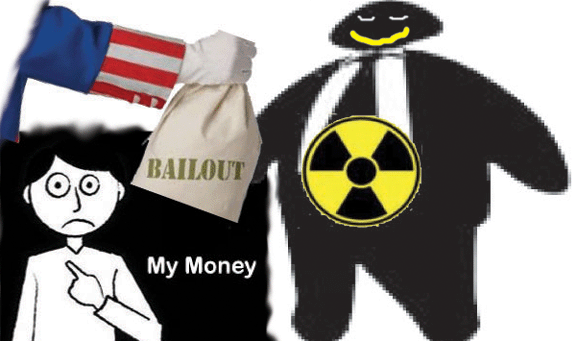
The Department of Energy announced that it would be providing a $3.7 billion loan guarantee to the Vogtle Electric Generation Plant located in near Waynesboro Georgia. That brings the total government financing on this project to $12 billion.
President Obama allocated an $8.3 billion loan to complete the Vogtle facility back in 2010 with the goal of constructing of the first new nuclear plant in the U.S. in 30 years. However, since President Obama’s initial loan, cost increases and delays (in part due to a contractor’s bankruptcy) have left the plant unfinished. Yet, taxpayers will now be forced to throw further good taxpayer money after bad.
Our March 22, 2019, blog highlighted how state-level bailout plans for failing nuclear power generation plants are gaining steam in several states, with the administration’s encouragement. The saga at Vogtle Electric underscores the hefty risk taxpayers would incur as bailouts continue across the country. For an administration keen on cutting wasteful government spending, an additional $3.9 billion loan undercuts that commitment and could be the first step toward a larger grid-intervention policy that will cost taxpayers dearly.
A July 19, 2018, report by the Brattle Group estimated it will cost taxpayers $34 billion over two years if every coal and nuclear plant in the country were bailed out as the administration originally proposed. That is a steep price to pay when those funds could be used for more practical measures like strengthening the nation’s energy grid, investing in cyber-protection technologies, or upgrading general infrastructure to bolster the nation’s natural gas supply.
To bailout a power plant that a private corporation has failed to keep within budget and on schedule brings this flawed policy to a new level. The latest announcement from Secretary Perry signals unnecessary political interference in energy markets. A corporation that cannot manage its projects properly doesn’t deserve a federal bailout by taxpayers. Taxpayer dollars are intended to serve the public, not support corporate irresponsibility.
STRATCOM to design blueprint for nuclear command, control and communications, Space News, by Sandra Erwin — March 29, 2019 U.S. Strategic Command was handed the responsibility last fall to solve one of the Defense Department’s most sensitive and complex technology problems: the modernization of the nation’s nuclear command, control and communications system, known as NC3. This job previously belonged to the Air Force Global Strike Command, but following the completion of the Pentagon’s Nuclear Posture Review last May, the Defense Department decided to give it to STRATCOM, the combatant command that oversees the nation’s nuclear forces.
The NC3 system includes terrestrial and space-based sensors that monitor the globe for threats, and a communications architecture that connects the nation’s decision makers to nuclear forces under any conditions. It is a classified system designed in the 1960s and 1970s during the height of the Cold War and is projected to stay in service for years to come. The technology is aging, however, and needs to be modernized so it can connect to the next generation of nuclear platforms the Pentagon is developing and expects to start deploying in the mid to late 2020s: the B-21 stealth bomber, the Columbia-class strategic ballistic missile submarine and the Ground Based Strategic Deterrent intercontinental ballistic missiles.
RADIOACTIVE contamination from Japan’s Fukushima Daichi nuclear power plant has drifted as far as America, experts claim. By EMILY FERGUSON EXPRESS UK, Mar 28, 2019
When a tsunami and 9.0-magnitude quake hit the Japanese nuclear plant’s reactors in March 2011, meltdowns were triggered at three of the plant’s six reactors. This resulted in radiation leaking into the air, soil and ocean – forcing 160,000 residents to flee. Radioactive contamination has reached as far north as a remote Alaskan island, scientists from the University of Alaska Fairbanks Sea Grant programme announced on Wednesday.
Water tests collected from seawater last year near St. Lawrence Island in the Bering Strait revealed a slight increase in levels of radioactive cesium-137 attributable to the Fukushima disaster.
But scientists say the levels need to be more than 3,000-times higher to pose a safety concern……..
n September last year the Japanese government acknowledge for the first that that a work at the nuclear power plant died from radiation exposure.
The worker, a man in his 50s, had spent his career working at nuclear plants around Japan and worked at the Fukushima Daiichi plant at least twice after the meltdowns at the station.
He was diagnosed with lung cancer in February 2016, an official said.
Illinois lawmakers move ahead with bill to benefit nuclear power plants, The Neighbour, By Cole Lauterbach | Watchdog.org, 29Mar19, Illinois lawmakers have set the wheels in motion to allow for power provider Exelon’s nuclear fleet, as well as wind and solar power providers, to sell energy to a state authority that opponents say will give it preferential pricing over coal and natural gas sources.
Testimony about how the legislation would affect costs for ComEd ratepayers differed, so what it means for consumers isn’t clear.
The move is a response to wholesale power grid operator PJM Interconnection Inc. separating Exelon’s nuclear power from other sources’ bids because Exelon gets subsidies from the state and would be able to undercut coal plants and others looking to sell energy commitments on the wholesale power market……..
The Future Energy Jobs Act, passed in 2016, allowed Exelon to receive state tax credits by classifying nuclear as a green form of energy. This allowed them to update two generating stations that they said were in risk of closure …….
Bristol selected to advise energy industry on safety of nuclear equipment, University of Bristol 28 March 2019, The University of Bristol has signed a Memorandum of Understanding to work with major national and international players in the energy market to ensure that all nuclear equipment meets required standards.
Under the partnership with EQUALLETM (an alliance of Framatome, Bureau Veritas, Doosan Babcock), Bristol will act as an expert guide for EQUALLE’s partners and suppliers, undertaking seismic qualification of equipment going onto nuclear power plants in the UK. ……
Bristol’s Faculty of Engineering has been heavily involved with UK civil nuclear stakeholders.
Already working with EDF Energy, substantial activities have been taking place to support the case for the UK Nuclear Plants life extension………. Thomas Epron, VP Global sales, Framatome’s Installed Base Business Unit, said: “This new partnership in equipment qualification with Bristol University is an additional step to build a comprehensive offer to the UK nuclear industry…….. http://www.bristol.ac.uk/news/2019/march/nuclear-partnership.html
Public will never know truth behind Three Mile Island, anti-nuclear energy advocates say https://www.witf.org/news/2019/03/public-will-never-know-truth-behind-three-mile-island-anti-nuclear-energy-advocates-say.phpby Ivey DeJesus/PennLive | Mar 26, 2019 The public will never know the truth behind some of the most basic facts about the nation’s worst nuclear disaster nor the actual amount of radiation that was released.Those were some of the messages underscored on Monday by the head of Three Mile Island Alert, an anti-nuclear advocacy group, and other advocates at a press conference in the Main Rotunda of the state Capitol.
Just days shy of the 40th anniversary of the partial meltdown at the Three Mile Island nuclear plant in Londonderry Township, TMI Alert’s Eric Epstein excoriated the nuclear industry for misrepresenting the facts of the accident, and in the process misleading and misinforming the public.
“Three Mile Island is an accident without an ending,” Epstein said. “There’s no bookends to it. If you look at the holy trinity of nuclear accidents, Three Mile Island, Chernobyl and Fukushima, we can probably pretty much tell you when they started. The reality is there is no ending. This is a funeral where the pallbearers need to stand in place for 500 years. That’s tough for a society that has the memory of a fruitfly.”
Epstein was joined by Tim Judson, executive director of Nuclear Information and Resource Service, and Arnie Gundersen, a nuclear engineer, who over the years converted from a proponent to an ardent critic.
Judson and Gundersen outlined the chain of events that took place on March 28, 1979, the start of the partial meltdown, as well as the levels of radiation released and subsequent impact on the health of the region.
Judson said the Three Mile Island story amounted to a “mistelling of history” of what could have been a preventable accident. He said that as a result of inconsistencies provided by the nuclear industry, the public was not given – nor will never have – a clear picture of the facts and the risks surrounding the meltdown.
Gundersen explained that because inadequate radiation monitors were in place at the time, officials were never able to get an accurate reading of radiation levels.
All analysis of radiation releases were based on mathematical corrections to estimates derived from off-site dose readings, he said.
“How much radiation was released? Nobody knows,” said Gundersen, who began a change of heart on nuclear energy in the 1990s when he served as an expert witness for plaintiffs in a lawsuit against Three Mile Island.
He is today chief engineer of Fairewinds Associates, an advocacy group for clean, renewable energy.
The Nuclear Regulatory Commission has long stood by its 40-year-old estimate that 10 million Curies of radiation were released. The NRC has also long held that the radiation released during the accident was well within levels deemed safe. The industry has reiterated that no one died or was harmed as a result of the accident.
Gundersen said that according to his own analysis of raw data, he calculated that 10 times that amount was released.
Epstein further excoriated legislative efforts to “bail out” Pennsylvania’s nuclear power plants, including Exelon Corp., current owner of TMI-1.
He said proposals to bail out the nuclear industry in Pennsylvania – to the tune of nearly $3 billion – were “fundamentally and manifestly unfair,” adding that Three Mile Island Alert categorically opposed any bailout.Proposed legislation would lead to the reclassification of Pennsylvania’s nuclear plants as “zero emission energy” and create new requirements on how electric companies purchase power.
Among the members of the audience, were several visitors from Fukushima, Japan, site of the 2011 post-tsunami nuclear disaster that led to the evacuation of a quarter of million people.
“The same (tactics) used to minimize the damage and risk of health is the same between Fukushima and TMI,” said Hiroko Aihara, a journalist from Fukushima.
She said citizen engagement has been pivotal in the case of Three Mile Island and continues to be so in the Fukushima aftermath.
“It’s very important to work together. To know we are not alone,” she said.
Aihara said the Japanese people – like residents of central Pennsylvania 40 years ago – were not provided with the truth.
“Many people are still suffering… about evacuation, radiation, contamination and economic situation,” she said. “We are still suffering or fighting the situation.”
40 years after Three Mile Island accident, debate over safety of nuclear energy still goes back and forth,Witf, by Ivey DeJesus/PennLive | Mar 26, 2019 Arnold “Arnie” Gundersen was a lead nuclear engineer in 1979 when the partial meltdown at Three Mile Island sent a tide of fear and panic across central Pennsylvania.Gundersen, a former licensed reactor operator, needed no coaxing to convince a jittery public that it had nothing to fear with regards to the March 28, 1979 accident at the Londonderry Township plant.
“I was on television telling people not to worry,” said Gundersen, whose wife was pregnant at the time. “I was telling everybody, ‘Don’t worry. No radiation got released.’ I think I said, ‘The Titanic hit the iceberg and the iceberg sunk.’ I think that was my comment at the time and boy was I wrong.”
But it took him about a decade to change his mind.
His conversion from proponent to nuclear whistleblower occurred gradually in the 1990s as Gundersen, among other things, served on nuclear energy symposiums and as an expert witness for plaintiffs lawsuits against the nuclear industry.
“I was on the other side of the argument,” said Gundersen, who sits on the board of the Fairewinds Energy Education, a Charleston, S.C.-based anti-nuclear energy nonprofit that advocates for renewable energy. “I would call myself a nuclear zealot back then as opposed to a nuclear critic now.”
Others come at the nuclear energy debate from a decidedly opposite direction. …
These days, Heather Matteson, who works at the Diablo Canyon nuclear plant in San Luis Obispo County, and Kristin Zaitz, who used to work there, are ardent supporters of nuclear energy. …..
Now 70, Gundersen, stands by his conviction that the health of untold numbers of people across central Pennsylvania was endangered by the Three Mile Island partial meltdown. Over the years in his testimonies, Gundersen has attested to a litany of factors, he said, contributed to the misrepresention by the nuclear industry about the facts of the accident, including the number of radiation plumes released, the amount of radiation released and the amount of radioactive waste that was released inside the reactor.
Gundersen said that because of the inaccurate assessments released to the public, subsequent medical studies on the impact of Three Mile Island radiation exposure were compromised.
“The plant wives pulled all the kids out of school by 11,” Gundersen said. “The plant staff knew how serious it was. Civilians, who trusted government, didn’t do a darn thing.”
The 2011 Fukushima Daiishi nuclear plant disaster in Japan has furthered fueled the debate on nuclear energy, reinforcing the public opinion chasm. Radiation particles from the plant, which was destroyed that March in the wake of a powerful tsunami, spread over an area the size of Connecticut. About a quarter of a million people fled the area……
A report published by Scientific America in January, noted some areas near the Fukushima plant continue to exceed five times the level of radiation set by Japan as safe for the general public. In certain spots radioactivity remains as high as 20 millisieverts, the maximum exposure recommended by international safety experts for nuclear power workers, according to Scientific America.
The debate goes beyond radiation and certainly includes arguments about uranium mining and radioactive waste. Nuclear proponents say that the mining of uranium levels a far lower impact on the environment compared to fracking, natural gas pipelines and other fossil fuel energy sources.
Gundersen argues that uranium mining exposes workers to radiation, and contaminates groundwater and aquifers….
Gundersen discredits the assessments released on Fukushima. He claims the nuclear industry used “identical tactics” to deal with that disaster as it did with the Three Mile Island accident, Chernobyl and even the Deepwater Horizon disaster. That includes downplaying the risks and telling the public it is in no immediate danger.
“The industry controls the narrative,” Gundersen said. “The orthodoxy very quickly circles the wagons and protects trillions of dollars of investment.”
Eric Epstein, chairman of Three Mile Island Alert, an anti-nuclear advocacy group, stands behind Gundersen’s assessment of the lack of transparency in the nuclear industry. Epstein says the industry will never own up to the dangers of nuclear energy nor the dangers inflicted on central Pennsylvania as a result of the Three Mile Island accident.
He says he remains resolutely cynical about nuclear: “We can all agree that there are no safe levels of radiation exposure. … But the industry can’t afford to acknowledge the truth. It would bankrupt the nuclear industry.”….
“It’s an orthodoxy,” Gundersen said. “The nuclear industry is an orthodoxy. What the high bishops say the lowly priests repeat. At the time I just accepted the party line of the orthodoxy.”
For Zaitz and Matteson, co-founders of Mothers for Nuclear, too much is at stake not to stand behind it.
Tell Congress: Prevent Nuclear Catastrophe in Iran
Read the Public Inquiry Report, the Commissioners’ report, Surrendering Australia: The AUKUS Deception is available to download for free at aukuspublicinquiry.com. Or just watch the replay of the National Press Club Luncheon.