nuclear-news

The News That Matters about the Nuclear Industry Fukushima Chernobyl Mayak Three Mile Island Atomic Testing Radiation Isotope

Nuclear industry is aggressively milking USA States for subsidies, despite Exelon profits

Is The Nuclear Industry Abusing Subsidies? Oil Price, One such state is Connecticut, where local news source the Connecticut Mirror just published a direct-to-the-point op-ed aptly titled “Nuclear plants will require ever-increasing subsidies”. The author Joel Gordes, a Connecticut-based energy and environmental strategist, argues that since the very beginning of nuclear energy in their country, when the argument for the resource was that nuclear energy was dirt cheap, nuclear has been deceptively pricey and getting pricier all the time.

“Please consider,” Gordes implores the reader, “the very basic fact that we have gone from nuclear technology sold in the 70s on the basis of being ‘too cheap to meter’ to one where they have been begging and receiving for what amounts to yet more subsidies. Even with the ‘too cheap to meter’ claim, in its heyday the nuclear industry was the recipient of huge amounts of subsidy in numerous forms.”

Gordes goes on to finish his denunciation of his state’s nuclear policy by imploring the government to rethink their history handouts: “With that, I suggest our leaders and regulators very carefully consider any actions contemplated to further subsidize this technology since that might add to its eventual stranded cost that will hold up newer, lower cost decentralized, modular and more secure options. Even more important is that aging plants may, themselves, present an existential danger to the citizens of the state.”

Meanwhile, energy insiders in Illinois are singing a similar tune. Chicago-based nuclear electric power generation company Exelon won ratepayer-funded subsidies for two nuclear plants in its home state just three years ago, and now it’s back in Springfield to ask for similar monetary support for other cash-strapped nuclear plants that have not yet had the benefit of a bailout. The bill will be voted on by the State of Illinois’ House Public Utilities Committee this week.

While Exelon is lobbying hard for more government support, however, it is receiving a fair amount of scrutiny and backlash. Just this month Monitoring Analytics released a “bombshell report” with the surprising findings that all five of Exelon’s nuclear plants in Northern Illinois are not in dire financial distress, but are in fact profitable, and are projected to continue to be so through 2021–by conservative estimates.

According to the Monitoring Analytics report, Exelon’s five Illinois-based nuclear plants will see a total estimated profit of approximately $472 million this year alone. What’s more, each individual plant will turn its own profit. Even in 2021, when it is anticipated that revenue will begin to decline, altogether the plants are still projected to earn a profit of $228 million–much lower, to be sure, but still a far cry from bankruptcy. The report has thrown doubt upon Exelon’s stance that the subsidy bill up for vote this week, which would legislate a very complex matter with massive consequences for Illinois’ power industry and energy market, is a matter of both urgency and necessity…….. https://oilprice.com/Energy/Crude-Oil/Is-The-Nuclear-Industry-Abusing-Subsidies.html

April 4, 2019 Posted by | politics, USA | 2 Comments

Silloth Town Council rejects nuclear waste dump for their area

Cumbria Trust 2nd April 2019 At the Silloth Town Council meeting held on 11 March 2019 it was
“RESOLVED that a letter be sent to say that Silloth Town Council will not
be volunteering to be a site for a GDF and that we don’t want it in our
area” which was in response to The Radioactive Waste Management –
Consultation on how they will evaluate potential sites for a GDF in the
future in England and Wales.

https://cumbriatrust.wordpress.com/2019/04/02/its-definitely-no-to-a-gdf-from-silloth-town-council/

April 4, 2019 Posted by | opposition to nuclear, politics, UK, wastes | Leave a comment

European Parliament votes to exclude nuclear power from receiving a green stamp of approval on financial markets.

Euractiv 29th March 2019 The European Parliament voted on a proposed classification for sustainable
assets on Thursday (28 March), voting to exclude nuclear power from
receiving a green stamp of approval on financial markets.

The text voted in Parliament also excludes fossil fuels and gas infrastructure from the
EU’s proposed green finance taxonomy, which aims to divert investments
away from polluting industries into clean technologies. In a bid to prevent
“green-washing”, the Parliament text also requires investors to
disclose whether their financial products have sustainability objectives,
and if they do, whether the product is consistent with the EU’s green
assets classification, or taxonomy.

While activists applauded the move, they said the classification voted by the European Parliament was too
narrow and applies only to a limited set of recognisable green assets, such
as wind and solar power companies.

https://www.euractiv.com/section/energy-environment/news/nuclear-power-excluded-from-eus-green-investment-label/

April 4, 2019 Posted by | climate change, EUROPE | Leave a comment

New legal action compensation claim by 25 Fukushim evacuees

ACROnique of Fukushima 26th March 2019 25 people from Fukushima, who resettled in Ehime Province on Shikoku
Island, took legal action for better compensation. They claimed a total of
137.5 million yen (1.1 million euros) with the main argument that this
disaster could have been avoided if preventive measures had been taken to
protect the plant following the re-assessment of the earthquake risks. and
tsunami in 2006.

They believe that the compensation received is
insufficient in view of the harm suffered which has separated families and
cut ties with the community. They claimed 5.5 million yen (€ 44,000) per
person to cover stress, loss of property and relocation.

https://fukushima.eu.org/tepco-et-letat-japonais-condamnes-a-indemniser-des-personnes-deplacees/

April 4, 2019 Posted by | Japan, Legal | Leave a comment

France’s Orano (formerly bankrupt Areva) to send MOX fuel to Japan

ACROnique of Fukushima 31st March 2019 According to the Asahi , Orano is preparing to send MOx fuel to Japan from
2020. It is intended for the Takahama power plant , operated by Kansai  Electric in Fukui province. The previous shipment dates from 2017. There are 32 nuclear assemblies that should sail to Japan. The amount of plutonium contained in these fuels is one tonne.

KEPCo will have yet to repatriate 10 tons of plutonium in the form of MOx fuel to clear its stock.
And Japan must also drastically reduce its stock in order to hope to start its reprocessing plant in Rokkashô mura, which is already 24 years behind schedule . However, only four reactors currently operate with MOx in Japan: Takahama 3 and 4, Genkai-3 and Ikata-3 ( see the state of the Japanese  nuclear fleet ).

https://fukushima.eu.org/nouvel-envoi-de-mox-vers-le-japon-en-preparation/

April 4, 2019 Posted by | Japan, reprocessing | Leave a comment

USA’s Secretary For Promoting Nuclear Energy, Rick Perry, wants Yucca waste dump site, not a bit worried about earthquake danger

As safety board cites quakes, Perry says Nevada nuke sites safe   By Gary Martin April 2, 2019

April 4, 2019 Posted by | politics, USA, wastes | Leave a comment

Hanford contractor responsible for radiation spread avoids penalty

Hanford contractor avoids fine for radioactive particles   https://www.nbcrightnow.com/hanford/hanford-contractor-avoids-fine-for-radioactive-particles/article_83ebdc71-a595-57c3-ba4e-64ad9c739c23.html  Apr 2, 2019 

HANFORD, WA (AP) — A Hanford contractor is expected to avoid federal penalties for the airborne spread of radioactive particles.

The U.S. Department of Energy does not intend to fine CH2M Hill Plateau Remediation Company in Hanford for five violations connected to contamination.

The agency says it will not fine CH2M because its possible incentive pay was already docked by $1 million in fiscal 2017 and $1.8 million in fiscal 2018.

The agency says radioactive contamination was found at the site in December 2017 near administrative buildings, on employee and government cars, and in trailers where workers ate.   Officials say tests found 42 workers inhaled or ingested small amounts of radioactive material and that contamination continued into 2018.

April 4, 2019 Posted by | Legal, USA | Leave a comment

Japanese panel says that people under 40 should have iodine tablets ready, in advance of nuclear emergencies

Panel: People under 40 should get iodine first  http://www.newsonjapan.com/html/newsdesk/article/124669.php
NHK — MAR 31 2019,
A panel of doctors in Japan’s Nuclear Regulation Authority says iodine tablets should be distributed in advance to residents under 40 to mitigate the effects of radiation exposure due to a nuclear accident.

The panel compiled the proposal on Friday.

Iodine tablets are used to prevent the thyroid gland storing radiation.

World Health Organization guidelines say iodine tablets should be distributed to children and pregnant women first because they may face high risks of thyroid cancer after radiation exposure in a nuclear accident.

Iodine tablets are distributed mainly to residents within five kilometers of nuclear plants. But actual distribution is very slow, making it urgent to put children first.

The panel proposes that in principle iodine tablets should be distributed in advance to people under 40 as well as pregnant women and lactating mothers.

It also says people aged 40 or over can ask for the tablets if there are sufficient supplies, even though it has not been proved that cases of thyroid cancer due to radiation exposure will increase among this age group.

April 4, 2019 Posted by | Japan, safety | Leave a comment

UK ‘public consultation’ on nuclear policy – submission ignored.

David Lowry’s Blog 1st April 2019 Last night I submitted my latest (of dozens) of responses to a Government
or nuclear industry sector public consultation on nuclear policy, this time
on the flawed machinations of trying to find site or sites where nuclear
waste can be disposed of.

I strongly complained that previous submissions
had been entirely ignored, which had reduced the incentive to commit to
researching and preparing detailed submission this time. The same complaint
was included in the Cumbria Trust submission, which asserted: “BEIS and its
predecessors have a track record of issuing consultation documents and
choosing to ignore responses that go against their preconceived plans.” My
own submission was very short, but appended the very long evidence I
submitted year ago, which was ignored, with the demand it be heeded this
time.

http://drdavidlowry.blogspot.com/2019/04/nuclear-waste-very-long-term.html

April 4, 2019 Posted by | politics, UK | Leave a comment

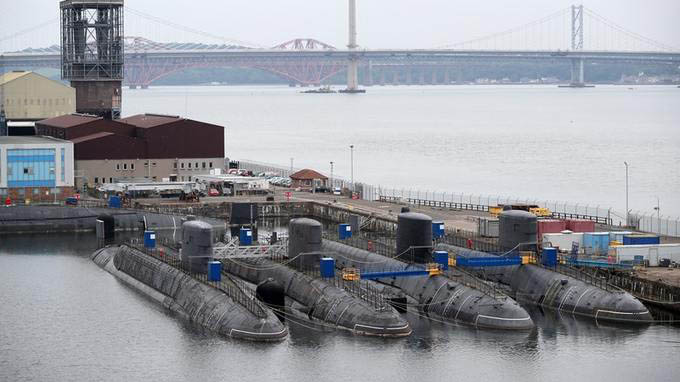
Massive costs of managing UK’s dead nuclear submarines

Times 3rd April 2019 Delaying the disposal of the Royal Navy’s retired submarine fleet has
cost the taxpayer £900 million, according to the Whitehall spending
watchdog. None of the 20 submarines that have left service since 1980 has
been fully defuelled or dismantled.
They include HMS Conqueror, which sank
the General Belgrano in the Falklands conflict in 1982, and the four
Polaris vessels that carried Britain’s nuclear deterrent until the
mid-1990s.
A National Audit Office report published today says that while
it is expensive to scrap the submarines, at £96 million per boat, delaying
the disposal programme is also costly, adding £900 million to the total
bill so far. Each decommissioned submarine costs £12 million a year to
store and maintain.
Meg Hillier, chairman of the Commons public accounts
committee, heaped scorn on the “dismal lack of progress” and
“spiralling costs”. She told the Ministry of Defence (MoD) to “get a
grip urgently before we run out of space to store and maintain submarines
and we damage our reputation as a responsible nuclear power”.
The budget
for the programme to dismantle retired submarines and remove their
radioactive parts has soared by £800 million, or 50 per cent, due to a
15-year delay in rolling out a tested approach. In addition, the 11-year
delay in the project to remove irradiated fuel from the nine retired
nuclear submarines has seen the budget rise by £100 million, or 57 per
cent. Regulators halted the defuelling of submarines in 2004 after
government facilities failed to meet required standards. The process is not
due to start again until 2023.
The bill for maintaining and disposing of
the navy’s 20 stored and 10 serving submarines stands at £7.5 billion
over the next 120 years, the time needed to deal with the nuclear waste.https://www.thetimes.co.uk/article/delays-to-scrapping-navy-s-submarines-cost-900m-kj8qqcdp0

April 4, 2019 Posted by | UK, wastes, weapons and war | Leave a comment

France’s ‘public consultation’ on old nuclear reactors – full of bureaucratic jargon – no debate took place

April 4, 2019 Posted by | France, politics | Leave a comment

Trump’s ?ultimatum piece of paper to Kim Jong Un – insulting and provocative

US asked North Korea to hand over all nuclear weapons: Report.  Donald Trump reportedly gave Kim Jong Un a document in Hanoi calling for the transfer of nuclear materials to the US. Aljazeera, 30 Mar 2019 On the day their talks in Hanoi collapsed last month, US President Donald Trump handed North Korean leader Kim Jong Un a piece of paper that included a blunt call for the transfer of Pyongyang’s nuclear weapons and bomb fuel to the United States, according to a document seen by Reuters news agency.

Trump gave Kim both Korean and English-language versions of the US position at Hanoi’s Metropole hotel on February 28, according to a source familiar with the discussions, speaking on condition of anonymity. It was the first time that Trump himself had explicitly defined what he meant by denuclearisation directly to Kim, the source said.

On the day their talks in Hanoi collapsed last month, US President Donald Trump handed North Korean leader Kim Jong Un a piece of paper that included a blunt call for the transfer of Pyongyang’s nuclear weapons and bomb fuel to the United States, according to a document seen by Reuters news agency.

Trump gave Kim both Korean and English-language versions of the US position at Hanoi’s Metropole hotel on February 28, according to a source familiar with the discussions, speaking on condition of anonymity. It was the first time that Trump himself had explicitly defined what he meant by denuclearisation directly to Kim, the source said.

A joint lunch for the two leaders was cancelled the same day. While neither side has presented a complete account of why the summit collapsed, the document may help explain it.

The document’s existence was first mentioned by NSA John Bolton in television interviews he gave after the two-day summit. Bolton did not disclose in those interviews the pivotal US expectation contained in the document that North Korea should transfer its nuclear weapons and fissile material to the US.

The document appeared to represent Bolton’s long-held and hardline “Libya model” of denuclearisation that North Korea has rejected repeatedly. It probably would have been seen by Kim as insulting and provocative, analysts said.

Trump had previously distanced himself in public comments from Bolton’s approach and said a “Libya model” would be employed only if a deal could not be reached.

The idea of North Korea handing over its weapons was first proposed by Bolton in 2004. He revived the proposal last year when Trump named him as his national security adviser.

The document was meant to provide the North Koreans with a clear and concise definition of what the US meant by “final, fully verifiable, denuclearisation”, the source familiar with discussions said.

The White House did not immediately respond to a request for comment, while the State Department declined to comment on what would be a classified document.

After the summit, a North Korean official accused Bolton and Secretary of State Mike Pompeo of “gangster-like” demands, saying Pyongyang was considering suspending talks with the US and may rethink its self-imposed ban on missile and nuclear tests.

The English version of the document, seen by Reuters, called for “fully dismantling North Korea’s nuclear infrastructure, chemical and biological warfare program and related dual-use capabilities; and ballistic missiles, launchers, and associated facilities”.

Aside from the call for the transfer of Pyongyang’s nuclear weapons and bomb fuel, the document had four other key points.

It called on North Korea to provide a comprehensive declaration of its nuclear programme and full access to the US and international inspectors; to halt all related activities and construction of any new facilities; to eliminate all nuclear infrastructure; and to transition all nuclear programme scientists and technicians to commercial activities.

The summit in Vietnam’s capital was cut short after Trump and Kim failed to reach a deal on the extent of economic sanctions relief for North Korea in exchange for its steps to give up its nuclear programme. ……… https://www.aljazeera.com/news/2019/03/asked-north-korea-hand-nuclear-weapons-report-190330093325886.html

April 1, 2019 Posted by | politics international, USA | 1 Comment

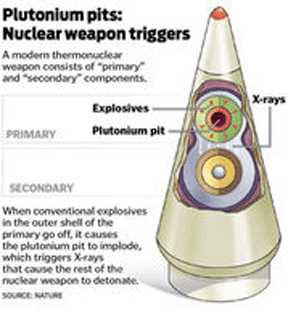
The very dangerous history of making plutonium weapons triggers – “pits” at Rocky Flats

Dangerous history of pit production  https://www.aikenstandard.com/opinion/guest-column-dangerous-history-of-pit-production/article_a22aa6b8-4ab2-11e9-83dc-7b695e05d8a7.html Dr. Rose O. Hayes

Recent comments on the proposed pit production at Savannah River Site warrant a cautionary comment. All is not wonderful news where pit production is concerned. It has a very dirty past. Awareness of that past is paramount to the protection of CSRA public health and safety.

The primary U.S. plant to smelt plutonium, purify it and shape it into “triggers” (pits) for nuclear bombs was Rocky Flats Nuclear Weapons Site. From 1952 to 1989, Rocky Flats manufactured more than 70,000 pits at a cost of nearly $4 million apiece. Each one contained enough breathable plutonium particles to kill every person on earth. Virtually all of the waste produced there remains on-site. As we have learned through the SRS waste storage struggles, there is no place for it to go and no government plan to develop a repository. What’s made at a nuclear processing plant, stays at the nuclear processing plant.

Much went wrong at Rocky Flats due to mismanagement, criminal government indifference and public complacency. It took more than 30 years for the public to become so concerned with the pollution hazards issuing from the plant before the Department of Energy (DOE) was forced to hold a public meeting in 1988 to address the problems. One example: The plant produced one boxcar a week packed with 140 drums of radioactive waste. They were parked on site. Moisture penetration of a drum could have triggered an explosion. Ground water, soil and air pollution were also major hazards. A subsequent DOE study indicated that Rocky Flats was the most dangerous site in the country.

On June 6, 1989 more than 70 FBI and EPA agents raided the plant to begin an official investigation of the contractor and DOE for environmental crimes. The plant manager acknowledged that problems were solved “when DOE wanted to pay for them.” The final FBI/EPA allegations included concealment of environmental contamination, false certification of federal environmental reports, improper storage and disposal of hazardous and radioactive waste, and illegal discharge of pollutants into creeks flowing to drinking water supplies. Another independent study found there was enough lost plutonium in the plant exhaust ducts to create the possibility of an accidental nuclear reaction. According to a later DOE report, about 62 pounds of plutonium was lost in the plant air ducts; enough for seven nuclear bombs.

A grand jury was convened to hear the case on Aug. 1, 1989. The contractor argued in court that it could not fulfill its DOE contract without also violating environmental laws. In order to remediate the damage, on Sept. 28, 1989, EPA added Rocky Flats to its Superfund cleanup list. The grand jury worked until May 1991, then voted to indict the plant contractor, five employees and three individuals working for DOE.

The Department of Justice refused to sign the indictments despite more than 400 environmental violations that occurred during the decades of pit production at the plant. All charges were dropped. A settlement guaranteed the contractor and all indicted individuals immunity. Although the contractor pleaded guilty to criminal violations of the federal hazardous waste law and the Clean Water Act, the fine was only $18.5 million, less than the corporation had collected in bonuses for meeting production quotas that year. The contractor’s annual fee to run the site was estimated at $10 million, with an additional $8.7 million paid from DOE for management and safety excellence.

The contractor was also allowed to sue for reimbursement of $7.9 million from taxpayers for fees and costs related to its case. In addition, the contractor’s plea agreement indemnified it from further claims and all future prosecution, criminal or civil. The trial records are permanently sealed. Further, the contractor argued that everything it did at Rocky Flats was at the behest of DOE and maintained the right to receive future government contracts.

Grand jury members asked to write their own report but the judge refused to read it or release it to the public. Not surprisingly, the report was leaked to the press and printed in a Denver newspaper and Harper’s magazine. In January 1993, a Congressional committee finally issued a report revealing evidence of high-level intervention by Justice Department officials for the purpose of reducing the contractor’s fines.

DOE has estimated that it will take until 2065 to clean up Rocky Flats, at a cost to American taxpayers of more than $40 billion. One DOE official testified to the Senate Armed Services Committee that some weapons plants, like Rocky Flats, may never be cleaned up because we lack the technology to do so at a reasonable cost. Another investigator, testifying before the U.S. Senate’s Governmental Affairs Committee, stated he did not believe it possible to reverse the harm done at Rocky Flats.

Could this history repeat itself at SRS? Without a comprehensive cradle to grave plan with built-in irrevocable government funding and independent oversight, including citizen stakeholder input, SRS could become the next Rocky Flats. How likely is the government to attach such planning and funding to an SRS pit processing campaign? Past experience at SRS includes years of having to do best guess planning under continuing resolution funding and government failures to pass a budget, decades of “temporarily” storing deadly radioactive waste due to the government’s failure to meet off-site disposition commitments, budget reductions, program cancellations (most recently, the MOX project), and more.

Plutonium pit production waste is not just radioactive. It is nuclear waste on steroids. If produced here, it will likely remain in our backyard, along with all the decades old waste at SRS. There is no place for it to go. Looming large as examples of the dangers and difficulties SRS will face in having pit production waste moved off-site are the explosion and prolonged closure at the New Mexico Waste Isolation Pilot Plant (the government’s only operating repository) and the abandonment of the Yucca Mountain project.

Is it the CSRA’s responsibility to take on this mission? Pit production, while bringing jobs to the Aiken/Augusts area, will add to the decades old SRS hazards waiting for DOE remediation. SRS is already part of the DOE nuclear complex cleanup program. That mission, 30 some years old, drags on under the burden of DOE mismanagement and variable federal funding. Estimates are it will take another 70 years to clean up the DOE nuclear complex and cost about $500 billion more. Celebration of plans to add U.S. pit production to SRS is a rush to judgement. Only the usual corporations, living large off gigantic federal awards, stand to benefit.

Dr. Rose O. Hayes is a medical anthropologist who spent her career in public health. She holds a B.S., M.S., M.A., and Ph.D. from SUNY and completed post-doctoral work in skeletal biology at The George Washington University. From 2009 to 2015, she served on the U.S. Department of Energy Site-Specific Advisory Board for the Savannah River plant, chairing its Nuclear Materials Committee. 

April 1, 2019 Posted by | - plutonium, history, legal, Reference, safety, USA | Leave a comment

Why Low dose radiation can be more dangerous- more cancers per person than at high doses

LeRoy Moore: Low-dose radiation can be more dangerous,  http://www.dailycamera.com/letters/ci_32543151/leroy-moore-low-dose-radiation-can-be-more 31 Mar 19  Though Maddie Nagle’s beautifully written column of March 8 criticizes me, more important is that she downplays the significance of low-dose exposure to the alpha radiation of plutonium at Rocky Flats. This could harm people unaware of the danger. Carl Morgan, the “Father of Health Physics,” studied the effects of radiation for those building Manhattan Project nuclear weapons. He knew that the alpha particles released by plutonium cannot be harmful unless inhaled or taken into the body through an open wound.

Toward the end of his life he spoke to Robert Del Tredici. He said “down at the low doses you actually get more cancers per person rem than you do at the high doses … because the high levels will often kill cells outright, whereas the low levels of exposure tend to injure cells rather than kill them and it is the surviving injured cells that are the cause for concern.” The effects of a small exposure “will be much more severe than had been anticipated.”(Del Tredici, “At Work in the Fields of the Bomb,” 1987, p. 133)

Nagle also makes misleading remarks about Tom K. Hei of Columbia University. Hei and colleagues demonstrated that a single plutonium alpha particle induces mutations in mammal cells. Cells receiving very low doses are more likely to be damaged than destroyed. Replication of these damaged cells constitutes genetic harm, and more such harm per unit dose occurs at very low doses than would occur with higher dose exposures. “These data provide direct evidence that a single alpha particle traversing a nucleus will have a high probability of resulting in a mutation and highlight the need for radiation protection at low doses.” (Hei et al., Proceedings of the National Academy of Sciences, vol. 94, April 1997, pp. 3765-3770.)

April 1, 2019 Posted by | radiation, Reference, USA | Leave a comment

The insanity of building Sizewell nuclear power station on the beach

April 1, 2019 Posted by | climate change, safety, UK | Leave a comment