Ohio’s subsidy Bill unnecessarily bails out nuclear, coal owner FirstEnergy Solutions
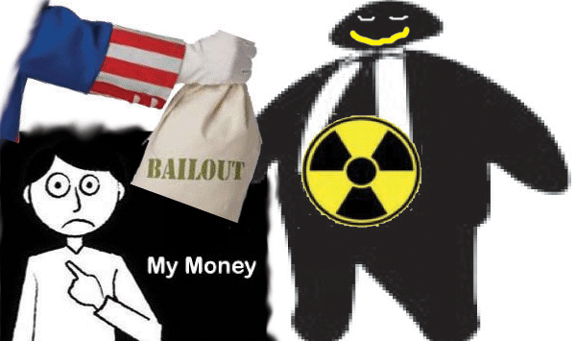 Ohio lawmakers pass bill to cut renewable requirement, help nuclear and coal Critics say the bill unnecessarily bails out nuclear, coal owner FirstEnergy Solutions. Ars Technica, MEGAN GEUSS – 6/1/2019, THIS WEEK, LAWMAKERS IN OHIO’S HOUSE OF REPRESENTATIVES VOTED 53-43 IN FAVOR OF A CONTROVERSIAL BILL THAT WOULD PERMIT A CONSUMER-FUNDED SUBSIDY FOR NUCLEAR PLANTS AND POSSIBLY FOR AILING COAL PLANTS AS WELL. The bill would also end Ohio’s renewable portfolio standard, which required that the state’s utilities to obtain 12.5 percent of their power from renewable sources by 2027. Instead, that renewable portfolio standard is replaced by smaller steps to bolster renewable power, but environmental groups say the bill is a step in the wrong direction.A version of House Bill 6 has now been introduced to the state’s Senate. If it passes there, it will likely become law due to the Governor’s support of the bill. A boon for FirstEnergy Solutions Currently, Ohioans pay a $4.39 surcharge on their electricity bills to fund Ohio’s renewable portfolio standard, according to local news site Cleveland.com. House Bill 6 would eliminate that surcharge and replace it with a $1 surcharge to raise more than $170 million per year, which would be given to Ohio energy company FirstEnergy Solutions to keep its Davis-Besse and Perry nuclear plants open. The subsidies would be retired in 2026. First Energy Solutions owns nuclear and coal plants throughout Ohio and Indiana. In April 2018, its coal business filed for Chapter 11 bankruptcy protection. The company then asked the Trump Administration to grant it an emergency bailout using Section 202(c) of the Federal Power Act, which allows the federal government to keep the electrical grid operating during emergencies. Thus far, the Administration has not invoked that Act. House Bill 6 also has some good news for the Ohio Valley Electric Corporation, which will be allowed to petition public utility regulators for an additional fee of $2.50 per month per customer to keep two of its coal plants in Ohio and Indiana open. Another, smaller provision in the bill would allow residents of unincorporated areas of Ohio to hold a referendum on whether to allow wind projects to proceed…….. UCS disputes that statement. “While the charges appearing on consumer bills might be less, this ignores the much greater energy bill savings consumers have been realizing through investments in energy efficiency,” UCS writes. “In addition, the cost of wind and solar has fallen by more than 70 percent over the past decade, making them more affordable for consumers and competitive with natural gas power plants in many parts of the country.” https://arstechnica.com/tech-policy/2019/05/ohio-house-passes-bill-that-would-allow-consumer-funded-nuclear-and-coal-subsidies/ |
|
Michael Cohen and an Alabama Nuclear Plant Show Everything About This Administration* Is for Sale
|
Michael Cohen and an Alabama Nuclear Plant Show Everything About This Administration* Is for Sale, A bipartisan swamp-dweller is back in the news. Esquire, BY
|
|
|
Nuclear envoys from Japan, U.S., South Korea discuss North Korea during trilateral meeting in Singapore
|
Nuclear envoys from Japan, U.S., South Korea discuss North Korea during trilateral meeting in Singapore, Japan Times, KYODO, MAY 31, 2019, SINGAPORE – Stephen Biegun, U.S. special representative for North Korea, held talks on the Korean Peninsula nuclear issue with his Japanese and South Korean counterparts in Singapore on Friday. Negotiations between Washington and Pyongyang are currently at a standstill.
The trilateral meeting was the first since North Korea fired projectiles that appeared to be short-range ballistic missiles on May 4 and May 9 in an apparent attempt to coax Washington into making concessions in denuclearization negotiations. Biegun met with Kenji Kanasugi, director-general of the Foreign Ministry’s Asian and Oceanian Affairs Bureau, and Lee Do-hoon, South Korea’s special representative for Korean Peninsula peace and security affairs. The outcome of the talks was not immediately available, but they probably exchanged views on how to pave the way for the resumption of denuclearization negotiations with Pyongyang, which have been stalled following the collapse of the second U.S.-North Korea summit in Hanoi in late February…… https://www.japantimes.co.jp/news/2019/05/31/national/politics-diplomacy/nuclear-envoys-japan-u-s-south-korea-discuss-north-korea-trilateral-meeting-singapore/#.XPGycBYzbGg |
|
Tokyo 2020 Olympic Torch Relay set to visit Fukushima nuclear complex
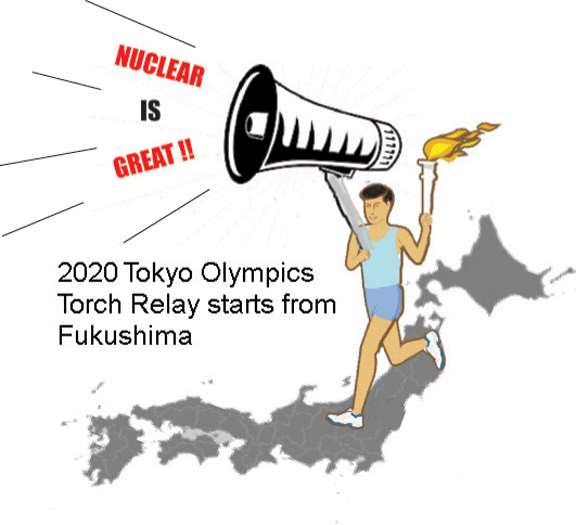
Tokyo 2020 Olympic Torch Relay set to visit Fukushima nuclear complex, PACNEWS, 1 June, 2019,
A staff takes out a banner featuring Tokyo 2020 Olympics emblem from the wall after a news conference in Tokyo, Japan June 30, 2017. REUTERS/Kim Kyung-Hoon
TOKYO, 01 JUNE 2019 (INSIDE THE GAMES) – A town devastated by the nuclear meltdowns in the Fukushima Prefecture in the wake of the 2011 earthquake and tsunami in Japan is set to feature on the route of the Olympic Torch Relay for Tokyo 2020. The relay course will pass through the Fukushima Daiichi Nuclear…. (subscribers only ) https://www.fijitimes.com/tokyo-2020-olympic-torch-relay-set-to-visit-fukushima-nuclear-complex/
Duke plans to decommission nuclear plant ahead of schedule
Duke plans to decommission nuclear plant ahead of schedule, Gainsville.com By Carlos E. Medina, 31 May 19, It will seek permission to decommission the idle Crystal River plant about 50 years sooner than planned at a cost of $540 million.
Duke Energy wants to tear down its Crystal River nuclear power plant about 50 years earlier than planned, the company announced Thursday.
In 2013, Duke decided to keep the facility idle until 2074 and then demolish the physical plant after removing all radioactive material. But a recent review of the cost to accelerate the timeline found the company had enough money in their decommissioning trust fund to cover the accelerated plan, said Heather Danenehower, Duke communications manager.
They need approval from the U.S. Nuclear Regulatory Commission to change plans and that process will take at least a year.
The accelerated process, which will take until 2027 to complete, would cost $540 million. The trust fund balance stood at $717 million on March 31. Whatever remains will go back to Duke’s customers. Customers, including the more than 66,000 in Marion County and the more than 4,000 in Alachua County, will not see their electricity bills increase because of the move, she said…… https://www.gainesville.com/news/20190530/duke-plans-to-decommission-nuclear-plant-ahead-of-schedule
Volcanoes not the major cause of global warming
Humans and volcanoes caused nearly all of global heating in past 140 years, Guardian, Dana Nuccitelli 30 May 19
New study confirms natural cycles play little role in global temperature trends and tackles discrepancies in previous models, Emissions from fossil fuels and volcanoes can explain nearly all of the changes in Earth’s surface temperatures over the past 140 years, a new study has found.
The research refutes the popular climate denial myth that recent global warming is merely a result of natural cycles….. https://www.theguardian.com/environment/2019/may/30/humans-and-volcanoes-caused-nearly-all-of-global-heating-in-past-140-years
Proposals to transport nuclear waste through Bridgwater, Somerset
Somerset Live 29th May 2019 , Bridgwater residents only have a few days to have their say on proposals to
transport nuclear waste through their town. Magnox Ltd currently operates
the Hinkley Point A site near Stogursey, which includes a small area where
nuclear waste is stored before being moved elsewhere for processing. The
company has applied to Somerset County Council for permission to store
waste from other nuclear power stations at the Hinkley site – which would
involve moving it through Bridgwater on agreed routes.
It is staging four drop-in sessions in June where residents of Bridgwater and the surrounding
villages can have their say on the plans before county councillors make a
final decision. Magnox’s proposals relate to “intermediate-level waste”,
which includes cladding around nuclear fuel and materials which have become
contaminated in the process of decommissioning a nuclear reactor.
https://www.somersetlive.co.uk/news/somerset-news/bridgwater-residents-only-few-days-2921627
Swedish court rejects effort to delay Assange hearing
https://www.theage.com.au/world/europe/swedish-court-rejects-effort-to-delay-assange-hearing-20190529-p51s61.html 29 May 19. Stockholm: A Swedish court has rejected efforts to postpone a hearing relating to Julian Assange, a lawyer for the WikiLeaks founder says.
A Swedish prosecutor this month filed a request for Assange to be detained for a June 3 hearing about a rape allegation.
Defence lawyer Per Samuelson told Reuters he visited Assange in British custody on Friday before seeking to postpone the hearing.
“One of the reasons is that Assange’s health situation on Friday was such that it was not possible to conduct a normal conversation with him,” Samuelson said.
“I meant that it should be postponed until I had time to meet again and go through the issues in peace and quiet. I suggested no specific date and meant it should be postponed until everything was ready, but the district court has now decided that this won’t happen .
he Uppsala district court, where the hearing is due to take place, was not immediately available for comment. A prosecutors’ office spokesman declined to comment.
Sweden reopened the investigation into alleged rape, which Assange denies, in early May. It was begun in 2010 but dropped in 2017 while Assange was in refuge in Ecuador’s London embassy.
Assange was arrested in London last month after spending nearly seven years inside the embassy.
If the court order is granted, it would be the first step in a process to have Assange extradited from Britain, where he is serving a 50-week sentence for skipping bail.
US authorities are separately seeking to extradite Assange on charges relating to the public release by WikiLeaks of a cache of secret documents, and last week unveiled 17 new criminal charges against him, including espionage.
The British courts will have to rule on the two extradition requests, with the home secretary having the final say on which one takes precedence.
A new way to remove CO2 from the air – (perhaps – or too good to be true?)
Scientists Have Found A Way To Remove CO2 From Air, Which May Reverse Global Warming, https://www.indiatimes.com/technology/science-and-future/scientists-have-found-an-easy-way-to-remove-co2-from-air-reduce-global-warming-368327.html A number of research teams around the world are currently working towards scrubbing all the excess carbon dioxide from the air. It’s one of the prime reasons we are seeing record breaking rise in temperature across India this summer.Not only could this do wonders to push back global warming, but we can also put all of that CO2 to good use in other applications. Take this research team from the University of Toronto Engineering for instance. They’ve developed a new electrochemical path to transform carbon dioxide that’s been pulled from the atmosphere into valuable products like jet fuel or plastics.
“Today, it is technically possible to capture CO2 from the air and, through a number of steps, convert it to commercial products,” says Professor Ted Sargent who led the research team. “The challenge is that it takes a lot of energy to do so, which raises the cost and lowers the incentive. Our strategy increases the overall energy efficiency by avoiding some of the more energy-intensive losses.”
The previous direct-air carbon capture method does so by forcing air through an alkaline liquid solution. The CO2 dissolves in the liquid, forming a carbonate. To use that captured CO2 however, it has to be turned back into a gas, which is the convoluted part. It requires adding chemicals to the carbonate to turn it into a solid salt, and then heat that powder to a whopping 900-degrees Celsius to regain CO2 gas. That heating method is what’s responsible for the energy wastage that makes this sub-optimal.
This team’s new method instead uses an electrolyzer, a device that uses electricity to power a chemical reaction. Electrolyzers are sometimes used to produce hydrogen fuel from water, and this team realised they can also use it to release the CO2 from dissolved carbonate, skipping the heating entirely.
The electrolyzer also has a silver-based catalyst that immediately converts the CO2 into a gas mixture known as syngas. Syngas can be easily turned into a wide variety of products, including jet fuel and plastic precursors.
“This is the first known process that can go all the way from carbonate to syngas in a single step,” says Sargent.
According to the team’s reports, their method has an overall energy efficiency of 35 percent, much higher than current methods. They do believe there’s scope to improve that, and it can of course be scaled up to an industrial level given enough time.
When that happens, we might actually be able to set up giant plants, the sole purpose of which is to scrub carbon dioxide from our air, and turn it into products we can use, helping reverse climate change in the process.
Climate change is already gravely threatening American nuclear reactors
 Jon Tidon 30 May 19 Hate to say it. It is true though. Expect a nuclear accident in the United States soon.
Trump has deregulated supervision of the 97 old nuclear reactors, in America.
Sixty of the old, beat-up, reactors are in flood zones and hurricane zones. The others are so old and decrepit, that any inclement-unpredictable weather, could cause a nuclear accident.
The soil in much of the Midwestern United States, Southeastern USA, and in the Southern United States is saturated with water from flooding, this year. That is the way it is now, in May 2019.
The soil is saturated from atmospheric rivers of rain, moving in quickly and, dumping their massive loads of water. The atmospheric-river phenomenon has been going on, for more than 10 years now, in the United States.
Atmospheric rivers of rain that come put of nowhere.
Hurricanes have grown progresssively worse and more numerous, in the past 10 years .
A deadly one-two punch of spring floods and later, Tropical storms and hurricanes, is upon us again.
The combination of flooding-saturation and then serial Hurricanes, cause Mega Climate Disasters. It also increases the probability of a Nuclear Accident in these regions, where there are numerous reactors.
We saw it with Hurricane Florence in Carolina, Harvey in Texas, Maria in Florida and Puerto Rico.
Paces like Tennessee, Arkansas, Louisiana, Texas are saturated with water now. The water in the Atlantic and Gulf Of Mexico is hotter and higher, than it has ever been. People could not go to the beach, along much of the Gulf of Mexico on Memorial day because, the surf flooded the beaches. The beaches were flooded, from high winds and storming in the Gulf of Mexico. Similar phenomenon preceded the Horrendous Hurricane seasons, of the past few years. The surface of the Gulf is warmer than ever.
Nuclear power, useless against climate change, is itself threatened by climate change’s weather extremes
|
Nuclear power is not the answer in a time of climate change, https://aeon.co/ideas/nuclear-power-is-not-the-answer-in-a-time-of-climate-change Heidi Hutner, Erica Cirino-November 2018, In the Woolsey Fire scorched nearly 100,000 acres of Los Angeles and Ventura counties, destroying forests, fields and more than 1,500 structures, and forcing the evacuation of nearly 300,000 people over 14 days. It burned so viciously that it seared a scar into the land that’s visible from space. Investigators determined that the Woolsey Fire began at the Santa Susana Field Laboratory, a nuclear research property contaminated by a partial meltdown in 1959 of its failed Sodium Reactor Experiment, as well as rocket tests and regular releases of radiation. The State of California’s Department of Toxic Substances Control (DTSC) reports that its air, ash and soil tests conducted on the property after the fire show no release of radiation beyond baseline for the contaminated site. But the DTSC report lacks sufficient information, according to the Bulletin of Atomic Scientists. It includes ‘few actual measurements’ of the smoke from the fire, and the data raises alarms. Research on Chernobyl in Ukraine following wildfires in 2015 shows clear release of radiation from the old nuclear power plant, calling into question the quality of DTSC’s tests. What’s more, scientists such as Nikolaos Evangeliou, who studies radiation releases from wildfires at the Norwegian Institute for Air Research, point out that the same hot, dry and windy conditions exacerbating the Woolsey Fire (all related to human-caused global warming) are a precursor to future climate-related radioactive releases.
With our climate-impacted world now highly prone to fires, extreme storms and sea-level rise, nuclear energy is touted as a possible replacement for the burning of fossil fuels for energy – the leading cause of climate change. Nuclear power can demonstrably reduce carbon dioxide emissions. Yet scientific evidence and recent catastrophes call into question whether nuclear power could function safely in our warming world. Wild weather, fires, rising sea levels, earthquakes and warming water temperatures all increase the risk of nuclear accidents, while the lack of safe, long-term storage for radioactive waste remains a persistent danger.
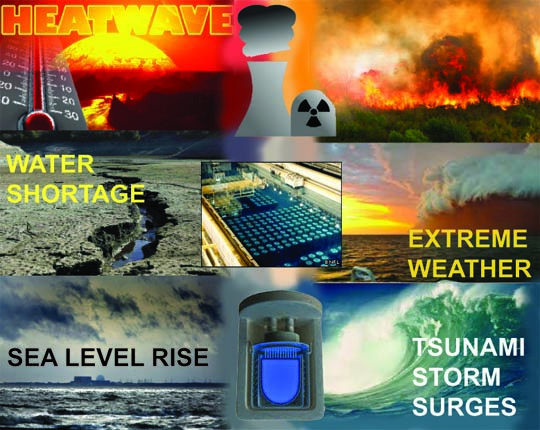 The Santa Susana Field Laboratory property has had a long history of contaminated soil and groundwater. Indeed, a 2006 advisory panel compiled a report suggesting that workers at the lab, as well as residents living nearby, had unusually high exposure to radiation and industrial chemicals that are linked to an increased incidence of some cancers. Discovery of the pollution prompted California’s DTSC in 2010 to order a cleanup of the site by its current owner – Boeing – with assistance from the US Department of Energy and NASA. But the required cleanup has been hampered by Boeing’s legal fight to perform a less rigorous cleaning. Like the Santa Susana Field Lab, Chernobyl remains largely unremediated since its meltdown in 1986. With each passing year, dead plant material accumulates and temperatures rise, making it especially prone to fires in the era of climate change. Radiation releases from contaminated soils and forests can be carried thousands of kilometres away to human population centres, according to Evangeliou. Kate Brown, a historian at the Massachusetts Institute of Technology and the author of Manual for Survival: A Chernobyl Guide to the Future (2019), and Tim Mousseau, an evolutionary biologist at the University of South Carolina, also have grave concerns about forest fires. ‘Records show that there have been fires in the Chernobyl zone that raised the radiation levels by seven to 10 times since 1990,’ Brown says. Further north, melting glaciers contain ‘radioactive fallout from global nuclear testing and nuclear accidents at levels 10 times higher than elsewhere’. As ice melts, radioactive runoff flows into the ocean, is absorbed into the atmosphere, and falls as acid rain. ‘With fires and melting ice, we are basically paying back a debt of radioactive debris incurred during the frenzied production of nuclear byproducts during the 20th century,’ Brown concludes. Flooding is another symptom of our warming world that could lead to nuclear disaster. Many nuclear plants are built on coastlines where seawater is easily used as a coolant. Sea-level rise, shoreline erosion, coastal storms and heat waves – all potentially catastrophic phenomena associated with climate change – are expected to get more frequent as the Earth continues to warm, threatening greater damage to coastal nuclear power plants. ‘Mere absence of greenhouse gas emissions is not sufficient to assess nuclear power as a mitigation for climate change,’ conclude Natalie Kopytko and John Perkins in their paper ‘Climate Change, Nuclear Power, and the Adaptation-Mitigation Dilemma’ (2011) in Energy Policy. Proponents of nuclear power say that the reactors’ relative reliability and capacity make this a much clearer choice than other non-fossil-fuel sources of energy, such as wind and solar, which are sometimes brought offline by fluctuations in natural resource availability. Yet no one denies that older nuclear plants, with an aged infrastructure often surpassing expected lifetimes, are extremely inefficient and run a higher risk of disaster. ‘The primary source of nuclear power going forward will be the current nuclear fleet of old plants,’ said Joseph Lassiter, an energy expert and nuclear proponent who is retired from Harvard University. But ‘even where public support exists for [building new] nuclear plants, it remains to be seen if these new-build nuclear plants will make a significant contribution to fossil-emissions reductions given the cost and schedule overruns that have plagued the industry.’ Lassiter and several other energy experts advocate for the new, Generation IV nuclear power plants that are supposedly designed to deliver high levels of nuclear power at the lowest cost and with the lowest safety risks. But other experts say that the benefits even here remain unclear. The biggest critique of the Generation IV nuclear reactors is that they are in the design phase, and we don’t have time to wait for their implementation. Climate abatement action is needed immediately. ‘New nuclear power seemingly represents an opportunity for solving global warming, air pollution, and energy security,’ says Mark Jacobson, director of Stanford University’s Atmosphere and Energy Programme. But it makes no economic or energy sense. ‘Every dollar spent on nuclear results in one-fifth the energy one would gain with wind or solar [at the same cost], and nuclear energy takes five to 17 years longer before it becomes available. As such, it is impossible for nuclear to help with climate goals of reducing 80 per cent of emissions by 2030. Also, while we’re waiting around for nuclear, coal, gas and oil are being burned and polluting the air. In addition, nuclear has energy security risks other technologies don’t have: weapons proliferation, meltdown, waste and uranium-worker lung-cancer risks.’ Around the world, 31 countries have nuclear power plants that are currently online, according to the International Atomic Energy Agency. By contrast, four countries have made moves to phase out nuclear power following the 2011 Fukushima disaster, and 15 countries have remained opposed and have no functional power plants. With almost all countries’ carbon dioxide emissions increasing – and China, India and the US leading the pack – the small Scandinavian country of Denmark is an outlier. Its carbon dioxide emissions are decreasing despite it not producing any nuclear power. Denmark does import some nuclear power produced by its neighbours Sweden and Germany, but in February, the country’s most Left-leaning political party, Enhedslisten, published a new climate plan that outlines a path for the country to start relying on its own 100 per cent renewable, non-nuclear energy for power and heat production by 2030. The plan would require investments in renewables such as solar and wind, a smart grid and electric vehicles that double as mobile batteries and can recharge the grid during peak hours. Gregory Jaczko, former chairman of the US Nuclear Regulatory Commission and the author of Confessions of a Rogue Nuclear Regulator (2019), believes the technology is no longer a viable method for dealing with climate change: ‘It is dangerous, costly and unreliable, and abandoning it will not bring on a climate crisis.’ Edited by Pam Weintraub |
–
|
Panicky nuclear lobby produces a propaganda book, desperate to win public support

U.S., Canada Energy Leaders Announce New Book on Nuclear Innovation in Clean Energy USA Dept of Energy
MAY 28, 2019, VANCOUVER, CANADA – Today, leaders from the United States and Canada are unveiling a new book, Breakthroughs: Nuclear Innovation in A Clean Energy System, at the Tenth Clean Energy Ministerial (CEM10), a forum including ministers from 25 nations, occurring this year in Vancouver, Canada from May 27-29. MAY 28, 20
“The combination of vision and innovation is having a profound impact on our energy landscape, and nowhere is that more true than nuclear energy,” said U.S. Under Secretary of Energy Mark W. Menezes. “Nuclear energy is one of our most reliable and cleanest sources of energy, and we are determined to revive and revitalize the nuclear energy industry with advanced and smart designs. This book highlights some of the incredible transformative opportunities nuclear innovation can bring to society and the clean energy future of our planet.”
Canada’s Minister of Natural Resources Amarjeet Sohi said, “The Clean Energy Ministerial is part of building the world’s clean energy future. Canada is proud to host the 10th Clean Energy Ministerial in Vancouver at this historic moment in time. We are pleased to be working with the United States, Japan, and other countries under the nuclear innovation initiative. We also welcome the release of Breakthroughs – a collection a real stories about nuclear innovations and how they can contribute to our climate change goals.” ………
The Breakthroughs book is a product of the CEM Nuclear Innovation: Clean Energy Future (NICE Future) initiative that was launched at the May 2018 Ninth CEM in Copenhagen, Denmark. The NICE Future initiative envisions nuclear energy’s many uses in contributing to clean, reliable energy systems of the future. …….. https://www.energy.gov/articles/us-canada-energy-leaders-announce-new-book-nuclear-innovation-clean-energy
France’s many nuclear waste locations revealed in an interactive map

Nuclear waste map of France published by Greenpeace, https://www.connexionfrance.com/French-news/Nuclear-waste-map-of-France-published-by-environmental-activists-Greenpeace-on-issue 29 May, 19, Nuclear waste is becoming a hot topic of discussion, as Greenpeace publishes a map of waste across France
A new interactive map showing the locations of nuclear waste across France has been published by environmental group Greenpeace, as part of its forthcoming campaign on the issue.
The map was published online this week, with the NGO aiming to “compile in a single place” all of the information it has on the location of radioactive material, to let people know how close they may be living to the waste.
The map categories include storage centres (at which the waste will be stored for 300 years minimum); nuclear centres that generate all forms of nuclear waste; more than 200 old uranium mines, operational up to 2001; factories and other plants; and radioactive waste from more than 70 military sites.
The data was collected from records of radioactive waste agency l’Agence Nationale pour la Gestion des Déchets Radioactifs (Andra).
The map does not include waste from medical use or research.
The map allows you to search by post code (Greenpeace.fr / Screenshot)Greenpeace is hoping to raise awareness and prompt debate over the extent of nuclear waste, and ask questions on the potential impact it may have. This also includes the impact of transporting nuclear waste by road or rail.
The group is also seeking to gather signatures and support for its national campaign on the issue, which it will later address to French ecology minister François de Rugy.
The map features a button saying “Agir! (Act!)”, allowing members of the public to add their support.
A public debate is set to be held on September 25 on this exact question – the issue of nuclear waste in France. It will be held on a platform via which the public will be able to ask for further information and have their say.
Nuclear waste disposal is also expected to be on the agenda at the G20 summit being held in Japan next month.
Breathtaking series on Chernobyl nuclear catastrophe
(Foxtel Showcase 12 June 8.30 pm and 10.30 pm)
Chernobyl: horrifying, masterly television that sears on to your brain. This breathtaking series throws us right into the hellish chaos of the nuclear disaster – and its terrors are unflinching and unforgettable, Guardian, Rebecca Nicholson, 29 May 2019 After three of its five episodes aired, the miniseries Chernobyl found its way to the top of IMDB’s top 250 TV shows in history list. While the fan-voted chart might seem hyperbolic, given that the drama had only just crossed the halfway point, it is not undeserving of the honour. Chernobyl is masterful television, as stunning as it is gripping, and it is relentless in its awful tension, refusing to let go even for a second. That old ‘don’t spoil the ending’ joke about Titanic will inevitably be rebooted here, but it is confident enough to withstand any familiarity with the story.
Chernobyl’s “liquidators” suffered acute, and long-term health effects
|
How Did Radiation Affect the ‘Liquidators’ of the Chernobyl Nuclear Meltdown? https://www.livescience.com/65563-chernobyl-radiation-effects-body.html These liquidators, who worked between 1987 and 1990, were exposed to high levels of radiation, on average around 120 millisievert (mSv), according to the World Health Organization. That’s over a thousand times more powerful than a typical chest X-ray, which delivers 0.1 mSv of radiation. And some of the very first responders were exposed to levels astronomically higher than that. So, what happens to the human body when exposed to such high levels of radiation? [5 Weird Things You Didn’t Know About Chernobyl] It’s like walking into a giant, powerful X-ray machine shooting radiation everywhere, said Dr. Lewis Nelson, chairman of emergency medicine at Rutgers New Jersey Medical School. Except, in this case, most of the radiation consisted of an even more damaging type of radiation than X-rays, called gamma-rays. This radiation, as it passes through the body, is ionizing. This means that it removes electrons from atoms in the body’s molecules, breaking chemical bonds and damaging tissues. Very high levels of ionizing radiation cause “radiation sickness.” At Chernobyl, 134 liquidators quickly developed radiation sickness, and 28 of them died from it. These people were exposed to radiation levels as high as 8,000 to 16,000 mSv, or the equivalent of 80,000 to 160,000 chest X-rays, according to the World Health Organization. Radiation sickness mostly manifests in the gastrointestinal tract and the bone marrow, Nelson said. Those areas have rapidly dividing cells, which means that instead of being tightly coiled and a little more protected, the DNA is unraveled so that it can be copied. That makes it more susceptible to the radiation (this is also why radiation therapy works to target cancer cells, which also rapidly divide). Within a couple of hours of the exposure, people with radiation sickness develop symptoms such as diarrhea and vomiting, Nelson said. When cells cannot properly divide, the mucosa or tissue lining of the GI tract also break downs, releasing cells and the bacteria that live in the gut (including in the stool) into the bloodstream. This would make even a healthy person sick, Nelson said. But because the radiation is also stopping the bone marrow from producing infection-fighting white blood cells, the body can’t fight those infections. People who have radiation sickness therefore have a weakened immune systemand frequently die of blood poisoning, or sepsis, within a couple of days, he said. High levels of radiation can also cause burns and blisters on the skin, which show up minutes to a few hours after the exposure and look just like a sunburn, Nelson said. While the GI-tract symptoms and burns happen almost immediately to a couple of hours after exposure to the radiation, the bone marrow survives for a couple of days. This means there is a latency period, when the person might even seem to improve, before showing symptoms of sepsis. The people who survived radiation sickness from Chernobyl took years to recover, and many of them developed cataracts because the radiation damaged the eye lenses, according to the World Health Organization. Lower exposuresBut much of the health focus around Chernobyl survivors has focused on the long-term consequences of the radiation exposure in these areas. The main consequence, for them, is an elevated risk of cancer. “But remember, the cancer risk is something you see 10 years down the road, so you have to live for 10 more years in order to see [that],” Nelson said. So the cancer risk is generally more of a concern for those who survived Chernobyl but were exposed to lower levels of radiation. The data on this risk is murky, with very approximate numbers, but it is estimated that 270,000 people in the Ukraine, Russia and Belarus who wouldn’t have otherwise developed cancers did develop these illnesses. This mainly manifested as thyroid cancer, directly caused by radioactive particles of iodine-131 released by the explosion. The thyroid needs iodine in order to produce hormones that regulate our metabolism. But if it doesn’t have enough of the healthy, nonradioactive iodine found in many foods, it absorbs the radioactive iodine, and this can eventually lead to thyroid cancer. This is why in the HBO series “Chernobyl,” people take iodine pills; filling those stores of iodine in the thyroid prevents it from absorbing the radioactive iodine. These radioactive particles, which also include others such as cesium-137 enter the body through contact with the skin or through the mouth and nose. In Chernobyl, these particles were thrown into the air, carried by winds and later fell back down in surrounding areas, contaminated crops and water, and the people who ate them. |
|
1 This Month
Tell Congress: Prevent Nuclear Catastrophe in Iran

Tell Congress: Prevent Nuclear Catastrophe in Iran

Read the Public Inquiry Report, the Commissioners’ report, Surrendering Australia: The AUKUS Deception is available to download for free at aukuspublicinquiry.com. Or just watch the replay of the National Press Club Luncheon.


Shut down the radiation-damaged Heysham nuclear reactors now
To see nuclear-related stories in greater depth and intensity – go to https://nuclearinformation.wordpress.com

Say No to NASA’s Reckless Nuclear Reactor on the Moon
Say No to NASA’s Reckless Nuclear Reactor on the Moon
-
Archives
- November 2026 (202)
- October 2026 (302)
- September 2026 (339)
- August 2026 (330)
- July 2026 (355)
- June 2026 (287)
- May 2026 (306)
- April 2026 (356)
- March 2026 (251)
- February 2026 (267)
- January 2026 (308)
- December 2025 (358)
-
Categories
- 1
- 1 NUCLEAR ISSUES
- business and costs
- climate change
- culture and arts
- ENERGY
- environment
- health
- history
- indigenous issues
- Legal
- marketing of nuclear
- media
- opposition to nuclear
- PERSONAL STORIES
- politics
- politics international
- Religion and ethics
- safety
- secrets,lies and civil liberties
- spinbuster
- technology
- Uranium
- wastes
- weapons and war
- Women
- 2 WORLD
- ACTION
- AFRICA
- Atrocities
- AUSTRALIA
- Christina's notes
- Christina's themes
- culture and arts
- Events
- Fuk 2022
- Fuk 2023
- Fukushima 2017
- Fukushima 2018
- fukushima 2019
- Fukushima 2020
- Fukushima 2021
- general
- global warming
- Humour (God we need it)
- Nuclear
- RARE EARTHS
- Reference
- resources – print
- Resources -audiovicual
- Weekly Newsletter
- World
- World Nuclear
- YouTube
-
RSS
Entries RSS
Comments RSS

