A generation of Canadian children was given radiation treatment and never warned of the cancer risks https://theconversation.com/a-generation-of-canadian-children-was-given-radiation-treatment-and-never-warned-of-the-cancer-risks-116403 Itai Bavli
PhD candidate in Interdisciplinary Graduate Studies (Public Health and Political Science), University of British Columbia June 20, 2019 On February 9, 2001, the Vancouver Sun published an article about Nancy Riva who lost her two brothers and was diagnosed with cancer as a result of thymus radiation treatment they received as children — in the belief that this would prevent sudden infant death.
Riva and her brothers were born in Vancouver General Hospital (VGH) in the late 1940s and underwent radiation treatment at the hospital as babies.
Radiation treatment for benign illnesses (that is not for treating cancer), like Riva’s inflamed thymus gland, was a standard medical practice worldwide during the 1940 and 1950s. The treatment was considered to be safe and effective for non-cancerous conditions such as acne and ringworm as well as deafness, birthmarks, infertility, enlargement of the thymus gland and more.
In the early 1970s, medical research confirmed the long-standing suspicion that children and young adults treated with radiation for benign diseases, during the 1940s and 1950s, showed an alarming tendency to develop thyroid cancer and other ailments as adults.
In our recent paper, published in the American Journal of Public Health, Shifra Shvarts and I have explored how health authorities in the United States responded to the discovery of the late health effects of radiation treatment.
Over two million people are estimated to have been treated with radiation in the U.S. for benign conditions. We show how an ethical decision at Michael Reese Hospital in Chicago in 1973 to locate and examine former patients, who had been treated with radiation in childhood, led to a nationwide campaign launched in July 1977 by the National Cancer Institute (NCI) — to warn the medical community and public about the late effects of radiation treatment in childhood for a variety of diseases.
U.S. campaign promotes thyroid checkups
Media coverage of the Chicago hospital’s campaign had a snowball effect that prompted more medical institutions to follow suit (first in the Chicago area and later in other parts of the U.S.), resulting in the NCI’s campaign.
Hundreds of thousands of pamphlets were distributed in shopping centres across the U.S., asking people who had undergone radiation treatment to go to their family doctor for a thyroid checkup. In addition, television presenters opened their programs with warnings; notices were published in newspapers.
Meanwhile in Canada, an unknown number of patients, like Riva and her brothers, were treated with radiation. Interviewed by the Vancouver Sun in 2001, Riva wanted to raise public awareness about this issue, encouraging people who might have been treated with radiation as children to have their thyroid checked.
According to VGH’s officials, quoted in the article, locating former patients was logistically impossible. Spokeswoman Tara Wilson told Vancouver Sun reporter Pamela Fayerman:
“Under the Hospital Act, records only have to be maintained for 10 years after a patient’s last hospital admission, so it’s unlikely we would have these birth records, although people can still phone the hospital to check.”
No systematic investigation in Canada
Riva’s story raises the question of why the Canadian health authorities did not launch a campaign to warn the public, as happened in the United States. Early detection of thyroid cancer saved lives.
The U.S. campaign was known in Canada. On July 14, 1977 a Globe and Mail article titled, “U.S. increasing efforts to warn million potential cancer victims,” described the national program to alert the public of the late health effects of radiation treatment.
Moreover, in an article published in Annals of Internal Medicine in February 1978, two University of Toronto professors of medicine, Paul Walfish and Robert Volpé, discussed the long-term risk of therapeutic radiation and described the efforts made by the U.S. Department of Health, Education and Welfare to educate the American public about the late effects of the treatment.
To date, there has been no known attempt to systematically investigate how many children underwent radiation treatment in Canada for benign conditions and what has been done to alert the public and the medical community of the risks. From Riva we learn that in 2001 patients were still looking for advice.
Had the Canadian health authorities effectively warned the public of the long-term risk of radiation treatment, illnesses and deaths may have been prevented.
Perhaps some still could?
June 20, 2019
Posted by Christina Macpherson |
Canada, radiation, USA |
Leave a comment
Decades later, Maine Yankee plant stuck with spent nuclear fuel as feds pick up $10M tab https://www.lohud.com/story/news/investigations/2019/06/19/maine-yankee-nuclear-plant-stuck-spent-fuel/1345799001/
AT A COST OF $10 MILLION A YEAR, THE OWNERS OF THE CLOSED PLANT PAY ARMED GUARDS TO WATCH 60 CEMENT AND STEEL CASKS FULL OF SPENT NUCLEAR FUEL.
Thomas C. Zambito, Rockland/Westchester Journal News June 19, 2019 The 11-acre site on a peninsula off the coast of Wiscasset, Maine, is home to what may be the nation’s most expensive storage facility.
At a cost of $10 million a year, the owners of the shuttered Maine Yankee nuclear power plant pay armed guards to watch 60 cement and steel canisters loaded with decades’ worth of spent nuclear fuel, each weighing 150 tons.
When Maine Yankee stopped producing power in 1996, folks in Wiscasset figured it would be a few years before that spent fuel would be shipped to Yucca Mountain in the Nevada desert, where the federal government was preparing an underground repository for the nation’s nuclear waste.
That never happened. Twenty-three years later, Wiscasset is still waiting.
“For 20 years we’ve heard, ‘Oh, it’s all going to Yucca Mountain, don’t worry about it,'” said Benjamin Rines Jr., a longtime Wiscasset selectman who was around when Maine Yankee was built in 1972. “Well, you know what happened to all of that, and here we are.”
Maine Yankee wrapped up its decommissioning in 2005, one of the first at a nuclear power plant in the U.S.
Early on, the company faced major hurdles. Maine Yankee was forced to take on the job of removing fuel from the reactor and dismantling buildings itself after the contractor it hired could not finish the $250 million job.
But the effort is still considered an achievement in a nuclear power industry that once saw decommissioning as a 60-year job.
Maine Yankee leads the way
Techniques used at Maine Yankee are now being applied by a new generation of decommissioning companies that have promised to match the eight years it took Maine Yankee to tear down its plant.
A hot-spot removal program used radiation detection equipment to identify for removal any pipes and valves with high levels of radiation, so workers would be spared exposure to dangerous doses of radiation.
And in 2004, explosives were used to demolish the plant’s 150-foot containment dome, the first time that was done at a nuclear power plant, according to Maine Yankee. It created 25 million pounds of rubble.
Three miles of pine forest separate Paul Berkowicz’s ranch-style home from a cluster of towering canisters on a concrete pad containing one of mankind’s most dangerous substances.
For decades, the 68-year-old retired educator has lived and worked near the Oyster Creek Generating Station, the nation’s oldest operating commercial nuclear power plant until it stopped energy production in September.
But while the plant’s decommissioning was labeled a success, efforts to redevelop portions of the 800-acre site on which it stood have fizzled. And many don’t see any prospects ahead until the spent fuel is gone.
The spent fuel installation sits behind a chain-link fence on the 180-acre Bailey Point Peninsula, where the plant’s reactor was located. The canisters there are said to be warm enough in winter to melt snow.
“The surrounding communities are stuck with a spent fuel installation, which is safe and secure, and I don’t think anybody doubts that, but it’s an impediment to any future use of this property,” said Don Hudson, the chairman of Maine Yankee’s Community Advisory Panel. “Once it’s out of there, then you can imagine a number of things happening.”
Maine Yankee donated 200 acres to the Chewonki Foundation for use as a nature preserve and walking trails as part of a 1999 settlement agreement, which allowed Maine Yankee to increase charges to ratepayers so it could move ahead with the decommissioning. And some 430 acres were eventually sold to a developer who specializes in “challenging” properties.
So far, though, there has been no development.
A 2007 referendum proposal to build an energy plant that turned coal into gas was shot down by voters.
In the interim, the owners of Maine Yankee and two other Yankee plants decommissioned in Connecticut and Massachusetts have won some $472 million after suing the federal government for failing to create an underground repository for the nation’s nuclear waste, as it had promised.
Yucca Mountain was supposed to be ready by 1998, but those efforts stalled amid political opposition from Nevada lawmakers and environmentalists.
As part of the 1999 agreement, Maine Yankee sued the U.S. Department of Energy (DOE) to recover the money ratepayers had, through the years, kicked in for the plant’s decommissioning.
“Had they [the DOE] met their obligation, all of the fuel would have been gone by 2004 and Maine Yankee as a single-asset company would have been out of business by 2008,” said Eric Howes, the director of public and government affairs for Maine Yankee.
Public pension funds invested with J.F. Lehman
J.F. Lehman’s $883 million fund received at least $126.5 million from variouspublic employee retirement funds that may have invested in nuclear decommissioning projects through J.F. Lehman & Co.
With Maine Yankee no longer making electricity, Wiscasset was left with a gaping hole in its budget.
The town took in nearly $12 million a year in taxes from Maine Yankee, more than 90 percent of its tax base. In 2005, the year the decommissioning was finished, the total was $1 million and last year it was closer to $700,000, according to town figures.
Taxes had to be raised. Municipal jobs went unfilled. And the village started charging for sewer service.
Similar scenarios have played out in towns across the U.S. — in places like Zion, Illinois, and Vernon, Vermont — when nuclear power plants shut down, leaving communities with economic challenges.
Wiscasset was helped by long-term investing ahead of the shutdown that left some $12 million in reserve, money used years later to keep taxes down, said Rines, the selectman.
“It was always the thought of the town that we would put it away for a rainy day when we needed it, and the rainy day showed up a lot quicker than we thought,” said Rines, 66.
Wiscasset remains a busy pass-through for travelers using Route 1 on the way to Boothbay and Bar Harbor. Some will stop in at Sarah’s, where “The First Ingredient is Love,” or Red’s Eats across the street for a lobster roll.
Maine Yankee’s spent fuel is located some 5 miles away, past car dealerships, Big Al’s Fireworks and a welcome sign that announces Wiscasset as “The Prettiest Village in Maine.”
After the plant shut down, Hudson, then the director of the Chewonki Foundation, was asked to lead Maine Yankee’s community advisory panel. The company arranged for Hudson and others to visit Yucca Mountain to see the underground rail tunnels where Maine Yankee’s spent fuel would be sent to cool down.
“It’s out in the middle of a vast desert about as far away as you can be from anywhere,” Hudson said. “If we can’t put it there, I don’t know where we’re going to put it.”
These days, the panel meets just once a year. Its primary business is drafting a letter to federal lawmakers urging them to back legislation written to aid towns stuck with nuclear waste.
“We write the delegation, we reference the bills, we encourage them,” Hudson said. “We’re basically the cheerleaders for moving this stuff along, and we’re trying to give them the moral courage and public support that says, ‘We’re with you. We know this is really difficult. We encourage you to tackle it.’ ”
June 20, 2019
Posted by Christina Macpherson |
USA, wastes |
Leave a comment
 Investors see huge profits from old nuclear plants, but it could cost taxpayers https://www.lohud.com/story/news/watchdog/2019/06/19/nuclear-plant-decommissioning-holtec-other-firms-see-profit/1456809001/
INVESTORS ARE SCRAMBLING TO BUY OLD NUCLEAR PLANTS. THEY SAY THEY CAN CLEAN THEM FOR PROFIT. IF THEY FAIL, EXPERTS WORRY TAXPAYERS MAY BE ON THE HOOK.
Christopher Maag, North Jersey Record, June 19, 2019 Shutting down nuclear plants is set to become a multi-billion dollar business. If that business fails, critics say, your tax dollars – and possibly your safety – could be on the line. Learn more in our USA TODAY NETWORK Northeast project, The Nuclear Option.
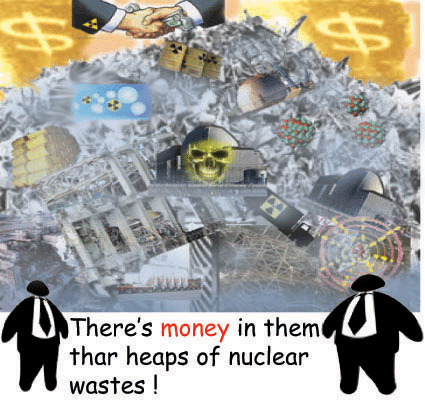
Some of the nation’s richest investors are betting they see profit where no one else does: tearing down America’s aging nuclear reactors.
Among them is one of the most recognized names from the Reagan Administration, former Secretary of the Navy John Lehman.
Lehman’s plans are shrouded in secrecy. The hedge fund that bears his name does not disclose basic information about its finances.
But an examination of deals made by the hedge fund since 2017 to raise money and acquire firms, makes it clear the company sees a pot of gold for the taking — some $60 billion accumulating in trust funds owned by nuclear power plants — all of it bankrolled by ratepayers.
“We believe that the profitability potential remains high,” said Daryl Walcroft, a lead adviser at the accounting firm PwC, which recently released a 20-page report titled “Ready, set…shut down!” to lure new investors.
If they succeed, investors will control a brand-new industry. If they fail, as some independent experts predict, those investors — including public employee pension funds for teachers, police and firefighters — could lose hundreds of millions of dollars.
Past projects blew their budgets by up to half a billion dollars, forcing ratepayers to cover the costs. Current projects may be even riskier, as companies saddle the trust funds with new cleanup costs that federal rules never envisioned, and do not allow.
Such deals may enable big investors like Lehman to take their profit and walk away, leaving “taxpayers to bear the financial burden and responsibility for finishing the work,” Massachusetts Attorney General Maura Healey said in a petition to federal regulators.
For years, power companies supervised reactor cleanup themselves. Nearly every project was a financial failure. In some cases the cost approached $1 billion, double the original estimate.
“I would say all of the early projects went over budget,” said Scott State, CEO of NorthStar Group, a company that deconstructs buildings.
Industry leaders like State believe they can decommission a nuclear plant faster and cheaper, and share the savings with their investors as profit.
“They’re taking on a big risk that they can do a big job,” said Tom LaGuardia, an engineer widely regarded as the world’s top expert on decommissioning costs.
The New Model
TO INVESTORS, EACH REACTOR IS A POT OF GOLD
To some people, a closed nuclear plant is a dangerous place contaminated with radioactive waste.
To investors, each reactor is a pot of gold.
Federal law requires electricity companies to save money in trust funds for the eventual closure and cleanup of nuclear reactors. Fund totals ranged from $286.6 million for Beaver Valley reactor 1 in Pennsylvania to $1.5 billion for Diablo Canyon reactor 2 in California, according to 2016 tallies from the Nuclear Regulatory Commission, the latest available.
Nationwide, trust fund balances topped $60 billion in 2016, the NRC found. They grew to $70 billion by 2018, according to The Callan Institute, which advises fund managers. And the total may soon rise to $90 billion, according to PwC, a major accounting firm formerly known as PriceWaterhouseCoopers.
And unlike virtually every other big construction project, companies decommissioning nuclear plants get paid upfront, before work even starts.
“Having pre-funded work is very good,” said State, of NorthStar.
Powerhouses including the PwC accounting firm also see profit opportunity in teardown deals.
“(T)he growth of this market is accelerating more quickly than predicted,” according to the company’s recent report. “Already, we are seeing qualified decommissioning specialists and institutional investors clamoring through various deals to own” decommissioning companies.
Here’s what that clamor looks like. After serving as President Ronald Reagan’s Secretary of the Navy, John Lehman founded J.F. Lehman & Co., a hedge fund that invested $1.9 billion primarily in defense and aerospace industries, according to the company’s website.
In 2016, J.F. Lehman & Co. sought to raise $700 million. It attracted more than 48 investors, including “leading public and private pension funds” who together invested $883 million, more than 25 percent above Lehman’s original plan, according to a Lehman press release.
Investments included $40 million from the Teachers’ Retirement System of Oklahoma. Another $36.5 million came from three public employee retirement funds in Connecticut. The public employee retirement fund in Montgomery County, Maryland invested $23 million, the Arkansas Teacher Retirement System invested $14.6 million, and the retirement system for municipal police in Louisiana invested $12.5 million, according to the funds’ annual reports, for a total of at least $126.6 million. Together, these funds own $75.9 billion in assets.
Three months after Lehman announced it had beaten its fundraising goal, in June 2017, it gained a foothold in the decommissioning industry by acquiring NorthStar. The following month, it announced a partnership with a company now called Orano, which specializes in nuclear teardowns. In January 2018 Lehman bought Waste Control Specialists, which owns radioactive waste disposal sites in Texas.
The deals allow Lehman’s companies to save money at every step of decommissioning, said State, who is CEO of both NorthStar and Waste Control Specialists.
“We own and control everything we need to do this work,” State said.
Important details about Lehman’s companies remain unknown, including how much cash each keeps for emergencies. Even less is known about Holtec’s decommissioning venture Comprehensive Decommissioning International, which is co-owned with SNC-Lavalin, a large Canadian engineering firm.
The company is secretive about its finances, refusing to disclose basic information about its revenue, assets or ability to handle contingencies. “Both Holtec and SNC-Lavalin supplied the capital for establishing CDI,” Joe Delmar, a Holtec spokesman, said by email.
Potential pitfalls
HOLTEC AND NORTHSTAR HAVE REQUESTED EXEMPTIONS FROM THE NRC’S TRUST FUND FORMULA
The financial success or failure of decommissioning a nuclear reactor hinges on one thing: the size of its trust fund.
“The most unique risk in this market has to do with the health of the trust fund,” said Walcroft, lead adviser on American infrastructure projects for PwC.
In Holtec’s application to buy Pilgrim nuclear power plant in Massachusetts, and in NorthStar’s application to buy the Vermont Yankee plant, both companies said they expect each reactor’s trust fund to pay for the entire project.
“I am telling you they will get it done with the trust fund because they’re really good,” said Rod McCullum, senior director of used fuel and decommissioning at the Nuclear Energy Institute, the industry’s powerful trade group.
Consultants, financial experts and three federal agencies are not so confident. Plant owners must prove their trust funds meet the Nuclear Regulatory Commission’s minimum formula, which the commission estimates will generate enough money to clean up a nuclear plant’s radioactive contamination.
But the commission’s own Office of Inspector General, as well as the Government Accountability Office and Pacific Northwest National Laboratory, together published four reports since 2011 finding the formula — created in the early 1980s — is so old that it consistently underestimates the amount of money needed.
“The NRC estimate is still low,” said LaGuardia, who said he has completed cost estimates on 90 percent of all decommissioning projects in North America.
Moreover, Holtec and NorthStar plan to use trust funds in ways the NRC never envisioned. According to federal rules, trust money may be used only to clean up nuclear contamination. Other jobs, like managing spent reactor fuel and removing asbestos or lead, must use other money.
“It comes from their own money, their own profits,” said Richard Turtil, a senior financial analyst for the NRC.
That’s not what NorthStar and Holtec have in mind. At Pilgrim, Holtec requested an exemption allowing the trust fund to cover $541 million in spent fuel management and site restoration costs. NorthStar requested a similar exemption at Vermont Yankee for $425 million. Both companies stated the funds will have sufficient money to cover the additional work, and provide them with profits.
“This very substantial amount — over a billion dollars — in Pilgrim’s [trust fund] will be sufficient to cover the estimated cost of decommissioning and spent fuel management, as well as site restoration,” Holtec said in a filing to the NRC.
Some current and former regulators disagree. If granted, the exemption “poses a significant risk that insufficient funds will exist” to clean the site, Massachusetts Attorney General Maura Healey told the NRC.
“Certainly, I think the funds are sufficient to cover the cost of the cleanup,” Gregory Jaczko, former chairman of the Nuclear Regulatory Commission, said in May at a Congressional briefing. “But I’m not sure that they’re sufficient to cover the costs of the cleanup and a very nice level of leftover benefit for the company.”
Blowing budgets?
THE BIGGEST DRIVER OF COST INCREASES IS FINDING POCKETS OF PREVIOUSLY UNKNOWN CONTAMINATION
Finally, there’s the question of cost overruns. The cost to decommission Yankee Rowe nuclear plant in Massachusetts was estimated at $370 million in 1994. By the time it was finished in 2003, costs rose by an extra $266 million, according to book co-authored by LaGuardia. At Connecticut Yankee the final bill was $931 million, more than double original estimates.
“Almost invariably in the work I’ve done, the costs were greater than expected,” said Julia Moriarty, senior vice president of The , which advises nuclear fund managers.
Work accidents and changing government rules caused many projects to run over-budget, LaGuardia said, but the biggest driver of cost increases is finding pockets of previously unknown contamination.
Companies learned from these mistakes, State and Delmar said. Teardown experts now perform more intensive site studies; avoid cutting apart reactors with tools like grit sanders that spread contamination around a site; and often control the final disposition of nuclear waste. This means they can simply “rip and pitch” waste into trucks or trains bound for disposal sites, State said, rather than spend valuable workers’ time decontaminating materials on-site.
“They’re getting smarter now, and they’re doing site characterization first,” LaGuardia said. “They know the risks. If they’re not comfortable with their cost estimating method, they’re not going to be in this business.”
Site studies remain imperfect, however.
“Site conditions are never known with absolute precision,” Warren K. Brewer, a decommissioning expert, told the Vermont Public Utilities Commission.
All construction companies build cushions into their plans to cover unexpected costs. At Vermont Yankee, NorthStar set aside 10 percent of the trust fund’s $500 million for contingency and profits, far below standard industry practice, according to Brewer and Gregory Maret, another expert hired by the state.
Even small changes in site conditions or state regulations could increase costs by up to $200 million, Brewer found, enough to overwhelm the contingency fund.
“That’s a very risky business play,” LaGuardia said of NorthStar’s plan.
Eventually NorthStar and its partners committed $200 million in additional financial assurances, said Dan Dane, a financial expert involved in the negotiations.
Holtec’s contingency at Pilgrim is even smaller. The company will set aside 17 percent of Pilgrim’s projected $1.3 billion trust fund for surprises, it told the NRC.
But as Healey found, Holtec plans to spend all but $3.6 million of the $1.3 billion in its trust fund on basic decommissioning work.
“In other words, its contingency allowance covers costs it expects to incur,” Healey wrote in her petition. “Holtec’s attempt to account for contingencies and uncertainty risk is woefully deficient.”
The buck stops where?
IF EVEN A HANDFUL OF PROJECTS GO BROKE, RETIREES IN AT LEAST FIVE STATES STAND TO LOSE $126.6 MILLION
Leaders of decommissioning companies are confident they can avoid the failures of the past.
“Does that mean every project will go perfectly? No,” State said. “But I don’t lose any sleep thinking we aren’t going to be able to do these projects in precisely the way we say we expect we can.”
Consultants think failure is an option, however.
“I think the vast majority will do just fine,” said Moriarty, who has monitored nuclear funds for 20 years. “I think there will be cases where they run into problems.”
If even a handful of decommissioning projects goes broke, current and future public employees in at least five states stand to lose $126.6 million in investments. In its report, PwC advised investors to consider, “Do I have the financial capability to manage the nuclear decommissioning trust fund as required by the NRC — or to make up the difference if it falls short?”
If investors can’t step up, some worry it will fall to “taxpayers to bear the financial burden and responsibility for finishing the work,” Healey told the NRC.
“If they go bankrupt,” Moriarty said, “I assume the taxpayers are on the hook.”
Email: maag@northjersey.com
Data reportreFrank Esposito contributed to this report.
June 20, 2019
Posted by Christina Macpherson |
business and costs, USA, wastes |
Leave a comment