August 2- The Intermediate-Range Nuclear Forces Treaty expires- new arms race begins

 Demise of US-Russian Nuclear Treaty Triggers Warnings, VOA News , By Charles Maynes, July 31, 2019 “……… “Gorbachev and Reagan had the goal of arms reduction and they did not allow themselves to be pushed off track,” Palazhchenko says.
Russia’s coverup of 2017 nuclear accident in the Ural mountains
|
On July 26, a large group of experts led by Olivier Masson from the Institute of Radioprotection and Nuclear Safety in Durance, France, and Georg Steinhauser of the Institute of Radioecology and Radiation Protection in Hanover, Germany, published a paper definitively attributing a radiation cloud that spread over Europe in 2017 to an undeclared accident in the Southern Urals region of Russia, likely at the Mayak nuclear facility near Chelyabinsk. Two years ago, Russia promised to investigate where the cloud could have come from, but a commission formed on Russia’s initiative failedto produce a clear conclusion. At the same time, Mayak and Rosatom, the state-owned nuclear power company to which it belongs, have denied that any accident took place. In late September 2017, several Russian regions and then a number of European countries detected high concentrations of radioactive ruthenium-106 in the atmosphere. As the contamination traveled, more countries noticed it and published reports. The first Russian denials, from the authorities of the Sverdlovsk and Chelyabinsk regions in the Urals, came a week later. Even after the Russian state weather service Roshydromet reported ruthenium-106 pollution in the South Urals, a Rosatom-led commission insisted the contamination wasn’t the result of an accident and suggested that it could have been caused by a defunct satellite burning up in the atmosphere. The Masson-Steinhauser group ruled out the satellite theory: Such an incident would have caused higher concentrations of ruthenium at high altitudes, which was not the case. Instead, the researchers argued that only a nuclear reprocessing facility could have caused this particular type of contamination. A number of Western and Russian facilities had been responsible for ruthenium-106 releases in the past. By analyzing the weather patterns and ruthenium measurements, including those from Roshydromet, the international team placed the source close to the location of Mayak, the erstwhile scene of a major nuclear disaster – the 1957 “Kyshtym Accident” that forced the evacuation of 10,000 people in the area and caused long-term consequences for residents’ health. The 2017 ruthenium release, luckily, hurt no one – the radioactive gas quickly became diluted and there was no significant fallout. This made it easier for the Russian authorities to deny that an accident had taken place. But then, just like in the Soviet Union, which did its best to keep the Chernobyl disaster under wraps until it could no longer deny it or minimize its impact, denying everything is more or less the officially adopted tactic in Vladimir Putin’s Russia, even when there are casualties. The government and its propaganda apparatus have, for example, put out a progression of elaborate but untrustworthy versions of the 2014 downing of Malaysia Airways Flight 17 — which was hit with a Russian missile from territory held by pro-Russian rebels in eastern Ukraine. Even after the Masson-Steinhauser team published its findings, Leonid Bolshov, a physicist who was a key member of the Russian-led commission, claimed that the paper “ignored” measurements taken near Mayak, “where almost no ruthenium-106 was detected.” According to Bolshov, the commission’s findings weren’t affected by the new analysis. The dispatch quoting Bolshov from the Russian propaganda agency RIA Novosti bore the headline “Physicists Connected Ruthenium-106 Leak with Experiments in Italy.” Indeed, the Masson-Steinhauser paper discusses a possible link between the accident and Mayak’s work on a cerium-144 source for an Italian neutrino experiment; Mayak canceled the order soon after the ruthenium release. But the headline carefully avoids mentioning Mayak or Russia. The right thing for Mayak and Rosatom to do would be to share with international experts any data on that work, including, of course, whatever could have led to the ruthenium release. That, however, is as likely as an honest Chernobyl movie made in Putin’s Russia. Last week, the unofficial trailer of a new Russian Chernobyl series was leaked on YouTube. Its maker, NTV, a television company with close ties to Putin’s inner circle, promptly pulled it down and threatened those who post it with legal consequences for copyright infringement. But those who sawthe video flooded it with dislikes and negative comments; indeed, it looks like a tear-jerking soap opera with no attempt at authenticity. One of the plot lines appears to involve U.S. Spies. When the series runs, it’ll be another reminder to foreign, especially European, scientists that it’s up to them to watch the Russian nuclear industry for signs of serious accidents. Russia, like the Soviet Union before it, won’t be the first to tell the world about them. |
|

Elizabeth Warren proposed “no first use” policy on nuclear weapons
 Warren, Bullock spar over ‘no first use’ nuclear policy, The Hill
In defending the proposed policy, Warren argued for diplomatic and economic solutions to conflict, saying “we should not be asking our military to take on jobs that do not have a military solution.”
But Bullock opposed that proposal, saying, “I don’t want to turn around and say, ‘Well, Detroit has to be gone before we would ever use that.’”
Warren is the lead sponsor of the Senate version of a bill that would make it U.S. policy not to use nuclear weapons first.
It has long been the policy of the United States that the country reserves the right to launch a preemptive nuclear strike.
Backers of a no first use policy argue it would improve U.S. national security by reducing the risk of miscalculation while still allowing the United States to launch a nuclear strike in response to an attack.
During the debate, Warren argued such a policy would “make the world safer.”
“The United States is not going to use nuclear weapons preemptively, and we need to say so to the entire world,” she said. “It reduces the likelihood that someone miscalculates, someone misunderstands.”
Bullock argued he wouldn’t want to take the option off the table, but that there should be negotiations to eliminate nuclear weapons……https://thehill.com/policy/defense/455472-warren-bullock-spar-over-no-first-use-nuclear-policy
Samantha Smith – a 10 year old who acted to reduce nuclear weapons
 Your voice matters in reducing nuclear weapons https://www.thestar.com/opinion/contributors/2019/07/31/your-voice-matters-in-reducing-nuclear-weapons.html
Murky Middle East nuclear deal involving Trump’s billionaire friend
 Trump’s friend tried to profit from Middle East nuclear deal, lawmakers say https://www.theguardian.com/us-news/2019/jul/29/tom-barrack-saudi-arabia-nuclear-deal-envoy
Congressional report finds Tom Barrack tried to buy Westinghouse as he sought a related government post

A billionaire friend of Donald Trump pursued a plan to buy Westinghouse Electric Corp – even as he lobbied Trump to become a special envoy and promote the company’s work on nuclear power in Saudi Arabia, a congressional report released on Monday.
While Tom Barrack failed in both efforts, the report provides fresh evidence of the ease with which some corporate and foreign interests have gained access to the US president and other senior members of his administration.
Documents obtained by the Democratic-led House oversight committee raise “serious questions about whether the White House is willing to place the potential profits of the President’s friends above the national security of the American people and the universal objective of preventing the spread of nuclear weapons”, the report said.
The report is the second from the panel’s investigation into the plan to construct 40 nuclear power plants in Saudi Arabia and elsewhere in the Middle East. The plan was supported by Trump’s first national security adviser, Michael Flynn; Barrack, Trump’s inaugural committee chairman; and a consortium of companies led by retired US military commanders and former White House officials called IP3.
One company was Westinghouse, the only US manufacturer of large reactors, which was bought out of bankruptcy by Brookfield Asset Management last August.
The report comes alongside a number of other investigations into the administration being conducted by the panel chaired by the US representative Elijah Cummings – including into the use of personal texts and emails for official business by Trump’s daughter, Ivanka, and her husband, Jared Kushner.
Trump attacked Cummings, an African American from Baltimore, in weekend tweets that the president’s critics denounced as racist.
Monday’s report was based largely on thousands of documents provided by unidentified private companies. The White House, the report said, provided no documents, while other federal agencies submitted some.
The committee may subpoena White House documents, it said.
Documents showed that Barrack negotiated with Trump and other White House officials to seek “powerful positions”, including special Middle East envoy, as he took steps to profit from the civil nuclear scheme he advocated.
A previous committee report, published in February, said efforts to advance the nuclear power scheme began during Trump’s 2016 presidential campaign.
Trump officials have continued meeting with IP3 even though White House lawyers in January 2017 instructed staff to cease work on the plan over concerns that Flynn was breaking conflict of interest laws, according to that report. Flynn, fired by Trump in February 2017, advised IP3 while serving on his campaign and transition team, said both reports.
White House lawyers also worried that promoters of IP3’s so-called “Middle East Marshall Plan” sought to transfer US nuclear know-how to Saudi Arabia even as they pushed back on Riyadh’s behalf against certain safeguards, the reports said. Known as the “Gold Standard”, the safeguards are designed to prevent nuclear weapons development. IP3 called the standard a “total roadblock”, Monday’s report said.
A Barrack spokesman said the billionaire had been cooperating with the oversight committee and had provided it with requested documents. Barrack’s investments and business development in the region were for a “better aligned Middle East”, he said. “This is not political, it is essential.“
The White House and IP3 did not immediately respond to requests for comment.
Ohioans Against Corporate Bailouts takes step towards Repealing Ohio Nuclear Bailout
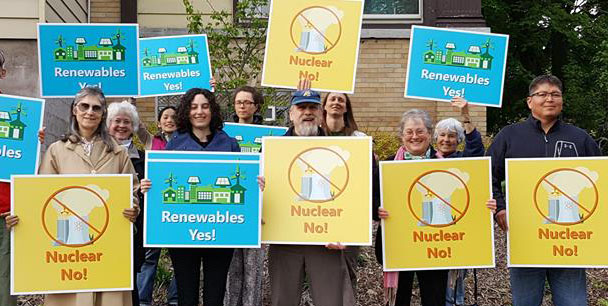 Group Takes First Step Toward Repealing Ohio Nuclear Bailout, WOSU By ANDY CHOW • JUL 30, 2019 Ohioans Against Corporate Bailouts has filed its first round of signatures with the Ohio Attorney General’s Office to hold a referendum on the law that bails out nuclear plants and scraps green energy policies.
If their petition language is approved they will start collecting signatures to put the issue on the 2020 ballot in November. Ohioans Against Corporate Bailouts would need 265,774 valid signatures to qualify for the ballot. The new law, created through HB6, would create a new 85 cent charge on monthly electric bills for residential ratepayers. Commercial and industrial ratepayers would also see a new fee which will generate $150 million for FirstEnergy Solutions’ two nuclear plants, Davis-Besse and Perry. FirstEnergy Solutions has been seeking a significant subsidy from Ohio lawmakers for several years, saying it was one of the only ways to avoid shutting down both plants. That new charge on electric bills creates an additional $20 million for existing solar farms. The law also props up two struggling coal plants through language that allows utilities to charge customers up to $1.50 a month to subsidize the Ohio Valley Electric Corporation’s two coal plants, Kyger Creek in Gallia County and Clifty Creek in Madison, Indiana. In addition to the new subsidies, the law rolls back policies that required investment in renewable energy and energy efficiency….. https://radio.wosu.org/post/group-takes-first-step-toward-repealing-ohio-nuclear-bailout#stream/0 |
|
Fukushima governor accepts Tepco plan to scrap No. 2 nuclear plant and store spent fuel on site
Fukushima governor accepts Tepco plan to scrap No. 2 nuclear plant and store spent fuel on site, Japan Times, 31 July 19
KYODO FUKUSHIMA – Fukushima Gov. Masao Uchibori said Tuesday his prefecture will accept a decision by Tokyo Electric Power Company Holdings Inc., or Tepco, to scrap the Fukushima No. 2 nuclear complex, which is located near the No. 1 plant that was crippled in the March 2011 disaster.
In a meeting with Tomoaki Kobayakawa, the president of the utility, the governor also accepted its plan to build an on-site storage facility to store spent nuclear fuel.
The decision means that all 10 nuclear reactors in the northeastern prefecture, including the six at the Fukushima No. 1 complex 12 kilometers from the No. 2 plant, will be scrapped, though the decommissioning work will take decades.
Tepco’s decision to scrap the No. 2 complex, expected to cost around ¥280 billion ($2.6 billion), was formally approved at the company’s board meeting held on Wednesday.
While three of the reactors at the No. 1 complex experienced meltdowns in March 2011, the earthquake and tsunami disaster did not cause serious structural damage to the No. 2 plant…….
Tepco has not picked a final disposal site for the spent fuel from the No. 2 complex, raising concern among local residents that the radioactive nuclear waste may remain stored on-site for a long time.
“The premise is that the nuclear fuel will be transported out of the prefecture. Temporary storage for the time being is unavoidable,” Uchibori said.
He later told reporters Tepco had assured him that the storage facility would not be permanent.
The No. 2 plant currently has around 10,000 assemblies of spent fuel cooling in pools.
The scrapping of the No. 2 plant also means that the central government’s annual subsidies of around ¥1 billion for each of the towns of Naraha and Tomioka that host the facility will eventually be terminated.
Revenue linked to the nuclear plant, from property taxes and in other forms, accounted for 25 percent of Naraha’s total revenue and 40 percent of Tomioka’s.
Uchibori said he will ask the government to take into account “the financial situation of the two towns in view of the special circumstances relating to the decommissioning.”https://www.japantimes.co.jp/news/2019/07/31/national/fukushima-governor-accepts-tepco-plan-scrap-no-2-nuclear-plant-store-spent-fuel-site/#.XUIPkm8zbIU
40 Ways Ohio Now Proposes Nuclear Suicide
By Harvey Wasserman, 1 August 19
A bought, gerrymandered Ohio Legislature has just handed a much-hated $150 million/year public bailout to two dinosaur nuke reactors primed to explode.It also bails out two filthy 50-year-old coal burners and guts programs for increased efficiency.But a possible repeal referendum could reverse all that—-and have a serious impact on the Trumpsters who pushed it—-in the 2020 election.Here are some basics:X The 42-year-old Davis-Besse reactor near Toledo and 33-year-old Perry, east of Cleveland, are both dangerously crumbling.X Neither can compete with wind, solar, gas or increased efficiency.X Both would shut immediately in a free market environment.X Like all nuke reactors, both emit substantial quantities of heat, radiation and carbon.X Both threaten the entire north coast and Great Lakes region with a radioactive apocalypse.X Neither can get private disaster insurance.X Their owner, FirstEnergy (FE) of Akron, is bankrupt.X The utility stands to gain some $150,000,000/year at the expense of ALL Ohio electric consumers, not just those in its territory. .X FE’s top seven execs are paid roughly $25,000,000/year; CEO Chuck Jones gets $9,500,000.X In 2003 FE blacked out 50,000,000 people.X Davis-Besse’s infamous 2002 “hole-in-the-head” came when boric acid ate nearly all the way through the reactor pressure vessel.X In 1986 (as the Challenger blew up) Perry became the first US reactor to be damaged by an earthquake; a 4.0 shock recently hit less than 25 miles away.X A state-mandated 1986-7 study showed northern Ohio cannot be evacuated from a melt-down…and certainly not amidst an earthquake.X Ohio’s North Coast is flat, blown by constant lake-based winds, criss-crossed with transmission lines and good turbine sites near the cities to be served.X Local farmers are desperate for the income the turbines would provide.X Some $4.2 billion in private capital is poised to pour into the region for wind farms creating thousands of jobs and lowering electric rates.X Turbines in Lake Erie, plus land-based wind and solar farms, enhanced by batteries and efficiency, can provide all Ohio’s electricity far cheaper than from nukes and/or fossil fuels, creating far more jobs.X But in 2014, with zero basis in health or environmental protection, FE’s bought legislators put in the Ohio Code a setback clause that has killed wind development in the state.X Ohio now has far less installed wind capacity than neighboring Indiana, Michigan, New York or Pennsylvania, which have comparable wind resources but no such set-back clause.X Ohio is a national leader in manufacturing wind turbine components, virtually none of which are deployed in Ohio.X Perry & DB have been repeatedly bailed out dating back at least to 1999, when FE scammed a $9 billion “stranded cost” give-away.X It was called a “stranded cost” bailout because FE complained even then the reactors could not compete in an open market.X This latest bailout was directly pushed by Trump, at least one of whose co-conspirators personally lobbied key legislators for it.X Ohio is roughly 50/50 Republican/Democrat, but the GOP has heavily gerrymandered majorities in both houses of the Legislature.X In 2018 FE targeted a dozen GOP legislative primaries, buying at least 11 bailout votes.X This latest bailout bill could not have passed without votes from key corporate Democrats.X A strong statewide grassroots movement arose to oppose the bailout.X An overwhelming majority of testifiers before the Legislature were opposed.X A strong majority of the state’s newspapers was also opposed.X All were ignored by Democrats and Republicans alike.X Efforts are now underway to put a referendum on the fall 2020 ballot.X If filed within 90 days, the bailout will be put on hold until the vote.X Polls show a strong majority of Ohioans oppose the bailout.X If the bailout is on the 2020 ballot, it could encourage a strong opposition turnout that could hurt Trump and help tip the election in a key swing state.X But Trump, FE and the nuke industry will spend unlimited millions to defeat it.X It’s been widely known since at least 2004 that Ohio’s registration rolls and voting procedures are heavily rigged to favor the GOP and its corporate owners.X The longer Perry and Davis-Besse operate the higher the odds they’ll obliterate Toledo, Cleveland and the entire Great Lakes region.X Neither has private disaster insurance.X FE can’t handle its radioactive wastes, evacuate the region when disaster strikes or credibly maintain the reactors in their current (deteriorating) state.Should the referendum get on the ballot, it could help take down Trump and save the region from an apocalyptic catastrophe, as well as economic ruin. Should it fail, the odds on a major nuclear catastrophe along the shores of Lake Erie are too high to contemplate.The stakes could not be higher.—————Harvey Wasserman is co-author of KILLING OUR OWN: THE DISASTER OF AMERICA’S EXPERIENCE WITH ATOMIC RADIATION (free on line) and SOLARTOPIA! OUR GREEN-POWERED EARTH at www.solartopia.org.

The Deep Isolation Texas nuclear waste plan
 An excellent article, explaining Deep Isolation, and thoroughly outlining the global problem of radioactive trash.
What a pity, then, that this article, and its title, mindlessly accept the current dogma about nuclear power being the solution to climate change!. To believe this is to ignore nuclear’s serious problems, and especially the fact that the thousands of nuclear reactors required would never be built in time to have any effect on global warming – even if that claim were true – which it isn’t.
WHAT TO DO WITH THE DEADLY RADIOACTIVE WASTE? ensia, 31 July 19
The Deep Isolation Texas demonstration
Skip forward to Cameron, Texas, on January 16, 2019. This was a nerve-wracking day for Liz Muller, co-founder of California startup technology company Deep Isolation and her father, Richard Muller, professor emeritus of physics at the University of California, Berkeley, and now chief technology officer at Deep Isolation.
The father-daughter team had invited 40 nuclear scientists, U.S. Department of Energy officials, oil and gas professionals, and environmentalists to witness the first-ever attempt to test whether the latest oil-fracking technology could be used to permanently dispose of the most dangerous nuclear waste.
At 11:30 a.m., the crew of oil workers used a wire cable to lower a 30-inch (80-centimeter)-long, 8-inch (20-centimeter)-wide 140-pound (64-kilogram) canister — filled with steel rather than radioactive waste — down a previously drilled borehole. Then, using a tool called a “tractor” invented by the industry to reach horizontally into mile-deep oil reservoirs, they pushed it 400 feet (120 meters) farther away from the borehole through the rock.
Five hours later, the crew used the tractor to relocate and collect the canister, attach it to the cable and pull it back to the surface — to the cheers of the workers. Until then, few people in the nuclear industry believed this could be done.
By avoiding the need to excavate large, expensive tunnels to store waste below ground, the Deep Isolation team believes it has found a solution to one of the world’s most intractable environmental problems — how to permanently dispose of and potentially retrieve the hundreds of thousands of tons of nuclear waste presently being stored at nuclear power plants and research and military stations around the world.
“We showed it could be done,” Elizabeth Muller says. “Horizontal, directional drilling has come a long way recently. This is now an off-the-shelf technology. Using larger canisters, we think about 300 boreholes with tunnels up to 2 miles (3 kilometers) long would be able to take much of the U.S.’s high-level nuclear waste. We think we can reduce by two-thirds the cost of permanent storage.” ……In 80-odd years of nuclear power, in which more than 450 commercial reactors, many experimental stations and tens of thousands of nuclear warheads have been built, great stockpiles of different levels of waste have accumulated.
Depending on how countries classify waste, only about 0.2–3% by volume is high-level waste, according to the World Nuclear Association, a London-based industry group that promotes nuclear power. Mostly derived from civil reactor fuel, this is some of the most dangerous material known on Earth, remaining radioactive for tens of thousands of years. It requires cooling and shielding indefinitely and contains 95% of the radioactivity related to nuclear power generation.
A further 7% or so by volume, known as intermediate waste, is made up of things like reactor components and graphite from reactor cores. This is also highly dangerous, but it can be stored in special canisters because it does not generate much heat.
The rest is made up of vast quantities of what is called low-level and very low level waste. This comprises scrap metal, paper, plastics, building materials and everything else radioactive involved in the operation and dismantling of nuclear facilities.
The consensus is that around 22,000 cubic meters (29,000 cubic yards) of solid high-level waste has accumulated in temporary storage but not been disposed of (moved to permanent storage) in 14 western countries, along with unknown amounts in China, Russia and at military stations. A further 460,000 cubic meters (600,000 cubic yards) of intermediate waste is being stored, and about 3.5 million cubic meters (4.6 million cubic yards) of low-level waste. Some 34,000 cubic meters (44,000 cubic yards) of new high-level and intermediate waste is generated each year by operating civil reactors, says another nuclear industry group, the World Nuclear Association (WNA).
The U.S., with 59 nuclear power plants comprising 97 working civil reactors each generating at least several tons of high-level waste per year, has around 90,000 metric tons (99,000 tons) of high-level waste awaiting permanent disposal, according to the U.S. Government Accountability Office. Although it’s impossible to come up with a global total because of differences in how quantities are measured and reported, and with some inventories kept secret, other countries harbor significant amounts of waste as well.
Many Ideas
In the early days of nuclear power, waste of any sort was barely considered. British, U.S. and Russian authorities, among others, dumped nuclear waste, including more than 150,000 metric tons (160,000 tons) of low-level waste at sea or in rivers. Since then, billions of dollars have been spent trying to identify how best to reduce the amount produced and then store it for what may be eternity.
Many ideas have been investigated, but most have been rejected as impractical, too expensive or ecologically unacceptable. They include shooting it into space; isolating it in synthetic rock; burying it in ice sheets; dumping it on the world’s most isolated islands; and dropping it to the bottom of the world’s deepest oceanic trenches.
Vertical boreholes up to 5,000 meters (16,000 feet) deep have also been proposed, and this option is said by some scientists to be promising. But there have been doubts because it is likely to be near impossible to retrieve waste from vertical boreholes…….
Only Finland is close to completing a deep repository for high-level waste. In May, work started on an “encapsulation” plant where waste will be packed inside copper canisters that will be transferred into 400- to 450-meter (1,300- to 1,500-foot)-deep underground tunnels. But doubt has been cast on the long-term safety of the canisters.
“The problem is intractable,” says Paul Dorfman, founder of the Nuclear Consulting Group, a group of around 120 international academics and independent experts in the fields of radiation waste, nuclear policy and environmental risk. “The bitter reality is that there is no scientifically proven way of disposing of the existential problem of high- and intermediate-level waste. Some countries have built repositories, some plan them. But given the huge technical uncertainties, if disposal does go ahead and anything goes wrong underground in the next millennia, then future generations risk profound widespread pollution.”
Many people now doubt that a satisfactory final repository will ever be found. ….. https://ensia.com/features/radioactive-nuclear-waste-disposal/#comment-344362
U.S. bipartisan lawmakers aim to restrict nuclear deals with Saudi Arabia
U.S. Senate Targets Saudi Nuclear Technology https://foreignpolicy.com/2019/07/30/us-senate-targets-saudi-nuclear-technology-senate-van-hollen-lindsey-graham/
The bipartisan bill follows the revelation that a longtime Trump advisor was pushing for lucrative nuclear deals with Riyadh.
BY ROBBIE GRAMER JULY 30, 2019 A bipartisan group of lawmakers is introducing new legislation aimed at restricting the transfer of nuclear technology to Saudi Arabia, the latest sign of growing congressional backlash to the Trump administration’s close relationship with the wealthy Gulf nation.The bill, put forward by Democratic Sen. Chris Van Hollen and Republican Sen. Lindsey Graham, would bar the U.S. Export-Import Bank from financing the transfer of nuclear technology and equipment to Saudi Arabia, absent nuclear cooperation agreements, and adopting restrictive international standards to safeguard against nuclear proliferation. The Export-Import Bank plays a key role in funding the export of U.S. nuclear energy equipment and technology abroad.
“We should never allow nuclear material to fall into the wrong hands, and certainly the [Saudi] crown prince and this regime have demonstrated they can’t be trusted,” said Van Hollen in a phone interview.
The legislation comes on the heels of a bombshell new report from a House oversight committee that alleges a longtime associate of U.S. President Donald Trump, the wealthy businessman Thomas Barrack, was using his relationships in the White House to advance lucrative business deals on nuclear power in Saudi Arabia and stood to profit from the efforts.
The report, released by Democrats on the House Oversight Committee on Monday, “exposes how corporate and foreign interests are using their unique access to advocate for the transfer of U.S. nuclear technology to Saudi Arabia,” Rep. Elijah Cummings, the Democratic chairman of the committee, said in a statement.
Van Hollen and Graham’s bill, according to a draft obtained by Foreign Policy, would bar the Export-Import Bank from funding such transfers to Saudi Arabia unless Riyadh renounces uranium enrichment and reprocessing, establishes a nuclear cooperation agreement in line with the Atomic Energy Act that regulates civilian nuclear energy, and adopts additional safeguard protocols in line with the International Atomic Energy Agency. Republican Sen. Jerry Moran and Democratic Sen. Jeff Merkley are also co-sponsoring the bill.
The legislation would also require the bank to report to Congress details of any agreement on nuclear transfers to Saudi Arabia. One such proposal is already underway. The Export-Import Bank in 2018 received an application to finance U.S. exports for a proposed nuclear power plant in Saudi Arabia, according to an email sent by a senior Export-Import Bank official to Senate staff, obtained by Foreign Policy. “The application is in the early stages of review,” the official wrote in the email.
While Saudi Arabia has plans to develop an extensive nuclear power program, its government thus far “has demonstrated little willingness to accept strong non-proliferation measures” the draft legislation reads.
Critics of the Trump administration say it is not requiring Saudi Arabia to use the so-called “gold standard” in a nuclear cooperation agreement, which requires a foreign country to commit to not using transferred nuclear technology to make nuclear weapons.
Van Hollen said the Trump administration has not been transparent with Congress on its push to transfer nuclear technologies to Saudi Arabia. “This administration’s been secretly moving ahead to try to transfer nuclear technology to the Saudis without appropriate oversight and without appropriate conditions,” he said. When Congress asks for more information, “they’ve been totally opaque, they’ve been dragging their feet, they’ve not been providing information,” he said.
The Trump administration has locked horns with Congress for months over the United States’ relationship with Saudi Arabia in the wake of Riyadh’s role in the deadly conflict in Yemen and Saudi officials’ roles in the murder of the Washington Post journalist Jamal Khashoggi last year.
Japan to scrap remaining nuclear reactors in Fukushima
Japan to scrap remaining nuclear reactors in Fukushima, Aljazeera, 1 Aug 19
Tepco to decommission four more reactors in the Fukushima prefecture, eight years after Japan’s worst nuclear disaster. Tokyo Electric Power Company has announced plans to decommission its Fukushima Daini nuclear plant, located a few kilometres south of the Fukushima Daiichi plant where three reactors melted down after an earthquake and tsunami in 2011.
The decision by Tepco’s board on Wednesday means all 10 nuclear reactors in the northeastern Fukushima prefecture will be decommissioned.
The prefectural government had previously urged the operator to dismantle the Daini plant, saying its existence has hampered reconstruction efforts, according to Kyodo news agency.
The Daini plant, which started its commercial operation in 1982, only narrowly avoided a major accident at the time of the disaster at the Daiichi. …….In April, Japan partially lifted an evacuation order in one of the two hometowns, Okuma, for the first time since the disaster, but many former residents are still reluctant to return.
The other hometown, Futaba, remains off-limits, as are several other towns nearby.
Tepco said it will take more than four decades to dismantle the four reactors at the Daini plant. The estimated cost for dismantling and decontamination will be 280 billion yen ($2.6bn).
Company president Tomoaki Kobayakawa visited Fukushima Governor Masao Uchibori and told him about the decision and the governor asked Kobayakawa to “make safe and steady progress” on the decommissioning.
The utility plans to build an on-site facility to store spent nuclear fuel from the plant, though it has yet to pick a final disposal site for the fuel, Japanese daily The Mainichi reported.
The decommissioning means Japan is left with 33 reactors to generate electricity nationwide, compared with 54 before the disaster.
Of the 33 units, seven reactors are in operation amid lingering concerns about nuclear energy………. https://www.aljazeera.com/news/2019/07/japan-shut-remaining-nuclear-reactors-fukushima-190731134314037.html
Belgium broke law but can keep nuclear plants open, EU court rules
Belgium broke law but can keep nuclear plants open, EU court rules, DW, 31 July 19
Belgium’s self-imposed deadline for giving up nuclear power is not far off. Environmentalists look forward to the end of the atomic era, but not everyone thinks the country is ready to change course. The European Union’s top court ruled on Monday that Belgium can continue to run two aging nuclear reactors, despite breaking EU law by not carrying out the necessary environmental audits.
By failing to carry out the environmental assessments before prolonging the life of Doel 1 and 2 nuclear reactors near the northern port city of Antwerp, Belgium infringed EU law, the court ruled.
However, the plants could stay open provisionally, the European Court of Justice (ECJ) said: “Where there is a genuine and serious threat of an interruption to electricity supply.”
More than half of Belgium’s electricity is generated by nuclear power with reactors in Doel and in Tihange, in the east, near the border with Germany. But a 2003 law says the country’s last reactor must shut down by December 1, 2025.
The grid operator Elia has warned of a “serious crisis” if the government doesn’t act to fill gaps in production. Despite recent technical hitches, some think Belgium has no choice but to keep its nuclear plants running.
Impact assessments
In recent years, reactors at both the Doel power station near Antwerp (pictured above) and the Tihange plant near Liège have been shut down temporarily because inspectors found tiny cracks caused by hydrogen flakes. During one period last autumn, six of Belgium’s seven reactors were down at the same time.
Nuclear power always carries risks, including the potential for leakage and cyber attacks, according to Sara Van Dyck from BBL, a Belgian environmental NGO. She says Belgium’s two nuclear plants “were designed in other times with other security standards.” The reactors all started production between 1975 and 1985.
The problems have attracted protest. In 2017, tens of thousands of anti-nuclear demonstrators formed a human chain stretching from Tihange to the nearby Dutch city of Maastricht and the German city of Aachen. The Antwerp-based “elf Maart Beweging” (March 11 Movement),” named after Japan’s Fukushima nuclear disaster of March 11, 2011, says keeping the Doel plant running is tantamount to playing “Russian roulette with Antwerp.” Doel has more people living in the vicinity of a nuclear plant than anywhere else in Europe — 9 million within 75 kilometers (46 miles). …….
What all sides can agree on is that Belgium must make a decision, one way or another. Following the national elections in May, the country still doesn’t have a new government, and can’t afford to skirt the issue. https://www.dw.com/en/belgium-broke-law-but-can-keep-nuclear-plants-open-eu-court-rules/a-49787150
Brexit: nuclear medicine at risk from no-deal

A no-deal Brexit will disrupt the supply chains that bring medicines to the UK and take goods from the UK to continental Europe. About 45m packs of medicine travel from the UK to Europe every month and the UK receives 37m packs in return. Even if a deal is reached, supply chains will continue to be disrupted long after the event.
Healthcare professionals are particularly concerned about the impact this could have on nuclear medicine. This branch of medicine mostly involves using radioactive dyes to perform diagnostic tests, which can be used to check if cancer has spread or to see how well the heart or kidneys are working. Therapies are also used to treat hyperthyroidism or thyroid cancer with radioactive iodine.
According to the British Nuclear Medicine Society, 60% of the radiopharmaceuticals the UK uses come from the EU and are used during the treatment of as many as 600,000 patients per year. These are transported mostly by road and rail across the English Channel.
Danger of delays
All medicines have expiration dates, but with radioactive pharmaceuticals there is the added problem of radioactive decay. This happens as the radioactive substance changes into one that is more stable. While this process releases the radiation needed for scans and therapies, it also means they don’t last forever.
A measure of how quickly a radioactive substance decays is its half-life. This is the time taken for the strength (or activity) of the measured radiation to decrease by half. For example, the radioactive iodine used in therapies, iodine-131, has a half-life of only eight days. After two days the strength is reduced by 15% and after eight days, by 50%.
The speed of decay means that unplanned delays of only a couple of days at a border could render the nuclear medicine unusable. The shelf life of nuclear medicines is therefore often low compared with other drugs. Extensive stockpiles simply cannot be kept……..
For UK taxpayers, the government depending on the pharamaceutical industry, either domestic or foreign, for supply of medicines is an expensive option. The NHS can use its vast purchasing power to source drugs much more cheaply than healthcare providers can in most other countries, including the US. Indeed, UK sale prices of the top 20 selling medicines are only one-third of the US equivalent.
For specialised areas such as nuclear medicine, the cost difference compared with the US is probably much more. Brexit, especially without a deal, places the NHS in a precarious position and will mean suppliers are in an advantageous position to close this price gap, driving up prices in the UK. Also, the US administration may offer a poisoned chalice in the form of a US free-trade agreement that includes the NHS, meaning higher prices like in the US.
Patients and the NHS may end up paying much higher prices for nuclear medicine, if they can get the supplies at all. https://theconversation.com/brexit-nuclear-medicine-at-risk-from-no-deal-121139
Jolly propaganda about plutonium fuelling spacecraft
I do love the way that they trivialise the danger and massive tax-payer expense involved in the production and use of plutonium, for Mars travel etc.
 NASA’s Mars 2020 rover is fueling up for the Red Planet. NASA’s next spacecraft on Mars is getting a nuclear battery to do science on the Red Planet.
The Mars 2020 rover will soon be fueled using a multi-mission radioisotope thermoelectric generator, which is essentially a battery to keep it warm and productive on its mission in search of signs of habitability on Mars.
Mars 2020 isn’t alone in using nuclear power, as a host of other NASA spacecraft — 27 in all — have also used nuclear power. Some examples include the Voyager missions in interstellar space, the New Horizons mission that went past Pluto, and Curiosity — Mars 2020’s predecessor rover on the Red Planet.
Production of plutonium-238 — a radioactive isotope of plutonium that will fuel the Mars 2020 rover — was stopped for awhile in the U.S. in the late 1980s, then restarted in 2011 in a joint effort between NASA and the Department of Energy. The isotope is the main source of energy for spacecraft that cannot rely on solar power, usually because the craft is too far from the sun, or on a world where the sunlight is too weak to generate enough power.
A 2017 report from the Government Accountability Office said that there was enough plutonium-238 in stockpiles at that time for space missions planned through the 2020s. There were, however, long-term issues with plutonium-238 production, including reactor availability, technical matters with chemical processing, and workforce hiring and training. In 2018, citing progress with stockpile management, NASA said plutonium would be available for its next Discovery-class mission, which will announce Step 1 selections in 2020 and the final selections in 2021…….. https://www.space.com/mars-2020-rover-nuclear-battery-fueled-up.html
Environmental Groups Call For Unified Voice Against Nuclear Waste In Mountain West
Environmental Groups Call For Unified Voice Against Nuclear Waste In Mountain West, Wyoming Public Media, By NOAH GLICK 1 AUG 19 Environmental activists are calling for a united voice in protesting the Department of Energy’s recent shipment of nuclear waste through our region.
Earlier this month, the Department of Energy sent a shipment of nuclear waste from Tennessee to southern Nevada. The shipment was incorrectly labeled as low-level waste, but it was actually mixed with waste that needs treatment before disposal. Nevada officials accused the agency of trying to sneak the material into the state illegally.
Now, environmental activists are calling for Utah Governor Gary Herbert to join Nevada and New Mexico’s governors in their fight against nuclear waste shipments…… https://www.wyomingpublicmedia.org/post/environmental-groups-call-unified-voice-against-nuclear-waste-mountain-west#stream/0
1 This Month
19 November – Webinar – The Reality of Reprocessing
Time: 11:00 AM Pacific Time (US & Canada) / 2:00 PM Eastern / 7:00 PM UK / 8:00 PM CET
Register for the Zoom Event Here

Tell Congress: Prevent Nuclear Catastrophe in Iran

Tell Congress: Prevent Nuclear Catastrophe in Iran

Read the Public Inquiry Report, the Commissioners’ report, Surrendering Australia: The AUKUS Deception is available to download for free at aukuspublicinquiry.com. Or just watch the replay of the National Press Club Luncheon.


Shut down the radiation-damaged Heysham nuclear reactors now
To see nuclear-related stories in greater depth and intensity – go to https://nuclearinformation.wordpress.com

Say No to NASA’s Reckless Nuclear Reactor on the Moon
Say No to NASA’s Reckless Nuclear Reactor on the Moon
-
Archives
- November 2026 (190)
- October 2026 (302)
- September 2026 (339)
- August 2026 (330)
- July 2026 (355)
- June 2026 (287)
- May 2026 (306)
- April 2026 (356)
- March 2026 (251)
- February 2026 (267)
- January 2026 (308)
- December 2025 (358)
-
Categories
- 1
- 1 NUCLEAR ISSUES
- business and costs
- climate change
- culture and arts
- ENERGY
- environment
- health
- history
- indigenous issues
- Legal
- marketing of nuclear
- media
- opposition to nuclear
- PERSONAL STORIES
- politics
- politics international
- Religion and ethics
- safety
- secrets,lies and civil liberties
- spinbuster
- technology
- Uranium
- wastes
- weapons and war
- Women
- 2 WORLD
- ACTION
- AFRICA
- Atrocities
- AUSTRALIA
- Christina's notes
- Christina's themes
- culture and arts
- Events
- Fuk 2022
- Fuk 2023
- Fukushima 2017
- Fukushima 2018
- fukushima 2019
- Fukushima 2020
- Fukushima 2021
- general
- global warming
- Humour (God we need it)
- Nuclear
- RARE EARTHS
- Reference
- resources – print
- Resources -audiovicual
- Weekly Newsletter
- World
- World Nuclear
- YouTube
-
RSS
Entries RSS
Comments RSS

