Ex-Southern California Chief Justice Toal Takes Over Nuclear Debacle Cases
|
Ex-SC Chief Justice Toal Takes Over Nuclear Debacle Cases
A former South Carolina chief justice will oversee all court cases around the pair of nuclear reactors abandoned during construction in South Carolina. https://www.usnews.com/news/best-states/south-carolina/articles/2019-09-15/ex-sc-chief-justice-toal-takes-over-nuclear-debacle-cases |
|
Japan’s New Environmental Minister Calls for Closing Down All Nuclear Reactors to Prevent Another Disaster Like Fukushima

New environment minister says Japan should stop using nuclear power and scrap nuclear reactors after Fukushima

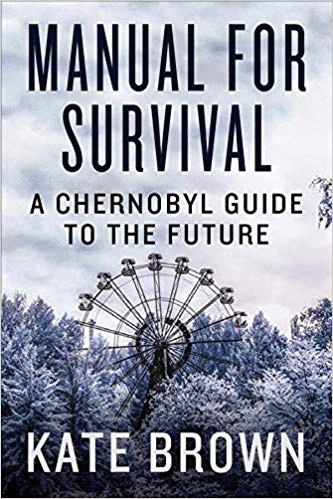
Kate Brown’s “Manual for Survival: A Chernobyl Guide to the Future” illuminates the truth about radioactive legacy of nuclear industry
[in 1992] Baverstock and his colleagues published a letter on their findings in the scientific journal Nature, in which they concluded, “the consequences to the human thyroid, especially in fetuses and young children, of the carcinogenic effects of radioactive fallout is much greater than previously thought.”
Now, after more than 30 years, U.N.-sponsored researchers have backed away from the 1992 UNSCEAR study by concluding that “studies of clean-up workers/liquidators suggest dose-related increases of thyroid cancer and hematological malignancies in adults,” as well as “increases in cardiovascular and cerebrovascular disease. If confirmed, these would have significant public health and radiation protection implications.”
The United States’ involvement with the Chernobyl aftermath was shaped largely, and shamefully, by the desire to avoid potential legal liabilities associated with the 166 U.S. open-air nuclear weapons tests in Nevada and the Marshall Islands. At the time of the Chernobyl accident, compensation radiation claims for injuries and deaths from bomb testing were looked upon by the nuclear weapons program as a dagger aimed at the heart of U.S. national security.
  Why Government Secrecy Is More Damaging to Public Health Than Nuclear Fallout https://washingtonspectator.org/alvarez-nuclear-fallout/?fbclid=IwAR3GipEEqcUnFhvI7hEcKW8_aLhv-ZHGd3JVtLACnjQETGjnZktuXMvaDCU September 11, 2019, By Robert Alvarez Much has been written about the strengths and flaws of Chernobyl—the HBO miniseries nominated for 19 Emmys that chronicles the catastrophe at the eponymous Russian nuclear power plant in 1986. In the mind of this reviewer, it’s a riveting if sobering television gem, and highly recommended. And to this newly enlivened debate over nuclear power we can now add Kate Brown’s book, Manual for Survival: A Chernobyl Guide to the Future, a tour de force about the radiological aftermath of the Chernobyl disaster. A science historian at the Massachusetts Institute of Technology, Brown peels away the layers of long-held mythologies—that in the end, the accident only killed 54 people, and that “radiation phobia” among the people who sustained heavy radioactive fallout was a bigger problem than any of the other health outcomes. Brown, who is conversant in Russian, devoted years to extensive archival research (much of which was scattered and hidden from official attempts at confiscation). She conducted interviews with villagers, military officials, factory workers, medical doctors, Soviet nuclear experts, emergency responders, KGB operatives (who assumed control over much of the data from the accident), and international nuclear safety and radiation health experts. The result is a rich and deeply disturbing picture of the environmental perils of extensive and lasting nuclear contamination. She digs prodigiously, much to the disfavor of defenders of nuclear power, into the widespread practice of secrecy and deception regarding the radiological harm from elevated, long-term, chronic exposures. Continue reading |
“The Guardian” co-opted by UK security services?
Getting Julian Assange The Guardian also appears to have been engaged in a campaign against the WikiLeaks publisher Julian Assange, who had been a collaborator during the early WikiLeaks revelations in 2010.
It seems likely this was innuendo being fed to The Observer by an intelligence-linked individual to promote disinformation to undermine Assange.
In 2018, however, The Guardian’s attempted vilification of Assange was significantly stepped up. A new string of articles began on 18 May 2018 with one alleging Assange’s “long-standing relationship with RT”, the Russian state broadcaster. The series, which has been closely documented elsewhere, lasted for several months, consistently alleging with little or the most minimal circumstantial evidence that Assange had ties to Russia or the Kremlin.

 How the UK Security Services neutralised the country’s leading liberal newspaper. https://www.dailymaverick.co.za/article/2019-09-11-how-the-uk-security-services-neutralised-the-countrys-leading-liberal-newspaper/ By Matt Kennard and Mark Curtis• 11 September 2019, The Guardian, Britain’s leading liberal newspaper with a global reputation for independent and critical journalism, has been successfully targeted by security agencies to neutralise its adversarial reporting of the ‘security state’, according to newly released documents and evidence from former and current Guardian journalists.
The UK security services targeted The Guardian after the newspaper started publishing the contents of secret US government documents leaked by National Security Agency contractor Edward Snowden in June 2013.
Snowden’s bombshell revelations continued for months and were the largest-ever leak of classified material covering the NSA and its UK equivalent, the Government Communications Headquarters. They revealed programmes of mass surveillance operated by both agencies.
According to minutes of meetings of the UK’s Defence and Security Media Advisory Committee, the revelations caused alarm in the British security services and Ministry of Defence. Continue reading
Fears of nuclear closures in France, as welding faults found in more nuclear reactors
France flags welding fault at five or more EDF nuclear reactors, PARIS (Reuters) 13 Sept 19, – At least five nuclear reactors operated by French utility EDF might have problems with weldings on their steam generators, a fault which has raised fears of closures, France’s nuclear regulator was quoted as saying.
State-controlled EDF, whose shares were down 0.9% on Thursday, had said on Tuesday it had identified issues with weldings of some existing reactors, sparking a stock price fall of nearly 7%.
France has the world’s second-largest fleet of nuclear reactors behind the United States, but a spate of technical problems, coupled with hitches at reactors under construction, has tarnished EDF’s image as a leader in nuclear technology.
EDF has exported to China, Finland, South Africa and South Korea, with Britain also set to use its equipment.
“At least five nuclear reactors are affected by this problem,” Le Figaro newspaper quoted Bernard Doroszczuk, head of the ASN regulator, as saying.
“EDF has advised that in around a week it will give an exact number of facilities affected,” Doroszczuk added.
A spokesman for EDF said that there was no plan to shut down the reactors involved for the time being, but the situation could change and it would be for ASN to decide.
The spokesman added that EDF could also decide to halt the affected reactors…….. https://www.reuters.com/article/us-edf-safety/france-flags-welding-fault-at-five-or-more-edf-nuclear-reactors-idUSKCN1VX0N7
Japan says TEPCO will dump more than 1 million tons of radioactive water from Fukushima nuclear plant into Pacific Ocean
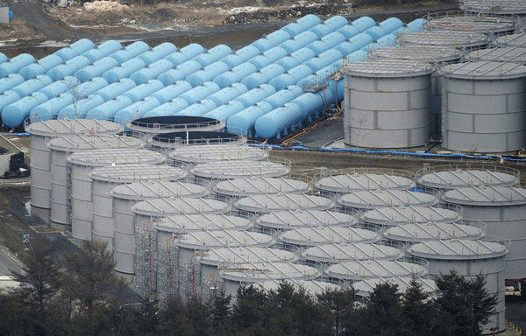
10 Sept 2019 | Japan’s environment minister announced Tuesday that the country will have to dump radioactive water from the Fukushima power plant into the ocean because it is running out of space, Reuters reported. According to Reuters, Tokyo Electric, or Tepco, has collected more than 1 million tonnes of contaminated water from the cooling pipes used to keep fuel cores from melting since the plant was crippled by an earthquake and tsunami in 2011. “The only option will be to drain it into the sea and dilute it,” the minister, Yoshiaki Harada, told a news briefing in Tokyo…The government is awaiting a report from an expert panel before making a final decision on how to dispose of the radioactive water. (The Hill, Reuters)
How to warn distant future generations about nuclear waste?
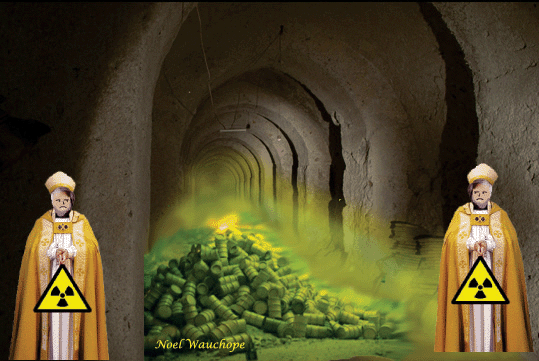
How do you leave a warning that lasts as long as nuclear waste? Phys Org, by Helen Gordon, 13 Sep 19 “……. First, it is difficult to predict how future generations will behave, what they will value and where they will want to go. Second, creating, maintaining and transmitting records of where waste is dumped will be essential in helping future generations protect themselves from the decisions we make today. Decisions that include how to dispose of some of today’s most hazardous material: high-level radioactive waste from nuclear power plants.
The red metal lift takes seven juddering minutes to travel nearly 500 metres down. Down, down through creamy limestone to reach a 160-million-year-old layer of clay. Here, deep beneath the sleepy fields and quiet woods along the border of the Meuse and Haute-Marne departments in north-east France, the French National Radioactive Waste Management Agency (Andra) has built its underground research laboratory.
The laboratory’s tunnels are brightly lit but mostly deserted, the air dry and dusty and filled with the hum of a ventilation unit. Blue and grey metal boxes house a series of ongoing experiments—measuring, for example, the corrosion rates of steel, the durability of concrete in contact with the clay. Using this information, Andra wants to build an immense network of tunnels here.
It plans to call this place Cigéo, and to fill it with dangerous radioactive waste. It is designed to be able to hold 80,000 cubic meters of waste……
High-level radioactive waste is primarily, spent fuel from nuclear reactors or the residues resulting from reprocessing that fuel. This waste is so potent that it must be isolated from humans until its levels of radiation, which decrease over time, are no longer hazardous. The timescale Andra is looking at is up to one million years……. Some scientists call this long-lived waste “the Achilles heel of nuclear power,” and it’s a problem for all of us—whatever our stance on nuclear. Even if all the world’s nuclear plants were to cease operating tomorrow, we would still have more than 240,000 tonnes of dangerously radioactive material to deal with.
Currently, nuclear waste is stored above ground or near the surface, but within the industry this is not considered an acceptable long-term solution. This kind of storage facility requires active monitoring. As well as regular refurbishment it must be protected from all kinds of hazards, including earthquakes, fires, floods and deliberate attacks by terrorists or enemy powers.
This not only places an unfair financial burden on our descendants, who may no longer even use nuclear power, but also assumes that in the future there will always be people with the knowledge and will to monitor the waste. On a million-year timescale this cannot be guaranteed.
So, after considering a range of options, governments and the nuclear industry have come to the view that deep, geological repositories are the best long-term approach. Building one of these is an enormous task that comes with host of complex safety concerns.
Finland has already begun construction of a geological repository (called Onkalo), and Sweden has begun the licensing process for its site. Andra expects to apply for its construction license within the next two years.
If Cigéo goes into operation it will house both the high-level waste and what is known as intermediate-level long-lived waste—such as reactor components. Once the repository has reached capacity, in perhaps 150 years’ time, the access tunnels will be backfilled and sealed up. If all goes according to plan, no one will ever enter the repository again……..
For waste buried deep underground, the major threat to public health comes from water contamination. If radioactive material from the waste were to mix with flowing water, it would be able to move relatively swiftly through the bedrock and into the soil and large bodies of water such as lakes and rivers, finally entering the food chain via plants, fish and other animals.
To prevent this, an underground repository such as Cigéo will take great care to shield the waste it stores. Within its walls there will be metal or concrete containers to block the radiation, and liquid waste can be mixed into a molten glass paste that will harden around it to stop leakage…….
Deep geological repositories are designed as passive systems, meaning that once Cigéo is closed, no further maintenance or monitoring is required. Much more difficult to plan for is the risk of human intrusion, whether inadvertent or deliberate.
In 1980, the US Department of Energy created the Human Interference Task Force to investigate the problem of human intrusion into waste repositories. What was the best way to prevent people many thousands of years in the future from entering a repository and either coming into direct contact with the waste or damaging the repository, leading to environmental contamination?
Over the next 15 years a wide variety of experts were involved in this and subsequent projects, including materials scientists, anthropologists, architects, archaeologists, philosophers and semioticians—social scientists who study signs, symbols and their use or interpretation………
In the very long term, though, these plans also have a major drawback: how can we know that anyone living one million years in the future will understand any of the languages spoken today?
Think of the differences between modern and Old English. Who of us can understand “Ðunor cymð of hætan & of wætan”? That—meaning “Thunder comes from heat and from moisture”—is a mere thousand years old.
Languages also have a habit of disappearing. Around 4,000 years ago in the Indus Valley in what is now Pakistan and north-west India, for example, people were writing in a script that remains completely indecipherable to modern researchers. In one million years it is unlikely that any language spoken today will still exist……. https://phys.org/news/2019-09-nuclear.html?fbclid=IwAR2Kyunn90VCKgkNnwyGsMDYSYi3-UghDX7UNKcZNILzBuflZq2Gkq7daZE
Japan’s new Environment Minister looks to the end of nuclear power
New Japanese environment minister touts end of nuclear power https://www.pv-magazine.com/2019/09/12/new-japanese-environment-minister-touts-end-of-nuclear-power/?fbclid=IwAR0wa5N2qxBhKPMOibQzKmgxNxwLF_0wOxorChWnD2uYe7w1OfH8K2aE-nI
A day later Japan inaugurated a new environment minister who, at his very first press conference, flew in the face of prime minister Shinzo Abe’s plans to restart the nation’s nuclear power plants.
Shinjiro Koizumi took office yesterday and within hours revealed his intentions regarding the nuclear fleet, which comes under his ministerial purview.
“I would like to study how we will scrap them, not how to retain them,” said Koizumi of the reactors. “We will be doomed if we allow another nuclear accident to occur.”
Disaster
After an earthquake and subsequent tsunami battered the Fukushima-Daiichi nuclear power station in early 2011 – causing a triple meltdown at the plant – Japan shuttered its 54 reactors. Plans have been in place to restart most of them, encouraged by Prime Minister Abe. The PM says the country’s reliance on 30% of its energy from nuclear ensures it can hit its carbon emission reduction targets. Any permanent closure of nuclear assets could mean a big push on solar and other renewables.
Many Japanese heavily oppose nuclear. Tuesday’s announcement wastewater may be dumped into the ocean immediately had fisheries voicing protest, for example. The decision to dump the waste is not final and will be reviewed by a panel of experts appointed by the government.
At 38, Koizumi is Japan’s youngest post-war minister and has been dubbed “a rising star” by Japanese media. He is the son of former PM Junichiro Koizumi and does not appear content to remain in the old man’s shadow, with political analysts predicting the new environment minister is on the path to becoming PM himself.
The media blackout on Julian Assange’s imprisonment
 All around the world, Assange’s treatment seems to have given the green light to governments to intimidate and hassle journalists. Australian police, for instance, recently conducted a raid on journalist Annika Smethurst’s home. Smethurst had not long before that revealed that the Government had been secretly requesting permission to spy on its own citizens.
He must not be extradited’ – Vivienne Westwood on Julian Assange
The media blackout on Julian Assange’s imprisonment https://independentaustralia.net/business/business-display/the-media-blackout-on-julian-assanges-imprisonment,13094 By Mint Press News | 11 September 2019, The same media that has spent years dragging Assange’s name through the mud is now engaging in a blackout on his treatment.
If you are waiting for corporate media pundits to defend freedom of the press, you’re going to be disappointed.
The role of journalism in a democracy is publishing information that holds the powerful to account — the kind of information that empowers the public to become more engaged citizens in their communities so that we can vote in representatives that work in the interest of “we the people.”
There is perhaps no better example of watchdog journalism that holds the powerful to account and exposes their corruption than that of WikiLeaks, which exposed to the world evidence of widespread war crimes the U.S. military was committing in Iraq, including the killing of two Reuters journalists; showed that the U.S. Government and large corporations were using private intelligence agencies to spy on activists and protesters; and revealed how the military hid tortured Guantanamo Bay prisoners from Red Cross inspectors.
It’s this kind of real journalism that America’s First Amendment was meant to protect but engaging in it has instead made WikiLeaks publisher Julian Assange the target of a massive smear campaign for the last several years — including false claims that Assange is working with Vladimir Putin and the Russians and hackers, as well as open calls by corporate media pundits for him to be assassinated.
The allegations that Assange conspired with Putin to undermine the 2016 Election and American democracy as a whole fell completely flat earlier this month when a U.S. District Court for the Southern District of New York dismissed this case as ‘factually implausible’, with the judge noting that at no point does the prosecution’s ‘threadbare’ argument show ‘any facts’ at all, and concluding that the idea that Assange conspired with Russia against the Democratic Party or America is ‘entirely divorced from the facts’.
Perhaps the brazen character assassination was priming the public to become apathetic towards Assange in preparation for his brutal fate, which would land him in the hands of U.S. and British authorities after spending years isolated inside the Ecuadorian Embassy in London.
Today, Assange sits behind bars in a London prison under shocking conditions even a murderer wouldn’t expect. Renowned filmmaker and journalist John Pilger visited him there and fears for Assange’s life, noting he is held in isolation, heavily medicated and denied the basic tools needed to fight his charge of extradition to the United States.
The United Nations has consistently condemned the actions of the U.S., U.K. and Swedish governments, and called for Assange’s immediate release.
Their special rapporteur on torture and ill-treatment visited him in May, declaring:
[Assange has been] deliberately exposed, for a period of several years, to progressively [more] severe forms of cruel, inhuman or degrading treatment or punishment, the cumulative effects of which can only be described as psychological torture …The collective persecution of Julian Assange must end here and now.
On May 23, Assange was charged under the U.S. Espionage Act for the possession and dissemination of classified information given to him by army intelligence analyst Chelsea Manning, marking the first time the Espionage Act has been used against a journalist for publishing classified information.
He now faces a sentence of 175 years in gaol if found guilty.
But you may not have known any of this because it seems clear the very media that spent years dragging Assange’s name through the mud are deliberately engaging in a media blackout on his treatment. So if you were waiting for the corporate media or their lapdog pundits to defend freedom of the press and freedom of speech, you’d be disappointed.
It is important to ask ourselves what Julian Assange’s real crime is. In an era, dubbed the “Information Age”, where the strategy of the powerful appears to be to know as much as possible about the rest of us while ensuring that we know as little as possible about them and how they operate, Assange worked to prevent that imbalance from becoming a rout and stuck like a bone in the throat of the mighty.
A double chorus of voices across the mainstream media spectrum cheered the destruction of the First Amendment. The New York Times applauded Trump, claiming he’d ‘done well’ to charge Assange with an ‘indisputable crime’. CNN demanded that Assange finally “face justice,” while others claimed the day in court of the “narcissistic” “internet troll” who attacked America with his “vile spite” was “long overdue“.
All around the world, Assange’s treatment seems to have given the green light to governments to intimidate and hassle journalists. Australian police, for instance, recently conducted a raid on journalist Annika Smethurst’s home. Smethurst had not long before that revealed that the Government had been secretly requesting permission to spy on its own citizens. Meanwhile, independent media everywhere are being marginalised by the crackdown on internet freedom.
In a clear sign to the world, Assange held up Gore Vidal’s book The History of the National Security State to the cameras while being dragged from the Ecuadorian Embassy. The book warns of an increasingly powerful and unaccountable authoritarian government taking over the country.
Part of that is silencing dissent and limiting or destroying the freedoms centuries of struggle have won us.
If Assange is successfully prosecuted it will send a message to the world that the era of freedom to speak and publish is well and truly over. He will not be the last to be persecuted. The more a power oppresses and takes away rights, the more it needs to oppress and take away rights, until the last vestiges of opposition are destroyed or driven far underground.
We cannot expect corporate media to stand up to the corporate state. We have to do it ourselves, or any citizen of the world can be next. Will you heed this warning?
Mnar Muhawesh is founder, CEO and editor in chief of MintPress News, and is also a regular speaker on responsible journalism, sexism, neo-conservativism within the media and journalism start-ups.
This article was originally published by MintPress News and is republished under a Creative Commons licence.
Rick Perry to Discuss Nuclear Sharing Agreement With Saudi Arabia

|
Rick Perry to Discuss Nuclear Sharing Agreement With Saudi Arabia, September 14, 2019,By
and
Energy Secretary Rick Perry said he plans to meet with Saudi Arabia’s new energy minister Monday as the U.S. remains in talks with the kingdom for a deal to construct nuclear reactors there that could help the flagging U.S. domestic nuclear industry. The Trump administration has been in talks with Saudi Arabia to forge a nuclear sharing agreement since 2017, but it has been met with increasing alarm from Congress and others concerned they could forge a deal that doesn’t prohibit the kingdom from enriching uranium….. (subscribers only) https://www.bloomberg.com/news/articles/2019-09-13/perry-to-discuss-nuclear-sharing-agreement-with-saudis-on-monday |
|
|
Ohio’s petitioners against nuclear power bailout are being followed by paid workers for pro nuclear group “Generation Now”
 Nuclear Bailout Group Paying People To Follow Referendum Petitioners Radio WOSU
Harold Chung, a referendum petition worker for Ohioans Against Corporate Bailouts, called Dublin Police on September 10 to report that he was assaulted by one of Generation Now’s workers. Chung told police he tried to take a picture of the person who was following him, that person then slapped the phone out of his hand and shoved him.
Generation Now is not disclosing its donors.
Amazingly Trump told the truth about nuclear weapons and Libya
ON THURSDAY, PRESIDENT Donald Trump did something truly shocking: He told the truth.
When asked why he fired John Bolton, his former national security adviser, Trump said:
He made some very big mistakes. When he talked about the Libyan model for Kim Jong Un, that was not a good statement to make. You just take a look at what happened with Gaddafi.
Joe Cirincione, president of the Ploughshares Fund, said that Trump “is not ‘siding with Kim Jong Un’ when he points out, correctly, that Bolton’s surrender model of negotiations is a complete nonstarter for North Korea.” Trump’s statement has a deep significance, one that the Americans should consider carefully.
UK continues to pour tax-payers’ money into (non-existent) Small Modular Nuclear Reactors

Nuclear Energy Insider 11th Sept 2019 Rolls-Royce group wins funding as UK SMR race gathers pace. The UK SMR Consortium has received financial backing from the UK government to advance
its small modular reactor programme, as part of the Industrial Strategy
Challenge Fund.
The consortium, led by Rolls-Royce, comprises Assystem, SNC
Lavalin/Atkins, Wood, Arup, Laing O’Rourke, BAM Nuttall, Siemens,
National Nuclear Laboratory, and Nuclear AMRC. “The £18 million [US$22.3
million] government funding for phase 1 of the programme (from the ISCF
Wave 3 bid we were recommended from by government) is being matched by
industry funding in the consortium,” Ben Todd, Rolls-Royce Communications
Business Manager – Nuclear, told Nuclear Energy Insider.
“It’s a really big boost to the project, however we have a conservative outlook and
realise there remains a significant amount of work still to do and many
hurdles to overcome. Phase 2 will be a further circa £500 million [US$618
million] total (matched from government, industry and possibly equity
providers) to take through to the completion of the GDA process.”
https://analysis.nuclearenergyinsider.com/rolls-royce-group-wins-funding-uk-smr-race-gathers-pace
U.S. government continues to give tax-payers’ money to “New Nuclear”
U.S. Department of Energy Awards $15.2 Million for Advanced Nuclear Technology, WASHINGTON, D.C. SEPTEMBER 10, 2019 – The U.S. Department of Energy (DOE) today announced funding selectees for multiple domestic advanced nuclear technology projects. Three projects in three states will receive varying amounts for a total of approximately $15 million in funding. The projects are cost-shared and will allow industry-led teams, including participants from federal agencies, public and private laboratories, institutions of higher education, and other domestic entities, to advance the state of U.S. commercial nuclear capability.
The awards are through the Office of Nuclear Energy’s (NE) funding opportunity announcement (FOA) U.S. Industry Opportunities for Advanced Nuclear Technology Development. This is the sixth round of funding through this FOA…….
U.S. Secretary of Energy Rick Perry. “The Trump Administration is committed to reviving and revitalizing the U.S. nuclear industry.” ……https://www.energy.gov/ne/articles/us-department-energy-awards-152-million-advanced-nuclear-technology-0
1 This Month
19 November – Webinar – The Reality of Reprocessing
Time: 11:00 AM Pacific Time (US & Canada) / 2:00 PM Eastern / 7:00 PM UK / 8:00 PM CET
Register for the Zoom Event Here

Tell Congress: Prevent Nuclear Catastrophe in Iran

Tell Congress: Prevent Nuclear Catastrophe in Iran

Read the Public Inquiry Report, the Commissioners’ report, Surrendering Australia: The AUKUS Deception is available to download for free at aukuspublicinquiry.com. Or just watch the replay of the National Press Club Luncheon.


Shut down the radiation-damaged Heysham nuclear reactors now
To see nuclear-related stories in greater depth and intensity – go to https://nuclearinformation.wordpress.com

Say No to NASA’s Reckless Nuclear Reactor on the Moon
Say No to NASA’s Reckless Nuclear Reactor on the Moon
-
Archives
- November 2026 (190)
- October 2026 (302)
- September 2026 (339)
- August 2026 (330)
- July 2026 (355)
- June 2026 (287)
- May 2026 (306)
- April 2026 (356)
- March 2026 (251)
- February 2026 (267)
- January 2026 (308)
- December 2025 (358)
-
Categories
- 1
- 1 NUCLEAR ISSUES
- business and costs
- climate change
- culture and arts
- ENERGY
- environment
- health
- history
- indigenous issues
- Legal
- marketing of nuclear
- media
- opposition to nuclear
- PERSONAL STORIES
- politics
- politics international
- Religion and ethics
- safety
- secrets,lies and civil liberties
- spinbuster
- technology
- Uranium
- wastes
- weapons and war
- Women
- 2 WORLD
- ACTION
- AFRICA
- Atrocities
- AUSTRALIA
- Christina's notes
- Christina's themes
- culture and arts
- Events
- Fuk 2022
- Fuk 2023
- Fukushima 2017
- Fukushima 2018
- fukushima 2019
- Fukushima 2020
- Fukushima 2021
- general
- global warming
- Humour (God we need it)
- Nuclear
- RARE EARTHS
- Reference
- resources – print
- Resources -audiovicual
- Weekly Newsletter
- World
- World Nuclear
- YouTube
-
RSS
Entries RSS
Comments RSS

