Desperate times for the nuclear industry – could Australia be its saviour?
the number one goal of the nuclear lobby is to remove Australia’s national and state laws that prohibit the nuclear industry.
the campaign by the global nuclear industry, particularly the American industry, to kickstart another “nuclear renaissance”, before it’s too late.

Australia is the great ‘white’ hope for the global nuclear industry, Independent Australia, By Noel Wauchope | 19 November 2019, The global nuclear industry is in crisis but that doesn’t stop the pro-nuclear lobby from peddling exorbitantly expensive nuclear as a “green alternative”. Noel Wauchope reports.
The global nuclear industry is in crisis. Well, in the Western world, anyway. It is hard to get a clear picture of Russia and China, who appear to be happy putting developing nations into debt, as they market their nuclear reactors overseas with very generous loans — it helps to have stte-owned companies funding this effort.
But when it comes to Western democracies, where the industry is supposed to be commercially viable, there’s trouble. The latest news from S&P Global Ratings has made it plain: nuclear power can survive only with massive tax-payer support. Existing large nuclear reactors need subsidies to continue, while the expense of building new ones has scared off investors.
So, for the nuclear lobby, ultimate survival seems to depend on developing and mass marketing “Generation IV” small and medium reactors (SMRs). …..
for the U.S. marketers, Australia, as a politically stable English-speaking ally, is a particularly desirable target. Australia’s geographic situation has advantages. One is the possibility of making Australia a hub for taking in radioactive wastes from South-East Asian countries. That’s a long-term goal of the global nuclear lobby. …..
In particular, small nuclear reactors are marketed for submarines. That’s especially important now, as a new type of non-nuclear submarine – the Air Independent Propulsion (AIP) submarine, faster and much cheaper – could be making nuclear submarines obsolete. The Australian nuclear lobby is very keen on nuclear submarines: they are now promoting SMRs with propagandists such as Heiko Timmers, from Australian National University. This is an additional reason why Australia is the great white hope.
I use the word “white” advisedly here because Australia has a remarkable history of distrust and opposition to this industry form Indigenous Australians…..
The hunt for a national waste dump site is one problematic side of the nuclear lobby’s push for Australia. While accepted international policy on nuclear waste storage is that the site should be as near as possible to the point of production, the Australian Government’s plan is to set up a temporary site for nuclear waste, some 1700 km from its production at Lucas Heights. The other equally problematic issue is how to gain political and public support for the industry, which is currently banned by both Federal and state laws. SMR companies like NuScale are loath to spend money on winning hearts and minds in Australia while nuclear prohibition laws remain.
 Ziggy Switkowski, a long-time promoter of the nuclear industry, has now renewed this campaign — although he covers himself well, in case it all goes bad, noting that nuclear energy for Australia could be a “catastrophic failure“. ……
his submission (No. 41) to the current Federal Inquiry into nuclear power sets out only one aim, that
‘… all obstacles … be removed to the consideration of nuclear power as part of the national energy strategy debate.’
So the Environmental Protection and Biodiversity Conservation Act (EPBC Act) should be changed, according to Switkowski. In an article in The Australian, NSW State Liberal MP Taylor Martin suggested that the Federal and state laws be changed to prohibit existing forms of nuclear power technology but to allow small modular reactors.
Switkowski makes it clear that the number one goal of the nuclear lobby is to remove Australia’s national and state laws that prohibit the nuclear industry. And, from reading many pro-nuclear submissions to the Federal Inquiry, this emerges as their most significant aim.
It does not appear that the Australian public is currently all agog about nuclear power. So, it does seem a great coincidence that so many of their representatives in parliaments – Federal, Victorian, New South Wales, South Australia and members of a new party in Western Australia – are now advocating nuclear inquiries, leading to the repeal of nuclear prohibition laws.
We can only conclude that this new, seemingly coincidental push to overturn Australia’s nuclear prohibition laws, is in concert with the push for a national nuclear waste dump in rural South Australia — part of the campaign by the global nuclear industry, particularly the American industry, to kickstart another “nuclear renaissance”, before it’s too late.
Despite its relatively small population, Australia does “punch above its weight” in terms of its international reputation and as a commercial market. The repeal of Australia’s laws banning the nuclear industry would be a very significant symbol for much-needed new credibility for the pro-nuclear lobby. It would open the door for a clever publicity drive, no doubt using “action on climate change” as the rationale for developing nuclear power.
In the meantime, Australia has abundant natural resources for sun, wind and wave energy, and could become a leader in the South-East Asian region for developing and exporting renewable energy — a much quicker and more credible way to combat global warming. https://independentaustralia.net/politics/politics-display/australia-is-the-great-white-hope-for-the-global-nuclear-industry,13326
If Julian Assange is extradited to the United States, journalism will be incarcerated, too
JOHN PILGER: Assange’s case will define the future of free journalism, https://independentaustralia.net/life/life-display/john-pilger-assanges-case-will-define-the-future-of-free-journalism,13324 By John Pilger | 18 November 2019 John Pilger describes the disturbing scene inside a London courtroom last week when the WikiLeaks publisher, Julian Assange, appeared at the start of a landmark extradition case that will define the future of free journalism.
THE WORST MOMENT was one of a number of “worst” moments. I have sat in many courtrooms and seen judges abuse their positions. This judge, Vanessa Baraitser – actually she isn’t a judge at all; she’s a magistrate – shocked all of us who were there.
Her face was a progression of sneers and imperious indifference; she addressed Julian Assange with an arrogance that reminded me of a magistrate presiding over apartheid South Africa’s Race Classification Board. When Julian struggled to speak, he couldn’t get words out, even stumbling over his name and date of birth.
When he spoke truth and when his barrister spoke, Baraister contrived boredom; when the prosecuting barrister spoke, she was attentive. She had nothing to do; it was demonstrably preordained. In the table in front of us were a handful of American officials, whose directions to the prosecutor were carried by his — back and forth this young woman went, delivering instructions.
Having ignored Julian’s barrister’s factual description of how the CIA had run a Spanish security firm that spied on him in the Ecuadorean embassy, she didn’t yawn, but her disinterest was as expressive. She then denied Julian’s lawyers any more time to prepare their case — even though their client was prevented in prison from receiving legal documents and other tools with which to defend himself.
Her knee in the groin was to announce that the next court hearing would be at remote Woolwich, which adjoins Belmarsh Prison and has few seats for the public. This will ensure isolation and be as close to a secret trial as it’s possible to get. Did this happen in the home of the Magna Carta? Yes, but who knew?
Who will then dare to expose anything of importance, let alone the high crimes of the West? Who will dare publish ‘Collateral Murder’? Who will dare tell the public that democracy, such as it is, has been subverted by a corporate authoritarianism from which fascism draws its strength?
Once there were spaces, gaps, boltholes, in mainstream journalism in which mavericks, who are the best journalists, could work. These are long closed now. The hope is the samizdat on the internet, where fine disobedient journalism is still practised.
The greater hope is that a judge or even judges in Britain’s court of appeal, the High Court, will rediscover justice and set him free. In the meantime, it’s our responsibility to fight in ways we know but which now require more than a modicum of Julian Assange’s courage.
As negotiation deadline nears, tension between Kim Jong Un and Donald Trump
Trump, Kim at odds as deadline looms in nuclear talks, Glen Carey and Jihye Lee, Bloomberg, November 18, 2019
The bonhomie between President Donald Trump and North Korean leader Kim Jong Un is nearing a key deadline showing new signs of strain.
Trump urged Kim over the weekend to “act quickly” to get a nuclear deal done, suggesting the two leaders could meet again “soon.” His comments came hours after North Korea ruled out nuclear talks without a policy change by the U.S. and reported on a military drill observed by Kim himself.
Veteran North Korea nuclear adviser, Kim Kye Gwan, told Trump that Pyongyang will no longer give him “things to boast about,” the state’s official KCNA news agency on Monday quoted him as saying. He added North Korea is no longer interested in talks that the U.S. “uses to buy time.”
Trump and Kim Jong Un, who have previously displayed what Pyongyang calls “mysteriously wonderful chemistry,” appear to be going in different directions as the clock ticks down. Kim has given Trump until the end of the year to ease up on sanctions or risk him taking a “new path,” meaning a possible escalation of military tensions during the U.S. presidential campaign…….
After more than a year of talks and three Trump-Kim meetings, the two sides remain divided on issues from sanctions relief to disarmament. Even though North Korea hasn’t taken any major steps to give up its weapons, Kim has won concessions from Trump that include canceling some U.S.-South Korean joint military drills that have drawn Pyongyang’s anger.
North Korea hasn’t explained what Kim intends to do on his “new path,” although the regime has often referred to his decision to halt tests of nuclear bombs and intercontinental ballistic missiles two years ago. In May, North Korea resumed tests of shorter-range ballistic missiles.,,,,,,,
The North Korea warning about U.S. nuclear talks came despite the U.S.’s decision to suspend another round of military drills with South Korea. Defense Secretary Mark Esper said on the sidelines of a regional security conference that Washington and Seoul had “jointly decided to postpone this month’s combined flying training event” after “close consultation and careful consideration.”
Pyongyang last week blamed U.S.-South Korean military drills “as a main factor of screwing up tensions.”
The emerging potential new nuclear industry political scam
 Does Nuclear Power Slow Or Speed Climate Change? Forbes, Amory B. Lovins 17 Nov 19,
2. Through generally regulated utility tariffs, customers paid for the plants’ construction and financing, including a just and reasonable return on capital.
3. Customers paid over decades for the plants’ operation, including major repairs, power upratings, and safety upgrades.
4. Many customers reimbursed owners for “stranded-asset costs” totaling upwards of $70 billion to support the owner-demanded transition to competitive wholesale markets.
5. Over the past few years, when reactors generating 2 percent of U.S. electricity proved unable to compete in those wholesale markets (though most of their owners kept their finances secret and kept reporting profits to investors), the owners persuaded state legislators in Illinois, New York, New Jersey, Connecticut, and Ohio to vote billions of dollars a year for new multi-year operating subsidies.
6. Exelon, the nation’s largest nuclear operator and the leading player in the previous two steps, successfully sought Federal regulatory approval for greater capacity payments from power pools whose auctions found nuclear power uncompetitive and whose own rules were thrown off-balance by the new state subsidies. And now, as the annual logrolling season of “tax extenders” rolls around in Congress:
7. For the third year, Exelon is advancing a “Nuclear Powers America Act” to create a new federal investment tax credit on nuclear fuel and maintenance expenses to “help level the playing fuel with other clean energy sources”—whose temporary tax credits are meanwhile being phased down or out. This follows a longstanding pattern of giving different kinds of subsidies to renewables than to nuclear, then “leveling the playing field” by trying to duplicate renewables’ specific forms of subsidies with new ones for nuclear, but never the reverse.
This saga of selling the same hay seven times—and those clever lawyers aren’t done yet—doesn’t include many additional federal and state subsidies. It also doesn’t include an emerging potential scam that could end up with ratepayers’ and federal taxpayers’ getting stuck with vast decommissioning and waste-management liabilities. This emerging pattern has an LLC buy a closed reactor. Absent oversight or rules to stop misbehavior, the LLC could then choose to strip the accumulated customer-funded multi-billion-dollar cash decommissioning fund, not finish the job, and walk away, leaving the parent company whole and electricity customers or taxpayers holding the bag. Watch this space.
Exelon’s proposed “nuclear investment tax credit” has ingenious new features:
– By redefining normal accounting categories so fuel becomes a capital investment, it repays utilities for an “investment” that’s really just a normal operating cost—thus trying to make nuclear operating costs look small by shifting much of them to taxpayers.
The nuclear operating costs it covers have no counterpart for renewables (fuel, nuclear waste management, protection against catastrophic releases of radioactivity), or almost none (operation & maintenance costs), so a tax credit for them would specifically advantage nuclear against renewables.
– Nuclear owners may be able to double-dip, collecting the new federal subsidy and new state subsidies for the same plants and thus turning dead dinosaurs into juicy cash cows.
– There’s virtually no “means test”: the new federal subsidy would apply to about 95% of US operating reactors, including those that the industry claims are currently profitable.
– The proposed legislation, obscurely written in tax-law jargon, appears to be a 30% tax credit (phasing down to 26% in 2024, 22% in 2025, and a permanent 10% in and after 2026), and to cost ~$22–26 billion over the first decade, or ~$33 billion counting the crowding-out of cheaper competitors. Every billion dollars thus bilked from taxpayers is unavailable to provide more electrical services and save more carbon by cheaper means.
– By further distorting the delicate balance between federal, regional, and state regulation, the subsidy seems tailored to weaken or destroy the efficient regional power markets where renewables beat nuclear power. The goal is thus to pay nuclear power for values it doesn’t deliver, while blocking its most potent competitors from continuing to provide the values they do deliver.
– Unlike renewable credits that have helped to mature important new technologies, the nuclear credit would elicit no new production, capacity, or innovation. It would simply transfer tens of billions of dollars to the owners of uncompetitive nuclear assets bought decades ago—if they apply for license extension by 2026, as nearly all have done.
This covert attack on renewables is logical because renewables are now the supply-side competitor nuclear must beat but can’t. The nuclear industry is reluctant to admit that renewables are a legitimate competitor, since this would contradict its claims that renewables can’t supply reliable power. Renewables, unlike nuclear power, are also widely popular. Nuclear advocates therefore tend to blame their woes instead on cheap natural gas. However, new and often even existing combined-cycle gas-fired power plants no longer have a business case: a September 2019 study found that at least 90% of the 88 proposed US gas-fired plants are pre-stranded assets. ………https://www.forbes.com/sites/amorylovins/2019/11/18/does-nuclear-power-slow-or-speed-climate-change/#5b47c988506b
Japan’s METI says it’s safe to dump radioactive water from Fukushima nuclear disaster into ocean
The industry ministry said Monday it would be safe to release water contaminated by the Fukushima nuclear disaster into the ocean, stressing that on an annual basis the amount of radiation measured near the release point would be very small compared to levels to which humans are naturally exposed.
Discharging the water into the Pacific Ocean over the course of a year would amount to between just one-1,600th and one-40,000th of the radiation to which humans are naturally exposed, the Economy, Trade and Industry Ministry, or METI, told a government subcommittee on the issue.
Water used to cool the melted-down cores and groundwater from close to the damaged plant contain some radioactive materials, and are currently being collected and stored in tanks on the plant grounds.
But space is running out fast, and the government is exploring ways to deal with the waste water — which already totals more than 1 million tons with the volume increasing by more than 100 tons every day.
According to an estimate performed by the ministry, annual radiation levels near the release point after a release would be between 0.052 and 0.62 microsievert at sea, and 1.3 microsieverts in the atmosphere, compared with the 2,100 microsieverts that humans come into contact with each year in daily life.
One member of the subcommittee called on the ministry to provide detailed data showing the impact of different conditions such as ocean currents and weather.
Another member requested more information on the amount of radiation that people will be exposed to internally, depending on how much fish and seaweed they consume.
The waste water is currently being treated using an advanced liquid processing system referred to as ALPS, though the system does not remove tritium and has been found to leave small amounts of other radioactive materials.
The tanks storing the water are expected to become full by the summer of 2022, according to Tokyo Electric Power Company Holdings Inc., the operator of the Fukushima No. 1 nuclear power plant.
The plant was damaged by a magnitude 9.0 earthquake and ensuing tsunami on March 11, 2011.
While government officials stress the safety of releasing the waste water, local fishermen are opposed to discharging it into the ocean due to worries that it would cause reputational damage and impact their livelihoods.
South Korea has also expressed concern over the environmental impact.
In September, Japanese and South Korean officials traded barbs over the issue at a meeting of the International Atomic Energy Agency in Vienna.
A nuclear expert from the IAEA said in 2018 that a controlled discharge of such contaminated water “is something which is applied in many nuclear facilities, so it is not something that is new.”
Hinkley Point C nuclear, a super-expensive project for a dubious short term gain
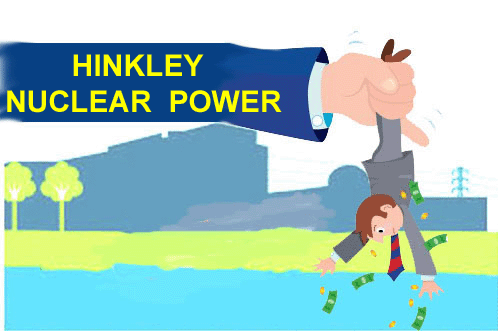 This is the West Country 17th Nov 2019, Stop Hinkley spokesman Roy Pumfrey questions whether the economic boost from Hinkley C is worth the cost I get tired of reading how easily impressed councillors are when they visit the giant incomplete building site that is HPC.
“biggest economic boost” is necessarily a good thing when it is also hugely
problematic and costly for anyone not directly involved? In our case,
economic growth also means a host of problems. There are more traffic jams
all around gridlocked Bridgwater. I’d like to travel from Bridgwater to
Taunton using the Taunton Road, but that simply adds 30 minutes to the
journey time.
schedule.
\ them to the reality of the massive hazard an untried new nuclear power
station running adjacent to her constituency represents.
20% drop in patient’s radiation dose achieved by U.S. radiologists
|
The report, published Monday, Nov. 18, by the National Council on Radiation Protection and Measurements, showed doses dropped by 15% to 20% among U.S. patients between 2006 and 2016. Per person, the estimated average dose fell from 2.92 millisievert (mSv) in 2006 to 2.16 mSv in 2016. “We are pleased, but not surprised, that despite a steadily increasing and aging population, the medical radiation dose Americans receive is going down,” Continue reading |

A new dangerous period of nuclear weapons rivalry
 The Coming Nuclear Crises, https://www.project-syndicate.org/commentary/coming-nuclear-arms-races-and-crises-by-richard-n-haass-2019-11 Nov 18, 2019 RICHARD N. HAASS We are entering a new and dangerous period in which nuclear competition or even use of nuclear weapons could again become the greatest threat to global stability. Less certain is whether today’s leaders are up to meeting this emerging challenge.
This past summer, however, the US withdrew from the 1987 Intermediate-Range Nuclear Forces Treaty after it concluded Russia had violated the INF’s terms. The treaty limiting longer-range US and Russian nuclear weapons will expire in 2021 unless it is extended, and it is not clear that it will be: both countries are committing substantial resources to modernize their existing arsenals.
Now, however, Iran has begun a slow but steady process of getting out from under many of the agreement’s limits. It may be doing this to persuade the US and Europe to ease economic sanctions. It may also be calculating that these steps could dramatically reduce the time it would need to produce nuclear weapons without being attacked. But it is at least as likely that Iran’s actions will lead the US, or more probably Israel, to undertake a preventive strike designed to destroy a significant part of its program.
The “Plutocene” danger – nuclear war, radioactive pollution, global heating
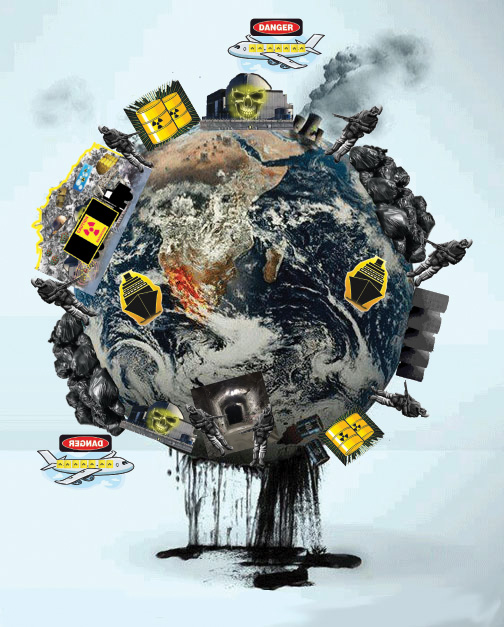
Why are these two facts related? Because they illustrate the two factors that could transport us beyond the Anthropocene—the geological epoch marked by humankind’s fingerprint on the planet—and into yet another new, even more hostile era of our own making.
My new book, titled The Plutocene: Blueprints for a post-Anthropocene Greenhouse Earth, describes the future world we are on course to inhabit, now that it has become clear that we are still busy building nuclear weapons rather than working together to defend our planet.
have coined the term Plutocene to describe a post-Anthropocene period marked by a plutonium-rich sedimentary layer in the oceans. The Anthropocene is very short, having begun (depending on your definition) either with the Industrial Revolution in about 1750, or with the onset of nuclear weapons and sharply rising greenhouse emissions in the mid-20th century. The future length of the Plutocene would depend on two factors: the half-life of radioactive plutonium-239 of 24,100 years, and how long our CO2 will stay in the atmosphere—potentially up to 20,000 years.
During the Plutocene, temperatures would be much higher than today. Perhaps they would be similar to those during the Pliocene (2.6 million to 5.3 million years ago), when average temperatures were about 2℃ above those of pre-industrial times, or the Miocene (roughly 5.3 million to 23 million years ago), when average temperatures were another 2℃ warmer than that, and sea levels were 20 to 40 meters (65-131ft) higher than today.
Under these conditions, population and farming centres in low coastal zones and river valleys would be inundated, and humans would be forced to seek higher latitudes and altitudes to survive—as well as potentially having to contend with the fallout of nuclear conflict. The most extreme scenario is that evolution takes a new turn—one that favors animals best equipped to withstand heat and radiation.
Climates past
While we have a range of tools for studying prehistoric climates, including ice cores and tree rings, these methods do not of course tell us what the future holds.
However, the basic laws of physics, the principles of climate science, and the lessons from past and current climate trends, help us work out the factors that will dictate our future climate.
Broadly speaking, the climate is shaped by three broad factors: trends in solar cycles; the concentration of atmospheric greenhouse gases; and intermittent events such as volcanic eruptions or asteroid impacts.
Solar cycles are readily predicted, and indeed can be seen in the geological record, whereas intermittent events are harder to account for. The factor over which we have the most control is our own greenhouse emissions.
CO2 levels have previously climbed as high as 2,000 parts per million (ppm), most recently during the early Eocene, roughly 55-45 million years ago. The subsequent decline of CO2 levels to just a few hundred parts per million then cooled the planet, creating the conditions that allowed Earth’s current inhabitants (much later including humans) to flourish.
But what of the future? Based on these observations, as reported by the Intergovernmental Panel on Climate Change (IPCC), several projections of future climates indicate an extension of the current interglacial period by about 30,000 years, consistent with the longevity of atmospheric CO2.
If global warming were to reach 4℃, as suggested by Hans Joachim Schellnhuber, chief climate advisor to the German government, the resulting amplification effects on the climate would pose an existential threat both to nature and human civilization.
Barring effective sequestration of carbon gases, and given amplifying feedback effects from the melting of ice sheets, warming of oceans, and drying out of land surfaces, Earth is bound to reach an average of 4℃ above pre-industrial levels within a time frame to which numerous species, including humans, may hardly be able to adapt. The increase in evaporation from the oceans and thereby water vapor contents of the atmosphere leads to mega-cyclones, mega-floods and super-tropical terrestrial environments. Arid and semi-arid regions would become overheated, severely affecting flora and fauna habitats.
The transition to such conditions is unlikely to be smooth and gradual, but may instead feature sharp transient cool intervals called “stadials.” Increasingly, signs of a possible stadial are being seen south of Greenland.
A close analogy can be drawn between future events and the Eocene-Paleocene Thermal Maximum about 55 million years ago, when release of methane from Earth’s crust resulted in extreme rise in temperature. But as shown below, [ diagram on original] the current rate of temperature rise is far more rapid—and more akin to the planet-heating effects of an asteroid strike.
Mounting our defense
Defending ourselves from global warming and nuclear disaster requires us to do two things: stop fighting destructive wars, and start fighting to save our planet. There is a range of tactics we can use to help achieve the second goal, including large-scale seagrass cultivation, extensive biochar development, and restoring huge swathes of the world’s forests.
Space exploration is wonderful, but we still only know of one planet that supports life (bacteria possibly excepted). This is our home, and there is currently little prospect of realising science fiction’s visions of an escape from a scorched Earth to some other world.
Yet still we waver. Many media outlets operate in apparent denial of the connection between global warming and extreme weather. Meanwhile, despite diplomatic progress on nuclear weapons, the Sword of Damocles continues to hang over our heads, as 14,900 nuclear warheads sit aimed at one another, waiting for accidental or deliberate release.
If the clock does strike nuclear midnight, and if we don’t take urgent action to defend our planet, life as we know it will not be able to continue. Humans will survive in relatively cold high latitudes and altitudes. A new cycle would begin.
Andrew Glikson is an Earth and paleo-climate scientist at the Australian National University.
Jeremy Corbyn could scrap UK’s nuclear weapons, in deal with Scottish National Party
 Jeremy Corbyn suggests he could SCRAP Britain’s nuclear weapons as the SNP demands he ‘gets rid’ of Trident missiles to win its backing in a government coalition, Daily Mail Labour leader said he wanted to add ‘realism’ to nuclear non-proliferation treaty
By DAVID WILCOCK, WHITEHALL CORRESPONDENT FOR MAILONLINE 18 November 2019 Jeremy Corbyn today suggested he would be prepared to give up the UK’s nuclear weapons after the SNP signalled it would be part of their price for propping up his future government. The Labour leader said he wanted to add ‘realism’ to the nuclear non-proliferation treaty (NNPT), with discussions about ‘every country’s nuclear weapons’. He also had a dig at Nato, disagreeing with a claim last week by General Sir Nick Carter, the professional head of the British Army, that the alliance was the most successful in history. His BBC interview came after the Scottish National Party’s Westminster leader Ian Blackford had said the upcoming election was ‘an opportunity to get rid of Trident’ – the UK’s atomic missile system…… The SNP has made removing Britain’s nuclear submarine fleet – based on the Clyde – out of Scotland a mainstay of its party policy. And Mr Corbyn, a former chairman of the Stop the War Coalition, has long opposed Britain’s nuclear weapons programme…. https://www.dailymail.co.uk/news/article-7694603/Now-SNP-demands-Jeremy-Corbyn-scrap-Britains-NUCLEAR-WEAPONS-win-votes-coalition.html |
|
Climate change is a health emergency – physicians
Visionary Leaders Symposium: ‘Our planet is our patient.’ http://publichealthnewswire.org/?p=physicians-for-social-responsibility-visionary-leaders-symposium#.XdARGW8_6rw.twitter by Louise Dettman on 11/8/2019 Nearly 200 organizations representing medical, health care and public and environmental health professionals, including APHA, have so far endorsed the 2019 U.S. Call to Action on Climate Change, Health and Equity: A Policy Agenda.It challenges government, business, civil society and the health sector to recognize climate change as a public health emergency and to act now for climate, health and equity.
 “Being health professionals, it’s important for us to realize that our planet is our patient, and it’s in the intensive care unit. We’re doctors to a dying planet and we have a job to do,” said Helen Caldicott, MD, keynote speaker at yesterday’s Physicians for Social Responsibility Visionary Leaders Symposium in Washington, D.C.
A PSR founder and former president, anti-nuclear activist, author and pediatrician from Australia, Caldicott has spent her life educating world leaders and the public about the medical hazards of the nuclear age. She urged those gathered at the Ronald Reagan Building for the symposium to “stop being polite and speak the truth loudly and clearly” about the need for action on climate change. As one of the drafters of the U.S. Call to Action, PSR is using it to mobilize and give voice to more health professionals.
It advocates for policies that promote a just transition to clean, safe renewable energy and energy efficiency; sustainable food production and diets; clean water; active transportation; and green cities. Such policies can lower climate pollution, reduce the incidence of communicable and non-communicable disease, improve mental health and realize significant cost savings in health care.
“I’m not being radical. I’m being a physician,” Caldicott said as she stressed the urgency of the situation; challenged attendees to question the role of politicians, corporations and the military in the production of greenhouse gases; and told everyone to contact members of Congress. “If you don’t use your democracy, they’ll swoop in and use it for you — for their own political and financial gain,” she said.
The U.S. Call to Action urges the health sector itself to reduce greenhouse gas emissions and — as a trusted voice — to effectively communicate the health threats of climate change and the health benefits of climate action. The symposium focused specifically on the role of women in the climate, health and equity movement and the importance of economic justice for the most vulnerable communities.
Heidi Hutner, PhD, a filmmaker, writer and professor at Stony Brook University, moderated an expert panel of women advocates discussing the health hazards of and solutions to nuclear power and climate change. Hutner opened the program with a trailer of her upcoming documentary about the women of Three Mile Island and, along with the other participants, questioned nuclear power as the answer for a just transition to clean energy.
Following the symposium, at the 2019 Visionary Leadership Awards, PSR presented Caldicott with a Lifetime Achievement Award for her work. It also recognized other individuals and organizations for their efforts in advancing nuclear weapons abolition and addressing environmental risks to human health, including the consequences of climate change.
World Nuclear Waste Report
The final disposal of high-level radioactive waste presents governments worldwide with major challenges that have not yet been addressed, and entails incalculable technical, logistical, and financial risks. This is the conclusion of the first “World Nuclear Waste Report ‒ Focus Europe” launched in Berlin in November.
The World Nuclear Waste Report (WNWR) is a project by a group of renowned international experts who want to draw more attention to radioactive waste as a significant and growing challenge with no long-term solutions yet available. The project was initiated by Rebecca Harms, and the original outline was produced by Wolfgang Neumann, Mycle Schneider (coordinator of the annual World Nuclear Industry Status Reports) and Gordon MacKerron. Numerous experts have contributed to the first edition of the WNWR (including former US Nuclear Regulatory Commission chair Allison Macfarlane).
The WNWR aims to make a substantial contribution to understanding nuclear waste challenges for countries around the world. It does so by describing national and international classification systems, the risks posed by specific radioactive waste forms, generated and estimated future waste quantities, the waste management and disposal strategies of governments and their financing mechanisms.
According to the WNWR, over 60,000 tons of spent nuclear fuel alone are stored in interim storage facilities across Europe (excluding Russia and Slovakia). Spent fuel rods are highly radioactive waste. To date, no country in the world has a repository for high-level waste from nuclear power in operation. Within the EU, France accounts for 25 percent of the current spent nuclear fuel, followed by Germany (15 percent) and the United Kingdom (14 percent).
In addition, more than 2.5 million cubic metres of low- and intermediate-level waste has been generated in Europe (excluding Slovakia and Russia). Over its lifetime, the European nuclear reactor fleet will produce an estimated 6.6 million cubic metres of nuclear waste. Four countries are responsible for most of this waste: France (30 percent), the UK (20 percent), the Ukraine (18 percent) and Germany (8 percent).
According to the WNWR, many governments underestimate the costs of interim and final storage. No country has a consistent financing model to date in places. This poses further financial risk for taxpayers.
Marcos Buser, a Swiss geologist and co-author of the report, said: “Increasing amounts of high level waste have to be interim stored for ever longer periods of time, as no country in the world has yet commissioned a deep geological repository for such waste. The problem is that interim storage facilities have not been designed for such long-term use.”
The Swiss nuclear expert warned that the storage facilities are already reaching the limits of their capacities. For example, storage capacity for spent fuel in Finland has already reached 93 percent saturation. Sweden’s decentralized storage facility CLAB is at 80 percent saturation. “The shutdown and decommissioning of many nuclear power plants will again drastically increase the quantities of nuclear waste,” warns Buser.
In addition to the safety aspects, the report identifies the enormous costs of interim storage and final disposal as another risk. “National governments and operators often significantly underestimate the costs of decommissioning, storage, and disposal of nuclear waste,” said Ben Wealer, co-author of the study and industrial engineer at the Technical University of Berlin.
In many countries there is a large gap between the expected costs and the financial resources earmarked for them. The problem would be exacerbated by the fact that final disposal also involves incalculable risks, which could lead to enormous cost increases, as the German government experiences with the Asse repository illustrate.
Nearly every government claims to apply the polluter-pays-principle, which makes operators liable for the costs of managing, storing, and disposing of nuclear waste. In reality, however, governments fail to apply the polluter-pays-principle consistently. “No country in Europe has taken sufficient precautions to finance the costs of the final disposal of nuclear waste. There is a threat that the real, massive costs will ultimately be borne by the taxpayers,” Wealer warned.
Ellen Ueberschär, President of the Heinrich-Böll-Stiftung, said: “The numerous unsolved problems in dealing with nuclear waste show that nuclear power has no future. At the same time, the report makes clear that phasing out nuclear power is not enough. Insufficient financial provisions for disposing of nuclear waste must not undermine the care and safety of decisions for interim storage and final disposal. The search for a suitable final repository needs greater public attention. The report is intended to facilitate a qualified international debate.”
World Nuclear Waste Report https://worldnuclearwastereport.org/
World Nuclear Waste Report 2019 ‒ Focus Europe: https://worldnuclearwastereport.org/wp-content/themes/wnwr_theme/content/World_Nuclear_Waste_Report_2019_Focus_Europe.pdf
NRC likely to extend licence for Westinghouse nuclear fuel factory, despite its history of spills and leaks
 Nuclear safety regulators take heat for downplaying threat from atomic fuel plant, The State BY SAMMY FRETWELL, 17 Nov 19, Federal nuclear safety regulators drew criticism Thursday night for concluding that an aging atomic fuel plant could operate another 40 years without having much impact on the environment of eastern Richland County.The 50-year-old Westinghouse nuclear fuel factory, located between Interstate 77 and Congaree National Park, has had a recent history of missteps, including spills and leaks that have focused attention on the facility and it’s safety culture. But as its troubles have surfaced, the company has sought federal permission for a new operating permit. A recent Nuclear Regulatory Commission report said the facility will continue to have leaks if its permit is renewed, yet those problems won’t have much affect on the surrounding landscape. The study said the plant was safe enough to operate if it receives a new 40 year license because pollution will be monitored and cleaned up before it leaves the property. Those speaking at a public hearing Thursday — mostly environmentalists — said they can’t understand why the NRC thinks a plant with a multitude of problems will operate safely for the next four decades. They called on the agency to conduct a more detailed study known as an environmental impact statement. If the NRC does approve a new license, it should be for less than 40 years, those speaking at the meeting said. “There have been releases to the environment, there are ongoing impacts to the environment and there are likely to be future impacts to the environment,’’ Congaree Riverkeeper Bill Stangler said, adding that the NRC has plenty of time to study the matter because the current license doesn’t expire until 2027…… The NRC’s environmental assessment, which was the subject of the meeting, will help the agency decide whether to issue the 40-year license so the plant can continue operating. A twin report that focuses on safety inside the plant is still under way. It also will be considered by the NRC in making a licensing decision, likely in April. ….. Despite its’ economic impact on the Columbia area, Westinghouse has failed to prevent extensive groundwater contamination since opening 50 years ago. Toxins such as nitrate, uranium and Technetium 99 have fouled groundwater, some of which is moving toward the Congaree River…… not everyone was satisfied that the NRC has done its job or comfortable with the agency’s assurances. Tom Clements, a nuclear safety watchdog from Columbia, said the NRC didn’t study the Westinghouse plant thoroughly enough to justify a new license. The agency’s environmental assessment left out key information and downplayed the threat of expected spills and leaks in the future, he said. One issue is the source of Technetium 99, a radioactive pollutant discovered in groundwater, he said. The NRC doesn’t have a clear picture of where the nuclear material is coming from. Clements said Westinghouse should have to operate for one year without major incidents before a license should be granted. The license should be for 10 years, instead of 40, if it needs approval, he said. The Westinghouse plant has had groundwater contamination dating to the 1980s, and through the years, the plant has been cited by the NRC over nuclear safety mistakes. But issues since 2016 have refocused attention on the facility, which is nestled in a wooded, rural area along the Congaree River of eastern Richland County. https://www.thestate.com/news/local/environment/article237369084.html |
|
Likely delay in clean-up of radioactive contamination at Dalgety Beach
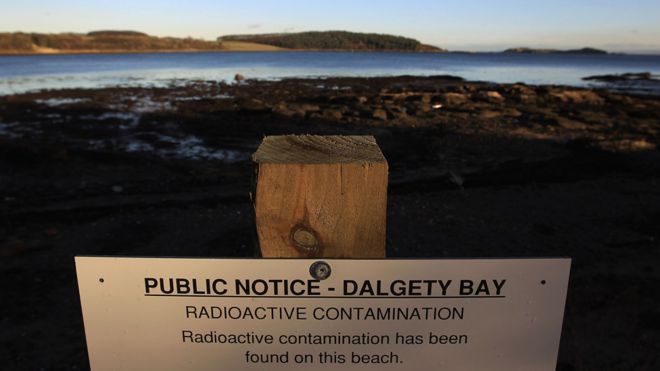
STV 13th Nov 2019, A clean-up operation to deal with radioactive contamination at a Fife beachis being held up by local landowners. Thousands of radioactive particles have been found on the shore at Dalgety Bay since 1990.
The objects are believed to come from eroded landfill that contains debris from Second World War aircraft that originally had radium dials. Stephen Ritchie told councillors: “We actually have had cabinet approval, ministerial approval – we have all the funding we need and authority to proceed. “However, the local stakeholders are dragging their feet. ”
We can’t get on the land to clean up the waste without the landowners’ permission. “There are four stakeholders for the area – one of which is the Crown, which is obviously not an issue. However, the other three have been dragging their feet.” Mr Ritchie told councillors that the MoD were looking to award the contract to a company to remove the waste by December 13, but if talks continued to stall, they could miss their window and the project would be delayed,meaning that the clean-up might not be able to happen in 2020.
https://stv.tv/news/east-central/1442361-work-to-clean-up-radioactive-beach-delayed-by-landowners/
Bulgaria nuclear reactor capacity reduced over generator malfunction
Bulgaria nuclear reactor capacity reduced over generator malfunction, SOFIA (Reuters) 18 Nov 19– Bulgarian nuclear power plant Kozloduy said on Saturday that its 1,000 MW Unit 5 was running at half capacity after one of its main circulation pumps shut down, activating the safety system.
1 This Month
19 November – Webinar – The Reality of Reprocessing
Time: 11:00 AM Pacific Time (US & Canada) / 2:00 PM Eastern / 7:00 PM UK / 8:00 PM CET
Register for the Zoom Event Here

Tell Congress: Prevent Nuclear Catastrophe in Iran

Tell Congress: Prevent Nuclear Catastrophe in Iran

Read the Public Inquiry Report, the Commissioners’ report, Surrendering Australia: The AUKUS Deception is available to download for free at aukuspublicinquiry.com. Or just watch the replay of the National Press Club Luncheon.


Shut down the radiation-damaged Heysham nuclear reactors now
To see nuclear-related stories in greater depth and intensity – go to https://nuclearinformation.wordpress.com

Say No to NASA’s Reckless Nuclear Reactor on the Moon
Say No to NASA’s Reckless Nuclear Reactor on the Moon
-
Archives
- November 2026 (178)
- October 2026 (302)
- September 2026 (339)
- August 2026 (330)
- July 2026 (355)
- June 2026 (287)
- May 2026 (306)
- April 2026 (356)
- March 2026 (251)
- February 2026 (267)
- January 2026 (308)
- December 2025 (358)
-
Categories
- 1
- 1 NUCLEAR ISSUES
- business and costs
- climate change
- culture and arts
- ENERGY
- environment
- health
- history
- indigenous issues
- Legal
- marketing of nuclear
- media
- opposition to nuclear
- PERSONAL STORIES
- politics
- politics international
- Religion and ethics
- safety
- secrets,lies and civil liberties
- spinbuster
- technology
- Uranium
- wastes
- weapons and war
- Women
- 2 WORLD
- ACTION
- AFRICA
- Atrocities
- AUSTRALIA
- Christina's notes
- Christina's themes
- culture and arts
- Events
- Fuk 2022
- Fuk 2023
- Fukushima 2017
- Fukushima 2018
- fukushima 2019
- Fukushima 2020
- Fukushima 2021
- general
- global warming
- Humour (God we need it)
- Nuclear
- RARE EARTHS
- Reference
- resources – print
- Resources -audiovicual
- Weekly Newsletter
- World
- World Nuclear
- YouTube
-
RSS
Entries RSS
Comments RSS

