Taxes, COVID-19 and nuclear weapons funding – America’s priorities
While dealing with the surreal impact of the current COVID-19 health crisis, the nuclear arms race forges ahead, spiraling out of control, as the U.S. pushes to lead the way in building a nuclear arsenal whose sole purpose — if it ever were to be used — is threatening to end life as we know it on our planet. Climate change is the second human-caused existential threat and is also connected to the threat of recurring pandemics and nuclear war.
The COVID-19 pandemic demands that we reassess our priorities through the lens of caring for one another and our basic human needs addressing income, health and environmental inequities across the nation that are so apparent at this time.
As the planet warms, habitat for animals, bacteria, parasites and viruses change — bringing the health of animals, humans and the planet into a new reality. In addition, climate changes human migration and resource availability, causing conflict which — under the right circumstances — can lead ultimately to war. We need to rethink how we spend our financial resources to address these interconnected issues.
Each year, Physicians for Social Responsibility Los Angeles publishes our Nuclear Weapons Community Costs Program. Now in its 32nd year, the program is used around the country to highlight the fiscal disparities in our communities and build support for nuclear weapons abolition work and for divestment from nuclear weapons — similar to what was done in South Africa to end apartheid.
As our nation grapples with the health and economic impacts of COVID-19, we continue to fund nuclear weapons programs — by our calculation — in the amount of $67.6 billion for fiscal year 2020.
These wasted expenditures deprive cities, counties and states across the nation of critical funds in the midst of this pandemic, compounding our ongoing daily health crisis dealing with nearly 90 million Americans without any, or with inadequate health insurance. The expenditures vary by community, as do each community’s financial needs.
Our nation’s capital will contribute in excess of $236 million for FY 2020 toward nuclear weapons programs. Large states like New York, and New Jersey — grappling with the devastation of COVID-19 and the inadequate resources to handle it — are spending in excess of $4.5 billion and $2.2 billion respectively, while California is spending over $8.7 billion on nuclear weapons programs, robbing their treasuries of critical funds necessary at this time. This is immoral, insane and wrong.
As physicians and health practitioners, we — just like our local elected officials — are first responders. The current pandemic with all of its global devastation pales by comparison with any nuclear conflict. Cities are being paralyzed as they try to deal with the crisis at hand. In a nuclear attack, there would be no adequate medical or public health response. The outcome is predictable and must be prevented.
The only way to prevent nuclear war is by the complete and verifiable abolition of nuclear weapons.
As with COVID-19, we must prevent that which we cannot cure. The world is moving to abolish nuclear weapons through the Treaty on The Prohibition of Nuclear Weapons, adopted at the U.N. in July 2017 and already ratified by 36 nations on its way to the 50 nations necessary to enter into force, like treaties dealing with all other weapons of mass destruction. The U.S. must take a leadership role to support this treaty and abide by our 50-year commitment under Article VI of the NPT Treaty to work in good faith to eliminate nuclear weapons. The rest of the world has grown weary and skeptical of the hollow promises of the U.S. and other nuclear nations to this obligation and are refusing to be held hostage any longer.
Shame on our legislative leaders for the continued funding of these weapons of mass destruction that have no utility and threaten our continued survival. There are no winners of nuclear war. In the words of our last great military General, President Dwight Eisenhower, “Every gun that is made, every warship launched, every rocket fired signifies, in the final sense, a theft from those who hunger and are not fed, those who are cold and are not clothed. This world in arms is not spending money alone. It is spending the sweat of its laborers, the genius of its scientists, the hopes of its children.”
We are one interconnected human family in this nation and on this planet — and at long last, it is time to recognize this fact. COVID-19 has made this imminently apparent. It is time to come together to abolish nuclear weapons and to direct the dollars wasted on them to address the economic, environmental and health inequities in our communities. We must all make our voices heard to prevent nuclear war, which would be the last epidemic.
Robert Dodge, M.D., is a family physician practicing in Ventura, Calif. He is the President of Physicians for Social Responsibility Los Angeles (www.psr-la.org), and sits on the National Board serving as the Co-Chair of the Committee to Abolish Nuclear Weapons of National Physicians for Social Responsibility (www.psr.org). Physicians for Social Responsibility received the 1985 Nobel Peace Prize and is a partner organization of ICAN, recipient of the 2017 Nobel Peace Price.
US. Dept of Energy wants to keep nuclear Waste Isolation Pilot Plant going till 2080

Federal agencies want to extend nuclear waste site to 2080 https://www.santafenewmexican.com/news/local_news/federal-agencies-want-to-extend-nuclear-waste-site-to-2080/article_acff4dbc-8573-11ea-93ac-2bea172dcd37.html By Scott Wyland swyland@sfnewmexican.com
- Apr 25, 2020 The more than 20-year-old nuclear waste disposal site in Southern New Mexico would remain active for at least 60 more years under a proposed permit renewal, reflecting the role of nuclear weapons in the country’s Cold War past and what many federal leaders envision for the future.
The Waste Isolation Pilot Plant’s permit is set to expire in 2024, but federal officials who oversee the nation’s nuclear programs believe the underground repository near Carlsbad can keep taking radioactive waste for decades to come.
Critics contend WIPP, where the waste is buried in salt beds 2,150 feet underground, should not operate beyond the 25-year life that was planned when it opened in 1999.
Yet federal agencies submitted a proposal calling for a permit renewal until 2080, Hancock said. And the latest proposal gives no date for when the permit extension would end, he said.
“So it’s WIPP forever,” he said.
WIPP has the word “pilot” in its name, which means it was supposed to be the first nuclear waste disposal site, not the only one, Hancock said.
Officials at the National Nuclear Security Administration, which oversees WIPP, did not provide answers Friday to questions about the site’s permitting, storage capacity and long-term future.
WIPP receives radioactive material from sources as varied as the decommissioned Hanford Site in Washington state and Los Alamos National Laboratory.
The Los Alamos lab’s legacy waste generated during the Cold War and Manhattan Project is sent to WIPP. If the lab and Savannah River Site in South Carolina ramp up nuclear-core production as planned by 2030, the new waste will go to WIPP.
The Department of Energy also wants to use WIPP as one of the sites to store 34 megatons of diluted plutonium waste. It’s unclear how much of the waste would go to WIPP.
The plan poses challenges, such as how to efficiently dilute the plutonium and how much storage space WIPP would have for the material, the National Academy of Sciences said in a 2018 report.
The 1992 Land Withdrawal Act limits WIPP to 6.2 million cubic feet of waste, or about 175,000 cubic meters.
It also restricts the storage to transuranic waste — from elements that have atomic numbers higher than uranium in the periodic table, primarily produced from recycling spent fuel or using plutonium to fabricate nuclear weapons. Taking in discarded plutonium would require Congress to amend the law, Hancock said.
But the Energy Department persuaded the state Environment Department in 2018 to change the calculation so the empty headspace in the containers isn’t counted.
Then, three weeks before Republican Gov. Susana Martinez left office at the end of 2018, the agency revised the permit to allow the Energy Department greater leeway in estimating WIPP’s remaining capacity. That included letting federal officials deduct a container’s headspace.
The Energy Department, in turn, estimated WIPP had only used about 40 percent of its capacity.
Hancock’s group and two other watchdogs filed a legal challenge, contending the methodology was invalid. They argued the original calculations based on container size should be used.
They also hoped Democratic Gov. Michelle Lujan Grisham’s administration would reverse the permit revision. But the administration has taken no action. When the federal government got plans for WIPP rolling in the 1980s, New Mexicans agreed to create a disposal site for nuclear waste for a limited time as a patriotic duty, said Joni Arends, executive director of Concerned Citizens for Nuclear Safety, one of the groups suing the Energy Department.
The effort to push WIPP’s operation beyond the original 25-year timeline and expand its limited capacity is “an affront to the promises made to New Mexicans,” Arends said. “It’s irresponsible on their part to say WIPP is going to stay open in perpetuity,” she added.
She questioned how WIPP could keep going for 60 more years when it’s already half-full after 17 years of operation.
WIPP lost almost three years of operations after the so-called kitty litter incident in 2014. That was when a Los Alamos lab container packed with a volatile blend of organic cat litter and nitrate salts burst, causing radiation to leak through the underground site.
The contamination, which cost about $2 billion to clean up, led to part of WIPP being sealed off. Crews are having to dig out more space in the salt beds to put waste containers, Arends said, so its footprint is growing.
There are also environmental concerns about disposing of massive nuclear waste at WIPP, she said. For instance, the waste, while embedded in the salt beds, could leach into subterranean clay seams linked to the Pecos River.
The Pecos connects to the Rio Grande, a source of drinking water in the region, she said.
“WIPP — it’s a complicated issue,” Arends said.
Trump administration to boost uranium mining, weaken environmental regulations
|
Trump officials pitch nuclear plan that would bolster struggling uranium industry, The Hill
BY REBECCA BEITSCH – 04/23/20 The Trump administration on Thursday outlined its plan for revitalizing the U.S. nuclear energy industry in a move that would boost uranium mining while benefiting just a handful of companies.The report from the Nuclear Fuel Working Group includes a set of recommendations to the White House and comes as the price of uranium has steadily fallen over the past decade. he effort to shore up nuclear power is sure to be controversial. Uranium mining has been floated in sensitive areas, including land near the Grand Canyon. …. Nuclear energy has also struggled to remain competitive with other energy sources, leaving some states to bail out nuclear reactors to the tune of tens of millions of dollars to keep them afloat…. To revitalize the industry, however, the new report backs President Trump’s proposal to spend $150 million on a uranium reserve, which would buy U.S.-mined uranium from the small number of domestic producers. The Uranium Producers of America identifies just eight members on its website……. Also at risk is nearly 1,562 square miles just outside the boundaries of the Grand Canyon that since 2012 have been off limits for production. Critics have worried Trump might seek to overturn that ban since he declared uranium a critical mineral for national security purposes at the end of 2017. Some uranium mining companies already own some of that land, and there’s been a push from some Republicans lawmakers to open the area for mining. “It’s despicable to risk irreversible harm to spectacular wild places by propping up uranium companies that can’t compete in global markets,” Taylor McKinnon with the Center for Biological Diversity said in a statement Thursday…….. The report published Thursday, however, calls for “expand[ing] access to uranium deposits on federal lands, including support for necessary legislation” and reconsidering categorical exclusions that bar mining in certain areas. It also recommends overhauling regulations to more quickly spur any number of nuclear projects and easing requirements under the National Environmental Policy Act (NEPA). The Trump administration has already proposed a major rollback of NEPA that is set to be finalized in the coming months, including provisions that give companies a greater role in assessing the environmental safety of their own projects. The report also identified potential new financing sources for nuclear projects, like the Export-Import Bank, and changing “legacy policies that disallow support for nuclear projects” to open up financing from the U.S. International Development Finance Corporation…… https://thehill.com/policy/energy-environment/494315-trump-officials-pitch-nuclear-plan-that-would-bolster-struggling |
|
Trump’s new uranium plans threaten Grand Canyon area
|
New Trump Nuclear Plan Favors Uranium Mining Bordering the Grand Canyon, The administration, seeking to restore America’s “competitive nuclear advantage,” also wants to create a $150 million uranium reserve in the coming decade. Inside Climate News, Judy Fahys APR 26, 2020
Evergreen forests blanket the Grand Canyon’s less traveled northern plateau, and the perfume of Ponderosa pine drifts down a creekbed to the bottom of the great redrock canyon. Downstream, the strangely blue waters of the Little Colorado River meet the main Colorado, coming from the southern plateau close to sacred places for indigenous people who have lived here for centuries.
Both plateaus are also where mining companies want to unearth uranium. Mining those claims has been barred since 2012, when Congress imposed a 20-year mining ban across 1,000 acres here because past uranium extraction has polluted drinking water and poisoned the air and the ground. Local tribes and environmental groups that sought the temporary ban have been pressing Congress to make the ban permanent. But in a sweeping plan to revive the domestic uranium mining industry unveiled Thursday, the Trump administration proposed instead to open the scenic and sacred areas once again in the name of economic vitality and national security. Allowing more uranium mining on federal lands is just one of the suggestions that emerged from an eight-month review by the White House Nuclear Fuel Working Group. Proposals outlined in the Restoring America’s Competitive Nuclear Advantage report quickly triggered criticism. Some environmentalists say that the administration shouldn’t propose using taxpayer funds during a pandemic to bail out a dirty, uncompetitive industry that’s largely owned by foreign companies. ….. |
|
France: The Forgotten Nuclear Power That Could Kill Billions of People
|
France: The Forgotten Nuclear Power That Could Kill Billions of People
Paris might not have a massive stockpile of nukes, but they could do some serious damage if need be. National Interest, by Caleb Larson, 26 Apr 20, The French nuclear arsenal is pretty substantial, with air- and sea-based components. Here is a breakdown of French nuclear capabilities. Nuclear Dyad Unlike the United States or Russia, who maintain a nuclear triad of land-based, submarine-launched, and air-launched missiles, France has a dyad of submarines that can launch nuclear ballistic missiles and a stockpile of air-launched nuclear cruise missiles. M51 Ballistic Missile The M51 is the heart of French nuclear deterrence at sea. Each missile has six to ten Multiple Independent Reentry Vehicles (MIRVs), and each of those MIRVs is guessed to be in the 75 to 110 kiloton range. Its range is estimated at 8,000 kilometers, or just under 5,000 miles and the missiles are launched from the nuclear-powered Triumphant-class submarines. Air-Sol Moyenne Portée The Air-Sol Moyenne Portée is the air-launched component of French strategic deterrence. The missiles play a unique role in French deterrence, where their use would be considered a warning shot of sorts before the more widespread use of nuclear weapons would be used in a conflict. …….. Hadès The Hadès missile system was at one point a land-based component of French strategic deterrence — though only at the tactical, not strategic level, due to the system’s relatively short 480 kilometer, or about 300 mile range……. https://nationalinterest.org/blog/buzz/france-forgotten-nuclear-power-could-kill-billions-people-148396 |
|
The end of reprocessing spent nuclear fuel has left an expensive UK plutonium stockpile with no peaceful use
 UK plutonium stockpile is a costly headache, https://climatenewsnetwork.net/uk-plutonium-stockpile-is-a-costly-headache/ April 23rd, 2020, by Paul Brown, The end of reprocessing spent nuclear fuel has left an expensive UK plutonium stockpile with no peaceful use LONDON, 23 April, 2020 − For 70 years Britain has been dissolving spent nuclear fuel in acid, separating the plutonium and uranium it contains and stockpiling the plutonium in the hope of finding some peaceful use for it, to no avail: all it has to show today is a UK plutonium stockpile. To comply with its international obligations not to discharge any more liquid radioactive waste into the Irish Sea, the United Kingdom government agreed more than 20 years ago under the Ospar Convention on the protection of the north-east Atlantic to shut its nuclear fuel reprocessing works at Sellafield in northwestern England at the end of this year. As well as 139 tonnes of plutonium, which has to be both carefully stored to prevent a nuclear chain reaction and protected by armed guards as well, to avoid terrorist attack, there are thousands of tonnes of depleted uranium at Sellafield. The reprocessing plant shut down prematurely as a result of a Covid-19 outbreak among its employees, and most of the 11,500 workers there have been sent home, leaving a skeleton staff to keep the site safe. Whether the plant will be restarted after the epidemic is unknown. Fewer than half Sellafield’s workers are involved in reprocessing. Most are engaged in cleaning up after decades of nuclear energy generation and related experiments. There are 200 buildings at the massive site, many of them disused. It costs British taxpayers around £2.3 billion (US$2.8bn) a year to run Sellafield and keep it safe. Solution needed soon While the British government has been reluctant to make any decision on what to do about its stockpiled plutonium and uranium, the Bulletin of the Atomic Scientists has expressed alarm about the danger it poses. “The United Kingdom has to find a solution for its plutonium stockpile, and quickly,” its report says. The scientists point out that there is enough plutonium to make hundreds of thousands of nuclear weapons, and that it is a permanent proliferation risk. The annual cost of £73m to keep the plutonium safe is dwarfed by the much larger cost of trying to make safe the whole site with its thousands of tonnes of nuclear waste. The Bulletin reports that the original reason for the reprocessing works was to produce plutonium for nuclear weapons. The UK supplied the US at times, as well as producing its own weapons. A 2014 agreement between the British and US governments gives an outline of the nuclear links which then existed between them.
For decades there were also plans to use plutonium in fast breeder reactors and to blend it with uranium to make Mixed Oxide Fuel (MOX) . This was a time when governments believed that the world’s supply of uranium would run out and that re-using it with plutonium would be a way of generating large amounts of electricity, as a way to avoid burning fossil fuels and as part of the solution to climate change. MOX was one possible fuel. Using recycled plutonium in fast breeder reactors was another possibility. And a third option was new-style reactors that burned plutonium, theoretically possible but never built. But uranium did not run out, and MOX did not prove economic. It and the new reactors proved so technically difficult they were abandoned. Despite these setbacks, successive British governments have continued reprocessing, always refusing to class plutonium as a waste, while still exploring ways of using it in some kind of new reactor. This is likely to remain the official position even after reprocessing ends in December. The UK’s Nuclear Decommissioning Authority, the agency that runs Sellafield, faced by this indecision, continues to store the plutonium behind three barbed-wire barricades, guarded by the only armed civilian police force in the country. Here to stay? One of the tricky political problems is that 23 tonnes of the plutonium is owned by Japan, which sent its spent fuel to be reprocessed at Sellafield but is unable to use the recycled material, which cannot be returned to Japan in its current state because of nuclear proliferation concerns. Despite these setbacks, successive British governments have continued reprocessing, always refusing to class plutonium as a waste, while still exploring ways of using it in some kind of new reactor. This is likely to remain the official position even after reprocessing ends in December. The UK’s Nuclear Decommissioning Authority, the agency that runs Sellafield, faced by this indecision, continues to store the plutonium behind three barbed-wire barricades, guarded by the only armed civilian police force in the country. Here to stay? One of the tricky political problems is that 23 tonnes of the plutonium is owned by Japan, which sent its spent fuel to be reprocessed at Sellafield but is unable to use the recycled material, which cannot be returned to Japan in its current state because of nuclear proliferation concerns. |
|
New tsunami estimates for megaquakes off Japan

April 21, 2020
A Japanese government panel says tsunami waves measuring more than 20 meters high could hit northern Japan if a megaquake of magnitude 9 or stronger occurs in one of two deep-sea trenches.
The government panel has been studying the possible scale of an earthquake, and tsunami waves it could trigger, in either a part of the Chishima Trench or the Japan Trench. The targeted area of the Chishima Trench extends from the Kuril Islands to Hokkaido while the area of the Japan Trench extends from Hokkaido to Iwate Prefecture. The study began after the 2011 disaster in northeastern Japan.
The panel’s latest estimate says a quake along the Chishima Trench would have a magnitude of 9.3.
Parts of eastern Hokkaido would be hit by tremors with an intensity of six-plus to seven on the Japanese scale of zero to seven.
A wide area of eastern Hokkaido would see tsunami more than 20 meters high. Waves could reach 27.9 meters in the town of Erimo.
A quake along the Japan Trench would have a magnitude of 9.1. Parts of Aomori and Iwate prefectures could have tremors with an intensity of six-plus.
Tsunami waves would top ten meters in northeastern Japan. Hachinohe City in Aomori Prefectures would be hit by tsunami as high as 26.1 meters, and Miyako City in Iwate Prefecture as high as 29.7 meters. Some areas could be hit by waves higher than those that struck in 2011.
As these areas have had powerful earthquakes in the past, the panel says massive tsunami can strike at any time.
The Cabinet Office plans to estimate the extent of damage and draw up disaster control measures based on these new figures by the end of March next year.
North Korea already has its nuclear arsenal. even if Kim should die.
|
Even if Kim Jong Un dies, he has given North Korea the nuclear arsenal it needed to deter the U.S.
While North Korea is still among the world’s most impoverished nations, living standards are rising for the ruling elite in Pyongyang. Kim has shown he can endure crushing economic sanctions,National Post, Bloomberg News, Jihye Lee and Jon Herskovitz, April 23, 2020 Whatever the state of Kim Jong Un’s health, he has already put North Korea in its strongest position to resist U.S. pressure in decades. Eight years after Kim filled the power vacuum left by the death of his reclusive father, Kim Jong Il, North Korea is more secure and less isolated. The 36-year-old supreme leader has achieved two key marks of legitimacy long sought by his predecessors: a nuclear arsenal that can credibly deter an American attack and a personal relationship with the U.S. president, including three face-to-face meetings with Donald Trump. While North Korea is still among the world’s most impoverished nations, living standards are rising for the ruling elite in Pyongyang. Kim has shown he can endure crushing economic sanctions, illustrated by a United Nations report published Tuesday accusing the regime of widespread evasion. Moreover, the Kim dynasty holds a renewed pledge of strategic support from its ultimate guarantor, China. “The country has pole-vaulted in their nuclear-destruction potential and missile-delivery capabilities compared to capabilities under grandfather or father Kim,” said Soo Kim, a Rand Corp. policy analyst who specializes in Korean peninsula issues. “The specter of a North Korean nuclear attack breeds enough unease in the international community to lean more towards accommodation than confrontation.”…….. North Korea has given up little since Kim’s unprecedented handshake with Trump almost two years ago in Singapore. Besides halting launches of missiles that can reach the U.S. mainland and demolishing some testing facilities, Kim has signed only a vaguely worded pledge to “work toward complete denuclearization of the Korean Peninsula.” …… https://nationalpost.com/news/world/despite-kim-jong-un-health-north-korea-has-little-to-worry-about-u-s-sanctions |
|
|
France’s nuclear company EDF in spiralling debt crisis
|
New York Times 22nd April 2020, Plummeting electricity demand and falling power prices during the coronavirus outbreak could leave EDF in need of a capital injection by the
end of 2020 to avoid a spiralling debt crisis, a source close to the French firm and analysts said. The state-controlled utility, which operates the
world’s largest nuclear fleet, has long been weighed down by a 41.1 billion-euro debt pile. Shrinking income due to the health crisis and likely delays in reforming France’s electricity market, which could have boosted the firm’s earnings power, are now adding to its challenges and pressuring its financial ratios. A source close to EDF’s management said
the company may need a capital injection towards the end of the year to cushion the shock, with one analyst putting the size of any rights issue at several billion euros. |
|
Latest delay in Olkiluoto nuclear fuel loadings leads to Fitch revising outlook to negative
|
Fitch 20th April 2020, Fitch Ratings has revised Teollisuuden Voima Oyj’s (TVO) Outlook to
Negative from Stable and affirmed the Long-Term Issuer Default Rating (IDR) at ‘BBB-‘. The Negative Outlook reflects the latest announced delay of fuel
loading, a critical milestone, at the third 1,600 MW nuclear plant Olkiluoto 3 (OL3) project caused by overall slow progress of works as well as disruption due to the coronavirus outbreak. There is a risk that the settlement agreement signed with the supplier consortium (Areva NP, Areva GmbH, Siemens AG (A/Stable) and Areva Group’s parent Areva SA) in March
2018 would not protect TVO from financial impacts should the start of power production be delayed beyond June 2021, because the consortium has not yet assigned a new date for the fuel loading. After this date, TVO would not be entitled to penalty payments from the supplier consortium under the settlement agreement anymore. |
|
European Solar Generation Breaks Records, As Coronavirus Shutdowns Reduce Air Pollution
|
As Coronavirus Shutdowns Reduce Air Pollution, European Solar Generation Breaks Records, 360 Yale, 23 Apr 20, Three of Europe’s biggest economies — Germany, Spain, and the United Kingdom — have recently achieved new records in solar generation, due in part to a drop in air pollution from coronavirus-related shutdowns, which has cleared skies and boosted production of photovoltaic cells, Greentech Media reported.
Germany generated a record-high 32.2 gigawatts (GW) of solar power earlier this week, accounting for 40 percent of the country’s electricity needs, according to Bloomberg News. And UK solar production peaked at 9.68 GW this week, up from a previous record of 9.55 GW set in May 2019, according to Sheffield Solar, a project of the University of Sheffield. In total, the UK has gone without coal power on its grid for nearly two weeks….. Spain’s record-high solar production is the result of last year’s boost in installations, which expanded new capacity by 4.7 gigawatts. On March 26, Spain generated 6.3 GW of solar power, accounting for about a quarter of the country’s electricity needs. https://e360.yale.edu/digest/as-coronavirus-shutdowns-reduce-air-pollution-european-solar-generation-breaks-records |
|
|
Members of Congress from Massachusett want details on how Seabrook Nuclear Power Plant is handling COVID-19.
Mass. Delegation Seeks Details on Seabrook Nuclear Plant’s Pandemic Operations, https://www.nhpr.org/post/mass-delegation-seeks-details-seabrook-nuclear-plants-pandemic-operations#stream/0 By ANNIE ROPEIK • APR 22, 2020 Members of Congress from Massachusetts want details on how Seabrook Nuclear Power Plant is handling COVID-19.
Seabrook Station is currently offline and in the midst of a periodic refueling. That process requires a large extra workforce.
The plant’s owner, NextEra, has said it’s operating under its pandemic plan but it hasn’t offered more details.
Now, Massachusetts U.S. Sens. Elizabeth Warren and Ed Markey and Congressman Seth Moulton of Salem, Mass., are asking for that plan. The delegation wrote to NextEra and the Nuclear Regulatory Commission this week. They also want details on any federal coronavirus exemptions that NextEra is planning to request.
Activists with Seabrook watchdog groups like C-10 have raised similar concerns in recent weeks, about how the pandemic may affect the plant or put workers at risk.
Federal regulators have already said some nuclear plants can ask to have employees work longer shifts during the pandemic.
Earth Day 2020: Climate change would be small fry compared to nuclear war
 Earth Day 2020: Climate change would be small fry compared to nuclear war https://www.pressenza.com/2020/04/earth-day-2020-climate-change-would-be-small-fry-compared-to-nuclear-war/
21.04.2020 – Abolition 2000, On this Earth Day 2020, members of the Abolition 2000 coodinating committee and others have written a statement in support of the need to address the triple threats facing humanity today: climate change, global pandemics and nuclear devastation. The statement is open for signatories by anyone who would like to endorse it. It highlights the fact that although climate change is a huge threat to human civilization given that a tipping point could be reached at any time, and covid-19 is killing thousands of people every day, a nuclear war has the capability to destroy civilization in a matter of days.
Addressing the threats to Planetary Survival
Earth Day 2020 sign on statement from members of the Abolition 2000 global network to eliminate nuclear weapons
The year 2020 marks the 50th Anniversary of Earth Day[i] and finds the planet facing existential threats like never before in human history.
The threat from climate change is manifesting itself more and more strongly as the years go by through extreme weather events, forest fires on a vast scale, the bleaching of coral reefs, and receding glaciers, among others. This year also sees the world facing a pandemic which, as we speak, is costing thousands of lives every day and seems likely to have an impact on our civilization for years, if not decades to come.
Alongside these threats to human existence, however, is the lesser-considered, but more dangerous threat from nuclear disaster, and in this context we recall that the year 2020 also marks the 75th anniversary of the U.S. atomic bombs dropped on Hiroshima and Nagasaki, killing an estimated 500,000 people either through immediate incineration by the blast or subsequent death over the following months and years from agonising radiation poisoning[ii]. 2020 also marks the 75th anniversary of the establishment of the United Nations to “save succeeding generations from the scourge of war,” by putting in place the common security mechanisms to achieve this. Unfortunately, the end of the 2nd World War also kicked off a race for nations to develop nuclear technology that has the possibility to inflict a more devastating blow to the planet in 10 days than climate change will have in 100 years.
Today, some 14,000 nuclear weapons – most of which are vastly more powerful than the bombs that destroyed Hiroshima and Nagasaki – continue to pose an intolerable threat to humanity as identified by Atomic Scientists who judge the planet to be a symbolic 100 seconds to midnight on their doomsday clock[iii]. These weapons, thousands of which can be launched within minutes of the order being given, are in the hands of sometimes erratic leaders who cannot be trusted to put the wellbeing of the planet ahead of their own domestic agendas. Research published in 2013 by International Physicians for the Prevention of Nuclear War concludes that up to 2 billion people would be at risk of starvation in a nuclear conflict consisting of the use of only 100 nuclear warheads[iv], and evidence from the ICRC showed that there is no capacity to provide humanitarian assistance in the case of nuclear bombs used in populated areas[v], either.
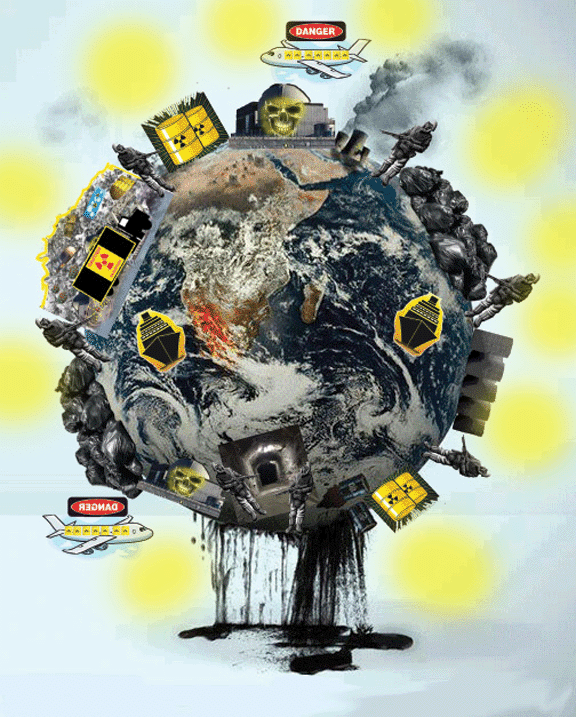 In addition, the over 400 nuclear power stations distributed all over the planet are capable of poisoning the entire planet with toxic radioactive waste that needs to be stored safely for 250,000 years. Each one of these stations is an accident waiting to happen and a potential terrorist threat. Over the last 50 years in which Earth Day has been marked, we have seen dramatic accidents at reactors in Three Mile Island, Chernobyl and Fukushima. At the time of writing, forest fires around Chernobyl are cause for concern as they approach the reactor location, and the fires themselves are re-releasing into the atmosphere the radioactive material previously absorbed by trees and other plants since the reactor exploded[vi].
Colonised and indigenous peoples have, in the large part, borne the brunt of nuclear devastation – from the mining of uranium and the testing of nuclear weapons on indigenous peoples land, to the dumping, storage and transport of plutonium and nuclear wastes, and the theft of land for nuclear infrastructure.[vii]
On this Earth Day, as the world faces the triple threats of climate change, virus pandemic and nuclear oblivion, we  call on all people of good faith around the world to come together and construct the foundations of a new world: a world without nuclear weapons and nuclear energy, a sustainable world in which the land, oceans, atmosphere, glaciers, wildernesses, flora and fauna in all its diversity can recover, and an equitable world with an economic system that provides a dignified life for all the planet’s inhabitants.
An essential part of this new world will be better implementation of the UN Charter prohibition on war and the utilisation of diplomacy and law to resolve international disputes. It will also require redirection of military spending towards human security, the elimination of nuclear weapons, the rapid phasing out of nuclear power, and a turn to clean, safe renewable energy sources.[viii][ix]
As a species, we have the capability of doing this, and the current global crisis is the wake-up call we need in order to make a better world for all.
We, the undersigned, are ready to do our part. Who is with us?
Click here to add your name to the list of signatories
Click here to view the full list of signatories
[i] https://www.earthday.org/earth-day-2020/
[ii] https://www.pressenza.com/2019/07/interview-with-kathleen-lawand-international-committee-of-the-red-cross/
[iii] https://thebulletin.org/2020/01/press-release-it-is-now-100-seconds-to-midnight/
[iv] https://www.ippnw.org/pdf/nuclear-famine-two-billion-at-risk-2013.pdf
[v] https://www.regjeringen.no/globalassets/upload/ud/vedlegg/hum/hum_malich.pdf
[vi] https://www.bbc.co.uk/news/world-europe-52274242
[vii] http://www.abolition2000.org/en/resources/newsreleasesstatements/moorea-declaration/
[viii] http://www.abolition2000.org/a2000-files/sustainable-now.pdf
[ix] https://www.irena.org/newsroom/pressreleases/2020/Apr/Renewable-energy-can-support-resilient-and-equitable-recovery
EDF nuclear power company looks to a profitable future in small-scale, distributed RENEWABLE energy
 Can EDF Make Big Money in Small-Scale Renewables?, Greentech Media
The world’s leading nuclear power generator is betting big on a future of small-scale, distributed energy.
Électricité de France operates 58 nuclear reactors in its home country and owns stakes in several U.S. nuclear plants that it’s now moving to sell. But EDF’s biggest stamp on the American power market has come in large-scale renewables: Its San Diego-based EDF Renewables North America subsidiary has developed and now operates gigawatts of wind and solar farms across the country.
Now, EDF Renewables is trying to replicate that success on a much smaller scale. How it fares in the distributed space will be of great interest to other 20th-century energy giants feeling their way toward a transformed, low-carbon future.
Over the past few years, and largely through acquisitions, EDF Renewables has amassed one of the most comprehensive U.S. distributed energy businesses, covering solar, energy storage, microgrids and electric vehicle chargers.
The coronavirus crisis may open the door to more dealmaking, said Raphael Declercq, who runs the Distributed Solutions unit at EDF Renewables North America. “There will be some casualties in our sector: Assets seemed overpriced up to a month ago; that may change and we may be able to grow through acquisitions,” Declercq told GTM.
Several European energy giants have been on a recent shopping spree for distributed energy companies in the startup-rich U.S. — notably Shell, EDF and Enel. Without their own U.S.-based utilities to worry about taking business from, they can roll up fleets of behind-the-meter energy assets and deliver power to customers in new ways, while learning lessons that can be applied in other markets.
“It’s a grab game right now, getting as much of that value chain as possible,” said Elta Kolo, content lead for grid edge research at Wood Mackenzie. “In a way, you’re almost seeing a new type of utility emerging in the market,” she said.
It’s a hazardous moment for the energy industry, oil companies and utilities alike. State-controlled EDF last week pulled its financial guidance for 2020 and 2021, saying it expects a sharp drop in its French nuclear output this year as the coronavirus outbreak depresses power demand…….
The rising importance of corporate renewables…….
16 hour days, 86 hour weeks for nuclear workers, amid pandemic panic?
 Nuclear agency clears way for long days, weeks for Palo Verde employees, azfamily.comMorgan Loew 22 Apr 20, PHOENIX (3TV/CBS 5) – The Nuclear
 Regulatory Commission has given the operator of the Palo Verde Nuclear Generating Station permission to work its employees 16 hours per day and as many as 86 hours in a week, according to a letter from the NRC obtained by CBS 5 Investigates.
“Palo Verde Generating Station requested and received this exemption from the Nuclear Regulatory Commission early and proactively so that the option to modify work hours is immediately available in response to an extreme circumstance. Work schedules are not changing at this time, nor is a change imminent,” stated Jill Hanks in an email. She is a senior communications consultant at APS…..
environmentalists, like Steve Brittle from Don’t Waste Arizona, say they don’t think exemptions like these are a good idea. “All of the money this industry has, this is the best they can do?” said Brittle.
He said he only found out about the changes because of a standing records request he has on file with the NRC. “Government agencies as well as potential polluters – they all need to have somebody watching over them,” said Brittle.
The NRC has granted similar exemptions to other nuclear reactors across the country and allowed some facilities to postpone scheduled maintenance. Environmental groups warn that reducing maintenance, worker’s protections, and oversight could lead to accidents.
Morgan Loew’s hard-hitting investigations can be seen weekdays on CBS 5 News at 6:30 p.m. and 10 p.m.https://www.azfamily.com/news/investigations/cbs_5_investigates/nuclear-agency-clears-way-for-long-days-weeks-for-palo-verde-employees/article_116ace1e-844a-11ea-890d-b3c0d57fab8c.html
1 This Month

Tell Congress: Prevent Nuclear Catastrophe in Iran

Tell Congress: Prevent Nuclear Catastrophe in Iran

Read the Public Inquiry Report, the Commissioners’ report, Surrendering Australia: The AUKUS Deception is available to download for free at aukuspublicinquiry.com. Or just watch the replay of the National Press Club Luncheon.

19 November – Webinar – The Reality of Reprocessing
Time: 11:00 AM Pacific Time (US & Canada) / 2:00 PM Eastern / 7:00 PM UK / 8:00 PM CET
Register for the Zoom Event Here


Shut down the radiation-damaged Heysham nuclear reactors now
To see nuclear-related stories in greater depth and intensity – go to https://nuclearinformation.wordpress.com

Say No to NASA’s Reckless Nuclear Reactor on the Moon
Say No to NASA’s Reckless Nuclear Reactor on the Moon
-
Archives
- November 2026 (147)
- October 2026 (302)
- September 2026 (339)
- August 2026 (330)
- July 2026 (355)
- June 2026 (287)
- May 2026 (306)
- April 2026 (356)
- March 2026 (251)
- February 2026 (267)
- January 2026 (308)
- December 2025 (358)
-
Categories
- 1
- 1 NUCLEAR ISSUES
- business and costs
- climate change
- culture and arts
- ENERGY
- environment
- health
- history
- indigenous issues
- Legal
- marketing of nuclear
- media
- opposition to nuclear
- PERSONAL STORIES
- politics
- politics international
- Religion and ethics
- safety
- secrets,lies and civil liberties
- spinbuster
- technology
- Uranium
- wastes
- weapons and war
- Women
- 2 WORLD
- ACTION
- AFRICA
- Atrocities
- AUSTRALIA
- Christina's notes
- Christina's themes
- culture and arts
- Events
- Fuk 2022
- Fuk 2023
- Fukushima 2017
- Fukushima 2018
- fukushima 2019
- Fukushima 2020
- Fukushima 2021
- general
- global warming
- Humour (God we need it)
- Nuclear
- RARE EARTHS
- Reference
- resources – print
- Resources -audiovicual
- Weekly Newsletter
- World
- World Nuclear
- YouTube
-
RSS
Entries RSS
Comments RSS

