Purpose of nuclear bombing of Nagasaki? to test a new weapon – an immoral purpose
 Harry Truman and the nuclear bombs dropped on Hiroshima and Nagasaki, Frank Jackson, 9 Aug 20 Whether the bombing of Hiroshima or the entry of the Soviet Union into the war was the crucial event in causing the Japanese surrender can never be conclusively settled (Hiroshima at 75: bitter row persists over US decision to drop the bomb, 5 August). However, very little is said about the motives for the second bomb, on Nagasaki three days later. Few argued that it was necessary to reinforce the message of Hiroshima. Rather, the military and scientific imperative was to test a different bomb design – “Fat Man”, an implosion type using plutonium, as opposed to the uranium of Hiroshima’s “Little Boy”. To my mind that, destroying a mainly civilian city for such reasons, makes it even more of a war crime, if that is possible, than the bombing of Hiroshim.a
Former co-chair, World Disarmament Campaign https://www.theguardian.com/world/2020/aug/07/harry-truman-and-the-nuclear-bombs-dropped-on-hiroshima-and-nagasaki
Trump administration keen for nuclear power, – so is Joe Biden
 Trump Administration Pivots To Nuclear Energy, Finds Lever Against China, Russia, Forbes, Dipka Bhambhani, 9 Aug 20, Expanding U.S. commercial nuclear power abroad could become the Trump administration’s strongest lever against Chinese hegemony and Russian expansion in the global market. The U.S. Department of Energy, which is leading the national initiative, is on an aggressive timeline—five to seven years—to bring new advanced nuclear reactors for electric power to the international market. A senior Energy Department official told Forbes it’s a matter of national security……. a year ago, President Trump asked his Energy Secretary, Dan Brouillette, to assemble a nuclear energy working group to find ways to expand the U.S. nuclear energy industry in an effort to compete globally. ……
This May, DOE released Restoring America’s Competitive Nuclear Energy Advantage, a blueprint to transform a U.S. nuclear industry notorious for massive facilities, long construction timelines, cost overruns and a sour public opinion.
Baranwal has launched the $230 million Advanced Reactor Demonstration Program (ARDP) currently calling on the U.S. private sector to apply to demonstrate they can construct smaller, more efficient, more affordable advanced reactors that can be commercially available within five to seven years. Applications are due August 12.
…..the issue is bipartisan, giving it breath to continue regardless of who wins in the presidential election in November.
For about a dozen years, the U.S. government poured money into nuclear energy research and development (R&D) at DOE’s national laboratories. Now, the U.S. government will use those existing platforms, resources, materials and expertise to help commercialize private sector innovation and bring new nuclear reactors to the world market. ……. Government Financing for Nuclear is Lining Up DOE’s blueprint tacitly instructed the U.S. Development Finance Corporation (DFC), formerly the Overseas Private Investment Corporation, to remove legacy policies that prevented it from investing in nuclear power projects overseas. A few weeks ago, DFC did just that. It said it would “prioritize support of advanced nuclear technology in emerging and frontier markets that adheres to the highest safety standards.” DOE also cited a role for the U.S. Export-Import Bank (EXIM Bank). Last November, Republican and Democratic lawmakers agreed to President Trump’s request to reauthorize the country’s export credit agency. EXIM Bank is chartered to finance and facilitate the sale of U.S.-made products for export. Forbes reported extensively on the long-term value of the reauthorization, proving useful for global nuclear energy. …… Chinese officials told Forbes the country would be willing to sign new 123 agreements with the U.S. and welcomes continued cooperation, not an adversarial relationship. China and the U.S. established a 123 agreement about two decades ago led by the DOE’s assistant secretary of international affairs in the Clinton administration, Robert Gee, now president of Gee Strategies Group in Washington. Zheng Dongdong, director of China’s Department of Energy Research, said, “Nuclear energy expansion is a global issue that should be considered with global perspective.” Zheng is also China’s assistant secretary-general of the Energy Investment Professional Committee under the Investment Association of China, an administrative arm of China’s Ministry of Civil Affairs, which promotes global investment in China. Zheng said the energy relationship with the U.S. has not always been strained. In 2007, China, the United States, France, Japan, and Russia jointly established the Global Nuclear Energy Partnership, a multilateral effort to share R&D of advanced nuclear energy technologies, adopt safe, reliable global nuclear energy power systems and promote nonproliferation. “This is a good platform and a very effective means to strengthen global nuclear energy cooperation,” Zheng said…… https://www.forbes.com/sites/dipkabhambhani/2020/08/07/trump-administration-pivots-to-nuclear-energy-finds-lever-against-china-russia/#70baa6f547b1 |
|

Nuclear bomb devastation killed ove 90% of the doctors and nurses in Hiroshima
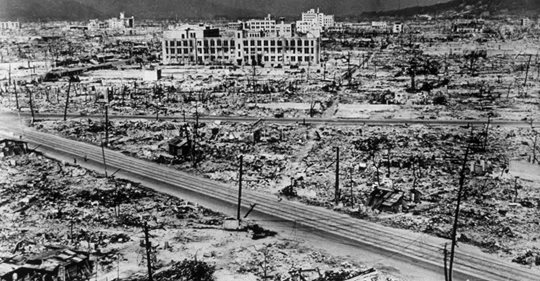
The horrific impact of the bomb was exacerbated by the fact that more than 90 percent of Hiroshima’s doctors and nurses were killed or injured by the bomb, while the blast left 42 out of 45 of the city’s civilian hospitals and two large army hospitals non-functional, according to the The International Campaign to Abolish Nuclear Weapons (ICAN).
This meant it was nearly impossible for the scores of injured to access aid, and most died without any care to ease their suffering from severe burns and radiation poisoning.
Before the attack Hiroshima had around 200 doctors, but the vast majority perished leaving only about 30 physicians who were able to perform their normal duties, according to a report created by the United States Strategic Bombing Survey.
Furthermore, more than 1,600 nurses out of nearly 1,800 were also killed, while medical stocks and supplies were also mostly destroyed.
Any hospitals within around 3,000 feet of ground zero were completely destroyed with almost everyone in them dying.
Two other large hospitals made from reinforced concrete that were located nearly 5,000 feet from the blast’s epicenter remained standing. However, the interiors suffered severe damage and around 90 percent of the occupants died, with many killed due to falling plaster, flying glass and fire.
Several medical centers that were located more than 7,000 feet away from ground zero also remained standing, although many were so badly damaged that they were not able to function.
The lack of medical facilities and staff only served to exacerbate the situation, as one eyewitness to the aftermath, Father Siemes, a German-born Jesuit professor who was in Hiroshima when the bomb fell, described, recounting the scene at an improvised first aid station.
“Iodine is applied to the wounds but they are left uncleansed. Neither ointment nor therapeutic agents are available. Those that have been brought in are laid on the floor and no one can give them any further care. What could one do when all means are lacking? Among the passersby, there are many who are uninjured,” he wrote.
“In the official aid stations and hospitals, a good third or half of those that had been brought in died. Everything was lacking, doctors, assistants, dressings, drugs, etcetera.”
Medical help had to be sent into the city from the outside, however, this took some time to arrive and several individuals who came to assist also ended up dying due to the high levels of lingering radiation.
On the 75th anniversary of the bombing, the International Physicians for the Prevention of Nuclear War (IPPNW), the only international medical organization dedicated to the abolition of nuclear weapons, told Newsweek that there can be “no useful medical response” to even a single nuclear attack on one city in their view.
“The infrastructure necessary would be destroyed and the personnel needed would be killed or badly wounded,” Chuck Johnson, IPPNW Director of Nuclear Programs, said. “Even a relatively small nuclear war would have atmospheric effects beyond the immediate blast, fire, and radiation, which could threaten billions of people with starvation due to crop failure. An all out nuclear war between the U.S. and Russia would end civilization and threaten to extinguish all human life.”
“We agree with President Reagan’s statement that ‘nuclear war can never be won and must never be fought,’ and are greatly concerned by the growing development of a new nuclear arms race among the nine nuclear weapons states.”
However, Johnson said the organization was “greatly encouraged” on the 75th anniversary of the first nuclear weapons attack on a human population, that three more nations—Nigeria, Ireland, and Niue—have become states parties to the UN Treaty on the Prohibition of Nuclear Weapons. This leaves only seven more states to submit ratification papers for the nuclear ban treaty to enter into force.”
“We look forward to the day when the UN declares that rogue nations which persist in developing and possessing nuclear weapons must listen to the world community and cease their activities which threaten all of us.”
Russia will regard any incoming missile as a nuclear attack
|
Russia warns it will see any incoming missile as nuclear VLADIMIR ISACHENKOV
MOSCOW (AP) 7 Aug 20, — Russia will perceive any ballistic missile launched at its territory as a nuclear attack that warrants a nuclear retaliation, the military warned in an article published Friday. The harsh warning in the official military newspaper Krasnaya Zvezda (Red Star) is directed at the United States, which has worked to develop long-range non-nuclear weapons. The article follows the publication in June of Russia’s nuclear deterrent policy that envisages the use of atomic weapons in response to what could be a conventional strike targeting the nation’s critical government and military infrastructure. In the Krasnaya Zvezda article, senior officers of the Russian military’s General Staff, Maj.-Gen. Andrei Sterlin and Col. Alexander Khryapin, noted that there will be no way to determine if an incoming ballistic missile is fitted with a nuclear or a conventional warhead, and so the military will see it as a nuclear attack. “Any attacking missile will be perceived as carrying a nuclear warhead,” the article said. “The information about the missile launch will be automatically relayed to the Russian military-political leadership, which will determine the scope of retaliatory action by nuclear forces depending on the evolving situation.”……….https://apnews.com/888e0816c6fa7f58b9ad4f1e97993643 |
|
|
Conservative politicians in UK gathering opposition to China’s involvement in nuclear projects
|
China tensions raise doubts over UK nuclear projects
After Huawei’s ban, rebel Tory MPs turn their sights on CGN and its plans to build a new plant Ft.com
Jonathan Ford and Jim Pickard in London and Nathalie Thomas in Edinburgh AUGUST 6 2020 Flushed with their success at changing UK government policy towards Huawei, rebel Conservative MPs are now turning their attention to a proposed Chinese project to build a nuclear power station at Bradwell-on-Sea in the south-east of England.
In their sights is an agreement forged by the government of David Cameron, that would allow the Chinese nuclear group CGN to build its own nuclear plant in return for backing two giant French-led nuclear projects in Britain. The first of those French projects — a plant at Hinkley Point in the south west of England that could cost £22.5bn — is well under way and CGN has already pumped billions into the scheme.
“There are an awful lot of Tory MPs who will use their summer break to get their heads around the CGN situation,” said one person close to the rebel MPs. “Bradwell will be the focus of attention.” Just as with the decision to remove telecoms company Huawei from Britain’s 5G mobile phone networks by 2027, they are being encouraged by a US administration vocal in its opposition to China’s involvement in Britain’s nuclear programme.
In 2018, the US assistant secretary for international security and non-proliferation, Christopher Ashley Ford, warned the UK against partnering with the company, saying Washington had evidence it was taking civilian technology and converting it to military uses. CGN declined to comment.
At a private meeting with MPs last month, the subject of CGN’s activities was raised by US secretary of state Mike Pompeo, according to one person in the room. The senior Tory MP, Iain Duncan Smith has called for a review of nuclear contracts on the grounds that China is not a “trusted vendor”, and has likened Britain’s commercial dealings with Beijing to 1930s appeasement.
The closer scrutiny of China’s role in Britain’s nuclear programme comes at a crucial moment. The UK’s Committee on Climate Change has said that the country might need 38 per cent of its power from non-weather-dependent sources to help achieve “net zero” carbon emissions by 2050. Supporters of nuclear say it is the only proven technology capable of delivering that target. Yet despite this, plans to build a fleet of new reactors using private sector funding have stalled. ……..
Some MPs believe that Britain no longer needs CGN’s money because Boris Johnson’s government may be willing to contemplate public subsidies. The government last year launched a consultation on an alternative funding model, Regulated Asset Base (RAB), which is used for other infrastructure such as the Thames Tideway “super sewer” and would see consumers pay for nuclear plants upfront via their energy bills. Some experts have also floated the idea of the state taking direct stakes in schemes. …….
So far CGN has invested £3.8bn in the UK, the majority in Hinkley. CGN is funding a third of the construction costs for Hinkley and 20 per cent of the development costs of Sizewell C in Suffolk. ………
Ministers are yet to deliver their verdict on the RAB funding model and have continuously delayed a white paper on energy, originally expected last year, and which nuclear industry executives hope will emerge in October.
Last week the managing director of Hinkley Point C, Stuart Crooks, said the UK government “needs to decide if it wants nuclear or not.” ……..
environment groups such as Greenpeace insist there are far cheaper, greener ways of meeting the future country’s energy needs, such as offshore wind power. …… https://www.ft.com/content/9d0d3a75-d3f4-4cab-9176-be582140987c
|
|
Opening the floodgates at Fukushima
- Ken O. Buesseler
See all authors and affiliations
Vol. 369, Issue 6504, pp. 621-622
DOI: 10.1126/science.abc1507
Summary
Summary
In the time since Japan’s triple earthquake, tsunami, and nuclear disaster in 2011, much has improved in the ocean offshore from the Fukushima Daiichi Nuclear Power Plant (FDNPP). Concentrations of cesium isotopes, some of the most abundant and long-lived contaminants released, are hundreds of thousands of times lower than at their peak in April 2011. Since mid-2015, none of the fish caught nearby exceed Japan’s strict limit for cesium of 100 Bq/kg (1, 2). Yet, enormous challenges remain in decommissioning the reactors and clean-up on land. Small, and sometimes unexpected, sources of contaminants still continue to enter the ocean to this day (3). Two of the biggest unresolved issues are what to do with the more than 1000 tanks at the site that contain contaminated water and the impact of releasing more than 1 million tons of this water into the ocean.
http://www.sciencemag.org/about/science-licenses-journal-article-reuse
This is an article distributed under the terms of the Science Journals Default License. View Full Text
Nuclear testing: ‘Why do we need to start a new arms race?’
|
Nuclear testing: ‘Why do we need to start a new arms race?’
Provision in National Defense Authorization Act to ban testing, Big Country, by: Alexandra Limon Aug 7, 2020 WASHINGTON (Nexstar) — The United States has not conducted live nuclear weapons tests for 28 years. But reports indicate the Trump Administration has discussed re-starting the nuclear testing program.
That has Democrats from the areas impacted by past testing — in Nevada and Utah — pushing a provision in this year’s National Defense Authorization Act to ban new nuclear tests. “It would prevent this administration or any in the future from using funds to restart nuclear weapons testing,” said Nevada Rep Dina Titus, who introduced the bill with support from Utah’s Ben McAdams. “Thousands and thousands of Utahns have developed cancer and died from those tests. And I think it’s important that we don’t see that testing resume,” he said. The ban on live nuclear testing was included in the House version of the NDAA, but it’s unclear if it will make it into the final version. “We can test our stockpile without doing tests with yield and our scientists have been doing it for over 20 years,” Titus said. “Why do we need to start a new arms race?”……. The National Defense Authorization Act likely won’t be finalized until after the November election. https://www.bigcountryhomepage.com/news/politics/nuclear-testing-why-do-we-need-to-start-a-new-arms-race/ |
|
What can a pandemic teach us about nuclear threats?
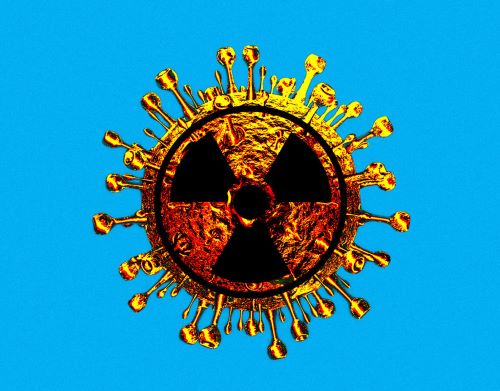 What can a pandemic teach us about nuclear threats? Bulletin of the Atomic Scientists, By Ted Lieu, August 7, 2020 “……. Over 700,000 people worldwide have died from COVID-19, including over 160,000 in the United States. SARS-CoV-2 spread like wildfire in part due to global and domestic travel made far easier by technological progress. At the same time, failures in human institutions allowed the virus to escalate out of control in numerous places. The lessons learned from this pandemic make the case for re-thinking the United States’ national security framework to decide which investments truly improve US national security and which seek to win yesterday’s wars. Who would have thought that the equipment needed to fight an enemy that has already killed far more Americans than died in World War I was not the Trident missile or B-1 Bomber, but face masks and ventilators? Or that the heroes risking their lives this year are health care workers and grocery store employees? The United States has already learned three important lessons from its failed pandemic response that should inform its nuclear strategy, so it doesn’t repeat similar mistakes in the future: investing in prevention is key; experts matter; and America needs to adjust to a new communications environment. Investing in catastrophe prevention. Until 2017, both Democratic and Republican administrations understood the importance of preventing a pandemic. Before leaving office, the Obama administration set up the White House National Security Council Directorate for Global Health Security and Biodefense. In 2005, President George Bush spoke at the National Institutes of Health and said, “If we wait for a pandemic to appear, it will be too late to prepare.” Indeed, one of the principal reasons for the existence of the Centers for Disease Control and Prevention, which was created in 1946, is “detecting and confronting new germs and diseases around the globe to increase our national security.” Unfortunately, the Trump administration eliminated the NSC Directorate for Global Health Security and Biodefense in 2018. The administration declined to renew funding for a federal pandemic detection program in 2019. The administration also proposed budget cuts to the CDC. And the Trump Administration ignored a step-by-step guide the Obama administration created on how to prevent a pandemic. … … the budgets under the Trump administration have prioritized military spending over all other instruments of national power. We can already destroy the world several times over with our nuclear and conventional weapons. It is time to invest in our other instruments of national power. Unfortunately, in the last few years, our diplomatic capacity has withered. As a member of the House Foreign Affairs Committee, I have seen how, under the Trump Administration, the US State Department has been gutted, as employees depart and positions go unfilled; morale has fallen; and several ambassadors and the Secretary of State have come under investigation for inappropriate or illegal behavior. We need to reverse course and re-invest in a large, professional, and ethical diplomatic corps. We have also seen an unfortunate shift towards go-it-alone US nuclear policy that expands the risk of miscalculation and escalation. Withdrawing from nuclear arms control treaties and expanding the capabilities of our nuclear arsenal are destabilizing. The Trump administration’s decisions to withdraw from Intermediate-Range Nuclear Forces (INF) Treaty last year, to announce its formal intent to withdraw from the Open Skies Treaty this year, and to lay the groundwork for allowing the New START Treaty to expire early next year all amount to a regressive policy that increases the chances of a nuclear conflict. Similarly, the Trump administration’s decision to produce new low-yield warheads increases the risk that nuclear weapons will be used. And the use of a low-yield nuclear weapon can easily escalate a conflict to an all-out nuclear war that cannot be won. That’s one reason I and other members of Congress introduced the bicameral “Hold the LYNE Act” to prohibit low-yield nuclear weapons for submarine-launched ballistic missiles. nstead of moving away from a prevention strategy, the United States needs to move toward one. Among the more obvious ways a catastrophic nuclear war could start is if a president launched a nuclear first strike. In October 2016, Sen. Ed Markey and I introduced the “Restricting First Use of Nuclear Weapons Act” to mitigate that possibility and to reassert the war making authority that the framers of the Constitution gave to Congress alone. The current nuclear launch approval process gives the president the sole authority to decide whether and when to launch a nuclear first strike. No member of the cabinet, the judiciary, or Congress is required to be involved in that decision. And once the President orders the launch, the execution of the order would occur frighteningly fast……….. The value of expertise. Another reason America leads the world in COVID-19 cases and deaths involves the failure of far too many people, including government officials, to listen to experts. ……. In many ways, this pandemic has taught us exactly what not to do in a nuclear-armed world where the Doomsday Clock says it is 100 seconds to midnight. We need to stop rejecting science,,……….https://thebulletin.org/2020/08/what-can-a-pandemic-teach-us-about-nuclear-threats/# |
|
Anti-nuclear protests at Kings Bay Naval Submarine Base
Anti-nuclear protests at Kings Bay https://thebrunswicknews.com/news/local_news/anti-nuclear-protests-at-kings-bay/article_8ac11cdb-6416-579b-b298-961419776e2a.html By GORDON JACKSON gjackson@thebrunswicknews.com ST. MARYS 7 Aug 20,
Organizers of an annual protest against nuclear weapons at Naval Submarine Base Kings Bay expected a large crowd to commemorate the 75th anniversary of the first atomic bomb dropped on Hiroshima, Japan, to help hasten the end of World War II.
Five people ended up standing outside a base gate Thursday holding signs with anti-nuclear weapons messages.
Glenn Carroll, coordinator of Nuclear Watch South, said the ongoing COVID-19 pandemic compelled many who were planning to attend to stay home for health concerns. But Carroll said her trip from Atlanta to join others with concerns about nuclear weapons Thursday was worth the time.
“Our mission is to stop the arms race,” Carroll said. “It’s a security risk and phenomenally expensive. This has become a business model and it’s deadly.”
Kings Bay is home to six ballistic missile submarines and two guided missile submarines. The base employs more than 9,000 civilian workers and active-duty sailors. Supporters say the ballistic missile submarines are a vital deterrent to nuclear attack.
“Thank God they were non violent,” she said. “They did highlight you cannot secure this base with this kind of power. It’s called an illusion of security.”
Grady said the military’s priorities “are all messed up” by continuing to develop powerful nuclear weapons.
“There is nothing they can do but kill,” she said.
She also expressed concerns about the length of time the growing stockpile of nuclear waste will need to be contained.
Carroll said she and others will continue to share their concerns about nuclear weapons. While Carroll said she’s anti-nuclear, she’s not anti-military.
“We need a defense,” she said. “We don’t need a weapons system unmatched on this planet.”
Problems with Russia’s hype about “super weapons”- and risk of escalating war
|
The Hypersonic Hype and Russia’s Diminished Nuclear Threshold, Jamestown Foundation, Eurasia Daily Monitor Volume: 17 Issue: 116, By: Pavel Felgenhauer, August 6, 2020 President Vladimir Putin used the July 26, 2020, Navy Day and the Main Navy Parade in St. Petersburg to once again promote Russia’s “superweapons,” which will ostensibly give the Russian Military-Maritime Fleet (Voyenno-Morskoy Flot—VMF) “a unique advantage” over its Western counterparts. According to Putin, “The deployment of advanced technologies that have no equals in the world, including hypersonic strike systems and underwater drones, will increase naval combat capabilities” (Interfax, July 26). The Main Navy Parade displayed some 46 vessels. Smaller, satellite parades were also held in six other Russian naval base cities as well as at Russia’s foreign naval base in Tartus, Syria (Militarynews.ru, July 26).
The Ministry of Defense used the Navy Day festivities to announce that the nuclear-powered super-torpedo “Poseidon” is now in its final stages of development and will be soon tested using the specially designed nuclear submarine Belgorod—a modified Oscar II–class cruise missile submarine……… Together with the Poseidon, Russia’s president has been touting the Zircon hypersonic missile, which is also reportedly in its final stages of development. The Zircon, according to Putin, can fly at speeds exceeding Mach 9, with a range of up to 1,000 kilometers. …… The Zircon has been in development since the 1970s and 1980s. It is apparently a weapon specifically designed to strike US carriers or other large, high-value seaborne assets. Aiming the hypersonic missile at land targets would be impractical since its radar is apparently only able to distinguish large-contrast targets on the open sea. ……. its chances of hitting a moving ship directly seem to be remote—a carrier would have moved a mile or two away while the Russian hypersonic missile blindly traverses its distance to the original target (Vpk-news, March 24). The extended-range Zircon thus makes sense only as a nuclear weapon with a 200+ kiloton warhead—an underwater massive nuclear explosion would disable a carrier with shockwave even from a mile or two away. The Russian VMF had not received a new destroyer in 30 years, and it is presently struggling to build frigates like the Gorshkov because Ukraine stopped selling it frigate engines after 2014…….. The main problem with Putin’s superweapons is that they are truly doomsday devices, valuable only for deterrence. The Kremlin is constantly plying the deterrence game by trying to scare the West. But this situation has two dangerous ramifications. First, the nuclear threshold is becoming lower: in any serious skirmish, the Russian navy would either need to go nuclear or risk being sunk. And second, while the Russian leadership believes it has surpassed the West militarily thanks to its dazzling superweapons, Moscow’s threshold for employing military force in conflict situations may also drop further. https://jamestown.org/program/the-hypersonic-hype-and-russias-diminished-nuclear-threshold/ |
|
Another Hiroshima is Coming…Unless We Stop It Now
Today, an unprecedented campaign of propaganda is shooing us all off like rabbits. We are not meant to question the daily torrent of anti-Chinese rhetoric, which is rapidly overtaking the torrent of anti-Russia rhetoric. Anything Chinese is bad, anathema, a threat: Wuhan …. Huawei. How confusing it is when “our” most reviled leader says so.
The target is China. Today, more than 400 American military bases almost encircle China with missiles, bombers, warships and nuclear weapons. From Australia north through the Pacific to South-East Asia, Japan and Korea and across Eurasia to Afghanistan and India, the bases form, as one US strategist told me, “the perfect noose”.
In the Sydney Morning Herald, tireless China-basher Peter Hartcher described those who spread Chinese influence in Australia as “rats, flies, mosquitoes and sparrows”. Hartcher, who favourably quotes the American demagogue Steve Bannon, likes to interpret the “dreams” of the current Chinese elite, to which he is apparently privy. These are inspired by yearnings for the “Mandate of Heaven” of 2,000 years ago. Ad nausea.
To combat this “mandate”, the Australian government of Scott Morrison has committed one of the most secure countries on earth, whose major trading partner is China, to hundreds of billions of dollars’ worth of American missiles that can be fired at China.
At a quarter past eight on the morning of August 6, 1945, she and her silhouette were burned into the granite.
I stared at the shadow for an hour or more, then I walked down to the river where the survivors still lived in shanties.
I met a man called Yukio, whose chest was etched with the pattern of the shirt he was wearing when the atomic bomb was dropped.
He described a huge flash over the city, “a bluish light, something like an electrical short”, after which wind blew like a tornado and black rain fell. “I was thrown on the ground and noticed only the stalks of my flowers were left. Everything was still and quiet, and when I got up, there were people naked, not saying anything. Some of them had no skin or hair. I was certain I was dead.”
Nine years later, I returned to look for him and he was dead from leukaemia.
“No radioactivity in Hiroshima ruin” said The New York Times front page on 13 September, 1945, a classic of planted disinformation. “General Farrell,” reported William H. Lawrence, “denied categorically that [the atomic bomb] produced a dangerous, lingering radioactivity.”
Only one reporter, Wilfred Burchett, an Australian, had braved the perilous journey to Hiroshima in the immediate aftermath of the atomic bombing, in defiance of the Allied occupation authorities, which controlled the “press pack”.
“I write this as a warning to the world,” reported Burchett in the London Daily Express of September 5,1945. Sitting in the rubble with his Baby Hermes typewriter, he described hospital wards filled with people with no visible injuries who were dying from what he called “an atomic plague”.
For this, his press accreditation was withdrawn, he was pilloried and smeared. His witness to the truth was never forgiven.
The atomic bombing of Hiroshima and Nagasaki was an act of premeditated mass murder that unleashed a weapon of intrinsic criminality. It was justified by lies that form the bedrock of America’s war propaganda in the 21st century, casting a new enemy, and target – China.
During the 75 years since Hiroshima, the most enduring lie is that the atomic bomb was dropped to end the war in the Pacific and to save lives.
“Even without the atomic bombing attacks,” concluded the United States Strategic Bombing Survey of 1946, “air supremacy over Japan could have exerted sufficient pressure to bring about unconditional surrender and obviate the need for invasion. “Based on a detailed investigation of all the facts, and supported by the testimony of the surviving Japanese leaders involved, it is the Survey’s opinion that … Japan would have surrendered even if the atomic bombs had not been dropped, even if Russia had not entered the war [against Japan] and even if no invasion had been planned or contemplated.”
The National Archives in Washington contains documented Japanese peace overtures as early as 1943. None was pursued. A cable sent on May 5, 1945 by the German ambassador in Tokyo and intercepted by the US made clear the Japanese were desperate to sue for peace, including “capitulation even if the terms were hard”. Nothing was done.
The US Secretary of War, Henry Stimson, told President Truman he was “fearful” that the US Air Force would have Japan so “bombed out” that the new weapon would not be able “to show its strength”. Stimson later admitted that “no effort was made, and none was seriously considered, to achieve surrender merely in order not to have to use the [atomic] bomb”.
Stimson’s foreign policy colleagues — looking ahead to the post-war era they were then shaping “in our image”, as Cold War planner George Kennan famously put it — made clear they were eager “to browbeat the Russians with the [atomic] bomb held rather ostentatiously on our hip”. General Leslie Groves, director of the Manhattan Project that made the atomic bomb, testified: “There was never any illusion on my part that Russia was our enemy, and that the project was conducted on that basis.”
The day after Hiroshima was obliterated, President Harry Truman voiced his satisfaction with the “overwhelming success” of “the experiment”.
The “experiment” continued long after the war was over. Between 1946 and 1958, the United States exploded 67 nuclear bombs in the Marshall Islands in the Pacific: the equivalent of more than one Hiroshima every day for 12 years. Continue reading
NuScam’s (sort of) small nuclear reactors rejected by Utah Taxpayers Association

Critics of planned nuclear power project urge Utah cities to pull out before it’s too late, Utah Taxpayers Association warns it believes proposal is too costly, not transparent DeseretNews, By Amy Joi O’Donoghue@Amyjoi16 Aug 4, 2020 SALT LAKE CITY — The Utah Taxpayers Association and a former member of the U.S. Nuclear Regulatory Commission are urging cities that have signed on to a planned nuclear power plant in Idaho to get out while they can before costs become too great.
NuScale’s Small Modular Reactor is planned for construction at the Idaho National Laboratory near Idaho Falls and would provide 720 megawatts of power, or enough energy for 720,000 homes.
The Carbon Free Power Project is promoted as the next generation design for nuclear power, featuring 12 distinct modules, with the first scheduled to come online in 2029 with the 11 others following the next year.
The project is a collaborative effort involving the U.S. Department of Energy, NuScale and the Utah Associated Municipal Power Systems, a political subdivision of the state of Utah. ……
there are several off-ramps in those phases for cities to exit, one of which is coming up Sept. 14. That deadline prompted the taxpayers association to urge cities to get out now before they get trapped into paying millions for a technology it says is unproven.
“Small modular reactor power is just not cost competitive,” said Rusty Cannon, vice president of the taxpayer group, adding participating cities and districts should hold a public vote to withdraw from the project……..
Peter Bradford, a former member of the U.S. Nuclear Regulatory Commission, said enthusiasm over new developments in nuclear technology that turned out to be flawed have cost ratepayers and taxpayers in multiple states billions of dollars.
He said that of 31 projects pending before the commission in 2009, only two remain — with the rest canceled or indefinitely postponed.
“The stranded costs of nuclear plants paid off by customers in the 1990s exceeded $50 billion nationwide,” he said. “Each period of abject failure is followed by an array of new proposals.”…….
The project is backed heavily by the U.S. Department of Energy, which gave NuScale a competitive award of $226 million in 2013 to develop the technology. Two years later, the federal agency gave NuScale $16.7 million for licensing preparation……..
Cannon and Bradford also criticized the municipal power association for not being transparent enough because its briefing meetings are exempt from the Utah open meetings law and are closed……… https://www.deseret.com/utah/2020/8/4/21354171/critics-nuclear-power-project-urge-utah-cities-pull-out-nuscale-small-modular-reactor-idaho
Hiroshima survivor Koko Kondo met the man who dropped that atomic bomb
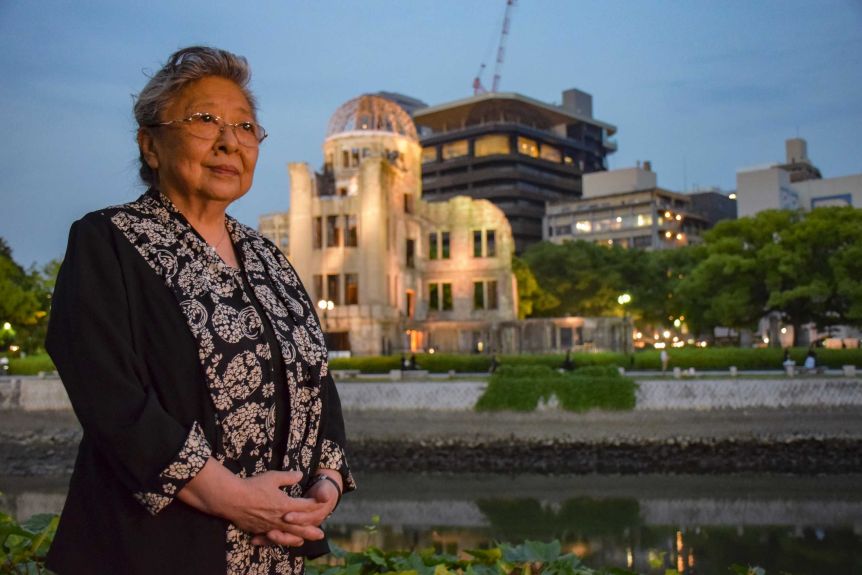
Hiroshima’s atomic bomb changed Koko Kondo’s life, but so did meeting the man who dropped it, ABC News,By Tracey Shelton, 6 August, 20, Eight-month-old Koko was in her mother’s arms the day the world’s first nuclear weapon was dropped on Hiroshima, bringing their family home crashing down on them on this day 75 years ago.
Key points:
Between 90,000 and 166,000 victims died within months of the Hiroshima bombing
Koko Kondo met pilot Robert Lewis on the set of This is Your Life
More than 150 denshosha volunteers are carrying on the memories of survivors
She was almost 40 years old before her mother finally sat her down and told her the full story of how she had inched through the rubble in darkness, with little Koko wrapped in her arms, towards a small pocket of dusty sunlight.
“She first pushed me out [through the opening], then next, she was able to get out … but the fire was all over the place according to my mother,” said Koko Kondo, who is now 75.
Ms Kondo’s father — Methodist minister Kiyoshi Tanimoto, who was visiting a parishioner across town — said in a US television interview “the whole city was on fire” as he ran through the streets to find his family.
He described people running in silence with skin hanging from their bodies “like a procession of ghosts”
In the sky above, pilot Robert Lewis was part of the United States Air Force crew who dropped the atomic bomb known as Little Boy that day, unleashing around 13 kilotons of force on the city below, where Ms Kondo’s family and about 290,000 other civilians lived, according to the Atomic Heritage Foundation.
Estimates on how many people died from the bomb either instantly or in the following months range between 90,000 and 166,000, but the Little Boy would go on to claim the lives of thousands more as the effects of radiation took their toll.
After looking back to see the once-flourishing city “disappear”, Captain Lewis wrote in his log book “My God, what have we done?”…….
While Ms Kondo said most people avoided speaking of the bombing in the decades that followed, her father made it his mission to help the injured, rebuild the city and ensure the world never forgot.
Her family had suffered from radiation sickness and Ms Kondo was subjected to years of tests and examinations to study the effects of radiation exposure.
One of Ms Kondo’s earliest memories — at around two or three years old — was of a group of teenage girls attending a sermon at her father’s church.
“Some girls could not close their eyes. Some girls — their lips were all melted with their chins so they could not close [their mouths],” she told the ABC.
While her manners did not permit her to ask questions, she would listen to her parents’ conversations and learned that the destruction and pain that surrounded her was caused by a single US B-29 bomber.
Ms Kondo said her childhood became consumed by hatred and thoughts of revenge.
“Someday when I grow up, I am definitely going to find the people who were on that B-29 bomber to do the revenge,” she said.
“That was my plan, that was my thinking. But life is interesting.”
When Koko was 10, her mother and siblings received a phone call from the then popular US television program This is Your Life.
They were immediately flown to the United States for an episode featuring the work of her father, who had taken a group of young survivors to the US for plastic surgery……
As Hiroshima mission pilot Robert Lewis was introduced, Koko glared at him with all the hatred a 10-year-old could muster.
“I was so shocked!” she recalled.
“What could I do? I wanted to run to the middle of the stage and give him a punch, a bite or a kick.”
But as he recalled his memories of that day, she saw tears begin to well in his eyes.
“I thought he was a monster, but monsters don’t have tears.”
Ms Kondo said she realised she had lived her short life full of hate for a man she knew nothing about……..
the life of this man was not easy, she said, and he “suffered greatly” not only with the weight of his involvement in the bombing, but he was also “harassed” for speaking about it publicly.at 75, she is among the youngest of a dwindling number of survivors who can tell the world first hand of the horrors these weapons unleashed……….
“My concern is today nuclear weapons are much, much stronger. We have to abolish them now,” urged Ms Kondo. ….
If these stories were lost, “probably our planet would be gone”, she said.
Doctoral candidate Tomoko Kubota is one of more than 150 denshosha — a designated keeper of the memories of a Hiroshima or Nagasaki survivor.
As a denshosha volunteer, she spent three years training and learning from survivor Sadae Kasaoka, so in the future she can “give testimony” on her behalf by sharing her “experiences, the reality of the atomic bombing, and desires for peace”.
That story includes how, at 12 years of age, Ms Kasaoka lost her mother and watched her father die — within days of the blast — in agony from horrific burns and wounds that became infested with maggots.
For other survivors, the memories were too painful to talk about, Ms Kasaoka said, while discrimination against those who did speak out had silenced many over the years…………. https://www.abc.net.au/news/2020-08-06/atomic-bomb-survivors-75-years-after-hiroshima-nuclear-attack/12501636
Russia plans removal of its nuclear trash from Arctic waters
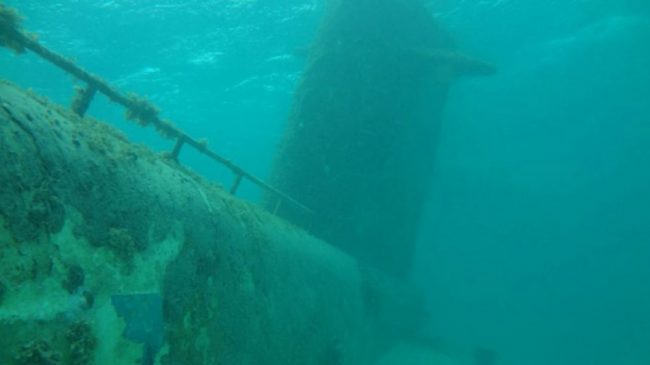
Russia to Remove Hazardous Nuclear Objects Dumped in Its Arctic Waters,
The country’s nuclear energy company will over the next eight years lift two submarines and four reactor compartments from the bottom of the Barents and Kara Seas. By The Barents Observer 5 Aug 20, Russia’s state nuclear agency plans to remove several nuclear objects from the depths of Russia’s Arctic waters in an effort to reduce environmental hazards, Rosatom said this week as it presented a clean-up plan for the region.
Russia’s state nuclear agency plans to remove several nuclear objects from the depths of Russia’s Arctic waters in an effort to reduce environmental hazards, Rosatom said this week as it presented a clean-up plan for the region.
From the late 1960s to the late 1980s, about 18,000 radioactive objects were dumped into Russia’s remote northern waters. Most of them present little environmental risk. But some are increasingly seen as a hazard to Arctic ecosystems.
“Rosatom over the next eight years intends to lift from the bottom of Russia’s Arctic waters six objects that are most dangerous in terms of radioactive pollution,” the company’s spokesperson told the state-run TASS news agency.
The company plans to lift the reactors from the K-11, K-19 and K-140 submarines as well as spent nuclear fuel from the reactor that served the Lenin icebreaker.
In addition, two entire submarines will be lifted: the K-27 from the Kara Sea and K-159 from the Barents Sea. While the former was deliberately dumped by Soviet authorities in 1982, the latter sank during a towing operation in 2003.
The K-27 is located in 33-meter depths east of the Novaya Zemlya archipelago. It has been described by experts as a potential radioactive “time bomb.” The K-159 is located in 200-meter depths off the coast of the Kola Peninsula.
These six objects represent more than 90% of radioactive sources dumped at sea, Rosatom said………
Lifting the six hazardous nuclear objects will not only be technically difficult, but also very expensive.
A recent report made for Rosatom and the European Commission estimated the costs of lifting these six objects at 278 million euros. That includes the cost of bringing them safely to a yard for decommissioning and long-term storage.
Lifting the K-159 alone is estimated to cost 57.5 million euros. Lifting the K-27 and transporting it to a shipyard for decommissioning and long-term storage in Saida Bay will carry a price tag of 47.7 million euros, the report said.
It’s unlikely that Russia’s increasingly cash-strapped treasury will have the 278 million euros needed for the cleanup.
Several countries have previously allocated billions to assist Russia’s post-Soviet efforts to cope with nuclear waste.
Norway has since the mid-90s granted about 1.5 billion kroner (140 million euros) to nuclear safety projects in the Russian part of the Barents region. https://www.themoscowtimes.com/2020/08/05/russia-to-remove-hazardous-nuclear-objects-dumped-in-its-arctic-waters-a71060
Beirut explosion was not an atomic bomb
The Beirut explosion created a huge mushroom cloud and visible blast wave, but nuclear-weapons experts say it wasn’t an atomic bomb. Here’s why. Business Insider , DAVE MOSHER, AUG 5, 2020,
- An explosion at a port rocked the Lebanese capital city of Beirut on Tuesday, killing at least dozens of people.
- As videos of the explosion spread across social-media sites, some observers likened the appearance of a mushroom cloud to that of an atomic bomb.
- The Lebanese prime minister has said the blast came from a stockpile of ammonium nitrate in a warehouse.
- Nuclear-weapons experts say the detonation was definitely not triggered by an atomic bomb.
- Atomic explosions are characterised by a blinding flash of light, a pulse of searing heat, and radioactive fallout, none of which were detected…………. https://www.businessinsider.com.au/beirut-explosion-not-nuclear-bomb-despite-mushroom-cloud-no-flash-2020-8?r=US&IR=T
1 This Month

Tell Congress: Prevent Nuclear Catastrophe in Iran

Tell Congress: Prevent Nuclear Catastrophe in Iran

Read the Public Inquiry Report, the Commissioners’ report, Surrendering Australia: The AUKUS Deception is available to download for free at aukuspublicinquiry.com. Or just watch the replay of the National Press Club Luncheon.

19 November – Webinar – The Reality of Reprocessing
Time: 11:00 AM Pacific Time (US & Canada) / 2:00 PM Eastern / 7:00 PM UK / 8:00 PM CET
Register for the Zoom Event Here


Shut down the radiation-damaged Heysham nuclear reactors now
To see nuclear-related stories in greater depth and intensity – go to https://nuclearinformation.wordpress.com

Say No to NASA’s Reckless Nuclear Reactor on the Moon
Say No to NASA’s Reckless Nuclear Reactor on the Moon
-
Archives
- November 2026 (138)
- October 2026 (302)
- September 2026 (339)
- August 2026 (330)
- July 2026 (355)
- June 2026 (287)
- May 2026 (306)
- April 2026 (356)
- March 2026 (251)
- February 2026 (267)
- January 2026 (308)
- December 2025 (358)
-
Categories
- 1
- 1 NUCLEAR ISSUES
- business and costs
- climate change
- culture and arts
- ENERGY
- environment
- health
- history
- indigenous issues
- Legal
- marketing of nuclear
- media
- opposition to nuclear
- PERSONAL STORIES
- politics
- politics international
- Religion and ethics
- safety
- secrets,lies and civil liberties
- spinbuster
- technology
- Uranium
- wastes
- weapons and war
- Women
- 2 WORLD
- ACTION
- AFRICA
- Atrocities
- AUSTRALIA
- Christina's notes
- Christina's themes
- culture and arts
- Events
- Fuk 2022
- Fuk 2023
- Fukushima 2017
- Fukushima 2018
- fukushima 2019
- Fukushima 2020
- Fukushima 2021
- general
- global warming
- Humour (God we need it)
- Nuclear
- RARE EARTHS
- Reference
- resources – print
- Resources -audiovicual
- Weekly Newsletter
- World
- World Nuclear
- YouTube
-
RSS
Entries RSS
Comments RSS

