Ohio Attorney General could seek injunction to stop nuclear plant surcharge
 Ohio AG Yost considering lawsuit to halt nuclear plant surcharge, LIZ SKALKA. The Blade. lskalka@theblade.com–26 Aug 20, COLUMBUS — Ohio Attorney General Dave Yost on Wednesday said he’s prepared to seek an injunction that would stop the imposition of a ratepayer surcharge flowing to two northern Ohio nuclear power plants at the center of the $61-million statehouse corruption scandal.
Mr. Yost, a Republican, indicated he’s considering moving ahead with a lawsuit as the Ohio Senate prepares to return to Columbus next week to discuss repealing or replacing the energy law, House Bill 6, at the heart of the scandal.
Pressuring lawmakers to act quickly on what will be a complex process, Mr. Yost said he could file a lawsuit as soon as September if the legislature doesn’t move swiftly to repeal the law. He declined to set a deadline or elaborate on what might trigger him to file, except to say he supports a repeal……..
 Lawmakers have debated how to handle the controversial law since former House Speaker Larry Householder (R., Glenford) and four others were charged in July with conspiring to funnel $61 million from FirstEnergy and related interests to help elect Mr. Householder’s allies who would then elevate him to speaker. The political power he gained was used to pass the energy law.
Its key feature is a new surcharge to FirstEnergy Solutions’ customers monthly bills beginning in 2021 to generate $150 million a year to support the struggling nuclear plants and $20 million a year for solar projects.
House Republicans and Democrats have introduced separate repeal bills that would block the new subsidies while restoring mandates that utilities obtain more of their power from renewable sources.
A bipartisan measure doing the same thing has been introduced in the Senate.
Mr. Yost said a lawsuit would stop a billion-dollar revenue stream from flowing to the nuclear plants while lawmakers deal with the fallout from the corruption scandal. ……
The Coalition to Restore Public Trust, a pro-repeal group, applauded Mr. Yost.
“The potential injunction sought by AG Yost should serve as further notice to Ohio’s legislature that they must move expeditiously to remove this tainted legislation from Ohio law,” executive director Michael Hartley said in a statement. https://www.toledoblade.com/business/energy/2020/08/26/ohio-ag-yost-considering-lawsuit-to-halt-nuclear-plant-charge/stories/20200826129
Local opposition to Holtec’s temporary storage for nuclear waste in New Mexico
 Public comments are due by Sept. 22, and can be made at the online meetings; by email to Holtec-CISFEIS@nrc.gov; at the federal rule-making website (www.regulations.gov, Docket ID NRC-2018-0052); or by mail (Office of Administration, Mail Stop: TWFN-7-A60M, ATTN: Program Management, Announcements and Editing Staff, U.S. NRC, Washington, DC 20555-0001).
Licensing of temporary storage for nuclear waste in New Mexico inching forward
Nuclear regulator poised to OK move of spent fuel from reactors like San Onofre to temporary storage in New Mexico, but locals are opposed, By TERI SFORZA | tsforza@scng.com | Orange County Registerl August 26, 2020
The quickest way to get nuclear waste off Southern California’s quake-prone coast? Temporary storage sites in sparsely populated corners of the nation, experts say.
After years of processing, the Nuclear Regulatory Commission’s preliminary recommendation is that Holtec International be granted a license to build and operate such an interim storage site in New Mexico — which would first accept “stranded waste” from shuttered plants like the San Onofre Nuclear Generating Station.
“Hopeful,” said David Victor, an international law professor at UC San Diego and chair of San Onofre’s volunteer Community Engagement Panel. “But the regulatory process and the political process for the New Mexico site are moving in opposite directions.”
The NRC is hosting online meetings to present the project’s draft environmental impact report and gather public comment. The next virtual meetings are slated for 3 p.m. Wednesday, Aug. 26, and 8 a.m. Tuesday, Sept. 2. Public comments must be submitted to the NRC by Sept. 22.
Holtec hopes to build the first of a 20-phase project that eventually would cover 330 acres. It would be located in southeast New Mexico, about halfway between the cities of Carlsbad and Hobbs, and would look quite familiar to Southern Californians: Waste, potentially from all over the nation, would be stored in a Holtec HI-STORM UMAX in-ground system like the one at San Onofre.
But anyone familiar with the saga of Yucca Mountain — as well as the controversy surrounding waste storage here at San Onofre — won’t be surprised to find that the underlying issues are universal: Many locals adamantly oppose storing nuclear waste in their backyards.
Though the license period for Holtec’s New Mexico proposal would be 40 years, people fear nuclear waste would remain there forever
“Establishing an interim storage facility in this region would be economic malpractice,” wrote New Mexico’s governor, Michelle Lujan Grisham, in a letter asking President Donald Trump to oppose Holtec’s project. “Accidents are possible and unacceptably detrimental to the safety of New Mexicans, our economy and our state.”
The governor argued that the site is geologically unsuitable, would place a financial burden on the state and local communities and poses a danger as spent nuclear fuel is shipped into New Mexico from around the nation.
Many New Mexicans, however, say that’s not enough. Speaking “under protest” at virtual meetings they believe may be unlawful, critics said the NRC must present its findings in state and in person. Since in-person gatherings can’t happen during the pandemic, deadlines should be postponed until after the pandemic is over, they argued.
Speakers also attacked Holtec’s crediblilty. The company is currently embroiled in conflict in New Jersey, where it sued the New Jersey Economic Development Authority in March for holding up a $26 million payment that was part of a tax incentive program to build a facility in Camden.
The authority asserts that Holtec failed to mention that it had run into hot water with the Tennessee Valley Authority on its tax credit application in 2014.
The Southern California News Group reported that the U.S. Attorney’s Office looked into bribery allegations and asserted that a subcontractor manufacturing Holtec’s casks — U.S. Tool & Die — wrote checks totaling $54,212 to the account of a TVA manager. That money, the U.S. Attorney’s Office said, originated with Holtec.
The TVA manager pleaded guilty to falsifying financial statements by not disclosing those payments. Holtec said it wasn’t privy to any of this, and was not charged. But in 2010, the company paid a $2 million “administrative fee” to the TVA and became the first contractor in TVA history to be debarred. Its contract was suspended for 60 days, and it submitted to a yearlong monitoring program of its operations, according to the TVA’s inspector general.
Holtec continued supplying waste storage casks to the TVA, as well as to other nuclear plants in America and overseas.
At San Onofre, Holtec has had other bumps, including a surprise redesign of the canisters that hold nuclear waste and a snippy war of words with members of the San Onofre Community Engagement Panel. Errors loading spent fuel into the UMAX stopped operations for nearly a year, but were laid at the feet of operator Southern California Edison.……..
Public comments are due by Sept. 22, and can be made at the online meetings; by email to Holtec-CISFEIS@nrc.gov; at the federal rule-making website (www.regulations.gov, Docket ID NRC-2018-0052); or by mail (Office of Administration, Mail Stop: TWFN-7-A60M, ATTN: Program Management, Announcements and Editing Staff, U.S. NRC, Washington, DC 20555-0001). https://www.ocregister.com/2020/08/25/licensing-of-temporary-storage-for-nuclear-waste-in-new-mexico-inching-forward/
24 million have now been infected with coronavirus, but WHO says pandemic is slowing
 WHO says pandemic is slowing – but 24 million have now been infected https://inqld.com.au/news/2020/08/26/who-says-pandemic-is-slowing-but-24-million-have-been-infected/The COVID-19 pandemic is still expanding, but the rise in cases and deaths has slowed globally, except for southeast Asia and the eastern Mediterranean regions the World Health Organisation (WHO) says. In its latest epidemiological update, issued on Monday night, it said that the Americas remains the hardest-hit region, accounting for half of newly reported cases and 62 per cent of the 39,240 deaths worldwide in the past week. More than 23.65 million people have been reported to be infected by the coronavirus globally and 811,895 have died, according to a Reuters tally on Tuesday. Over 1.7 million new COVID-19 cases and 39,000 new deaths were reported to WHO for the week ending 23 August, a 4 per cent decrease in the number of cases and a 12 per cent decrease in the number of deaths compared to the previous week, the WHO said. Over 1.7 million new COVID-19 cases and 39,000 new deaths were reported to WHO for the week ending 23 August, a 4 per cent decrease in the number of cases and a 12 per cent decrease in the number of deaths compared to the previous week, the WHO said. In WHO’s eastern Mediterranean region, the number of reported cases rose by 4 per cent, but the number of reported deaths has consistently dropped over the last six weeks, the WHO said. Lebanon, Tunisia and Jordan reported the highest increase in cases compared to the previous week. The number of cases and deaths reported across Africa decreased by 8 per cent and 11 per cent respectively in the past week, “primarily due to a decrease in cases reported in Algeria, Kenya, Ghana, Senegal and South Africa”, it said. “In the European region, the number of cases reported has consistently increased over the last three weeks,” it said. “However, only a slight decrease (1 per cent) was reported in the most recent week, and the number of deaths have continued to decrease across the region.” In WHO’s western Pacific region, the number of new cases dropped by 5 per cent, driven by less spread in Japan, Australia, Singapore, China and Vietnam. South Korea reported an 180 per cent jump in cases, “mainly due to an increase in cases associated with religious gatherings”. |
|
Two U.S.cities cut their losses, pullout of dodgy NuScam “small” nuclear reactor project
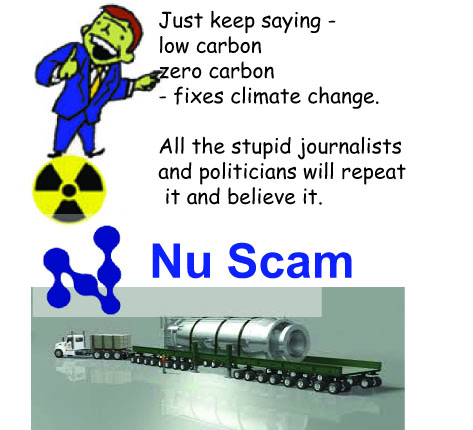 Lehi, Logan Back Out Of First-Of-Its-Kind Nuclear Power Plant Project Citing Financial Risk InKuer, By KATE GROETZINGER • 27 Aug 20, Two Utah cities have pulled out of a nuclear power plant investment — saying the financial risks are just too high. But 28 other towns and service districts in the state are still involved in the project, which is organized by a utility cooperative called Utah Associated Municipal Power Systems, or UAMPS. The Carbon Free Power Project involves a first-of-its-kind technology called “small modular nuclear reactors”, which would produce around 720 megawatts of nuclear energy. UAMPS and the U.S. Department of Energy have invested $3 million in the project since it began in 2017. But the reactors are still in development, and it’s unclear how much the project — and the power — will ultimately cost. That’s one reason the city of Logan cited in its decision to leave the project ahead of a Sept. 30 deadline to invest in its next phase, which is expected to cost $130 million. Logan was planning to use seven megawatts of power from the plant and has put around $250,000 into the project based on that amount so far. The city would have had to put in another $654,000 over the next three years to remain invested in the project. The cost could continue to grow, according to Mark Montgomery, director of light and power for Logan. He told the city council that Logan could end up having to pay millions into the project during the second phase of its licensing period, from 2023 to 2025……. Montgomery also cited concerns that it’s still up in the air whether the Department of Energy will invest in the project. The department pledged to fully fund the first reactor in 2018, but it went back on that deal. Now, it plans to invest $1.4 billion in the project — about a quarter of its total $6 billion price tag. That agreement is not yet final and the appropriation would need to be approved by Congress. The city of Lehi also voted to leave the project during a city council meeting this week. So far, Lehi has invested $455,000 in the project for a 21 megawatt subscription. Power Director Joel Eves said the project has struggled to find new investors, while its budget almost doubled to $6 billion from $3.4 billion since 2017. “A big piece of this is project subscription, and that does make us nervous,” Eves said. “It seems like we’re going at this alone as UAMPS members.” ……. https://www.kuer.org/post/lehi-logan-back-out-first-its-kind-nuclear-power-plant-project-citing-financial-risk#stream/0 |
|
Major holes in ozone hole treaty must be addressed to avert stronger climate change
 Experts reveal major holes in international ozone treaty https://www.eurekalert.org/pub_releases/2020-08/uos-erm082520.php – 26-AUG-2020
Major holes in ozone hole treaty must be addressed to avert stronger climate change and serious risks to human health, experts warn
A new paper, co-authored by a University of Sussex scientist, has revealed major holes in an international treaty designed to help repair the ozone layer, putting human health at risk and increasing the speed of climate change.
Evidence amassed by scientists in the 1970s and 1980s showed that the depletion of the ozone layer in the stratosphere was one of the first truly global threats to humanity.
Chemicals produced through economic activity were slowly drifting to the upper atmosphere where they were destroying the ozone layer, which plays an indispensable role in protecting humanity and ecosystems by absorbing harmful ultraviolet radiation from the sun.
In 1987, countries signed up to a treaty to take reparative action, known as the ‘Montreal Protocol on Substances that Deplete the Ozone Layer, which was eventually ratified by all 197 UN member states.’
But in a paper published today in Nature Communications, experts have flagged major gaps in the treaty which must be addressed if the ozone layer is to be repaired and avert the risks posed to human health and the climate.
Professor Joseph Alcamo, Director of the Sussex Sustainability Research Programme and former Chief Scientist at UNEP, said: “The Montreal Protocol and its amendments have no doubt been an effective worldwide effort to control the toughest substances depleting the ozone. But our paper shows that the treaty has developed too many gaps to fully repair the ozone layer. It’s time to plug the holes in the ozone hole treaty.”
Professor Alcamo, along with lead author Professor Susan Solomon of Massachusetts Institute of Technology (MIT) and co-author Professor A. R. Ravishankara of Colorado State University, have identified several ‘gaps’ which consist of ozone depleting substances not covered in the treaty.
These include:
- Unaccounted for new sources of CFC and HFC emissions recently detected in the atmosphere.
- Leakages of ozone depleting substances from old air conditioners, refrigerators and insulating foams.
- Inadvertent releases of ozone-depleting gases from some manufacturing processes.
- Emissions of the ozone-depleting gas, nitrous oxide, stemming mostly from agricultural activities.
The authors have called for a range of solutions to plug the gaps including:
- A toughening of compliance with the treaty by using provisions that are already part of the Montreal Protocol.
- Boosting the effectiveness of the treaty by adding in regular environmental monitoring of ozone-depleting substances.
- Controlling the emissions of substances that have slipped through the treaty up to now, including nitrous oxide emissions from agriculture, and ozone-depleting substances leaking from old refrigerators and other equipment.
- In addition, because ozone-depleting substances and their substitutes contribute significantly to global warming, the authors urge a faster phasing out of all of these substances as a way of combatting climate change.
The ozone layer absorbs harmful ultraviolet radiation from the sun but this protective layer is slowly destroyed by industrial gases that slowly drift up from the earth’s surface including CFCs (chlorofluorocarbons) contained in refrigerants, foaming agents and, earlier, propellants in aerosol sprays.
Discovery of the ‘ozone hole’ above high latitudes in the 1980s provided final evidence of the importance of ozone depletion.
By 1985, countries had signed the Vienna Convention, which pledged to reduce CFCs and other ozone-depleting substances. Two years later, they signed the Montreal Protocol that laid out a plan of action.
During his time as the first Chief Scientist of UNEP, which hosts the Secretariat of the Montreal Protocol, Professor Alcamo coordinated groups of scientists in producing policy-oriented reports that addressed emerging ozone depletion issues.
UNEP reports that 98% of the chemicals targeted for removal in the Montreal Protocol had been phased out by 2009, avoiding hundreds of millions of cases of skin cancer and tens of millions of cases of cataracts. However, this new paper shows that some important sources were not targeted by the Protocol – and urgently need to be now.
Professor Alcamo said: “Since most ozone-depleting gases and their current substitutes are also potent greenhouse gases, it’s time to use the Montreal Protocol to draw down these gases even faster to help avoid dangerous global warming.
“We won’t be able to reach the global Sustainable Development Goals by 2030 without closing the gaps in the ozone treaty. It’s hard to imagine, for example, how the global health and climate goals could be reached without drastically drawing down all ozone-depleting gases and their substitutes. If we fail, humanity will have to face a higher risk of skin cancers and more rapid climate change.”
Strong opposition in Hokkaido to taking on nuclear waste
Hokkaido town becomes flashpoint in Japan’s nuclear waste debate, Mayor and governor clash over ethics and risks of potential disposal site, Nikkei Asian Review, TORU TAKAHASHI, Nikkei staff writer, August 27, 2020
TOKYO — An idyllic town on the northern Japanese island of Hokkaido is embroiled in a hot debate over nuclear waste, as its mayor weighs building a disposal facility there over the opposition of the governor as well as surrounding towns………
Hokkaido Gov. Naomichi Suzuki has swiftly mobilized opponents. “Hokkaido has no intention of taking on nuclear waste,” he said on Aug. 13, shortly after Kataoka’s announcement. “The national government is basically shoving wads of cash in our face,” he also said on Aug. 18, criticizing the cash offer. ……..
several local industry groups oppose the idea. Fishermen in particular worry that a local nuclear facility could tarnish the reputation of their catch.
Nearby towns and villages also feel they could face all of the risks of the nuclear waste disposal site without any payout from the national government…… https://asia.nikkei.com/Politics/Hokkaido-town-becomes-flashpoint-in-Japan-s-nuclear-waste-debate
Sizewell nuclear plant to take 20 years to build, emitting 5.7 million tonnes of carbon dioxide


|
|
Times 25th Aug 2020 A proposed new nuclear plant in Suffolk could take six years to offset the greenhouse gas
emissions generated in its construction, EDF has admitted. The French energy group estimates that 5.7 million tonnes
of carbon dioxide will be emitted in the nine to twelve years that it will take to build the Sizewell C plant. It argues
that this is “small in comparison to the savings that would be achieved once the power station becomes operational,
when the station will be displacing more carbon-intensive energy from the national grid”.
In publicity material, EDF claims that Sizewell C will “save nine million tonnes of carbon dioxide emissions for every
year of its operation”, based on it replacing gas-fired power plants. However, in planning documents it admits that
the actual savings may be far lower. By the time that the proposed plant is built, Britain’s power mix is expected to
be far greener, as more wind and solar farms are built.
Alison Downes, of Stop Sizewell C, said this meant that it would be 2040 before the plant was “making a positive
contribution to the UK’s net zero targets . . . EDF’s revelation that it will be 20 years before Sizewell C is built and has
paid off the carbon from its construction exposes what a hopeless — as well as expensive and risky — solution it is to
our urgent climate crisis.” National Grid has said that it plans to be able to run Britain’s power network with entirely
“zero carbon” electricity by 2025 whenever there is sufficient renewable generation to do so — well before Sizewell
|
America needs to abandon the idea of Yucca Mountain for nuclear waste dump: both Trump and Biden have
|
US policy regarding spent fuel disposal has been hung up for decades on whether to build a repository at Yucca Mountain. The site has been controversial since 1987, when Congress designated it as the future home for high-level radioactive waste – provided, of course, that it meets all technical requirements and is licensed by the Nuclear Regulatory Commission. Thirty-plus years and more than $15 billion later, all technical work to assess the site’s suitability has stopped and the licensing review is dead in the water. The US Congress has refused to appropriate funds to the project for years. And because the government has not met its commitment to begin accepting waste for disposal in 1998, it is forced to pay utilities more than $600 million every year to store their spent fuel on site. Moreover, the most realistic approach for managing the tons of spent fuel—an interim storage facility—is held hostage to progress on Yucca Mountain. Current law requires that the NRC issue a license for Yucca Mountain before a consolidated interim storage could begin to accept spent fuel. The sooner everyone agrees to pull the plug on Yucca Mountain, the sooner the United States can move forward on consolidated storage for the next 40 to 50 years, since this is likely the amount of time it will take to bring a long-term repository into operation. This will give the government time to find a new site using a consent-based process………..https://thebulletin.org/2020/08/if-trump-and-biden-agree-there-shouldnt-be-a-nuclear-waste-site-at-yucca-mountain-cant-we-all/#
|
|
|

Iran to grant IAEA inspectors access to suspected ex-nuclear sites
|
Iran to grant IAEA inspectors access to suspected ex-nuclear sites, BBC News, 26 Aug 20, Iran has agreed to give International Atomic Energy Agency inspectors access to two suspected former nuclear sites.A joint statement said Iran was doing so in good faith to resolve outstanding issues related to nuclear safeguards.
The agreement came during a visit to Tehran by the IAEA’s director general. The global watchdog has criticised Iran for not answering its questions about possible undeclared nuclear material and nuclear-related activities at the two locations, and denying it access. It is thought the activities took place long before 2015, when Iran struck a landmark deal with world powers that placed limits on its nuclear programme. Iran insists it has never sought nuclear weapons, but evidence previously collected by the IAEA suggests that until 2003 it conducted “a range of activities relevant to the development of a nuclear explosive device”…………. https://www.bbc.com/news/world-middle-east-53922717 |
|
Radiation hazard at Dead Horse Bay, Brooklyn
|
Scavengers Unearth Buried History — and Maybe Radiation — at Dead Horse Bay“It’s the closest you can come to time travel.” Cured, New York, By Caroline Spivack Aug 25, 2020, “It’s pretty devastating,” said Vanessa Dudley of the radiation recently discovered at Dead Horse Bay, a cove in southeastern Brooklyn that was once, many years ago, home to a landfill. For decades, the bay and its surrounding area have been burping up intriguing early-20th-century detritus onto the beach. Dudley, an administrator at Weill Cornell Medicine, is one of many treasure hunters and artists who regularly visited the beach to pick through mud-flecked glass bottles, ceramic shards, and rusted bits of metal. “You can see the lives of people through these objects. It’s like their memory lives on through them.”
But earlier this month, the three footpaths that snake from Flatbush Avenue through thick brush to the beach were marked with canary-yellow signs warning: “Danger Area Closed. Potential Hazardous Material.” Authorities had closed the southern half of the bay (near Floyd Bennett Field) following the discovery of radioactive material on the beach and near one of the paths. The radiation was first noticed during an environmental survey in 2019, when the National Park Service (which manages the bay as part of the Gateway National Recreation Area) discovered 31 locations along the shore and nearby trails with excessive levels of gamma radiation. At two of those sites, the culprits turned out to be old deck markers — small, glowing disks that were once used on Navy ships — that were leaking radium-226. These were recently removed, and the possibility of a more extensive cleanup is now being considered…….. In 1926, after many of the factories had moved elsewhere, Barren Island was connected via landfill to the mainland. In the 1950s, Robert Moses further expanded the area’s land mass by building landfills. Moses flooded the area with the city’s garbage — much of which was likely the rubble of other neighborhoods Moses himself destroyed as he reshaped New York — and then covered it with a layer of topsoil. Erosion has since released much of that debris, which collects at the bay’s eastern shore, providing New Yorkers with an eclectic compendium of 20th-century trash. But in light of new knowledge about the radiation there, exploring that garbage — and discovering the clues it holds about the city’s history — comes at a risk. ……… https://ny.curbed.com/2020/8/25/21398976/dead-horse-bay-beach-brooklyn-radiation-scavengers |
|
City in Northern Utah pulls out of NuScam small nuclear reactors project

Northern Utah city opts out of planned nuclear power project over money concerns Deseret News, Amy Joi O’Donoghue @Amyjoi 16 Aug 24, 2020,
SALT LAKE CITY — Cost concerns over Logan’s participation in a next-generation nuclear power plant planned at Idaho National Laboratory led the city to withdraw from the project, and Lehi is considering a similar move in its council meeting Tuesday.
“My concerns were many and varied,” Logan Finance Director Richard Anderson said of last week’s decision
……. changes in funding by the U.S. Department of Energy for the Carbon Free Power Project caused Anderson concern, as it did for Mark Montgomery, the city’s light and power director, and prompted both of them to recommend Logan withdraw its participation.
Ultimately, the energy department committed to spend $1.4 billion on the project with an eye toward reducing carbon emissions, combating climate change and to position the country as a world leader in nuclear technology.
But critics say the proposed 720-megawatt plant is too risky and ratepayers — hence taxpayers — should not be footing the cost for technology they say is yet to be proven.
LaVarr Webb, spokesman for the municipal power association, said the investment schedule was specifically designed with these exit opportunities if cities or special districts become nervous.
The project, he added, will not proceed if costs prove too high.
The project has also come under criticism for what some say is a lack of transparency.
Earlier this month, the Utah Taxpayers Association urged cities to withdraw ahead of the deadline and complained about meetings in which groups were turned away unless they were project participants.
Rusty Cannon, vice president of Utah Taxpayers Association, said because the municipal power association is exempt from Utah’s open meeting laws, it can close its doors to others.
“We asked to observe a recent meeting and were denied access. That is the same response many others have also received,” Cannon said.
While association leaders have spent hours on video calls with the association and others, Cannon said that format does not provide the same answers.
Webb said meetings in which non-project participants were turned away, with perhaps the exception of one, are in line with why other governmental entities can close meetings under Utah law, such as contractual issues, litigation or personnel issues.
On Tuesday in Lehi, the City Council will consider a resolution outlining the city’s withdrawal from the project……. https://www.deseret.com/utah/2020/8/24/21399537/northern-utah-city-opts-out-of-planned-nuclear-power-project-over-money-concerns
Compromise, compromise: U.S. Democrats almost merging into Republicans
 Media Praise Biden’s ‘Centrist Coalition’ for Steering Clear of ‘Progressive Demands’, Fair 24 Aug 20, “Abortions for some, miniature American flags for others.”
That’s the line that an alien imposter who comes to America to run for president on The Simpsons (10/27/96) came up with after realizing any firm position on reproductive rights would draw some opposition, but a lukewarm compromise coupled with a sentimental devotion to the flag would get people cheering. Corporate media seem to be having a reaction similar to the cartoon alien as they opine on the nomination of former Vice President Joe Biden as the Democratic presidential candidate, with Sen. Kamala Harris as his running mate.
The Los Angeles Times (8/12/20) shared that optimism, with political reporter Janet Hook reporting that the Biden/Harris ticket has “a center-left brand that steers clear of the most far-reaching progressive demands,” which “has complicated the Trump White House’s efforts to portray the ticket as ‘dangerous radicals’”:
Harris, like Biden…has rebuffed some demands of the party’s rising progressive wing. That’s a profile that could help Biden appeal to moderate swing voters he needs to win in states like Michigan and Wisconsin.
Extreme weather – derecho storm brings about early closure of Duane Arnold nuclear plant
 Duane Arnold nuclear plant decommissioning early after damage from the derecho
by Rebecca Kopelman, Tuesday, August 25th 2020 https://cbs2iowa.com/news/local/duane-arnold-nuclear-plant-
Iowa (Iowa’s News Now) — The Duane Arnold Energy Center is beginning their decommissioning process after the August 10th derecho.
The energy center is the only nuclear power plant in Iowa. It was set to be decommissioned at the end of October, but will be closing due to the damage.
This is a statement from NextEra Energy Resources:
“After conducting a complete assessment of the damage caused by recent severe weather, NextEra Energy Resources has made the decision not to restart the reactor at Duane Arnold Energy Center. The strong storms that hit the area on Aug. 10 caused extensive damage to Duane Arnold’s cooling towers, and our evaluation found that replacing those towers before the site’s previously-scheduled decommissioning on Oct. 30, 2020, was not feasible.
As we have done since we announced the decommissioning of Duane Arnold in 2018, we will continue to work with all our employees to minimize the impact of this situation on them and their families.”
The storms damaged the cooling towers which are used to produce electricity to cool steam after it exits the turbine.The cooling towers are not required to cool critical nuclear components. There was also damage to the outside of the building. None of the damage impacted safety systems or critical components.
Russia releases previously classified film of “Tsar Bomba” the most powerful nuclear bomb blast E\eve
Russia Releases “Tsar Bomba” Test Footage Of The Most Powerful Nuclear Bomb Blast Ever This previously classified film provides a new and fascinating glimpse into the 50-megaton Cold War nuclear test that occurred nearly six decades ago. The Drive BY THOMAS NEWDICK, AUGUST 24, 2020 The nuclear bomb, codenamed “Ivan,” that was dropped by the Soviet Union over Novaya Zemlya in the Arctic Ocean on October 30, 1961, was the largest device of its kind ever detonated. The monstrous weapon had a yield of around 50 megatons — equivalent to 50 million tons of TNT. Until now, the available imagery of that test has been strictly limited, consisting of short, grainy clips and poor-quality stills.
for “dozens of kilometers” in every direction, the earth has been scorched, most of the snow vaporized, and the few structures that existed above the surface have been obliterated.
1 This Month

Tell Congress: Prevent Nuclear Catastrophe in Iran

Tell Congress: Prevent Nuclear Catastrophe in Iran

Read the Public Inquiry Report, the Commissioners’ report, Surrendering Australia: The AUKUS Deception is available to download for free at aukuspublicinquiry.com. Or just watch the replay of the National Press Club Luncheon.

19 November – Webinar – The Reality of Reprocessing
Time: 11:00 AM Pacific Time (US & Canada) / 2:00 PM Eastern / 7:00 PM UK / 8:00 PM CET
Register for the Zoom Event Here


Shut down the radiation-damaged Heysham nuclear reactors now
To see nuclear-related stories in greater depth and intensity – go to https://nuclearinformation.wordpress.com

Say No to NASA’s Reckless Nuclear Reactor on the Moon
Say No to NASA’s Reckless Nuclear Reactor on the Moon
-
Archives
- November 2026 (128)
- October 2026 (302)
- September 2026 (339)
- August 2026 (330)
- July 2026 (355)
- June 2026 (287)
- May 2026 (306)
- April 2026 (356)
- March 2026 (251)
- February 2026 (267)
- January 2026 (308)
- December 2025 (358)
-
Categories
- 1
- 1 NUCLEAR ISSUES
- business and costs
- climate change
- culture and arts
- ENERGY
- environment
- health
- history
- indigenous issues
- Legal
- marketing of nuclear
- media
- opposition to nuclear
- PERSONAL STORIES
- politics
- politics international
- Religion and ethics
- safety
- secrets,lies and civil liberties
- spinbuster
- technology
- Uranium
- wastes
- weapons and war
- Women
- 2 WORLD
- ACTION
- AFRICA
- Atrocities
- AUSTRALIA
- Christina's notes
- Christina's themes
- culture and arts
- Events
- Fuk 2022
- Fuk 2023
- Fukushima 2017
- Fukushima 2018
- fukushima 2019
- Fukushima 2020
- Fukushima 2021
- general
- global warming
- Humour (God we need it)
- Nuclear
- RARE EARTHS
- Reference
- resources – print
- Resources -audiovicual
- Weekly Newsletter
- World
- World Nuclear
- YouTube
-
RSS
Entries RSS
Comments RSS

