UK govt’s spin to Scotland, promoting nuclear submarines – but the Scots are nae sae daft
 We cannot defeat our real enemies by using nuclear weapons, https://www.thenational.scot/news/18850915.cannot-defeat-real-enemies-using-nuclear-weapons/, Jim Taylor, Edinburgh, 6 Nov 20
At the conclusion of the programme, Rear Admiral John Weale tells us that no-one really wants nuclear weapons … but “we are planning to have them for the next 50 years”.
So it’s a done deal, whether we Scots support it or not. Our UK Union membership means we will be forced against our will to be party to this inhumane weapon system, and the increased danger it puts us in with its continued location at Faslane.
Trident’s replacement is currently reckoned to cost around £200 billion, before any expected design, construction, operational cost overruns and other usual ongoing cost increases. With the potential for a further cycle of replacement during the next 50 years, going forward, the cost to the nation will rise exponentially.
Clearly the Royal Navy took the unprecedented step to permit this programme being made at the behest of the UK Government trying to warm our feelings about nuclear weapons, recognise a “need” for them and in the hope this will drive a wedge in Scotland’s drive to call upon its Claim of Right and independence.
Isn’t the UK Government’s mistake assuredly that Scots are nae sae daft?
Nuclear now costs twice the price of renewables and the gap is growing. No need for Hinkley C, Sizewell, Bradwell etc

 North writes,
” ………The Green Party have been arguing for many years in recognition of the work by Friends of the Earth, the Centre for Alternative Technology (CAT) in Wales and many others, that we do not need ‘further expansion of nuclear and gas turbines’ but to be far more clever about our energy use, easy to do now that renewables are cheaper than nuclear and new gas.
CAT has been at the forefront of development of research on renewable technology and Green building for some 50 years.
Their latest report ‘Zero Carbon Britain (Rising to the Climate Emergency)’ clearly demonstrates that the UK has the tools and technology to efficiently power this country with 100 per cent renewable technology (read the executive summary, it’s only eight pages long).
By using energy more efficiently we can power down by 60 per cent with particularly large savings in heating buildings and transport.
There is absolutely no need for nuclear power in our energy mix and we cannot afford it, let alone pay for cleaning up the sites at the end which taxpayers always end up paying for.
Nuclear now costs twice the price of renewables and the gap is growing.
How many Herald readers know that the electricity from the Hinkley Point nuclear reactor will cost UK consumers £92.50 per Kwh (the most recent offshore wind turbine fields are half of this)?
The deal was signed by (former Prime Minister) Theresa May and supported by Labour and Lib Dems.
The profits are going to the Chinese government which will run it for 40 years. The French firm (EDF) that has been building Hinkley Point and wants to build more nuclear reactors in the UK wants to cushion the financial blow of future nuclear power stations in this country by charging electricity customers a few extra pounds every month on their bill even now.
This is referred to as a new funding model, I’d call it a rip-off. Are people really happy to put billions of pounds into the coffers of the Chinese government and EDF rather than invest, as part of a Green New Deal, in insulation and draught-proofing of UK homes to keep us warmer, take over two and a half million households out of fuel poverty and permanently reduce everyone’s fuel bills. https://www.cravenherald.co.uk/opinion/opinion_letters/18824349.letter-no-need-nuclear-power/
Nuclear power – simply unaffordable for the Philippines
|
DOE to submit ‘nuclear power plan’ to Duterte this December, Manila Bulletin, November 6, 2020, by Myrna M. Velasco” For BNPP’s repowering, Duterte previously instructed the energy department to also undertake a study on that proposal; and to assess the cost impact that will have on consumers’ pockets.
But on that particular sphere, Senate Committee on Energy Chairman Sherwin T. Gatchalian sounded off cynicism on claims that electricity rates in the Philippines will go down with the proposed repowering of the mothballed 620-megawatt BNPP project. “It’s not true that prices are lower because of the layers of technology that shall be integrated into the nuclear power facility to ensure its safe operations,” he claimed. Gatchalian noted that in Vietnam’s case, that country shelved its planned nuclear power development after determining that the resulting power price will just be comparable with other electric generating facilities — and yet there’s great degree of risk that they have to manage on the safety aspect of technology deployment. ………In the Philippines, the propounded revival of BNPP’s operations had been hurdled by concerns of ‘social acceptance’ in the many years that already passed; and there are also questions on where to source the US$1.0 billion to US$2.0 billion funding for BNPP’s rehabilitation.The other major issue is which entity shall be designated to operate the plant, since the Electric Power Industry Reform Act (EPIRA) already prohibits state-run National Power Corporation (NPC) from engaging into operation or investments in power generation… |
A new nuclear power plant at Sizewell is the wrong choice for a zero carbon Britain
|
A new nuclear power plant at Sizewell is the wrong choice for a zero carbon Britain, The climate column: The proposed Sizewell C will not produce electricity until about 2040, which it means it cannot reduce the UK’s carbon emissions with the speed necessary to avoid catastrophic tipping points The Independent , Donnachadh McCarthy@DonnachadhMc 6 Nov 20,
Just weeks ago, the Climate Assembly set up by parliament rejected nuclear power as an answer to creating a zero-carbon economy. This was due to cost, safety and difficulties with waste storage and decommissioning. Yet Boris Johnson is reported to be about to commit Britain to buying another hugely expensive nuclear power station. As this new plant would not be producing electricity until about 2040, it means it cannot reduce the UK’s carbon emissions with the speed necessary to avoid catastrophic tipping points, whereas cheaper renewables can be up and running within a couple of years of being commissioned. Consider the following analogy. Four years ago, you needed to replace your gas boiler and a company came along and offered to sell you the world’s most expensive experimental boiler ever. It’s been trying to build the first four of them for over 20 years but had not yet got any actually working. The first one it tried to build, in Finland, is already 13 years behind schedule and has more than tripled in price. The second one it tried to build, in France, is 10 years behind schedule, now costs six times the original quote and has encountered monumental safety issues. They then tell you the boiler was filled with lethal toxins, which if the boiler’s seals broke, could explode and kill everybody in your house. All your neighbours would have to be permanently evacuated immediately without being allowed to collect their lethally contaminated belongings and the area around your boiler would become an exclusion zone for generations. The sales-person added that the boiler will cost up to twice as much to run as your current boiler. They demanded you sign a 35-year inflation-proofed deal that makes it difficult to switch to a cheaper renewable energy supplier or use energy efficiency measures to reduce your need for the boiler. Every single bank refused to lend you the money to install your new boiler, as they believed it was a financially insane project to lend money to. There was another problem. The experimental boiler continuously produces highly-toxic explosive waste that the supplier, after 70 years of trying, still has no idea what to do with. You would have to store it in your cellar, until somebody miraculously comes up with a way to store it safely for millennia. The salesperson neglected to add that you had to pay for the costs of removing the boiler at the end of its life but that the process takes hundreds of years to complete. I tell you this imaginary tale to try and explain the utter insanity of what the UK government did when it signed the contract with EDF Energy to build a new Hinkley Point nuclear power plant in 2016. Hinkley is already a year behind schedule and nearly £3bn over budget.
And now imagine this. Despite all of the above and knowing that renewable energy alternatives have already fallen to less than half of the cost of this experimental boiler and that new renewable electricity storage technologies have been likewise collapsing in price, the same contractor comes back to you to persuade you to buy another of these hugely expensive boilers for your second home. Unlike almost every single government in the world, Boris Johnson’s government is reported to be planning on announcing in the next few weeks that the UK will agree to build a second new EDF nuclear power plant at Sizewell in Suffolk. Why would any supposedly sane country sign such crazy energy contracts? ……… https://www.independent.co.uk/voices/nuclear-power-plant-sizewell-boris-johnson-b1622086.html |
|
The most frightening prospect – Trump remaining still in control of nuclear weaponry
 The Guardian view on the election endgame: end Trump’s war on the truthm Editorial, 6 Nov 20 https://www.theguardian.com/commentisfree/2020/nov/06/the-guardian-view-on-the-election-endgame-end-trumps-war-on-the-truth
Around the world former democracies are slipping into autocracy. The United States is not immune
Since he took office Donald Trump has posed a grave threat to democracy. His wild, relentless post-poll fight against reality this week has shown just how dangerous he can be. Designed to give his supporters a rationale for their anger over losing the popular vote, the falsehoods raised troubling questions about when, and how, Mr Trump will leave the White House.
The bad news is that it won’t be anytime soon. Democracy in America is rare in giving a president more than 10 weeks of power after losing an election. Mr Trump is using this time to ratchet up the rhetoric to a fever pitch, seeding the idea that society is irreconcilably at odds with itself. This is profoundly damaging to America, a fact that cable networks have thankfully and belatedly woken up to after election day. Around the world former democracies are slipping into autocracy. The United States is not immune.
The fact is Mr Trump will lose the popular vote by millions of votes and only America’s outdated electoral college has saved him from a crushing defeat. The president should be preparing to leave the White House, not be instructing his lawyers. Perhaps Mr Trump cannot afford to lose. Presidential immunity from prosecution vanishes once Mr Trump leaves office, a consideration that may weigh heavily given the ongoing investigations by the New York district attorney into reported“protracted criminal conduct at the Trump Organization”. Mr Trump denies any wrongdoing.
or months it has been obvious that Mr Trump would claim victory and fraud should he lose the election. He has refused to say he would accept a peaceful transfer of power. The polls, he claimed, could not be trusted. Without a shred of shame, Mr Trump appears willing to challenge the validity of the vote in any state he loses, seeking to undermine the electoral process and ultimately invalidate it.
This is a dangerous moment. There’s no evidence of widespread illegal votes in any state. Yet a fully fledged constitutional crisis over the process of counting ballots is on the cards because Mr Trump is demanding recounts and court cases while conditioning his base to view the election in existential terms. Last year, in an influential and prescient analysis, Ohio University’s Edward B Foley wargamed how a quarrel over mail-in ballots in Pennsylvania could lead to a disputed result in the 2020 presidential election.
The most frightening scenario, said Prof Foley, was “where the dispute remains unresolved on January 20, 2021, the date for the inauguration of the new presidential term, and the military is uncertain as to who is entitled to receive the nuclear codes as commander-in-chief”. This ends with the US attorney general, William Barr, announcing that it is legally sound for Mr Trump to be recognised as re-elected for a second term while Democrats call for nationwide protests to dislodge the squatters in the White House. It would be better to avoid such a predicament rather than plan to get into it.
Republicans must not be seduced by Mr Trump into manipulating the electoral system, through political and legal battles, to defy the popular will for partisan advantage. The Grand Old Party has profited from voter suppression and gerrymandering to keep an emerging Democratic majority at bay. But these darker impulses have given rise to Mr Trump and an unhealthy reliance on a shrinking coalition of overwhelmingly white Christian voters paranoid about losing power.
Joe Biden looks to have done enough to win the White House. He will have his work cut out when he gets there, needing to rebuild the US government’s credibility after Trumpism hollowed out its institutions. That means offering hope to a country that faces a pandemic and an economic recession. He will have to reassert America’s role as the global problem-solver. Under Mr Trump the “indispensable nation” disappeared when it was needed the most. By any reasonable standard Mr Biden should not have to continue to run against Mr Trump. He must be allowed to get on with running America.
 |
ReplyForward
|
Several U.S. utilities back out of deal to build Small Nuclear Reactors

|
Several U.S. utilities back out of deal to build novel nuclear power plant, Science, By Adrian Cho, Nov. 4, 2020 Plans to build an innovative new nuclear power plant—and thus revitalize the struggling U.S. nuclear industry—have taken a hit as in recent weeks: Eight of the 36 public utilities that had signed on to help build the plant have backed out of the deal. The withdrawals come just months after the Utah Associated Municipal Power Systems (UAMPS), which intends to buy the plant containing 12 small modular reactors from NuScale Power, announced that completion of the project would be delayed by 3 years to 2030. It also estimates the cost would climb from $4.2 billion to $6.1 billion………. critics of the project say the developments underscore that the plant, which is designed by NuScale Power and would be built at the Department of Energy’s (DOE’s) Idaho National Laboratory, will be untenably expensive. M. V. Ramana, a physicist who works on public policy at the University of British Columbia, Vancouver, says he’s not surprised that so many utilities have opted out of the project. The question, he says, is why so many are sticking with it. “They ought to be seeing the writing on the wall and getting out by the dozens,” he says. ……… if the NuScale plant doesn’t run constantly at full output, it will be less efficient and even more expensive to operate, in terms of cost per megawatt hour (MWh) of energy, Ramana argues. Peter Bradford, a former member of the Nuclear Regulatory Commission (NRC) and former chair of the state utility commissions in Maine and New York, says renewables coupled with short-term storage in batteries would likely be a cheaper means to even out the supply……. in the 1980s, Washington Public Power Supply System agreed to build several nuclear reactors in Washington that ran far overbudget and were never completed, leading to the biggest default on municipal bonds in U.S. history. Public utilities are particularly vulnerable to such risks, Bradford says, as other than ratepayers they have few sources of revenue that could be used to cover cost overruns. “Not only are there no deep pockets, there are no pockets,” he says. On 28 October, Heber Light & Power in Utah withdrew from the project, just 1 day after utilities in the Utah communities of Bountiful and Beaver pulled out. Still, even critics doubt the UAMPS deal will fall apart immediately. In August, the NuScale design passed a key milestone in the NRC review process, receiving its safety evaluation report, and observers expect final “design certification” to come next year. In the meantime, UAMPS is moving to complete an application to construct and operate the plant, Webb says. That application should be submitted in 2023, construction of the plant should start in 2025, he says. Before construction can start, however, UAMPS still has to line up customers to buy the full 720-megawatt output of the plant, Webb says. So far, UAMPS members involved in the project have agreed to take only a relatively small fraction of that output. So UAMPS may have to convince plenty of other folks that it’s a good deal. https://www.sciencemag.org/news/2020/11/several-us-utilities-back-out-deal-build-novel-nuclear-power-plant |
|
Chernobyl’s bumblebees still affected by radiation
This new data shows effects on bumblebees are happening at dose rates previously thought safe for insects, and the current international recommendations will need to be re-evaluated.
|
Chernobyl: bumblebees still at risk from radiation nearly 35 years on, https://theconversation.com/chernobyl-bumblebees-still-at-risk-from-radiation-nearly-35-years-on-149055, Katherine Raines, Fellow and Lecturer, University of Stirling, November 5, 2020 In the early hours of April 26 1986, reactor four of the Chernobyl nuclear power plant in Ukraine exploded, causing the largest nuclear disaster in history. More than 350,000 people were evacuated, and a 4,700km² exclusion zone was formed in Ukraine and Belarus. Despite the intervening 34 years, there is still uncertainty about the effects of the radiation exposure on wildlife living in the Chernobyl exclusion zone (CEZ).
|
Japanese nuclear regulator’s website hit by possible cyberattack
Japanese nuclear regulator’s website hit by possible cyberattack, Japan Times, https://www.japantimes.co.jp/news/2020/11/04/national/nuclear-regulator-website-cyberattack, KYODO, Nov 4, 2020
The Nuclear Regulation Authority said Tuesday its official website became inaccessible possibly due to cyberattacks.
The incident comes a week after the regulatory body’s intranet had an unauthorized access from outside.
According to the NRA, the government’s cybersecurity institute notified it of the website disruption on Tuesday afternoon. There was no abnormality when the NRA updated the website Monday evening, it said.
The website remained inaccessible for hours, but the problem was resolved by around 8:30 p.m., the NRA said.
In August, a fake website resembling that of the NRA was discovered by an official of the regulator.
United States under Donald Trump formally exits Paris Agreement on climate change
|
United States under Donald Trump formally exits Paris Agreement on climate change https://www.abc.net.au/news/2020-11-05/us-formally-exits-paris-climate-change-agreement-trump/12849940
The Trump administration told the United Nations it intends to pull out of the agreement in 2017. Some 189 countries remain committed to the 2015 Paris Agreement. Moving forward the agreement aims to keep the global increase in average temperatures worldwide “well below” two degrees Celsius, ideally no more than 1.5 Celsius, compared to pre-industrial levels. A further six countries have signed, but not ratified the pact. Scientists said any rise beyond two degrees Celsius could have a devastating impact on large parts of the world, raising sea levels, stoking tropical storms and worsening droughts and floods. The only binding requirement is that nations have to accurately report on their efforts. The United States is the world’s second-largest emitter of heat-trapping gases such as carbon dioxide, with only China producing more. In recent weeks, China, Japan and South Korea have joined the European Union and several other countries in setting national deadlines to stop pumping more greenhouse gases into the atmosphere. While the Trump Administration has shunned Federal Government measures to cut emissions, some states, cities and businesses in the US have pressed ahead with their own efforts. Democratic presidential candidate Joe Biden has said he favours signing the US back up to the Paris Accord. With the United States outside the pact, it will be harder for the rest of the world to reach the agreed goals. |
|
Some problems that will handicap the development of Small Nuclear Reactors
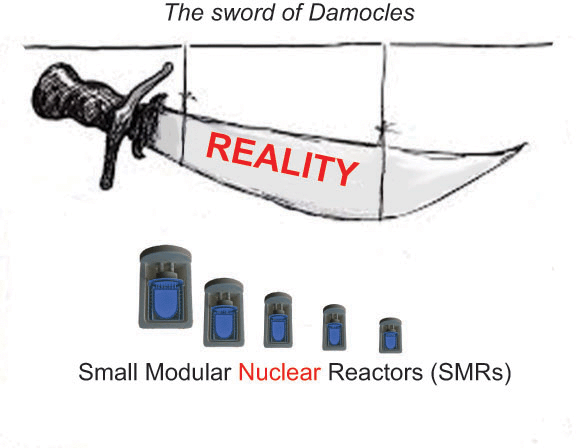 The I&C challenges for small modular reactors, Nuclear Engineering International 4 November 2020 Dr Li Li examines the instrumentation and control requirements and challenges for a new generation of small modular reactors.
REACTOR DEVELOPERS ARE DEVELOPING A wide variety of small modular reactor (SMRs)….. Many use Generation III+ pressurised water reactor (PWR) technology similar to that used in current gigawatt-scale reactors, while others are based on advanced Generation IV technologies ranging from high temperature gas-cooled reactors to molten-salt reactors.
Each design will have its own requirements for instrumentation and control (I&C) systems for the operation, monitoring and control of the reactor, turbine island and balance of plant. Even among PWRs, the design principles and I&C architectures are very different and cannot be easily replicated from one design to another.
To understand the challenges, let’s look at three competing designs: the UK SMR being developed by a consortium of companies including Rolls-Royce, Jacobs, Assystem and Atkins with support from research institutions including Nuclear AMRC; the NuScale Power Module backed by Fluor Corporation with funding from the US Department of Energy; and the Westinghouse SMR, which adapts technologies from the established AP1000 design………..
The issue of cyber security will be critical for the certification of digital I&C systems. According to the Industrial Control Systems Cyber Emergency Response Team, part of the US Department of Homeland Security, cyber-attacks and security infringement targeting control systems have increased significantly in recent years. With more digital smart devices used in nuclear power plant of any size, it must be a priority to protect the vulnerability of smart devices and digital I&C system from cyber attack and malicious sniffing from hostile individuals or organisations…….
in most cases, new codes and standards will need to be developed for advanced reactors.
The development of new codes and standards is a very lengthy process. It will take resources and time to publish a new standard for the nuclear industry, and we might not see one ready before new SMR developers file their design certification application……….
Many SMR designs, including the three considered above, have the potential to be used for co-generation of process heat, district heating or desalination. This will introduce additional complexity for regulators to approve the power plant I&C design, if the co-generation processes are located at same site for economic reasons. This brings new challenges because extra safety measures must be considered. For example, additional safety features of the control system and evacuation plan must be approved by an adequate jurisdictional authority for the orderly shutdown of both the nuclear plant and industrial processes in the event of an accident.
Author information: Dr Li Li, Head of the digital I&C group at the UK’s Nuclear Advanced Manufacturing Research Centre (Nuclear AMRC) https://www.neimagazine.com/features/featurethe-ic-challenges-for-small-modular-reactors-8345341/
Poland’s nuclear energy plans not likely to be supported by the European Commission
Nuclear power is not considered environmentally sustainable, and there is little hope this approach will change. Therefore, the possibilities for bankrolling nuclear energy are very limited.
Brussels’s impact on Poland’s nuclear project, https://biznesalert.com/brusselss-impact-on-polands-nuclear-project/ : Paweł Wróbel, @Pawrobel 4 Nov 20, Poland’s nuclear power plant constrsuction program has been riddled with ambiguity for many years. Neverthele, among the few certainties remains the necessity to abide by the EU law on granting state aid. The project cannot happen without Brussels. Investments in nuclear energy are one of the most expensive in the energy sector, which is why building a nuclear plant in Poland will not be possible without state support. Therefore, the European Commission will have to approve the selected financing model – Paweł Wróbel, CEO of Gate Brussels, writes for BiznesAlert.pl.
Sizewell C – Britain walking into a trap that benefits only the nuclear industry
 Sizewell C – Britain walking into a trap that benefits only the nuclear industry, Sizewell C: Dodgy deals and obscure decision-making https://eciu.net/blog/2020/sizewell-c-dodgy-deals-and-obscure-decision-making By Jonathan Marshall, Head of Analysis@JMarshall_ECIU, 02 November 2020 This weekend the BBC reported that the Government was close to reaching a deal with EDF to construct a new nuclear power station at Sizewell in Suffolk. Sizewell C is expected to be a carbon-copy of the plant under construction at Hinkley Point, and will help fill the gap left as Britain’s existing nukes retire.
There is little point in re-hashing the well-worn arguments about whether we need new nuclear in the UK. No changing of minds on either side looks likely, nor is there much point trying to counter the six-or-so lines from either side about why nuclear is a good or bad choice.
What is worth scrutiny, though, is how the Government appears to be making another hash of agreeing terms and penning a contract.
Just three years ago the National Audit Office delivered a stinging rebuke of the deal with EDF for Hinkley Point C, saying it has ‘locked consumers into a risky and expensive project with uncertain strategic and economic benefits’; that efforts to ensure value for money had been overlooked; and that there remained a risk that the developer would come cap-in-hand for more cash before the project was finished, at which point the Government would not be in the strongest position to say no.
Backroom dealings
And it is hard to see how the Government has let itself be backed into this corner, allowing EDF to present itself as ‘the only option’ for the new nuclear it is no doubt saying is essential to reach net zero.
Sizewell has even received public backing from those usually in favour of a small state and as little Government intervention as possible, a position miles away from what is seemingly imminent.
Endless stalling on policy decisions and lack of support for other plants has seen other proposals evaporate, changing economics have seen developers pull out globally (Japan, for example, has said it will get to net zero without new nuclear), and a constant drumroll of political support for the as-yet-to-exist Small Modular Reactors rather than traditional large plant have left EDF as the only player in town.
The Government, well aware of the benefits of pitting projects against each other, has been lauding the successes of doing exactly that in auctions for offshore wind, in the capacity market and in a host of nascent markets for flexible power. Yet, nuclear remains exempt.
And while there are some factors that would make an auction system more difficult – high project start-up costs, lengthy safety sign-offs, etc, it is surely not beyond the wit of ministers and their advisors, and the civil service, to force something into place.
The only winners from the current behind-closed-doors set-up are the nuclear industry, which is not an effective way to make policy.
Time-Limited Backstop
The desperation to bring costs down for nuclear mean British electricity users are set to be on the hook for the costs of building Sizewell before it starts generating.
This situation would raise eyebrows in many instances, but for a scheme based on projects currently running wildly over budget and embarrassingly behind schedule, this seems like madness.
There are few guarantees in British media, but stories about rising energy bills are about as close as one can get. Extra costs on households to pay back investors, rather than for actually producing energy, mean this deal could be a toxic legacy for years to come.
It remains to be seen what protections from overrunning costs are put in place for consumers, and what guarantees that the cost agreed through a Regulated Asset Base (RAB) model will not increase as the project inevitably runs over budget. Both of these are pretty essential for allaying concerns that the public is being sold another white elephant.
Going Blind
On finances, the latest BEIS assessments of generation costs didn’t include nuclear, apparently for commercial confidentiality reasons. We should now expect these to be updated, especially as the latest iteration included the associated ‘system costs’ of different technologies. Doing this for nuclear (which of course imposes other costs on the power grid due to its inflexibility) is now vital.
Where are the assessments of how new nuclear can fit into increasingly smart and flexible power grids? Churning out a constant stream of electrons is good for keeping the country running, but it would be more useful if there was some data to show how it impedes on the rest of the grid.
What thought has been given to location? The Suffolk coast is set to be the landing point for a huge amount of offshore wind capacity – is it the best place for a new nuclear plant? Or just the only place still in the running?
How could the power output from Sizewell be used most effectively? What are the economics behind building an electrolyser nearby to convert excess power into hydrogen? Can the waste heat be made use of?
Providing answers to these sort of questions (just a few of many more) would help us to have a more grown up debate around nuclear, and would help understand the reasons for signing what, at first sight, looks like another dodgy deal.
Theresa May’s decision to sign off Hinkley was met with widespread dismay, for the reasons above and for many more. Without more clarity on Government thought, it appears our current Prime Minister could be walking into the same trap.
UK nuclear weapons making to be run by the Ministry of Defence
Public Technology 3rd Nov 2020, The government has claimed that bringing the manufacturing of nuclear
warheads back in house will enable it to better “invest in technology”.
Since 1993, the Atomic Weapons Establishment – which is responsible for
developing, manufacturing, and managing the UK’s arsenal of nuclear
weapons – has operated as a private company, under contract from the
government.
Hunting-BRAE held the contract until 1999, at which point a
25-year deal was awarded to AWE Management Ltd, a joint venture led by 51%
shareholder Lockheed Martin, supported by Serco and Jacobs Engineering.
Defence secretary Ben Wallace announced in parliament this week that,
following a review, the “Ministry of Defence has concluded that AWE will
revert to a direct government ownership model”. From as early as next
summer, the nuclear agency will become an arm’s-length government body,
wholly owned by the ministry.
Basingstoke Gazette 3rd Nov 2020, THE government will take control of a nuclear weapons manufacturer in
Aldermaston. AWE, which also has a site in Burghfield, is to be taken over
by ministers to “simplify and further strengthen” the relationship between
the operator and the Ministry of Defence. It means that Lockheed Martin,
which owns 51 per cent of AWE Management Ltd, and Serco, which owns 24.5
per cent, will be stripped of their control of the base when the lucrative
25-year contract comes to an end, with Sky News reporting that it could be
as soon as next year.
https://www.basingstokegazette.co.uk/news/18842320.awe-aldermaston-taken-government/
Ohio Nuclear-Plant Owner’s Bankruptcy Plan Upheld by Appeals Court
|
Ohio Nuclear-Plant Owner’s Bankruptcy Plan Upheld by Appeals Court, Environmental groups and consumer advocates had asked court to reconsider Energy Harbor’s chapter 11 plan, WSJ, By Andrew Scurria Nov. 3, 2020
Monday’s decision by the U.S. Court of Appeals for the Sixth Circuit in Cincinnati affirmed the chapter 11 restructuring of Energy Harbor, which filed for bankruptcy in 2018 as a subsidiary of FirstEnergy and emerged in February owned by investors. Environmental… (Subscribers only) https://www.wsj.com/articles/ohio-nuclear-plant-owners-bankruptcy-plan-upheld-by-appeals-court-11604434946 |
|
Exelon may be about to split off its unprofitable nuclear generation business.
Exelon has secured zero-emissions credits for financially struggling nuclear plants in New York and New Jersey, two states seeking to eliminate their carbon emissions by midcentury, and has won similar credits as part of Illinois’ 2016 Future Energy Jobs Act that supply about $235 million per year in zero-emissions credits to its Clinton and Quad Cities nuclear plants.
But Exelon has not secured subsidies for four other Illinois nuclear power plants, including the Byron and Dresden facilities. In August it announced it will close those plants in 2021 and may also seek early retirement of its Braidwood and LaSalle power plants unless it can obtain state support to bolster their economics. ………
State support for zero-carbon nuclear scrambled by bribery scandal
But the FRR plan contained in last year’s Clean Energy Jobs Act lost lawmaker support in the wake of Exelon utility ComEd’s connection to a federal bribery investigation alleging the utility steered jobs, contracts and payments to House Speaker Michael Madigan in exchange for favorable treatment in the state capitol. Exelon agreed to pay a $200 million fine and submit to a deferred prosecution agreement this summer.
1 This Month

Read the Public Inquiry Report, the Commissioners’ report, Surrendering Australia: The AUKUS Deception is available to download for free at aukuspublicinquiry.com. Or just watch the replay of the National Press Club Luncheon.



19 November – Webinar – The Reality of Reprocessing
Time: 11:00 AM Pacific Time (US & Canada) / 2:00 PM Eastern / 7:00 PM UK / 8:00 PM CET
Register for the Zoom Event Here



Shut down the radiation-damaged Heysham nuclear reactors now
To see nuclear-related stories in greater depth and intensity – go to https://nuclearinformation.wordpress.com

Say No to NASA’s Reckless Nuclear Reactor on the Moon
Say No to NASA’s Reckless Nuclear Reactor on the Moon
-
Archives
- November 2026 (109)
- October 2026 (302)
- September 2026 (339)
- August 2026 (330)
- July 2026 (355)
- June 2026 (287)
- May 2026 (306)
- April 2026 (356)
- March 2026 (251)
- February 2026 (267)
- January 2026 (308)
- December 2025 (358)
-
Categories
- 1
- 1 NUCLEAR ISSUES
- business and costs
- climate change
- culture and arts
- ENERGY
- environment
- health
- history
- indigenous issues
- Legal
- marketing of nuclear
- media
- opposition to nuclear
- PERSONAL STORIES
- politics
- politics international
- Religion and ethics
- safety
- secrets,lies and civil liberties
- spinbuster
- technology
- Uranium
- wastes
- weapons and war
- Women
- 2 WORLD
- ACTION
- AFRICA
- Atrocities
- AUSTRALIA
- Christina's notes
- Christina's themes
- culture and arts
- Events
- Fuk 2022
- Fuk 2023
- Fukushima 2017
- Fukushima 2018
- fukushima 2019
- Fukushima 2020
- Fukushima 2021
- general
- global warming
- Humour (God we need it)
- Nuclear
- RARE EARTHS
- Reference
- resources – print
- Resources -audiovicual
- Weekly Newsletter
- World
- World Nuclear
- YouTube
-
RSS
Entries RSS
Comments RSS

