Pandemic, climate, nuclear weapons – lessons for survival in 2021

Lessons from pandemic-nuclear weapons nexus for survival in 2021 http://www.koreatimes.co.kr/www/opinon/2020/12/197_301593.html By Peter Hayes, 30 Dec 20,
As Earth hurtled around the Sun at over 100,000km per hour, humans were rudely reminded in 2020 by the COVID-19 pandemic that no-one is in charge ― or rather, nature is in charge.
Humanity faces many intertwined global problems in 2021. The short list includes climate change, habitat loss, biodiversity loss, biochemical pollution, overpopulation, demographic aging, food insecurity, water scarcity, disease and pandemics. These problems are both cause and effect of extreme poverty, inequality, forced migration, and social conflict that leads to war.
Hovering above all these inter-twined global problems is the truly existential threat of nuclear war. Nuclear war is the most immediate and direct extinction trap into which the species could fall.
Yet unlike other global problems, nuclear weapons are uniquely and 100 percent human-made. The RECNA Nuclear Warhead Data Monitoring Team at Nagasaki University estimates that as of June 2020, nine nuclear armed states maintain 13,410 nuclear warheads ― enough for about one ton of TNT-equivalent explosive power for every human alive today.
By the same token, the threat of nuclear war is one global problem that can be solved, relatively quickly, and ultimately, forever. Northeast Asia, where the pandemic likely increases the risk of nuclear war, is a case in point. COVID-19 may destabilize nuclear commands and ravage nuclear and conventional forces and, destabilize nuclear-prone conflicts at a time when tension should be reduced, not increased.
To reduce this risk, the Nagasaki 75th Anniversary Pandemic-Nuclear Nexus Scenarios project concluded that leaders in this region must, among many other urgent measures,
― Slow and reverse nuclear force developments and operations in the Northeast Asian region, including through nuclear-weapon-free zones and nonproliferation treaties
― Develop a secure, reliable nuclear hotline network for communicating in a nuclear crisis
― Launch public health security initiatives in the Northeast Asian region to respond to pandemics
― Engage younger generations in the nuclear disarmament movement and mobilize a broader base of potential stakeholders in nuclear issues
― Enlarge existing city networks such as Mayors for Peace and establish new city/regional cooperation networks to play a more direct role in reducing nuclear risk and pushing for nuclear disarmament
Rather than merely increasing the velocity of existing change and bringing underlying conflicts to the surface, the pandemic heralds an epochal, global, and systemic transformation that will lead to a new distribution of power capacities in geopolitical, geoeconomic, and geoecological dimensions.
In this permanent pandemic world, the effective governance of global problems in an era of permanent pandemics may rise bottom-up from “first responder” cities, provinces, corporations, and civil society organizations, driven by sheer necessity to create a global mosaic of networked responses and shared solutions.
This is a world that might adopt the Treaty on the Prohibition of Nuclear Weapons as the foundation of nuclear governance, not the old legal order that approves of the existence and even the use of nuclear weapons.
Cutting across this hopeful image is a darker portrayal of how humans may respond to multiple existential threats in an epoch defined by pandemics. In this 21st century feudalism, great powers are weakened relative to each other, and small and medium powers acquire symmetric and ultra-modern means of military power projection designed to maintain control and keep the other outside borders during protracted pandemics.
Thus, today’s Cold Peace struggling to manage COVID-19 may degenerate into a new Cold War with more states and even non-state actors armed with nuclear weapons.
Although humans can make nuclear weapons to destroy life on a massive scale, they can’t make even a simple life form, let alone a single ant or an ecosystem. Arguably, humanity’s best bet for survival is to reduce its global footprint, anticipate the impacts of global change, and adapt rapidly while nature restores itself.
That task begins with making all humans safe from pandemic infections because no human can be safe while other humans are infected. This is the equivalent of delivering one ton of TNT-equivalent of destructive power in the form of a vial of vaccine ― surely achievable even if revolutionary in principle. From this simple proposition flows a revolution in global governance in all affairs, without which humans will likely face a dire, dark, and bleak future.
As we enter 2021, therefore, states and people must ask themselves whether there are better ways to prepare for the uncertain futures created by the COVID-19 pandemic than to rely on primitive nuclear weapons, and which of these is most robust.
Peter Hayes is honorary professor at the Center for International Security Studies, Sydney University, Australia and director at the Nautilus Institute in Berkeley, California. He is also a research director of the Asia-Pacific Leadership for Nuclear Non-Proliferation and Disarmament (APLN). His article was published in cooperation with the APLN (www.apln.network).
Extending the operating licences on nuclear reactors to 60, 80, 100 years – a recipe for disaster
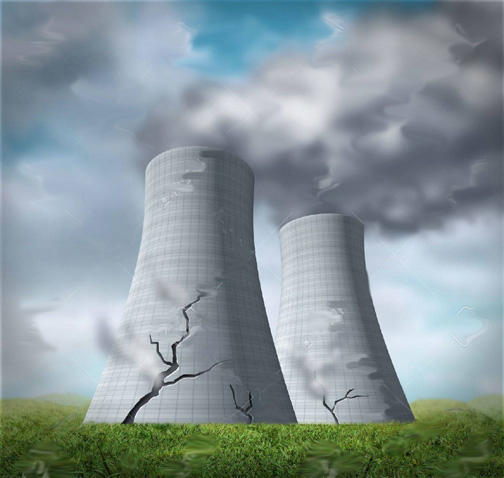 Inviting Nuclear Disaster Counterpunch BY KARL GROSSMAN 30n Dec 20, Nuclear power plants when they began being constructed were not seen as running for more than 40 years because of radioactivity embrittling metal parts and otherwise causing safety problems. But in recent decades, the U.S. Nuclear Regulatory Commission has extended the operating licenses of nuclear power plants from 40 years to 60 years and then 80 years, and is now considering 100 years.
“It is crazy,” declares Robert Alvarez, a former senior policy advisor at the U.S. Department of Energy and a U.S. Senate senior investigator and now senior scholar at the Institute for Policy Studies and is an author of the book Killing Our Own: The Disaster of America’s Experience with Atomic Radiation.
No reactor in history has lasted that long,” commented Alvarez. The oldest nuclear power plant in the U.S. was Oyster Creek, five miles south of Toms River, New Jersey, which opened in 1969 and was shut down 49 years later in 2018.
The move is “an act of desperation in response to the collapse of the nuclear program in this country and the rest of the world,” he declares.
The nuclear industry and nuclear power advocates in government are “desperately trying to hold on,” says Alvarez. With hardly any new nuclear power plants being constructed in the U.S. and the total number down to 94, they seek to have the operating licenses of existing nuclear power plants extended, he says, to keep the nuclear industry alive.
It’s a sign of “the end of the messy romance with nuclear power.”
The NRC will be holding a webinar on January 21 to consider the extending of nuclear plant operating licenses to 100 years. As its announcement is headed: “PUBLIC MEETING ON DEVELOPMENT OF GUIDANCE DOCUMENTS TO SUPPORT LICENSE RENEWAL FOR 100 YEARS OF PLANT OPERATION.”
Nuclear power plant construction has been in a deep depression for some time. Vogtle Units 3 and 4 in Georgia are “the first new nuclear units built in the United States in the last three decades,” notes on its website Georgia Power, one of the companies involved in that project. The cost projection in 2008 to build the two nuclear plants was $14.3 billion. “Now, updated estimates put the total project cost at roughly $28 billion,” states Taxpayers for Common Sense, and construction is more than five years behind schedule.
It’s not just the gargantuan price of nuclear power, and the preferability economically today of green, renewable energy led by solar and wind. Nuclear plant construction in the U.S. and much of the world has been in the doldrums because of the Three Mile Island, Chernobyl and Fukushima nuclear power plant catastrophes. People not only don’t want to waste their money–they don’t want to lose their lives to nuclear power.
“There is no empirical evidence” to support the notion that nuclear plants can have a century-long life span, says Alvarez. There “is no penciling away the problems of age” of nuclear power plants which operate under high-pressure, high-heat conditions and are subject to radiation fatigue. “The reality of wear-and-tear can’t be wished away.”
“Who would want to ride in a 100 year-old car?” he asks.
Paul Gunter, director of the Reactor Oversight Project of the organization Beyond Nuclear, says: “The new construction of nuclear power plants is proving to be more expensive and more dubious than ever before. So, the nuclear industry and the NRC are in the process of developing a plan to get these existing aging and inherently dangerous machines to run for 100 years.”
“This raises all kinds of problems that have never been addressed,” says Gunter.
And the NRC and the U.S. Department of Energy don’t want to address them…………….
an AP review of historical records, along with an interview of an engineer who helped develop nuclear power, shows that … Reactors were made to last only 40 years. Period.”
Further, the piece—”Aging Nukes: NRC and industry rewrite nuke history”—said “the AP found that the relicensing process often lacks fully independent safety reviews. Records show that paperwork of the U.S. Nuclear Regulatory Commission sometimes matches word-for-word the language used in a plant operator’s application.”
Getting operating license extensions “is a lucrative deal for operators,” said AP.
Priscilla Star, director of the Coalition Against Nukes, said of extending the operating licenses of nuclear power plants to 100 years: “There is no sane argument to perpetuate the lifespan of our already decrepit nuclear reactors other than the NRC seeking to perpetuate the endless profits to its licensees.”
“All kinds of technical foul-ups occur in the daily operations of a nuclear power plant,” she continued. ‘It’s a crapshoot running any of them safely on any given day because human error plays such a big part of operational safety. More frequent cyber hacking will also put hs at greater risk if this form of energy production is not abolished in favor of renewables. It’s time for a presidential administration to curb the noblesse oblige appetite of the NRC and once and for all consider it unsafe and unsound as a regulatory agency putting profit before public safety.”
What the NRC has also done extending nuclear power plant licenses to 60 and then 80 years is to allow the plants to be “uprated” to generate more electricity—to run hotter and harder increasing the chance of accidents. It is asking for nuclear disaster. ……..https://www.counterpunch.org/2020/12/30/inviting-nuclear-disaster/?fbclid=IwAR1YQ614qqcsQZ3mwVCo9UV2JlqCfVBgmS358L7DCCwcShjKDJFtzH-nZ0k
USA is not facing up to the climate threats to its nuclear wastes
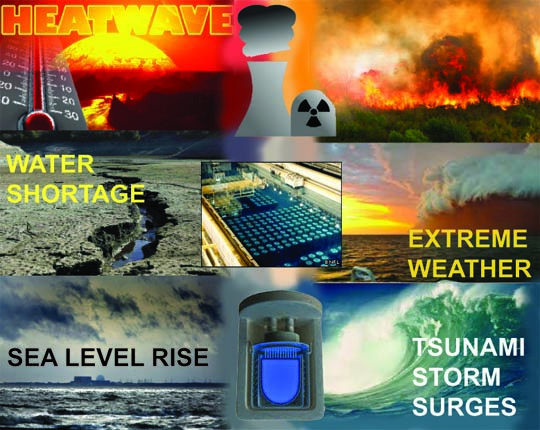 US is Ill-Prepared to Safely Manage its Nuclear Waste from Climate Threats. More than 150 sites across the country have to be managed for radioactive waste for centuries or millennia. But there’s no plan in place for how this will be done, says GAO report. Earth Island Journal , CHARLES PEKOW, December 29, 2020 The Cold War never erupted into the nuclear nightmare that the world feared for decades. But the legacy of the never-used nuclear weapons remains a ticking time bomb that could endanger countless people and lead to environmental catastrophe any time.
The GAO report, “Environmental Liabilities: DoE Needs to Better Plan for Post-Cleanup Challenges Facing Sites” (pdf), issued earlier this year, found, among other things, that the DoE doesn’t have a plan for how to address challenges at some sites that may require new cleanup work that is not in the scope of LM’s expertise.
some of these sites have already been creating serious problems.
Among the many other problem sites, the Legacy Management office is struggling to figure out what to do with contaminated groundwater at the Shiprock nuclear waste dump on the Navajo Nation Indian Reservation in northwest New Mexico. Contaminated water, the legacy of uranium mining for nuclear power plants and weapons, is being pumped to an evaporation pond there.
nuclear watchdog groups aren’t satisfied with the slow progress on this front. The nation needs “a reverse Manhattan project,” to figure out how to safely diffuse the radioactive waste, says Schaeffer of the Alliance for Nuclear Accountability. https://www.earthisland.org/journal/index.php/articles/entry/us-is-ill-prepared-to-safely-manage-its-nuclear-waste-from-climate-threats
Cover-up! how consumers will be forced to pay for cost-overruns for Sizewell C nuclear construction
 Cover-up! how consumers will be forced to pay for cost-overruns for Sizewell C construction, https://100percentrenewableuk.org/cover-up-how-consumers-will-be-forced-to-pay-for-cost-overruns-for-sizewell-c-construction–by David Toke, 30 Dec 20, In a historic change of policy the Conservatives have announced that consumers, not EDF, will pay for cost overruns in building Sizewell C. The crucial phrase in the Government’s document on the so-called ‘Regulated Asset Base’ (RAB) model is ‘Cost overruns that were not excluded from the RAB would be shared between investors and consumers through suppliers’ (para 47 page 14). Note: ‘consumers’ means electricity consumers who will have to pay twice for Sizewell C; extra on their bills long before any power is generated and for many years after generation begins. The RAB document was produced alongside the Government’s new Energy White Paper. This should be compared to the Government position in the 2011 White Paper which stated that ‘new nuclear stations should receive no public support unless similar support is available to other low-carbon technologies’. (page 8) Under the Government’s RAB proposals it is claimed that clear criteria are going to be set for what cost overruns will be payable by the consumer and what by the developer, with the outcomes carefully monitored by a ‘Regulator’. But of course once the construction juggernaut for Sizewell C starts rolling where information, not to mention armies of lawyers and hired consultants of various sorts, will be controlled by EDF, I do not seriously believe that EDF will be stopped from passing on virtually whatever costs it wants to pass on to the consumer. It is not even certain that the ‘Regulator’ will be able to stop costs of building (the still uncompleted) Hinkley C being passed onto the consumer through the books assigned to Sizewell C- that is given that workers are likely to be switched from one operation to the other. In other words, it is a blank cheque for EDF for a power plant that is not only unnecessary but which will actually cause large quantities of renewable energy to be wasted because of nuclear power’s inflexible operation (see our report on this). In effect not just consumers but renewable energy operators will be paying for the cost-overruns of building Sizewell C. Laughingly, in a world where no (at least western) nuclear power plant has been attempted this century without massive construction cost overruns being generated, the RAB document talks about ‘low probability risks such as cost overruns above a certain threshold’ (page 12). In the case of Hinkley C the cost overruns are mounting already. The most charitable explanation for the RAB document is that Treasury officials are allowing themselves to be engaged in an exercise of self-deception in order to launder a policy that if stated plainly would be deemed politically unacceptable. Reading between the lines of the RAB document and the Energy White Paper itself, the only substantial barrier stopping EDF being handed a blank cheque contract is the payment that EDF would receive for electricity generated. The White Paper says ‘We expect the sector to deliver the goal it set for itself in our Nuclear Sector Deal, published in 2018, to reduce the cost of nuclear new build projects by 30 per cent by 2030’ (page 49). So in other words the Treasury wants EDF to accept less than £65 per MWh in 2012 prices. (2012 prices, the year in which Hinkley C’s contract was priced is the funny money basis for electricity contracts these days!). Obviously EDF wants more, but with the RAB mechanism it may not need more. This is because RAB mechanism is a piece of political jelly that will allow any nuclear developer to offer to complete Sizewell C for a low sum when in reality British electricity consumers will pay for what will be called ‘cost overruns’ over and above such a figure. The RAB mechanism is a flexible political device that allows Sizewell C to be built regardless of cost realities. It is an act of public manipulation and mystification worthy of the best traditions of ‘Yes Minister’. But even so these plans are likely to cause mounting opposition when consumers realise they are likely to have to start paying extra on their bills without getting any electricity in return. Then they will have to pay extra again for the power when (evenutally) it does start being generated. Professor Tom Burke, the founding Director of E3G commented: ‘Constructing Sizewell will cost just over £20 billion. If EDF borrow this money it will double the cost to over £40 billion. EDF is negotiating with the government to make consumers pay the construction cost in advance by a levy on everyone’s energy bills. They will then have to pay again for the electricity which will still be more expensive than that from renewables.’ In effect consumers will have to pay twice for the project – first for several years before the plant has generated anything, and then again for up 40 years afterwards.
|
|
|
Doubtful that aging Los Alamos National Laboratory could safely produce plutonium triggers, no matter how much funding it gets
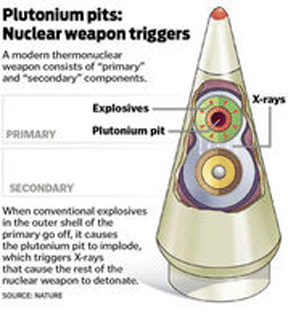 Los Alamos National Laboratory may get boost in nuclear funding, Santa Fe New Mexico By Scott Wyland swyland@sfnewmexican.com– 30 Dec 20, Los Alamos National Laboratory will get a hefty funding boost — including for its work on plutonium pit production — in the military spending bill held up by a presidential veto. Many predict the veto will be overridden, and if it is, the lab’s budget will increase to $3.3 billion from the $2.3 billion allocated last year. The bill puts $837 million into the lab’s plutonium operations, more than double the previous year’s $308 million, as Los Alamos pursues production of 30 nuclear bomb cores by 2026 — a goal critics have questioned. Plans call for the Savannah River Site in South Carolina to make an additional 50 plutonium pits by 2030, so the two facilities will produce a combined 80 pits per year as stated in the 2018 Nuclear Posture Review……..
Watchdog groups call the Trump administration’s more aggressive push to bolster the nuclear stockpile hawkish and unsustainable, and expressed uncertainty about how much the incoming Biden administration might pull back. …… Tom Clements, executive director of SRS Watch, another watchdog group, said the 2021 budget will have to be carried out, and it will take time for President-elect Joe Biden’s administration to draft a new nuclear posture review. But Biden is likely to examine the nuclear modernization program in the coming months, including whether it’s feasible to convert Savannah River’s unfinished mixed-oxide fuel plant into a pit factory, Clements said. “There are growing signs that the SRS pit plant is gonna get a thorough review by the new administration,” Clements said……… Mello said he remains doubtful the aging plutonium facility that never produced more than a dozen pits in a year can be upgraded to crank out 30-plus pits yearly, no matter how much money is spent. “There’s a question of whether Los Alamos will ever be able to do so safely,” Mello said. https://www.santafenewmexican.com/news/local_news/los-alamos-national-laboratory-may-get-boost-in-nuclear-funding/article_cd55c8a6-49f5-11eb-8718-2333908445b5.html |
|
Hanford’s dangerous collection of nuclear waste sites, including 177 underground leaky tanks
Washington’s new nuclear waste lead takes on Hanford’s aging tanks, OPB, By Anna King (Northwest News Network), Dec. 30, 2020.
David Bowen is charged with holding the U.S. Department of Energy accountable for its cleanup of a site that once produced plutonium for nuclear weapons.
At the Hanford site in southeastern Washington, along the Columbia River, millions of gallons of radioactive sludge are cradled in aging underground tanks.
Nearly 2,000 capsules filled with cesium and strontium rest unquietly in an old, glowing-blue pool of water. Two reactors along the Columbia still need to be sealed up and cocooned.
And those are just some of the bigger waste sites out of hundreds at the 580-square-mile cleanup site.
177 underground tanks filled with radioactive waste It’s a lot to ponder and a steep learning curve for freshly hired David Bowen. …..He started his new job Dec. 16 as the Nuclear Waste Program lead for Washington’s Department of Ecology in Richland.
he’ll hold the U.S. Department of Energy accountable for its cleanup at the site using the Tri-Party Agreement. That’s a 1989 document struck between Ecology, the federal Department of Energy and the U.S. Environmental Protection Agency.
Hanford houses leftovers from World War II and the Cold War, when it was the nation’s factory for plutonium. Trenches, pits and buildings are all contaminated with loads of chemicals and radioactive waste generated at breakneck speed.
The stickiest problem: 177 tanks — some of them leakers — filled with radioactive waste.
“Some of [the underground tanks] are 50-plus years old,” Bowen said. “And they weren’t designed to last this long. There are still fluids in them, millions of gallons, in sludge, et cetera. So, there’s the opportunity for that to escape and get into the Columbia River — or the groundwater is high.”
A massive waste treatment plant is being built in the desert at Hanford to treat that tank waste. But the cleanup timeline has been pushed back several times since the 1980s. It could be pushed back more because of the pandemic.
……. Aging infrastructure, aging expertsHanford is much like a complex small city: thousands of commuting workers, miles of highways and intertwining roads.
Then there are all the stakeholders: multiple tribes, Seattle-based Hanford watchdog groups, salmon and Columbia River advocates and multiple government agencies. Losing Hanford experts to retirement or attrition to other agencies is a big problem — and a growing one. Some key Ecology experts have recently been lured away to federal posts or to work as Hanford contractors. And many have already retired. Bowen said he’s well aware he needs to work fast……… https://www.opb.org/article/2020/12/29/washington-nuclear-waste-program-manager-hanford/
Avril Haines is unfit for Director of National Intelligence, with her history of coverup of tortures.
|
The Trouble With Avril Haines for Intelligence, December 29, 2020 Biden’s nominee is a drone assassin who played a key role in covering up the U.S. torture program, Consortium News, By Medea Benjamin and Marcy Winograd
World BEYOND War Even before President-Elect Joe Biden sets foot in the White House, the Senate Intelligence Committee may start hearings on his nomination of Avril Haines as director of national Intelligence. President Barack Obama’s top lawyer on the National Security Council from 2010 to 2013 followed by CIA deputy director from 2013 to 2015, Haines is the proverbial wolf in sheep’s clothing. She is the affable assassin who, according to Newsweek, would be summoned in the middle of the night to decide if a citizen of any country, including our own, should be incinerated in a U.S. drone strike in a distant land in the greater Middle East. Haines also played a key role in covering up the U.S. torture program, known euphemistically as “enhanced interrogation techniques,” which included repeated water boarding, sexual humiliation, sleep deprivation, dousing naked prisoners with ice cold water and rectal rehydration. For these reasons, among others, the activist groups CODEPINK, Progressive Democrats of America, World Beyond War and Roots Action have launched a campaign calling on the Senate to reject her confirmation. These same groups ran successful campaigns to dissuade Biden from choosing two other warmongering candidates for critical foreign policy positions: China-hawk Michele Flournoy for secretary of defense and torture apologist Mike Morell for CIA director. By hosting calling parties to senators, launching petitions and publishing open letters from DNC delegates, feminists—including Alice Walker, Jane Fonda and Gloria Steinem—and Guantanamo torture survivors, activists helped derail candidates who were once considered shoo-ins for Biden’s cabinet. Now activists are challenging Avril Haines. In 2015, when Haines was CIA deputy director, CIA agents illegally hacked the computers of the Senate Intelligence Committee to thwart the committee’s investigation into the spy agency’s detention and interrogation program. Haines overruled the CIA’s own inspector general in failing to discipline the CIA agents who violated the U.S. Constitution’s separation of powers. According to former CIA whistleblower John Kiriakou, she not only shielded the hackers from accountability but even awarded them the Career Intelligence Medal. Redacting Role And there’s more. When the exhaustive 6,000-page Senate Intelligence Committee report on torture was finally complete, after five years of investigation and research, Haines took charge of redacting it to deny the public’s right to know its full details, reducing the document to a 500-page, black-ink-smeared summary. This censorship went beyond merely “protecting sources and methods.” It avoided CIA embarrassment, while ensuring her own career advancement. Moreover, Haines supported torture apologist Gina Haspel as Trump’s CIA director. Haspel ran a secret black site prison in Thailand where torture was regularly inflicted. Haspel also drafted the memo ordering the destruction of almost 100 videotapes documenting CIA torture. As David Segal of Demand Progress told CNN, “Haines has an unfortunate record of repeatedly covering up for torture and torturers. Her push for maximalist redactions of the torture report, her refusal to discipline the CIA personnel who hacked the Senate and her vociferous support for Gina Haspel — which was even touted by the Trump White House as Democrats stood in nearly unanimous opposition to the then-nominee to lead the CIA — should be interrogated during the confirmation process.” This sentiment was echoed by Mark Udall, a Democratic senator on the intelligence committee when it finished the torture report…………….. Empty Words on Paper Haines’s policy guidance also states that the U.S. would respect other states’ sovereignty, only undertaking lethal action when other governments “cannot or will not” address a threat to the U.S. This, too, became simply empty words on paper. The U.S. barely even consulted with the governments in whose territory it was dropping bombs and, in the case of Pakistan, openly defied the government. In December 2013, the National Assembly of Pakistan unanimously approved a resolution against U.S. drone strikes in Pakistan, calling them a violation of “the charter of the United Nations, international laws and humanitarian norms” and Pakistan’s former Prime Minister Nawaz Sharif stated: “The use of drones is not only a continual violation of our territorial integrity but also detrimental to our resolve and efforts at eliminating terrorism from our country.” But the U.S. ignored the pleas of Pakistan’s elected government……………. There are many other reasons to reject Haines. She advocates intensifying crippling economic sanctions on North Korea that undermine a negotiated peace, and “regime change”—hypothetically engineered by a U.S. ally — that could leave a collapsed North Korea vulnerable to terrorist theft of its nuclear material; she was a consultant at WestExec Advisors, a firm that exploits insider government connections to help companies secure plum Pentagon contracts; and she was a consultant with Palantir, a data-mining company that facilitated Trump’s mass deportations of immigrants. But Haines’ record on torture and drones, alone, should be enough for senators to reject her nomination. The unassuming spy — who got her start at the White House as a legal adviser in the Bush State Department in 2003, the year the U.S. invaded Iraq—might look and sound more like your favorite college professor than someone who enabled murder by remote control or wielded a thick black pen to cover up CIA torture, but a clear examination of her past should convince the Senate that Haines is unfit for high office in an administration that promises to restore transparency, integrity, and respect for international law……… https://consortiumnews.com/2020/12/29/the-trouble-with-avril-haines-for-intelligence/ |
|
USA’s Nuclear Regulatory Commission “sanitises” report, wipes off safety findings about nuclear license renewals
 Inviting Nuclear Disaster Counterpunch BY KARL GROSSMAN, 30 Dec 20, “……….Paul Gunter points to what happened to a report which the NRC commissioned the DOE’s Pacific Northwest National Laboratory to make. “The federal laboratory was contracted by the NRC to develop the criteria and guidance document to address and close numerous ‘knowledge gaps’ in the license renewal safety review process to provide the ‘reasonable assurance’ that the reactors could be operated reliably and safely into the license extension period,” relates Gunter. The 2017 report raised many significant issues regarding extending the operating licenses of nuclear plants.
The report is titled “Criteria and Planning Guidance for Ex-Plant Harvesting to Support Subsequent License Renewal.”
It “was publicly posted by Pacific Northwest National Laboratory to its website in December 2017,” relates Gunter, “as well as to the websites of the Department of Energy Office of Scientific and Technical Information and the International Atomic Energy Commission’s International Nuclear Information System.”
But then Gunter attended a public meeting at the NRC’s headquarters in Rockville, Maryland on September 26, 2018 on operating license extensions “and I started asking questions citing the report” of the year before. The NRC officials there “were quite surprised.”
And the NRC “wiped all three websites of the report.”
The NRC was to repost the report, but it was then “scrubbed clean of dozens of references to safety-critical knowledge ‘gaps’ pertaining to many known age-related degradation mechanisms described in the original published report,” says Gunter. “The NRC revision also scrubbed Pacific Northwest National Laboratory findings and recommendations to ‘require’ the harvesting of realistic and representative aged materials from decommissioning nuclear power stations—base metals, weld materials, electric cables, insulation and jacketing, reactor internals and safety-related concrete structures like the containment and spent fuel pool—for laboratory analyses of age degradation. The laboratory analyses are intended to provide ‘reasonable assurance’ of the license extension safety review process for the projected extension period.”
However, Beyond Nuclear had downloaded and saved a copy of the original report which you can view here.
And you can view what Gunter terms the “sanitized version” of the report which has the same title but is dated March 2019. It’s here.
The omissions start with what is headed “Abstract” in the original 2017 report. The “Abstract” states: “As U.S. nuclear power plants look to subsequent license renewal (SLR) to operate for a 20-year period beyond 60 years, the U.S. Nuclear Regulatory Commission and the industry will be addressing technical issues around the capability of long-lived passive components to meet their functionality objectives. A key challenge will be to better understand likely materials degradation mechanisms in these components and their impacts on component functionality and safety margins. Research addressing many of the remaining technical gaps in these areas for SLR may greatly benefit from materials sampled from plants (decommissioned or operating). Because of the cost and inefficiency of piecemeal sampling, there is a need for a strategic and systematic approach to sampling materials from structures, systems and components in both operating and decommissioned plants.”
But in the 2019 version of the report, this “Abstract,” among other material, is gone.…… ……..https://www.counterpunch.org/2020/12/30/inviting-nuclear-disaster/?fbclid=IwAR1YQ614qqcsQZ3mwVCo9UV2JlqCfVBgmS358L7DCCwcShjKDJFtzH-nZ0k
Slovakia: Krško nuclear power station shut down as a precaution after quake
Krško nuclear power station shut down as a precaution after quake | Slovenska tiskovna agencija https://english.sta.si/2849550/krsko-nuclear-power-station-shut-down-as-a-precaution-after-quake Krško, 29 December 20, –
The Krško Nuclear Power Station was shut down as a precaution Tuesday after a strong 6.4-magnitude earthquake hit near Petrnija, Croatia, around midday. Such a shutdown is standard procedure in the event of a strong earthquake, the company told the STA.
Ohio Supreme Court stops collection of nuclear plant subsidy
  Ohio Supreme Court stops collection of nuclear plant subsidy The order comes a week after a judge in Franklin County issued a preliminary injunction to stop collection of the fees. Associated Press 10 WBNS, December 28, 2020 The Ohio Supreme Court on Monday issued a temporary stay to stop collection of a fee from nearly every electric customer in the state starting Jan. 1 to subsidize two nuclear power plants, a provision included in a scandal-tainted bill approved by the state Legislature in July 2019. The order signed by Chief Justice Maureen O’Connor comes a week after a judge in Franklin County issued a preliminary injunction to stop collection of the fees. Common Pleas Judge Chris Brown in his ruling from the bench last Monday said, “To not impose an injunction would be to allow certain parties to prevail. It would give the OK that bribery is allowed in the state of Ohio and that any ill-gotten gains can be received. The Ohio Manufacturers’ Association appealed to the Supreme Court earlier this month after the Public Utilities Commission of Ohio in August cited the legislation known as HB6 in issuing an order approving collection of the fees and then refused to reconsider the group’s request for a new hearing. The law calls for the plant’s new owner, Energy Harbor, to receive as much as $150 million a year and nearly $1 billion in total. Another $20 million a year from the fees are earmarked for five large solar projects, none of which are operational. The maelstrom surrounding the subsidies began in late July when U.S. Attorney David DeVillers announced the arrests of then-Ohio House Speaker Larry Householder and four others for their roles in what he called the biggest bribery scandal in state history. Householder is accused of controlling an effort secretly funded by Akron-based FirstEnergy to win legislative approval for the nuclear plant subsidies and to stop a referendum on the bill……….. https://www.10tv.com/article/news/local/ohio/ohio-supreme-court-stops-collection-of-nuclear-plant-subsidy/530-91a539b5-687e-429b-b512-8249d65a416a |
|
Plowshare anti nuclear-weapons activists again face prison .
 Longtime Anti-Nuke Activists Face Prison, Again, After Breaking Into Naval Base https://www.npr.org/2020/12/28/948116757/longtime-anti-nuclear-activists-face-prison-again-after-breaking-into-naval-base
December 28, 20205: Heard on Morning Edition
EMMA PEASLEE. Dressed in black, the seven intruders cut through a fence and stole along the perimeter of the naval base, trying to avoid detection from the guard towers, as a loudspeaker overhead blared: “Deadly force is authorized!”
Patrick O’Neill, who had a GoPro strapped to his head, tried to reassure himself by remembering a scene in the Bible where Jesus escapes unscathed from a wrathful mob that wants to throw him off a cliff.
When O’Neill and the others reached their target, they poured their own blood on the shield of the Kings Bay naval base in Georgia and attached a poster of Martin Luther King Jr. to a mock-up of a Trident II D5 ballistic missile at the welcome area.
The anti-nuclear activists — Roman Catholics who call themselves Plowshares, from the Biblical passage about “beating swords into plowshares” — followed the metaphor quite literally and took a hammer to the replica of the warhead.
The break-in on the night of April 4, 2018, ended with the arrest and conviction on charges of trespassing and destruction of property for the seven activists aged 58 to 81.
And in the midst of a pandemic that’s wreaking havoc on prisons and disproportionately affecting older people, six of them have been sentenced to up to 33 months in prison. The seventh is scheduled to be sentenced in February.
The Plowshares activists were seeking to revive the anti-nuclear movement by committing acts of civil disobedience.
They are part of a larger faith-based movement that has been around since the 1980s, when anti-nuclear protests used to draw millions into the streets.
Those days are long gone, but the threat of nuclear warfare isn’t. According to some atomic scientists, the threat may be even greater now, and the activists are frustrated that in their view hardly anyone is paying attention.
Which is one reason why they have broken into military bases and sometimes succeeded in doing damage to actual nuclear armaments. In a highly publicized protest in 1980, Plowshares activists hammered two missile nose cones at a General Electric complex in King of Prussia, Pa., causing tens of thousands of dollars worth of damage. In 2012, another group that included an 82-year-old Catholic nun defaced a bunker holding weapons-grade uranium at the Y-12 National Security Complex in Oak Ridge, Tenn.
People are always astounded that a bunch of old people or unarmed people or whatever people can gain access to these weapons at all,” said O’Neill, 64.
Martha Hennessey, 65, had already been to prison three times before beginning her sentence at a federal prison in Danbury, Conn., on Dec. 14. She is the granddaughter of the journalist-turned-activist Dorothy Day, who founded the pacifist Catholic Worker Movement in the 1930s.
Rather than dwell on her own sentence, she drew attention to the mass incarceration of people who have committed minor offenses.
“I mean, there are people being thrown into prison for years for, you know, things that are not even crimes,” she said in an interview before reporting to prison.
Members of the Plowshares group prefer not to talk about the risks they might face in prison, but their families are worried.
“I’m afraid that my dad might die in prison,” said Maura O’Neill, 26, one of O’Neill’s eight children. “I worry that he might contract COVID and get really sick, and it feels like a real possibility.”
Brexit: UK and Euratom have signed a Nuclear Cooperation Agreement (NCA)
World Nuclear News 29th Dec 2020, The UK and the European Atomic Energy Community (Euratom) have signed a
Nuclear Cooperation Agreement (NCA). This is separate from the wider UK-EU Trade and Cooperation Agreement that was also announced on 24 December and which has since been approved by ambassadors from the 27 EU Member States, paving the way for it to take effect on 1 January. UK lawmakers will tomorrow return to the House of Commons, the lower chamber of parliament,
to vote on the so-called post-Brexit trade deal.
https://www.world-nuclear-news.org/Articles/UK-and-Euratom-sign-Nuclear-Cooperation-Agreement
Scotland wants no part in the Tories’ latest nuclear energy folly
|
Douglas Chapman: Scotland wants no part in the Tories’ latest nuclear energy folly https://leftfootforward.org/2020/12/douglas-chapman-scotland-wants-no-part-in-the-tories-latest-nuclear-energy-folly/ Douglas Chapman MP, 30 Dec 20,
As Scotland moves away from nuclear power, the UK Government is trying to impose this costly distraction, writes Douglas Chapman MP. The UK Government’s publication of their new Energy White Paper shows that they are still very much out of sync with Scotland.With nuclear power at the centre of Johnson’s great green revolution, Scotland and Westminster are once more at loggerheads. The UK Government argues that we must examine all renewable and low to zero carbon options as we turn from fossil fuels and face the climate crisis head on. But the White Paper reveals that the UK government are in discussions with French energy giant, EDF, to build a £20bn nuclear power plant at Sizewell in Suffolk. In addition, they plan to develop Small Modular Reactors (SMRs) or pop-up nuclear power plants built in factories rather than involving heavy construction, as well as research and development into more advanced nuclear technologies. This is a problem for Scotland given that energy is a reserved power and we have very different plans for our renewable development. The Scottish Government rejects the case for nuclear power to be included in the push to net zero, arguing that our future clean energy ambitions can be met by far safer, more affordable and more environmentally sound means. Scotland is in the fortunate position of having an abundance of natural resources with 25% of Europe’s tidal and wind resource for instance. We are aware of our responsibility to the natural environment as well as our citizens and our updated Climate Plan reflects these values of fairness, wellbeing and a just transition to a greener future. White elephant Right now, nuclear power is still included in our current energy mix and is sourced from two stations at Torness and Hunterston. The Scottish Government is moving towards decreasing this output and increasing solar, offshore and onshore wind sources, with our wind turbines having already produced nearly twice of our entire nations domestic power with some left over for export back in 2019. When wind and solar are by far the cheaper option as compared to nuclear, at £39.65/MWh to Hinkley’s £92.50, it’s a no brainer on cost. Overall, the nuclear industry is a slow and expensive business. Given we are facing a climate emergency of terrifying proportions, turning to nuclear energy and the development of new technologies like SMR’s will not be a quick fix. The vast sums pledged by Johnson to support EDF at Sizewell are even more controversial given that the government is examining a “regulated asset base” approach to funding, or in other words putting the financial risk on to the UK consumer. No to nuclear Results from the recent UK wide Citizens Assembly on Climate Change indicate that it’s not just the Scots who are concerned with nuclear power. Nearly half – 46% – of assembly members strongly disagreed that nuclear should be part of the renewable energy plan citing concerns with cost, safety, long-term waste management, and damage to the local environment. For Scotland, it’s more personal than that. We already carry the weight of responsibility as home to the UK’s domestic nuclear power base; a key tenant of SNP policy is ridding Scotland of the burden of Trident when we become independent, a hugely popular pledge with the Scottish electorate. And then there’s the not insignificant matter of toxic waste and the decommissioning debacle of existing nuclear reactors such as Dounreay in Thurso, which, according to the Nuclear Decommissioning Authority, will take another 313 years before its regarded as a “safe site”. In addition, in 2018, the nuclear reactors at Hunterston were shut down due to concerns over cracks in the graphite core. People living close by had every right to be worried. Big plans Now Johnson’s government is forcing through the Internal Market Bill and the blatant devolution power grab, Scotland will have even less say in how we manage our renewable resources, as devolved powers such as grant of consent and planning permission could be deliberately reserved in the name of Brexit. We may be a small nation, but we have big plans in fulfilling our obligation to the planet and our responsibility in this global climate challenge. New nuclear power stations are not and never will be part of these plans. The UK Government will have a fight on their hands if they try to derail our ambition. Douglas Chapman is the Scottish National Party MP for Dunfermline and West Fife. |
|
In so many ways, Sizewell C nuclear plan is a bad deal for Britain, and especially for climate action
 Why Sizewell C is a bad deal for the UK public and our net zero goals
https://bhesco.co.uk/blog/stop-sizewell-c-nuclear-power by Dan Curtis on 21/12/2020 It has been a tumultuous few weeks for the UK’s energy policy, with the Prime Minister’s Ten Point Plan for achieving Net Zero by 2050 followed swiftly by the Government’s long overdue Energy White Paper.
Then, the news broke that the UK Government has begun discussions with French utility EDF for the development of a new nuclear reactor at Sizewell, “C” in Suffolk, basically scrapping their 10 year policy that “there will be no levy, direct payment or market support for electricity supplied or capacity provided by a private sector new nuclear operator, unless similar support is also made available more widely to other types of generation”.
The site at Sizewell contains two existing nuclear power facilities, Sizewell A (decommissioning and site restoration until 2098 at taxpayers’ cost) and Sizewell B (still active). The new proposals are to build an extension to the site, implementing the same reactor design as that Hinkley Point “C” in Somerset.
Defenders of the project invariably claim that expanding the UK’s nuclear fleet will contribute to the decarbonisation of the energy supply, ensure energy security, while providing consumers with long-term affordable electricity – all arguments which fail to stand up to scrutiny, as we shall demonstrate.
Nuclear power does not provide good value for money
It takes a phenomenal amount of money to develop new nuclear power stations, before we even begin to consider the additional cost of storing and managing the radioactive waste material.
Hinkley C was originally estimated to cost £18 billion but the project has been mired in delays and is now vastly over-budget, predicted to cost up to £3 billion more than initially forecast – a quite remarkable overspend.
To address this vulnerability to financial losses for the project developers EDF and Chinese firm CGN, who are considering withdrawing their investment, the UK Government are considering investing directly in Sizewell C, shifting risk and cost to the British taxpayer.
This is in addition to a suggestion of implementing a “regulated asset base” financing model which would enable EDF to charge energy customers for the cost of construction as well as the cost of electricity generation (thereby exposing both customers and taxpayers to the risk of project cost overruns).
Adding to the financial nonsense of new nuclear power is the sky-high cost of the electricity that is produced to the end user. The government has granted a guaranteed, inflation linked price of £92.50 per megawatt hour for the electricity to be produced by Hinkley Point C.
Compare this to the cost of offshore wind, which under a 2019 contract for difference auction, saw prices come in at £39.65 per megawatt hour – less than half the cost of energy from Hinkley.
In contrast to the ever-increasing costs of nuclear (Sizewell C has an estimated starting price tag of £20 billion, which will no doubt balloon), the cost of solar and wind power continue to fall year on year, with solar costs having declined by an astonishing 87% since 2010.
A primary motivation for nuclear power is its value for military applications
The astronomical construction and decommissioning costs of nuclear power does not make financial sense when looking at it from a UK taxpayer/ consumer viewpoint. It is only when considering the wider potential applications of a nuclear programme that we can begin to understand why successive UK governments have been so supportive of the industry.
Researchers at the University of Sussex found compelling evidence that the UK’s domestic nuclear power programme is only supported by the Government because of its value in contributing towards the military nuclear weapons programme, which would otherwise be financially unviable without such subsidised support from domestic energy customers.
Prof Andrew Stirling of the university’s Science Policy Research Unit (SPRU) said:
”The exclusion of these issues from the consultation remit reflects a serious military-driven bias in UK Government attachments to nuclear power. This is not only making carbon emissions reductions slower and more expensive, but also impeding possibilities for the UK post-COVID economic recovery”.
We believe that the arguments in favour of nuclear power are disingenuous. Backers of nuclear power should be honest that they want to build more nuclear plants not because they will provide energy security or a good deal for customers, but because they are necessary for maintaining the UK’s fleet of nuclear submarines, and all of the sabre rattling ‘seat at the table’ geo-political bravado that goes along with retaining our position as a nuclear power.
New nuclear power takes too long to build to have any meaningful role in tackling the urgent climate crisis
Wherever new nuclear power stations are being built we see long delays and broken promises.
Hinkley Point C has suffered setbacks and complications ever since development began in 2017 and it is not expected to come online until 2025. It’s the same story at other locations where this type of reactor is being built, such as in Flamanville in France which is seven years overdue and the Olkiluoto plant in Finland which is ten years late! There is only one EPR nuclear reactor operational in the world. This is the Taishun plant in China, built on the same sea where Fukishima exploded in 2011.
Clearly, new nuclear power plants will not address the issue of urgent and radical carbon emissions reductions needed to be achieved by 2030 if we are to avoid irreversible climate breakdown.
It is also worth noting the gigantic carbon footprint that would result from the construction of Sizewell C. When considering the pros and cons of nuclear power, it is vital to honestly account for the enormous quantities of cement (which has a huge carbon footprint) and other hazardous materials required to build the facility in the first place.
Adding insult to the assertion that Sizewell C will be a long-term benefit to the environment is the fact that the site is to be located adjacent to an RSPB nature reserve Minsmere, a AONB site that EDF has already started demolishing.
Nuclear power produces nuclear waste which lasts for thousands of years
The by-product of nuclear fission is hazardous nuclear waste which remains radioactive for thousands of years. This presents an extraordinary liability and storage risk to future UK taxpayers and residents.
The current liability cost of decommissioning and safely storing our existing nuclear waste is estimated to be in the region of £232 billion – a truly eye-watering sum, and one that will only continue to increase as more nuclear reactors such as Hinkley and Sizewell contribute additional toxic waste materials for every year that they are operational.
The UK already has the largest stockpile of radioactive plutonium in the world, estimated to be between 112 and 140 tons, stored in an area of outstanding natural beauty in Cumbria. Future generations will not think kindly of us if we continue to add to this dangerous legacy with more hazardous nuclear waste that costs billions each year to manage to avert disaster.
The UK does not need Sizewell C or any other nuclear power stations – we can meet our energy needs with 100% clean renewable energy
We already have the means at our disposal to meet our heat and power needs through a combination of renewable energy and energy storage technologies.
Combine this with a comprehensive programme to reduce demand through energy efficiency improvements and we can conclude with confidence that there is no reason to develop new nuclear power stations in the UK. In fact, the alternatives will deliver lower energy prices for the consumer and better taxpayer value over the long term.
A common defence for nuclear power is the need for a steady supply of ‘base load’ power in the event that intermittant renewables cannot meet demand.
But this way of thinking is obsolete. Our future energy supply in the UK will be based on dynamism and flexibility, where consumers adapt their behaviour in sync with variable generation output. As Steve Holliday, former CEO of National Grid said in 2015:
“The idea of baseload power is already outdated. I think you should look at this the other way around. From a consumer’s point of view, baseload is what I am producing myself. The solar on my rooftop, my heat pump – that’s the baseload.”
The Government’s recent announcement that it is entering into talks with EDF regarding Sizewell C is, we are told, the beginning of a long consultation process which will consider the long-term costs and benefits of such a project before reaching a conclusion on whether to give it the go ahead.
These talks are by no means a ‘green-light’ to the project. We hope that it is not naïve to believe that due diligence will be done, that the information will be honest and transparent, and that logical, rational thinking for the benefit of all residents of our small island will prevail.
But this way of thinking is obsolete. Our future energy supply in the UK will be based on dynamism and flexibility, where consumers adapt their behaviour in sync with variable generation output. As Steve Holliday, former CEO of National Grid said in 2015:
“The idea of baseload power is already outdated. I think you should look at this the other way around. From a consumer’s point of view, baseload is what I am producing myself. The solar on my rooftop, my heat pump – that’s the baseload.”
The Government’s recent announcement that it is entering into talks with EDF regarding Sizewell C is, we are told, the beginning of a long consultation process which will consider the long-term costs and benefits of such a project before reaching a conclusion on whether to give it the go ahead.
These talks are by no means a ‘green-light’ to the project. We hope that it is not naïve to believe that due diligence will be done, that the information will be honest and transparent, and that logical, rational thinking for the benefit of all residents of our small island will prevail.’
Sources ……
South Korean government to cut nuclear power generation
Government to Cut Coal-fired and Nuclear Power Generation, Business Korea, By Jung Suk-yee, December 29, 2020The South Korean government finalized its ninth national power supply plan on Dec. 28. According to it, half of coal-fired power plants in South Korea will be shut down within 15 years for the purpose of carbon reduction, 11 old nuclear power plants will be shut down at the ends of their service lives without any service life extension, and LNG- and renewable energy-based power generation will be expanded to offset the resultant decrease in power supply. ……
1 This Month

Read the Public Inquiry Report, the Commissioners’ report, Surrendering Australia: The AUKUS Deception is available to download for free at aukuspublicinquiry.com. Or just watch the replay of the National Press Club Luncheon.


19 November – Webinar – The Reality of Reprocessing
Time: 11:00 AM Pacific Time (US & Canada) / 2:00 PM Eastern / 7:00 PM UK / 8:00 PM CET
Register for the Zoom Event Here



Shut down the radiation-damaged Heysham nuclear reactors now
To see nuclear-related stories in greater depth and intensity – go to https://nuclearinformation.wordpress.com

Say No to NASA’s Reckless Nuclear Reactor on the Moon
Say No to NASA’s Reckless Nuclear Reactor on the Moon
-
Archives
- November 2026 (109)
- October 2026 (302)
- September 2026 (339)
- August 2026 (330)
- July 2026 (355)
- June 2026 (287)
- May 2026 (306)
- April 2026 (356)
- March 2026 (251)
- February 2026 (267)
- January 2026 (308)
- December 2025 (358)
-
Categories
- 1
- 1 NUCLEAR ISSUES
- business and costs
- climate change
- culture and arts
- ENERGY
- environment
- health
- history
- indigenous issues
- Legal
- marketing of nuclear
- media
- opposition to nuclear
- PERSONAL STORIES
- politics
- politics international
- Religion and ethics
- safety
- secrets,lies and civil liberties
- spinbuster
- technology
- Uranium
- wastes
- weapons and war
- Women
- 2 WORLD
- ACTION
- AFRICA
- Atrocities
- AUSTRALIA
- Christina's notes
- Christina's themes
- culture and arts
- Events
- Fuk 2022
- Fuk 2023
- Fukushima 2017
- Fukushima 2018
- fukushima 2019
- Fukushima 2020
- Fukushima 2021
- general
- global warming
- Humour (God we need it)
- Nuclear
- RARE EARTHS
- Reference
- resources – print
- Resources -audiovicual
- Weekly Newsletter
- World
- World Nuclear
- YouTube
-
RSS
Entries RSS
Comments RSS

