Watchdog group has concerns over nuclear micro-reactor plans
Monday, June 26th 2023, By Nestor Licanto, https://www.kuam.com/story/49121972/watchdog-group-has-concerns-over-nuclear-microreactor-plans
U.S. defense department proposal to use a nuclear micro-reactor as a power backup for the planned missile defense system on Guam is now being considered by Congress.
But a local watchdog group is sounding the alarm over the danger of the largely untested technology.
Leland Bettis of the local think tank and research group, pacific center for island security has been tracking the missile defense system plans for Guam and the potential for a nuclear micro-reactor.
“That’s not been disclosed by the MDA yet but we’ve sorta been tracking this. I think what really drew our attention was over the weekend the Senate Armed Services Committee’s executive summary, their NDAA language includes this piece which asks for a briefing for the Senate about the possibility of placing microreactors in Guam. 109
Bettis acknowledges that nuclear power has proven to be safe, and can provide huge cost savings even for private commercial use. [??]
But he believes a red line is crossed if they become targets in a combat situation.
“Just imagine if these reactors are a principal source of power for some of the measures, and counter-measures that the military is operating they’re certainly gonna be a target,” Bettis said. “That means that the environmental impact is not just about how does the nuclear reactor perform in producing power but how might a micro nuclear reactor perform if it’s targeted and hit.”
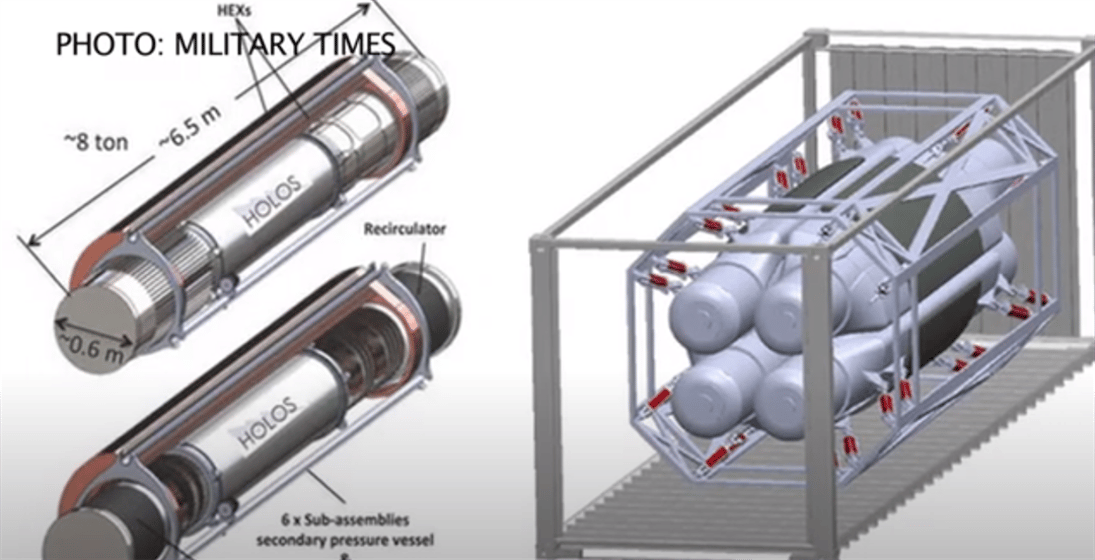
An article last year in the “Military Times” mentions Guam as a potential site for the mobile nuclear equipment.
It describes a 40-ton reactor that can fit into three to four 20-foot containers and can provide up to 5 megawatts of power.
The army has been considering the use of mobile nuclear power for years in a program called project pele, ironically named after the Hawaiian goddess of fire and volcanoes.
The benefits as a power source in remote, austere locations is clear, but there are drawbacks in battle situations.
If however that reactor is struck during conflict all the troops that are around that will be affected. So I think the concerns that they had about the use of these particular power devices for military people is magnified ten-fold when you think about the possibility that these might be placed in proximity to a civilian community.
And the military has confirmed that the planned 360-degree missile defense system could have as many as twenty different sites scatttered across the island.
Bettis says we need to know now more than ever, what’s going into each of these sites.
The people that I’ve talked to talk about a micro nuclear reactor and say if it hits you need a set-aside that’s at least a mile. That’s gonna be a very different sort of thing then if you had command and control module in your neighborhood, so I think as a community we need better transparency about what is being planned at all these locations.
Andrew Little tells nuclear powers New Zealand’s stance isn’t just ‘wishful thinking’
Thomas Manch in Singapore , 3 June 23 https://www.stuff.co.nz/national/politics/132221789/andrew-little-tells-nuclear-powers-new-zealands-stance-isnt-just-wishful-thinking
Defence Minister Andrew Little has told the nuclear powers that New Zealand’s nuclear-free stance is not “wishful thinking”, and the country will gear up to defend “our free and democratic way of life”.
Little gave a speech on nuclear threats at the Shangri-La Dialogue, a summit held in Singapore, on Friday evening. He told an audience that New Zealand had “clear eyes” about challenges to security and was increasing its military spending.
“Do not confuse my country’s moral clarity with wishful thinking,” he said.
“New Zealanders must be prepared to equip ourselves … to protect our own national security. And we are
“We will stand prepared, and will maintain the military capability necessary to contribute to the rules- based international order and protection of our free and democratic way of life now and in the future.”
Little was part of a panel discussion on nuclear issues that included General Sahir Shamshad Mirza of Pakistan, a nuclear state; Kim Gunn, a South Korean special representative; and Angus Lapsley, assistant secretary general of the nuclear deterrent alliance Nato.
On the sidelines of the summit on Friday, he also met Chinese Defence Minister Li Shangfu, Ukraine’s defence minister Oleksiy Reznikov, Singapore Defence Minister Ng Eng Hen and the East Timor Defence Minister Filomeno da Paixão de Jesus.
Speaking at the panel discussion, Little said a range of regional issues, including “destabilising” actions in the South and East China Seas and “Pacific Rim state” Russia invading of Ukraine, had heightened tensions – and increased nuclear threats.
He said there had been a “false” categorisation of “so-called tactical or battlefield nuclear weapons”. Reuters reported last week that Russia was progressing plans to station such weapons in neighbouring Belarus.
“There are no circumstances in which their use could be morally justified,” he said.
”It is not possible to confine all of the effects of the use of nuclear weapons to a period of kinetic engagement or a zone of conflict.”
Little said there was “no ambiguity” in New Zealand’s position on nuclear weapons, and its nuclear ban would remain, including for nuclear-powered vessels. New Zealand’s only formal defence ally, Australia, is planning to obtain nuclear-powered submarines in the coming decades.
“For small, liberal democracies like New Zealand, we do not get to avoid the real-life effects of geostrategic competition,” Little said.
“Our way of life, including the freedoms we cherish … can never be fully safeguarded from the effects of nuclear conflict in a world that tolerates nuclear weapons.”
The Shangri-La Dialogue is the Asia region’s premier defence summit, attended by defence minister and military leaders from 40 countries. It is hosted by London-based think-tank International Institute for Strategic Studies.
Security and access to the event is tight. Singapore has closed the airspace within 1 kilometre of the Shangri-La hotel, and its special police force of Gurkhas from Nepal are guarding the event. There is no space afforded for media in the rooms where delegates are speaking, except for limited photo and video opportunities.
The headline speakers at the event will be Australian Prime Minister Anthony Albanese, giving the keynote speech late on Friday evening, United States defence secretary Lloyd Austin and China’s defence minister Li, speaking on Saturday and Sunday respectively.
Freak May typhoon shows Philippines is now in constant state of climate emergency
‘Super typhoons have become our new normal,’ activists say
Stuti Mishra, 30 May 23 https://www.independent.co.uk/climate-change/news/typhoon-mawar-philippines-climate-change-b2348165.html—
Typhoon Mawar, an unusually intense cyclone that has struck Guam and the Philippines before heading towards Taiwan and southern Japan, shows the southeast Asian country is in a “constant state of climate emergency”, activists have said, demanding reparations for vulnerable nations.
In a statement released on Monday, Greenpeace International demanded fossil fuel companies take responsibility for the intensifying extreme weather events seen worldwide and pay reparations for climate impacts.
The typhoon left Guam flooded and without power for days and has prompted evacuations and amid extreme weather warnings in the Philippines.
Mawar, known locally in the Philippines as typhoon Betty, is the strongest typhoon of the year so far and the strongest northern hemisphere cyclone ever recorded in the month of May.
“The Philippines is in a constant state of climate emergency,” said Greenpeace Philippines campaigner Jefferson Chua.
Pacific islanders are not convinced that the release of Fukushima wastewater is safe
“………………………………………..Selling the water release plan to the Pacific
Nuclear experts from South Korea, which has been hostile to the planned discharge, have this week been given an unprecedented six-day personalised tour of the Fukushima plant.
The prime minister of the Cook Islands and chair of the Pacific Islands Forum, Mark Brown, said there had been an increase in “more intense dialogue” with Japan, and he was presently happy with the level of transparency………………..
Dozens rally against water release
However, a series of public relations disasters by TEPCO have fuelled public distrust in the plan.
There have been numerous cases where TEPCO failed to reveal that tainted water had leaked into the sea.
Local media also exposed that most water storage tanks did contain water still contaminated with dangerous radioactive elements, such as the cancer-causing strontium-90, despite TECPO’s assurances this was not the case.
TEPCO now says about a third of the tanks are ready for release, and water not up to standards will be reprocessed until it is.
“They don’t provide true information,” said Gen Hirai, a protester who gathered outside the company’s headquarters in May.
“It’s a company that blocks information to citizens.”
What do surrounding countries think of the plan?
Earlier in May, the Solomon Islands reportedly rebuked an offer from Japan to step up maritime cooperation, citing the planned Fukushima discharge.
“Japan keeps emphasising the significance of maritime security, they still decided to dump the radioactive wastewater into the ocean,” the Solomon Star reported from a government source.
Whereas Papua New Guinea (PNG) is reportedly softening its stance to accept Japan’s position.
But PNG Prime Minister James Marape couldn’t be drawn on whether the country would support Japan’s plan, saying it was “another conversation.”………….. https://www.abc.net.au/news/2023-05-26/treated-fukushima-water-to-flow-into-pacific-oaten/102380592
Public health expert says Fukushima waste water release a retrograde step
ABCNewsAustralia 30 May 23 Operators of the Fukushima Daiichi Nuclear Power Plant, which was destroyed by a massive tsunami followed by nuclear meltdowns in March 2011, are set to release treated wastewater into the ocean in coming months.
Public health expert Tilman Ruff says the danger with dumping the contaminated water is that it could settle on the sea floor or concentrate up the food chain.
New Zealand won’t give up its nuclear-free stance, says Prime Minister Chris Hipkins
Mark Quinlivan, 23 May 23, https://www.newshub.co.nz/home/politics/2023/05/new-zealand-won-t-give-up-its-nuclear-free-stance-says-prime-minister-chris-hipkins.html
“New Zealand’s nuclear-free position is long-standing and it’s not going to change.”
Chris Hipkins is refusing to budge on New Zealand’s nuclear-free status and says there are still no plans for Aotearoa to join a non-nuclear arm of a US-led defence alliance.
The Prime Minister appeared on AM on Tuesday, having just returned from a trip to Papua New Guinea to meet with US Secretary of State Antony Blinken and Pacific leaders.
“I was pretty clear [with Blinken]; New Zealand’s nuclear-free position is long-standing and it’s not going to change,” he told host Ryan Bridge.
Hipkins noted that position would prevent New Zealand from “ever” being directly involved in a defence alliance between Australia, the UK and the US – known as AUKUS.
“The US is still committed to a security relationship with New Zealand regardless of our nuclear-free status – I think that’s a good thing.”
Hipkins would not be drawn on even considering the possibility of allowing US nuclear submarines into New Zealand waters.
“We don’t allow those in New Zealand waters and that’s not going to change,” he said. “Many other Pacific nations have similar concerns.”
Bridge asked Hipkins what New Zealand’s specific concerns were.
The Prime Minister said New Zealand was “concerned about nuclear energy… because of the environmental impact of it, and the potential for environmental disaster”.
As for New Zealand joining a second, nuclear-free tier of AUKUS, Hipkins reiterated it remained unclear how that would work.
It comes after Defence Minister Andrew Little earlier this year confirmed Washington had raised the possibility of New Zealand becoming a non-nuclear partner of the alliance.
Ocean release of Fukushima nuclear wastewater endangers Pacific Islanders’ welfare
CGTN News 21 May 23,
As Japan continues to carry out its intentions to dump more than one million metric tonnes of diluted nuclear wastewater into the Pacific Ocean, Pacific Islanders’ safety and subsistence living are in jeopardy…………………………………………
“Our Pacific people did not have the opportunity to ask decades ago when our region and our ocean was identified as a nuclear test field,” Henry Puna, secretary general of the inter-governmental organization Pacific Islands Forum said, urging Japan to hold off on any such release until the people of the Pacific Island countries are certain about the implications of such discharge on the environment and on human health………………………………………
Meanwhile, a recent poll shows that more than 90 percent of Japanese believe that the discharge of nuclear wastewater into the sea will bring “negative word-of-mouth” to Japan’s fishing industry and aquatic products, and over 60 percent think that the Japanese government and TEPCO have not given enough explanation.
As said by Puna, the decision for any ocean release is not and should not only be a domestic matter for Japan but a global and transnational issue that should give rise to the need to examine the issue in the context of obligations under international law.
Japan does not own the Pacific Ocean either. If Tokyo persists in its risky, poisonous nuclear wastewater discharge plan, it will leave another indelible mark of sin on its history as a result of its irresponsible behavior. https://news.cgtn.com/news/2023-05-21/Fukushima-nuclear-wastewater-dump-endangers-Pacific-Islanders-welfare-1jYQQWdReIU/index.html
French Polynesia’s anti-nuclear organisation Association 193 criticises France for downplaying impact of tests
Walter Zweifel, RNZ Pacific Reporter walter.zweifel@rnz.co.nz https://www.rnz.co.nz/international/pacific-news/490142/anti-nuclear-group-criticises-france-for-downplaying-impact-of-tests 17 May 23
French Polynesia’s anti-nuclear organisation Association 193 has criticised the latest French report about the impact of the French nuclear weapons tests.
France’s National Institute of Health and Medical Research evaluated additional declassified data from the tests at Mururoa and found that radiation from them had a minimal role in causing thyroid cancer.
The Association’s president, Father Auguste Uebe-Carlson, told the AFP news agency there was a tendency by the French state and the Institute to minimise the impact of the nuclear fallout.
He said the French Committee for the Compensation of Victims of Nuclear Tests refused to recognise the files of victims born after 1974, when the military carried out its last atmospheric test.
But Uebe-Carlson said there was an argument to also recognise cancer sufferers born since 1974.
According to Uebe-Carlson, the Institute would one day have to explain why there were so many cancers in French Polynesia.
He has repeatedly accused France of refusing to recognise the impact of the tests, instead using propaganda to say they were clean or a thing of the past.
He said health problems were now being attributed to poor diet and lifestyle choices.
Three years ago he said he carried out survey in Mangareva, which is close to the former weapons test sites, and found that from 1966 onward all families reported cases of still-born babies.
Call for release of scientific data
The president of the test veterans’ organisation Moruroa e tatou said the release of the scientific data was not enough.
Hiro Tefaarere told La Premiere it was “absolutely necessary” for his organisation to get from the French state the register of the cancer patients and cancer deaths during the testing period.
He said it was “imperative” that these files be given to Moruroa e tatou.
Tefaarere said this research, if the state agrees to release it, would give his organisation the essential elements to consolidate the complaints which have been filed.
President to take report into account
An assembly member Hinamoeura Cross, who suffers from leukemia, said she was outraged that reports were still being published downplaying the tests’ effects.
The new president, Moetai Brotherson, said he would take the latest report into account when he enters into discussions with the French government.
French Polynesia has for years been trying to get France to reimburse it for outlays for cancer sufferers.
Its social security agency CPS said since 1995 it had spent almost $US1 billion to treat 10,000 people suffering from cancer as the result of radiation from the tests.
In 2010, Paris recognised for the first time that the tests had had an impact on the environment and health, paving the way for compensation.
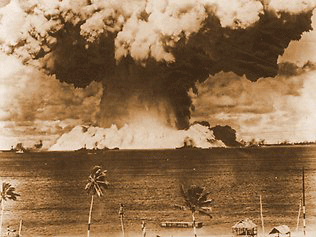
Between 1966 and 1996, France carried out almost 200 tests in the South Pacific, involving more than 100,000 military and civilian personnel.
Paris has refused to apologise or the tests, but President Emmanel Macron said France owed ‘a debt’ to French Polynesia’s people.
Pacific leaders remain steadfast against nuclear waste disposal
National Indigenous Times, Gorethy Kenneth (PNG Post Courier) – May 11, 2023
Pacific has a combined voice on “no nuclear waste” in the Pacific, Prime Minister James Marape told reporters in Port Moresby on Tuesday.
He was asked by reporters if the country would support Japan on its nuclear waste issue.
Mr Marape said that he would release a statement at a later date on the latter.
Japan allegedly reported that it was due to start dumping one million tonnes of nuclear waste from the damaged Fukushima Daiichi nuclear power plant into the Pacific ocean in only a few months.
And according to Japan’s government, the waste water was to be treated by an Advanced Liquid Processing System, which would remove nuclides from the water.
However, the Pacific island leaders united and demanded that Japan share pivotal information about the plan.
Japan, however, assured the Pacific leaders that there was no such threat, and instead defended that the country and their government had no plans to dump more than one million tonnes of radioactive waste water into the Pacific ocean……….. https://nit.com.au/11-05-2023/5922/pacific-leaders-remain-steadfast-against-nuclear-waste-disposal-png23
The Philippines to be the South East Asian guinea pig for NuScam’s small nuclear reactors?

New in Marcos’ nuclear push: US firm seeks site in Philippines for costly small reactors Cristina Chi – Philstar.com, May 2, 2023 |
MANILA, Philippines (Corrected, May 3; 10:33 a.m.)— A top nuclear energy firm from the United States that has been developing a type of nuclear reactor flagged for being potentially financially risky as renewable energy becomes more affordable has expressed interest in putting up a site in the Philippines.
This comes as President Ferdinand “Bongbong” Marcos Jr. takes his aggressive nuclear energy push to talks with US officials during his visit there this week — an agenda backed by his cousin House Speaker Martin Romualdez but roundly criticized by environmental groups………………………
Too expensive, too risky’
NuScale Power was flagged by independent think-tank Institute for Energy Economics and Financial Analysis in 2022 for developing SMR technology that is “too expensive, too risky and too uncertain.”
The group also recommended that SMR “should be abandoned” given that the costs of available renewable sources are falling rapidly and that the SMR wouldn’t generate electricity before 2029.
Marcos is on a four-day trip to the United States that began last weekend, and he has so far met with US President Joe Biden and other business leaders, including executives of the energy firm.
…………. Clayton Scott, NuScale executive vice president for business, also expressed confidence that NuScale’s small modular reactor (SMR) technology “will perform as expected.” NuScale was also accompanied by local partner Enrique Razon, representing Prime Infrastructure Capital, Inc.
Marcos first met with NuScale executives in 2022 on the sidelines of the 77th United Nations General Assembly.
Among the deals clinched during Marcos’ meeting with US officials is the US Agency for International Development’s commitment to invest $5 million to support the Philippines’ exploration of the potential for nuclear energy to meet the country’s need for clean energy, “consistent with the highest standards of nuclear security, safety and nonproliferation.”
Environmental groups’ pushback
A financially unrewarding nuclear energy deal may not be the only risk posed by NuScale Power’s entry in the Philippines, according to environmental group Greenpeace.
Nuclear energy companies are “practically making the Philippines the guinea pig for untested risky technologies to promote their business” despite other local options for safer and cheaper renewable energy, Greenpeace campaigner Khevin Yu said.
Yu warned of the potential consequences of tapping nuclear energy for electricity in the Philippines given that Germany, like other developed countries, has weaned off nuclear power — an undertaking that it began in 2002 and was accelerated in 2011 after the Fukushima nuclear disaster in Japan.
Italy also permanently shut down all of its functioning nuclear plants in 2022.
Yu said that risks related to nuclear technology remain unresolved, and SMRs “are still untested and unproven.”
“(And) there is currently no way to safely store nuclear waste,” Yu said.
“Even if they actually succeed in putting up nuclear plants, it will take a long time before we are able to use it. Furthermore, we will be stuck with maintaining a ticking time-bomb, which will endanger the lives of nearby communities should an accident occur,” Yu added.
Yu, meanwhile, pointed out that the pivot to renewable energy became a topic of discussion between Marcos and Bide, which he said should now “be the focus of the current administration.” https://www.philstar.com/headlines/climate-and-environment/2023/05/02/2263238/new-marcos-nuclear-push-us-firm-seeks-site-philippines-costly-small-reactors
‘New Zealand should say sorry’ – sailors posted to watch nuclear tests
RNZ Jimmy Ellingham, Manawatū reporter, jimmy.ellingham@rnz.co.nz 1 May 23
New Zealand sailors exposed to British nuclear tests in the Pacific in the 1950s remain unhappy they have never had a government apology for being placed in harm’s way.
On the weekend the veterans, now aged at least in their 80s, held a reunion in Palmerston North.
For many of them it could be their last chance to catch up with their mates from Operation Grapple, which happened in 1957 and 1958, when New Zealand vessels HMNZS Pukaki and Rotoiti observed tests near Christmas Island, now part of Kiribati……………………………….
In the mid-1990s, Tahi and fellow veteran, the late Roy Sefton, organised the first reunion in Palmerston North, which revealed four decades of suffering.
“They stood up and spoke about the defects they had with their children, and that was terrible.
“A guy stood up and said, ‘How come I lost my two boys? They were 18 years old. They had cancer.’ He was carrying the genes, you see.”
Sefton and Tahi led the veterans’ association and have lobbied successive governments for an apology for being exposed to radiation, to no avail……………
The lack of acknowledgement from New Zealand’s government was particularly frustrating for the veterans, given the effects the tests had on them were confirmed by a scientific study.
It was done by now-retired Massey University associate professor Dr Al Rowland.
“I conducted a big research programme on the nuclear test veterans and I discovered alarming evidence of long-term genetic damage.”
This damage was a consequence of Operation Grapple, he said.
Rowland is the veterans’ association patron and he said it saddened him that they still had not received an apology.
“What we are looking for is recognition of the research, from the government.
“The international scientific community have accepted the work and I’ve received a lot of plaudits. In fact, I received an ONZM for the research from John Key’s government.”
Despite that, he said the veterans’ association had regular meetings with ministers, but was making no progress.
Roy Sefton died two years ago, but down the years he fought for pensions for veterans and their families, said his daughter, Anu……………………………………… https://www.rnz.co.nz/news/national/489021/new-zealand-should-say-sorry-sailors-posted-to-watch-nuclear-tests
New Zealand’s nuclear test veterans seek recognition
More than 500 sailors on New Zealand navy ships were exposed to tests of hydrogen bombs in the late 1950s. Aaron Smale spoke to one ahead of Anzac Day.
newsroom, Aaron Amale 23 Apr 23
He was a 17-year-old kid from Te Kuiti when he was ordered onto the deck of a Navy ship and told to sit down with his back facing out to sea. He and his mates donned dark glasses and wore what was grossly inadequate protection. Then he saw the bones in his hands from the flash of a hydrogen bomb being detonated.
Ordered to stand up and turn around, Tere Tahi saw what should have been a frightening sight but his reaction was one of awe and wonder.
“It was the most beautiful thing. It was fantastic. It was fantastic seeing all the different colours in the blast. It was a marvellous experience to see something like that, but we didn’t know what effects it would have on us after that. We went in close to the fallout when the sea was being drawn towards the mushroom.”
Tahi had joined the Navy as a teenager and was stationed on the ship Rotoiti, one of two New Zealand ships that was sent to Christmas Island and witnessed the British testing hydrogen bombs in 1958. The legacy of those tests continues to affect those who saw them and has been passed down through their families.
“We were told to get on to the upper deck with anti-flash gear, put on dark glasses and to have our backs towards the detonation and when that was completed, we were told to turn and watch the blast. We had all this gear on and dark glasses and when it went off we could see the bones in our fingers, in our hands, with our hands over the dark glasses.”
“I wasn’t scared, because we didn’t know what the after effects would be.”…………
Tahi is now the president of the Nuclear Test Veterans Association in New Zealand and has taken on the fight to try and help veterans and their families affected by the impacts of being exposed to radiation. The association is having a reunion on April 28-30 in Palmerston North.
“I’ve set up some projects to help our veterans that have illnesses. What I want to do is give them some assistance helping them out with the illnesses. Some of them are finding it difficult to finance.”
The illnesses are not limited to the veterans themselves.
“Another problem that we faced with is a lot of our children, a lot of the veterans’ children have been born with deformities. It’s been very bad too. And that’s my final legacy – if you try and do something for them.”………………………
It wasn’t only New Zealand personnel who were exposed to the blasts. British sailors were also present and have been waging the same war to get recognition.
“I went to England to a nuclear test veterans association commemoration. I was invited by the English government to go over there, this was in November of last year. It was the British. It was them that dropped the bomb.”
He says in hindsight he believes they were being used in an experiment. He worked as a radio operator and heard the secret communications coming through.
“As a radio man we receive secret signals saying that the reason they wanted troops there was to see what effects it would have on the equipment, which would have been our ships and the equipment on the ships, and to what see what effects it would have on the men. It was terrible. They wanted to see what effects it would have on us. It was obvious we were guinea pigs.
“Hiroshima and Nagasaki, our bomb was a hundred times worse than that. A hundred times worse.”……………………………….
An estimated 20,000 British servicemen, 524 New Zealand soldiers and 300 Fijian soldiers were deployed to “Christmas Island” from 1956 to 1962.
Between May 1957 and September 1958 the British government tested nine thermonuclear weapons on Kiritimati for Operation Grapple. In 1962, the UK cooperated with the US on Operation Dominic, detonating another 31 bombs on Kiritimati.
The long-term impact on their lives and families largely hasn’t been formally acknowledged. The inhabitants of the islands have never been acknowledged either. https://www.newsroom.co.nz/nuclear-test-veterans-still-waiting-for-recognition—
Maori workers exposed to radiation in cleaning up USA’s failed nuclear reactor in Antarctica
Detour: Antarctica – Kiwis ‘exposed to radiation’ at Antarctic power plant, https://www.nzherald.co.nz/travel/detour-antarctica-kiwis-exposed-to-radiation-at-antarctic-power-plant/NY5WTQ72JF4OFUW4F35ZSUCB6U/ 8 Jan, 2022 By Thomas Bywater, Thomas Bywater is a writer and digital producer for Herald Travel
In a major new Herald podcast series, Detour: Antarctica, Thomas Bywater goes in search of the white continent’s hidden stories. In this accompanying text series, he reveals a few of his discoveries to whet your appetite for the podcast. You can read them all, and experience a very special visual presentation, by clicking here. To follow Detour: Antarctica, visit iHeartRadio, or wherever you get your podcasts.
The Waitangi Tribunal will consider whether NZ Defence Force personnel were appropriately warned of potential exposure to radiation while working at a decommissioned nuclear reactor in Antarctica.
It’s among a raft of historic claims dating from 1860 to the present day before the Military Veterans Inquiry.
After an initial hearing in 2016, the Waitangi Tribunal last year admitted the Antarctic kaupapa to be considered alongside the other claims.
“It’s been a bloody long journey,” said solicitors Bennion Law, the Wellington firm representing the Antarctic claimants.
Between 1972 and the early 1980s, more than 300 tonnes of radioactive rubble was shipped off the continent via the seasonal resupply link.
Handled by US and New Zealand personnel without properly measuring potential exposure, the submission argues the Crown failed in its duty of care for the largely Māori contingent, including NZ Army Cargo Team One.
“This failure of active protection was and continues to be in breach of Te Tiriti o Waitangi,” reads the submission.
The rubble came from PM3A, a portable nuclear power unit on Ross Island, belonging to the US Navy. Decommissioned in 1972, its checkered 10-year operating history led it to be known as ‘Nukey Poo’ among base inhabitants. After recording 438 operating errors it was shut off for good.
Due to US obligations to the Antarctic Treaty, nuclear waste had to be removed.
Peter Breen, Assistant Base Mechanic at New Zealand’s Scott Base for 1981-82, led the effort to get similar New Zealand stories heard.
He hopes that NZDF personnel involved in the cleanup of Ross Island might get medallic recognition “similar to those who were exposed at Mururoa Atoll”. Sailors were awarded the Special Service Medal Nuclear Testing for observing French bomb sites in the Pacific in 1973, roughly the same time their colleagues were helping clear radioactive material from Antarctica.
A public advisory regarding potential historic radiation exposure at McMurdo Station was published in 2018.
Since 1975 the Waitangi Tribunal has been a permanent commission by the Ministry of Justice to raise Māori claims relating to the Crown’s obligations in the Treaty of Waitangi.
The current Military Veterans’ Kaupapa includes hearings as diverse as the injury of George Nepata while training in Singapore, to the exposure of soldiers to DBP insecticides during the Malayan Emergency.
Commenced in 2014 in the “centenary year of the onset of the First World War” the Māori military veterans inquiry has dragged on to twice the duration of the Great War.
Of the three claimants in the Antarctic veterans’ claim, Edwin (Chaddy) Chadwick, Apiha Papuni and Kelly Tako, only Tako survives.
“We’re obviously concerned with time because we’re losing veterans,” said Bennion Law.
Detour: Antarctica is a New Zealand Herald podcast. You can follow the series on iHeartRadio, Apple Podcasts, Spotify or wherever you get your podcasts.
Imperial Visits: US Emissaries in the Pacific
Australian Independent Media Binoy Kampmark 19 Mar 23
For some time, Washington has been losing its spunk in the Pacific. When it comes to the Pacific Islands, a number have not fallen – at least entirely – for the rhetoric that Beijing is there to take, consume, and dominate all. Nor have such countries been entirely blind to their own sharpened interests. This largely aqueous region, which promises to submerge them in the rising waters of climate change, has become furiously busy.
A number of officials are keen to push the line that Washington’s policy towards the Pacific is clearly back where it should be. It’s all part of the warming strategy adopted by the Biden administration, typified by the US-Pacific Island Country summit held last September. In remarks made during the summit, President Joe Biden stated that “the security of America, quite frankly, and the world, depends on your security and the security of the Pacific Islands. And I really mean that.”
Not once was China mentioned, but its ghostly presence stalked Biden’s words. A new Pacific Partnership Strategy was announced, “the first national US strategy for [the] Pacific Islands.” Then came the promised cash: some $810 million in expanded US programs including more than $130 million in new investments to support, among other things, climate resilience, buffer the states against the impact of climate change and improve food security.
The Pacific Islands have also seen a flurry of recent visits. In January this year, US Indo-Pacific military commander Admiral John Aquilino popped into Papua New Guinea to remind the good citizens of Port Moresby that the eyes of the US were gazing benignly upon them. It was his first to the country, and the public affairs unit of the US Indo-Pacific Command stated that it underscored “the importance of the US-Papua New Guinea relationship” and showed US resolve “toward building a more peaceful, stable, and prosperous Indo-Pacific region.”
In February, a rather obvious strategic point was made in the reopening of the US embassy in the Solomon Islands. Little interest had been shown towards the island state for some three decades (the embassy had been closed in 1993). But then came Beijing doing, at least from Washington’s perspective, the unpardonable thing of poking around and seeking influence.
Now, Prime Minister Manasseh Sogavare finds himself at the centre of much interest, at least till he falls out of favour in the airconditioned corridors of Washington………………………………………………………………………………………….. https://theaimn.com/imperial-visits-us-emissaries-in-the-pacific/
Samoa’s desperate plea for world climate action

Samoa PM urges world to save Pacific people from climate crisis
obliteration. The world must step back from the brink of climate disaster
to save the people of the Pacific from obliteration, the prime minister of
Samoa has urged.
On the eve of a landmark report by the Intergovernmental
Panel on Climate Change, which is expected to deliver a scientific “final
warning” on the climate emergency, Fiame Naomi Mata’afa, Samoa’s prime
minister, issued a desperate plea for action. “We’re all impacted, but
the degree of the impact is in the particular circumstance of countries. So
our low-lying atoll countries, it’s right there, we’re living with it,”
said Mata’afa. “There are already examples in the Pacific of communities,
whole communities, that have relocated to different countries,” she said.
“They’re really having to address issues of sovereignty through loss of
land.”
Guardian 19th March 2023
1 This Month

of the week – Shut Down Drone Warfare!


Tell the Ukrainian Government to Drop Prosecution of Peace Activist Yurii Sheliazhenko

Petition to revoke the licensing of the Near Surface Nuclear Disposal Facility (NSDF) at Chalk River. https://www.ourcommons.ca/petitions/en/Petition/Details?Petition=e-7247
To see nuclear-related stories in greater depth and intensity – go to https://nuclearinformation.wordpress.com
-
Archives
- March 2026 (237)
- February 2026 (268)
- January 2026 (308)
- December 2025 (358)
- November 2025 (359)
- October 2025 (376)
- September 2025 (257)
- August 2025 (319)
- July 2025 (230)
- June 2025 (348)
- May 2025 (261)
- April 2025 (305)
-
Categories
- 1
- 1 NUCLEAR ISSUES
- business and costs
- climate change
- culture and arts
- ENERGY
- environment
- health
- history
- indigenous issues
- Legal
- marketing of nuclear
- media
- opposition to nuclear
- PERSONAL STORIES
- politics
- politics international
- Religion and ethics
- safety
- secrets,lies and civil liberties
- spinbuster
- technology
- Uranium
- wastes
- weapons and war
- Women
- 2 WORLD
- ACTION
- AFRICA
- Atrocities
- AUSTRALIA
- Christina's notes
- Christina's themes
- culture and arts
- Events
- Fuk 2022
- Fuk 2023
- Fukushima 2017
- Fukushima 2018
- fukushima 2019
- Fukushima 2020
- Fukushima 2021
- general
- global warming
- Humour (God we need it)
- Nuclear
- RARE EARTHS
- Reference
- resources – print
- Resources -audiovicual
- Weekly Newsletter
- World
- World Nuclear
- YouTube
-
RSS
Entries RSS
Comments RSS
 nuclear-news