Pacific wants open discussion on AUKUS to ensure region is nuclear free
Eleisha Foon, RNZ Pacific Journalist, @eleishafoon, more https://www.rnz.co.nz/international/pacific-news/508948/pacific-wants-open-discussion-on-aukus-to-ensure-region-is-nuclear-free 12 Feb 24
Keeping the Pacific nuclear-free, in line with the Rarotonga treaty, was a recurring theme from the leaders of Tonga, Cook Islands and Samoa to New Zealand last week.
The New Zealand government’s Pacific mission wrapped up on Saturday with the final leg in Samoa.
Over the course of the trip, defence and security in the region was discussed with the leaders of the three Polynesian nations.
In Apia, Samoan Prime Minister Fiamē Naomi Mataʻafa addressed regional concerns about AUKUS.
New Zealand is considering joining pillar two of the agreement, a non-nuclear option, but critics have said this could be seen as Aoteroa rubber stamping Australia acquiring nucelar-powered submarines.
“We would hope that both administrations will ensure that the provisions under the maritime treaty are taken into consideration with these new arrangements,” Fiamē said.
New Zealand’s previous labour government was more cautious in its approach to joining AUKUS because it said pillar two had not been clearly defined, but the coalition government is looking to take action.
Prime Minister Fiamē said she did not want the Pacific to become a region affected by more nuclear weapons.
She said the impact of nuclear weapons in the Pacific was still ongoing, especially in the North Pacific with the Marshall Islands, and a semblance of it is still in the south with Tahiti.
She said it was crucial to “present that voice in these international arrangements”.
“We don’t want the Pacific to be seen as an area that people will take licence of nuclear arrangements.”
The Treaty of Rarotonga prohibits signatories – which include Australia and New Zealand – from placing nuclear weapons within the South Pacific.
Cook Island’s Prime Minister Mark Brown said Pacific leaders were in agreement over the security matter.
“I think our stance mirrors that of all the Pacific Island countries. We want to keep the Pacific region nuclear weapons free, nuclear free and that hasn’t changed.”
Reflecting on dicussions during the Pacific Islands Forum in 2023, he said: “A review and revisit of the Rarotonga Treaty should take place with our partners such as New Zealand, Australia and others on these matters.”
“It’s timely that we have them now moving forward,” he said.
Last year, Fiji’s Prime Minister Sitiveni Rabuka proposed a Pacific peace zone which was discussed during the forum leaders’ meeting Rarotonga.
This year, Tonga will be hosting the forum and matters of security and defence involving AUKUS are expected to be a key part of the agenda.
Tonga’s Acting Prime Minister Samiu Vaipulu acknowledged New Zealand’s sovereignty and said dialogue was the way forward.
“We do not interfere with what other countries do as it is their sovereignty. A talanoa process is best,” Vaipulu said.
Foreign Minister Winston Peters and Health and Pacific People’s Minister Shane Reti reiterated that they care and have listened to the needs outlined by the Pacific leaders.
They said New Zealand would deliver on funding promises to support improvements in the areas of health, education and security of the region.
Fijian youths condemn Japan’s discharge of radioactive water
Global Stringer, 22-Jan-2024, https://news.cgtn.com/news/2024-01-22/We-Talk-Fijian-youths-condemn-Japan-s-discharge-of-radioactive-water-1qz4wGtqnkc/p.html
The fourth round of discharge of nuclear-contaminated water from the Fukushima Daiichi nuclear power plant will begin in late February 2024, with a total release of 7,800 tonnes, local media reported on December 18. Japan has so far completed three rounds of nuclear discharge, sending more than 23,000 tonnes of nuclear wastewater into the Pacific Ocean in less than three months.
CGTN Stringer took to the streets of Fiji and asked many local college students for their opinions on this matter. The students expressed their strong opposition, noting that the islanders depend on the sea for a living. The discharge of nuclear-contaminated water into the sea will pollute the Pacific Ocean and destroy coral groups. It will seriously affect the living resources of the islanders, endanger the health of the people of the island country, and cause immeasurable damage to ecosystems.
Halt the US-Philippines Nuclear Deal
Sign on to Letter to US Congress
Full statement and sign on: tinyurl.com/haltUSPHdeal
While thousands gathered in San Francisco to protest the Asia Pacific Economic Cooperation (APEC) and Philippine President Ferdinand Marcos Jr.’s presence at its meetings, United States Secretary of State Anthony Blinken signed a new Section 123 Nuclear Agreement with the Philippine Energy Secretary Raphael Lotilla. This agreement would allow the United States to export nuclear technology and material to Manila. Negotiations for the agreement began upon Kamala Harris’ November 2022 trip to the Philippines, making it the fastest Section 123 agreement ever signed, according to Blinken.
President Marcos Jr. portends the so-called “peaceful nuclear cooperation,” to be an alternative energy solution for the Philippines. The agreement must now go before the US Congress for approval.Here are five reasons why we must act now to oppose it:
- In a country already prone to climate disaster, vulnerable communities in the Philippines will be further at risk. Located in the notoriously active seismic zone known as the “ring of fire,” the Filipino people are among those that climate change and natural disasters most endanger, seen in the yearly typhoons and major disasters such as Typhoon Haiyan in 2013, which some estimate affected around 16 million people. History meanwhile provides no doubt about the potential disasters that can come with nuclear energy; we are already witness to the devastation caused by the nuclear accidents in Chernobyl and Fukushima. US-based nuclear companies are pivoting their projects to the Philippines, making the country a guinea pig for their untested and risky technologies.
2 Nuclear energy poses a threat to the health and safety of communities in the Philippines. Exposure to toxic nuclear waste is linked to increased rates of cancer, cardiovascular disease and other adverse health effects, particularly in sensitive populations including children. The Philippines is highly abundant in safer forms of renewable energy, and it is better to use precautionary principles than put already vulnerable communities at further risk. There is no confidence in the Philippine government to handle this type of radiation processing of energy, especially if they are privatized and the main objective is profit.
3 Fashioned in the style of the Marcos Sr. Dictatorship, this deal benefits only the US and Philippine elite. This is not the first attempt of the Philippine government to prioritize nuclear energy with the United States. Marcos Sr., following his declaration of Martial Law, worked with US companies to begin the building of the Bataan Nuclear Plant. The Bataan Plant, a point of protest for activists in the Philippines, quickly failed and was mothballed when the Marcos dictatorship, full of corruption and plundering of public funds for personal use, could not complete the construction. Now, Marcos Jr., known for his lavish spending on global travel, has sought to revive a nuclear project like his father’s to earn foreign investment. House of Representatives Member Mark Cojuangco, a billionaire and long-time supporter of the Marcos family, has been a proponent of nuclear projects. These families support said nuclear project because it benefits their widespread power over land and profit in the Philippines Creating a deal with the US and foreign corporations will serve their business interests, not those of the Filipino people. For the US and US based corporations, it gives the opportunity to control and profit further from the resources in the Philippines, a country which, since 2022, has allowed 100 percent foreign ownership over “clean” energy projects.
4 The so-called “peaceful transfer” of nuclear materials thwarts the Filipino people’s right to peace, development and self-determination. Known as the deadliest country for land defenders, environmental activists, indigenous people, farmers and people in rural areas of the Philippines are currently facing brutal attacks under the Marcos’ counterinsurgency program – recently documented by UN Special Rapporteur Ian Fry. In its attempts to squash the CPP-NPA-NDF, the Marcos regime has continued the US-designed counterinsurgency policy of Duterte and many presidents before him that result in the militarization of indigenous and rural communities, indiscriminate aerial bombings, forced surrender of civilians and mass displacement of people from their homelands. At the roots of the armed conflict in the Philippines is the Filipino people’s struggle for land and sustainable, national development, free from foreign intervention and control. The transfer of nuclear materials paves the way for more displacement of indigenous people, land grabbing for the sake of foreign corporations and further militarization of the countryside. The potential monopoly of foreign ownership over energy in the Philippines further aggravates the people’s aspiration to control and determine the development of their own economy. The US agreement with the Marcos regime gives further approval of Marcos’s policies and rewards his family for their ongoing plunder and exploitation of the Filipino people.5 As tensions with China escalate, the storage of nuclear materials will set a precedent for the US to allow a nuclear arsenal to be stored in the Philippines. The required technology and infrastructure for facilities to hold nuclear materials will open up the door for conversations to allow for the potential storage of US nuclear weapons on Philippine soil. President Marcos has already allowed the ongoing Kamandag war game exercises between the US, Philippines, South Korea, and Japan, only serving to escalate tensions in the region and drag the Philippines into conflict between the US and China. By allowing the US to store nuclear materials in the Philippines, Marcos is setting the stage to welcome US nuclear weapons as an opportunity to advance his foreign affairs relationship with US President Biden.
For these reasons, we, members of the Filipino community and allies in solidarity, demand that members of US Congress halt the Section 123 US-PH Nuclear Deal.
Nuclear energy in Philippines? Group says there’s not even a Filipino expert on safety, radiation.
By: Cristina Eloisa Baclig – Content Researcher Writer / @inquirerdotnet, INQUIRER.net / 03:08 PM November 27, 2023
MANILA, Philippines—In a convergence of scientific and environmental dissent, progressive groups, scientists, and climate activists expressed strong opposition to the newly signed nuclear deal between the Philippines and the United States (US).
Last Nov. 17, Energy Secretary Raphael Lotilla and US Secretary of State Anthony Blinken signed the 123 agreement, or the “peaceful nuclear cooperation agreement,” on the sidelines of the Asia-Pacific Cooperation (Apec) Summit.
It took a year to negotiate the breakthrough agreement between the two countries. Blinken described it as “the fastest that the United States has ever negotiated this kind of agreement.”
The deal, which awaits approval by the US Congress, establishes a legally binding framework allowing the transfer of nuclear material and the export of nuclear fuel, reactors, and equipment from the US to the Philippines…………………………
A ‘reckless decision’
The group Advocates of Science and Technology for the People (AGHAM) said the government’s decision to “impulsively” enter into the agreement was a “reckless decision that lacks careful consideration.”
The group explained that despite its promised and expected benefits, there is still no detailed study on whether nuclear power is necessary and appropriate for the country.
“This omission leaves the Marcos administration without a solid foundation to justify their nuclear aspirations, as the International Atomic Energy Agency (IAEA) emphasizes the importance of such studies in assessing a country’s needs and potential for nuclear energy,” the group added.
AGHAM argued that nuclear energy will only worsen the energy crisis in the country, where, according to the group, other indigenous sources of energy remain largely untapped or with inefficient and incomplete distribution systems.
It also described the agreement as “dangerously premature,” considering that the science and technology sector in the country remains severely underfunded and understaffed.
“To illustrate, as of this moment, there is no Filipino expert in nuclear safety or in radiological environmental impact assessment in the country,” the group explained.
“This means that we will have to disproportionately rely on the US nuclear regulatory mechanism, which will lead to us being clueless guinea pigs for their new nuclear technologies; since we do not have our own way of technically assessing future implementations.”
Not a solution for clean energy security
President Ferdinand “Bongbong” Marcos Jr., who witnessed the signing of the pact, said the deal would ensure a “more energy secure and green Philippines.”
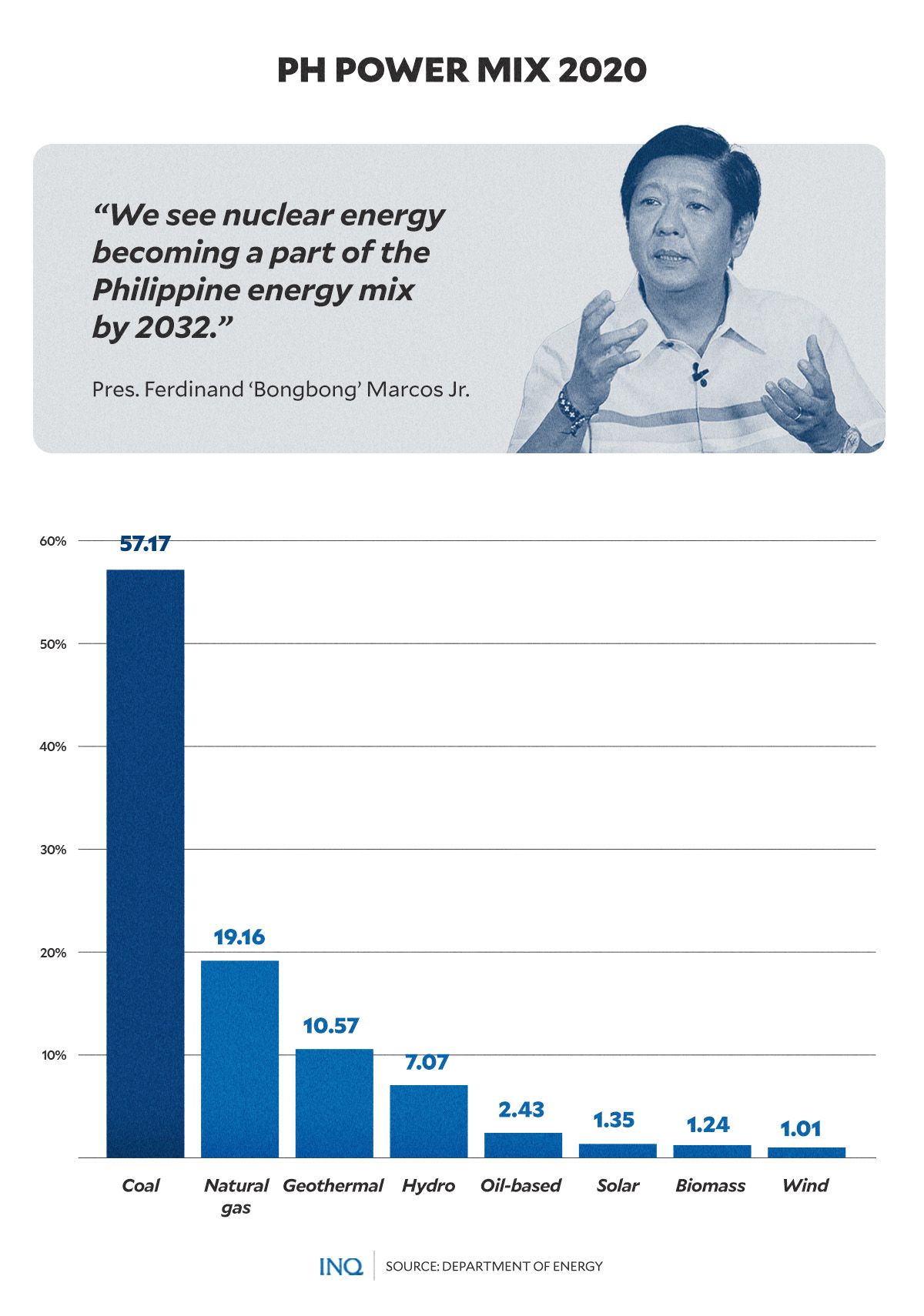
“We see nuclear energy becoming a part of the Philippine energy mix by 2032, and we would be more than happy to pursue this path with the United States as one of our partners,” said Marcos Jr. in a speech.
“The signing of the Philippines-United States Agreement for Cooperation Concerning Peaceful Uses of Nuclear Energy, or the 123 Agreement, is the first major step in this regard, taking our cooperation on capacity building further and actually opening the doors for U.S. companies to invest and participate in nuclear power projects in the country,” he added.
However, according to the Philippine Movement for Climate Justice (PMCJ), the 123 Agreement poses a threat by acquiring risky nuclear technologies, misleadingly promoted as a remedy for clean energy security.
“[T]he agreement’s purported benefits are debunked. Nuclear energy, touted for clean energy, releases pollutants worsening the planet’s temperature. The resulting radioactive waste persists for years, often irresponsibly dumped or stored, lacking proper technology for disposal,” PMCJ said in a statement.
PMCJ said that it “vehemently opposes nuclear energy in the country, advocating for a shift towards sustainable solutions.”
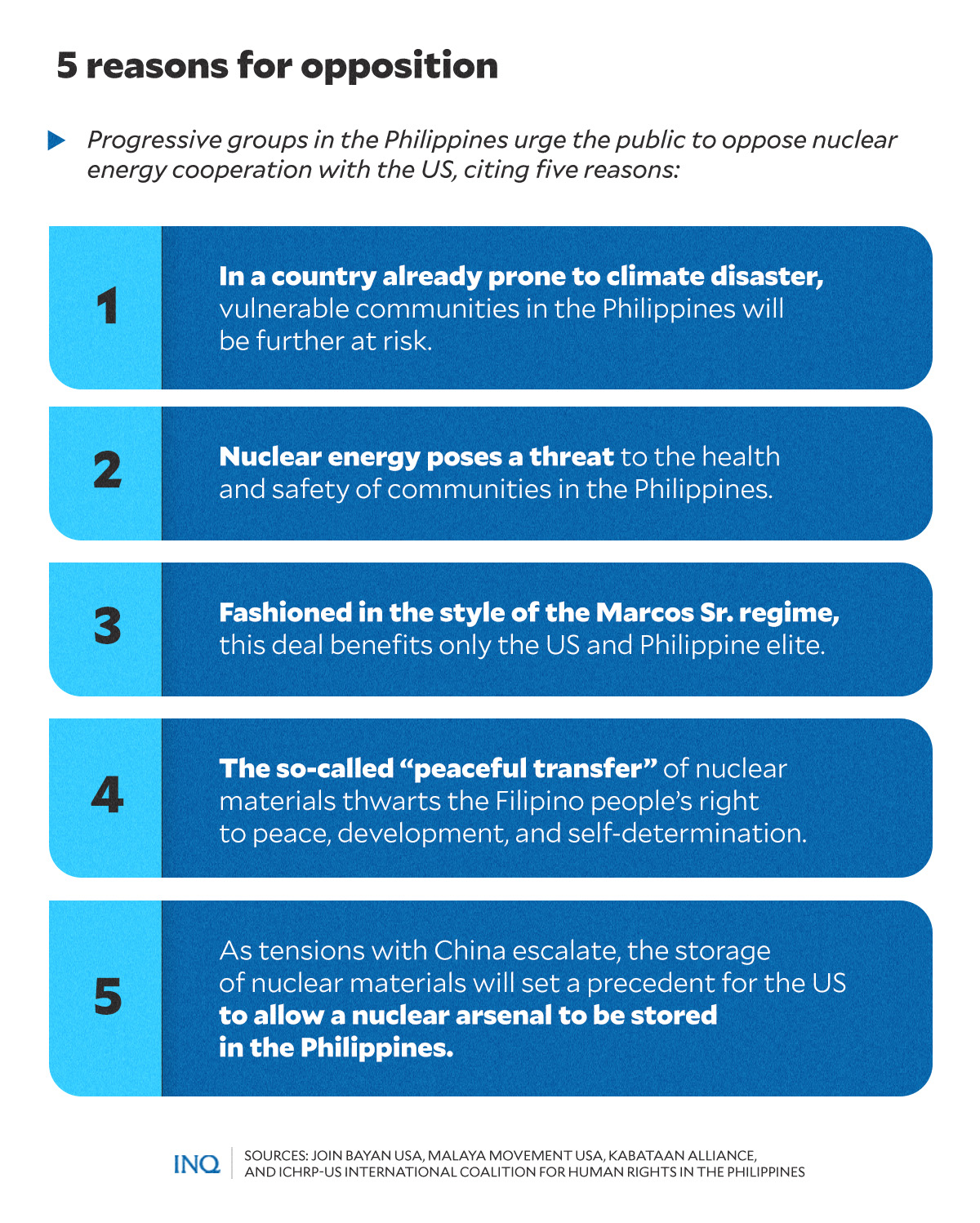
Despite the supposed benefits, the International Coalition for Human Rights in the Philippines (ICHRP-US), along with progressive groups — Bayan USA, Malaya Movement USA, Kabataan Alliance — demanded that members of the US Congress halt the nuclear deal, citing five reasons:
- In a country already prone to climate disaster, vulnerable communities in the Philippines will be further at risk.
- Nuclear energy poses a threat to the health and safety of communities in the Philippines.
- Fashioned in the style of the Marcos Sr. regime, this deal benefits only the US and Philippine elite.
- The so-called “peaceful transfer” of nuclear materials thwarts the Filipino people’s right to peace, development, and self-determination.
- As tensions with China escalate, the storage of nuclear materials will set a precedent for the US to allow a nuclear arsenal to be stored in the Philippines.
Renewable vs nuclear energy
Both PMCJ and AGHAM questioned Marcos Jr. and his administration’s plans to use more renewable energy while also pushing for the use of nuclear power……………………………………………………………………………………………………………..
“As with his other policies, this will just be an edifice to be used as a talking point for the purposes of extending the Marcoses’ cling to power; with no real positive contribution, and even potentially dangerous, to the Filipino people,” the group continued.
Environmental group Greenpeace Philippines has previously called out Marcos Jr. for showing mixed signals on his stance on energy.
“He used renewable energy when he ran for president, and continues to talk about it like he means it, but it’s all a game of pretend. If you look at his actions, he’s actually out to promote nuclear energy and fossil gas–both of which will block major RE development,” said Greenpeace Philippines country director Lea Guerrero.
“Greenpeace believes this is climate hypocrisy at its most dangerous,” she added.
https://newsinfo.inquirer.net/1866612/nuclear-energy-in-ph-group-says-theres-not-even-a-filipino-expert-on-safety-radiation#ixzz8KL4mjfe6
Follow us: @inquirerdotnet on Twitter | inquirerdotnet on Facebook
A four-decade-old Pacific treaty was meant to preserve the ‘peaceful region’. Now experts say it’s being exploited
“We regret that the Aukus agreement … is escalating geopolitical tensions in our region and undermining Pacific-led nuclear-free regionalism,” says the Pacific Elders’ Voice,
the US and the UK will increase rotations of nuclear-powered submarines to Australia,
Pacific countries rushed to join the TPNW six years ago, reflecting their longstanding concerns about nuclear testing legacies. It’s the same regional sentiment that spurred the earlier Treaty of Rarotonga.
Daniel Hurst in Rarotonga
Nearly 40 years after the Treaty of Rarotonga came into force, the region is on edge about another rise in geopolitical tension
…………………………………………………………………………….heightened concerns permeated the region in the months leading up to the crucial meeting in the Cook Islands in August 1985 where leaders endorsed a nuclear-free zone.
Hawke, the Australian prime minister at the time, hailed the negotiations as a “dramatic success” that would send “a clear and unequivocal message to the world”, with the treaty leaving major powers in no doubt about the region’s desire to preserve “the South Pacific as the peaceful region which its name implies”.
But nearly 40 years after the Treaty of Rarotonga came into force, the region is on edge about another rise in geopolitical tensions – and critics say gaps in the treaty’s coverage are now being exploited.
“The treaty was really important to a lot of people, especially for grassroots activists,” says Talei Mangioni, a Fijian-Australian board member of the International Campaign to Abolish Nuclear Weapons Australia.
But it was quite watered down. And so even though we celebrate it today, what activists were saying in the 1980s and what progressive states like Papua New Guinea, Solomon Islands and Vanuatu were saying was that it wasn’t comprehensive enough.”
Mangioni, who researches the legacy of the Nuclear Free and Independent Pacific Movement, adds: “That’s what’s left us now with things like Aukus exploiting certain loopholes that have remained in the treaty.”
A hotbed of great-power competition?
When leaders met last week in the Cook Islands for the annual meeting of the Pacific Islands Forum (Pif), the Treaty of Rarotonga was once again on everyone’s lips.
The host of the summit, prime minister Mark Brown of the Cook Islands, argued the region “should rediscover and revisit our Rarotonga treaty to ensure that it reflects the concerns of Pacific countries today, and not just what occurred back in 1985”.
The treaty – signed on the 40th anniversary of the US atomic bombing of the Japanese city of Hiroshima – reflected “the deep concern of all forum members at the continuing nuclear arms race and the risk of nuclear war”.
Also known as the South Pacific Nuclear Free Zone Treaty, it designated a vast area from the west coast of Australia to Latin America where its parties must prevent the “stationing” (critics say this was always a deliberately ambiguous word) of nuclear weapons.
“The treaty prohibits the use, testing or stationing of nuclear explosive devices in the South Pacific,” the Cook Islands News explained on 7 August 1985.
“It does not prohibit countries from transporting nuclear devices through the zone nor does it prohibit nuclear-powered or equipped ships from calling in ports within the area.”
Today the parties to this treaty are Australia, Cook Islands, Fiji, Kiribati, Nauru, New Zealand, Niue, Papua New Guinea, Samoa, Solomon Islands, Tonga, Tuvalu and Vanuatu.
Once again, many of these nations are worried about the Pacific becoming a hotbed of great-power competition and the risk of that spiralling into conflict. Aukus feeds into some of those fears.
“We regret that the Aukus agreement … is escalating geopolitical tensions in our region and undermining Pacific-led nuclear-free regionalism,” says the Pacific Elders’ Voice, a group of former leaders whose members include Anote Tong, the ex-president of Kiribati.
The legality of a treaty – and the spirit of it
Under the Aukus plan, Australia will buy at least three Virginia class nuclear-powered submarines from the US in the 2030s, before Australian-built boats enter into service from the 2040s.
In the meantime, the US and the UK will increase rotations of nuclear-powered submarines to Australia, all aimed at deterring China from unilateral action against Taiwan or destabilising activities in the increasingly contested South China Sea.
One point of sensitivity is that it will be the first time a provision of the Nuclear Non-Proliferation Treaty regime has been used to transfer naval nuclear propulsion technology from a nuclear weapons state to a non-weapons state.
The Australian government has worked assiduously behind the scenes to reassure Pacific leaders on a key point about Aukus.
“Certainly when I was talking to people about it I would explain how it was consistent with the Treaty of Rarotonga,” says the Australian minister for the Pacific, Pat Conroy.
Donald Rothwell, a professor of international law at the Australian National University, concurs. The treaty, he notes, does not deal with nuclear-propelled submarines.
“My view is that Aukus is consistent with Australia’s Treaty of Rarotonga obligations,” Rothwell says.
“Pacific states may have concerns about the potential stationing of US and UK nuclear-armed warships in Australian ports under Aukus. The stationing of such vessels, as opposed to port visits, would be contrary to the treaty.”
The Australian prime minister, Anthony Albanese, sought to allay any Aukus-related concerns when he briefed Pacific leaders during the Pif meetings last week and appears to have held off any open rebellion.
Albanese insists the treaty remains “a good document” and “all of the arrangements that we’ve put in place have been consistent with that”.
But anti-nuclear campaigners point to the planned new aircraft parking apron at the Tindal base in the Northern Territory that will be able to accommodate up to six US B-52 bombers.
The US refuses to confirm or deny whether the aircraft on rotation would be nuclear-armed, in line with longstanding policy.
“We should delineate between a legalistic interpretation of the Treaty of Rarotonga and the spirit of it,” says Marco de Jong, a Pacific historian based in Aotearoa New Zealand.
“Pacific nations are growing increasingly frustrated at Australia’s reliance on loopholes and technicalities.”
Australia: the regional outlier
The Nobel prize-winning International Campaign to Abolish Nuclear Weapons says a good way for Australia to reassure the region about its long-term intentions would be to sign the newer Treaty on the Prohibition of Nuclear Weapons (TPNW).
This is an idea Albanese previously supported enthusiastically but which appears stalled.
One potential problem is that the US has warned that the TPNW – which includes a blanket ban on helping others to use or threaten to use nuclear weapons – wouldn’t allow for close allies like Australia to enjoy the protection of the American “nuclear umbrella”.
Documents obtained by the Guardian under freedom of information laws show the Australian defence department has warned the Labor government that the TPNW is “internationally divisive” because the nuclear weapons states “are all opposed”.
But Mangioni, a member of the Youngsolwara Pacific movement of activists, counters that Pacific countries rushed to join the TPNW six years ago, reflecting their longstanding concerns about nuclear testing legacies. It’s the same regional sentiment that spurred the earlier Treaty of Rarotonga.
“I would say that Australia is indeed the outlier compared to the rest of the Pacific states,” Mangioni says.
“Australia depends on nuclear deterrence as its policy but the rest of the Pacific states are nuclear abolitionists.” https://www.theguardian.com/world/2023/nov/19/a-40-year-old-pacific-treaty-was-meant-to-maintain-the-peaceful-region-now-experts-say-its-being-exploited
Collective calls on Pacific leaders to oppose Fukushima nuclear wastewater discharge
The Pacific Collective on Nuclear Issues has denounced once again the dumping of radioactive wastewater from the damaged Fukushima nuclear power plant into the Pacific Ocean, calling on Pacific leaders to suspend Japan’s status as a Pacific Islands Forum (PIF) dialogue partner.
The Collective, composed of civil society groups, non-governmental organizations and movements in the Pacific, issued a statement this week, during which the 52nd Pacific Islands Forum Leaders Meeting was held in the Cook Islands.
The statement condemned the Japanese government and the facility operator, Tokyo Electric Power Company (TEPCO), for insisting on this flawed and dangerous course of action.
“The findings of the independent panel of scientific experts commissioned by the Pacific Islands Forum were unequivocal – the data provided so far, to support Japan’s claim that the treated wastewater is safe, is inconsistent, unsound and therefore far from reliable,” the statement said, adding that “if the Japanese government and TEPCO believe the radioactive wastewater is safe, they should be prepared to safely dispose of it within terrestrial Japan.”
The Collective also declared that such dumping into the Pacific Ocean is a direct violation of human rights.
Aside from being a brazen violation of international law, the Collective said, Japan’s behavior and handling of this matter is an affront to the very sovereignty of Pacific states and unbecoming of a dialogue partner of the PIF.
Founded in 1971, the PIF is the region’s premier political and economic policy organization which comprises 18 members.
The Collective called on the Pacific leaders to reaffirm the long-held position of the Pacific to keep their region nuclear-free and to review diplomatic relations with Japan at the next Pacific Islands Forum Leaders Meeting in 2024.
They also called on the international community not to turn a blind eye to the threat that dumping radioactive wastewater into the Pacific Ocean poses to Pacific peoples, their livelihoods, safety, health and well-being.
Japan conducted the third round of release of nuclear-contaminated wastewater from the crippled Fukushima Daiichi Nuclear Power Plant into the Pacific Ocean earlier this month, despite numerous and repeated objections by governments and communities, environmental groups, NGOs, and anti-nuclear movements in Japan and the Pacific
Pacific island nations express concern over Fukushima water release
Japan Times, AVARUA, COOK ISLANDS – 11 Nov 23
Leaders of Pacific island nations expressed strong concerns over the release of treated radioactive water from Japan’s wrecked Fukushima No. 1 nuclear plant into the Pacific Ocean during a regional summit, according to Cook Islands Prime Minister Mark Brown.
Brown, who currently chairs the Pacific Islands Forum, said Thursday there were “strong concerns” raised by “our forum leaders for the significance of potential threats of contamination to the health and security of the blue Pacific.”
The bloc’s 18 members have expressed differing views on the treated wastewater discharge from the Fukushima No. 1 nuclear power plant, which began in late August, after extensive dialogue between the member states and Japan………………………………………………….
The leaders’ meeting began in the Cook Islands Monday, with the main talks taking place Wednesday and Thursday on Rarotonga, the country’s most populous island, and Aitutaki.
The Pacific Islands Forum comprises Australia, the Cook Islands, Micronesia, Fiji, French Polynesia, Kiribati, the Marshall Islands, Nauru, New Caledonia, New Zealand, Niue, Palau, Papua New Guinea, Samoa, the Solomon Islands, Tonga, Tuvalu and Vanuatu. https://www.japantimes.co.jp/news/2023/11/11/japan/politics/japan-pacific-island-nations-fukushima-water-release/
Pacific Islands Forum – time to reinvigorate the Treaty of Rarotonga, the nuclear weapons-free pact ?

Pacific backs Australian climate policy: Albanese
St George and Sutherland Shire Leader, Australian Associated Press 9 Nov 23
“…………………………………………………………………………………………………. Joining climate as one of the top issues at the gathering are nuclear concerns, with Pacific leaders showing their resolve to keep the region nuclear-free.
The Pacific is stridently nuclear-free, a legacy of the region’s painful history with testing of nuclear weapons by the United States, United Kingdom and France.
Australia’s AUKUS deal to obtain nuclear-powered submarines raises concern among many, given the sensitivity of nuclear issues.
Leaders in Kiribati, Tuvalu, Solomon Islands and Fiji have previously expressed reservations on different fronts, including the extravagant cost, which exceeds the entire annual GDP of PIF members excepting Australia and New Zealand.
PIF chair and Cook Islands Prime Minister Mark Brown has suggested the time could have come to “reinvigorate” the Treaty of Rarotonga, the nuclear weapons-free pact signed during the Cold War.
Mr Albanese was less forthcoming on whether reform was needed, declining to respond to questions on whether he supported Mr Brown’s calls.
“We support the Treaty of Rarotonga. It is a good document. It has stood the test of time, all of the arrangements that have been in place, we’ve been consistent with that, and it retains our support,” he said.
The legacy of another nuclear incident – the 2011 Fukushima power plant disaster – also hangs over the Pacific.
Japan is releasing treated wastewater from the power plant, insisting it is safe to do so, with an International Atomic Energy Agency report as proof.
Australia and New Zealand accept those guarantees, but a growing number of Pacific nations hold concerns, including Polynesian and Melanesian blocs.
At the PIF summit, Fiji Prime Minister Sitiveni Rabuka is championing another initiative: declaring the Pacific an “ocean of peace”.
That proposal, the nuclear concerns and the Suva Agreement regional unity pact are late inclusions onto the agenda of the leaders retreat. https://www.theleader.com.au/story/8417306/pacific-backs-australian-climate-policy-albanese/
#nuclear #antinuclear #nuclearfree #NoNukes #radioactive #Israel #Palestine
Short film explores nuclear legacy through the lens of the Marshallese community
Hawaii Public Radio | By Cassie Ordonio. October 27, 2023, https://www.hawaiipublicradio.org/local-news/2023-10-27/short-film-explores-nuclear-legacy-through-the-lens-of-the-marshallese-community
Several decades after the United States detonated 67 nuclear bombs on the Marshall Islands, many Marshallese in the diaspora are longing to return home.
“In Exile,” which explores the nuclear legacy in the Pacific told through the experience of the Marshallese community in Arkansas, premiered at the Hawai’i International Film Festival this month.
Brooklyn-based director Nathan Fitch said the nuclear migration of the Marshallese is a blind spot in American history.
“The film is partly intended for an American audience who just doesn’t know anything about the Marshall Islands, let alone that piece of American history,” Fitch said. “Also, the fact that the (Marshallese) people have been in exile for nearly 70 years and still dream of going home.”
The Marshall Islands is located roughly 2,000 miles southwest of Hawaiʻi. It’s a sovereign nation comprising over 1,200 islands and chains of coral atolls, including its most populous Majuro and Kwajalein. The U.S. conducted a series of nuclear tests in Bikini and Enewetak Atolls during the Cold War between 1946 and 1958.
The radioactive fallout from the tests impacted people’s health, and many experienced birth defects and cancer. Descendants of the Bikini islands have lived in exile since 1946, and much of the island today is still unlivable.
Thousands of Marshallese have lived in the U.S. under the Compacts of Free Association. This agreement allows the Marshallese to migrate visa-free to the U.S. and its territories in exchange for the U.S. military having strategic denial rights of vast swaths of water in the surrounding islands.
The film follows the story of the Marshallese in Springdale, Arkansas, who gather annually to commemorate the Nuclear Victims Remembrance Day. Arkansas has one of the largest populations of Marshallese in the U.S., with a population of roughly 15,000.
Also, the film revealed that many Marshallese only knew the nuclear history once they were older. This was eye-opening for Angela Edward, a film producer and a Pohnpeian podcaster.
“They were never told about the nuclear testing their whole lives, almost until they were adults,” Edward said. “For them, it was almost a survival thing because they felt like it was their way of coping with this humongous tragedy that happened historically. “
The debut of “In Exile” is in juxtaposition with the negotiations of the Compacts of Free Association, according to Fitch. Recently, the U.S. and the Marshall Islands have renewed their agreement to extend economic assistance for another 20 years.
Fitch said he hopes the film will give an audience an understanding of why Marshallese, as well as other COFA citizens, migrated to the U.S.
“In Exile” sold out tickets at the Hawaiʻi International Film Festival. It recently won the Reel South Award at the Hot Springs Documentary Film Festival.
The short film is part of a larger film project called “Essential Islanders,” which Fitch said is still in the works.
“In Exile” will be available online next year. #nuclear #antinuclear #NoNukes #radiation
Multiple radionuclides detected in Fukushima nuke wastewater planned for 3rd round of ocean discharge
Xinhua 21 Oct 23 https://www.chinadaily.com.cn/a/202310/21/WS65339e99a31090682a5e9ef2.html
TOKYO — The third batch of Fukushima nuclear-contaminated water to be released during Japan’s next round of ocean discharge contains carbon-14, cobalt 60, strontium-90 and other radionuclides, according to pre-discharge test results released by the Tokyo Electric Power Company (TEPCO).
Despite mounting concerns and opposition among local fishermen as well as from other countries, TEPCO said that preparations for the third round of ocean discharge will begin after the second round of discharge is completed and relevant maintenance and confirmation operations are carried out.
The nuclear-contaminated wastewater from the crippled Fukushima Daiichi nuclear power plant, after advanced liquid processing system (ALPS) treatment, must enter the measurement and confirmation facility and wait for pre-discharge test results before being discharged into the ocean.
The measurement and confirmation facility is split into three groups of 10 tanks with each of the groups used on a rotating basis as receiving tanks, measurement and confirmation tanks, and discharge tanks.
At present, the 10 tanks in Group B were emptied in the first round of discharge starting on Aug 24. Meanwhile, the 10 tanks in Group C were confirmed to meet the discharge standards on Sept 21, and the discharge started on Oct 5.
The sampling of the nuclear wastewater stored in Group A tanks for the third round of discharge was completed on July 10. The analysis results showed that they contained trace amounts of carbon-14, cobalt 60, strontium-90, iodine-129 and cesium-137, of which strontium-90 was not detected in the second round of discharge from Oct 5, according to reports released on Thursday by TEPCO.
TEPCO claims that its ALPS facility, a multi-nuclide removal system, can remove 62 radioactive substances except tritium, but it was found that about 70 percent of the water in the storage tanks contained non-tritium radionuclides at a concentration exceeding the regulatory standards applicable for discharge into the environment. #nuclear #antinuclear #nuclearfree #NoNukes
Question from Jamaica: are we being the world’s guinea pig for SMR nuclear power?
Oct 15, 2023 Dennis A Minott, PhD, is a physicist and energy specialist. https://www.jamaicaobserver.com/columns/are-we-being-the-worlds-guinea-pig-for-smr-nuclear-power/
Hard Question #1:
If a small modular nuclear reactor (SMR) in the Caribbean goes wrong, who can physically, or by financial means, stop it before it causes widespread harm in our relatively small archipelagic crescent of geographical space?
This question is hard because it forces us to confront the reality of nuclear incidents and accidents, which can be catastrophic and irreversible. Even if we or the owner can summarily replace the top managers of an SMR plant with more “experienced experts”, it may not be enough or in time to avert a disaster. SMRs are a new and unproven technology, and there is no guarantee that they will be safe or that the new hires know anything appropriate to do since the technology would be absolutely novel to them.
How do you fix something like a getaway hazardous process that you do not quite understand when, even at your quickest and brightest, you have no time to learn because “things” are so immediate?
In the event of a nuclear accident the consequences could be devastating for the Caribbean. The islands are densely populated and rely heavily on tourism, which would be severely disrupted by even a hint of a nuclear disaster. The region is also certainly vulnerable to earthquakes, hurricanes, and other natural disasters, which could make it difficult to contain a nuclear accident. Jamaican and all Caribbean people deserve a serious and honest assessment of the risks and benefits of SMRs. They need to know that if something goes wrong, there may be no way to stop it.
Hard Question #2: How can we ensure that SMRs are safely designed, built, and operated in the Caribbean?
Hard Question #3: What are the long-term risks of nuclear waste disposal in the region?
Hard Question #4: What are the economic and social costs of nuclear accidents?
Hard Question #5: Are there better proven and practically risk-free green alternatives to SMRs for meeting the Caribbean’s energy needs?
Hard Question #6: Can any Caribbean terrorist gang/insurgents or group of enemy combatants gain the capacity to hold citizens or any governing authority to ransom by occupying or targeting an SMR from 200 Ukraine-like kilometres?
These are just six of the hard questions that need to be answered before any decision is made about whether to deploy SMRs in the Caribbean.
As I recall, Jamaica is still within the Caribbean where even a little 5.0-magnitude shaker near Hope Bay vibrated The Turks & Caicos, Cuba, Florida, and Hispaniola. Within exactly three minutes of 7:31 pm that Thursday, one of my friends in America was calling to know if I was OK.
I hate to break it this way: My friend understands geophysics. My daughter is a Yale teaching fellow geophysics specialist, and my late wife was an ODPEM senior director who understood these matters very well as she taught the stuff at university level for many years, up to months before she died of cancer. As a physicist who communicates with my tribe I would be dishonest if I pretended ignorance of the true reason for my friend’s call. Here it is:
The Enriquillo-Plantain Garden fault zone is a major fault system that extends through Haiti and the Dominican Republic into Jamaica. It is a strike-slip fault where the motion is primarily horizontal, with the Caribbean plate moving eastward relative to the Gonâve microplate. This fault has been associated with significant earthquakes in the past, including the devastating 2010 Haiti earthquake which laid claim to 0.25 million human lives in minutes.
Both Jamaica and Haiti are located in seismically active regions, and understanding the fault lines and tectonic activity in these areas is crucial for assessing and mitigating seismic risks to even the best-designed SMR touted by our wealthiest citizens who know money movements but, respectfully, not the deadly movements of neighbourhood tectonic plates. My learned friend in America does, and called me immediately.
Flow’s cables remained unbroken — one more time. #nuclear #antinuclear #NuclearFree #NoNukes #NuclearPlants
Byron Blake Critical assessment of nuclear energy in Jamaica’s future
October 1, 2023 https://jamaica-gleaner.com/article/focus/20231001/byron-blake-critical-assessment-nuclear-energy-jamaicas-future
In an article published in the Sunday Gleaner of July 30, titled ‘The Potential of Nuclear Energy as Part of the Future Energy Mix in Jamaica’, Oshane Hamilton explored the viability of integrating nuclear energy into Jamaica’s energy landscape. While his exposition on this nuclear prospect may be persuasive at first glance, a more critical evaluation is warranted.
Hamilton’s central argument for nuclear energy in Jamaica is predicated on the promise of Small Modular Reactors (SMRs), an emerging design stage technology. Approximately 85 per cent of the article is dedicated to extolling the merits of nuclear power as a low-greenhouse-gas-emissions, highly available energy source, and emphasising the advantages of SMRs over conventional nuclear power plants.
Positioned as an apt solution for a small island nation, SMRs are presented as a “burgeoning technology”. But, that burgeoning is all “on paper”, as it is still at the design stage. In that regard, it is important to note Hamilton’s concession in his article’s closing lines that the deployment and validation of SMRs are yet to be realised.
FALLS SHORT
One key advantage highlighted by Hamilton is the small spatial footprint of SMRs. However, the article falls short of clarifying the required number of units to establish a substantial power-generating facility. Procuring upwards of 35 acres of suitable, flat, remote, and uninhabited land, and possibly several pieces, in Jamaica, could be a formidable challenge, given the island’s limited available space and topography.
The article seems to dismiss concerns about nuclear plant safety by arguing that SMRs are safer than conventional nuclear plants, which, in turn, are supposedly safer than alternative energy sources. But, to be safer than the alternative does not make a technology safe. Further, this perspective sidesteps the perpetual challenge of nuclear waste disposal and management, radiation hazards, and the long-term implications. One significant apprehension in Jamaica and the Caribbean pertains to nuclear material usage and the required safe disposal of waste. Considering the region’s high dependence on tourism and the Caribbean Sea’s extensive traffic, coupled with the presence of geographical parts of nuclear-armed states, a nuclear-free stance has been advocated and rigorously pursued.
DEFICIENCY
We do well to remind ourselves that, while illogical, parts of the US, France, and UK are within the Caribbean. These realities have underpinned historical efforts to establish the Caribbean as a nuclear-free zone and the region’s consistent protests against the trans-shipment of nuclear waste through the Caribbean Sea. The unbroken collaboration within the Caribbean underlines the importance of thorough consultation before any action to alter this stance.
A notable deficiency in Hamilton’s article lies in its treatment of renewable energy sources. In the brief segment addressing renewables, he acknowledges Jamaica’s abundant renewable resources, which could substantially diminish reliance on costly, environmentally detrimental fossil fuels. However, the subsequent section titled ‘Problems with Renewable Energy’ focuses disproportionately on the limitations of solar and wind power. While it is true that these sources are subject to natural variability, entail high initial costs, and require extensive land, a comparative analysis should encompass both financial and economic costs and benefits. It is crucial to recognise that the costs of these technologies have been falling, economic costs escalate with global climate change, and many of the financial costs are localised, thus reducing foreign currency demands. Moreover, innovative placement of wind turbines at sea or in remote areas, as well as efficient land use in solar project spaces, have demonstrably enhanced their overall viability.
Curiously, Hamilton’s article omits any mention of biomass-based energy, which holds, perhaps, the greatest potential in the Caribbean’s humid tropical environment. Biomass offers the added advantage of capturing greenhouse gases from the atmosphere and sequestering them, while serving numerous other agricultural, economic, and environmental purposes. It is, for example, a means of enhancing the rediscovered importance of agriculture in national development.
In conclusion, the article has a discernible inclination to validate a preconceived notion. The exploration moved quickly to the advancement of viability. The rigour in interrogating an unproven technology and the consequent cautions are absent. The case of potential alternatives, in particular the alternative for which Jamaica is best endowed, is superficial. These shortcomings notwithstanding, Oshane Hamilton’s piece could serve as a valuable catalyst for serious deliberation on a subject with far-reaching policy implications for both Jamaica and the wider Caribbean. It is hoped that the opportunity will spark substantial discourse among stakeholders and policymakers before commitments are given and investments made which will bind Jamaican citizens and taxpayers.
Byron Blake is former assistant secretary general of the Caribbean Community (CARICOM), based in Kingston, Jamaica. Send feedback to ambassadorblake@gmail.com
US Pacific Security Deal With Marshall Islands at Risk Over #Nuclear Payments Description
VOA News, 1 Oct 23, #antinuclear #nuclear-free #NoNukes
The United States struck security agreements this week with Pacific Island nations seen as a key part of U.S. plans to counter China’s territorial expansion. But after three years of negotiations, one of those Pacific nations — the Marshall Islands — still has not reached a deal with Washington.
A member of the U.S. negotiating team blames the State Department’s legal team for the holdup, saying they object to how the agreement describes money for compensation from U.S. nuclear testing in the Marshall Islands some 60 years ago.
The agreement — known as the Compacts of Free Association — gives Washington exclusive access to large parts of the Pacific Ocean surrounding Micronesia, Palau and the Marshall Islands. Funding runs out on September 30.
“You would have to say that there was mission failure,” said Howard Hills in an exclusive interview with VOA.
Hills negotiated those compacts alongside presidential envoy Ambassador Joseph Yun but left his position September 7. Deals with Micronesia and Palau have been reached, while talks with the Marshall Islands have stalled.
In a speech before the United Nations General Assembly on September 20, President David Kabua laid out the Republic of the Marshall Island’s remaining demand.
“What the United States must realize is that Marshallese people require that the nuclear issue be addressed.”
Kabua was referring to the environmental and health impacts of the 67 atomic bomb tests conducted in the Marshall Islands between 1946 and 1958.
But Hills says the State Department won’t let Yun officially designate the funds as compensation for the effects of American nuclear tests in the Marshalls………………………………………………………………………………………. more https://www.voanews.com/a/7290553.html
 | |||
| |||
If Fukushima water is safe, store it in Japan, says Prime Minister of Solomon Islands
Solomon Islands acknowledges ‘inconclusive,’ IAEA report on Japan nuclear waste
If Fukushima water is safe, store it in Japan, says Prime Minister Manasseh Sogavare
Riyaz ul Khaliq |23.09.2023 ISTANBUL https://www.aa.com.tr/en/asia-pacific/solomon-islands-acknowledges-inconclusive-iaea-report-on-japan-nuclear-waste/2999123
The Solomon Islands acknowledged a Friday that a report released by the UN nuclear watchdog on Fukushima radioactive water was “inconclusive,” but launched into a scathing criticism about Japan for the release of nuclear waste into the sea.
“We note IAEA’s (International Atomic Energy Agency) assessment report is inconclusive and that the scientific data shared remains inadequate, incomplete and biased,” Prime Minister Manasseh Sogavare told the 78th session of the UN General Assembly in New York.
“Solomon Islands stands with like-minded Pacific islanders and is appalled by Japan’s decision to discharge over a million tons of treated nuclear wastewater into the ocean,” he said.
Tokyo began releasing nuclear waste from the crippled Fukushima power plant last month, triggering severe reaction from China, which banned seafood imports from Japan.
Ahead of Japan’s release of nuclear waste, the IAEA released a report that claimed Tokyo’s move would have no effect on human and marine life.
But it neither recommended nor backed Japan’s decision.
Sogavare said “concerns were ignored.”
“If this nuclear waste water is safe, it should be stored in Japan. The fact that is dumped into the ocean shows that it is not safe,” he told the UN.
He urged Japan to stop the release of the radioactive water and said: “The effect of this act is transboundary and intergenerational and is
an attack on global trust and solidarity.”
“The increased warming and acidification of the ocean against the discharge of treated nuclear water over a period of 30 plus years poses worrying risks for our people’s wellbeing and future,
“If we are to rebuild trust and reignite global solidarity, we must be honest and frank in protecting our oceans which is the lifeblood of our people,” said Sogavare.
Guam residents inch closer to compensation for US nuclear testing

By Marian Faa, 11 Sept 23, https://www.abc.net.au/pacific/programs/pacificbeat/guam-nuclear-compensation-us-government-testing/102838844
Guam residents are one step closer to being eligible for compensation from the US government if they’ve suffered exposure to nuclear testing.
The US Senate recently endorsed a major expansion to the Radiation Exposure Compensation Act, which would include Guam and New Mexico.
President of the Pacific Association for Radiation Survivors, Robert Celestial, has spent years lobbying for compensation to include Guam.
His campaign started when he was researching de-classified US documents to understand his own exposure to radiation as an army veteran who worked in the Marshall Islands.
1 This Month

of the week – Shut Down Drone Warfare!


Tell the Ukrainian Government to Drop Prosecution of Peace Activist Yurii Sheliazhenko

Petition to revoke the licensing of the Near Surface Nuclear Disposal Facility (NSDF) at Chalk River. https://www.ourcommons.ca/petitions/en/Petition/Details?Petition=e-7247
To see nuclear-related stories in greater depth and intensity – go to https://nuclearinformation.wordpress.com
-
Archives
- March 2026 (237)
- February 2026 (268)
- January 2026 (308)
- December 2025 (358)
- November 2025 (359)
- October 2025 (376)
- September 2025 (257)
- August 2025 (319)
- July 2025 (230)
- June 2025 (348)
- May 2025 (261)
- April 2025 (305)
-
Categories
- 1
- 1 NUCLEAR ISSUES
- business and costs
- climate change
- culture and arts
- ENERGY
- environment
- health
- history
- indigenous issues
- Legal
- marketing of nuclear
- media
- opposition to nuclear
- PERSONAL STORIES
- politics
- politics international
- Religion and ethics
- safety
- secrets,lies and civil liberties
- spinbuster
- technology
- Uranium
- wastes
- weapons and war
- Women
- 2 WORLD
- ACTION
- AFRICA
- Atrocities
- AUSTRALIA
- Christina's notes
- Christina's themes
- culture and arts
- Events
- Fuk 2022
- Fuk 2023
- Fukushima 2017
- Fukushima 2018
- fukushima 2019
- Fukushima 2020
- Fukushima 2021
- general
- global warming
- Humour (God we need it)
- Nuclear
- RARE EARTHS
- Reference
- resources – print
- Resources -audiovicual
- Weekly Newsletter
- World
- World Nuclear
- YouTube
-
RSS
Entries RSS
Comments RSS
 nuclear-news