Wind power and solar replacing diesel on Galapagos
Wind turbines on Galapagos replace millions of liters of diesel since 2007, meet 30 percent of energy needs World’s top utilities hand over project keys, chart path for Ecuador’s famously biodiverse archipelago to meet 70 percent of fast-rising energy needs with renewables, Eureka Alert, 29 May 16.
GLOBAL SUSTAINABLE ELECTRICITY PARTNERSHIP A global renewable energy project on the Galapagos Islands — one of Earth’s most fragile and important ecological treasures — has helped avoid many tanker loads worth of risky diesel fuel imports since 2007, reduced the archipelago’s greenhouse gas emissions and preserved critically endangered species.
Now, after eight successful years, the project’s new operators are pursuing an ambitious expansion that would multiply the benefits of renewable energy for this remote, precious archipelago with a growing appetite for electricity.
A performance summary and recommendations for the expansion are contained in a new report by the Global Sustainable Electricity Partnership (GSEP), a not-for-profit association of 11 of the world’s foremost electricity firms, which led and financed the $10 million project.
The project’s three 51-metre-tall wind turbines and two sets of solar panels have supplied, on average, 30% of the electricity consumed on San Cristóbal, the archipelago’s second-largest island in size and population, since it went into operation in October 2007.
During that time, it has displaced 8.7 million litres (2.3 million gallons) of diesel fuel and avoided 21,000 tonnes of carbon dioxide emissions, the GSEP report states. The achievements have led to awards from Power Engineering Magazine, World Energy Forum, and Energy Globe.
The proposed expansion could boost the renewable energy share to 70 per cent, en route to a hoped-for elimination of fossil fuels, the report states. It could also be a template for energy development elsewhere in the Galapagos chain — where renewable sources now account for 20% of electricity production — and elsewhere around the world……..http://www.eurekalert.org/pub_releases/2016-05/tca-wto052016.php
Lawsuit on Bikini Atoll nuclear tests
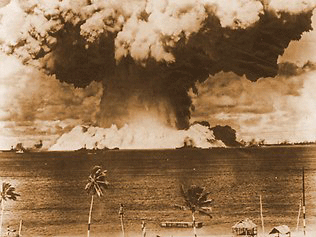 Revisiting Bikini Atoll nuclear tests Japan Times, 15 May 16 A recent lawsuit filed by former crew members and relatives of deceased crew members of fishing boats operating near the area where the United States conducted a series of nuclear weapons tests in the Pacific in 1954 — seeking compensation from the Japanese government over its questionable behavior at the time and in subsequent years — carries historical significance. More than six decades after the hydrogen bomb tests at Bikini Atoll in the Marshall Islands, beginning with a test explosion code-named Castle Bravo on March 1, 1954, the lawsuit will help shed fresh light not only on the scope of radiation exposure for Japanese fishermen but also on whether the Japanese and U.S. governments acted properly to deal with the consequences of the fallout from the tests.
Even before the court proceedings begin, the omission on the part of the Japanese government seems clear — its failure to properly examine and keep track of the potential damage to the fishermen’s health and nondisclosure for decades of the records of their radiation exposure.
In connection with the 15-megaton Castle Bravo test, which was over 1,000 times more powerful than the atomic bomb dropped on Hiroshima on Aug. 6, 1945, the tragedy of the tuna trawler Fukuryu Maru No. 5, also known as the Lucky Dragon, is widely known. The fallout from the test fell onto the vessel for a few hours, causing its 23 crew members to suffer nausea. By the time they returned to their home port of Yaizu, Shizuoka Prefecture, two weeks later, they had developed serious symptoms of radiation sickness, and the radio operator, Aikichi Kuboyama, died six months later. The Fukuryu Maru incident sowed the seed for civic anti-nuclear movements in Japan.
The islanders suffered a great deal. The H-bomb tests contaminated many areas of the Marshall Islands so badly that they became unlivable. The tests destroyed the culture of the islands and irradiated thousands of people. In the years after the tests, the U.S. told evacuated islanders that it was safe to return. But many returning residents were exposed to contaminated water, air and food due to the false assurance.
The plaintiffs in the lawsuit, the first legal action seeking state compensation over the 1954 H-bomb tests, are former crew members of fishing boats other than the Fukuryu Maru that were operating in the area around the time of the tests and family members of fishermen who have since died. Most of the fishing boats were from Kochi Prefecture……
With the lawsuit, the plaintiffs will try to bring to light the government’s omission, including its failure to conduct follow-up health surveys on the crew members and to pay compensation to those who fell ill due to causes linked to the radiation exposure. Several of the former fishermen died of cancer — although it will be difficult to establish the causal relationship because so much time has passed. At least the court proceedings should shed light on how the government acted when it negotiated the settlement with the U.S. over the Fukuryu Maru incident — as well as on why the records of the radiation exposure suffered by other Japanese fishermen were kept undisclosed for so long and why no follow-up checks on the fishermen’s health were made. http://www.japantimes.co.jp/opinion/2016/05/15/editorials/revisiting-bikini-atoll-nuclear-tests/#.VzjsOTV97Gg
Nuclear shipwreck still highly radioactive over 60 years later
Details Emerge from Cold War-Era Nuclear Shipwreck, New Historian, David DeMar May 01, 2016 More details have emerged regarding the wreck of the USS Independence, a US Navy vessel deliberately sacrificed in 1946 at the Bikini Atoll nuclear weapons tests at the very inception of the Cold War…….
NOAA and Boeing used a combination of high-resolution sonar imaging and an unmanned submersible known as “Echo Ranger” to locate and safely survey the still-irradiated wreck of the Independence. The resultant case study, plus newly declassified files on the Navy ship straight from the US National Archives, concerning its time as a nuclear weapons testbed, have been published in theJournal of Maritime Archaeology (JNA)……
merging documentary evidence with a study of the physical remains of a maritime archaeological site is a goal that can and should be pursued…….
The infamous tests at Bikini Atoll, The Bikini tests, conceived and undertaken just one year after dropping not one but two nuclear weapons on Japan, at Hiroshima and Nagasaki, to end the Second World War, was one of the most visible and noteworthy events to signal a fundamental shift in postwar history.
 In one of the newly-declassified reports dating from the era, it was suggested that the awesome power of nuclear weaponry represented a new era where the utter destruction of man had become possible, scouring the Earth of nothing but vestigial traces of humanity. http://www.newhistorian.com/details-emerge-cold-war-era-nuclear-shipwreck/6397/
Climate Change threatens the already leaking Marshall Islands radioactive dome
This dome in the Pacific houses tons of radioactive waste – and it’s leaking
The Runit Dome in the Marshall Islands is a hulking legacy of years of US nuclear testing. Now locals and scientists are warning that rising sea levels caused by climate change could cause 111,000 cubic yards of debris to spill into the ocean , Guardian Coleen Jose, Kim Wall and Jan Hendrik Hinzel on Runit Island 3 July 2015
“……..Officially, this vast structure is known as the Runit Dome. Locals call it The Tomb.

Below the 18-inch concrete cap rests the United States’ cold war legacy to this remote corner of the Pacific Ocean: 111,000 cubic yards of radioactive debris left behind after 12 years of nuclear tests.
Brackish water pools around the edge of the dome, where sections of concrete have started to crack away. Underground, radioactive waste has already started to leach out of the crater: according to a 2013 report by the US Department of Energy, soil around the dome is already more contaminated than its contents.
Now locals, scientists and environmental activists fear that a storm surge, typhoon or other cataclysmic event brought on by climate change could tear the concrete mantel wide open, releasing its contents into the Pacific Ocean.
“Runit Dome represents a tragic confluence of nuclear testing and climate change,” said Michael Gerrard, director of the Sabin Center for Climate Change Law at Columbia University, who visited the dome in 2010.
“It resulted from US nuclear testing and the leaving behind of large quantities of plutonium,” he said. “Now it has been gradually submerged as result of sea level rise from greenhouse gas emissions by industrial countries led by the United States.”
Enewetak Atoll, and the much better-known Bikini Atoll, were the main sites of the United States Pacific Proving Grounds, the setting for dozens of atomic explosions during the early years of the cold war……..http://www.theguardian.com/world/2015/jul/03/runit-dome-pacific-radioactive-waste
Marshall Islands legal case puts nuclear weapons back on the world agenda
 Tiny Marshall Islands Taking On 3 World Nuclear Powers In Court http://www.npr.org/sections/thetwo-way/2016/03/07/469521887/tiny-marshall-islands-taking-on-3-world-nuclear-powers-in-court
March 8, 2016 MERRIT KENNEDY The Marshall Islands is on an unlikely mission — trying to press India, Pakistan and the United Kingdom to curb their nuclear programs.
The Pacific archipelago, which was the site of dozens of U.S. nuclear tests in the ’40s and ’50s, is suing the three countries in the U.N.’s International Court of Justice. The Marshall Islands says the three countries haven’t carried out in good faith their obligations to pursue negotiations leading to nuclear disarmament.
It says the U.K. is obligated to do so because it is a signatory to the Nuclear Non-Proliferation Treaty. India and Pakistan haven’t signed the NPT, but the Marshall Islands argues that this principle is sufficiently well-enshrined in international law to be considered customary law.”Nobody expects the Marshall Islands to force the three powers to disarm, but the archipelago’s dogged campaign highlights the growing scope for political minnows to get a hearing through global tribunals,” Reuters reports.
So why isn’t the Marshall Islands suing the U.S., the country that was actually testing its nukes on their territory? The short answer: It tried. As the Two-Way reported when the case was filed in 2014, the island chain attempted to file suit against all nine countries believed to possess a nuclear arsenal:
“Besides the U.S., the Marshall Islands is also suing Russia, China, France and the U.K., which have all signed the Non-Proliferation Treaty, or NPT, as well as four other countries that have never signed — India, Pakistan, North Korea and Israel, which has never acknowledged possessing nuclear weapons. …
“In court documents, the Marshall Islands argues that the 1968 NPT, which did not come into force until 1970, amounts to a compact between nuclear haves and have-nots. Non-weapons states essentially agreed not to try to acquire nuclear weapons in exchange for weapons states moving toward disarmament, the Marshalls says.”
However, only the cases against India, Pakistan and the U.K. are still proceeding. That’s because these are the only three countries that have “made a commitment to respond to suits brought at the ICJ,” Reuters reports. Preliminary hearings against India started on Monday in The Hague, with sessions on Pakistan and the U.K. scheduled in the coming weeks.
The Marshall Islands is pursuing global disarmament as a result of its “particular awareness of the dire consequences of nuclear weapons,” according to court documents.In 2014, the Two-Way reported on the lasting impact of those tests:
“Although islanders were relocated from Bikini and Eniwetok atolls — ground zero for the majority of the tests — three other Marshall atolls underwent emergency evacuations in 1954 after they were unexpectedly exposed to radioactive fallout. The Marshallese say they’ve suffered serious health issues ever since.
“The Marshall Islands were governed by the U.S. until 1979 and won full independence in 1986.”
The International Court of Justice hasn’t issued an opinion on nuclear weapons since 1996. As Dapo Akande, professor of international law at Oxford University, tells Reuters: “The success will be in putting the issue back on the agenda. … This is as much as the Marshall Islands can hope for.”
Pacific islands take on the world’s nuclear powers in court action
Tiny Marshall Islands take on world nuclear powers in court, SMH, March 5, 2016 Amsterdam: A small chain of Pacific islands will face off against Britain, India and Pakistan in court next week to try and get an international ruling ordering them to start work on dismantling their nuclear arsenals.
While nobody expects the Marshall Islands to force the three powers to disarm at Monday’s hearing, the archipelago’s dogged campaign at the International Court of Justice highlights the growing scope for political minnows to get a hearing through global tribunals.
All three are expected to argue that the Marshall Islands’ claims are beyond the Hague court’s jurisdiction and should be thrown out. But many activists and academics believe getting them into court is a victory in itself.
The island republic, a US protectorate until 1986 and home to just 50,000 people, was the site of 67 nuclear tests by 1958, the health impacts of which linger to this day……
In another David-and-Goliath case, the Pacific island state of Palau, that is threatened by rising sea levels, is pushing for the United Nations General Assembly to ask the ICJ for an advisory opinion on the obligation of the world’s nations to combat climate change. http://www.smh.com.au/world/tiny-marshall-islands-take-on-world-nuclear-powers-in-court-20160305-gnbacp.html#ixzz429kkshuW
France promises more compensation to Pacific nuclear test victims
France pledges more compensation for Polynesia nuclear tests http://www.reuters.com/article/us-france-nuclear-idUSKCN0VV1XW, 28 Feb 16 PAPEETE, FRENCH POLYNESIA Residents of French Polynesia who suffered due to 30 years of French nuclear tests in the Pacific archipelago have a legitimate right to compensation, President Francois Hollande said on his first visit to the region on Monday.
The sensitive issue of reparations for damage caused by the atomic testing between 1966 and 1996 at Mururoa Atoll is top of the agenda of Hollande’s tour of French Pacific territories. “If France is what it is today, with this deterrent capability, it is because there were nuclear tests for a very long period,” he said on arrival in Papeete.
“It’s quite legitimate that France should make good for a number of consequences, whether social, health-related or economic,” he said in a joint news conference with Polynesian president Edouard Fritch.
Regional authorities say compensation approved by a 2010 law has been slow to arrive. An anti-nuclear pressure group said only 19 people, of whom just five Polynesians, had received payments.
An annual 150 million euro ($165.2 million) subsidy fixed when President Jacques Chirac ended nuclear tests in 1996 is set to shrink to 84 million euros this year.
Employers and trade unions that manage the regional health fund are demanding 450 million euros in costs for treating people they say are suffering from cancer due to radiation.
(Reporting by Daniel Pardon; Writing by Paul Taylor)
Huge savings in planned solar energy project for Marshall Islands
Big solar project aims to save Marshall Islands millions of dollars, Marianas Variety, 22 Feb 2016 By Giff Johnson – For Variety MAJURO — A large-scale solar project that would slash the need for diesel imports for power generation in the Marshall Islands is being considered by two big donor agencies, said the new President of the country, Dr. Hilda Heine.
Although the carbon output of the Marshall Islands is virtually non-existent when compared to developed nations, Heine said Friday her country wants to “walk the talk” on climate by reducing its carbon footprint.
The planned solarization of Jaluit, Wotje and Rongrong islands will dramatically change their energy status from 100 percent reliance on diesel-powered electricity to a 90 percent solar-10 percent diesel mix. This is projected to save the government $1 million in annual subsidy. Ebeye Island, which has a 20 percent of the Marshall Islands population of 55,000, is to convert 35 percent of its grid power to solar, with a 12-acre array of solar panels being installed on a neighboring island. This will slash the Ebeye utility firm’s fuel bill by over $1 million a year, a cost now subsidized by the government………http://www.mvariety.com/regional-news/83935-big-solar-project-aims-to-save-marshall-islands-millions-of-dollars
USA had nuclear weapons on Okinawa- declassified information, but everyone knew anyway
“Fact of” Nuclear Weapons on Okinawa Declassified http://fas.org/blogs/secrecy/2016/02/okinawa-nuclear/ Feb.19, 2016 The Department of Defense revealed this week that “The fact that U.S. nuclear weapons were deployed on Okinawa prior to Okinawa’s reversion to Japan on May 15, 1972” has been declassified.
While this is indeed news concerning classification policy, it does not represent new information about Okinawa.
According to an existing Wikipedia entry, “Between 1954 and 1972, 19 different types of nuclear weapons were deployed in Okinawa, but with fewer than around 1,000 warheads at any one time” (citing research by Robert S. Norris, William M. Arkin and William Burr that was published in 1999 in the Bulletin of the Atomic Scientists). As often seems to be the case, declassification here followed disclosure, not the other way around.
If there is any revelation in the new DoD announcement, it is that this half-century-old historical information was still considered classified until now. As such, it has been an ongoing obstacle to the public release of records concerning the history of Okinawa and US-Japan relations.
Because this information had been classified as “Formerly Restricted Data” under the Atomic Energy Act rather than by executive order, its declassification required the concurrence of the Department of Defense, the Department of Energy, and (in this case) the Department of State. Any one of those agencies had the power to veto the decision to declassify, or to stymie it by simply refusing to participate.
Instead, the information was declassified as a result of a new procedure adopted by the Obama Administration to coordinate the review of nuclear weapons-related historical material that is no longer sensitive but that has remained classified under the Atomic Energy Act by default. The new procedure had been recommended by a 2012 report from the Public Interest Declassification Board, and was adopted by the White House-led Classification Reform Committee.
Also newly declassified and affirmed this week was “The fact that prior to the reversion of Okinawa to Japan that the U.S. Government conducted internal discussion, and discussions with Japanese government officials regarding the possible re-introduction of nuclear weapons onto Okinawa in the event of an emergency or crisis situation.”
Such individual declassification actions could go on indefinitely, since there are innumerable other “facts” whose continued classification cannot reasonably be justified by current circumstances. A more systemic effort to recalibrate national security classification policy government-wide is to be performed over the coming year
Update: The National Security Archive posted the first officially declassified document on nuclear weapons in Okinawa, which was released in response to its request. See Nuclear Weapons on Okinawa Declassified, February 19, 201
International Court of Justice sets March dates for Marshall Islands’ nuclear case
 Marshalls nuclear case set for ICJ hearing http://www.radionz.co.nz/international/pacific-news/295377/marshalls-nuclear-case-set-for-icj-hearing 1 Feb 16, The Marshall Islands’ legal battle against the world’s nuclear powers has inched forward after an international court announced dates for hearings involving India, Pakistan and Britain.
The UN’s highest court, the International Court of Justice, set dates between 7 March and 16 March for separate hearings for the three cases.
The Marshall Islands, where the United States tested 67 nuclear weapons between 1946 and 1958, launched action in 2014 against nine nuclear states.
It has accused them of flagrant violation of international law for failing to pursue the negotiations required by the 1968 Nuclear Non-Proliferation Treaty.
In the cases against India and Pakistan, the court at The Hague will examine whether it is competent to hear the lawsuits.
The hearing involving Britain will look at preliminary objections raised by Britain.
The Marshall Islands’ case against the US hit a stumbling block last year when it was thrown out by the Federal District Court in San Francisco.
An appeal is underway. The Marshall Islands also filed suits against Russia, France, China, Israel and North Korea.
Hope for nuclear disarmament – the Marshall Islands legal case
Say hello to the Marshall Islands, the tiny, heroic island nation in Micronesia, with a population just over 70,000. This former U.S. territory, which still bears the terrible scars of 67 above-ground nuclear blasts between 1946 and 1958, when this country used it as an expendable nuclear test site, has engaged the United States — and, indeed, all nine nations that possess nuclear weapons — in lawsuits demanding that they comply with the 1968 Nuclear Non-Proliferation Treaty and begin the process of negotiating global nuclear disarmament.
Taking on the Nuclear Goliath http://www.counterpunch.org/2016/01/08/taking-on-the-nuclear-goliath/ by ROBERT KOEHLER
“Just as we stood for freedom in the 20th century, we must stand together for the right of people everywhere to live free from fear in the 21st century. And . . . as the only nuclear power to have used a nuclear weapon, the United States has a moral responsibility to act. We cannot succeed in this endeavor alone, but we can lead it, we can start it.
“So today, I state clearly and with conviction America’s commitment to seek the peace and security of a world without nuclear weapons.”
Uh…
These words, the core of President Obama’s first major foreign policy speech, delivered in Prague in April 2009, now resonate with nothing so much as toxic irony — these pretty words, these words of false hope, which disappeared into Washington’s military-industrial consensus and failed to materialize into action or policy.
James Carroll, writing at Mother Jones in 2013, describes what happened in the wake of this extraordinary policy declaration:
“In order to get the votes of Senate Republicans to ratify the START treaty, Obama made what turned out to be a devil’s bargain. He agreed to lay the groundwork for a vast ‘modernization’ of the US nuclear arsenal, which, in the name of updating an aged system, is already morphing into a full-blown reinvention of the arms cache at an estimated future cost of more than a trillion dollars. In the process, the Navy wants, and may get 12 new strategic submarines; the Air Force wants, and may get a new long-range strike bomber force. Bombers and submarines would, of course, both be outfitted with next-generation missiles, and we’d be off to the races. The arms races.”
And the cause of global nuclear disarmament, once a dream with geopolitical cred, may wind up entombed in eternal apathy. Continue reading
Marshall Islands continues the fight for nuclear disarmament, with lawsuitagainst US govt
Marshall Islands fights back in nuclear lawsuit http://www.radionz.co.nz/international/pacific-news/292690/marshall-islands-fights-back-in-nuclear-lawsuit The Marshall Islands has pulled up the US government over its interpretation of treaty law in a continuing David and Goliath legal battle over nuclear disarmament.
The two sides have been submitting their briefs for the appeal by the Marshall Islands against a US federal judge’s decision to throw out the case.
The Marshall Islands says the US government lawyers have broadly misstated the law surrounding treaty disputes as it pushes ahead with its so-called Nuclear Zero lawsuit.
The country, which was used as a testing ground for the US’ nuclear programme in the forties and fifties, launched action last year to get the world’s nuclear powers to honour their promise to disarm under the Nuclear Non Proliferation Treaty.
But the case against the US was thrown out in February on constitutional grounds. In its appeal brief the Marshall Islands says the US courts do have the power to oversee disputes over international treaties saying no law elevates the president’s authority to make a treaty above the judiciary’s power to decide disputes.
It also argued it can bring the suit because the US has violated its treaty negotiations and because of the measurable increased danger it faces.
The government contends even if a foreign state was able to sue in US courts, it can’t challenge the president’s foreign affairs responsibilities.
The Marshalls’ Foreign Minister Tony de Brum earlier said the Marshall Islands would use every legal avenue to make sure the lawsuit is won in his lifetime.
The Court of Appeals for the Ninth Circuit will now appoint a three-judge panel to consider the briefs.
Climate refugees will be needing help, whether or not COP21 talks produce a result
Even If Paris Climate Talks Succeed, Pacific Islanders Will Be Looking For New Homes, New Matilda, By Thom Mitchell on December 4, 2015 Australia’s Pacific Island neighbours already face poverty, and soon they’ll be facing even worse. Thom Mitchell reports from Paris.
More than 70 per cent of households in the Pacific Islands of Tuvalu and Kiribati to Australia’s north east say they’re likely to migrate if the impacts of climate change become any worse than they already are, according to research presented in Paris at a global summit on climate change yesterday.

Climate change already exists as a key driver of migration in the region, according to the study presented by the United Nations University’s Dr Koko Warner, which found it motivating 23 per cent of Kiribati’s migration and eight per cent of Tuvalu’s.
In Nauru – an island nation Australia uses to arbitrarily and indefinitely detain many of its asylum seekers – more than 40 per cent of households said they feel migration would be their likely response if sea level rise or flooding worsened.
All three islands are extremely vulnerable to the climate change impacts like sea level rise, saltwater intrusion, and storm surges, and the survey of more than 7,000 people across the three countries found that climate change was already affecting agriculture and fish stocks, and reclaiming or spoiling land.
Pacific Island leaders have been pushing the issue of climate-induced migration in the opening days of the Paris talks, arguing for a more ambitious target than the two degrees of average global warming the negotiations are aiming for. Tuvaluan Prime Minister Enele Sopoaga said the two degree target was about “saving economies,” and that for Pacific Islanders their preferred target of a 1.5 degree rise in temperatures is about “saving our people”……..
The President of Kiribati, Anote Tong, has repeated his calls for Australia to stop approving new fossil fuel developments at the talks, arguing that to be serious about cutting emissions you’ve got to be serious about not approving new coal mines.
“They use the excuse of the poor. But we are the poor, and we are speaking on our own behalf and we will be affected,” Tong said in November. Yesterday, Australia’s Environment Minister Greg Hunt argued that the reason he approved the massive Carmichael coal mine in Queensland is that, as a government minister, he makes assessments of projects against the existing law, that greenhouse gasses do not form part of that law, and that it would be “neo-colonial” to make decisions about another countries’ “energy future”…….
Greens Deputy Leader Larissa Waters is also at the Paris climate talks, and she said it is “dishonest and deceptive for Minister Hunt to say he hopes there are no climate refugees at the same time as he approves mega coal mines that he knows full well drive dangerous global warming and threaten our Pacific Island neighbours”.
“President Tong yesterday said that politicians have no compassion, only election cycles; and looking at the Turnbull Government’s dangerous climate policies it’s hard not to agree,” she said………
Phil Glendenning is the Director of the Pacific-focused Edmund Rice Centre and the Refugee Council of Australia, and he said a two degree rise in temperatures would be devastating for Tuvalu and Kiribati.
“Where will these people go? And more importantly, if there was some sort of arrangement where they had some sort of certainty of their future, that would give them a choice and ease the burden they feel at the moment, where they feel it’s all inevitable,” he said.
“I think Australia could play a creative role to become part of the solution rather than a fence or a barrier, but having said that most people want to stay in their homes,” he said. “If they do choose to move, though, Australia should make it easier rather than harder.”
Glendenning said it would be good to see “some sort of freedom of association that would be different but similar to the arrangements that New Zealand has with the Cook Islands and Niue; different but similar to what the Marshall Islands have with the United States”.
“Kiribati and Tuvalu do not have that access,” he said, “and yet both of those countries use Australian currency, and look to Australia as their largest neighbour”.
“Why not have a look at that, because if we look at it Tuvalu has a population the size of Lithgow (to Sydney’s north west) and Kiribati is the same size as Toowoomba (in Queensland’s Darling Downs).”
The study found that while the majority of respondents would prefer to migrate if climate impacts worsen, the average monthly per capita income is just US$12 across the three countries studied, and only a quarter of the population felt their households will have the financial means to relocate. https://newmatilda.com/2015/12/04/even-if-paris-climate-talks-succeed-pacific-islanders-will-be-looking-for-new-homes/
Marshall Islands – first nuclear destruction, now climate destruction as well
A ground zero forgotten, WP, Dan Zak, 29 Nov 15 The Marshall Islands, once a U.S. nuclear test site, face oblivion again A boy and his grandfather are fishing in the shallows off their tiny island, a dot of green in the sapphire eternity between Hawaii and Australia. The flash comes first, silent and brighter than the sun, from a four-mile-wide fireball beyond the horizon. The sky turns blood red. Wind and thunder follow.
Even 61 years after, Tony deBrum gets “chicken skin” when sharing his memories of the largest American nuclear-weapons test — the biblical, 15-megaton detonation on Bikini Atoll, 280 miles northwest of his island. Its flash was also seen from Okinawa, 2,600 miles away. Its radioactive fallout was later detected in cattle in Tennessee.
About this story: This article was made possible by a grant from the Pulitzer Center on Crisis Reporting.
“We pause today to remember the victims of the nuclear-weapons testing program,” deBrum says to a couple hundred people seated in a convention hall in Majuro, the capital of the Marshall Islands, a little-known nation that was entrusted to the United States as a primitive society 68 years ago.
It’s March 2 at an event marking Nuclear Victims Remembrance Day, and the boy in the shallows is now the foreign minister of the Marshall Islands, which has entered the 21st century as part trust-fund baby, part welfare state. Its elders have endured burns that reached to the bone, forced relocation, nightmarish birth defects, cancers in the short and long term. Its young people have inherited a world unmade, remade and then virtually forgotten by Washington, D.C.
The victims of the tests “have been taken from us before their time,” deBrum says, so that Americans could learn more about the “effects of such evil and unnecessary devices.”
From 1946 to 1958, the United States conducted 67 tests in the Marshall Islands. If their combined explosive power was parceled evenly over that 12-year period, it would equal 1.6 Hiroshima-size explosions per day.
This is not something one gets over quickly.
Payday at Bikini Jack’s“Washington — and this is just my personal opinion — I think they’re going out of their way to wash their hands of the Marshalls,” says Jack Niedenthal, a Pennsylvanian who arrived in the islands with the Peace Corps in 1981 and eventually became one of their unofficial representatives to the United States. “You look at what they spend on Iraq and Afghanistan, and it’s billions upon billions. For four bullets into a tree in Iraq, they could fix this entire place.”……
The RMI, as the republic is called, is both vast and slight. There are 1,200 islands — spread out over a chunk of ocean the size of Mexico — whose combined land area is roughly equivalent to D.C.’s. American arrogance and American generosity collide here, and paradox reigns. It was once called the most contaminated place on Earth, yet it has the dizzy beauty of a mirage. Wealthy foreigners spirit themselves to surfer paradise, past islanders living with sky-high rates of diabetes and thyroid abnormalities. In a place where the United States has sunk billions, children play in landfills. The Marshallese couldn’t exist without the ocean, but now sea-level rise attributed to global warming imperils their homes and lives.
Seven thousand miles away is Washington, its tough-love parent, delivering an annual allowance for the RMI’s operations while trying to close the book on a history of destruction and sadness. The United States has been an epic force here for 70 years, and decisions made over the next decade could save the islands or seal their fate……
A chosen people
On a Sunday after church in 1946, a Navy commodore met with the people of Bikini Atoll and told them they were like the Israelites, a chosen people, and that perfecting the atomic bomb would deliver mankind from future wars. Within one month of that conversation, the Bikinians had boarded U.S. ships for relocation. Within five, the first two tests had been conducted.
“We located the one spot on Earth that hadn’t been touched by the war and blew it to hell,” Bob Hope reportedly once said.
“Paradise Lost” with Lijon Eknilang – Marshall Islands
The Marshallese culture is rooted in a history of resource sharing, ecological balance, of an intimate knowledge of how the winds blow, how the waves break, how the stars slip across the sky. Over the past 70 years, though, victimhood, corruption and dependency have produced a different kind of fallout.
“We have basically destroyed a culture,” says Glenn Alcalay, an anthropology professor at New Jersey’s Montclair State University who took part in Greenpeace’s second evacuation of Rongelap in 1985. “We’ve stolen their future. When you take the future from a people, you’ve destroyed them.”…….
cancer and birth defects are the modern connections to the past. There are still radiation-related cancers that have yet to develop or be diagnosed in the population of Marshallese who were on the islands between 1948 and 1970, according to a 2004 report by the U.S. National Cancer Institute. Everyone seems to have a relative whose cancer falls on the Energy Department’s list of ailments traceable to radiation…..http://www.washingtonpost.com/sf/national/2015/11/27/a-ground-zero-forgotten/
Republic of Marshall Islands seeks refuge in USA for its climate (and nuclear) victims
A ground zero forgotten, WP, Dan Zak, 29 Nov 15 “……Last year the RMI filed lawsuits against the United States and the eight other nuclear-armed nations, alleging noncompliance with the Non-Proliferation Treaty. The news caught most Marshallese, including RMI officials, by surprise. The Nuclear Age Peace Foundation in California engineered the lawsuits in collaboration with deBrum, who has been their cheerleader. The suits were filed in U.S. District Court in San Franciscoand to the International Court of Justice.
The U.S. Justice Department, in its motion to dismiss, implied that the lawsuit is a stunt that has no business in the court system. A federal judge in San Francisco dismissed the suit in February (the RMI appealed), and it’s a nonissue in the international court, since the U.S. government does not recognize that court’s jurisdiction.
No matter, deBrum says. It’s the principle of the thing, particularly in this year of the 70th anniversaries of Hiroshima and Nagasaki, and with next year’s 70th anniversary of the first atomic test in the Marshalls.
He comes to the country he’s suing a couple of times a year, to preach about the connection he sees between a nuclear past and a climate-change future. Just 45 minutes away from Majuro by air, 500 Bikinians are struggling on Kili, a rocky island without a lagoon where their elders were exiled. A ship bearing food and diesel arrives every three months, if the weather behaves. In February, the yearly king tide washed completely over the island, fouling freshwater reservoirs.
DeBrum is lobbying Congress to amend U.S. law to definitively allow Bikinians to use their resettlement funds to relocate to the United States.
“How can you separate nuclear from climate with Bikini and Kili?” deBrum says during a reception last month in the Rayburn House Office Building, where anti-nuclear nonprofit groups gave him an award for his work. “It’s the classic case of one meeting the other. You have nuclear refugees on an island affected by climate change.”…….
The U.S. Embassy considers the Marshall Islands to be on the front line of climate change, which manifests most dramatically during late-winter king tides. In March of last year, 1,000 people evacuated Majuro as the surge pulled homes into the ocean.
“Climate change is my nuclear experience,” says Mark Stege, 37, who grew up in Majuro, studied at Columbia University and is now director of the Marshall Islands Conservation Society. “I can see a lot of connections at the emotional level, and the community level, at the individual family level. The same questions are relevant in both situations. There’s this really deep sense of loss.”….http://www.washingtonpost.com/sf/national/2015/11/27/a-ground-zero-forgotten/
1 This Month
19 November – Webinar – The Reality of Reprocessing
Time: 11:00 AM Pacific Time (US & Canada) / 2:00 PM Eastern / 7:00 PM UK / 8:00 PM CET
Register for the Zoom Event Here

Tell Congress: Prevent Nuclear Catastrophe in Iran

Tell Congress: Prevent Nuclear Catastrophe in Iran

Read the Public Inquiry Report, the Commissioners’ report, Surrendering Australia: The AUKUS Deception is available to download for free at aukuspublicinquiry.com. Or just watch the replay of the National Press Club Luncheon.


Shut down the radiation-damaged Heysham nuclear reactors now
To see nuclear-related stories in greater depth and intensity – go to https://nuclearinformation.wordpress.com

Say No to NASA’s Reckless Nuclear Reactor on the Moon
Say No to NASA’s Reckless Nuclear Reactor on the Moon
-
Archives
- November 2026 (166)
- October 2026 (302)
- September 2026 (339)
- August 2026 (330)
- July 2026 (355)
- June 2026 (287)
- May 2026 (306)
- April 2026 (356)
- March 2026 (251)
- February 2026 (267)
- January 2026 (308)
- December 2025 (358)
-
Categories
- 1
- 1 NUCLEAR ISSUES
- business and costs
- climate change
- culture and arts
- ENERGY
- environment
- health
- history
- indigenous issues
- Legal
- marketing of nuclear
- media
- opposition to nuclear
- PERSONAL STORIES
- politics
- politics international
- Religion and ethics
- safety
- secrets,lies and civil liberties
- spinbuster
- technology
- Uranium
- wastes
- weapons and war
- Women
- 2 WORLD
- ACTION
- AFRICA
- Atrocities
- AUSTRALIA
- Christina's notes
- Christina's themes
- culture and arts
- Events
- Fuk 2022
- Fuk 2023
- Fukushima 2017
- Fukushima 2018
- fukushima 2019
- Fukushima 2020
- Fukushima 2021
- general
- global warming
- Humour (God we need it)
- Nuclear
- RARE EARTHS
- Reference
- resources – print
- Resources -audiovicual
- Weekly Newsletter
- World
- World Nuclear
- YouTube
-
RSS
Entries RSS
Comments RSS

