New Zealand has maintained its anti nuclear stance
 NZ’s nuclear resolve, Otago Daily Times, 25 Jul 2016 “……In 1987, Labour passed the New Zealand Nuclear Free Zone, Disarmament and Arms Control Act, meeting an election promise.
In a largely symbolic response, the US Congress retaliated with the Broomfield Act, downgrading New Zealand’s status from ally to friend.
Former prime minister David Lange said if the security alliance was the price New Zealand must pay to remain nuclear-free, it was the price the country was prepared to pay.
In 1989, 52% of New Zealanders indicated they would rather break defence ties than admit nuclear-armed ships. By 1990, National had signed up to the anti-nuclear stance.
There the situation has remained until Mr Biden accepted an invitation for the US to send a ship to the Royal New Zealand Navy’s 75th birthday in November……..
New Zealand is consistently said to have made a difference in peace-keeping activities around the world, being an independent thinker when it comes to solving complex security issues.
New Zealand is part of the Five Eyes intelligence sharing network.
Although New Zealand is not seen as reliable as Australia as an ally, it does have qualities which it can bring to any situation.
So despite the urging of Mr Key, the return to New Zealand waters by a US ship in November cannot be taken lightly. It is a win for the resolve of Kiwis to keep this country nuclear free.
It is not known if the US ship will be a warship or something tamer.
Under New Zealand’s law, Mr Key has to sign a declaration he is satisfied the ship complies with New Zealand law, something he says he has done about 40 times since he became prime minister.
Publicly available information will make it possible for watchers of maritime issues to identify if the ship is nuclear-armed or nuclear-powered……..http://www.odt.co.nz/opinion/editorial/391403/nz-s-nuclear-resolve
New Zealand has been well served by its nuclear-free policy
Nuclear-free has ‘served us well’ – Geoffrey Palmer, Radio New Zealand, 22 July 16 An architect of New Zealand’s once contentious anti-nuclear law says it remains the right approach for the country.
The law is in the spotlight as preparations begin for the first visit by an American warship since the landmark legislation was passed in 1987.
Under the law, the Prime Minister must make an assessment of whether the ship will breach New Zealand’s ban on nuclear weapons and nuclear power.
The US has not sent a naval ship since 1983, as it refuses to say whether its ships are nuclear-armed, as required by New Zealand’s nuclear-free law.
The deputy prime minister at the time the nuclear-free law was passed, Sir Geoffrey Palmer, told Morning Report the policy, and the law behind it, was sound…….http://www.radionz.co.nz/news/national/309192/nuclear-free-has-‘served-us-well’-geoffrey-palmer
New Zealand set to get stream of refugees: Pacific atolls ‘could be underwater by 2050
Pacific atolls ‘could be underwater by 2050 Radio New Zealand Chris Bramwell, Deputy Political Editor – @chrisbramwell, 15 July 16 The government is being warned to prepare for an impending stream of refugees from the Pacific as low-lying atolls are swamped by sea-level rise over the coming decades.

Labour is also calling for the government to take a humanitarian approach to people from the region
who are overstayers in New Zealand.
United Nations warns if sea level rise continues at the current rate, the Pacific atolls of Kiribati and Tuvalu could be completely submerged within decades……
Labour’s Su’a William Sio said the people of the Pacific were fighting a losing battle. The government could take a more sympathetic approach to overstayers from Kiribati and Tuvalu and not send them back to islands already under pressure, he said.
“The main islands they’ve got issues not just with climate change, but with population growth and waste on both Tuvalu and Kiribati, so I think we’ve got to seriously look at what we do with that, and my view is that we need to adopt a humanitarian stance with the overstayers that are here.”
Climate change refugees might not be a serious issue now, but they would become one, he said.
“The overwhelming scientific evidence is telling us these islands will be underwater by 2050 or 2070, so we actually do need to have a strategic long term plan in preparation to help these islanders because we can’t just sit around once those islands are underwater.”…..http://www.radionz.co.nz/news/political/308703/pacific-atolls-could-be-underwater-by-2050
Workers on strike at Hanford Nuclear Reservation due to health concerns
 Work stoppage continues at Hanford Nuclear Reservation http://q13fox.com/2016/07/12/work-stoppage-continues-at-hanford-nuclear-reservation/ JULY 12, 2016, BY ASSOCIATED PRESS SPOKANE, Wash. (AP) — A rare work stoppage continues by some Hanford Nuclear Reservation workers who contend that radioactive wastes left from the production of nuclear weapons are making them sick.
Union president Dave Molnaa, who ordered the work stoppage, said it will continue until all employees are provided with bottled air when working around all of the underground nuclear waste storage tanks on the Hanford site.
Workers have contended for years that chemical vapors escaping from the tanks are making them sick.
The steel tanks, some dating back to World War II, contain wastes created by the production of plutonium for nuclear weapons.
The Hanford Atomic Metal Trades Council, a coalition of 15 unions that represent workers on the site near Richland, issued the “stop work” order on Monday morning.
New Zealanders’ anti-nuclear weapon win
 NZers celebrate anti-nuclear weapon win, News Hub NZ, 9 Jul 2016 People in Christchurch have reflected on how “a little peace group” in their city defied the world’s most powerful nations to win a court case that triggered cuts in the world’s nuclear arsenal.
Events were held in Christchurch on Friday to mark 20 years since a historic judgment by the International Court of Justice (ICJ), ruling that the threat, let alone the use, of nuclear weapons was generally illegal.
Professor Paul Millar sums it up as an “important piece of history no one knows about”. Since then the number of nuclear weapons globally has fallen to 15,000 from 70,000.
It’s a story of how “citizen pressure” can change what politicians do, Dr Millar says.
Dr Kate Dewes was a housewife, a mother and a music teacher who went to a talk about peace and decided to do something.
“Kate and others were excited by the possibility and began the World Court Project and it led ultimately to this decision,” Prof Millar says…….http://www.newshub.co.nz/nznews/nzers-celebrate-anti-nuclear-weapon-win-2016070905#axzz4DrMcQTSf
Nuclear bomb tests on Bikini Atoll – the 70th anniversary
 70th Anniversary of Operation Crossroads Atomic Tests in Bikini Atoll, July 1946
EXCELLENT VIDEOS and PHOTOS, National Security Archive Government Films and Photographs Depict Test “Able” on 1 July 1946

 Removal of 167 Bikinians from the Atoll Preceded the Atomic Tests
National Security Archive Electronic Briefing Book No. 553 July 1, 2016 Edited by William Burr with Stav Geffner For more iThe Atomic Tests at Bikini Atoll, July 1946nformation contact: William Burr at 202/994-7000 or nsarchiv@gwu.edu.
The Atomic Tests at Bikini Atoll, July 1946 Washington, D.C., July 1, 2016 – Seventy years ago this month a joint U.S Army-Navy task force staged two atomic weapons tests at Bikini atoll in the Marshall Islands, the first atomic explosions since the bombings of Japan in August 1945. Worried about its survival in an atomic war, the Navy sought the tests in order to measure the effects of atomic explosions on warships and other military targets. The test series was named Operation Crossroads by the task force’s director, Rear Admiral William Blandy. The first test, Able, took place on 1 July 1946. Of the two tests, the second, Baker, on 25 July 1946, was the most dangerous and spectacular, producing iconic images of nuclear explosions. A third test was scheduled, but canceled. Photographs and videos posted today by the National Security Archive document Crossroads, focusing on the Able test.
Also documented is the U.S. Navy’s removal, in early March 1946, of 167 Pacific islanders from Bikini, their ancestral home, so that the Navy and the Army could prepare for the tests. The Bikinians had the impression that the relocation would be temporary but the islands remain uninhabitable due to subsequent nuclear testing in the atoll……….
Video gallery
U.N. Decolonization Committee adopts French Polynesia Resolution
U.N. Decolonization Committee adopts French Polynesia Resolution, Overseas Territories Review , 3 July 16
Recognized the significant health and environmental impacts of nuclear testing conducted by the administering Power in the Territory over a 30-year period.New climate change strategy adopted by Small Pacific Island States
Small Island States adopt new climate change strategy http://www.radionz.co.nz/international/pacific-news/307877/small-island-states-adopt-new-climate-change-strategy The Forum Secretariat’s Alfred Schuster, 4 July 16 The Small Island States of the Pacific Islands Forum have adopted a new climate change strategy to ensure their vulnerabilities are addressed as part of the regional policy agenda.
The strategy was agreed to by leaders from the Cook Islands, Kiribati, Marshall Islands, Nauru, Palau and Tuvalu at a meeting last week in Palau.
The Forum Secretariat’s Development Co-operation Advisor, Alfred Schuster, says addressing climate change is one of the top priorities of the strategy.
He says the Small Island States want to band together when applying for climate change mitigation funding from the United Nations.
“It’ll be a new approach, from what we understand a joint proposal of countries and governments hasn’t yet been brought to the attention of the Green Climate Fund. But we’d like to think it’s a much more strategic way in light of the administrative burden and administrative requirements of the Green Climate Fund to generate the sort of revenue that’s required by the SIS.”
Pacific Island of Kiribati faces eventual inundation, as searises
A Remote Pacific Nation,Threatened by Rising Seas
Text by MIKE IVES Photographs and video by JOSH HANERJULY 2, 2016“…..For years, scientists have been predicting that much of Kiribati may become uninhabitable within decades because of an onslaught of environmental problems linked to climate change. And for just as long, many here have paid little heed. But while scientists are reluctant to attribute any specific weather or tidal event to rising sea levels, the tidal surge last winter, known as a king tide, was a chilling wake-up call.
Pacific island nations are among the world’s most physically and economically vulnerable to climate change and extreme weather events like floods, earthquakes and tropical cyclones, the World Bank said in a 2013 report. While world powers have summit meetings to negotiate treaties on how to reduce and mitigate carbon emissions, residents of tiny Kiribati, a former British colony with 110,000 people, are debating how to respond before it is too late.
Much of Kiribati, a collection of 33 coral atolls and reef islands scattered across a swath of the Pacific Ocean about twice the size of Alaska, lies no higher than six feet above sea level. The latest climate models predict that the world’s oceans could rise five to six feet by 2100. The prospects of rising seas and intensifying storms “threaten the very existence and livelihoods of large segments of the population,” the government told the United Nations in a report last year. Half of the 6,500-person village of Bikenibeu, for instance, could be inundated by 2050 by sea-level rises and storm surges,according to a World Bank study.
The study lays out Kiribati’s future in apocalyptic detail. ……
a 2011 government-commissioned report cast doubt on whether the World Bank project helped Kiribati prepare for climate change. And while the mangroves and water management plans have helped, a 2014 study said the first round of sea walls, made of sandbags, had proved counterproductive and caused more erosion.
“Adaptation is just this long, ugly, hard slog,” said the study’s lead author, Simon Donner, a professor of geography at the University of British Columbia in Vancouver. “The idea that an outside organization can just come in with money, expertise and ideas and implement something easily is naïve. What you need is consistent, long-term funding — the type of stuff that’s hard to pull off with development aid.”….
migration may become increasingly important. Mr. Tong said he hoped to prepare his people to move with job-training programs that would meet standards recognized in Australia and New Zealand. “The science of climate change is not 100 percent precise,” he said in the interview. “But we know without any argument that, in time, our people will have to relocate unless there are very, very significant resources committed to maintain the integrity of the land…..”http://www.nytimes.com/2016/07/03/world/asia/climate-NYT, change-kiribati.html?
Fiji making its mark in renewable energy
Solar energy: Innovative start-up puts Fiji ahead on renewable energy, ABC News, 1 July 16 By Pacific economic and business reporter Jemima Garrett Fiji is making its mark as a leader in renewable energy thanks to an innovative start-up company focusing on supplying energy to the corporate sector.
Sunergise is the brain-child of entrepreneurs from Africa and the Pacific and has attracted investment interest from the World Bank as well as from Australia, New Zealand, North America and China……..
The installation of the first 700 photovoltaic cells at the marina was completed in 2012, just two days before Cyclone Evan hit, with winds gusting up to 270 kph.
Only one panel was damaged.
Sunergise has since completed two more installations at the Port of Denarau, creating the biggest marina-based solar plant in the world.
Australia ‘well behind’
In Australia, corporate solar is lagging behind residential investment and Sunergise is something advocacy group Solar Citizens would like to see more of.
“Australia leads the world in terms of residential roof-top solar,” Solar Citizen consumer campaigner Reece Turner said.
“Mums and dads have invested $8 billion of their own money in solar panels in just the last six or seven years. But we are well behind in the commercial space; comparatively we are probably 20th or 30th in the world in terms of commercial solar.
“That is where we are seeing some of the growth now but we really need to incentivise that uptake of commercial solar.”
We sell energy’
Sunergise’s business model is to focus on blue chip corporate clients and to own and operate the infrastructure they put on their roof.
“We don’t sell solar panels, we sell energy,” Sunergise chairman Bob Lyon said.
“We install the panels, the clients get an instant discount on their power, they don’t pay anything [for the infrastructure].”
Sunergise sells contracts that run for 10 or more years, with the client enjoying an initial saving of about 10 per cent and certainty on their power costs for the full term of the contract.
One of Fiji’s top hotels, the Tokoriki Island resort, uses Sunergise’s solar power technology and has cut its power bill by 50 per cent and silenced its expensive diesel generators.
The World Bank’s International Finance Corporation, its private sector arm, made its decision to take a 20 per cent stake in Sunergise based on the skills of its people………http://www.abc.net.au/news/2016-06-30/innovative-start-up-puts-fiji-ahead-on-renewable-energy/7557594
French Polynesia at UN presses case for compensation for nuclear tests
French Polynesia goes to UN over nuclear compensation http://www.radionz.co.nz/international/pacific-news/307569/french-polynesia-goes-to-un-over-nuclear-compensation, 29 June 16, A legislator from French Polynesia has appeared at the United Nations pressing the territory’s case for compensation over nuclear testing.
Richard Tuheiava appeared before the UN Committee on Decolonisation, in an effort to bring the issue to international attention.
The French Government has compensated just a handful of French Polynesians who suffered from exposure to radiation after thirty years of tests in the territory’s vicinity.
Mr Tuheiava said France should compensate the territory as well as individuals.
“The fact is since the nuclear testing most of the diseases were cancer, leukaemia. Most of the diseases were as a result of the nuclear testing, so we collectively also put a request for the state of France, the colonial power to not only compensate directly the veterans, but also compensate this fund, this public health care fund.”
Richard Tuheiava said he has serious doubts about whether anything will come from the negotiations, but at least the truth is being exposed on a global stage.
Earlier this year during a visit to the territory, the French president Francois Hollande acknowledged that the weapons tests had an environmental impact with consequences for people’s health.
He promised to revisit the way compensation claims are being treated.
Island states most at risk of global warming impact – Maldives want action
 Maldives urges rich countries to rapidly ratify Paris climate agreement
Environment and energy minister of small island state, one of the countries most at risk of global warming impacts, says ‘no time to waste’ on Paris deal, Guardian, Fiona Harvey, 21 June 16 Rich countries must ratify the climate change agreement reached in Paris last December, one of the world’s most at-risk nations has warned.
Thoriq Ibrahim, environment and energy minister of the Maldives, told the Guardian that there was “no time to waste”, in ratifying the agreement that was reached more than six months ago, and that it should be a matter of urgency for industrialised countries.
So far, almost the only countries to have passed the accord into law are the small islands most at risk from rising sea levels, and other smaller developing nations.
France became the first large industrialised nation to ratify the Paris agreementonly earlier this month, although a ceremony was held in New York in April at which countries were supposed to affirm their commitment to the international agreement…….https://www.theguardian.com/environment/2016/jun/21/maldives-urges-rich-countries-to-rapidly-ratify-paris-climate-agreement
Parts of Philippines May Submerge Due to Global Warming
More than 167,000 hectares of coastland – about 0.6% of the country’s total area – are projected to go underwater in the Philippines, especially in low-lying island communities. …
The Philippines government has been forced to take this into consideration. The Department of Environment and National Resources has its own climate change office, which has set up various programs to educate communities in high-risk areas. …
But soon, adaptation on a local level won’t be enough. Policy makers need to convince governments to curb their emissions on a global level. https://www.sciencedaily.com/releases/2016/06/160606101406.htm
Alarmingly high levels of radiation remain at Bikini Atoll
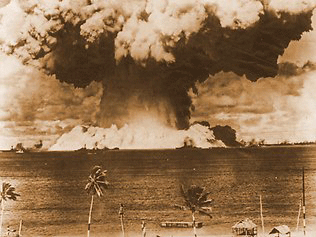 Bikini Atoll radiation levels remain alarmingly high https://www.sciencenews.org/article/bikini-atoll-radiation-levels-remain-alarmingly-high New measurements made decades after Pacific island used to test nuclear bombs BY THOMAS SUMNER , JUNE 6, 2016
Radioactive material such as cesium-137 currently produces, on average, 184 miLLIREMS OF RADIATION PER YEAR ON BIKINI ATOLL. AND SOME PARTS OF THE ISLAND HIT 639 MILLIREMS PER YEAR, RESEARCHERS REPORT ONLINE THE WEEK OF JUNE 6 IN THE PROCEEDINGS OF THE NATIONAL ACADEMY OF SCIENCES. THOSE MEASUREMENTS, MADE LAST YEAR, SURPASS THE 100 MILLIREMS PER YEAR SAFETY STANDARD SET BY THE UNITED STATES AND THE REPUBLIC OF THE MARSHALL ISLANDS, WHICH CONTROLS THE ISLAND.
Scientists had predicted that, by now, radiation levels would have dropped to 16 to 24 millirems per year. But those estimates came from extrapolating from measurements made in the 1970s. The mismatch probably stems from incorrect assumptions about how rapidly radioactive material washes off the island, proposes study coauthor Emlyn Hughes, a physicist at Columbia University.
Whether the higher radiation levels pose a serious health risk to caretakers who live on the island for part of the year depends on how long they stay on the island and whether the local fruit they eat is safe, Hughes says.
Wind power and solar replacing diesel on Galapagos
Wind turbines on Galapagos replace millions of liters of diesel since 2007, meet 30 percent of energy needs World’s top utilities hand over project keys, chart path for Ecuador’s famously biodiverse archipelago to meet 70 percent of fast-rising energy needs with renewables, Eureka Alert, 29 May 16.
GLOBAL SUSTAINABLE ELECTRICITY PARTNERSHIP A global renewable energy project on the Galapagos Islands — one of Earth’s most fragile and important ecological treasures — has helped avoid many tanker loads worth of risky diesel fuel imports since 2007, reduced the archipelago’s greenhouse gas emissions and preserved critically endangered species.
Now, after eight successful years, the project’s new operators are pursuing an ambitious expansion that would multiply the benefits of renewable energy for this remote, precious archipelago with a growing appetite for electricity.
A performance summary and recommendations for the expansion are contained in a new report by the Global Sustainable Electricity Partnership (GSEP), a not-for-profit association of 11 of the world’s foremost electricity firms, which led and financed the $10 million project.
The project’s three 51-metre-tall wind turbines and two sets of solar panels have supplied, on average, 30% of the electricity consumed on San Cristóbal, the archipelago’s second-largest island in size and population, since it went into operation in October 2007.
During that time, it has displaced 8.7 million litres (2.3 million gallons) of diesel fuel and avoided 21,000 tonnes of carbon dioxide emissions, the GSEP report states. The achievements have led to awards from Power Engineering Magazine, World Energy Forum, and Energy Globe.
The proposed expansion could boost the renewable energy share to 70 per cent, en route to a hoped-for elimination of fossil fuels, the report states. It could also be a template for energy development elsewhere in the Galapagos chain — where renewable sources now account for 20% of electricity production — and elsewhere around the world……..http://www.eurekalert.org/pub_releases/2016-05/tca-wto052016.php
1 This Month



Shut down the radiation-damaged Heysham nuclear reactors now
To see nuclear-related stories in greater depth and intensity – go to https://nuclearinformation.wordpress.com

Say No to NASA’s Reckless Nuclear Reactor on the Moon
Say No to NASA’s Reckless Nuclear Reactor on the Moon
-
Archives
- October 2026 (256)
- September 2026 (339)
- August 2026 (330)
- July 2026 (355)
- June 2026 (287)
- May 2026 (306)
- April 2026 (356)
- March 2026 (251)
- February 2026 (267)
- January 2026 (308)
- December 2025 (358)
- November 2025 (359)
-
Categories
- 1
- 1 NUCLEAR ISSUES
- business and costs
- climate change
- culture and arts
- ENERGY
- environment
- health
- history
- indigenous issues
- Legal
- marketing of nuclear
- media
- opposition to nuclear
- PERSONAL STORIES
- politics
- politics international
- Religion and ethics
- safety
- secrets,lies and civil liberties
- spinbuster
- technology
- Uranium
- wastes
- weapons and war
- Women
- 2 WORLD
- ACTION
- AFRICA
- Atrocities
- AUSTRALIA
- Christina's notes
- Christina's themes
- culture and arts
- Events
- Fuk 2022
- Fuk 2023
- Fukushima 2017
- Fukushima 2018
- fukushima 2019
- Fukushima 2020
- Fukushima 2021
- general
- global warming
- Humour (God we need it)
- Nuclear
- RARE EARTHS
- Reference
- resources – print
- Resources -audiovicual
- Weekly Newsletter
- World
- World Nuclear
- YouTube
-
RSS
Entries RSS
Comments RSS

