It is the world’s largest coal exporter, and both major political parties are financially backed by the coal lobby. Rather than move away from coal, the government is seeking to expand exports dramatically, with public subsidies and taxpayer-funded infrastructure.
The contrast could not be starker. While Pacific leaders are praised for their efforts to develop global climate solutions, Australia faces ignominy. Unless Australia changes direction, it will continue to be seen as an irresponsible middle power – a rogue state undermining global efforts to tackle climate change.
 Pacific pariah: how Australia’s love of coal has left it out in the diplomatic cold, https://theconversation.com/pacific-pariah-how-australias-love-of-coal-has-left-it-out-in-the-diplomatic-cold-64963 The Conversation, Wesley Morgan, 7 Sept 16, Australia’s Prime Minister Malcolm Turnbull will have some explaining to do when he attends the Pacific Islands Forum leaders’ meeting in Pohnpei, Micronesia, this week.
Australia’s continued determination to dig up coal, while refusing to dig deep to tackle climate change, has put it increasingly at odds with world opinion. Nowhere is this more evident than when Australian politicians meet with their Pacific island counterparts.
It is widely acknowledged that Pacific island states are at the front line of climate change. It is perhaps less well known that, for a quarter of a century, Australia has attempted to undermine their demands in climate negotiations at the United Nations.
The Pacific Islands Forum (PIF) – organised around an annual meeting between island leaders and their counterparts from Australia and New Zealand – is the Pacific region’s premier political forum. But island nations have been denied the chance to use it to press hard for their shared climate goals, because Australia has used the PIF to weaken the regional declarations put forward by Pacific nations at each key milestone in the global climate negotiation process. Continue reading →
September 7, 2016
Posted by Christina Macpherson |
AUSTRALIA, climate change, OCEANIA |
Leave a comment
Philippines: Alarm sounded over revival of mothballed nuclear plant, http://en.radiovaticana.va/news/2016/09/01/philippines_alarm_over_revival_of_mothballed_nuclear_plant_/1255178 A diocese in the northern Philippines has voiced opposition to a government plan to revive a nuclear power plant constructed in the 1970s.
The Bataan Nuclear Power Plant in the town of Morong in Bataan province was constructed during the term of former president Ferdinand Marcos. Costing US$.2.3 billion by the time of its completion in 1984, it remains intact though never fueled. Successive governments have not tried to operate the plant after studies revealed it was built near a major geological fault line and lies close to the then dormant Mount Pinatubo volcano.
“We don’t want to put the lives of people in danger … we don’t want our sources of livelihood destroyed,” read a pastoral letter issued by Bishop Ruperto Santos of Balanga. “The diocese has already spoken on this, and we are again making our position known,” said Bishop Santos “For us, life is more precious than profit or money that will come from cheap electricity” he added and “we want to take care of God’s creation in response to His call to take care, not destroy and abuse creation”. Bishop Santos said the government should tap other sources of energy instead of reviving the nuclear plant.
The proposal to revive the plant came during a three-day international conference this week to discuss the prospects of nuclear power in the Asia-Pacific region. Philippine Energy Secretary Alfonso Cusi told journalists on the sidelines of the conference that the country should consider nuclear power to address power shortages and the high cost of electricity. Cusi said the government is already working on a road map and consulting experts on nuclear power.
The Philippine Movement for Climate Justice said that while nuclear energy is not a major contributor to climate change it poses “more danger to humanity than any kind of calamity or disaster known.” The faith-based group warned that the Philippines, with its high poverty incidence, “cannot withstand the disaster that may be brought about by a nuclear accident.”
A safety inquiry in the 1980s, revealed that the Bataan nuclear plant had over 4,000 defects.
September 2, 2016
Posted by Christina Macpherson |
opposition to nuclear, Philippines |
Leave a comment
Senators divided on revival of Bataan Nuclear Power Plant August 31, 2016 By KATHRINA CHARMAINE ALVAREZ, GMA News Senators have opposing positions on the possibility of the Bataan Nuclear Power Plant (BNPP) being revived to ensure the long-term supply of energy in the country.
At the hearing of the Senate committee on energy Wednesday, Energy Sec. Alfonso Cusi said he was in favor of reviving the 620-megawatt nuclear plant, declaring that it was “safe for use.”
“I have a bias. If I will make a decision, I will open it but it’s not for me to decide, it’s for the country to decide,” Cusi told the committee.
While Cusi assured that we have sufficient supply, reviving the Bataan plant would beef up power reserves, lowering the risk of parts of the country being placed under yellow and red alerts as what happened in recent months………
But Sen. Sherwin Gatchalian, chairman of the energy committee, opposed the plan, saying the needed $1-billion investment to refurbish the power plant would be better spent on “more feasible generation projects.”
Gatchalian added that the BNPP’s location atop a geological fault makes it a safety hazard for the entire Luzon island group.
He said the plant, built four decades ago, was simply outdated……..http://www.gmanetwork.com/news/story/579582/money/economy/senators-divided-on-revival-of-bataan-nuclear-power-plant
September 2, 2016
Posted by Christina Macpherson |
Philippines, politics |
Leave a comment
 Paris to up Tahiti nuclear debt payment http://www.radionz.co.nz/international/pacific-news/312402/paris-to-up-tahiti-nuclear-debt-payment France says it plans to give French Polynesia an additional ten million US dollars from next year as part of its nuclear compensation payment.
This was announced by the French High Commission in Papeete and relates to the funding set up by Paris in 1996 after it stopped testing its nuclear weapons in the South Pacific.
The funding was originally conceived as a limited subsidy to help the territory readjust its economy overly dependent on military spending but it has since been converted into an annual transfer.
According to the High Commission, the French budget will next year allot French Polynesia $US100 million as a so-called autonomy fund.
This also follows an undertaking by the French president Francois Hollande in February to help the territory overcome the nuclear legacy.
France carried out weapons tests in French Polynesia for 30 years from 1966 and claimed until six years ago that they were clean.
There are continued calls for France to compensate the test victims and French Polynesia’s Protestant church has decided to take France to the International Criminal Court for alleged crimes against humanity.
September 2, 2016
Posted by Christina Macpherson |
OCEANIA, weapons and war |
Leave a comment
 Protests outside nuke conference venue in Manila http://www.business-standard.com/article/news-ians/protests-outside-nuke-conference-venue-in-manila-116083000516_1.html IANS | Manila August 30, 2016 Around a dozen protesters gathered outside the venue of an international conference on nuclear power in this capital city on Tuesday, denouncing the development of atomic power in the Philippines.
The conference on the prospects of nuclear power in the Asia Pacific region hosted by thePhilippinesDepartment of Energy (DOE) brought together representatives from 18 countries who are members of the International Atomic Energy Agency (IAEA) to discuss the issues and challenges of nuclear power, reports Efe news .
The Philippine Movement for Climate Justice (PMCJ) organised the protest where the group members held up red placards that read “No To Nukes” and seven white umbrellas which together spelt out “No to another Fukushima” and “No to nukes”.
They also shouted slogans warning of the dangers of nuclear power and the threat of meltdowns, like the one at the Fukushima nuclear plant in Japan. he protest was motivated by fears that the government is using the conference to revive the dormant Bataan Nuclear Power Plant, about 100 km west of Manila, which was built during the time of late Philippinesdictator Ferdinand Marcos but has never launched.
The conference will run until Thursday
August 31, 2016
Posted by Christina Macpherson |
opposition to nuclear, Philippines |
Leave a comment
MANILA – The Philippines is looking into operating the country’s only nuclear power plant, built four decades ago at more than $2 billion but never used, to ensure the long-term supply of clean and cheap electricity, its energy minister said.
The Southeast Asian country is joining more than two dozen other countries looking to add nuclear power to their energy mix, including neighbors Indonesia, Vietnam, Malaysia and Thailand.
Energy Secretary Alfonso Cusi said on Tuesday reviving the mothballed 620-megawatt nuclear plant in Bataan province, northwest of Manila, will require a $1 billion investment.
Nuclear generation is one of the options for the Philippines to meet its growing power needs, with annual electricity demand expected to rise by an average 5 percent until 2030, he said. “We have to weigh all our options, with emphasis not just on meeting capacity requirements, but sustainability and environmental obligations as well,” Cusi said, speaking at the opening of a three-day international conference on nuclear power in Manila.
Cusi will revive a government task force created in 2007 to study nuclear power as an alternative to imported fuel oil and coal, which currently provide more than half of the country’s energy mix.
He said technical experts, including those from the International Atomic Energy Agency, have been invited to help the country identify the next steps and come up with a “well-informed” decision.
Cusi is not committing any timetable for the study, but he expects the move to reignite protests against the project, especially by environmentalists and the Catholic Church arguing restarting the plant is unsafe and expensive.
“We need to move away from fossil fuels like coal but nuclear energy is not safe and will also harm the people and environment,” said Zaira Patricia Baniaga of the Philippine Movement for Climate Justice in a statement issued before the conference.
The late Philippine dictator Ferdinand Marcos order the plant built in 1976 in response to rising energy prices and it was finished in 1984.
The facility never started generating electricity after it was declared unsafe because it sits on a major earthquake fault line and lies near the Pinatubo volcano, which was dormant at that time.
Pinatubo’s 1991 eruption had no effect on the Bataan plant, 70 km (45 miles) away, but the project was mothballed in the wake of the Chernobyl disaster in 1986.
A decade ago Manila looked into reopening the plant but the 2011 Fukushima nuclear incident renewed concerns about safety.
August 31, 2016
Posted by Christina Macpherson |
business and costs, Philippines, politics |
Leave a comment

 Tahiti Protestants take France to court, Radio New Zealand, 9 August 2016 French Polynesia’s Protestant church has decided to take France to the International Criminal Court over the legacy of the French nuclear weapons tests. The decision was announced at the conclusion of the Maohi Protestant Church Synod in Tahiti.
Its secretary general Celine Hoiore said the case will be filed in The Hague for alleged crimes against humanity as a result of 193 nuclear weapons tests in the South Pacific.
The action is being taken for all the consequences of the tests, including contempt for the illnesses Polynesians suffer from as a result of the tests she said.
Oscar Temaru, a pro-independence opposition politician, has welcomed the church decision as historic.
The church will also raise its concern with the United Nations (UN) where Mr Temaru has already been campaigning on the matter as part of his decolonisation effort.
In October, the French Polynesian president Edouard Fritch is due to go to the UN as his government is against decolonisation.
He is yet to react to the church decision.
In 2010, France passed a law to compensate victims but the law’s scope has been too narrow to allow more than just a handful of people to get recognition and there have been calls to review the law…….http://www.radionz.co.nz/international/pacific-news/310514/tahiti-protestants-take-france-to-court
August 17, 2016
Posted by Christina Macpherson |
Legal, OCEANIA |
Leave a comment
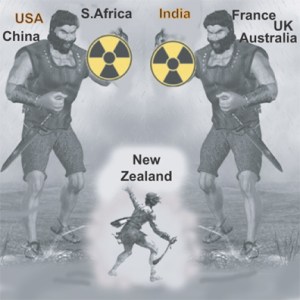 New Zealand set to mark anti-nuclear victory over the United States, ABC News 14 Aug 16 By Veronika Meduna in Wellington New Zealand’s anti-nuclear campaigners are claiming victory against a Goliath.
Key points:
- The NZ public overwhelmingly supports its anti-nuclear stance
- The US suspended its ANZUS obligations to NZ after its destroyer was denied access in 1985
- Peace protests expected when non-nuclear ships visit NZ in November
When the NZ Navy celebrates its 75th birthday in November, US warships will be there. It will be the first time any American military ship has entered a New Zealand port since the country’s controversial anti-nuclear legislation was passed in 1987.
“What this means is that any ship that comes here will be coming on New Zealand’s terms,” says investigative journalist Nicky Hager, a key figure in the anti-nuclear movement at the time.
“Our terms were set 30 years ago with the nuclear-free policy.”
Peace campaigner and former Green MP, Keith Locke, agrees. “It is recognition that most of the New Zealand public does not want nuclear ships and the US cannot get around that,” he says.
Anti-nuclear stance strains relationship with US
The stand taken by the comparatively tiny nation caused a rift between the allies which has lasted three decades, and has been likened to a mouse that roared.
New Zealand’s anti-nuclear movement was spurred to action when France tested nuclear weapons at Mururoa Atoll in French Polynesia in the 1960s. More than 80,000 New Zealanders signed a petition calling for a nuclear-free Southern Hemisphere.
“It was the biggest petition anywhere since the Suffragettes’ campaign of the 1890s,” Mr Locke says.
The anti-nuclear mood gripped the nation. Visiting US warships powered by small nuclear reactors sparked massive protests in the 1970s and 1980s, drawing thousands onto the streets…….
The nuclear ship ban has been a central pillar of New Zealand’s foreign policy ever since.
Warships from other nuclear-weapons states, such as the UK and China, have docked in New Zealand ports because they were prepared to declare their vessels “nuclear-free”.
However, the US stuck rigidly to its policy of “neither confirming nor denying” if a ship was nuclear-armed or powered. And that has kept American naval vessels out…….http://www.abc.net.au/news/2016-08-13/new-zealand-celebrates-anti-nuclear-victory-over-united-states/7731644
August 14, 2016
Posted by Christina Macpherson |
New Zealand, opposition to nuclear, politics international |
Leave a comment
Carteret climate refugees seek home A grassroots group in Bougainville is scrambling to relocate the Carteret Islanders before rising sea levels swallow their land forever. ABC News 7 Aug 16 By Lauren Beldi for Pacific Beat At only 1.5 metres above sea level at their highest point, the Carteret Islands are some of the first to succumb to the rising ocean tides.
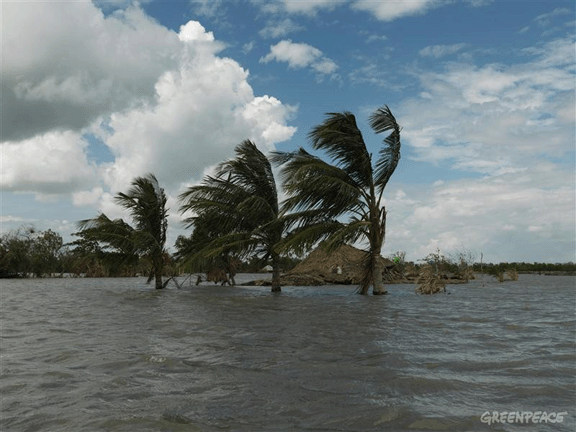
The grassroots Tulele Peisa group, which means “sailing the waves on our own” in the local Halia language, is hoping to relocate more than half of the population by 2020. They have secured land for new homes on the main island of the Autonomous Region of Bougainville, to the east of mainland Papua New Guinea.Tulele Peisa formed in late 2006 after the Council of Elders on the islands decided to establish their own relocation program. The group’s chief executive, Ursula Rakova, says the encroaching tides on the islands have a major impact on people’s health. “We’re beginning to get more requests for people wanting to move because of the situation and the dire need for food,” she says.
The storm surges not only wash away houses, but also vegetable gardens, which are critical for the islanders’ survival.
With no cash economy on the Carterets, the only source of food is what people are able to grow for themselves……
Tulele Peisa has also provided thousands of mangrove seedlings to prevent the erosion of the coastline, and helped to build raised garden beds. But this will only stave off the inevitable for so long.
“Those are adaptation strategies, they aren’t really long-term solutions to containing the islands, because we know the islands are going, but we are looking at supporting our families,” Ms Rakova says.
She says the islanders want to maintain their independent way of living but that the international community should provide more support.
“The islanders on the Carterets are victims of what other people have caused and the international community needs to aid and support the work that we are doing,” she says.
“We have found our way forward [and] we would like to share the way forward with other people, but we need this process to be funded financially so that we can continue to sustain ourselves.” http://www.abc.net.au/news/2016-08-07/carteret-climate-refugees-new-home/7693950?section=environment
August 8, 2016
Posted by Christina Macpherson |
climate change, OCEANIA, oceans |
Leave a comment
NZ’s nuclear resolve, Otago Daily Times, 25 Jul 2016 “……In 1987, Labour passed the New Zealand Nuclear Free Zone, Disarmament and Arms Control Act, meeting an election promise.
In a largely symbolic response, the US Congress retaliated with the Broomfield Act, downgrading New Zealand’s status from ally to friend.
Former prime minister David Lange said if the security alliance was the price New Zealand must pay to remain nuclear-free, it was the price the country was prepared to pay.
In 1989, 52% of New Zealanders indicated they would rather break defence ties than admit nuclear-armed ships. By 1990, National had signed up to the anti-nuclear stance.
There the situation has remained until Mr Biden accepted an invitation for the US to send a ship to the Royal New Zealand Navy’s 75th birthday in November……..
New Zealand is consistently said to have made a difference in peace-keeping activities around the world, being an independent thinker when it comes to solving complex security issues.
New Zealand is part of the Five Eyes intelligence sharing network.
Although New Zealand is not seen as reliable as Australia as an ally, it does have qualities which it can bring to any situation.
So despite the urging of Mr Key, the return to New Zealand waters by a US ship in November cannot be taken lightly. It is a win for the resolve of Kiwis to keep this country nuclear free.
It is not known if the US ship will be a warship or something tamer.
Under New Zealand’s law, Mr Key has to sign a declaration he is satisfied the ship complies with New Zealand law, something he says he has done about 40 times since he became prime minister.
Publicly available information will make it possible for watchers of maritime issues to identify if the ship is nuclear-armed or nuclear-powered……..http://www.odt.co.nz/opinion/editorial/391403/nz-s-nuclear-resolve
July 25, 2016
Posted by Christina Macpherson |
New Zealand, politics international |
Leave a comment
Nuclear-free has ‘served us well’ – Geoffrey Palmer, Radio New Zealand, 22 July 16 An architect of New Zealand’s once contentious anti-nuclear law says it remains the right approach for the country.
The law is in the spotlight as preparations begin for the first visit by an American warship since the landmark legislation was passed in 1987.
Under the law, the Prime Minister must make an assessment of whether the ship will breach New Zealand’s ban on nuclear weapons and nuclear power.
The US has not sent a naval ship since 1983, as it refuses to say whether its ships are nuclear-armed, as required by New Zealand’s nuclear-free law.
The deputy prime minister at the time the nuclear-free law was passed, Sir Geoffrey Palmer, told Morning Report the policy, and the law behind it, was sound…….http://www.radionz.co.nz/news/national/309192/nuclear-free-has-‘served-us-well’-geoffrey-palmer
July 22, 2016
Posted by Christina Macpherson |
New Zealand, politics |
1 Comment
Pacific atolls ‘could be underwater by 2050 Radio New Zealand Chris Bramwell, Deputy Political Editor – @chrisbramwell, 15 July 16 The government is being warned to prepare for an impending stream of refugees from the Pacific as low-lying atolls are swamped by sea-level rise over the coming decades.

Labour is also calling for the government to take a humanitarian approach to people from the region
who are overstayers in New Zealand.
United Nations warns if sea level rise continues at the current rate, the Pacific atolls of Kiribati and Tuvalu could be completely submerged within decades……
Labour’s Su’a William Sio said the people of the Pacific were fighting a losing battle. The government could take a more sympathetic approach to overstayers from Kiribati and Tuvalu and not send them back to islands already under pressure, he said.
“The main islands they’ve got issues not just with climate change, but with population growth and waste on both Tuvalu and Kiribati, so I think we’ve got to seriously look at what we do with that, and my view is that we need to adopt a humanitarian stance with the overstayers that are here.”
Climate change refugees might not be a serious issue now, but they would become one, he said.
“The overwhelming scientific evidence is telling us these islands will be underwater by 2050 or 2070, so we actually do need to have a strategic long term plan in preparation to help these islanders because we can’t just sit around once those islands are underwater.”…..http://www.radionz.co.nz/news/political/308703/pacific-atolls-could-be-underwater-by-2050
July 16, 2016
Posted by Christina Macpherson |
climate change, New Zealand, OCEANIA |
Leave a comment
 Work stoppage continues at Hanford Nuclear Reservation http://q13fox.com/2016/07/12/work-stoppage-continues-at-hanford-nuclear-reservation/ JULY 12, 2016, BY ASSOCIATED PRESS SPOKANE, Wash. (AP) — A rare work stoppage continues by some Hanford Nuclear Reservation workers who contend that radioactive wastes left from the production of nuclear weapons are making them sick.
Union president Dave Molnaa, who ordered the work stoppage, said it will continue until all employees are provided with bottled air when working around all of the underground nuclear waste storage tanks on the Hanford site.
Workers have contended for years that chemical vapors escaping from the tanks are making them sick.
The steel tanks, some dating back to World War II, contain wastes created by the production of plutonium for nuclear weapons.
The Hanford Atomic Metal Trades Council, a coalition of 15 unions that represent workers on the site near Richland, issued the “stop work” order on Monday morning.
July 13, 2016
Posted by Christina Macpherson |
employment, health, New Zealand |
Leave a comment
 NZers celebrate anti-nuclear weapon win, News Hub NZ, 9 Jul 2016 People in Christchurch have reflected on how “a little peace group” in their city defied the world’s most powerful nations to win a court case that triggered cuts in the world’s nuclear arsenal.
Events were held in Christchurch on Friday to mark 20 years since a historic judgment by the International Court of Justice (ICJ), ruling that the threat, let alone the use, of nuclear weapons was generally illegal.
Its decision was sparked by the World Court Project, an international campaign pioneered by New Zealanders.
Professor Paul Millar sums it up as an “important piece of history no one knows about”. Since then the number of nuclear weapons globally has fallen to 15,000 from 70,000.
It’s a story of how “citizen pressure” can change what politicians do, Dr Millar says.
Dr Kate Dewes was a housewife, a mother and a music teacher who went to a talk about peace and decided to do something.
“Kate and others were excited by the possibility and began the World Court Project and it led ultimately to this decision,” Prof Millar says…….http://www.newshub.co.nz/nznews/nzers-celebrate-anti-nuclear-weapon-win-2016070905#axzz4DrMcQTSf
July 8, 2016
Posted by Christina Macpherson |
New Zealand, weapons and war |
1 Comment
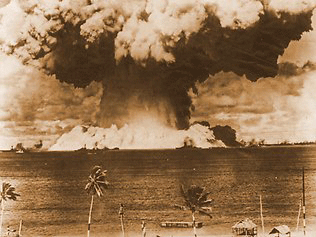
 70th Anniversary of Operation Crossroads Atomic Tests in Bikini Atoll, July 1946
EXCELLENT VIDEOS and PHOTOS, National Security Archive Government Films and Photographs Depict Test “Able” on 1 July 1946
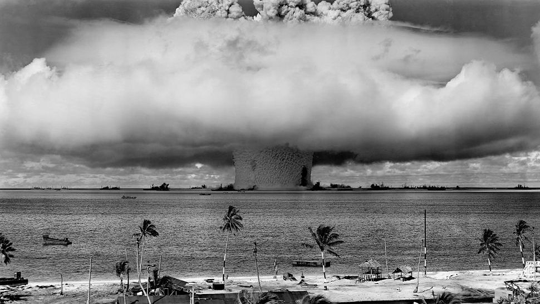
 Removal of 167 Bikinians from the Atoll Preceded the Atomic Tests
National Security Archive Electronic Briefing Book No. 553 July 1, 2016 Edited by William Burr with Stav Geffner For more iThe Atomic Tests at Bikini Atoll, July 1946nformation contact: William Burr at 202/994-7000 or nsarchiv@gwu.edu.
The Atomic Tests at Bikini Atoll, July 1946 Washington, D.C., July 1, 2016 – Seventy years ago this month a joint U.S Army-Navy task force staged two atomic weapons tests at Bikini atoll in the Marshall Islands, the first atomic explosions since the bombings of Japan in August 1945. Worried about its survival in an atomic war, the Navy sought the tests in order to measure the effects of atomic explosions on warships and other military targets. The test series was named Operation Crossroads by the task force’s director, Rear Admiral William Blandy. The first test, Able, took place on 1 July 1946. Of the two tests, the second, Baker, on 25 July 1946, was the most dangerous and spectacular, producing iconic images of nuclear explosions. A third test was scheduled, but canceled. Photographs and videos posted today by the National Security Archive document Crossroads, focusing on the Able test.
Also documented is the U.S. Navy’s removal, in early March 1946, of 167 Pacific islanders from Bikini, their ancestral home, so that the Navy and the Army could prepare for the tests. The Bikinians had the impression that the relocation would be temporary but the islands remain uninhabitable due to subsequent nuclear testing in the atoll……….
Video gallery
Continue reading →
July 4, 2016
Posted by Christina Macpherson |
indigenous issues, OCEANIA, Reference, weapons and war |
Leave a comment










 nuclear-news