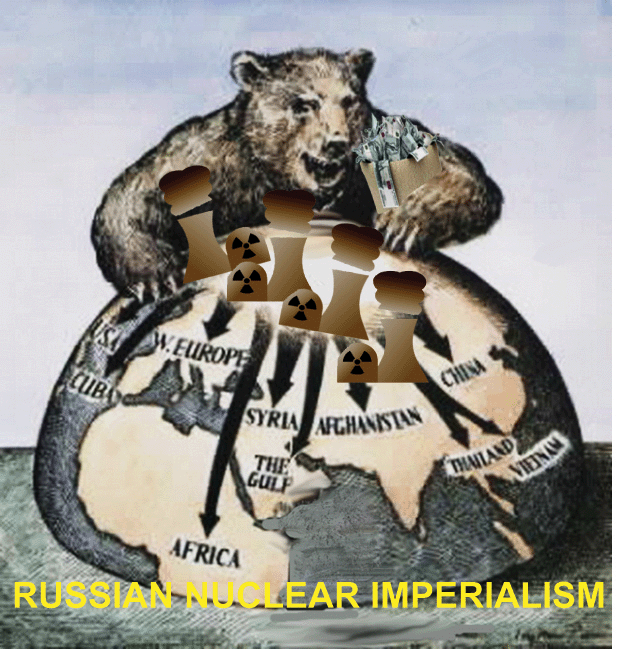
Duterte dials Russia for nuclear power future, Joel Guinto, ABS-CBN News, Jun 19 2017 “…….President Rodrigo Duterte is bringing the Philippines closer to tapping nuclear power than any of his immediate predecessors by dialing Russia, which is offering its technology to the world. Duterte’s government forged an agreement with the Russian State Atomic Energy Corp. (ROSATOM) for the possible development of nuclear infrastructure, personnel training, and courting public support for the technology following his visit to Moscow last month.
Russia also offered to supply the Philippines with nuclear power barges and capsules.
ROSATOM on Monday opened an showcase of Russian nuclear technology, hoping to attract new clients from around the world, including the Philippines.
“We want to cooperate and be partners” said Sergey Kirienko, first deputy chief in the office of Russian President Vladimir Putin……
Project financing is the biggest concern of developing economies that seek to tap nuclear power, said Iliya Rebrov, economic and finance director at ROSATOM.
Rebrov said ROSATOM helps its clients secure funding from various sources, including loans.
“The key competitive factor is the ability of the contractor to arrange financing,” Rebrov said, citing a recent wind-farm project in southern Russia that was financed with Gazprombank.
ROSATOM is “very confident” in the world market as it diversifies its offerings to meet growing demand, said Kirill Komarov, the company’s First Deputy Director general for corporate development and international business. http://news.abs-cbn.com/focus/06/19/17/duterte-dials-russia-for-nuclear-power-future
June 21, 2017
Posted by Christina Macpherson |
marketing, Philippines, Russia |
Leave a comment
FSM and Marshalls urge nuclear clean-up, Radio New Zealand 9 June 17 A number of Pacific leaders have used the UN Oceans Conference to bring global attention to nuclear contamination and World War Two wrecks that have become environment hazards.
Federated States of Micronesia and the Marshall Islands have led the charge in highlighting what they call ‘real concerns’ confronting their people in the event of nuclear contamination or an oil spill from shipwrecks in their territorial waters.
The Secretariat of the Pacific Regional Environment Programme (SPREP) said since 2005, when its regional strategy on marine pollution from World War 2 wrecks was adopted, not much had been implemented because coastal states preferred to deal with the issue bilaterally with the flag states.
The two flag states for most of the 800 wrecks that litter the territorial waters of five Pacific countries are the United States and Japan.
Most of the wrecks are remnants of World War 2……..
Nuclear Contamination
Also speaking at the Oceans Conference the President of the Federated States of Micronesia Peter Christian said nuclear contamination was a serious threat for small island countries in the north Pacific as there were claims the fall-out from the nuclear tests conducted in the Marshall Islands may have reached as far as Palau.
The FSM pointed out a storage dome for radioactive waste on Enewetak Atoll was cracking and leaking and plants around it were dying.
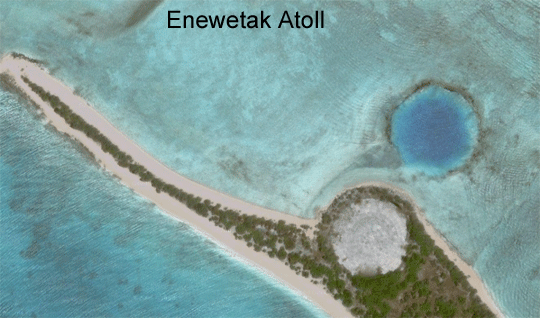
The FSM called for the Pacific Islands Forum to invite countries responsible for the nuclear contamination and Second World War shipwrecks to the Forum leaders’ summit later this year to explain what they intended to do about the waste.
The Samoan Prime Minister and Forum chair Tuilaepa Sailele Malielegaoi said the issue will be on the agenda at the September meeting. http://www.radionz.co.nz/international/pacific-news/332467/fsm-and-marshalls-urge-nuclear-clean-up
June 12, 2017
Posted by Christina Macpherson |
environment, OCEANIA |
Leave a comment
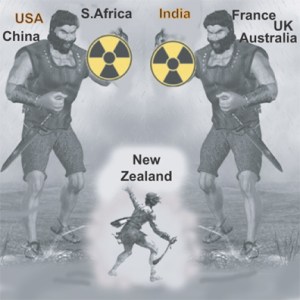 Aucklanders celebrate anniversary of nuclear-free New Zealand, 11/06/2017, Newshub staff It’s been 30 years since New Zealand became the first country in the world to declare itself Nuclear Free.
On Sunday, hundreds formed a human peace symbol at the Auckland Domain, similar to the one made in 1983, in order to commemorate the anniversary of the passing of the New Zealand Nuclear Free Zone, Disarmament, and Arms Control Act. …….
The anniversary comes just days before a United Nations conference involving 132 countries which will negotiate a treaty to ban nuclear weapons. http://www.newshub.co.nz/home/new-zealand/2017/06/aucklanders-celebrate-anniversary-of-nuclear-free-new-zealand.html
June 12, 2017
Posted by Christina Macpherson |
New Zealand, weapons and war |
Leave a comment
French nuclear tests ‘showered vast area of Polynesia with radioactivity’ https://www.theguardian.com/world/2013/jul/03/french-nuclear-tests-polynesia-declassified
Declassified papers show extent of plutonium fall-out from South Pacific tests of 60s and 70s was kept hidden, says French paper, Guardian, Angelique Chrisafis in Paris, Thursday 4 July 2013, French nuclear tests in the South Pacific in the 1960s and 1970s were far more toxic than has been previously acknowledged and hit a vast swath of Polynesia with radioactive fallout, according to newly declassified ministry of defence documents which have angered veterans and civilians’ groups.
The papers, seen by the French paper Le Parisien, reportedly reveal that plutonium fallout hit the whole of French Polynesia, a much broader area than France had previously admitted. Tahiti, above, the most populated island, was exposed to 500 times the maximum accepted levels of radiation. The impact spread as far as the tourist island, Bora Bora.
Thousands of veterans, families and civilians still fighting for compensation over health issues have insisted France now reveals the full truth about the notorious tests whose impact was kept secret for decades.
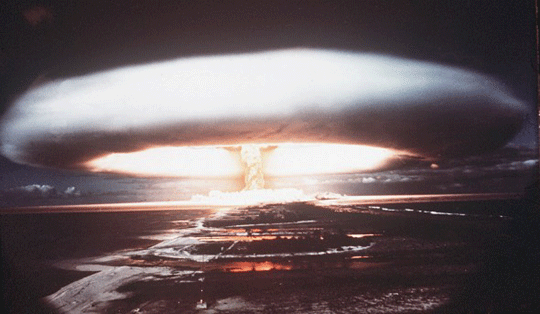
From 1960 to 1996, France carried out 210 nuclear tests, 17 in the Algerian Sahara and 193 in French Polynesia in the South Pacific, symbolised by the images of a mushroom cloud over the Mururoa atoll. For decades, France argued that the controlled explosions were clean. Jacques Chirac, the French president, controversially resumed nuclear atoll explosions in the South Pacific shortly after being elected in 1995.
Le Parisien said the documents “lifted the lid on one of the biggest secrets of the French army”. It said papers showed that on 17 July 1974, a test exposed Tahiti to 500 times the maximum allowed level of plutonium fallout.
Bruno Barillot, who has investigated the impacts of the nuclear tests for the Polynesian government, complained of the high levels of thyroid cancers and leukaemia in Polynesia. He said the declassified documents revealed Tahiti had “literally been showered with plutonium for two days” during the Mururoa test; from the outset France knew the impact spread further than it publicly admitted. But of the 2,050 pages declassified, 114 remained blacked out.
Richard Oldham, a member of the Polynesia nuclear workers’ association Mururoa e Tatou, told Radio New Zealand International : “It’s the right for our future generations to know what has happened in this country.”
In 2006 a French medical research body found nuclear testing had caused an increase in cancer on the nearest inhabited islands. The French judiciary began investigating health implications. It was not until 2010 that France acknowledged that there could be a compensation process for veterans and civilians. But that is complex and limited to a small geographical area and certain ailments.
About 150,000 veterans and civilians worked on, or were present during, nuclear tests, including 127,000 in Polynesia. But of 800 dossiers, only 11 people have received compensation.
Troops who worked on the tests have described a staggering lack of precaution for workers. During the Mururoa tests in French Polynesia in the late 1960s, one veteran described how he was stationed in shorts and a T-shirt on a boat only about 15 miles from the explosion before having to sail immediately to the area of the vast mushroom cloud to examine the damage.
Others on different tests wore shorts and had no sunglasses; they were told simply to shield their eyes and turn their backs at the time of the explosion.
May 29, 2017
Posted by Christina Macpherson |
environment, OCEANIA, weapons and war |
Leave a comment
 Philippines, Russia forge nuclear cooperation deal, ABS-CBN News, May 26 2017 MANILA – The Philippines and Russia have agreed to develop cooperation on nuclear energy under an agreement signed in Moscow, Russia’s state nuclear agency said Friday.
Under the memorandum of cooperation, the two nations will pursue the “development of the nuclear infrastructure” in the Philippines, including personnel training and securing public acceptance of nuclear power, Rosatom State Atomic Energy Corp said in a statement……Duterte has approved a study on the feasibility of nuclear power to augment the country’s electricity supply.
The Philippines has a nuclear power plant in Bataan, which has never been used.http://news.abs-cbn.com/business/05/26/17/philippines-russia-forge-nuclear-cooperation-deal
May 27, 2017
Posted by Christina Macpherson |
marketing, Philippines, Russia |
Leave a comment
Russia, Philippines forge Defense Cooperation Agreement, UPDATE PH, May 26, 2017 Caleb Velasquez The defense cooperation will expand exchanges in terms of training, seminars and best practices between the two countries, with the end to develop relations in the field of military education, including military medicine, military history, sports, and culture as well as experiences in consultation, observer participation in military training exercises, and military port calls…..
Memorandum of Agreement between the Department of Science and Technology of the Philippines and the State Atomic Energy Corporation, otherwise known as ROSATOM on Cooperation on the Use of Nuclear Energy for Peaceful Purposes was also forged. https://www.update.ph/2017/05/russia-philippines-forge-defense-cooperation-agreement/17735
May 27, 2017
Posted by Christina Macpherson |
marketing, Philippines, Russia |
Leave a comment
Our country will vanish’: Pacific islanders bring desperate message to Australia, Guardian, 14 May 17, Kiribati and other low-lying countries are under threat from climate change, and while their people would rather stay behind, they may be left with no choice “……… i-Kiribati man Erietera Aram is in Australia delivering his message about the reality of climate change in his country, and of its immediacy. Each discussion, he says, is like a drop of water, adding to the one before it, slowly building understanding of the existential threat to his people and place.
“Climate change is not something off in the future, it’s not a problem for later. We are living it now,” he says.
The archipelago of Kiribati – 33 tiny coral atolls spanning 3.5m square kilometres of ocean – is the world’s lowest-lying country, with an average height above sea level of just two metres.

Most of the 113,000 i-Kiribati live crammed on to Tarawa, the administrative centre, a chain of islets that curve in a horseshoe shape around a lagoon.
“My place is very small,” Aram says. “If you stand in the middle, you can see water on both sides. We are vulnerable. One tsunami, one tsunami and our whole country will disappear.”
Already, there is less and less of Kiribati for its inhabitants. The coastline is regularly being lost to king tides and to creeping sea levels, and in a very real sense, there is nowhere to go.
The loss of land is causing conflict – Tarawa is growing ever more densely crowded, as families living on the coastline are forced inwards, infringing on another’s claim.
The next round of multinational climate talks in November – COP 23 – will be chaired by Fiji, and is expected to swing particular focus of the global climate debate to the Pacific, where comparatively minuscule amounts of carbon are produced, but the effects of climate change have been felt first, and most acutely.
Assuming the COP presidency, the Fijian prime minister, Frank Bainimarama, said he would “bring a particular perspective to these negotiations on behalf of some of those who are most vulnerable to the effects of climate change – Pacific Islanders and the residents of other small island developing states and low-lying areas of the world”…….https://www.theguardian.com/world/2017/may/14/our-country-will-vanish-pacific-islanders-bring-desperate-message-to-australia
May 15, 2017
Posted by Christina Macpherson |
AUSTRALIA, climate change, OCEANIA |
Leave a comment
Tiny frogs face a troubled future in New Guinea’s tropical mountains, ABC News, The Conversation, 30 Mar 17, By Paul Oliver and Michael Lee At night, the mountain forests of New Guinea come alive with weird buzzing and beeping calls made by tiny frogs, some no bigger than your little fingernail.
These little amphibians — in the genus Choerophryne — would shrivel and dry up in mere minutes in the hot sun, so they are most common in the rainy, cooler mountains.
Yet many isolated peaks, especially along northern New Guinea, have their own local species of these frogs.
So how did localised and distinctive species of these tiny frogs come to be on these isolated peaks, separated from each other by hotter, drier and rather inhospitable lowlands?
Our new study of their DNA, published this week in the open access journal PeerJ, reveals how they achieved this feat. It reveals a dynamic past, and more worryingly it highlights the future vulnerability of tropical mountain forests and their rich biodiversity………
During past phases of global cooling (glacial periods), the colder, wetter, mountainous habitats of New Guinea expanded downhill, a process termed elevational depression.
If depression was extensive enough, the frogs on one mountain might have been able to travel across tracts of cool, wet lowlands to colonise other mountains.
Later, a warming climate would wipe out the lowland populations, leaving two isolated mountain populations, which might eventually become new species………
The little frogs and the future
Why does it matter how the tiny frogs moved to their mountain habitats? Because it could be a warning to their future survival……..
As we’ve shown, the global cooling in past glacial periods allowed the mountain-dwelling frogs to move down across the lowlands to find new mountain peaks.
But today, as global temperatures soar to levels not seen for millions of years, their habitable cool zones are heading in the other direction: shrinking uphill.
We have no idea how quickly these frogs will respond to these changes, but recent research elsewhere in New Guinea has found birds are already shifting upslope rapidly.
We don’t yet know what could happen to these cute little amphibians should temperatures continue to climb, and they in turn run out of mountainside to climb……… http://www.abc.net.au/news/2017-03-31/tiny-frogs-face-a-troubled-future-in-new-guineas-mountains/8403936
April 1, 2017
Posted by Christina Macpherson |
environment, OCEANIA |
Leave a comment
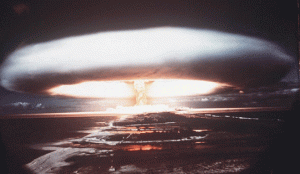 Big shift afoot in French nuclear compo law http://www.radionz.co.nz/international/pacific-news/323947/big-shift-afoot-in-french-nuclear-compo-lawThe French joint law commission has decided to remove the term negligible risk from the nuclear compensation law in what is seen as a breakthrough for French Polynesia’s test victims.
The unanimous decision is now to go to the National Assembly and the Senate for approval as Paris is to make good on its promise to loosen the law.
The compensation law, drawn up by Herve Morin when he was the defence minister in 2009, has been widely criticised for being too restrictive because almost all claims have been thrown out.
A month ago, two French lawmakers urged the social affairs minister Marisol Touraine to amend the decree on compensation to ensure that unsuccessful claimants can resubmit their files.
One of the MPs Jean-Patrick Gille said veterans would find it incomprehensible if the earlier rejection of their compensation bids were to be final.
France tested its atomic weapons first in Algeria and then from 1966 to 1996 in the South Pacific in a programme which involved more than 100,000 personnel.
February 8, 2017
Posted by Christina Macpherson |
Legal, OCEANIA, weapons and war |
Leave a comment
Ta’u island in American Samoa will rely on solar panels and Tesla batteries as it does away with diesel generators, Guardian Eleanor Ainge Roy, 28 Nov 16, A remote tropical island has catapulted itself headlong into the future by ditching diesel and powering all homes and businesses with the scorching South Pacificsun.
Using more than 5,000 solar panels and 60 Tesla power packs the tiny island of Ta’u in American Samoa is now entirely self-sufficient for its electricity supply – though the process of converting has been tough and pitted with delays……https://www.theguardian.com/environment/2016/nov/28/south-pacific-island-ditches-fossil-fuels-to-run-entirely-on-solar-power
November 30, 2016
Posted by Christina Macpherson |
decentralised, OCEANIA |
Leave a comment
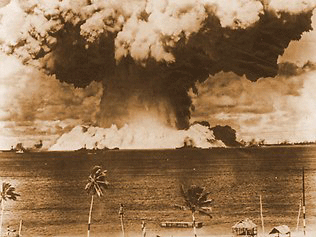
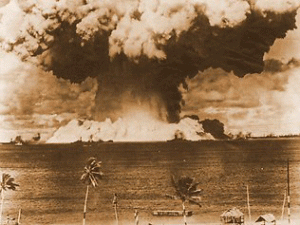 Bikini was just the beginning, bombs still threaten the islanders, New Internationalist DECEMBER 2016 John Pilger visits the Marshall Islands and its bomb survivors, still blighted by US nuclear weapons. “……..The explosion vaporized an entire island, its fall-out spreading over a vast area. There was a ‘miscalculation’, according to the official history; the wind ‘changed suddenly’. These were the first of many lies, as declassified documents and the victims’ testimony have since revealed.
Gene Curbow, a meteorologist assigned to monitor the test site, said, ‘They knew where the radioactive fall-out was going to go. Even on the day of the shot, they still had an opportunity to evacuate people, but [people] were not evacuated; I was not evacuated… The United States needed some guinea pigs to study what the effects of radiation would do.’
The secret of the Marshall Islands was Project 4.1. Official files describe a scientific programme that began as a study of mice and became a study of human beings exposed to the radiation of a nuclear weapon. Most of the women I interviewed had suffered from thyroid cancer; many in their communities did not survive.
The US Navy returned the population of Rongelap atoll, which is downwind of Bikini, even though the food was unsafe to eat and the water unsafe to drink. As a result, reported Greenpeace – which eventually sent a ship to rescue them – ‘a high proportion of their children suffered from genetic effects’.
Archive film refers to them as ‘amenable savages’. A US Atomic Energy Agency official boasts that Rongelap is ‘by far the most contaminated place on earth’, adding, ‘It will be interesting to get a measure of human uptake when people live in a contaminated environment.’
Holding a photograph of herself as a child, with terrible facial burns and most of her hair missing, Nerje Joseph told me, ‘We were bathing at the well. White dust started falling from the sky. I reached to catch the powder. We used it as soap to wash our hair. A few days later, my hair started falling out.’
Lemoyo Abon said, ‘Some people were in agony. Others had diarrhoea. We were terrified. We thought it must be the end of the world.’
Human radiation experiments
As a nine-year-old, Tony de Brum witnessed the Bravo bomb. He became foreign minister of the Republic of the Marshall Islands, an indefatigable voice demanding justice for his people. Clutching the evidence, he stood up at the United Nations in 2005 and said, ‘United States government documents clearly demonstrate that its scientists conducted human radiation experiments with Marshallese citizens. Some of our people were injected with or were coerced to drink fluids laced with radiation. Other experiments involved the resettling of people on islands highly contaminated to study how human beings absorbed radiation from the food and environment.’
The Marshall Islands were, until 1986, a Trust Territory administered by the United States with a legal obligation to ‘protect the inhabitants against the loss of their land and resources’ and to ‘protect their health and well-being’. In 2004, the US Cancer Institute reported to Congress that future Marshallese generations were likely to contract 530 cancers.
The US relinquished direct control of the islands only after the Marshallese had agreed to accept a mere $150 million as compensation for their suffering and to allow the huge US base on Kwajalein atoll, with its ‘mission to combat communist China’ and known as the Ronald Reagan Missile Test Facility.
Commanding the Pacific all the way to Asia and China, the base continues to subject the islanders to the testing of weapons of mass destruction. Missiles are launched at night, or fired into the lagoon from California. Following each ‘shot’, islanders fall sick with a ‘mystery illness’. The Environmental Protection Agency says fish in the bay cannot be eaten; fish was once the staple. The cost of firing one missile is $100 million, or two-thirds of the compensation paid to the islanders……..
In 2014, President Obama announced that the US was ‘creating the world’s largest marine reserve in the Pacific, banning fishing and other commercial activities across pristine sea dotted with coral atolls’.
In fact, as part of Obama’s military build-up in the Pacific, known as the ‘pivot to Asia’, the US has taken control of nine million square miles of ocean – an area double the size of the mainland United States. Under cover of a marine reserve, a ‘marine range complex’ will be run by the Pentagon, with torpedoes, underwater mines and numerous other detonations. Bikini was just the beginning. https://newint.org/features/2016/12/01/bikini-was-just-the-beginning/
November 28, 2016
Posted by Christina Macpherson |
OCEANIA, USA, weapons and war |
Leave a comment
The participants also agreed the Marrakech Proclamation, a statement re-affirming the intentions of all 197 signatories to the Paris deal.Seen as show of unity on the issue in the light a possible US withdrawal, countries stated they would live up to their promises to reduce emissions. The proclamation also called on all states to increase their carbon cutting ambitions, urgently.
Some of the poorest nations in the world announced that they were moving towards 100% green energy at this meeting.
The Climate Vulnerable Forum said that the 47 member countries, including Bangladesh, Ethiopia and Yemen, would achieve this goal between 2030 and 2050. And they challenged richer countries to do the same.
Despite these steps forward there were still some areas of significant difference between the parties, especially over money. The talks will continue in 2017 with a new US delegation picked by the Trump administration.
 Climate talks: ‘Save us’ from global warming, US urged http://www.bbc.com/news/science-environment-38034171 By Matt McGrath Environment correspondent 19 November 2016 The next head of the UN global climate talks has appealed for the US to “save” Pacific islands from the impacts of global warming.
Fijian Prime Minister Frank Bainimarama said that the islands needed the US now as much as they did during World War Two. He was speaking as global climate talks in Marrakech came to an end.
Mr Bainimarama said that climate change was not a hoax, as US President-elect Donald Trump has claimed. Mr Trump has promised to pull the US out of the Paris Climate Agreement and scrap all payments for UN global warming projects.
But as he accepted the role of president of the Conference of the Parties for the year ahead, the Fijian leader took the opportunity to call on to the next US president to step away from his scepticism.
“I again appeal to the President-elect of the US Donald Trump to show leadership on this issue by abandoning his position that man-made climate change is a hoax,” said Mr Bainimarama.
“On the contrary, the global scientific consensus is that it is very real and we must act more decisively to avoid catastrophe.” He also made a direct call to the American people to come to their aid in the face of rising seas, driven by global warming. Continue reading →
November 21, 2016
Posted by Christina Macpherson |
climate change, OCEANIA |
Leave a comment
Helen did not hold back, explaining that nuclear war means “blindness, burning, starvation, disease, lacerations, haemorrhaging, millions of corpses and an epidemic of disease”. Helen’s dramatic and blunt style reduced many in her audiences to tears. She always ended her talks with a call to action – especially to parents – as she strongly believes that nuclear disarmament is “the ultimate medical and parenting issue of our time.”
To those who would claim New Zealand was not a target she had a short reply: “Trident submarines in ports are targeted. They are a first strike target. It is much easier to destroy subs when they are in dock than it is when they are submerged in the ocean.”
The new Labour Government of 1984 passed the New Zealand Nuclear Free Zone, Disarmament and Arms Control Act in 1987, the world’s first national nuclear-free legislation. Dr Helen Caldicott’s influence had culminated in the passage of the cornerstone of New Zealand’s foreign policy.
 Marilyn Waring on the Australian hero of nuclear-free New Zealand http://thespinoff.co.nz/society/14-11-2016/the-australian-hero-of-nuclear-free-new-zealand/ By Marilyn Waring November 14, 2016 The former National MP whose decision to support anti-nuclear legislation led to the 1984 snap election writes on the transformative influence of the passionate Australian physician Helen Caldicott, who speaks in Auckland this week
If you were growing up in New Zealand and Australia post World War II, there’s a chance you knew about the United States using the Marshall Islands as a nuclear testing site from 1947 until 1962. In an agreement signed with the United Nations, the US government held the Marshall Islands as a “trust territory” and detonated nuclear devices in this pristine area of the Pacific Ocean – leading, in some instances, to huge levels of radiation fall-out, health effects, and the permanent displacement of many island people. In all, the US government conducted 105 underwater and atmospheric tests. You would have also known that the British conducted seven atmospheric tests between 1956 and 1963 on traditional Aboriginal land, in Maralinga, Australia.
It may be that you read Neville Shute’s 1957 novel On the Beach, in which people in Melbourne, Australia wait for deadly radiation to spread from a Northern Hemisphere nuclear war. This book made a memorable impact on Helen when she read it as a teenager.
Both Helen and I saw Peter Watkin’s The War Game, a BBC documentary drama about nuclear war and the consequences in an English city. In New Zealand the film was restricted for children unless accompanied by an adult, so I had to get my father to take me. The War Game won the Oscar for the best documentary in 1965.
France began its series of over 175 nuclear tests at Mururoa, in the South Pacific, in 1966. At least 140 of these tests were above ground. In 1973, the New Zealand and Australian governments took France to the World Court for continued atmospheric testing, and forced the last tests underground. The testing finally came to an end in 1976.
In New Zealand the US Navy made regular visits between 1976 and 1983 with nuclear-powered and, most likely, nuclear-armed, ships. These visits produced spectacular protest fleets in the Auckland and Wellington harbours, when hundreds of New Zealanders — in yachts of all sizes, in motor boats and canoes, even on surf boards — surrounded the vessels and tried to bring them to a complete stop. By 1978, a campaign began in New Zealand to declare borough and city council areas nuclear-free and, by the early 1980s, this symbolic movement had quickly gained momentum, covering more than two-thirds of the New Zealand population.
Helen Caldicott and I had not met up to this point, but these were shared parts of our history and consciousness when Helen visited New Zealand in 1983. Helen Caldicott graduated with a medical degree from University of Adelaide Medical School in 1961. She moved to the United States, becoming an Instructor in paediatrics at Harvard Medical School and was on the staff of the Children’s Hospital Medical Centre in Boston, Massachusetts. In the late 1970s, Helen became the President of Physicians for Social Responsibility. This group was founded when Helen was finishing medical school, quickly making its mark by documenting the presence of Strontium-90, a highly radioactive waste product of atmospheric nuclear testing, in children’s teeth. The landmark finding eventually led to the Limited Nuclear Test Ban treaty, which ended atmospheric nuclear testing.
But it was the Three Mile Island accident that changed Helen’s life. An equipment failure resulted in a loss of cooling water to the core of a reactor at the Three Mile Island Nuclear Generating Station in Pennsylvania, causing a partial meltdown. Operator failure meant that 700,000 gallons of radioactive cooling water ended up in the basement of the reactor building. It was the most serious nuclear accident to that date in the US Helen published Nuclear Madness the same year. In it she wrote: “As a physician, I contend that nuclear technology threatens life on our planet with extinction. If present trends continue, the air we breathe, the food we eat, and the water we drink will soon be contaminated with enough radioactive pollutants to pose a potential health hazard far greater than any plague humanity has ever experienced.” In 1980, Helen resigned from her paid work positions to work full time on the prevention of nuclear war.
In 1982, Canadian director Terre Nash filmed a lecture given by Helen Caldicott to a New York state student audience. Nash’s consequent National Film Board of Canada documentary If You Love this Planet was released during the term of US President Ronald Reagan, at the height of Cold War nuclear tensions between the United States and the Soviet Union. The US Department of Justice moved quickly to designate the film “foreign propaganda,” bringing a great deal of attention to the film. It went on to win the 1982 Academy Award for Documentary Short Subject. That same year, Helen addressed about 750,000 people in Central Park, New York in the biggest anti-nuke rally in the United States to that date.
In 1983, I was serving as a member of the New Zealand parliament, having been elected eight years earlier at the age of 23. Our parliament established a Disarmament and Arms Control Select Committee to conduct hearings on the possibility of making New Zealand a nuclear-free zone. During this critically important time, Helen was invited to New Zealand on a lecture tour. The documentary If You Love This Planet was shown at her speaking engagements.
I did not get to meet her, nor hear any of her lectures in person, as I was working in parliament every night. But I did follow the media coverage.
Helen told the Listener about having observed five-star generals in US congressional and senate committees complaining that the Russian missiles were bigger than the American ones. “The Russian missiles are very big [and] inaccurate and clumsy. America has very small, very accurate missiles, which are better at killing people and destroying targets,” she explained. A frequent message in her talks to New Zealand audiences was the redundant overkill capacity of both superpowers. Caldicott noted to her audiences that “The US has 30,000 bombs and Russia 20,000.”
I had sat in a New Zealand parliamentary committee hearing some months earlier, when a government colleague, brandishing a centrefold of a Russian submarine, excitedly called for us to “Look at how big it is.” I had thought that no one would believe me if I had repeated such an inane banality – when an adult male was more impressed by the size of the submarine than its capacity to destroy life on this planet.
Helen’s public addresses were grounded in the potential impact of nuclear weapons. “Imagine a 20-megaton bomb targeted on Auckland,” she told audiences in New Zealand. “The explosion, five times the collective energy of all the bombs dropped in the Second World War, digs a hole three-quarters of a mile wide by 800 feet deep and turns people, buildings and dirt into radioactive dust. Everyone up to six miles will be vaporised, and up to 20 miles they will be dead or lethally injured. People will be instantly blinded looking at the blast within 40 miles. Many will be asphyxiated in the fire storm.”
Helen did not hold back, explaining that nuclear war means “blindness, burning, starvation, disease, lacerations, haemorrhaging, millions of corpses and an epidemic of disease”. Helen’s dramatic and blunt style reduced many in her audiences to tears. She always ended her talks with a call to action – especially to parents – as she strongly believes that nuclear disarmament is “the ultimate medical and parenting issue of our time.”
To those who would claim New Zealand was not a target she had a short reply: “Trident submarines in ports are targeted. They are a first strike target. It is much easier to destroy subs when they are in dock than it is when they are submerged in the ocean.”
In 2015, I asked Helen how she managed to deliver such bad news and yet keep her audiences with her. “Being a doctor helps because you have to learn to negotiate with a patient and with language they can understand,” she explained. “You have to convert the medical diagnosis and treatment to lay language. I also have to keep them awake sometimes by letting them laugh because it relieves their tension and because the stuff I say is pretty awful.” Helen told me that she practises “global preventative medicine”.
Helen’s tour through New Zealand in 1983 had a huge, and lasting, impact. At one stop, Helen addressed over 2,000 people at a public event in Auckland. The librarian with whom I corresponded looking for old newspaper reports of Helen’s visit, wrote to me: “Her chillingly detailed description of the effects of a nuclear device detonated over the hall in which we were sitting remains rooted in my psyche to this day! …The other message I most recall is the dichotomy she evoked between the destructive drive of ‘old men’ rulers, the instigators of war, versus the procreative energy of mothers most impelled to oppose them — which, however reductive, retains the compelling logic of a truism!”
Helen’s approach was transformative in New Zealand. Helen’s speaking events packed auditoriums, and overflows of audiences had to be accommodated using loud speaker systems. People responded strongly to this woman, whose life work involved caring for children, speaking about medical effects of fallout, and speaking without the use of the clichéd military and defence ideological rhetoric that treated people as if they were simpletons who couldn’t understand. Her speeches inspired people to act. After Helen spoke, the volume of mail delivered to my parliamentary office increased—particularly from women.
On May 24, 1983, 20,000 women wearing white flowers and armbands and holding banners with peace signs marched quietly up a main street in Auckland to hold a huge rally and call for New Zealand to be nuke-free. It was one of the largest women’s demonstrations in New Zealand’s history. In her book, Peace, Power and Politics – How New Zealand Became Nuclear Free, Maire Leadbetter writes: “I am one of many activists who think of Helen Caldicott’s visit as the point when the peace movement began to grow exponentially … Helen had a magical ability to motivate previously passive citizens to become activists.”
Shortly after Helen’s visit to New Zealand, in 1984, I advised that I intended to vote for the opposition-sponsored nuclear-free New Zealand legislation. This prompted conservative Prime Minister Rob Muldoon to call a snap election. Muldoon told media that my “feminist anti-nuclear stance” threatened his ability to govern.
The new Labour Government of 1984 passed the New Zealand Nuclear Free Zone, Disarmament and Arms Control Act in 1987, the world’s first national nuclear-free legislation. Dr Helen Caldicott’s influence had culminated in the passage of the cornerstone of New Zealand’s foreign policy.
This essay is one of 28 stories by notable women about remarkable women peacemakers, When We Are Bold: Women Who Turn Our Upsidedown World Right, to mark the 10th anniversary of the Nobel Women’s Initiative. Dr Caldicott speaks at AUT on Tuesday November 15.
November 14, 2016
Posted by Christina Macpherson |
history, New Zealand |
Leave a comment
The ‘flexible’ carbon mitigation mechanism of National Determined Contributions that makes contribution to emission cuts voluntary allows for the watering down of the historic and current responsibility of big polluter countries like the United States and China. Pressure is unjustly put on low carbon economies of developing countries when there should be none in the first place.
There are no concrete commitments and mechanisms that will ensure adequate and unconditional support for climate vulnerable countries. Even more marginalized was the proposed mechanism for ‘Loss and Damage’ that sought to facilitate compensation from industrialized nations to vulnerable nations that are already suffering climate impacts.
Transnational corporations and financial institutions, meanwhile, are given free rein to promote multi-billion dollar false climate solutions such as mega hydro, clean coal, and nuclear power plants, timber plantations, carbon credits, and other projects that displace communities and degrade the environment.
These are just the tip of the iceberg.
There are bigger battles outside the Paris Agreement http://opinion.inquirer.net/98960/there-are-bigger-battles-outside-the-paris-agreement INQUIRER.net November 04, 2016 LEON DULCE
Campaign Coordinator Kalikasan People’s Network for the EnvironmentWe write with regard to the resurgence of debate on President Rodrigo Duterte’s ambivalence over the Paris Agreement on Climate Change, as it comes in a time when deeper public discourse and action on the climate crisis is urgently needed.
World leaders will gather at the United Nations “COP22″ climate talks once again to attempt to concretize the Paris Agreement’s agreed common actions on mitigating carbon emissions that induce climate change, adapting communities to worsening climate impacts, and ensuring financing, technology transfer, capacity building, and loss and damage mechanisms.
COP22’s commencement fittingly coincides with the Philippines’ commemoration of the third anniversary of Super Typhoon Yolanda (international name Haiyan). World leaders should be reminded that some 16 million people were severely affected by Yolanda’s powerful winds, floods and storm surges across the Philippines, and that these impacted communities are still struggling to recover three years later—a preview of what future climate norms are in store for us if climate disruption is left unfettered.
An alarming evidence of this was the findings of current Social Welfare Secretary Judy Taguiwalo that at least 200,000 Yolanda survivors have yet to receive emergency shelter assistance from the state because of discrimination by local politics during the Aquino administration.
Meanwhile, the specter of ‘disaster capitalism’ continues to haunt Yolanda survivors. Initial findings of an environmental investigation mission held by the Center for Environmental Concerns and scientist group AGHAM regarding the proposed P7.9-billion Leyte Tide Embankment Project revealed how the biggest post-Yolanda mega-infrastructure solution actually threatens the livelihood and environment of some 10,000 residents across the east coast of Leyte.
Unfortunately, there is still a yawning gap between the abject plight of Yolanda survivors and other frontline communities and the reality of the Paris Agreement.
The ‘flexible’ carbon mitigation mechanism of National Determined Contributions that makes contribution to emission cuts voluntary allows for the watering down of the historic and current responsibility of big polluter countries like the United States and China. Pressure is unjustly put on low carbon economies of developing countries when there should be none in the first place.
There are no concrete commitments and mechanisms that will ensure adequate and unconditional support for climate vulnerable countries. Even more marginalized was the proposed mechanism for ‘Loss and Damage’ that sought to facilitate compensation from industrialized nations to vulnerable nations that are already suffering climate impacts.
Transnational corporations and financial institutions, meanwhile, are given free rein to promote multi-billion dollar false climate solutions such as mega hydro, clean coal, and nuclear power plants, timber plantations, carbon credits, and other projects that displace communities and degrade the environment.
These are just the tip of the iceberg. It is hard not to cast a shadow of doubt over the Paris Agreement and the uphill battle to step up the pact’s ambition in the upcoming COP22. It is actually commendable how President Duterte asserts our people’s right to develop as the foundation of his argument, a right of vulnerable and poor nations that is given only tokenisms in the agreement.
The climate talks, however, are still a legitimate venue to advance the concrete needs and aspirations of our people.
President Duterte can take a leaf from the book of Bolivian President Evo Morales, who called out global capitalism as the root of the climate and environmental crises in his plenary speech at COP21 last year, or from Pope Francis who also called for system change with his encyclical “Laudato Sii.”
At COP22, Duterte can take up the cudgels for the Filipino people struggling for climate justice, from the Lumad, Igorot, and other indigenous peoples resisting big coal and metallic mines to the Yolanda survivors that will march once again on ‘ground zero’ come November 8 to assert their demands for resilient homes and livelihoods.
These are the bigger battles outside the Paris Agreement that need to be fought, as these are the ones winning the struggle against the global system that perpetuates climate injustice. Let these stories of struggles in the frontlines be at the core of the climate talks.
—
November 5, 2016
Posted by Christina Macpherson |
2 WORLD, climate change, Philippines, politics international |
Leave a comment
 Gatchalian with Duterte on stand vs nuclear power . By: Tarra Quismundo / @TarraINQ Philippine Daily Inquirer / November 04, 2016 Sen.Sherwin Gatchalian on Friday expressed agreement with President Rodrigo Duterte’s stand against the use of nuclear power, saying further studies must first be undertaken to ensure that it would be a viable and safe energy source for the Philippines.
Gatchalian, chair of the Senate energy committee, said the Department of Energy should first “formulate a comprehensive nuclear energy policy” before forging ahead with the use of nuclear power.
Energy Secretary Alfonso Cusi earlier proposed the use of the long-mothballed Bataan Nuclear Power Plant, but Gatchalian expressed reservations, citing safety concerns over the aged facility.
“The President and I see eye to eye on this matter. More research should be done to prove that nuclear power is a safe and viable energy option for the Philippines. At this point, I am not convinced,” said Gatchalian in a statement.
He said he was willing to hear out advocates of nuclear power but proposed to shift focus first on more viable energy sources……http://newsinfo.inquirer.net/841149/gatchalian-with-duterte-on-stand-vs-nuclear-power
November 5, 2016
Posted by Christina Macpherson |
Philippines, politics |
Leave a comment