Okinawa Governor says NO to hosting prohibited U.S. nuclear missiles
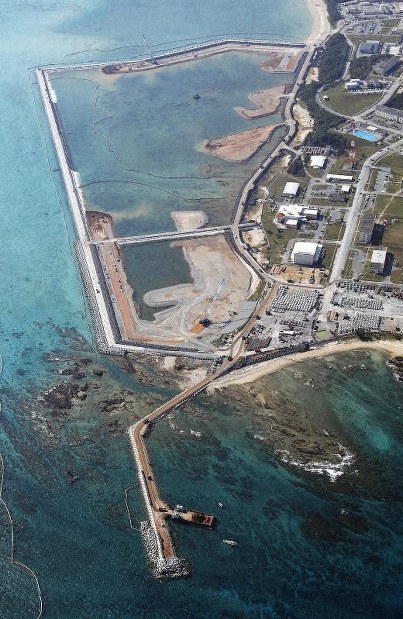 Okinawa Governor Refuses to Host Prohibited U.S. Nuclear Missiles, In Depth News, By Jaya Ramachandran, 29 June 20, GENEVA (IDN) – Governor Denny Tamaki of Okinawa district has rejected the U.S. plans to base on the island missiles capable of threatening China – apparently as part of President Donald Trump’s move to challenge Beijing and upgrade the importance of Taiwan, 500 kilometres away from the island. If a plan for Okinawa to host such missiles were to develop, Tamaki said: “I can easily imagine fierce opposition from Okinawa residents.”Okinawa comprises more than 150 islands in the East China Sea between Taiwan and Japan’s mainland. It’s known for its tropical climate, broad beaches and coral reefs, as well as World War II sites.
Okinawa has been a critical strategic location for the United States Armed Forces since the end of World War II. The island hosts around 26,000 U.S. military personnel, about half of the total complement of the United States Forces Japan, spread among 32 bases and 48 training sites.
The largest island (Okinawa) hosts the Okinawa Prefectural Peace Memorial Museum, commemorating a massive 1945 Allied invasion, and Churaumi Aquarium, home to whale sharks and manta rays.
Missiles the U.S. plans to base on Okinawa are prohibited by the 1987 Intermediate-Range Nuclear Forces (INF) Treaty between the U.S. and the Soviet Union which, after dissolution, reconstituted into the Russian Federation in 1991.
U.S. President Ronald Reagan and the then Soviet General Secretary Mikhail Gorbachev agreed to eliminate and permanently forswear all of their nuclear and conventional ground-launched ballistic and cruise missiles with ranges of 500 to 5,500 kilometres.
It was the first arms-control treaty to abolish an entire category of weapons systems. Besides, two protocols to the agreement established unprecedented procedures for observers from both nations to verify first-hand the other countries destruction of its missiles.
The INF Treaty led to the elimination of 2,692 U.S. and Soviet nuclear and conventional, ground-launched ballistic and cruise missile. The U.S. President Donald Trump formally withdrew from the treaty August 2, 2019, citing Russian noncompliance with the accord. The Pentagon tested two previously prohibited missiles in August and December 2019.
Since the United States withdrew from the Treaty, Australia, Japan, the Philippines, and South Korea have publicly said that they were not asked to nor are they considering serving as hosts for new U.S. ground-launched missiles. Secretary of Defence Mark Esper has previously suggested that he would like to see the deployment of such missiles in Europe and particularly Asia to counter China.
A senior Defence Department official told the Los Angeles Times that the Pentagon is “very attentive to our allies’ concerns, and we recognized their political challenges”. However, the official continued, “everything that’s said in the media is not necessarily what’s said behind closed doors”.
As the Washington-based Arms Control Association reported on June 26, Secretary-General of the North Atlantic Treaty Organization (NATO) Jens Stoltenberg said on June 17 after a NATO Defence Ministerial that the alliance has “no intention to deploy new land-based nuclear missiles in Europe”.
China is firmly opposed to any deployment of such missiles in the Asia-Pacific. “If the U.S. insists on the deployment, it will be a provocation at China’s doorstep,” said Chinese Defence Ministry Spokesperson Senior Colonel Wu Qian on June 24. “China will never sit idle and will take all necessary countermeasures,” he warned…….. https://www.indepthnews.net/index.php/armaments/nuclear-weapons/3648-okinawa-governor-refuses-to-host-prohibited-u-s-nuclear-missiles
New Zealand stood up to the nuclear bullies- the Rainbow Warrior story

NZ gained ‘international creds’ as nuclear-free nation with Rainbow Warrior bombing, says author, Asia Pacific Report
New Zealand established its credentials as an independent small nation after the fatal bombing of the Greenpeace flagship Rainbow Warrior in 1985, says an author and academic who spent weeks on the vessel shortly before it was attacked.
On 10 July 1985, the Rainbow Warrior was sunk at an Auckland wharf by two bombs planted on the hull of the ship by French secret agents.
The event is often referred to as the first act of terrorism in New Zealand.
LISTEN: The Afternoons with Jesse Mulligan Crime NZ interview with David Robie
WATCH: Eyes of Fire archival videos
READ: The Eyes of Fire book
Two French agents planted two explosives on the ship while it was berthed at Marsden wharf, the second explosion killing Greenpeace photographer Fernando Pereira.
Dr David Robie, who is an AUT professor of journalism and communication studies, as well as the director of the university’s Pacific Media Centre, had spent more than 10 weeks on the ship as a journalist covering its nuclear rescue mission in the Pacific.
He wrote about his experience in Eyes of Fire, a book about the last voyage of the first Rainbow Warrior – two other Rainbow Warrior ships have followed.
In 1985, Rongelap atoll villagers in the Marshall Islands asked Greenpeace to help them relocate to a new home at Mejato atoll. Their island had been contaminated by radioactive fallout from US atmospheric nuclear weapons testing in the Pacific.
Environmental journalism
“At the time I was very involved in environmental issues around the Pacific and in those days Greenpeace was very small, a fledgling organisation,” he tells Jesse Mulligan.
“They had a little office in downtown Auckland and Elaine Shaw was the coordinator and she was quite worried that this was going to be a threshold voyage.
“It was probably the first campaign by Greenpeace that was humanitarian, it wasn’t just environmental – to rescue basically the people who had been suffering from nuclear radiation.” ……….
Moruroa protest planned
The US had carried out 67 nuclear tests at the Marshall Islands. France was also carrying out 193 tests in the Pacific and Greenpeace had planned on confronting that situation at Moruroa Atoll after its Marshall Islands rescue effort.
New Zealand had already voiced disapproval of the testing in the region, with then Prime Minister David Lange in 1984 rebuking the French for “arrogantly” continuing the programme in the country’s backyard.
Dr Robie left the ship when it docked in Auckland after the Marshall Islands stage of the mission. Three days after the ship had docked, a birthday celebration was held for Greenpeace campaign organiser Steve Sawyer onboard. The attack happened after the party.
Just before midnight on the evening of 10 July 1985, two explosions ripped through the hull as the ship.
Portuguese crew member Fernando Pereira was killed after returning on board after the first explosion……..
Thirteen foreign agents were involved, operating in three teams. The first team brought in the explosives, the second team would plant these and the third was on stand-by in case anything went wrong with the first two teams.
“A commanding officer kept an overview of the whole operation. I think there was an element of arrogance, the same arrogance as with the testing itself. There was a huge amount of arrogance about taking on an operation like this in a peaceful country – we were allies of France at the time – and it is extraordinary that they assumed they could get away with this outrageous act.”
Two of the spies were caught. Two General Directorate for External Security (DGSE) officers, Dominique Prieur and Alain Mafart, were arrested on July 24. Both were charged with murder, pleaded guilty to manslaughter and were sentenced to 10 years’ imprisonment.
Repression of independence movements
“You have to see it within the context of the period of the time,” Dr Robie says.
He says that the French policy of repression against independence movements in New Caledonia and Tahiti, with assassinations of Kanak leaders like Eloi Machoro, needed to be understood to put the Rainbow Warrior attack in perspective. France was bitterly defending its nuclear force de frappe.
“New Zealand was unpopular with the major nuclear powers and there was certainly no sympathy for New Zealand’s position about nuclear testing. So, there wasn’t really any co-operation, even from our closest neighbour, Australia……..
The case was a source of considerable embarrassment to the French government.
“They did pay compensation after arbitration that went on with the New Zealand government and Greenpeace. But justice was never really served… the 10 years were never served, both Prieur and Mafart were part of the negotiations with French government.
NZ was held ‘over a barrel’
“Basically, France had New Zealand over a barrel over trade and the European Union, so compromises were reached and Prieur and Mafart were handed over to France for three years. Essentially house arrest at Hao atoll, the rear base of the French nuclear operations in Polynesia.”
Dr Robie said the rear base was widely regarded as a military “Club Med”.
He says they didn’t even spend three years there, but left for France within the time period.
While the attack was on an international organisation rather than New Zealand itself, most New Zealanders saw it as an attack on the sovereignty of the nation
Dr Robie says it left a long-lasting impression on New Zealanders.
“It was a baptism of fire. It was a loss of innocence when that happened. And in that context, we had stood up as a small nation on being nuclear-free. Something we should have been absolutely proud of, which we were, with all those who campaigned for that at the time. I think that really established our independence, if you like, as a small nation.
“I think we have a lot to contribute to the world in terms of peace-making and we shouldn’t lose track of that. The courage that was shown by this country, standing up to a major nuclear power. We should follow through on that kind of independence of thought.” https://asiapacificreport.nz/2020/06/29/nz-gained-international-creds-as-nuclear-free-nation-with-rainbow-warrior-bombing-says-author/
Pacific leaders fear climate change campaign will ‘lose momentum’ amid COVID-19 pandemic
Pacific leaders fear climate change campaign will ‘lose momentum’ amid COVID-19 pandemic, ABC, By foreign affairs reporter Melissa Clarke 19 June 20
Key points:
- Pacific leaders do not want the coronavirus pandemic to distract from work on climate change
- Nations in the Pacific are concerned environmental impacts of climate change will ruin their tourism industry
- Leaders are calling on Australia to not forget about emissions reduction commitments
Senior political leaders from both the Fijian and Samoan governments have raised concerns that climate change is being overlooked while global leaders and the media focus on the coronavirus.
The Fijian Government, which has been a strong critic of Australia for not doing more to reduce carbon emissions, has said the urgency for addressing climate change has not abated.
“It may appear that climate change has taken a back seat, but it cannot and should not,” Fiji’s Attorney-General Aiyaz Sayed-Khaiyum said.
Coronavirus update: Follow all the latest news in our daily wrap.Taking part in an online forum hosted by the Australian National University (ANU) on Thursday, Mr Sayed-Khaiyum said the impacts of climate change were being felt every day by Fijians.
“Climate change is a reality and we cannot lift our foot off the pedal,” he said.
Pacific nations regard climate change as an existential threat, with changing weather systems affecting sea levels, fish stocks, water quality and the frequency of severe weather events.
Samoa’s Deputy Prime Minister Fiame Naomi Mata’afa, speaking on the same forum, said it is important attention isn’t diverted from climate change.
“We’re talking about a pandemic, but… climate change impacts us in all aspects of our lives, including health as well.”……..
Pacific Island nations have been trying to get all countries to agree to register more ambitious emissions reductions targets under the Paris Agreement on climate change.
Ms Mata’afa is concerned their campaign could “lose momentum” during the pandemic and appealed for Australia’s help.
“I think it is very important for Australia, as a member of the Pacific [Islands] Forum, that it comes in strongly as one of our larger members, with the Pacific and the message: to ensure that the 1.5 [degree] objective that we’ve been advocating for and that we raise the global ambition in regards to [cutting] emissions.”
Pacific nations have previously expressed their disappointment that Australia has not fully embraced their calls for more global action……… https://www.abc.net.au/news/2020-06-18/pacific-leaders-fear-coronavirus-distraction-climate-change/12371182
The most effective leader in the world – Jacinda Adern
 New Zealand’s Prime Minister May Be the Most Effective Leader on the Planet. Uri Friedman 19 April 20 The Atlantic Amid the Trump administration’s calamitous response to the Covid-19 pandemic, media have been looking to other countries for inspiration in responsible leadership during a period of crisis. New Zealand Prime Minister Jacinda Arden has been one popular pick, having capably managed to limit the damage to only 1,504 infections and 22 deaths, as of June 5.
A widely shared article in the Conversation (4/5/20) described Ardern as putting on a “masterclass in crisis leadership.” The Washington Post (4/7/20) characterized her government’s response as a “triumph of science and leadership.” Elsewhere, she has been praised as “the most effective leader on the planet” (Atlantic, 4/19/20) who “should be teaching the rest of the world” (Guardian, 4/10/20). The Financial Times (4/19/20) unironically anointed her “Saint Jacinda.”
Despite its obvious geographical and economic advantages, New Zealand certainly deserves praise. But less deserving have been the European countries corporate media consistently highlight as outstanding performers. With over 185,000 cases and 8,763 deaths, Germany has one of the highest per capita fatality rates in the world. Yet Chancellor Angela Merkel has drawn effusive praise as somebody who “embraces science” (Atlantic, 4/19/20; Guardian, 4/16/20; Financial Times, 4/3/20). CNN (5/7/20) proclaimed her a “global leader on coronavirus”; Vox (5/21/20) said she’d been “praised for her clear and effective communication with her country — and the world.”
In its editorial on crisis leadership, the New York Times editorial board (4/30/20) also praised Merkel (while attacking China for supposedly covering up the outbreak). They highlighted and applauded the leadership of several other countries, including Denmark, Norway and Finland. Amazingly, the editorial also singled out and commended Italian Prime Minister Giuseppe Conte, whose inept response has led to Italy having the third-highest number of deaths in the world at the time of its publication.
There was far less praise for leaders in the Global South. Indeed, the only one mentioned by name was Taiwan’s Tsai Ing-wen, and this was primarily because she “sent millions of face masks to the United States and Europe”—although with 443 total cases and only seven deaths, Taiwan has had a far more enviable record on Covid-19 than most of the countries featured in the editorial. True Asian leadership, according to the Times editorial board, is helping white people, apparently.
High rate of cancers among Mururoa nuclear veterans’ families
|
Research confirms high rate of cancers among Mururoa nuclear veterans’ families https://www.stuff.co.nz/national/121726358/research-confirms-high-rate-of-cancers-among-mururoa-nuclear-veterans-families 5 June 20, A navy veteran who saw his own finger bones in the flash of a nuclear blast says families should be compensated for suffering health problems linked to the military service of their relatives.And he now has evidence to prove the link.
Gavin Smith, 69, served in the navy in 1973 when Prime Minister Norman Kirk sent two frigates and 500 men on a sea-borne protest to nuclear testing at a French Polynesian atoll. It was at Mururoa that he and his colleagues were exposed to harmful radiation while observing two nuclear explosions by the French on board HMNZS Canterbury. Smith, also president of the Mururoa Veterans Group, was one of 83 sailors and 65 children included in a University of Otago study, which was published in the New Zealand Medical Journal in May. The research proves they have a higher risk of transferring genetic illnesses. It shows 30 per cent of veterans suffer a cocktail of cancers, including prostate, non-Hodgkin lymphoma, leukaemia and skin conditions. Thirty-one per cent also suffer joint problems. Forty per cent of veterans’ children reported fertility problems, including endometriosis, miscarriages and polycystic ovarian syndrome. Some had taken more than 12 months to conceive children, while others chose not to have kids because of their fathers’ exposure to radiation. Smith said the next step was to create a registry for veterans and their families. He had contacted Minister of Defence Ron Mark about the study and hoped to gain funding for further genetic studies. This would detect heritable change, where scientists could look at specific changes in genetic code. Smith said the cost of veterans’ health problems were covered by Veterans Affairs, however the plight of their descendents were not. “We’re pleased to have the cold facts, because we’ve been fighting for this for 40 years,” he said. “It proves what we’ve been saying all along – that there is a problem and it needs addressing. “We now know [the rate of cancer] is higher among veterans and their descendents than the average rate, but further genetic studies will confirm the link.” The university’s director of veterans’ health research David McBride conducted the study, alongside a team of trainee doctors. McBride said only 21 veterans in the study were receiving Government support. “Ionising radiation can cause changes in the chromosomes carrying the genetic code, but we know neither if these changes result in disease nor whether they can be passed on by fathers to offspring.” McBride said more genetic testing was required to show the way genes express themselves through decoding. This would involve establishing a registry of veterans and their families, and storing tissue samples for analysis. |
|
France goes back to its restrictive nuclear compensation law affecting Polynesian nuclear test survivors
The new law reintroduces the need for every claimant to prove a minimum exposure to radiation for a compensation claim to be accepted.
It was approved by a joint commission of the National Assembly and the Senate which met after last week’s rejection of the text in the Senate.
The National Assembly had earlier voted for the law, and in a first reading, the Senate had initially also approved it but then acceded to amendments.
The French Polynesian members of the legislature have not been in Paris since the start of the Covid-19 pandemic and couldn’t take part in the discussion of the proposed law.
The compensation law clause defining the minimum exposure had been removed in 2017 because almost all compensation claims kept being rejected.
However, in 2018 the government changed its mind and reintroduced the restrictions as part of a finance act to complement a health act.
This was challenged and in February, the supreme court ruled that compensation claims lodged before the 2018 law change were not subject to the new terms.
With the new law, however, all outstanding claims have to meet the same requirements.
Between 1966 to 1996, France carried out 193 nuclear weapons tests in French Polynesia and until a decade ago, France claimed its tests were clean caused no harm to humans.
The test sites of Moruroa and Fangataufa remain excised from French Polynesia and are French no-go zones.
Fiji ratifies the TREATY ON THE PROHIBITION OF NUCLEAR WEAPONS.
Prohibition of Nuclear weapons treaty ratified https://www.fbcnews.com.fj/news/parliament/prohibition-of-nuclear-weapons-treaty-ratified/
|
|

During pandemic, U.S. military runs the largest maritime war games in the world
COVID-19: US Military Pursues War Games Amid Contagion, Consortium News, May 26, 2020 A robust schedule of military maneuvers and exercises is either underway or planned for Europe and the Pacific this year, with more in store for 2021, Ann Wright reports. During the pandemic the U.S. military is running the largest maritime military maneuvers in the world, with Rim of the Pacific (RIMPAC) coming to the waters off Hawaii Aug. 17-31, bringing 26 nations, 25,000 military personnel, up to 50 ships and submarines and hundreds of aircraft.Hawaii hasstringent measures to combat the spread of Covid-19, with a mandatory 14-day quarantine for all persons arriving in the state; returning residents as well as visitors. This quarantine is required until at least June 30, 2020.
The U.S. Army is also pursuing a 6,000-person war game in Poland, June 5-19, with a Polish airborne operation and a U.S.-Polish division-size river crossing.
If these weren’t too many military operations during an epidemic in which personnel on 40 U.S. Navy ships have come down with the hyper-contagious virus and during which military personnel and their families have been told not to travel, plans are also underway for a U.S. Army division-sized exercise in the Indo-Pacific region in less than a year. Known as Defender 2021, the U.S. Army has requested $364 million to conduct the war exercises throughout Asian and Pacific countries.
The pivot to the Pacific, begun under the Obama administration, and maintained by the Trump administration, is reflected in a U.S. National Defense Strategy (NDS) that sees the world as “a great power competition rather than counterterrorism and has formulated its strategy to confront China as a long-term, strategic competitor.”
Earlier in May, the U.S. Navy sent at least seven submarines, including all four Guam-based attack submarines, several Hawaii-based ships and the San Diego-based USS Alexandria to the western Pacific in what the Pacific Fleet Submarine Force announced as simultaneous “contingency response operations” for all of its forward-deployed subs. This was all in support of the Pentagon’s “free and open Indo-Pacific ” policy — aimed at countering China’s expansionism in the South China Sea — and as a show of force to counter ideas that the capabilities of U.S. Navy forces have been reduced by Covid-19…….
In May, 2020, the Australian government announced that a delayed six-month rotation of 2,500 U.S. Marines to a military base in Australia’s northern city of Darwin will go ahead based on strict adherence to Covid-19 measures including a 14-day quarantine. The Marines had been scheduled to arrive in April but their arrival was postponed in March because of the pandemic.
The remote Northern Territory, which had recorded just 30 Covid-19 cases, closed its borders to international and interstate visitors in March, and any arrivals must now undergo mandatory quarantine for 14 days. U.S. Marine deployments to Australia began in 2012 with 250 personnel and have grown to 2,500. The Joint U.S. Defense facility Pine Gap— the U.S. Department of Defense, Five Eyes and CIA surveillance facility that pinpoints airstrikes around the world and targets nuclear weapons, among other military and intelligence tasks — was also adapting its policy and procedures to comply with Australian government COVID restrictions.
As the U.S. military expands its presence in Asia and the Pacific, one place it will NOT be returning to is Wuhan, China. In October 2019, the Pentagon sent 17 teams with more than 280 athletes and other staff members to the Military World Games in Wuhan. Over 100 nations sent a total of 10,000 military personnel to the games in Wuhan last October.
The presence of a large U.S. military contingent in Wuhan just months before the outbreak of the Covid-19 in Wuhan in December 2019, fueled a theory by some Chinese officials that the U.S. military was somehow involved in the outbreak, which now has been used by the Trump administration and its allies in Congress and the media that the Chinese deliberately used the virus to infect the world and adding justification for the U.S. military build-up in the Pacific region.
Ann Wright served 29 years in the U.S. Army/Army Reserves and retired as a colonel. She was a U.S. diplomat for 16 years and served in U.S. Embassies in Nicaragua, Grenada, Somalia, Uzbekistan, Kyrgyzstan, Micronesia, Afghanistan and Mongolia. She resigned from the U.S. government in March 2003 in opposition to President George W. Bush’s war on Iraq. She is co-author of “Dissent: Voices of Conscience.” https://consortiumnews.com/2020/05/26/covid-19-military-pursues-war-exercises-amid-contagion/
Nuclear power policy now a low priority for Philippines govt
|
Nuclear policy approval stalls during crisis, Business World May 20, 2020 THE approval of a proposed policy pushing for nuclear energy has been relegated to a lower priority as the government focuses on containing the public health and economic fallout from the pandemic, officials said.Energy Undersecretary William Felix B. Fuentebella said the government is fully focused on arresting the spread of coronavirus disease 2019 (COVID-19).
‘Di siya masyadong nabigyan ng highlight kasi ang tutok ng buong government (sa) COVID (The nuclear policy is not a priority because the government’s focus is on fighting COVID),” he said. Separately, Energy Secretary Alfonso G. Cusi told reporters that the Department of Energy is still waiting for the approval of President Rodrigo R. Duterte of its proposed executive order pushing for the establishment of nuclear power infrastructure, which it submitted on Feb. 20. The department wanted the regulatory and legal framework for nuclear power, along with the national policy, to be approved within the present government’s term due to the long gestation period for building nuclear power plants…….https://www.bworldonline.com/nuclear-policy-approval-stalls-during-crisis/ |
|
A moment of reckoning – when coronavirus meets climate change
 A moment of reckoning – when coronavirus meets climate change A moment of reckoning – when coronavirus meets climate change Cyclones in the Pacific and pandemics tell us a lot about global inequality and highlight our futile pursuit of profit, Aljazeera Dr Jale Samuwai, 18 May 20 In the midst of economic shocks and border closures caused by the coronavirus pandemic, the Pacific region has yet again been ravaged by a Category 5 cyclone that left a trail of destruction across four Pacific island countries in a span of four days from April 5 to 8.The economic toll from Cyclone Harold and the response to the coronavirus pandemic to Pacific economies is yet to be determined, but they have for sure rolled backed significant economic gains in these countries. The economic, social and environmental impacts of the pandemic, exacerbated by climate-induced disasters such as tropical Cyclone Harold, will reverberate well into the future for these countries. COVID-19 and climate change have re-emphasised the fragility of Pacific economies and their acute vulnerability to global phenomena. Oxfam’s report on the potential economic impact of the coronavirus – Dignity not Destitution – demonstrates that the scenario unfolding in the Pacific is a reality that most vulnerable and poor developing countries in the Global South could relate to in light of the current global precarity and uncertainty. The Pacific double whammy brings us to an important moment for the world to reexamine our current approach to development, specifically the dominant economic model that prioritises profit over people and the environment. Both COVID-19 and climate change continue to expose the failures in our economic structures and the need to change our approach to how our economies are governed. Inequality – the common denominatorInequality is perhaps the most obvious flaw of the current economic model. Both cyclones and pandemics exacerbate the persistent inequalities at different levels of our societies. Those who are bound to suffer the most from the extreme effects of these two phenomena are the poorest and the “have nots” in societies. In a global economy where the world’s richest one percent of people have more than twice as much wealth as 4.6 billion of the poorest people on earth, according to a report by Oxfam in 2020, the ability of the majority of the population right now to access the resources they need to holistically build their resilience and bounce back from global crisis is severely limited and in some cases non-existent. Oxfam’s briefing, Dignity not Destitution, forecasts that half a billion more people are now likely to be pushed into poverty because of the pandemic without an urgent and a human-oriented emergency global rescue package that is compassionate towards the needs of world’s poorest and vulnerable countries. What we need is a global rescue package that not only focuses on protecting small businesses but one that also provides safety nets to the most vulnerable populations. Importantly, the pandemic and climate change have once again shone a harsh light on the persistent social gendered inequalities in our communities……… We are now approaching a crossroads; we can either continue with the business-as-usual way of development, or we can change: We transform the way we do things and build an economy that nurtures our people and our planet. This is the political choice that is at stake. For our sake, and the sake of our children, we urge our leaders to choose the latter, because sticking with the status quo will only bring about more suffering and destruction to our world. https://www.aljazeera.com/indepth/opinion/moment-reckoning-coronavirus-meets-climate-change-200423105300035.html |
|
French government tries to downgrade radiation risk, avoid compensating Polynesian victims of nuclear testing
Outrage in Tahiti over French nuclear law moves, https://www.rnz.co.nz/international/pacific-news/416865/outrage-in-tahiti-over-french-nuclear-law-moves There has been an outcry in French Polynesia over moves by the French National Assembly to slip a clause about compensation over nuclear weapons testing into Covid-19 legislation.
A French Polynesian member of the French Assembly Moetai Brotherson said it was a scandal that this was added into deliberations when French Polynesia’s members were away from Paris because of the pandemic.
The nuclear test veterans organisations, Moruroa e tatou and Association 193, also expressed outrage.
The French government wants to re-introduce the concept of neglible risk of the tests in compensation cases after a court ruling had done away with it.
Over a 30-year period of France’s weapons tests in the South Pacific some of the atmospheric blasts irradiated most islands.
Mr Brotherson said he had only just heard about the National Assembly move and wondered what the French Polynesian people had ever done to be so detested by the French state.
Hiro Tefaarere of Moruroa e tatou said he was outraged but not surprised about the way France was going about it.
He said all presidents, from de Gaulle to Macron, couldn’t care less about Polynesians, and although France was responsible for public health in Tahiti it failed to keep a register to see how many people died because of fallout from the weapons tests.
Auguste Uebe Carlson, who heads Association 193, said France kept refusing to recognise the impact of the tests, using instead propaganda to say they were clean or a thing of the past.
He said nothing was recognised, with health problems now being attributed to poor diet and life-style choices.
ast year, French Polynesia’s social security agency calculated that it had so far spent $US770 million on health care costs for people deemed to have radiation-induced illnesses.
Climate change: lakes and rivers will become drier, increasingly infectious and toxic
Climate change: lakes and rivers will become drier, increasingly infectious and toxic, Stuff NZ, Olivia Wannan, Apr 30 2020
By dragging our feet on climate action, we increasingly condemn our beloved lakes and rivers to a future of salmonella contamination, algal blooms, species extinctions and drying out, a new report warns.
Our Freshwater 2020, produced by the Ministry for the Environment and Statistics NZ, is a stark reminder that the already-threatened health of our waterways rests on our ability to urgently shift away from fossil fuels.
Even if emissions stay at historically low levels, temperatures will continue to rise in the coming decades, due to the lag between releasing greenhouse gas and the effects on our atmosphere, seas and waterways.
As the climate warms, rain storms will intensify, snowfall will decrease, glaciers will melt, soils will dry out and the sea level will rise – each affecting our lakes and rivers.
In the east, regions such as Hawke’s Bay will see increasingly low waterways by the end of the century, says Ministry for the Environment departmental science advisor Dr Alison Collins.
In the west – particularly in the South Island – rivers and lake levels are expected to rise, potentially leading to flooding.
After extreme downpours, drinking water and swimming spots are at high risk of being contaminated with infectious tummy bugs such as salmonella and harmful strains of E.coli, she says. Northern and remote eastern communities with less-developed water supply systems are particularly vulnerable.
Toxic algal blooms will become more common, as warmer temperatures reduce the mixing between upper and lower levels of deep lakes, boosting nutrient levels at the surface and algal growth. Without the waters mixing, the lake bottom is also deprived of oxygen, which drives out animals such as crayfish (kōura) and mussels (kākahi).
Combined with pollution and habitat loss, climate change is likely to push some freshwater species – both native and introduced – to extinction, the report says. …… https://www.stuff.co.nz/environment/climate-news/121178883/climate-change-lakes-and-rivers-will-become-drier-increasingly-infectious-and-toxic
With the threat of Covid 9, nuclear test affected Pacific Islanders need Medicaid restored

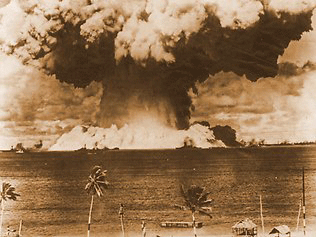 Lawmakers push to restore Medicaid for islanders affected by nuclear tests https://www.politico.com/news/2020/04/16/coronavirus-uninsured-pacific-islanders-190979
Islanders were given coverage after U.S. nuclear-weapons tests drove them from their homes, but lost it in the 1996 welfare reform. By DAN DIAMOND, 04/17/2020
Alarmed by the threat posed by the Covid-19 pandemic, lawmakers are urging congressional leaders to restore health coverage for tens of thousands of uninsured Pacific Islanders who were promised Medicaid after U.S. nuclear weapons testing but lost coverage in the 1996 welfare reform bill.
“We are in the middle of a national crisis that is unlike anything we’ve ever faced. Stopping the spread of the virus begins with ensuring that everyone has access to health care,” said Rep. Tony Cárdenas (D-Calif.), who’s leading the bipartisan effort with Sen. Mazie Hirono (D-Hawaii). “We have ignored this problem for too long, and it is time we fixed it.”
The United States promised that residents of the Marshall Islands, Palau and Micronesia would have access to Medicaid through a 1986 pact known as the Compact of Free Association, or COFA — about four decades after the U.S. conducted dozens of nuclear weapons tests in the Marshall Islands that have been linked to myriad cancers and other health problems. However, the 1996 U.S. Personal Responsibility and Work Opportunity Act stripped the islanders of their access to Medicaid, a decision described as a legislative oversight.
Cárdenas, Hirono and colleagues like GOP Reps. Steve Womack (R-Ark.) and Don Young (R-Alaska) urged congressional leaders on Wednesday to use the next coronavirus stimulus package to restore Medicaid for the 61,000-plus islanders who live in the United States.
“As the United States confronts the Covid-19 pandemic, it is vital that individuals in our communities can access testing and treatment so they can care for themselves and help prevent additional transmission of the virus,” the lawmakers wrote in a letter shared with POLITICO.
Marshall islanders continue their fight for nuclear justice
Fight for nuclear justice continues in the Marshall Islands https://www.rnz.co.nz/international/pacific-news/410871/fight-for-nuclear-justice-continues-in-the-marshall-islands 3 March 2020
The fight for nuclear justice continues in the Marshall Islands where people have been gathering to call for the US to atone for its legacy of testing.The country marked National Nuclear Victims Remembrance Day on Monday, the 64th anniversary of the Castle Bravo hydrogen bomb test that exposed thousands of people to downwind effects.At a ceremony in the capital, Majuro, a tribute was paid to 22 living survivors from the communities affected by the nuclear testing.
This comes as the Marshall Islands and the United States have begun preliminary talks on a new agreement to address the legacy of testing.
The compact of free association, which guarantees relations and funding for the Marshalls from the US, expires in two years.
Last year, it was revealed the US withheld information about nuclear waste it left behind when the Marshalls gained independence, and the extent of the tests it carried out.
Washington previously said there would be no replacement compact. But the chair of the Marshall Islands Nuclear Commission, Rhea Moss-Christian, said nuclear issues were a key, ongoing aspect of negotiations.
“Well we are coming up on renegotiating the economic provisions of the compact, and we’ve had some initial discussions with the US officials.
“So yes internally we are working on our strategy and pulling together all the key issues to include in those negotiations, including the nuclear legacy.”
Ms Moss-Christian, who said formal talks should start later in the year, vowed that the fight for nuclear justice for Marshall Islanders would continue.
“Really it comes down to compensation for loss of land. It’s about health care for those who might be having medical issues,” she said.
“It’s about livelihoods and how much their lifestyles were forced to change when they were moved from their land. These are just a few examples.”
Meanwhile, an essay competition for high schoolers was held as part of Monday’s commemoration programme.
The winner was a senior at Marshall Islands High School on Majuro, Rosie Ammontha, who wrote:
“They had the choice to test those bombs, we didn’t. They had the choice to be truthful about the consequences that awaited us, we didn’t. They had the choice not to endanger innocent lives, we didn’t. They had the choice to help protect our oceans and environment, we didn’t. At the end of the day, nuclear justice means righting what was wronged.”
Catholic prelate calls on President Duterte to reject nuclear energy
By Leslie Ann Aquino A Catholic prelate has called on President Duterte to reject the proposal to use nuclear energy in the country.
“I am greatly concerned with the proposed Executive Order that is said to be drafted by (Department of Energy or DOE) Secretary Al Cusi which would include nuclear power in our energy mix,” San Carlos Bishop Gerardo Alminaza said in a statement.
“We urge President Duterte not to sign this Executive Order and instead remind Sec. Cusi to make renewable energy our primary source of electricity.”
The vice chairman of the Catholic Bishops’ Conference of the Philippines National Secretariat for Social Action (CBCP-NASSA) said the disasters in Chernobyl, Three Mile Island, and Fukushima are “sorrowful reminders” of the risks of nuclear power that Filipinos need not be exposed to.
The prelate asked Duterte to stand firm on his previous directive to the DOE to promote renewable energy, which is a cheaper and safer source of energy.
“We hope and pray that President Duterte will not turn back on his word in the 2019 SONA (State of the Nation Address) which charged the DOE with the task of promoting renewable energy,” Alminaza said.
“This is what would truly be beneficial for our people, and would also serve as a concrete act of care for our Common Home.”
On Tuesday, Presidential Spokesperson Salvador Panelo told reporters that Duterte will be studying the proposed inclusion of nuclear power in the Philippines’ energy mix.
1 This Month

of the week – Shut Down Drone Warfare!


Tell the Ukrainian Government to Drop Prosecution of Peace Activist Yurii Sheliazhenko

Petition to revoke the licensing of the Near Surface Nuclear Disposal Facility (NSDF) at Chalk River. https://www.ourcommons.ca/petitions/en/Petition/Details?Petition=e-7247
To see nuclear-related stories in greater depth and intensity – go to https://nuclearinformation.wordpress.com
-
Archives
- March 2026 (244)
- February 2026 (268)
- January 2026 (308)
- December 2025 (358)
- November 2025 (359)
- October 2025 (376)
- September 2025 (257)
- August 2025 (319)
- July 2025 (230)
- June 2025 (348)
- May 2025 (261)
- April 2025 (305)
-
Categories
- 1
- 1 NUCLEAR ISSUES
- business and costs
- climate change
- culture and arts
- ENERGY
- environment
- health
- history
- indigenous issues
- Legal
- marketing of nuclear
- media
- opposition to nuclear
- PERSONAL STORIES
- politics
- politics international
- Religion and ethics
- safety
- secrets,lies and civil liberties
- spinbuster
- technology
- Uranium
- wastes
- weapons and war
- Women
- 2 WORLD
- ACTION
- AFRICA
- Atrocities
- AUSTRALIA
- Christina's notes
- Christina's themes
- culture and arts
- Events
- Fuk 2022
- Fuk 2023
- Fukushima 2017
- Fukushima 2018
- fukushima 2019
- Fukushima 2020
- Fukushima 2021
- general
- global warming
- Humour (God we need it)
- Nuclear
- RARE EARTHS
- Reference
- resources – print
- Resources -audiovicual
- Weekly Newsletter
- World
- World Nuclear
- YouTube
-
RSS
Entries RSS
Comments RSS
 nuclear-news