A moment of reckoning – when coronavirus meets climate change
 A moment of reckoning – when coronavirus meets climate change A moment of reckoning – when coronavirus meets climate change Cyclones in the Pacific and pandemics tell us a lot about global inequality and highlight our futile pursuit of profit, Aljazeera Dr Jale Samuwai, 18 May 20 In the midst of economic shocks and border closures caused by the coronavirus pandemic, the Pacific region has yet again been ravaged by a Category 5 cyclone that left a trail of destruction across four Pacific island countries in a span of four days from April 5 to 8.The economic toll from Cyclone Harold and the response to the coronavirus pandemic to Pacific economies is yet to be determined, but they have for sure rolled backed significant economic gains in these countries. The economic, social and environmental impacts of the pandemic, exacerbated by climate-induced disasters such as tropical Cyclone Harold, will reverberate well into the future for these countries. COVID-19 and climate change have re-emphasised the fragility of Pacific economies and their acute vulnerability to global phenomena. Oxfam’s report on the potential economic impact of the coronavirus – Dignity not Destitution – demonstrates that the scenario unfolding in the Pacific is a reality that most vulnerable and poor developing countries in the Global South could relate to in light of the current global precarity and uncertainty. The Pacific double whammy brings us to an important moment for the world to reexamine our current approach to development, specifically the dominant economic model that prioritises profit over people and the environment. Both COVID-19 and climate change continue to expose the failures in our economic structures and the need to change our approach to how our economies are governed. Inequality – the common denominatorInequality is perhaps the most obvious flaw of the current economic model. Both cyclones and pandemics exacerbate the persistent inequalities at different levels of our societies. Those who are bound to suffer the most from the extreme effects of these two phenomena are the poorest and the “have nots” in societies. In a global economy where the world’s richest one percent of people have more than twice as much wealth as 4.6 billion of the poorest people on earth, according to a report by Oxfam in 2020, the ability of the majority of the population right now to access the resources they need to holistically build their resilience and bounce back from global crisis is severely limited and in some cases non-existent. Oxfam’s briefing, Dignity not Destitution, forecasts that half a billion more people are now likely to be pushed into poverty because of the pandemic without an urgent and a human-oriented emergency global rescue package that is compassionate towards the needs of world’s poorest and vulnerable countries. What we need is a global rescue package that not only focuses on protecting small businesses but one that also provides safety nets to the most vulnerable populations. Importantly, the pandemic and climate change have once again shone a harsh light on the persistent social gendered inequalities in our communities……… We are now approaching a crossroads; we can either continue with the business-as-usual way of development, or we can change: We transform the way we do things and build an economy that nurtures our people and our planet. This is the political choice that is at stake. For our sake, and the sake of our children, we urge our leaders to choose the latter, because sticking with the status quo will only bring about more suffering and destruction to our world. https://www.aljazeera.com/indepth/opinion/moment-reckoning-coronavirus-meets-climate-change-200423105300035.html |
|
French government tries to downgrade radiation risk, avoid compensating Polynesian victims of nuclear testing
Outrage in Tahiti over French nuclear law moves, https://www.rnz.co.nz/international/pacific-news/416865/outrage-in-tahiti-over-french-nuclear-law-moves There has been an outcry in French Polynesia over moves by the French National Assembly to slip a clause about compensation over nuclear weapons testing into Covid-19 legislation.
A French Polynesian member of the French Assembly Moetai Brotherson said it was a scandal that this was added into deliberations when French Polynesia’s members were away from Paris because of the pandemic.
The nuclear test veterans organisations, Moruroa e tatou and Association 193, also expressed outrage.
The French government wants to re-introduce the concept of neglible risk of the tests in compensation cases after a court ruling had done away with it.
Over a 30-year period of France’s weapons tests in the South Pacific some of the atmospheric blasts irradiated most islands.
Mr Brotherson said he had only just heard about the National Assembly move and wondered what the French Polynesian people had ever done to be so detested by the French state.
Hiro Tefaarere of Moruroa e tatou said he was outraged but not surprised about the way France was going about it.
He said all presidents, from de Gaulle to Macron, couldn’t care less about Polynesians, and although France was responsible for public health in Tahiti it failed to keep a register to see how many people died because of fallout from the weapons tests.
Auguste Uebe Carlson, who heads Association 193, said France kept refusing to recognise the impact of the tests, using instead propaganda to say they were clean or a thing of the past.
He said nothing was recognised, with health problems now being attributed to poor diet and life-style choices.
ast year, French Polynesia’s social security agency calculated that it had so far spent $US770 million on health care costs for people deemed to have radiation-induced illnesses.
Climate change: lakes and rivers will become drier, increasingly infectious and toxic
Climate change: lakes and rivers will become drier, increasingly infectious and toxic, Stuff NZ, Olivia Wannan, Apr 30 2020
By dragging our feet on climate action, we increasingly condemn our beloved lakes and rivers to a future of salmonella contamination, algal blooms, species extinctions and drying out, a new report warns.
Our Freshwater 2020, produced by the Ministry for the Environment and Statistics NZ, is a stark reminder that the already-threatened health of our waterways rests on our ability to urgently shift away from fossil fuels.
Even if emissions stay at historically low levels, temperatures will continue to rise in the coming decades, due to the lag between releasing greenhouse gas and the effects on our atmosphere, seas and waterways.
As the climate warms, rain storms will intensify, snowfall will decrease, glaciers will melt, soils will dry out and the sea level will rise – each affecting our lakes and rivers.
In the east, regions such as Hawke’s Bay will see increasingly low waterways by the end of the century, says Ministry for the Environment departmental science advisor Dr Alison Collins.
In the west – particularly in the South Island – rivers and lake levels are expected to rise, potentially leading to flooding.
After extreme downpours, drinking water and swimming spots are at high risk of being contaminated with infectious tummy bugs such as salmonella and harmful strains of E.coli, she says. Northern and remote eastern communities with less-developed water supply systems are particularly vulnerable.
Toxic algal blooms will become more common, as warmer temperatures reduce the mixing between upper and lower levels of deep lakes, boosting nutrient levels at the surface and algal growth. Without the waters mixing, the lake bottom is also deprived of oxygen, which drives out animals such as crayfish (kōura) and mussels (kākahi).
Combined with pollution and habitat loss, climate change is likely to push some freshwater species – both native and introduced – to extinction, the report says. …… https://www.stuff.co.nz/environment/climate-news/121178883/climate-change-lakes-and-rivers-will-become-drier-increasingly-infectious-and-toxic
With the threat of Covid 9, nuclear test affected Pacific Islanders need Medicaid restored

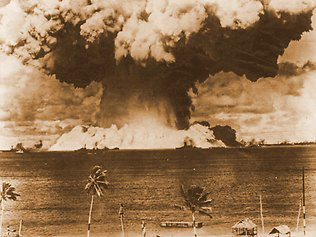 Lawmakers push to restore Medicaid for islanders affected by nuclear tests https://www.politico.com/news/2020/04/16/coronavirus-uninsured-pacific-islanders-190979
Islanders were given coverage after U.S. nuclear-weapons tests drove them from their homes, but lost it in the 1996 welfare reform. By DAN DIAMOND, 04/17/2020
Alarmed by the threat posed by the Covid-19 pandemic, lawmakers are urging congressional leaders to restore health coverage for tens of thousands of uninsured Pacific Islanders who were promised Medicaid after U.S. nuclear weapons testing but lost coverage in the 1996 welfare reform bill.
“We are in the middle of a national crisis that is unlike anything we’ve ever faced. Stopping the spread of the virus begins with ensuring that everyone has access to health care,” said Rep. Tony Cárdenas (D-Calif.), who’s leading the bipartisan effort with Sen. Mazie Hirono (D-Hawaii). “We have ignored this problem for too long, and it is time we fixed it.”
The United States promised that residents of the Marshall Islands, Palau and Micronesia would have access to Medicaid through a 1986 pact known as the Compact of Free Association, or COFA — about four decades after the U.S. conducted dozens of nuclear weapons tests in the Marshall Islands that have been linked to myriad cancers and other health problems. However, the 1996 U.S. Personal Responsibility and Work Opportunity Act stripped the islanders of their access to Medicaid, a decision described as a legislative oversight.
Cárdenas, Hirono and colleagues like GOP Reps. Steve Womack (R-Ark.) and Don Young (R-Alaska) urged congressional leaders on Wednesday to use the next coronavirus stimulus package to restore Medicaid for the 61,000-plus islanders who live in the United States.
“As the United States confronts the Covid-19 pandemic, it is vital that individuals in our communities can access testing and treatment so they can care for themselves and help prevent additional transmission of the virus,” the lawmakers wrote in a letter shared with POLITICO.
Marshall islanders continue their fight for nuclear justice
Fight for nuclear justice continues in the Marshall Islands https://www.rnz.co.nz/international/pacific-news/410871/fight-for-nuclear-justice-continues-in-the-marshall-islands 3 March 2020
The fight for nuclear justice continues in the Marshall Islands where people have been gathering to call for the US to atone for its legacy of testing.The country marked National Nuclear Victims Remembrance Day on Monday, the 64th anniversary of the Castle Bravo hydrogen bomb test that exposed thousands of people to downwind effects.At a ceremony in the capital, Majuro, a tribute was paid to 22 living survivors from the communities affected by the nuclear testing.
This comes as the Marshall Islands and the United States have begun preliminary talks on a new agreement to address the legacy of testing.
The compact of free association, which guarantees relations and funding for the Marshalls from the US, expires in two years.
Last year, it was revealed the US withheld information about nuclear waste it left behind when the Marshalls gained independence, and the extent of the tests it carried out.
Washington previously said there would be no replacement compact. But the chair of the Marshall Islands Nuclear Commission, Rhea Moss-Christian, said nuclear issues were a key, ongoing aspect of negotiations.
“Well we are coming up on renegotiating the economic provisions of the compact, and we’ve had some initial discussions with the US officials.
“So yes internally we are working on our strategy and pulling together all the key issues to include in those negotiations, including the nuclear legacy.”
Ms Moss-Christian, who said formal talks should start later in the year, vowed that the fight for nuclear justice for Marshall Islanders would continue.
“Really it comes down to compensation for loss of land. It’s about health care for those who might be having medical issues,” she said.
“It’s about livelihoods and how much their lifestyles were forced to change when they were moved from their land. These are just a few examples.”
Meanwhile, an essay competition for high schoolers was held as part of Monday’s commemoration programme.
The winner was a senior at Marshall Islands High School on Majuro, Rosie Ammontha, who wrote:
“They had the choice to test those bombs, we didn’t. They had the choice to be truthful about the consequences that awaited us, we didn’t. They had the choice not to endanger innocent lives, we didn’t. They had the choice to help protect our oceans and environment, we didn’t. At the end of the day, nuclear justice means righting what was wronged.”
Catholic prelate calls on President Duterte to reject nuclear energy
By Leslie Ann Aquino A Catholic prelate has called on President Duterte to reject the proposal to use nuclear energy in the country.
“I am greatly concerned with the proposed Executive Order that is said to be drafted by (Department of Energy or DOE) Secretary Al Cusi which would include nuclear power in our energy mix,” San Carlos Bishop Gerardo Alminaza said in a statement.
“We urge President Duterte not to sign this Executive Order and instead remind Sec. Cusi to make renewable energy our primary source of electricity.”
The vice chairman of the Catholic Bishops’ Conference of the Philippines National Secretariat for Social Action (CBCP-NASSA) said the disasters in Chernobyl, Three Mile Island, and Fukushima are “sorrowful reminders” of the risks of nuclear power that Filipinos need not be exposed to.
The prelate asked Duterte to stand firm on his previous directive to the DOE to promote renewable energy, which is a cheaper and safer source of energy.
“We hope and pray that President Duterte will not turn back on his word in the 2019 SONA (State of the Nation Address) which charged the DOE with the task of promoting renewable energy,” Alminaza said.
“This is what would truly be beneficial for our people, and would also serve as a concrete act of care for our Common Home.”
On Tuesday, Presidential Spokesperson Salvador Panelo told reporters that Duterte will be studying the proposed inclusion of nuclear power in the Philippines’ energy mix.
Nuclear power a very bad option for the Philippines
Greenpeace: Proposal to add nuclear to country’s energy mix ‘plain irresponsible, irrational’ Gaea Katreena Cabico (Philstar.com) – March 4, 2020 MANILA, Philippines — The inclusion of nuclear power in the Philippines’ energy mix will only bring more problems and debt to Filipinos, an environmental organization said as it urged the government to reject the proposal of the Energy department.
Energy Secretary Alfonso Cusi sought President Rodrigo Duterte’s nod for a proposed executive order to add nuclear power to the country’s energy sources, Malacañang said Tuesday.Presidential spokesperson Salvador Panelo said Cusi claimed that tapping nuclear power can help solve the country’s energy gap.’
According to environmental group Greenpeace Philippines, there is no rational reason for the Energy department to push a nuclear power agenda.
“Nuclear power is the most dangerous source of electricity and throughout their life cycle, nuclear plants contribute significantly to climate change. In other parts of the world, nuclear facilities are being decommissioned and phased out from energy plan,” Greenpeace campaigner Khevin Yu said.
From the 1960s until the mid 1980s, Ferdinand Marcos adopted a nuclear energy program and built the Bataan Nuclear Plant, called by critics the “monster” of Morong town. It was mothballed after President Corazon Aquino assumed office in 1986 due to safety concerns.
Nuclear power a costly option
Yu also said that nuclear is the most costly option for power generation.
In 2003, the Massachusetts Institute of Technology estimated the cost of a plant without financing would be US$2,000 per kilowatt. In their updated study released in 2009, the estimated cost was at US$4,000.
“Nuclear power will bring more problems and debt to the Filipino people,” Yu said, adding that pushing it as an energy source is “plain irresponsible and irrational.”
Safety concerns
Another big issue is the absence of safe and permanent storage of radioactive spent fuel, Yu said.
In 2018, Philippine Nuclear Research Institute Director Carlo Arcilla stressed the need to put forward radioactive waste management for discussion.
“It’s (nuclear power development) like putting up a mansion without toilets if you’re not talking of radioactive wastes,” Arcilla said then.
Duterte in 2018 said safety should be the priority when deciding whether to tap nuclear energy for the power needs of Filipinos.
Focus on renewable energy instead……https://www.philstar.com/headlines/2020/03/04/1998107/greenpeace-proposal-add-nuclear-countrys-energy-mix-plain-irresponsible-irrational
Veterans groups not happy -France wants to abolish the National Commission for Monitoring the Consequences of Nuclear Tests.
Dismay over plans to scrap French nuclear monitoring commission, https://www.rnz.co.nz/international/pacific-news/410780/dismay-over-plans-to-scrap-french-nuclear-monitoring-commission 2 March 2020 Nuclear test veterans groups in French Polynesia have reacted with dismay at reports that Paris wants to abolish the National Commission for Monitoring the Consequences of Nuclear Tests.
Last week, the French publication Canard Enchaine reported that as part of administrative changes and cost-cutting measures, dozens of commissions would be disestablished.
The commission is the body bringing together state authorities, representatives of the French Polynesian government and veterans associations to work on the list of radiation-induced illnesses deemed to be relevant for compensation.
The head of the group Moruroa e tatou Hiro Tefaarere has told the broadcaster La Premiere the move was inadmissible yet not surprising for the Macron government.
He said the French president on one hand described colonialism as a crime against humanity and on the other everything was suppressed which would recognise the consequences of the tests.
France carried out more than 190 nuclear weapons tests in the Pacific and until 2010 maintained that they were clean and posed no threat to human health.
Algeria and French Polynesia suffer from France’s 30 years of nuclear bomb testing
But Jean-Claude Hervieux has other memories. He joined the French testing efforts in Algeria as an electrician. He remembers a nuclear test in 1962 that did not go according to plan.
Radioactive dust and rock escaped from underground. Hervieux and others observing the testing ran for shelter. Two French ministers were among them. The group washed themselves in a military housing area to decontaminate.
France held more than 200 nuclear tests until a later president, Jacques Chirac, ended testing in 1996. Most tests took place in French Polynesia. But 17 took place in Algeria between 1960 and 1966, ending four years after Algeria’s independence from France.
Brahim Oumansour is a North Africa expert at the French Institute of International Relations in Paris. He said, “It’s part of the whole issue of decolonization and Algerians in general asking for recognition of colonization crimes.” He added that official recognition and financial compensation for the Algerian tests could cost millions of dollars.
Hervieux spent 10 years working on nuclear test areas in Algeria and later French Polynesia. Now 80 and living in France’s Lyon area, he says he is physically fine. But he used to receive some questionable radioactive testing results from the French government……
France’s nuclear compensation commission, CIVEN, said more than 1,600 claims have been filed under a 2010 French law that finally recognized health problems related to the testing.
Only about one-third have met the requirements needed to receive financial benefits. The requirements include about 24 possible radiation-related cancers. Almost all the claims came from France and French Polynesia. Of the 51 claims from Algeria, only one has been compensated…. https://learningenglish.voanews.com/a/questions-remain-as-france-marks-60-years-since-nuclear-tests-/5287541.html
Polynesian MP calls on France for “vast project” to withdraw radioactive waste in Mururoa
|
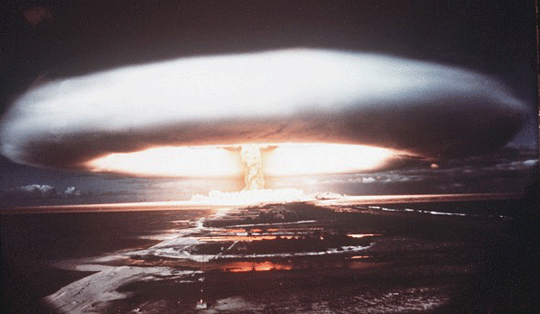
Polynesia: MP Moetai Brotherson asks Macron for a “vast project” to withdraw radioactive waste in Mururoa, 8 Feb 2020 https://la1ere.francetvinfo.fr/polynesie-depute-moetai-brotherson-demande-macron-vaste-projet-retrait-dechets-radioactifs-mururoa-798235.html [machine translate] The deputy of Polynesia Moetai Brotherson asked in a letter to Emmanuel Macron, who will be in April in the Polynesian archipelago, that he undertakes on “a vast project of withdrawal and reprocessing of all radioactive waste and residues from the Moruroa nuclear tests “.
From 1966 to 1996, the Mururoa and Fangataufa atolls were the scene of 193 nuclear tests , which had effects on the health and the environment of the populations. The head of state is expected to visit Polynesia in mid-April, when two summits are being held, “France-Oceania” and “One Planet Summit”.
” Mr. President, rather than ostrich, the French Republic would be honored to commit today to an ambitious and vast project to withdraw and reprocess all radioactive waste and residues from the tests Moruroa nuclear “, explains the deputy attached to the communist group in the Assembly and representative of Tavini Huiraatira, Polynesian separatist party, in a letter which AFP had a copy on Friday. Threats of collapse
He recalls that nuclear tests, ” especially in their underground part, generated a quantity of radioactive waste and residues “. ” Today, a significant proportion of this waste is stored in wells several hundreds of meters deep drilled in the coral ring of Moruroa, or worse, at the bottom of its lagoon, in particular at a place called ‘Colette bench ‘ “.
But ” cracks in the base of the atoll “, “induced by underground tests in particular “, threaten ” collapse part of the atoll. It appears that both the containment wells, as the Colette bank are precisely in the endangered area “,
“Dramatic message”For the Polynesian deputy, not to commit to the depollution of the site ” would be to send a dramatic message to the Polynesians, to the Peoples of the Pacific, but also to the People of France, in particular to his youth who wants to see (…) real strong actions in favor of the environment “. Moetai Brotherson underlines that ” the biggest investment made by the State in French Polynesia in recent years is the TELSITE geomechanical surveillance project of Moruroa. The billions invested still come to underline the reality of this collapse, real sword of Damocles, for the Polynesians first, for the Pacific region then, for the reputation of the French Republic finally
|
|
Australian bushfire smoke across the Pacific shows how French nuclear tests spread radiation
fallout from nuclear tests affected islands such as Tahiti. Smoke from Australia this month drifted over the south of French Polynesia after crossing New Zealand.
Mr Temaru said this was more than proof that fallout from France’s atmospheric nuclear weapons tests at Moruroa spread while France maintained they didn’t affect Tahiti.
He again called on France to tell the full truth about this dark chapter of history.
Until 1974 France detonated 46 atomic bombs over Moruroa and Fangataufa before continuing the tests with underground blasts.
France maintained until a decade ago that its nuclear tests were clean and posed no risk to human health.
A law brought in in 2010 offered compensation but its criteria were widely seen as too narrow because most applications by those suffering poor health were thrown out.
Its revision was changed again, leaving veterans organisations still dismayed. Mr Temaru made the comments as his Tavini Huiraatira party campaigned for the March municipal election.
However, Mr Temaru is yet to say whether he will seek re-election to the mayoralty of Faaa which he has held since 1983.
Among the candidates known so far are two assembly members of the ruling Tapura Huiraatira party.
New Zealand veterans await nuclear radiation genetic testing study
|
New Zealand veterans await nuclear radiation genetic testing study, https://www.rnz.co.nz/news/national/406922/new-zealand-veterans-await-nuclear-radiation-genetic-testing-study 8 Jan 2029Veterans deployed to the Mururoa Atoll will wait another two months to find out whether their children and grandchildren may be genetically impacted by nuclear radiation.
A Mururoa Nuclear Veterans Group teamed up with Otago University last year to produce a study about whether the families of veterans deployed to Mururoa Atoll in 1973, may have been affected by their parents’ exposure to radiation. University of Otago researcher David McBride is leading the study and said “the public need to know” what veterans had been facing and he hoped this study could help them in their quest for more support for their families. About 145 people participated in the study which took six weeks. It is now being peer reviewed for the New Zealand Medical Journal. “When and if our study is peer reviewed favourably then published, I’m hoping that’s not going to take too long,” he said. He said he suspected the veterans group would have to wait until March or April at the latest. “One of the most out-of-the-ordinary things you can have is exposure to nuclear radiation,” he said. “It certainly was a traumatising experience and they are right inthe fact that they may have passed defect onto their children and grandchildren.” |
|
Thorium and uranium pollution from Rio Tinto’s Madagascar mine
Concerns about radioactive contamination dog Rio Tinto’s Madagascar mine, MONGABAY, by Malavika Vyawahare on 31 December 2019
|
|
|
||||

U.S. Congress Demands Investigation Into the U.S.’s Nuclear Coffin, The Runit Dome
|
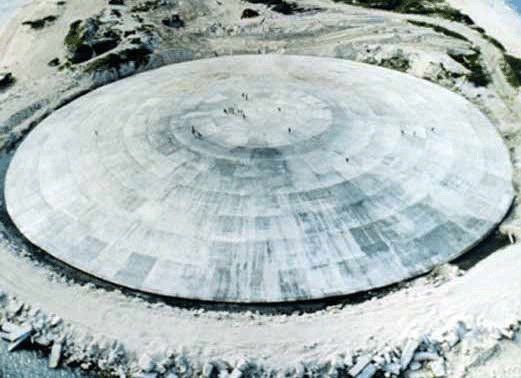
Congress Demands Investigation Into the U.S.’s Nuclear Coffin, The Runit Dome is leaking radioactive waste into the Pacific Ocean. https://www.popularmechanics.com/military/weapons/a30338371/congress-investigation-runit-dome-nuclear-waste/
Dec 27, 2019
|
|
Seafloor mapping reveals the degradation of ocean floor by Bikini nuclear bomb tests

Bikini Seafloor Hides Evidence of Nuclear Explosions, Seafloor mapping has revealed a crater and several shipwrecks persisting 73 years after the world’s first underwater nuclear test. Eos, Amanda Heidt 28 Dec 19
Seventy-three years after serving as the site of the world’s first underwater nuclear test, the seafloor around the Bikini Atoll remains scarred by finely detailed craters and littered with derelict ships.
Today, an interdisciplinary team of scientists is using sonar to assess the complex submarine environment. The results provide a sobering assessment of humanity’s capacity to alter nature…..
Unleashing the Power of the Atom
In the aftermath of World War II, the U.S. Navy chose the Bikini Atoll for a series of controlled nuclear explosions. Between 1946 and 1958, 23 confirmed tests were conducted throughout the area.
Trembanis and his team studied Able and Baker, a pair of tests conducted in July 1946 as part of Operation Crossroads. Both Able and Baker involved plutonium fission bombs with a yield of between 21 and 23 kilotons, but they were deployed differently……….
Clustering around a laptop, Trembanis and his team witnessed the real-time rendering of an underwater crater more than 800 meters across—big enough to fit three Roman Colosseums. ….
Littered throughout the atoll are the husks of strategically placed ships—decommissioned dreadnaughts, aircraft carriers, and submarines meant to bear the brunt of the Able and Baker explosions. …..
Even independent of their place in nuclear history, the Pilotfish and other Bikini shipwrecks attest to the long-lived effects of human activities on the environment.
As old ships decompose, they become ecological burdens, and researchers found that several wrecks on the Bikini seafloor are leaching plumes of oil. Trembanis and his team looked at sketches from surveys the National Park Service conducted in the late 1980s and saw the degradation of the past 40 years……. https://eos.org/articles/bikini-seafloor-hides-evidence-of-nuclear-explosions
1 This Month



Shut down the radiation-damaged Heysham nuclear reactors now
To see nuclear-related stories in greater depth and intensity – go to https://nuclearinformation.wordpress.com

Say No to NASA’s Reckless Nuclear Reactor on the Moon
Say No to NASA’s Reckless Nuclear Reactor on the Moon
-
Archives
- October 2026 (256)
- September 2026 (339)
- August 2026 (330)
- July 2026 (355)
- June 2026 (287)
- May 2026 (306)
- April 2026 (356)
- March 2026 (251)
- February 2026 (267)
- January 2026 (308)
- December 2025 (358)
- November 2025 (359)
-
Categories
- 1
- 1 NUCLEAR ISSUES
- business and costs
- climate change
- culture and arts
- ENERGY
- environment
- health
- history
- indigenous issues
- Legal
- marketing of nuclear
- media
- opposition to nuclear
- PERSONAL STORIES
- politics
- politics international
- Religion and ethics
- safety
- secrets,lies and civil liberties
- spinbuster
- technology
- Uranium
- wastes
- weapons and war
- Women
- 2 WORLD
- ACTION
- AFRICA
- Atrocities
- AUSTRALIA
- Christina's notes
- Christina's themes
- culture and arts
- Events
- Fuk 2022
- Fuk 2023
- Fukushima 2017
- Fukushima 2018
- fukushima 2019
- Fukushima 2020
- Fukushima 2021
- general
- global warming
- Humour (God we need it)
- Nuclear
- RARE EARTHS
- Reference
- resources – print
- Resources -audiovicual
- Weekly Newsletter
- World
- World Nuclear
- YouTube
-
RSS
Entries RSS
Comments RSS

