Pacific Nuclear test veterans encouraged quest for apology will succeed
Nuclear test veterans encouraged quest for apology will succeed https://www.stuff.co.nz/national/300309768/nuclear-test-veterans-encouraged-quest-for-apology-will-succeed, Jimmy Ellingham May 17 2021 Pacific nuclear test veterans are encouraged their quest to gain a long-awaited apology for being exposed to radiation appears to have ministerial support
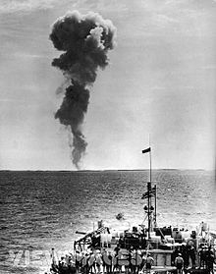
Kiwi sailors on the decks of the HMNZS Rotoiti and HMNZS Pukaki witnessed atomic explosions and collected weather data during Operation Grapple, Britain’s Pacific nuclear testing programme of the 1950s.
The New Zealand Nuclear Test Veterans’ Association, which represents the more than 500 Kiwi sailors involved, is pushing for a meeting with Prime Minister Jacinda Ardern.
The association wants an apology for the sailors, and help for medical problems in their children and grandchildren.
To lay the groundwork for the prime ministerial audience the association’s chairman, Tere Tahi, of Bulls, has met with Veterans’ Affairs Minister Meka Whaitiri.
Tahi said last week’s audience with the minister, her secretary and head of Veterans’ Affairs Bernadine Mackenzie went well, a feeling he hadn’t had from meetings with previous ministers.
“They were mighty to talk to. The minister was really good and she said that she’ll do what she can for the veterans.”
The trio listened to arguments about how what the navy veterans went through had affected their children and grandchildren. Tahi and his son James represented the association.
At present the veterans can get help for medical problems, but their offspring cannot.
Tahi said Whaitiri was asked if she could approach Ardern about a meeting, and she said she would try.
“We put our case across to her [Whaitiri], which is what we wanted to do. She was very good.
“We want recognition. We want an apology.”
The association’s plan was to argue its case to Ardern on humanitarian grounds, telling the stories of its members.
It’s thought about 60 of the Kiwi sailors are still alive.
The association’s plan was to argue its case to Ardern on humanitarian grounds, telling the stories of its members.
It’s thought about 60 of the Kiwi sailors are still alive.
The association was formed in the 1990s. At a reunion about that time it became clear many veterans were affected by cancer and other health
New Zealand nuclear veterans want apology and compensation from the government
New Zealand’s nuclear horror still not acknowledged say vets Stuff, Janine Rankin May 02 2021 Photos on a wall, names on a board and an academic study will ensure the radiation damage to 551 men who witnessed Britain’s nuclear bomb explosions in the Pacific is never forgotten.
But what the New Zealand survivors of those blasts really want is an apology and compensation from the Government.
The stories of the nuclear veterans and the subsequent heartache and illness affecting them and the off-spring of those who had families have been retold in Palmerston North this weekend.
It was the third opening of Denise Baynham’s exhibition of the photographs and stories of navy veterans “Operation Grapple, We were There” at Te Manawa art gallery……………
…….. The men exposed to those bomb blasts, many times more powerful than the bombs that ended World War II in Japan, suffered radiation damage, and still do.
A carefully controlled sample of 50 veterans showed three times the frequency of genetic damage, technically called total chromosome translocations, than the control group.
Rowland is now the association’s patron, and he and Sefton’s close friend and successor Tere Tahu are determined to have the Government acknowledge the harm done.
They have a meeting with Veterans’ Affairs Minister Meka Whaitiri on May 10, with the goal of gaining an audience with Prime Minister Jacinda Ardern.
Veteran John Purcell said until now, they had only received “a wall of silence” from successive ministers.
“It is my belief that the Crown abrogated its duty of care by dispatching HMNZS Pukaki and Rotoiti to take part in the British nuclear testing, being fully aware that we were being sent into harm’s way.”
What he wants is a public apology, a public acceptance of the research findings, urgent research regarding the children and grandchildren of veterans, and compensation., https://www.stuff.co.nz/national/125002784/new-zealands-nuclear-horror-still-not-acknowledged-say-vets
France tested 41 nuclear weapons in the Pacific, and grossly underestimated the radioactive fallout
Science 11th March 2021, From 1966 to 1974, France blew up 41 nuclear weapons in above-ground tests
in French Polynesia, the collection of 118 islands and atolls that is part of France. The French government has long contended that the testing was done safely.
But a new analysis of hundreds of documents declassified in 2013 suggests the tests exposed 90% of the 125,000 people living in French Polynesia to radioactive fallout—roughly 10 times as many people as theFrench government has estimated.
‘If it’s safe, dump it in Tokyo’ – Pacific Islanders don’t want Fukushima waste water
Guardian 26th April 2021, If it’s safe, dump it in Tokyo. We in the Pacific don’t want Japan’s
nuclear wastewater. To Pacific peoples, who have carried the
disproportionate human cost of nuclearism in our region, this is yet
another act of catastrophic and irreversible trans-boundary harm that our
region has not consented to.
While Japan’s plan is for the water to be
diluted first and discharged over the course of about 30 years, and the
Japanese government has tried its hardest to convince the wider public of
the treated water’s safety through the use of green mascots and backing
from American scientists, Pacific peoples are once again calling it for
what it is: an unjust act.
“We need to remind Japan and other nuclear
states of our Nuclear Free and Independent Pacific movement slogan: if it
is safe, dump it in Tokyo, test it in Paris, and store it in Washington,
but keep our Pacific nuclear-free,” said Motarilavoa Hilda Lini, Vanuatu
stateswoman and veteran activist of the Nuclear Free and Independent
Pacific (NFIP) movement, after Japan’s announcement. “We are people of
the ocean, we must stand up and protect it.”
Growing opposition to Rocket Lab in New Zealand
Rocket Lab: Growing opposition in New Zealand. By Murray Horton, 18 Apr 21,
Rocket Lab started life as a small New Zealand company but is now much bigger and has become the local subsidiary of a US company, with its owners including arms industry behemoths such as Lockheed Martin.
It specialises in frequent launches of small satellites for clients including a range of US military and intelligence agencies. These launches are conducted from New Zealand, which prides itself on being nuclear free (it was kicked out of the ANZUS Treaty in 1986 by the other two parties – the US and Australia – for having banned US nuclear warships from entering. That remains the status quo today).
NZ also claims to have an independent foreign policy. But it remains the most junior of the Five Eyes global electronic spying network (with the US, UK, Canada and Australia). Having Rocket Lab operating a private enterprise space port in New Zealand for US military and intelligence agencies, with the active backing of Jacinda Ardern’s Government, totally undermines that claim.
Rocket Lab has, up until recently, received uncritical, even adulatory, coverage by the NZ news media. That, plus the fact that its’ launch pad is in a very remote, sparsely populated area (the Mahia Peninsula on the North Island’s east coast) means that it has been off the radar (pardon the pun) of the NZ public.
In 2021 that is now changing. Mainstream media coverage has become more critical, the best example being “Mahia, We Have A Problem”, by Ollie Neas in the March 2021 North & South (a national monthly magazine). And opposition has started, right in Rocket Lab’s back yard, in the Mahia area, led by local Maori women (Maori are the indigenous people of New Zealand).
There was a protest against Rocket Lab’s most recent military satellite launch; the group – Rocket Lab Monitor – has taken its case to the local media; and, via billboards, etc, directly to the people. They have set up a Website.
Opposition is also being organised on a more national scale – New Zealand is one of the most urbanised countries in the world and Rocket Lab’s assembly plant and headquarters is situated in the country’s biggest city, Auckland.
Murray Horton
Secretary/Organiser
Anti-Bases Campaign
Christchurch, New Zealand
75 years after nuclear testing in the Pacific began, the fallout continues to wreak havoc

| 75 years after nuclear testing in the Pacific began, the fallout continues to wreak havoc https://theconversation.com/75-years-after-nuclear-testing-in-the-pacific-began-the-fallout-continues-to-wreak-havoc-158208?fbclid=IwAR3q9QJvy507ds2kD0ibOvkD6ZzxFqgGjfHsGrwqJUVMNpujOu8sAeLVPtY April 6, 2021 Patricia A. O’Brien Patricia A. O’Brien is a Friend of The Conversation.Historian, Visiting Fellow in the School of History, Australian National University and Adjunct Professor in the Asian Studies Program, Georgetown University, This year marks 75 years since the United States launched its immense atomic testing program in the Pacific. The historical fallout from tests carried out over 12 years in the Marshall Islands, then a UN Trust Territory governed by the US, have framed seven decades of US relations with the Pacific nation.Due to the dramatic effects of climate change, the legacies of this history are shaping the present in myriad ways. This history has Australian dimensions too, though decades of diplomatic distance between Australia and the Marshall Islands have hidden an entangled atomic past. In 1946, the Marshall Islands seemed very close for many Australians. They feared the imminent launch of the US’s atomic testing program on Bikini Atoll might split the earth in two, catastrophically change the earth’s climate, or produce earthquakes and deadly tidal waves. A map accompanying one report noted Sydney was only 3,100 miles from ground zero. Residents as far away as Perth were warned if their houses shook on July 1, “it may be the atom bomb test”. Australia was “included in the tests” as a site for recording blast effects and monitoring for atom bombs detonated anywhere in the world by hostile nations. This Australian site served to keep enemies in check and achieve one of the Pacific testing program’s objectives: to deter future war. The other justification was the advancement of science. The earth did not split in two after the initial test (unless you were Marshallese) so they continued; 66 others followed over the next 12 years. But the insidious and multiple harms to people and place, regularly covered up or denied publicly, became increasingly hard to hide. Radiation poisoning, birth defects, leukaemia, thyroid and other cancers became prevalent in exposed Marshallese, at least four islands were “partially or completely vapourised”, the exposed Marshallese “became subjects of a medical research program” and atomic refugees. (Bikinians were allowed to return to their atoll for a decade before the US government removed them again when it was realised a careless error falsely claimed radiation levels were safe in 1968.) In late 1947, the US moved its operations to Eniwetok Atoll, a decision, it was argued, to ensure additional safety. Eniwetok was more isolated and winds were less likely to carry radioactive particles to populated areas. Australian reports noted this site was only 3,200 miles from Sydney. Troubling reports of radioactive clouds as far away as the French Alps and the known shocking health effects appeared. Dissenting voices were initially muted due to the steep escalation of the Cold War and Soviet atomic weapon tests beginning in 1949. Opinion in Australia split along political lines. Conservative Cold War warriors, chief among them Robert Menzies who became prime minister again in 1949, kept Australia in lockstep with the US, and downplayed the ill-effects of testing. Left-wing elements in Australia continued to draw attention to the “horrors” it unleashed. The atomic question came home in 1952, when the first of 12 British atomic tests began on the Montebello Islands, off Western Australia. Australia’s involvement in atomic testing expanded again in 1954, when it began supplying South Australian-mined uranium to the US and UK’s joint defence purchasing authority, the Combined Development Agency. Australia’s economic stake in the atomic age from 1954 collided with the galvanisation of global public opinion against US testing in Eniwetok. The massive “Castle Bravo” hydrogen bomb test in March exposed Marshall Islanders and a Japanese fishing crew on The Lucky Dragon to catastrophic radiation levels “equal to that received by Japanese people less than two miles from ground zero” in the 1945 Hiroshima and Nagasaki atomic blasts. Graphic details of the fishermen’s suffering and deaths and a Marshallese petition to the United Nations followed. When a UN resolution to halt US testing was voted on in July, Australia voted for its continuation. But the tide of public opinion was turning against testing. The events of 1954 dispelled the notion atomic waste was safe and could be contained. The problem of radioactive fish travelling into Australian waters highlighted these new dangers, which spurred increasing world wide protests until the US finally ceased testing in the Marshalls in 1958. In the 1970s, US atomic waste was concentrated under the Runit Island dome, part of Enewetak Atoll (about 3,200 miles from Sydney). Recent alarming descriptions of how precarious and dangerous this structure is due to age, sea water inundation and storm damage exacerbated by climate change were contested in a 2020 Trump-era report. The Biden administration’s current renegotiation of the Compact of Free Association with the Republic of the Marshall Islands, and its prioritisation of action on climate change, will put Runit Island high on the agenda. There is an opportunity for historical redress for the US that is even more urgent given the upsurge in discrimination against US-based Pacific Islander communities devastated by the COVID-19 pandemic. Some are peoples displaced by the tests. Australia is also embarking on a new level of engagement with the Marshall Islands: it is due to open its first embassy in the capital Majuro in 2021.It should be remembered this bilateral relationship has an atomic history too. Australia supported the US testing program, assisted with data collection and voted in the UN for its continuation when Marshallese pleaded for it to be stopped. It is also likely Australian-sourced atomic waste lies within Runit Island, cementing Australia in this history. |
New research into the effects of nuclear bomb tests on Montebello islands
 Montebello Islands the focus of new research to test nuclear impact.
 By Susan Standen 22 Mar 21, A new Edith Cowan University research project hopes to collect important data on the impact of historical nuclear testing in the remote Montebello Islands area.
Key points:
- New research will look at remaining radioactive residue in Montebello Islands
- Plutonium nuclides persist in sediment of the marine environment
- The research may be used in future to track fish migrations along the WA coast
Sixty years after the British government conducted nuclear explosion testing on the islands, there is little data available to find how much residue plutonium still exists.
The project hopes to be the first study to outline how and where man-made radioactivity is still existing in the marine sediment.
Collections of sediment are being collected from remote field trips to the islands to analyse amounts of residue plutonium radionuclides.,,,,,,,,,,,,
Ms Hoffman says other island nations affected by nuclear blasts will be able to use the Montebello Islands research as a reference baseline to start their own investigations.
Will it inform health research?
Ms Hoffman says the first step is to find out what remains there as a legacy…………..
The project is a collaboration between the Edith Cowan University, the Department of Biodiversity and Conservation and the Australian Radiation Protection and Nuclear Safety Agency. https://www.abc.net.au/news/2021-03-22/montebellos-nucelar-fallout-research/13260242
Outcry in Tahiti over nuclear fallout study
Outcry in Tahiti over nuclear fallout study https://www.rnz.co.nz/international/pacific-news/438520/outcry-in-tahiti-over-nuclear-fallout-study 16 March 2021 Walter Zweifel, RNZ Pacific Reporter
For test veteran groups, the latest findings by Disclose confirmed that France had been economical with the truth.
At the heart of their campaign is the push for compensation, which has been a decade-long battle over measured and measurable fallout.
The Disclose assessment, if accepted, would make thousands more sick people eligible for compensation, and incur on France an obligation to pay out hundreds of millions of dollars.
The pro-independence leader Oscar Temaru said he denounced the tests all along and claims that the Disclose study proves that contamination extended to all inhabited islands as well as to other Pacific countries.
According to him, the test legacy should be raised by the Pacific Islands Forum.
Temaru furthermore pointed to the UN resolution of 2013 which put French Polynesia on the decolonisation list.
He argued that France had to report to the UN about the health and environmental impact of its 193 nuclear weapons tests.
Temaru accused France of duplicity in the way it dealt with French Polynesia and also took a swipe at the territory’s rival political side, which defended the tests.
A former president Gaston Flosse admitted he travelled the Pacific to reassure the region of the tests’ safety, but said he would now oppose the tests with physical force if he had known what price the territory had to pay.
In a statement, Flosse said on one hand that if the Disclose study was correct then France lied to French Polynesians for years.
On the other hand, he said France must re-examine all compensation claims that have been rejected, and should also scrap the compensation law because its very basis no longer existed.
The French Atomic Energy Commission, the French defence minister and the French High Commissioner in French Polynesia have largely dismissed the Disclose study.
In essence, they saw no new elements or said the existing studies had taken all relevant information into account.
The French Polynesian president Edouard Fritch expressed surprise at the virulent reaction in Tahiti.
However, nearly three years ago he told the assembly that he himself had been telling lies about the tests for decades.
For now, the French compensation commission will continue to pay compensation within the established framework, benefiting at best dozens of people.
Compensation is paid out of a sense of national solidarity not because the French state recognises any liability.
Time to clean up Bikini Atoll,to right the nuclear wrongs done to the Pacific islands people.
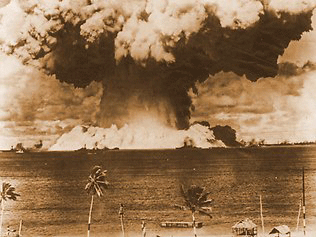 After 75 years, it’s time to clean Bikini https://thebulletin.org/2021/03/after-75-years-its-time-to-clean-bikini/?utm_source=Newsletter&utm_medium=Email&utm_campaign=ThursdayNewsletter03112021&utm_content=NuclearRisk_CleanBikini_03082021
By Hart Rapaport, Ivana Nikolić Hughes | March 9, 2021, Due to their remote location in the Northern Marshall Islands, the people of Bikini Atoll were spared the worst of the mid-Pacific fighting between the American and Japanese armies in the final years of World War II. Their millennia-old culture and sustainable way of life ended abruptly when, in early 1946, Commodore Ben Wyatt, a representative of the occupying United States Navy, informed King Juda and other Bikini residents that the US would begin to test nuclear weapons near their homes. Wyatt asked the Bikinians to move elsewhere, stating that the temporary move was for “the good of mankind and to end all wars.” Though Wyatt may have believed his words to be true, the show of might by the US that followed neither ended all conflict, nor was the exodus short-lived. Seventy-five years later, Bikinians have yet to return.
Nuclear testing in Bikini and other Marshall Islands, which lasted from 1946 to 1958, received international attention at the time. In those early Cold War days, America demonstrated its nuclear prowess through images of mushroom cloud blasts towering over the Pacific on the cover of Time magazine and other prominent publications. The word Bikini infiltrated popular culture via the name of a two-piece swimsuit (named by a French designer to be “explosive”) and SpongeBob’s home, without simultaneously suffusing our conscience with an awareness of the injustices and suffering those blasts caused the Marshallese people.
It is time, finally, to recognize and right the wrongs perpetrated by the US government in the Marshall Islands. The US forced a new and dangerous technology on the native lands and peoples, without fully comprehending the short- and long-term consequences. The Marshall Islands–and Bikini specifically–ended up the site of most of the tests of US hydrogen bombs, weapons up to a thousand times more powerful than atomic bombs used in attacks on Japan in 1945. Later, when the refugees were briefly returned to Bikini after testing ended, they were exposed to harmful radiation amounts with devastating health effects.
To be sure, the US government has taken steps to monitor and address the contamination that resulted from these nuclear detonations. However, the status quo—studies by the Energy Department for the sake of scientific publications and reports, while Bikinians continue to live on other islands—is not only inadequate, but morally repugnant. Bikini is a native land and water that, over thousands of years, was critical to the people’s sustenance and the bedrock of their culture. While some of those who survived the decades of relocations are still alive, their children and grandchildren, including the descendants of King Juda, have yet to resettle their ancestral home. Without an immediate US-government-funded plan to resettle the living refugees, the millennia-long culture and history tied to the atoll may be lost forever. Also, as one of the highest lying islands in the region, Bikini could be the solution to challenges the Marshallese face from global warming and corresponding rise of sea levels.
But it’s not as simple as saying: “Let’s move the Bikinians back.” A permanent return to the atoll by a multi-generational community would risk serious health effects unless sources of remaining radiological contamination in Bikini’s fruit, soil, and lagoon are addressed and removed, according to our research at Columbia University’s K=1 Project, Center for Nuclear Studies. We have found radioactive materials throughout Bikini Atoll, resulting in background gamma radiation above the limit agreed upon by the Republic of the Marshall Islands and US and levels of cesium-137 in various fruits that violate most relevant international and domestic safety standards. Even the waters surrounding Bikini, a formerly plentiful source of food, are riddled with radioisotopes from the detonations. The cleanup may require a novel scientific approach on par with that used after the Chernobyl and Fukushima nuclear accidents. That said, a modern nuclear testing cleanup protocol may prove useful in the event of future nuclear incidents in the United States or elsewhere.
The Biden administration has promised to lead in domestic and international spheres with morals and compassion. To do so, it must engage in a truthful, comprehensive accounting of past missteps in the Marshall Islands, regardless of whether the cost of reparations and resettlement exceeds its current pledge of roughly $110 million to Bikini. Commodore Wyatt’s allegedly “temporary” displacement of Bikinians from their native land has lasted 75 years and counting. Will the Biden administration act with morals to clean remaining radioactive material from US detonations? Will it act with compassion to help Bikinians find their way home?
French Nuclear tests: revelations about a cancer epidemic

|
Nuclear tests: revelations about a cancer epidemic https://www.mediapart.fr/journal/international/090321/essais-nucleaires-revelations-sur-une-epidemie-de-cancers MARCH 9, 2021 BY DISCLOSE
In a confidential report, the Polynesian government acknowledges the existence of a “cluster of thyroid cancers” directly linked to French nuclear tests.On July 2, 1966, in the greatest secrecy, France carried out its first nuclear test in the Polynesian sky. That day, at 5:34 am, Aldebaran, the name given to the bomb, was fired from a barge installed on an azure lagoon, near the Mururoa atoll. A few microseconds after the explosion, a fireball appears. This incandescent mass of several thousand degrees rises in the sky and forms, as it cools, a huge cloud of radioactive dust dispersed by the winds. No less than 46 “atmospheric” tests like this one have been carried out in the space of eight years. Each time, the explosion generated fallout contaminating everything in their path. Starting with the inhabitants of the islands. In total, they were exposed 297 times to intense levels of radioactivity. The general staff have always held to the same line of defense. The atmospheric tests, presented as “clean”, would not have had “consequences for the health” of the Polynesians. For years, the associations defending the victims of the trials have been convinced to the contrary. As for the scientific community, it has tried several times to verify this position through in-depth analyzes of official data, without success. Latest illustrations of this failure: the study published by the National Institute of Health and Medical Research (Inserm) on February 18. At the end of this work commissioned by the Ministry of Defense eight years ago, Inserm considered that the “links between the fallout from atmospheric tests and the occurrence of radiation-induced pathologies” were difficult to establish, due to a lack of data. reliable on the contamination of the archipelagos. Cluster of cancers ” However, a confidential report submitted to the Polynesian government a year earlier, in February 2020, argues the opposite. Disclose has obtained a copy of this never-before-released document. Soberly titled “Health consequences of French nuclear tests in the Pacific”, this eight-page report was written by a French military doctor at the request of the Monitoring Medical Center, an administration created in 2007 by the French and Polynesian governments and responsible for screening radiation-induced diseases. In other words, pathologies linked to repeated exposure to ionizing radiation. According to the author, some 10,000 Polynesians, including 600 children under the age of 15 living in the Gambier Islands, Tureia or even Tahiti have thus received a dose of radioactivity of 5 millisieverts (mSv), that is to say five times more than the minimum threshold (1 mSv) above which exposure is considered dangerous for human health. But the most embarrassing information is on page 5 of the document. For the first time, an official report establishes a direct link between nuclear tests and the extent of the number of cancers in the population. “The presence of a ‘cluster’ of thyroid cancers focused on the islands subjected to fallout during aerial shots, and in particular in the Gambier Islands, leaves little doubt about the role of ionizing radiation, and in particular of thyroid exposure to radioactive iodine, in the occurrence of this excess of cancers, ”says the author. The thyroid, an organ at the base of the neck, is particularly sensitive to ionizing radiation, especially in childhood, when the risk of developing thyroid cancer is greatest. The incidence of thyroid cancer and the link with the atmospheric gunfire campaign were precisely the subject of an Inserm analysis in 2010. According to this study, 153 thyroid cancers were diagnosed between 1985 and 1995 in the population born before 1976 and residing in French Polynesia. As a result, the number of people with thyroid cancer was two to three times higher than in New Zealand and Hawaii. Without being able to establish a direct link with nuclear tests, the college of experts already deplored the lack of available data. Based on data from the time, Disclose and Interprt, in partnership with the Science and Global Security program at Princeton University (United States), reassessed the doses of radioactivity received in the thyroid by the inhabitants of the Gambier, of Tureia and Tahiti during six of the most contaminating nuclear tests. Our estimates show that the doses received would be between two and ten times higher than the estimates established by the French Atomic Energy Commission (CEA) in 2006. How can we explain such a gap between our results and those of the CEA? The answer lies in the details of the calculation options chosen by the scientists at the Atomic Energy Commission. Take the example of Aldebaran, the first test in the open air. The CEA estimated that the population of the Gambier Islands, very exposed to toxic fallout, only drank river water, but no rainwater, which is much more loaded with radioactive particles. Many witnesses met in Polynesia question this assertion. This is the case with Julie Lequesme, 12 years old at the time of the events. “We had only that, rainwater,” says the resident of Taku, a village northeast of Mangareva, the main island of the Gambier archipelago. The same goes for Rikitea, the capital of the island, where “the running water network was not completed until the end of the 1970s”, specifies Jerry Gooding, the former president of the association. , the main organization supporting civilian victims of nuclear tests. Rainwater consumption is also confirmed by at least four official documents we obtained. A study by the Office for Scientific and Technical Research Overseas (Orstom) published in August 1966, one month after the start of the tests, thus notes that some of the islanders only consumed rainwater, in particular in because of their isolation. Same conclusion in a report from the Joint Biological Control Service (SMCB), an army service, dated April 24, 1968. By reintegrating the consumption of rainwater after Aldebaran, our estimates for the exposure of a child aged 1 to 2 at the time are 2.5 times higher than official calculations. Of the six tests we reconstructed, the consumption of rainwater was the main source of exposure to radioactivity for five of them. By choosing not to incorporate this data or by minimizing its importance, the state has therefore knowingly underestimated the extent of the contamination. In the Gambiers, cancer as a legacy According to the Ministry of the Armed Forces, the Gambier Islands have been affected by atmospheric fallout 31 times. In fact, the archipelago was struck by all the tests carried out between 1966 and 1974. Since then, cancer has spread everywhere. From Rikitea to Taku, to the shore of Taravai, the inhabitants are convinced: this plague is directly linked to atomic experiments. By investigating the field and meeting dozens of witnesses, Disclose was able to map the disease in Mangareva, the main Gambier island. Although we have not been able to establish a direct link between the trials and the number of cancers on site, the result is instructive. Yves Salmon developed carcinoma, a radiation-induced cancer of the blood, in 2010. His wife contracted breast cancer. She was recognized as a victim of French nuclear tests. The same goes for his sister. Utinio, Yves Salmon’s neighbor, contracted thyroid cancer in 2001. The man, who still lives near the village of Taku, spent his childhood in the Gambiers. In 2010, the French state finally recognized him as a victim of nuclear tests. Monique, 69, is Utinio’s cousin. She was a thyroid cancer survivor after two years in hospital and received state compensation in August 2011. Monique has six children, four of whom have thyroid cancer. Her two daughters have sought compensation from the Nuclear Test Victims Compensation Committee (Civen) without having received any answers yet. Sylvie (first name has been changed) and her older sister, born in 1972 and 1971, both suffered from breast cancer. “It was when our elders started dying that we really began to wonder,” said the eldest. Their mother died of the same disease in 2009. She was recognized as a victim of nuclear tests, just like Sylvie. This resident of Mangareva now fears for her daughter. Julie Lequesme’s father, an elder from Taku village, died of throat cancer in 1981 after working in Mururoa. “The island doctor told me that based on my father’s X-rays, he was a heavy smoker,” she says. However, my father never touched a cigarette. Her husband, a CEA alumnus, also died of cancer in 2010. In the family of Catherine Serda, a former resident of the small village of Taku, eight people suffered from cancer between the end of the 1970s and the beginning of the 1990s. Their common point: they all lived in Mangareva at the time. tests. If you have any information to give us, you can contact us at enquete@mediapart.fr. If you wish to send documents through a highly secure platform, you can connect to the frenchleaks.fr site |
|
110, 000 people in French Polynesia affected by the radioactive fallout from atomic bomb tests
BBC 9th March 2021, Researchers used declassified French military documents, calculations and testimonies to reconstruct the impact of a number of the tests. They
estimated that around 110,000 people in French Polynesia were affected by
the radioactive fallout. The number represented “almost the entire”
population at the time, the researchers found.
France has consistently underestimated the devastating impact of its nuclear tests in French Polynesia
Guardian 9th March 2021, France has consistently underestimated the devastating impact of its nuclear tests in French Polynesia in the 1960s and 70s, according to
groundbreaking new research that could allow more than 100,000 people to
claim compensation. France conducted 193 nuclear tests from 1966 to 1996 at
Moruroa and Fangataufa atolls in French Polynesia, including 41 atmospheric
tests until 1974 that exposed the local population, site workers and French
soldiers to high levels of radiation. By crunching the data from 2,000
pages of recently declassified French defence ministry documents, analysing
maps, photos and other records, and carrying out dozens of interviews in
France and French Polynesia, researchers have meticulously reconstructed
three key nuclear tests and their fallout.
New Zealand groups oppose launch of U.S. military nuclear satellite

a security expert has suggested it puts New Zealand into “the kill chain” and makes New Zealand a military target.
|
NZ rocket launches may breach nuclear-free laws, say peace groups, The Spinoff
Ollie Neas | 8 Mar 21, Rocket Lab launches of satellites honing US military targeting capabilities have been criticised by the Peace Foundation, which is calling on the PM to step in.Peace groups are calling on the prime minister, Jacinda Ardern, to stop the launch of a controversial US military satellite that is scheduled for lift-off from Mahia this month, saying it may contravene nuclear-free legislation.Rocket Lab’s next mission is due to carry a satellite for the US Army’s Space and Missile Defence Command, called the Gunsmoke-J. The satellite is designed to improve US military targeting capabilities by improving how data is provided to “warfighters”.The satellite has previously been condemned by the Green Party, while a security expert has suggested it puts New Zealand into “the kill chain” and makes New Zealand a military target. Non-profit group The Peace Foundation has now added to those concerns: the launch may breach New Zealand’s nuclear-free laws. In an open letter to the prime minister, the Peace Foundation’s International Affairs and Disarmament Committee says Rocket Lab’s launches for US military agencies risk drawing New Zealand “into supporting the weaponisation of space and the related nuclear arms race”. Satellites contributing to nuclear weapons programmes cannot be approved under New Zealand law. But the Peace Foundation says New Zealand may lack the technical expertise and information necessary to properly assess whether a satellite is making such a contribution. As a result, the Peace Foundation says approvals of US military satellites should be suspended, and approval of the Gunsmoke-J satellite revoked, until greater oversight of space launches is implemented. The letter has been endorsed by 17 civic, peace and religious groups, as well as members of the public………… The US Army says the technology being demonstrated could, among other purposes, assist in “long-range precision fires” – a type of missile used to provide “precision surface-to-surface deep-strike capability”. The minister responsible for approving the satellite, Stuart Nash, told parliament last month that he was “unaware” of its “specific military capabilities”. Otago University conflict resolution and disarmament expert Kevin Clements said it is “astonishing” that Nash was unaware of the Gunsmoke-J’s specific military capabilities. “It is even worse that he is willing to rely on the US Army alone to provide the information required by him and New Zealand’s space agency in relation to the approval process,” Clements said in a statement. “Rocket Lab’s launch programme is increasingly opaque. The precise content of each payload seems intentionally ambiguous and approvals do not seem to take New Zealand’s anti-nuclear legislation into account.” Strong parallel’ with nuclear ships issue The Peace Foundation says there is a “strong parallel” between the launch of US military satellites from New Zealand and the “neither confirm nor deny” issue of the 1980s. The US policy of neither confirming nor denying whether its ships were nuclear armed led to a ban on US warships visiting New Zealand ports – the seminal moment in the anti-nuclear campaign. As with that issue, the Peace Foundation says New Zealand cannot be confident that US military satellites launched from New Zealand are not contributing to nuclear weapons systems. The Peace Foundation says assessing whether the Gunsmoke-J complies with the nuclear free law would require detailed technical knowledge of how the technology might be used in the future. “Increasingly, space-based US military assets are ‘dual-capable’ (can support nuclear and non-nuclear weapons), and dual-capable satellites used for non-nuclear targeting today can easily be used for nuclear targeting tomorrow………. Call to reform space law In light of its concerns, the Peace Foundation says greater oversight is needed over New Zealand’s space regime. It proposes assigning oversight of space launches to the prime minister, strengthening space regulations, and mandating oversight of space-launch activity to the Public Advisory Committee on Disarmament and Arms Control (PACDAC) – a body set up by the Nuclear Free Zone Act to advise the government on disarmament matters. Minutes of PACDAC meetings obtained by The Spinoff under the Official Information Act show the committee has had ongoing concerns about the consistency of space activity with New Zealand’s nuclear free law. Space Agency officials have met with the committee to assure members of the legality of launches. The Peace Foundation also calls for changes to the Technology Safeguards Agreement that New Zealand signed with the US to allow for the transfer of sensitive rocket technology. The treaty requires the US to provide “sufficient information” about its spacecraft to allow New Zealand to assess them, but also allows the US government to veto any space launch from New Zealand. “There are some very big moral questions at stake here,” says Clements. “Is this current Labour government willing for New Zealand soil to be used by Rocket Lab in order to assist US government targeting in conventional and nuclear warfare?” The Peace Foundation’s letter comes a week after Rocket Lab announced that it would list publicly on the Nasdaq stock exchange, with a valuation of $5.7 billion. Although its main launch site and production facility is in New Zealand, Rocket Lab is US owned. Its investors include major US venture capital firms as well as aerospace and defence company Lockheed Martin, which produces nuclear weapons. Rocket Lab also unveiled plans to launch a larger rocket called the Neutron, which will allow it to launch astronauts. Since 2018, Rocket Lab has launched military or intelligence payloads on seven different missions for agencies ranging from US Special Operations Command to the National Reconnaissance Office, a major US spy agency. Rocket Lab says around 30% of its business is for defence agencies. https://thespinoff.co.nz/politics/09-03-2021/nz-rocket-launches-may-breach-nuclear-free-laws-say-peace-groups/ |
|
Nuclear Free And Independent Pacific Day 2021
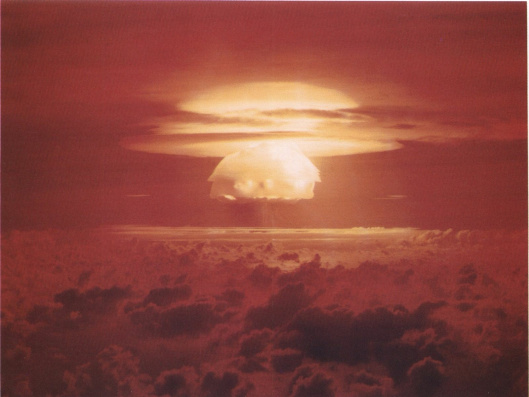
Peace Movement Aotearoa Today, 1 March, is Nuclear Free and Independent Pacific Day – the 67th anniversary of the ‘Bravo’ nuclear bomb detonation by the United States close to the surface of Bikini Atoll, in the Marshall Islands, which blasted out a crater more than 200 feet deep and a mile across.
Particles of radioactive fallout from the blast landed on the island of Rongelap (100 miles away) to a depth of one and a half inches in places, and radioactive mist appeared on Utirik (300 miles away). The US navy did not send ships to evacuate the people of Rongelap and Utirik until three days after the explosion. Fallout from this one nuclear weapon detonation spread over more than 7,000 square miles, and traces were detected throughout the Pacific, in India, Japan, the United States and Europe. The Marshallese, and other Pacific peoples subjected to more than 300 full scale nuclear bomb detonations in the Pacific – conducted by Britain, France and the US – were used as human guinea pigs in an obscene experiment to ‘progress’ the insane pursuit of nuclear weapons supremacy.
Nuclear Free and Independent Pacific Day is a day to remember that the arrogant colonial mindset which allowed, indeed encouraged, this horror continues today – the Pacific is still neither nuclear free nor independent.
Much of the Pacific remains under foreign control, from military or illegal occupation to dependence on a coloniser state for international representation, including ‘American’ Samoa, Cook Islands, French-Occupied Polynesia, Guam, Hawai’i, Kanaky, Niue, Norfolk Island, Northern Marianas, Pitcairn Island, Rapa Nui, Tokelau, Uvea mo Futuna, and West Papua. The voices of these Pacific peoples, along with the voices of ngā hapū o Aotearoa and indigenous Australians, are not heard directly in the UN General Assembly and other international forums where so many decisions on crucial issues affecting our region are made – not only on nuclear weapons and other disarmament priorities, but also on social and economic justice, human rights, protection of natural resources and the environment, the COVID-19 pandemic, climate justice and demilitarisation.
The Pacific is one of the regions that is being, and will continue to be, most impacted by climate change and extreme weather events which are affecting low-lying islands and Pacific peoples who are dependent on natural resources for food, clothing and shelter, and on water sources that are vulnerable to salinisation by rising sea levels and high seas. Yet the overwhelming majority of fossil fuel use and greenhouse gas emissions do not come from the Pacific island nations.
The Pacific is also one of the most highly militarised regions in the world – but only four Pacific island nations have armed forces. The overwhelming majority of militarisation in the Pacific comes from outside the region – military bases, military training exercises, and military occupation by the armed forces of Indonesia, France and the United States, in particular, along with Australia, Britain, China, New Zealand, Russia and others.
Nuclear Free and Independent Pacific Day is a day to think about the many faces of colonisation – physical, cultural, spiritual, economic, nuclear, military – past and present; the ongoing issues of independence, self-determination and sovereignty here in Aotearoa New Zealand and the other colonised and occupied countries of the Pacific; and the ability of Pacific peoples to stop further nuclearisation, militarisation and economic exploitation of our region.
It is a day to acknowledge and remember those who have suffered and died in the struggle for independence around the Pacific; those who have opposed colonisation in its many forms and paid for their opposition with their health and life; and those who have suffered and died as a result of the nuclear weapons states’ use of the Pacific for nuclear experimentation, uranium mining, nuclear bomb blasts and nuclear waste dumping.
It is a day to celebrate the courage, strength and endurance of indigenous Pacific peoples who have maintained and taken back control of their lives, languages and lands to ensure the ways of living and being which were handed down from their ancestors are passed on to future generations.
It is the day to pledge your support to continue the struggle for a nuclear free and independent Pacific, as the theme of the 8th Nuclear Free and Independent Pacific Conference said: “No te parau tia, no te parau mau, no te tiamaraa, e tu, e tu – For justice, for truth and for independence, wake up, stand up!”
The continuing tragedy and nuclear abomination of U.S. tests on the Marshall Islands
The lingering legacy of US nuclear testing in the Marshall Islands, https://www.nzherald.co.nz/world/the-lingering-legacy-of-us-nuclear-testing-in-the-marshall-islands/NTHZG3PJNS6NXV4SZLPTHCANNY/13 Dec, 2020, By RNZ.
The US detonated its largest nuclear bombs around the Marshall Islands in the 1940s and 50s – but the Marshallese are still campaigning for adequate compensation.
The Marshall Islands are two chains of 29 coral atolls in the middle of the Pacific Ocean between Papua New Guinea and Hawaii.
Following the tests, whole islands ceased to exist, hundreds of native Marshallese had to be relocated off their home islands and many were affected by fallout from the testing.
In 1977, US authorities put the most contaminated debris and soil into a huge concrete dome called the Runit Dome, which sits on Enewetak Atoll and houses 88,000 square metres of contaminated soil and debris.It has recently received media attention as it appears to be leaking, due to cracking and the threat from rising sea levels, while some Marshallese have fears it may eventually collapse.
However, American officials have said it’s not their problem and responsbility falls on the Marshallese, as it is their land.
The US has cited a 1986 compact of free association, which released the US goverment from further liability, which will go up for renegotiation in 2023.
Meanwhile, the Marshallese continue to campaign for adequate compensation from the US.
While he said that suggestions that the Rumit Dome – nicknamed “The Tomb” by locals – was about to collapse were alarmist, there were still major concerns surrouding it.
“The issue is it’s got plutonium, which has a half-life of 24,000 years, and how long does concrete last?”
Describing the structure as a “symbol of the nuclear legacy here”, Johnson said that US government scientists had reported there was already so much contamination in the area that it would be difficult to find what leakage from the dome had added.
The United States has continued to refuse to accept responsibility for the Runit Dome’s condition, despite its history of nuclear testing in the country.
“The nuclear weapons test legacy is the overriding issue in the Marshall Islands with the United States and it remains a festering problem, because US compensation and medical care and so forth was only partial for what was needed,” Johnson said.
The first compact to free association between the Marshall Islands and the US contained a compensation agreement, including the establishment of a nuclear claims tribunal to adjudicate all claims. While it determined there was a large amount of compensation due to Marshallese on various atolls, this has never been paid out, apart from funding of $150 million in 1986.
Since then, the US has accepted no more liability on nuclear compensation, as the compact resulted in the Marshall Islands being an independent country, able to join the United Nations.
However, Johnson said the United States Congress had taken a different position on this.
There have also been big differences in the treatment of Marshallese nuclear victims and those in the United States
“The US used Bikini and Enewetak to test its biggest hydrogen bombs,” Johnson said. “While it maintained a nuclear test site in Nevada, it only tested relatively small nuclear devices there, because it simply could not test hydrogen bombs in the continental United States – Americans wouldn’t have stood for it.”
Not long after the 1986 free association compact ended American responsibility for nuclear compensation in the Marshall Islands, the US Congress enacted a radiation compensation act for Americans – which Johnson said really emphasised the unfairness of the situation.
“Long story short, they appropriated $100 million and then they ran out, the US congress appropriated more, again ran out, appropriated more and fast-forward to 2020 and they’re over $2 billion in compensation awarded to American nuclear victims.
Johnson also had concerns about the lack of a baseline epidemiological study by the US, following the tests. Studies on the affects of radiation centred around thyroid issues, but many islanders have reported cancer, miscarriages and stillbirths in the years following.
His wife Darlene Keju died of breast cancer, which also affected her mother and father – she grew up on one of the islands in the downwind zone of the tests.
The US had never looked at rates of cancer, or studied the differences between low fallout and high fallout areas, he said.
Johnson hoped the nuclear legacy between the countries could be worked out amicably, but he wasn’t too optimistic.
Despite this tension, Johnson said the Marshallese did not harbour anti-American sentiment and the compensation issues were a “black mark on an otherwise good relationship” between the two countries.
He said around 30 to 40 percent of all Marshallese were living in the US.
“The Marshall Islands, since WWII, has a very long standing high regard and strong relationship with the US that came out of the end of the Japanese period of militarism and the execution of many islanders and privation, into a period where the US fostered democratic institutions, created opportunities for education, providing scholarships, opening the door to people going to the US and the unpacked treaty really put this together, in terms of the relationship that’s of benefit to both sides.”
However, ongoing tensions between the US and China may help the Marshall Islands in their push for further compensation.
“Possibly the changing geopolitical situation out here might offer an opening to get some interest to try to amicably do something to resolve the whole thing,” Johnson said.
But the nuclear legacy is not the only issue affecting the island – climate change is looming large and reports by US scientists have said that the Marshall Islands could be uninhabitable by the 2030s, due to rising sea levels.
1 This Month

of the week – Shut Down Drone Warfare!


Tell the Ukrainian Government to Drop Prosecution of Peace Activist Yurii Sheliazhenko

Petition to revoke the licensing of the Near Surface Nuclear Disposal Facility (NSDF) at Chalk River. https://www.ourcommons.ca/petitions/en/Petition/Details?Petition=e-7247
To see nuclear-related stories in greater depth and intensity – go to https://nuclearinformation.wordpress.com
-
Archives
- March 2026 (244)
- February 2026 (268)
- January 2026 (308)
- December 2025 (358)
- November 2025 (359)
- October 2025 (376)
- September 2025 (257)
- August 2025 (319)
- July 2025 (230)
- June 2025 (348)
- May 2025 (261)
- April 2025 (305)
-
Categories
- 1
- 1 NUCLEAR ISSUES
- business and costs
- climate change
- culture and arts
- ENERGY
- environment
- health
- history
- indigenous issues
- Legal
- marketing of nuclear
- media
- opposition to nuclear
- PERSONAL STORIES
- politics
- politics international
- Religion and ethics
- safety
- secrets,lies and civil liberties
- spinbuster
- technology
- Uranium
- wastes
- weapons and war
- Women
- 2 WORLD
- ACTION
- AFRICA
- Atrocities
- AUSTRALIA
- Christina's notes
- Christina's themes
- culture and arts
- Events
- Fuk 2022
- Fuk 2023
- Fukushima 2017
- Fukushima 2018
- fukushima 2019
- Fukushima 2020
- Fukushima 2021
- general
- global warming
- Humour (God we need it)
- Nuclear
- RARE EARTHS
- Reference
- resources – print
- Resources -audiovicual
- Weekly Newsletter
- World
- World Nuclear
- YouTube
-
RSS
Entries RSS
Comments RSS
 nuclear-news