Quick answer unlikely for nuclear hot potato
Quick answer unlikely for nuclear hot potato TriCity Herald by Rick Larson, 11 May 09 A piece of President Obama’s budget that hasn’t drawn as much attention as other high-profile programs would finally bury the controversial Yucca Mountain nuclear waste project in Nevada.Scrapping Yucca Mountain will leave a $13.5 billion hole in the ground, which is how much the Department of Energy has spent on the project since 1983, and it leaves unanswered the question of what to do with waste from nuclear power plants. It’s a question the nation has struggled with for some 30 years………………………………
Scrapping Yucca Mountain isn’t as simple, however, as just walking away from a massive hole in the ground. The problem of what to do with the 55,000 tons of used nuclear fuel sitting in 39 states in “temporary” storage at nuclear power plants — including the Energy Northwest plant at Hanford — remains.
And lawmakers from states with nuclear plants are getting angry, threatening to stop or reduce their payments to the federal government for nuclear waste management until a solution for nuclear waste emerges. The New York Times reported in April that at least four states — Maine, South Carolina, Michigan and Minnesota — were considering measures.
All of this comes as nuclear power plants are being promoted as potential sources of clean and reliable base power……………………
Quick answer unlikely for nuclear hot potato – Ask the Editors | Tri-City Herald : Mid-Columbia news
An American Tragedy
An American Tragedy
Augusta GazetteFri May 08, 2009,Approximately 225,000 American servicemen participated in atmospheric nuclear tests conducted between 1945 and 1962 in the U.S. and over the Atlantic and Pacific Oceans.
These Americans were placed in very hazardous, extremely dangerous areas and were constantly exposed to the unknown factors of radiation in the performance of their duties. They were assigned to these duties with no formal training, knowledge of the hazards and with very little or no safety gear.
They were America’s atomic guinea pigs and kept away from the public.
And still today the U.S. government remains reluctant to acknowledge the health problems created by the atomic testing, which left the servicemen with hidden wounds — not from bullets or shrapnel, but from radiation.
“Thousands of veterans have died while they begged for medical help. The government has never admitted that subjecting them to atomic radiation causes all different kinds of cancer,” said Gary Thornton of Leon, who has been working hard to bring honor and remembrance to our nation’s forgotten veterans…………………..
They were also instructed to sign a document stating that whatever they “witnessed, saw, or heard would not be revealed for 20 years under the penalty of execution and/or life imprisonment.” This was called the Atomic Secrets Act and no entries were made in the service jackets, medical records or orders of these soldiers.
Because of the sworn secrecy, it’s as if the testing never happened.
Thornton has been telling anyone who will listen that most of the Atomic veterans have experienced severe health problems, as well as their children and grandchildren.
Abandoned uranium mines pose health risk to New Mexicans
Abandoned uranium mines pose health risk to New Mexicans Study: The New Mexico Independent Increased likelihood of kidney disease and diabetes among people who live close to mines by Marjorie Childress 5 May 09
ALBUQUERQUE — New Mexico legislators are in Washington D.C. this week to press the federal government to help clean up hundreds of abandoned uranium mines that dot the state’s landscape.
The trip comes on the heels of an appropriation of $150,000 included in this year’s state budget to help complete the painstaking work of assessing the extent of the problem………………
…………The abandoned mines are found literally all over the state. But the overwhelming concentration is in the “Grants uranium belt” in western New Mexico. Uranium mining began in earnest on Navajo land in the 1950s and lasted until the late 1980s. This was the “Grants uranium boom,”……………………………
Data on the health impacts of uranium mining on communities is hard to come by. While studies have been done on miners themselves, studies looking at the effects on entire communities have been limited in scope.
Dr. Johnnye Lewis, director of the Community Environmental Health Department in the College of Pharmacy at UNM’s Health Sciences Center, is currently heading up an effort to assess the health impact of uranium mines in 20 chapters of the Eastern Agency of the Navajo Nation…………………….
Lewis’s team has only finished the first stage of the study, but initial findings show an increase in likelihood of kidney disease and diabetes among people who live close to mines, she said.
The findings have to take into account a higher prevalence of these health problems among Navajo and Hispanic populations in general, she said. However, a longterm medical monitoring program conducted in Fernald, Ohio has also shown an increase in kidney disease among people living near and drinking water contaminated by uranium. The initial findings in New Mexico support those results, she added…………………………….
The Mount Taylor Uranium Mine also faces a lot of scrutiny from the Navajo Nation, the Hopi Tribe, and the pueblos of Zuni, Acoma, and Laguna, which consider Mount Taylor a sacred site and pushed for its designation by the state last year as a traditional cultural property, as a direct result of the increased interest in uranium mining.
New Mexico Independent » Abandoned uranium mines pose health risk to New Mexicans
State Sues Over Nuclear Waste
State Sues Over Nuclear Waste
3WCASX-TV NEWS Montpelier, Vermont – May 5, 2009
The state of Vermont is suing the federal government over nuclear waste at Vermont Yankee.
Highly-radioactive spent fuel from the reactor is stored at the nuclear plant in Vernon. The safety of spent fuel is governed by the Nuclear Regulatory Commission, but it is not one of the factors the NRC will review as it considers whether to grant Vermont Yankee a license extension. The state wants to change that and is joining a federal lawsuit to force the NRC to consider spent fuel safety in the relicensing process.
State Sues Over Nuclear Waste – WCAX.COM Local Vermont News, Weather and Sports-
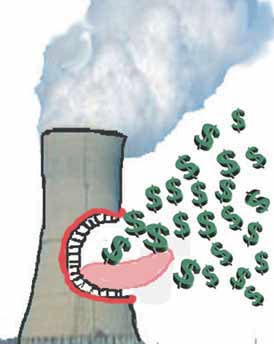
Nuclear solution comes with a huge price tag
 Nuclear solution comes with a huge price tag
North County Times By MARK WILLIAMS – AP Energy Writer | Saturday, May 2, 2009
COLUMBUS, Ohio —- A ghost from the nuclear industry’s early years has reappeared.
It is not public apprehension about safety or disposal issues this time, but the staggering cost of building nuclear reactors.
A wave of new reactors now in the works is intended to solve at least part of the nation’s energy problems as it attempts to shift away from fossil fuels. But cost is likely to plague every upcoming nuclear project.
This month in Missouri, the first of the next-generation reactors was put on hold because of the $6 billion price tag.
Whether or not AmerenUE’s Missouri reactor was a casualty of the current economic climate, the legal fight in several states shows how big the cost hurdle will be.
Some states have altered laws so that consumers begin footing the bill now, even before construction begins. Missouri did not.
“A large plant would be difficult to finance under the best of conditions, but in today’s credit-constrained markets, without supportive state energy policies, we believe getting financial backing for these projects is impossible,” said Thomas Voss, AmerenUE’s president and chief executive.
Reactors were expensive even 40 years ago at around $1 billion. The cost of AmerenUE’s Missouri project dwarfed even the market value of its parent company………………….. “It is so phenomenally costly that it crowds out capital needed for energy-efficiency and renewable energy,” said Mark Haim of Missourians for Safe Energy, a group that has been fighting Ameren’s plans.
Yet Republican lawmakers in Washington want more government funding for nuclear power…………….
http://www.nctimes.com/articles/2009/05/02/business/z6edbd99928ffa519882575a6006f16a6.txt
Can Clean Energy Revive Manufacturing?
Can Clean Energy Revive Manufacturing?
The New York Times By Kate Galbraith 4 May 09The manufacturing sector in the United States continues to shrink — but could the renewable-energy rush spur a manufacturing revival?
A number of solar-panel factories are coming online in the United States, as I reported on Sunday. Makers of wind turbines are also establishing factories in the heartland, where the factories’ proximity to wind farms on the Plains slashes the cost of shipping the giant machines from Europe…………………. many renewable-equipment manufacturers want to set up operations in the United States because they perceive it to be the largest market for the technologies in the years ahead. (Tax credits in the stimulus package for domestic production of renewable-energy equipment also help.) A key factor in bringing SolarWorld to Oregon, said Mr. Klebensberger, was the work force — and especially Oregonians’ “belief in change and how important renewables are.” Proximity to a cluster of semiconductor factories, some of whose workers SolarWorld has recently poached, was another attraction…………………….
http://greeninc.blogs.nytimes.com/2009/05/04/can-clean-energy-revive-manufacturing/.
Project to move 15 million tons of radioactive waste begins
http://www.nctimes.com/articles/2009/05/02/business/z6edbd99928ffa519882575a6006f16a6.txt
Project to move 15 million tons of radioactive waste begins KSLTV 4 May 09 “…………………..They’re finally moving 16 million tons of radioactive dirt away from the town of Moab.
The radioactive dirt is going into big boxes, the boxes onto rail cars: a project that will cost about $1 billion. “You cannot put a price on the image and reputation of the state,” said Gov. Jon Huntsman. “The fact that 50 years ago, during the height of the Cold War, the decision was to make this dump 3 miles out of town, nobody would have thought twice about it. And today, it seems absolutely ludicrous that ever would have been done.”
Moab has been trying to get rid of it almost ever since the uranium mill that produced it shut down 25 years ago. “It’s sitting in the flood plain of the Colorado River and draining into the river,” explained Bill Hedden, executive director of Grand County Trust.
Nuclear power foes not stilled in N.E.
Nuclear power foes not stilled in N.E.
Boston.com 4 May 09 “………………….A march in Montpelier last week was only the latest reminder of ongoing opposition to Vermont Yankee’s bid to extend its operating license 20 more years.
The Vermont Public Interest Research Group wants the Vermont Yankee plant shut down, and assurances that its owner, Entergy Corp., will pay the full cost of decommissioning it. “There are millions of people that live within a dangerous distance of this facility,” said James Moore, clean energy advocate for the group, known as VPIRG…………………… A cadre of activists who oppose Vermont Yankee have built a statewide coalition to oppose the 20-year renewal of the plant’s current license, which expires in 2012. The issue will be subject to a vote by the Vermont Legislature in the coming year.
At last week’s demonstration, activists marched from Montpelier’s City Hall to the State House to urge lawmakers to back development of clean sources of energy such as wind and solar. The marchers also announced they had gathered 12,000 signatures in support of closing Vermont Yankee……………………. Environmentalists and others remain concerned that there is no national plan for long-term storage of nuclear waste.
Safety issues revealed at nuclear facility
Safety issues revealed at nuclear facility
Contractors used substandard materials
The State 3 May 09 By James Rosen WASHINGTON — Contractors at the Savannah River Site — one of the country’s major nuclear-weapons complexes — repeatedly procured dangerous construction materials and components that failed to meet federal safety standards, according to a recently completed internal government probe.
One of the substandard materials revealed at the Savannah River Site on the South Carolina-Georgia border “could have resulted in a spill of up to 15,000 gallons of high-level radioactive waste,” the inspector general of the U.S. Energy Department found.
The five-month investigation also disclosed the purchase of 9,500 tons of substandard reinforcing steel at the SRS site near Aiken……………………. Many employees are engaged in a huge environmental cleanup effort to mediate decades of toxic nuclear waste production……………………. Some environmentalists and other critics cast the NRC as a weak regulator plagued by cozy relationships with the power utilities that own and operate the civilian nuclear reactors it is charged with licensing and overseeing.
Heads of the Energy Department’s Office of Environmental Management, in charge of waste cleanup at SRS and other nuclear complexes, didn’t dispute the inspector general’s findings. http://www.thestate.com/local/story/772791.html
Questions with nuclear plant
Questions with nuclear plant
Mountain Home News Diana Hooley April 29, 2009 – “The promoters for the proposed nuclear power plant have used the promise of jobs and money to strike an emotional chord in a down economy.But who are these people really and can they deliver the goods or are they just salesmen preying on people’s needs?……………………..Idaho and Elmore County land is being auctioned off potentially to out of state utility companies for the energy needs of out of state localities like Las Vegas and Los Angeles area.
Why would Elmore County ever be willing to give up control over its land and water to this group of developers? For the promise of jobs — not the assurance — just the promise………………………
With all the excitement about jobs and money, forgotten is the possibility that though the economy will fluctuate and the job market will get better, the nuclear waste will be stored on site in perpetuity.
This toxic waste will be something the children of Elmore County citizens, and their children, will have to live with for a long time.
Storing waste on that piece of property is a terrible risk. The soil and rock are porous and the ground slopes directly to the river. Any leak of toxic materials will run off.
Native Americans: Power for the persecuted
Native Americans: Power for the persecuted DIAMONDBACKONLINE Matt DernogaIs- 4/28/09 “……………Native American reservations contain large quantities of natural resources, including energy. There is little to no access or control over as to how they are used – 65 percent of North America’s uranium lies on these reservations, as is 80 percent of all the uranium mining and 100 percent of all the uranium processing in the country.
The result has been high rates of cancer, respiratory ailments, miscarriages and birth defects. The water and soil are loaded with lead, radium, thorium and other toxins. People who work in the mines rarely receive clothing, protection, medical evaluation or compensation. There is almost no wealth to show for this exploitation, and our tax dollars subsidize it daily through our funding of uneconomical nuclear power…………….
………..The reservations on the Great Plains have a windpower potential that tops 300 gigawatts, half our annual electric generation. Everyone wins with a clean energy economy, but I can’t think of a group in this country who would benefit more than Native Americans.
This would explain why I’ve been seeing and hearing a lot more of groups like the Indigenous Environmental Network. A good climate bill, a green energy bill and a new electric grid only benefit indigenous people if they are involved in the legislative process. We can’t abuse their renewable resources like we’ve abused their traditional resources. They need to be a partner, not a tool. The less we understand about their culture and history, the harder this will be.
Nuclear issues can’t be ignored
Nuclear issues can’t be ignored
Times Argus Robert Lincoln April 26, 2009 A recent opinion perpetuated the myth about nuclear waste reprocessing. Few countries in Europe and Asia have such programs because these have been financially and environmentally catastrophic.
The Bush administration began the new push for a Global Nuclear Energy Partnership. In 1979, a United States naval nuclear engineer and future President Jimmy Carter ended this dangerous program.
Reprocessing spent nuclear fuel was supposed to be one alternative to lots and lots of mining forever and forever. The biggest experiment in reprocessing was at Sellafield in Britain. In 2005, after decades of contamination and leaks and general spewing of horrible matter into the ocean, air, and land around the reprocessing plant, Sellafield was shut down because a bigger-than-usual leak of fuel dissolved in nitric acid — some tens of thousands of gallons-was discovered. It contained enough plutonium to make about 20 nuclear bombs.
A nuclear dump site just six miles from the famous Champagne vineyards in France is leaking radioactive waste into the groundwater. According to the French nuclear safety authority, the “wall of a storage cell fissured” while concrete was being added to a recent layer of nuclear waste. It showed levels of radioactivity leaking from another dump site run by the same company in Normandy — at up to 90 times above European safety limits. That waste has seeped into underground water used by farmers, with contamination spreading into the countryside and threatening dairy production. The Champagne site will receive a total of 4,000 terabequerels of tritium — more than three times the amount of tritium waste as the dumpsite in Normandy………..………….Reprocessing will not solve our country’s nuclear waste problem because it will make more waste streams that must be managed and cannot eliminate the need for a geologic repository. The United States has not cleaned up the mess from past reprocessing. The only private commercial reprocessing facility in the United States, West Valley in New York, resulted in radioactive waste that is still threatening the Great Lakes watershed more than 30 years later and will cost $5.2 billion to clean up.
U.S. taxpayers are also on the hook for more than $100 billion to clean up the reprocessing waste at the U.S. nuclear weapons sites that reprocessed to get plutonium for nuclear weapons, as well as reprocessed naval fuel. Let’s all think about our children for once.
Rutland
Oyster Creek’s safety issues unresolved
Oyster Creek’s safety issues unresolved
APP.com By JANET TAURO • April 24, 2009 Samuel J. Collins, regional director for the federal Nuclear Regulatory Commission, is barring the public from attending an upcoming safety meeting between the owners of the Oyster Creek Nuclear Generating Station and federal regulators. He is doing so even though the safety issues would never have been considered had citizens not identified them and intervened in relicensing proceedings.
By barring public participation, Collins further erodes public trust and disregards congressional demands for government transparency. Though the commission recently relicensed Oyster Creek for another 20 years, it did so with recommendations that NRC staff enhance enforcement of safety commitments made by Exelon to monitor corrosion of the reactor’s drywell shell, the steel containment shielding the public from radiation. The commission recommended that NRC staff increase enforcement because “Exelon’s series of errors . . . directly contradicts Exelon’s ability to meet the commitments.”
If Exelon and NRC staff were confident ongoing corrosion is resolved or that minimum safety standards are assured, they would welcome the public with open arms. Instead, Collins’ refusal to involve citizens exacerbates the perception of industry coziness and disdain for the public……………….
Oyster Creek’s safety issues unresolved | APP.com | Asbury Park Press
Waste and cost raise doubts about nuclear power
Waste and cost raise doubts about nuclear power indyweek.com 22 April 09 “………………………..
Beyond the valid safety arguments (see “New revelations about Three Mile Island disaster raise doubts over nuclear plant safety“), which pro- and anti-nuke contingents have argued bitterly about for four decades, there are other concerns about the nuclear solution: the exorbitant cost to build the plants, their financial risk—fraught with more uncertainty considering the country’s recession, and the absence of a place to dispose of tons of dangerous radioactive waste.
No new nuclear power plants have been constructed in this country in more than 20 years. Yet as of February 2009, there were 22 applications for new and expanded plants before the Nuclear Regulatory Commission—12 of them would be located in the South—but none has yet received permission to proceed with actual construction…………
…………nuclear fuel costs are lower compared to coal, peat, wood and natural gas—but not renewable energy sources. Nor do the overall costs include disposal or recycling (also known as reprocessing) of the radioactive waste. In the 1990s, the U.S. National Academy of Sciences studied the feasibility of recycling plutonium; a report concluded that 62,000 tons of spent fuel would cost $50 billion to $100 billion………..
…………..Under the new Construction Work in Progress guidelines signed into state law in 2007 as part of Senate Bill 3, the bulk of the costs for these proposed plants will be passed on to consumers—even if the plants are never completed.
“Taxpayers and ratepayers have been forced to bail out the nuclear power industry twice in the past 30 years, and if Congress gives the industry the massive loan guarantees it wants, we likely will have to cough up hundreds of billions of dollars to do it yet again,” wrote Ellen Vancko, the nuclear energy and climate change project manager at the Union for Concerned Citizens, in a report on federal loan guarantees commissioned by the group. “The industry has gone from promising electricity ‘too cheap to meter’ to being too costly to consider.”
Navajo uranium mine workers seek health assistance
Navajo uranium mine workers seek health assistance— By Brendan Giusti — The Daily Times 4/22/2009 — A grassroots effort to help uranium mine workers’ children affected by diseases and birth defects is picking up steam on the Navajo Nation.The Navajo Nation Dependents of Uranium Workers Committee will meet for the second time in a month to update community members and hear feedback from residents who suffer from cancer, kidney disease, birth defects and other illnesses resulting from prolonged radon exposure from uranium mines……………………
uranium mine workers were exposed to high levels of radon, which has caused inter-generational bouts of illnesses in communities across the Navajo Nation.
“A lot of people don’t want to talk about this in the public,” Harrison said………………………….
momentum in the fair-compensation movement is growing.
Community members, especially those directly affected by the lingering health issues, are ready to travel to Washington to lobby the federal government for compensation, said Gilbert Badoni, president of the Navajo Nation Dependents of Uranium Workers Committee, a co-sponsor of the meeting.
The group plans to hold meetings across the Navajo Nation before making the trek to the nation’s capital later this year.
Badoni estimates there are 15,000 dependents of uranium mine workers affected today from various diseases and birth defects.
From 2004 to 2005 only 8 percent of Navajo claims were paid, Harrison said.
This, according to Harrison, is because many Navajo don’t have the proper medical records, marital records, birth certificates, proof of residency or work history required under the act.
Navajo uranium mine workers seek health assistance – Farmington Daily Times
1 This Month



19 November – Webinar – The Reality of Reprocessing
Time: 11:00 AM Pacific Time (US & Canada) / 2:00 PM Eastern / 7:00 PM UK / 8:00 PM CET
Register for the Zoom Event Here



Shut down the radiation-damaged Heysham nuclear reactors now
To see nuclear-related stories in greater depth and intensity – go to https://nuclearinformation.wordpress.com

Say No to NASA’s Reckless Nuclear Reactor on the Moon
Say No to NASA’s Reckless Nuclear Reactor on the Moon
-
Archives
- November 2026 (64)
- October 2026 (302)
- September 2026 (339)
- August 2026 (330)
- July 2026 (355)
- June 2026 (287)
- May 2026 (306)
- April 2026 (356)
- March 2026 (251)
- February 2026 (267)
- January 2026 (308)
- December 2025 (358)
-
Categories
- 1
- 1 NUCLEAR ISSUES
- business and costs
- climate change
- culture and arts
- ENERGY
- environment
- health
- history
- indigenous issues
- Legal
- marketing of nuclear
- media
- opposition to nuclear
- PERSONAL STORIES
- politics
- politics international
- Religion and ethics
- safety
- secrets,lies and civil liberties
- spinbuster
- technology
- Uranium
- wastes
- weapons and war
- Women
- 2 WORLD
- ACTION
- AFRICA
- Atrocities
- AUSTRALIA
- Christina's notes
- Christina's themes
- culture and arts
- Events
- Fuk 2022
- Fuk 2023
- Fukushima 2017
- Fukushima 2018
- fukushima 2019
- Fukushima 2020
- Fukushima 2021
- general
- global warming
- Humour (God we need it)
- Nuclear
- RARE EARTHS
- Reference
- resources – print
- Resources -audiovicual
- Weekly Newsletter
- World
- World Nuclear
- YouTube
-
RSS
Entries RSS
Comments RSS

