Space-based missiles, killer robots key to U.S. effort to gain orbital dominance.

By Bill Gertz – The Washington Times – Wednesday, February 11, 2026
The U.S. Space Force is accelerating the deployment of counterspace weapons under a new Trump administration policy aimed at reasserting and ensuring American dominance over China and Russia in any potential orbital conflict.
The force is deploying three electronic satellite jammers and racing to match the more advanced space forces of China and Russia, which include arsenals of anti-satellite weapons.
Space Force Gen. B. Chance Saltzman, chief of space operations, said Defense Secretary Pete Hegseth recently set the goal for the U.S. military to dominate in space.
“And the Space Force was created to do just that,” Gen. Saltzman told The Washington Times. “The service has and will continue to invest in a full range of counterspace capabilities to deter conflict in space and to win decisively if called upon.
“Continuing to train and equip combat-credible Guardians is essential to maintaining our warfighting readiness,” he said.
Mr. Hegseth said in a speech to workers at the space company Blue Origin last week that the $25 billion being spent on the Golden Dome national missile and drone defense system would produce “cutting-edge, space-based capabilities which we are going to need.”……………….
“That is how we will establish total orbital supremacy,” he said.
Golden Dome systems are expected to support Space Force counterspace arms.
A Space Force spokeswoman declined to provide details on Gen. Saltzman’s plans for counterspace weapons, but at this point, the newest branch of the American military — the force was founded in 2019 under the first Trump administration — has only limited capabilities with counterspace systems. The force will be challenged to match enemy systems…………………….
Funding for counterspace weapons in the recently passed $890.6 billion defense authorization bill is relatively meager and does not appear to support a space dominance policy.
Procurement for counterspace weapons in the current fiscal year is $2 million, and the research, development, testing and evaluation budget for counterspace systems spending is $31.2 million, according to a funding chart in the defense authorization act.
Developing space weapons is a priority for the Pentagon because U.S. space systems, including high-altitude Global Positioning System satellites — used for GPS targeting and navigation in military operations, missile warning satellites and key imagery and communications systems — were not designed for conflict in space…………..
A Pentagon official said a presidential directive requires U.S. space superiority and therefore “American leadership in space is nonnegotiable.”…………………………..
“The Department of War has and will continue to invest in a full range of capabilities — kinetic, non-kinetic, reversible and irreversible — to restore deterrence and, if necessary, prevail in conflict.”………………………………………………
Charles Galbreath, a retired Space Force colonel, said Mr. Hegseth’s comments on space power dominance are “probably some of the most aggressive language I’ve heard ever, openly, about conflict in the space domain.”………………………………………………………..
The orbital playbook
Space Force plans for waging warfare in space are outlined in a March 2025 report, “United States Space Force Space Warfighting: A Framework for Planners.”
The report defined three main types of counterspace operations as control of space using both offensive and defensive action.
“Counterspace operations are conducted across the orbital, link and terrestrial segments of the space architecture,” the report said, creating effects aimed at “space superiority.”……………………
The combat will include “orbital warfare” using fires, movement and maneuver to control space.
Also used will be electromagnetic warfare to defeat enemy space and counterspace threats.
Cyberwarfare will be a major part of space combat, with strikes and other actions aimed at gaining control of space.
Offensive space combat will include orbital strike operations, pursuit and escort of satellites, standoff attacks, interdicting space communications links, and maneuvering killer satellites that can grab and crush enemy systems.
Orbital attacks will use “pursuit operations” with an attacking system maneuvering to an enemy spacecraft before firing weapons. Alternatively, the Space Force will use standoff operations — space-based or ground long-range missiles that attack without a nearby orbital rendezvous.
Space link interdiction will use electromagnetic or cybernetwork attacks……………………………………………
For electronic attacks, high-powered lasers and microwave weapons are being built, and some reports indicate that electromagnetic pulse arms could be used to damage satellite electronics without causing debris.
Emil Michael, undersecretary of defense for research and engineering, stated in a X post that the Pentagon has directed energy weapons………………………………………………………………………………..
U.S. policymakers must take urgent action to ensure the United States wins the new space race and retains the strategic high ground that has long underpinned our military and economic leadership, the panel said. https://www.washingtontimes.com/news/2026/feb/11/us-racing-build-space-weapons-counter-anti-satellite-power-china/?utm_source=Boomtrain&utm_medium=subscriber&utm_campaign=threat_status&utm_term=threat_status&utm_content=threat_status&bt_ee=wjQ2GCMecOIl6%2Ftk98uhjTa%2F2aWCScEubIvYIkRk66Y0v%2FpyHece2aahuYzGEgHT&bt_ts=1770914789113
What a naval ‘hellscape’ in the Pacific could actually entail: New Navy drone warship and undersea robot weapons
Navy drone warship, undersea robot weapon unveiled
By Bill Gertz – The Washington Times – Wednesday, February 11, 2026
U.S. Navy efforts to deploy large numbers of drone weapons advanced this week with the disclosure of a coming autonomous warship and a new undersea drone.
Blue Water Autonomy, a shipbuilding startup, announced the first autonomous warship called the Liberty that the company says will provide advanced warfare capabilities for the Navy as soon as later this year.
The Boston-based technology firm and shipbuilder said construction of its first 190-foot Liberty drone ship will begin next month with the goal of delivering the first vessel to the Navy in 2026.
The ship will be 190-feet long with a range of over 10,000 nautical miles and can carry more than 150 tons of payload capacity, Blue Water said in a press release.
“As the U.S. Navy drives to expand fleet capacity, accelerating the deployment of unmanned systems that complement traditional crewed ships has become a critical effort,” the company said……..
Separately, defense contractor Lockheed Martin this week disclosed its development of a new class of smart, stealthy, multimission autonomous undersea drone.
The Lockheed vessel, called the Lamprey, is capable of launching drone aircraft from the surface and is described by the company as a “do-it-all” submersible, “built to disrupt and deny enemy forces at sea.”
The undersea drone will be used to detect, disrupt, decoy and target enemy forces in support of sea denial missions and “subsea seabed warfare,” Lockheed said on its website.
The Lamprey can be hitched to submarines or warships, will launch aerial drones for surveillance or attacks, and can conduct electronic warfare to disrupt underwater enemy sensors.
Both drone warfare platforms are likely to become part of what the commander of the U.S. Indo-Pacific Command, Adm. Sam Paparo, has called a “hellscape” strategy to deter China.
The strategy, which remains mostly secret, calls for deploying thousands of low-cost armed drones as a deterrent and counter to any potential future Chinese attack on Taiwan or other locations in the region. The “hellscape” could also influence Chinese commanders’ decision-making on whether such attacks could be successful……………………………………….
“The Liberty class reflects our focus on building autonomous ships that are designed from the start for long-duration operations and repeat production,” said Rylan Hamilton, Blue Water Autonomy chief executive. “By adapting a proven hull and reengineering it for unmanned operations, we’re delivering a vessel that can operate for extended periods without crew while being produced at a pace the Navy urgently needs. This is a modern take on an old idea: building capable ships quickly and at scale.”
The drone warship will use artificial intelligence for its automated controls with limited human intervention for months-long deployments.
It was developed entirely with private capital without defense funding as part of push by Navy and Pentagon leaders on defense contractors to privately develop key military technology outside of a problematic procurement process.
The Liberty-class drone ships will be built at the Conrad Shipyard in Louisiana, with a goal producing 10 warships to 20 warships per year….. https://www.washingtontimes.com/news/2026/feb/11/inside-ring-navy-drone-warship-undersea-robot-weapon-unveiled/?utm_source=Boomtrain&utm_medium=subscriber&utm_campaign=threat_status&utm_term=threat_status&utm_content=threat_status&bt_ee=wjQ2GCMecOIl6%2Ftk98uhjTa%2F2aWCScEubIvYIkRk66Y0v%2FpyHece2aahuYzGEgHT&bt_ts=1770914789113
Shrimp with a side of cancer? Radioactive contamination is real.
by Kimberly Roberson, opinion contributor – 01/18/26,
https://thehill.com/opinion/healthcare/5692924-fda-radioactive-shrimp-threat/
The specter of radioactivity in food just reared its head again, with another shipment of imported shrimp recalled for possible Cesium-137 contamination.
The MAHA Commission 2025 report unfotunately ignored radioactivity as a possible cause of rising cancer and chronic illness. But even leaving aside nuclear accidents, studies show living near nuclear plants elevates cancer risk. Nuclear reactors generate radioactive waste and ionizing radiation, which get into the environment, contaminating air, water, soil and food.
Harmful isotopes like Cesium-137 aren’t natural; they’re made only in reactors, but persist in the environment and food for centuries. Decades after Chernobyl, for instance, researchers found Cesium-137 in meat from domestic and game animals in Poland, and in food and children’s bodies in Belarus, which caused pediatric cardiovascular disease.
Cesium-137 has a 30-year half-life but remains dangerous for 300 years, especially when ingested or inhaled. It lodges in soft tissues inside the body, irradiating cells and increasing cancer risk, according to the Centers for Disease Control and Prevention. Even very low doses have been shown to cause cancer, renal pathology and other damage.
This summer, the Food and Drug Administration issued multiple health hazard warnings about Cesium-137 detected in imported Indonesian shrimp, triggering massive recalls and worried coverage in mainstream outlets like “Martha Stewart Living.” Consumer Reports found evidence a wide swath of Indonesia’s land may be contaminated.
U.S. Sens. Bill Cassidy (R-L.) and John Kennedy (R-La.) then launched an inquiry, asking grocery chains how they will keep radioactive shrimp off their shelves. Kennedy said that eating Cesium-137-laced shrimp “will kill you. Even if doesn’t turn you into the alien from ‘Alien,’ I guarantee you’ll grow another ear.” Rep. Clay Higgins (R-La.) wrote to President Trump, calling radioactive shrimp a “significant public health threat” and asking him to pause all shrimp imports.
“Alien” shrimp penetrated public consciousness, but the radioactivity problem is much bigger. The FDA recently found radioactive cloves, and Malta customs officials found radioactive clothing, both contaminated with Cesium-137. The World Customs Organization launched “Operation Stingray” to intercept nuclear and radioactive materials, seizing 51 shipments in just three weeks.
Such action is overdue. Long before so-called “forever chemicals” or microplastics were recognized as health threats, watchdog groups were flagging the threat of radioactivity in food, especially after the 2011 Fukushima disaster. A 2013 FDA Citizen Petition demanded tighter regulation and lower allowable radioactivity levels. My organization has collected 1,600 comments and thousands of companion signatures.
Fears about radioactive fish surged in 2023 as Fukushima resumed dumping radioactive water into the Pacific. The FDA downplayed them, claiming “Cs-137 is readily excreted and does not accumulate in seafood.” But that’s a misdirection. The point is, it accumulates in our bodies when we ingest it, even in tiny amounts, according to the International Commission on Radiological Protection.
Health advocacy groups recently pointed this out in a joint letter, exhorting Kennedy and federal officials to “finally address the impact of radiation contamination of U.S. food on the trajectory of cancer and chronic illness by setting and enforcing much safer levels for Americans.” In its reply FDA demurred, calling it “unlikely that a fish exposed to significant levels of radionuclides near the [Fukushima] reactor could travel to U.S. waters and be caught and harvested.”
Yet we see evidence of consumer goods contaminated with radioactivity all around us. Instead of downplaying the problem, the FDA should tighten and enforce protective standards.
The Indonesian shrimp flagged as a health hazard had 68 becquerels of Cesium-137. The FDA’s “derived intervention level” — more of a guideline than an enforceable standard — is about 20 times higher, at 1,200 becquerels.
No level of Cesium-137 or other harmful radioactive isotopes is safe, yet Trump’s recent executive orders raise exposure limits and depart from the longstanding linear no-threshold model of radiation safety. Advocates warned the public health consequences would be severe, with women, children and fetuses worst impacted.
The standard should be, if Cesium-137 or other isotopes of concern are detectable in food items, they ought to be pulled off shelves, or at the very least labeled with warnings so consumers can make an informed decision. Unfortunately, that’s not the system we have. The importance of humility and transparency are among the lessons of Chernobyl and Fukushima, but the Trump administration is ignoring them in an explosion of hubris.
That’s nothing new; it’s deep in the nuclear culture. That 2011 International Commission on Radiological Protection report states, “There may be situations where a sustainable agricultural economy is not possible without placing contaminated food on the market. As such foods will be subject to market forces, this will necessitate an effective communication strategy to overcome the negative reactions from consumers outside the contaminated areas.”
But a communications strategy designed to soft-pedal radioactive contamination of food won’t make America healthy. Only setting and enforcing science-based standards will.
Kimberly Roberson is director of the Fukushima Fallout Awareness Network, a project of the National Institute for Science, Law and Public Policy.
Hanford begins removing waste from 24th single-shell tank.

Nuclear Newswire, Thu, Feb 12, 2026,
The Department of Energy’s Office of Environmental Management said crews at the Hanford Site near Richland, Wash., have started retrieving radioactive waste from Tank A-106, a 1-million-gallon underground storage tank built in the 1950s.
Tank A-106 will be the 24th single-shell tank that crews have cleaned out at Hanford, which is home to 177 underground waste storage tanks: 149 single-shell tanks and 28 double-shell tanks. Ranging from 55,000 gallons to more than 1 million gallons in capacity, the tanks hold around 56 million gallons of chemical and radioactive waste resulting from plutonium production at the site.
According to the Washington Department of Ecology, at least 68 of Hanford’s tanks are assumed to have leaked in the past, and three are currently leaking.
The transfer: Tank A-106 contains about 80,000 gallons of solid waste, which now are being transferred to one of the newer, double-shell tanks for continued safe storage. A-106 is one of two tanks currently undergoing retrieval operations by the Hanford Field Office and its tank operations contractor, Hanford Tank Waste Operations and Closure (H2C). In March 2025, H2C began retrieving waste from Tank A-102, a 1-million-gallon tank holding about 41,000 gallons of solid waste……………………………
Hanford’s waste tanks are organized into 18 different groups, called tank farms. The A Tank Farm, which contains six tanks, each with a million-gallon capacity, is the third farm to undergo retrieval at the site. Retrieval field operations on the farm’s first tank and Hanford’s 22nd single-shell tank, A-101, were completed last September……………………………… https://www.ans.org/news/2026-02-11/article-7751/hanford-begins-removing-waste-from-24th-singleshell-tank/
Air Force urged to build 200 B-21 bombers

By Bill Gertz – The Washington Times – Thursday, February 12, 2026
Current plans for U.S. bomber forces are inadequate for winning a future conflict with China and the Air Force needs 200 new B-21 bombers to bolster the strategic bomber shortfall, according to a new report by a think tank that supports the Air Force.
The larger bomber force is needed to attack Chinese inland sanctuaries should a war break out between the U.S. and China over Taiwan or other regional allies, the report by the Mitchell Institute for Aerospace Studies stated.
The U.S. military today lacks the post-Cold War combat aircraft power for conducting Air Force strikes deep inside enemy lines and denying operational sanctuary to enemies like China and its People’s Liberation Army………………………………………………
“A strong offense is the best defense, and a war-winning U.S. campaign must include strategic attacks against China’s military leadership, command and control, and long-range combat forces that now threaten the U.S. military’s ability to operate effectively in the Western Pacific,” the report said………………………………
“B-21s in sufficient numbers are necessary to seize the operational advantage in a conflict with China,” the report said.
Additionally, the Pentagon should build at least 300 of the new, sixth-generation F-47 jets.
“At that force size, the F-47’s longer range, larger payload, and all-aspect, wideband low observability may provide the Air Force a combat advantage against China’s formidable [integrated air defense systems],” the report said. “F-47s and B-21s in combination will be able to strike any target on China’s mainland to deny sanctuary and eliminate capabilities critical to the PLA’s air and missile forces.” https://www.washingtontimes.com/news/2026/feb/12/air-force-urged-build-200-b-21-bombers/?utm_source=Boomtrain&utm_medium=subscriber&utm_campaign=threat_status&utm_term=threat_status&utm_content=threat_status&bt_ee=wjQ2GCMecOIl6%2Ftk98uhjTa%2F2aWCScEubIvYIkRk66Y0v%2FpyHece2aahuYzGEgHT&bt_ts=1770914789113
Department of War Partners With Department of Energy in Historic Nuclear Energy Initiative

U.S. Department of War, Feb. 13, 2026
The Department of War (DoW) and the Department of Energy (DoE) are partnering to mark a historic milestone in advancing America’s nuclear energy landscape and strengthening national security.
This groundbreaking collaboration with Valar Atomics is directly aligned with President Trump’s Executive Order to reshape and modernize America’s nuclear energy landscape.

On Sunday, February 15, 2026, a next-generation nuclear reactor will be transported via C-17 from March Air Reserve Base in California to Hill Air Force Base in Utah. The reactor will then be transported to Utah San Rafael Energy Lab (USREL) in Orangeville, Utah, for testing and evaluation…………………………………………
This event is a testament to the ingenuity of the American spirit and a critical advancement in securing our nation’s freedom and strength for generations to come. https://www.war.gov/News/Releases/Release/Article/4406864/department-of-war-partners-with-department-of-energy-in-historic-nuclear-energy/
Trump warns Iran of ‘very traumatic’ outcome if no nuclear deal

Al Arabiya English, 13 Feb 26
US President Donald Trump threatened Iran Thursday with “very traumatic” consequences if it fails to make a nuclear deal – but Israeli Prime Minister Benjamin Netanyahu said he was skeptical about the quality of any such agreement.
Speaking a day after he hosted Netanyahu at the White House, Trump said he hoped for a result “over the next month” from Washington’s negotiations with Tehran over its nuclear program.
“We have to make a deal, otherwise it’s going to be very traumatic, very traumatic. I don’t want that to happen, but we have to make a deal,” Trump told reporters.
“This will be very traumatic for Iran if they don’t make a deal.”
Trump – who is considering sending a second aircraft carrier to the Middle East to pressure Iran – recalled the US military strikes he ordered on Tehran’s nuclear facilities during Israel’s 12-day war with Iran in July last year.
“We’ll see if we can get a deal with them, and if we can’t, we’ll have to go to phase two. Phase two will be very tough for them,” Trump said.
Netanyahu had traveled to Washington to push Trump to take a harder line in the Iran nuclear talks, particularly on including the Islamic Republic’s arsenal of ballistic missiles.
But the Israeli and US leaders apparently remained at odds, with Trump saying after their meeting at the White House on Wednesday that he had insisted the negotiations should continue……………………………………
Despite their differences on Iran, Trump signaled his strong personal support for Netanyahu as he criticized Israeli President Isaac Herzog for rejecting his request to pardon the prime minister on corruption charges.
“You have a president that refuses to give him a pardon. I think that man should be ashamed of himself,” Trump said on Thursday.
Trump has repeatedly hinted at potential US military action against Iran following its deadly crackdown on protests last month, even as Washington and Tehran restarted talks last week with a meeting in Oman.
The last round of talks between the two foes was cut short by Israel’s war with Iran and the US strikes.
So far, Iran has rejected expanding the new talks beyond the issue of its nuclear program. Tehran denies seeking a nuclear weapon, and has said it will not give in to “excessive demands” on the subject. https://english.alarabiya.net/News/middle-east/2026/02/12/trump-says-failure-to-make-deal-will-be-very-traumatic-for-iran
The Future of Los Alamos Lab: More Nuclear Weapons or Cleanup?
New Mexico Environment Department Issues Corrective Action Order
February 11, 2026, Jay Coghlan, lScott Kovac, nukewatch.org
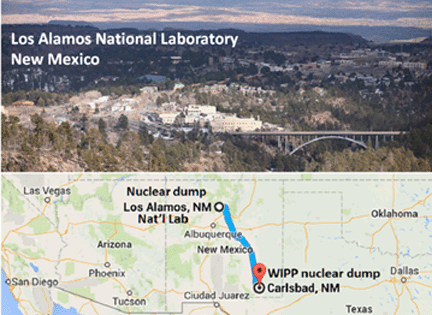
Santa Fe, NM – In its own words, “The New Mexico Environment Department [NMED] issued several actions today to hold the U.S. Department of Energy accountable for failing to prioritize the cleanup of Los Alamos National Laboratory’s “legacy waste” for disposal at the Waste Isolation Pilot Plant.”
Amongst these actions is an Administrative Compliance Order designed to hasten cleanup of an old radioactive and toxic waste dump that should be the model for Lab cleanup. Nuclear Watch New Mexico strongly supports NMED’s aggressive efforts to compel comprehensive cleanup given Department of Energy obstruction.
This Compliance Order comes at a historically significant time. On February 5 the New Strategic Arms Reduction Treaty expired, leaving the world without any arms control for the first time since the middle 1970s. The following day the Trump Administration accused China of conducting a small nuclear weapons test in 2020, possibly opening the door for matching tests by the United States.
NMED’s Compliance Order comes as LANL’s nuclear weapons production programs are radically expanding for the new nuclear arms race. The directors of the nuclear weapons laboratories, including LANL’s Thom Mason, are openly talking about seizing the opportunity provided by the Trump Administration’s deregulation of nuclear safety regulations to accelerate nuclear warhead production.
As background, in September 2023 NMED released a groundbreaking draft Order mandating the excavation and cleanup of an estimated 198,000 cubic meters of radioactive and toxic wastes at Material Disposal Area C, an old unlined dump that last received wastes in 1974. However, in a legalistic maneuver to evade real cleanup, DOE unilaterally declared that Area C:
“…is associated with active Facility operations and will be Deferred from further corrective action under [NMED’s] Consent Order until
it is no longer associated with active Facility operations.”
The rationale of DOE’s semi-autonomous nuclear weapons agency, the National Nuclear Security Administration (NNSA), is that Area C is within a few hundred yards of the Lab’s main facility for plutonium “pit” bomb core production. LANL is prioritizing that production above everything else while cutting cleanup and nonproliferation programs and completely eliminating renewable energy research. DOE’s and NNSA’s unilateral deferment of Area C until it “is no longer associated with active Facility operations” in effect means that it will never be cleaned up. No future plutonium pit production is to maintain the safety and reliability of the U.S.’ existing nuclear weapons stockpile. Instead, it is all for new design nuclear weapons for the new arms race that the NNSA intends to produce until at least 2050. Further, new-design nuclear weapons could prompt the United States to resume full-scale testing, which would have disastrous international proliferation consequences.
To break up the legalistic log jam around cleanup of Area C, NMED’s new Administrative Compliance Order orders DOE, NNSA, and their contractors to:
1) Provide within 30 days specific justifications for their unilateral “deferment” of an old radioactive and toxic waste dump from cleanup; and
2) Rescind their withdrawal of a 2021 “Corrective Measures Evaluation” (CME) which proposed possible cleanup methods. DOE had claimed that withdrawing the CME had mooted any legal basis for NMED to mandate comprehensive cleanup at LANL.
The Lab’s budget for nuclear weapons programs that caused the need for cleanup has more than doubled over the last decade, with a one billion dollar increase in this year alone. Nevertheless, DOE et al want cleanup on the cheap. Their plan is to “cap and cover” existing wastes, leaving them permanently buried in unlined pit and trenches as a perpetual threat to groundwater.
Ironically, there is no current need for pit production. In 2006 independent experts concluded that plutonium pits have serviceable lifetimes of at least 100 years (their average age now is ~43). Moreover, at least 20,000 existing pits are already stored at the NNSA’s Pantex Plant near Amarillo, TX.
Pit production is the NNSA’s most complex and expensive program ever. It will likely cost more than $60 billion over the next 25 years, exceeding the cost of the original Manhattan Project that designed and built a plutonium pit from scratch. However, the independent Government Accountability Office has repeatedly concluded that the NNSA has no credible cost estimates and no “Integrated Master Schedule” for planned redundant pit production at LANL and the Savannah River Site in South Carolina
In addition, it’s not clear where an estimated 57,500 cubic meters of radioactive transuranic wastes from future pit production will go. DOE is fundamentally changing the cleanup mission of the only existing permanent repository, the Waste Isolation Pilot Plant (WIPP) in southern New Mexico, to become the dumping ground for new nuclear bomb production. However, WIPP is already oversubscribed for all of the radioactive wastes that DOE wants to send to it. Moreover, NMED has previously ordered DOE to prioritize disposal of LANL’s Cold War wastes at WIPP (which it is not doing) and to begin looking for a new out-of-state waste dump, which will be politically controversial.
In all, NNSA’s expanded plutonium pit production is so plagued with problems that the DOE Deputy Secretary ordered a “special assessment” of the program completed by December 8, 2025. However, it is still not publicly available.
LANL and DOE have a long history of deception concerning contamination and cleanup. In 1992 a Lab pamphlet was inserted into the Sunday edition of The New Mexican newspaper which claimed that plutonium from LANL had never been found in the Rio Grande. This was despite the fact that a 1987 study detected Lab plutonium 17 miles south down the Rio Grande in Cochiti Lake, a popular recreational site.
As late as the late 1990s LANL was claiming that groundwater contamination was impossible, going so far as to request a waiver from even having to monitor for it (fortunately denied by NMED). Today we know of a massive hexavalent chromium plume whose size is still not known that has migrated onto San Ildefonso Pueblo lands (Lab maps showed it stopping at exactly the Pueblo border). Plutonium, high explosives and perchlorates have all been detected in groundwater. A 2005 hydrogeological study concluded that “Future contamination at additional locations is expected over a period of decades to centuries as more of the contaminant inventory reaches the water table.”
In 2018 DOE was falsely claiming that cleanup at the Lab was more than half complete. In Nuclear Watch New Mexico’s view, genuine cleanup of LANL has yet to begin. It will start with a final Order by NMED to DOE mandating excavation and treatment of the radioactive and toxic wastes at Area C. Lab-wide comprehensive cleanup is the only sure way to protect New Mexico’ life-sustaining groundwater and will provide hundreds of long-term, high paying jobs.
Jay Coghlan, Director of Nuclear Watch New Mexico, commented: “What is more important to New Mexicans, clean, uncontaminated groundwater or more nuclear weapons for the accelerating global arms race? We salute NMED’s efforts under the leadership of Secretary James Kenney to hold the Lab accountable and make it genuinely clean up. This enforcement action is a crucial step toward reining in Lab contamination. But it is also a global step in forcing the Los Alamos Lab to focus on cleanup instead of the buildup of nuclear weapons for another arms race that threatens us all.”
Rot at the Top: The Elite’s Darkest Secrets Spill Out
February 12, 2026, by Joshua Scheer, https://scheerpost.com/2026/02/12/rot-at-the-top-the-elites-darkest-secrets-spill-out/
In a political moment defined by secrecy, impunity, and the open decay of democratic institutions, few conversations cut as sharply as this one. Chris Hedges — Pulitzer Prize–winning former New York Times Middle East bureau chief — joins George Galloway to dissect the explosive Epstein files and the global elite they expose. What emerges is not a scandal at the margins, but a portrait of a ruling class so insulated, so depraved, and so unaccountable that its corruption has become a structural feature of Western power.
From the redactions shielding Trump and Netanyahu, to the British political meltdown engulfing Starmer’s inner circle, to the bipartisan rot in Washington, Hedges argues that the Epstein revelations are not an aberration but a window into a collapsing order. As he puts it, the files reveal “a depraved corrupt ruling global elite that has created a club that has locked the rest of us out,” one now reaching for authoritarian tools as its legitimacy crumbles.
This is a conversation about the Epstein affair — but also about the death spiral of American democracy, the rise of police‑state tactics, and the dangerous volatility of a declining empire whose leaders are losing their grip on reality. And with the Persian Gulf once again on the brink, Hedges warns that the same unaccountable forces exposed in the Epstein files are steering the world toward catastrophe.
If you want to understand the moment we’re living through — the corruption, the cover‑ups, the authoritarian drift, and the geopolitical brinkmanship — this exchange is essential.
Key Highlights
1. The Epstein Files as a Window Into Elite Rot
- Hedges calls the documents “a depraved corrupt ruling global elite that has created a club that has locked the rest of us out.”
- He argues the files expose not just individuals but the structure of unaccountable power across the US, UK, Israel, and Europe.
2. Trump’s Deep Exposure in the Files
- Mentioned “38,000 times” in emails, according to Hedges.
- Hedges says the redactions were designed “to protect Trump and Netanyahu.”
- The Republican Party’s resistance to releasing the files “crumbled,” forcing Trump’s hand.
3. UK Political Meltdown
Galloway details cascading scandals around Starmer’s appointments — from Mandelson to a newly exposed associate tied to a convicted pedophile.- British media saturation contrasts sharply with US silence, which Hedges says reflects “the breakdown of democratic institutions.”
4. Bipartisan Complicity in the US
- Hedges names Clinton, George Mitchell, and even Noam Chomsky as figures caught in the web.
- He stresses that both parties are implicated, making accountability structurally impossible.
5. The Missing Videos & Intelligence Links
- Epstein’s mansion contained a “closet‑sized safe” filled with recorded material.
- Hedges: “It’s a question to what extent Epstein was working for the Mossad.”
- Clear ties to Ehud Barak and Israeli intelligence raise the specter of kompromat.
6. Trump’s Cognitive Decline
- Hedges cites Trump claiming he imposed tariffs on Switzerland because of its “prime minister” — a position that doesn’t exist.
- He warns that a mentally deteriorating commander‑in‑chief is dangerous amid multiple potential war fronts.
7. The Rise of American Death‑Squad Policing
- Hedges describes ICE and federal agents as “death squads… killing with impunity,” ignoring court orders.
- He frames this as the defining feature of a police state.
8. Will Trump Attack Iran?
- Pentagon opposition remains strong.
- Netanyahu’s repeated visits suggest he’s not getting the commitment he wants.
- Hedges: Trump is impulsive enough that “he could wake up tomorrow” and reverse course.
9. Epstein as a Global Operator, Not a Lone Predator
- Epstein involved in Ukraine, Somaliland, even “a potential coup against Putin.”
- Hedges emphasizes his inexplicable rise: “He can barely write English… that is the enigma.”
10. The Authoritarian Turn as Self‑Protection
- As elites are exposed, Hedges argues they are “rapidly imposing authoritarian states” to maintain control.
- He cites both US and UK crackdowns on dissent as evidence.
US Military Helping Trump to Build Massive Network of ‘Concentration Camps,’ Navy Contract Reveals
The Department of Homeland Security is using a repurposed $55 billion Navy contract to convert warehouses into makeshift jails and plan sprawling tent cities in remote areas.
Stephen Prager, Feb 02, 2026, https://www.commondreams.org/news/military-contract-concentration-camps
In the wake of immigration agents’ killings of three US citizens within a matter of weeks, the Department of Homeland Security is quietly moving forward with a plan to expand its capacity for mass detention by using a military contract to create what Pablo Manríquez, the author of the immigration news site Migrant Insider calls “a nationwide ‘ghost network’ of concentration camps.”
On Sunday, Manríquez reported that “a massive Navy contract vehicle, once valued at $10 billion, has ballooned to a staggering $55 billion ceiling to expedite President Donald Trump’s ‘mass deportation’ agenda.”
It is the expansion of a contract first reported on in October by CNN, which found that DHS was “funneling $10 billion through the Navy to help facilitate the construction of a sprawling network of migrant detention centers across the US in an arrangement aimed at getting the centers built faster, according to sources and federal contracting documents.”
The report describes the money as being allocated for “new detention centers,” which “are likely to be primarily soft-sided tents and may or may not be built on existing Navy installations, according to the sources familiar with the initiative. DHS has often leaned on soft-sided facilities to manage influxes of migrants.”
According to a source familiar with the project, “the goal is for the facilities to house as many as 10,000 people each, and are expected to be built in Louisiana, Georgia, Pennsylvania, Indiana, Utah, and Kansas.”
SUBSCRIBE TO OUR FREE NEWSLETTER
Daily news & progressive opinion—funded by the people, not the corporations—delivered straight to your inbox.
Now Manríquez reports that the project has just gotten much bigger after a Navy grant was repurposed weeks ago. It was authorized through the Worldwide Expeditionary Multiple Award Contract (WEXMAC), a flexible purchasing system that the government uses to quickly move military equipment to dangerous and remote parts of the world.
The contract states that the money is being repurposed for “TITUS,” an abbreviation for “Territorial Integrity of the United States.” While it’s not unusual for Navy contracts to be used for expenditures aimed at protecting the nation, Manríquez warned that such a staggering movement of funds for domestic detention points to something ominous.
“This $45 billion increase, published just weeks ago, converts the US into a ‘geographic region’ for expeditionary military-style detention,” he wrote. “It signals a massive, long-term escalation in the government’s capacity to pay for detention and deportation logistics. In the world of federal contracting, it is the difference between a temporary surge and a permanent infrastructure.”
He says the use of the military funding mechanism is meant to disburse funds quickly, without the typical bidding war among contractors, which would typically create a period of public scrutiny. Using the Navy contract means that new projects can be created with “task orders,” which can be turned around almost immediately, when “specific dates and locations are identified” by DHS.
“It means the infrastructure is currently a ‘ghost’ network that can be materialized anywhere in the US the moment a site is picked,” Manríquez wrote.
Amid its push to deport 1 million people each year, the White House has said it needs to dramatically increase the scale of its detention apparatus to add more beds for those who are arrested. But Manríquez said documents suggest “this isn’t just about bed space; it’s about the rapid deployment of self-contained cities.”
In addition to tent cities capable of housing thousands, contract line items include facilities meant for sustained living—including closed tents likely for medical treatment and industrial-sized grills for food preparation.
They also include expenditures on “Force Protection” equipment, like earth-filled defensive barriers, 8-foot-high CONEX box walls, and “Weather Resistant” guard shacks.
Eric Feigl-Ding, an epidemiologist and health economist, said the contract’s provision of materials meant to deal with medical needs and death was “extra chilling.” According to the report, “services extend to ‘Medical Waste Management,’ with specific protocols for biohazard incinerators.”
The new reporting from Migrant Insider comes on the heels of a report last week from Bloomberg that US Immigration and Customs Enforcement (ICE) has used some of the $45 billion to purchase warehouses in nearly two dozen remote communities, each meant to house thousands of detainees, which it said “could be the largest expansion of such detention capacity in US history.”
The plans have been met with backlash from locals, even in the largely Republican-leaning areas where they are being constructed:
This month, demonstrators protested warehouse conversions in New Hampshire, Utah, Texas and Georgia after the Washington Post published an earlier version of the conversion plan.
In mid-January, a planned tour for contractors of a potential warehouse site in San Antonio was canceled after protesters showed up the same day, according to a person familiar with the scheduled visit.
In Salt Lake City, the Ritchie Group, a local family business that owns the warehouse ICE identified as a future “mega center” jail, said it had “no plans to sell or lease the property in question to the federal government” after protesters showed up at their offices to pressure them.
On January 20, Sen. Chris Van Hollen (D-Md.) joined hundreds of protesters outside a warehouse in Hagerstown, Maryland, that was set to be converted into a facility that will hold 1,500 people.
The senator called the construction of it and other detention facilities “one of the most obscene, one of the most inhumane, one of the most illegal operations being carried out by this Trump administration.”
Reports of a new influx of funding from the Navy come as Democrats in Congress face pressure to block tens of billions in new funding for DHS and ICE during budget negotiations.
“If Congress does nothing, DHS will continue to thrive,” Manríquez said. “With three more years pre-funded, plus a US Navy as a benefactor, Secretary Kristi Noem—or any potential successor—has the legal and financial runway to keep the business of creating ICE concentration camps overnight in American communities running long after any news cycle fades.”
WANTED: Volunteers to host nuclear waste, forever

By Sarah Mcfarlane, Timothy Gardner and Susanna Twidale, February 6, 2026, https://www.reuters.com/sustainability/land-use-biodiversity/wanted-volunteers-host-nuclear-waste-forever-2026-02-06/
- U.S. wants campuses to host nuclear facilities and data centers
- Asks states to volunteer, permanent waste disposal a must-have
- No deep geological waste facility yet in operation worldwide
LONDON/WASHINGTON, Feb 6 (Reuters) – The Trump administration’s plan to unleash a wave of small futuristic nuclear reactors to power the AI era is falling back on an age-old strategy to dispose of the highly toxic waste: bury it at the bottom of a very deep hole.
But there’s a problem. There is no very deep hole, and the stockpile of some 100,000 tons of radioactive waste being stored temporarily at nuclear plants and other sites across the United States keeps getting bigger.
To resolve this quandary, the U.S. administration is now dangling a radioactive carrot.
States are being asked to volunteer to host a permanent geological repository for spent fuel as part of a campus of facilities including new nuclear reactors, waste reprocessing, uranium enrichment and data centers, according to a proposal published by the Department of Energy (DOE) last week.
Its request for information (RFI) marks a big shift in policy. The plan to boost nuclear energy is now combined with a requirement to find a permanent home for waste and puts decisions in the hands of local communities – decisions worth tens of billions of dollars in investment and thousands of jobs, according to a spokesperson for the DOE’s Office of Nuclear Energy.
“By combining this all together in a package, it’s a matter of big carrots being placed alongside a waste facility which is less desirable,” said Lake Barrett, a former official at the U.S. Nuclear Regulatory Commission (NRC) and the DOE. States including Utah and Tennessee have already expressed interest in nuclear energy investments, he said.
The nuclear office said the request had generated interest but did not comment on individual states, which have 60 days to respond. Officials in Utah and Tennessee did not respond to requests for comment.
President Donald Trump wants to quadruple U.S. nuclear power capacity, opens new tab to 400 gigawatts by 2050 as electricity demand surges for the first time in decades thanks to the boom in data centers driving artificial intelligence and the electrification of transport.
In 2025, the DOE picked 11 new advanced nuclear test reactor designs for fast-track licensing and aims to have three pilots built by July 4 this year.
However, public acceptance of nuclear energy hinges partly on the promise of burying nuclear waste deep underground, according to studies by the U.S. and British governments as well as the European Commission.
“A complete nuclear strategy must include safe, durable pathways for final disposition, and that remains a required element of the RFI,” the Office of Nuclear Energy spokesperson said.
Previous efforts to find a solution have run into strong local opposition.
The DOE started looking for a permanent waste facility in 1983 and settled on Nevada’s Yucca Mountain in 1987. But former President Barack Obama halted funding in 2010 due to opposition from Nevada lawmakers worried about safety and the effect on casinos and hotels – with nearly $15 billion already spent.
NEW REACTOR DESIGNS
To accelerate the deployment of nuclear power, countries including the United States, Britain, Canada, China and Sweden are championing so-called small modular reactors (SMRs).
The appeal of SMRs lies in the idea they can be mostly prefabricated in factories, making them faster and cheaper to assemble than the larger reactors already in use.
But none of the new SMR designs are expected to solve the waste problem. Experts say designers are not compelled to consider waste at inception, beyond a plan for how it will be managed.
“This rush to create new designs without thinking about the full system bodes really poorly for effective regulatory oversight and having a well-run, safe, and reliable waste management program over the long term,” said Seth Tuler, associate professor at the Worcester Polytechnic Institute and previously on the U.S. Nuclear Waste Technical Review Board.
Most of the new SMRs are expected to produce similar volumes of waste, or even more, per unit of electricity than today’s large reactors, according to a study published in the Proceedings of the National Academy of Sciences in 2022.
SMRs can also be sited in areas lacking the infrastructure needed for larger plants, raising the prospect of many more nuclear sites which could become interim waste dumps too. And in the United States, “interim” can mean more than century after a reactor closes, according to the U.S. nuclear power regulator.
Reuters contacted the nine companies behind the 11 SMR designs backed by the DOE’s fast-track programme. Some said nuclear waste was an issue for the operators of the reactors, and the government.
Others said they hoped technological advances in the coming decades would improve prospects for reprocessing fuel, although they agreed a permanent repository was still needed.
The prospect of a new wave of nuclear reactors, has rekindled interest in reprocessing spent fuel whereby uranium and plutonium are separated out and, in some instances, reused.
“Modern technologies, particularly advanced recycling and reprocessing, can dramatically shrink the volume of nuclear material requiring disposal,” the spokesperson for the nuclear energy office said. “At the same time, reprocessing does not eliminate the requirement for permanent disposal.”
Nuclear security experts, however, questioned whether reprocessing would be included in any of the new campuses.
“Every time it’s been attempted, it’s failed, it creates security and proliferation risks, the costs are enormous, and it complicates waste management,” said former DOE official Ross Matzkin-Bridger. He said the few countries reprocessing fuel were recycling between zero to 2%, far below the 90% promised.
A PERMANENT PROBLEM
For now, most waste in the United States, Canada, Europe, and Britain is stored on site indefinitely, first in spent fuel pools to cool and then in concrete and steel casks. France sends spent fuel to La Hague in Normandy for reprocessing.
The more than 90 nuclear reactors operating in the United States – the world’s biggest nuclear power producer ahead of China and France – add about 2,000 tons of waste a year to existing stockpiles, according to the DOE.
Office of Nuclear Energy data shows that as of the end of 2024, U.S. taxpayers have paid utility companies $11.1 billion to compensate them for storing spent fuel, some of which can remain harmful to humans for hundreds of thousands of years.
Scotland’s Dounreay site, where the last reactor closed in 1994, has repeatedly extended its decommissioning period and budget due to complications handling waste, according to the British government, in an early sign of the issues the industry faces as older plants shut down.
Vast vaults are being stocked with low-level radioactive waste in large metal containers as Dounreay, once at the cutting edge of Britain’s nuclear industry, is dismantled.
Ever since the first commercial nuclear plant went online 70 years ago in England, the consensus has been that burying the most toxic waste deep underground is the safest option but there is still no repository in operation anywhere in the world.
Getting a repository up and running is a slow process. Governments need community buy-in and geological studies are required to determine the flow of groundwater and the stability of the rock up to 1,000 metres (1,090 yards) underground.
Finland has made the most progress and is close to opening the world’s first permanent nuclear repository in Olkiluoto – having also kicked off the process way back in 1983.
Posiva, the Finnish company behind the project, began transferring test canisters more than four hundred meters below ground in 2024. It told Reuters its goal is to start commercial operations this year, though it is waiting for the Finnish Radiation and Nuclear Safety Authority to approve the operating licence, which will be followed by technical checks.
Once up and running, separate underground tunnels will be filled with canisters made of copper and iron housing the waste, and then sealed forever.
Sweden began constructing its permanent repository in January 2025, aiming to have it running by the late 2030s. Canada has agreed a site in Ontario which it aims to be operational by the late 2040s. Switzerland and France have chosen sites too and hope to have their repositories open from about 2050. Britain is shooting for the late 2050s, but has yet to settle on a location.
Pending the construction of a permanent repository somewhere in the country, high-level waste from nuclear sites such as Dounreay is sent for storage at Sellafield in England.
Some decommissioned nuclear sites, including Dounreay, are also being promoted as locations for data centers, as they’re hooked up to the power grid already and won’t need to wait for a connection.
But the clean-up there has a way to go. Irradiated nuclear fuel was flushed into the sea decades ago and a “minor” radioactive fragment was found on a local beach as recently as January.
The last “significant” particle was found in April and fishing is banned within a 2 kilometer (1.25 mile) radius of Dounreay’s outlet pipe because of radioactive particles on the seabed.
Last year, Britain extended the time frame for the Dounreay clean-up from 2033 to the 2070s.
Reporting by Sarah McFarlane and Susanna Twidale in London, Timothy Gardner in Washington; Visual Production by Morgan Coates; Editing by David Clarke
Leading Papers Call for Destroying Iran to Save It

Gregory Shupak, February 10, 2026, https://fair.org/home/leading-papers-call-for-destroying-iran-to-save-it/
The United States has no right to wage war on Iran, or to have a say who governs the country. The opinion pages of the New York Times and Washington Post, however, are offering facile humanitarian arguments for the US to escalate its attacks on Iran. These are based on the nonsensical assumption that the US wants to help brighten Iranians’ futures.
In two editorials addressing the possibility of the US undertaking a bombing and shooting war on Iran, the Washington Post expressed no opposition to such policies and endorsed economic warfare as well.
Crediting Trump with “the wisdom of distinguishing between an authoritarian regime and the people who suffer under its rule,” the first Post editorial (1/2/26) approvingly quoted Trump’s Truth Social promise (1/2/26) to Iranian protesters that the US “will come to their rescue…. We are locked and loaded and ready to go.”
For the Post, the problem was not that Trump was threatening to bomb a sovereign state, but that “airstrikes are, at best, a temporary solution”:
If the administration wants this time to be different, it will need to oversee a patient, sustained campaign of maximum pressure against the government…. The optimal strategy is to economically squeeze the regime as hard as possible at this moment of maximum vulnerability. More stringent enforcement of existing oil sanctions would go a long way…. Western financial controls are actually working quite well.
Thus, the paper offers advice on how to integrate bombing Iran into a broader effort to overthrow the country’s government in a hybrid war. Central to that project are the sanctions with which the Post is so thoroughly impressed. Such measures have “squeeze[d] the regime” by, for example, decimating “the government’s primary source of revenue, oil exports, limiting the state’s ability to provide for millions of impoverished Iranians through social safety nets” (CNN, 10/19/25).
That the US continues to apply the sanctions, knowing that they have these effects, demonstrates that it has no interest in, as the Post put it, “free[ing]” Iranians “from bondage.”
‘Always more room for sanctions’
The second Washington Post editorial (1/23/26) expressed disappointment that, despite “mass killings” and the “most repressive crackdown in decades,” “Trump has ratcheted back his earlier rhetoric.” It emphasized that “the regime is now mocking Trump for backing down.” The paper offered advice for the president:
Airstrikes alone won’t bring down the regime—or make it behave like a normal country. But Israel and the US have shown in recent years that bombing can cause significant tactical setbacks. And there is always more room for sanctions pressure….
The president cannot maintain effective deterrence by turning the other cheek [in response to Iranians who have taunted him]. How he responds is just as important as how quickly he does it.
The implication is that, to deter Iran’s government from killing Iranians, the US needs to kill Iranians. After all, bombing campaigns come with “mass killings” of their own: The US/Israeli aggression against Iran last June killed more than 1,000 Iranians, most of them civilians.
Meanwhile, those sanctions the paper wants to use to deter the Iranian government from “harm[ing] its own people” do quite a bit of damage in their own right, often causing “low-income citizens’ food consumption” to “deteriorate due to sanctions”—a rather novel approach to harm reduction.
Bombing other countries, depriving them of food—is this what it means to “behave like a normal country”?
‘Too depraved’ for reform
Over its own pro–regime change piece, the New York Times editorial board headline (1/14/26) declared: “Iran’s Murderous Regime Is Irredeemable.”
“The Khamenei regime is too depraved to be reformed,” the editors wrote, spending the majority of the piece building its case to that effect before turning to solutions. For the Times, these start “with a unified expression of solidarity with the protesters,” and quickly move to punitive measures against the Iranian government:
The world can also extend the sanctions it has imposed on Iran. The Trump administration this week announced new tariffs on any countries that do business with Iran, and other democracies should impose their own economic penalties.
For the authors, “deprav[ity]” needs to be resisted by Washington and its partners, who have demonstrated their moral superiority with their presumably depravity-free sanctions. These have, as Germany’s DW (11/23/25) reported, “caused medical shortages that hit [Iran’s] most vulnerable citizens hardest,” preventing the country from being able “to purchase special medicines—like those required by cancer patients.”
The Times also supported US military violence against Iran—if with somewhat more restraint than the Post, asking Trump to “move much more judiciously than he typically does.” The Times wants him to seek “approval from Congress before any military operation,” and make “clear its limitations and goals.” The paper warned Trump not to attack “without adequate preparation and resources”:
Above all, he should avoid the lack of strategic discipline and illegal actions that have defined the Venezuela campaign. He should ask which policies have the best chance of undermining the regime’s violent repression and creating the conditions for a democratic transition.
One glaring problem with suggesting that a US “military operation” should be based on “policies [that] have the best chance of…creating the conditions for a democratic transition” is that very recent precedents show that US wars don’t bring about democracy, and are not intended to do so; instead, such wars bring about social collapse.
Consider, for example, US interventions in Libya and Syria. In both cases, the US backed decidedly nondemocratic forces (Jacobin, 9/2/13; Harper’s, 1/16) and, as one might expect, neither war resulted in democracy. In Libya’s case, the outcome has been slavery and state collapse (In These Times, 8/18/20). In Syria, the new, unelected government is implicated in sectarian mass murder (FAIR.org, 6/2/25).
If DHS killed Pretti, why not bomb Iran?
There are no grounds for believing that the US would chart a different course if it bombs Iran again. But that hasn’t stopped other Times contributors from suggesting that the US should conduct a war in Iran—for the good of Iranians, of course.
Times columnist Bret Stephens (1/27/26) worried about the “risk” posed by “the example of a US president who urged protesters to go in the streets and said help was on the way, only to betray them through inaction.”
Invoking the DHS’s killing of Minneapolis resident Alex Pretti, Stephens urged “thoughtful Americans” to encourage the same administration that killed him to exercise “the military option” in Iran:
But if Pretti’s death is a tragedy, what do we say or do in the face of the murder of thousands of Iranians? Are they, as Stalin might have said, just another statistic?
Stephens is citing people’s outrage against the US government killing a protester as a reason they should support the US government inflicting more violence against Iran. The logical corollary to that would be that if you’re opposed to Iran suppressing anti-government forces, you should therefore be in favor of Tehran launching armed attacks to defend protesters in the US.
Masih Alinejad, a US-government-funded Iranian-American journalist, wrote in the Times (1/27/26) that Trump
encouraged Iranians to intensify their mass protests, writing, “HELP IS ON ITS WAY.” That help never came, and many protesters now feel betrayed. Still, the USS Abraham Lincoln aircraft carrier strike group has recently arrived in the Middle East. Mr. Trump has not said what he plans to do now that it is there, but it does give him the option of striking a blow against government repression.
Policy of pain
Both Stephens and Alinejad present their calls for the US to assault Iran in moral terms, suggesting that the US should demonstrate loyalty to Iranian protestors by “help[ing]” them through an armed attack on the country in which they live. Their premise is that the US is interested in enabling the Iranian population to flourish, an assertion contradicted by more than 70 years of Washington’s policy of inflicting pain on Iranians in an effort to dominate them.
That US policy has included overthrowing Iran’s democratically elected government in 1953 (NPR, 2/7/19), propping up the Shah’s brutal dictatorship for the next 26 years (BBC, 6/3/16; AP, 2/6/19), sponsoring Saddam Hussein’s invasion of the country and use of chemical weapons against it (Foreign Policy, 8/26/13), partnering with Israel in a years-long campaign of murdering Iranian scientists (Responsible Statecraft, 12/21/20), and currently maintaining—along with its allies—a sanctions regime that is associated with a substantial drop in Iranian life expectancy (Al Jazeera, 1/13/26).
If Stephens or Alinejad had evidence that the US is so radically re-orienting its conduct in the international arena, one imagines that they would want to share with their readers the proof that the Trump administration’s magnanimity is so profound that it overrides the UN Charter, and justifies America carrying out a war to “help” a country it has terrorized for decades.
Bad Beginnings: The End of New START

Putin was also of the opinion that “a complete renunciation of New START’s legacy would, from many points, be a grave and short-sighted mistake”, having “adverse implications for the objectives of the [Nuclear Non-Proliferation Treaty].
11 February 2026 Dr Binoy Kampmark, AIM,
Future of How awful could it get? The New Strategic Arms Reduction Treaty (New START) expired on February 5, terminating an era of arms control and imposed limits on lunatically contrived nuclear weapons programs of the United States and Russia. The New START Treaty entered into force on February 5, 2011 and initially imposed a timeline of seven years for the parties to meet the central limits on strategic offensive arms. Those limits would then be maintained for the duration of the Treaty.
Till its expiry, the countries maintained limits on the following nuclear arms and systems: 700 deployed intercontinental ballistic missiles (ICBMs), deployed submarine-launched ballistic missiles (SLBMs), and deployed heavy bombers capable of using nuclear armaments; 1,550 nuclear warheads on all three deployed platforms; and 800 deployed and non-deployed nuclear capable systems (ICBM launchers, SLBM launchers, and nuclear capable heavy bombers).
Such limits were hardly laudatory, or even exceptional. The cap of 1,550 nuclear warheads is the sort of thing that would only impress the limited crazed circle that passes for arms negotiators in this field, and the various thanocrats who populate such institutes as RAND. Such a show is merely intended for both Moscow and Washington to tell other countries with, or without nuclear weapons, that they could impose restraints on their own gluttonous conduct. Even then, New START, as with all such instruments dealing with limiting nuclear weapons, came with the intended, gaping lacunae. It failed to cover, for instance, tactical nuclear weapons, nor limit the deployment of new strategic weapon systems.
The treaty also fell into neglect with the outbreak of the COVID-19 pandemic. Suspended on-site inspections never resumed after 2022. As François Diaz-Maurin of the Bulletin of the Atomic Scientists points out, “Russia has not shared data on its deployed strategic nuclear forces since September 2022, it suspended its treaty participation altogether in February 2023, and the United States has not published any aggregate numbers since May 2023.” New START came to increasingly look like a gentleman’s agreement being sniffed at by truculent adolescents.
In September last year, Russian President Vladimir Putin dangled the prospect of extending the treaty’s core limits for a year. At a September 22, 2025 Russian Security Council Meeting, he promised that Moscow was “prepared to continue observing the … central quantitative restrictions” stipulated in New START for twelve months provided the US acted “in similar spirit.” Following the year’s extension, “a careful assessment of the situation [and] a definite decision on whether to uphold these voluntary self-limitations” would be made. Putin was also of the opinion that “a complete renunciation of New START’s legacy would, from many points, be a grave and short-sighted mistake”, having “adverse implications for the objectives of the [Nuclear Non-Proliferation Treaty].
When word of this reached the White House, Press Secretary Karoline Leavitt expressed the view that the proposal sounded “pretty good.” Two weeks later, President Donald Trump responded to a question posed by a TASS reporter that Putin’s proposal sounded “pretty like a good idea to me.” Little, however, was subsequently done. Indeed, Trump has cut the number of diplomats tasked with nuclear matters in the State Department and made public statements last October that nuclear testing might be resumed. He has also complicated arms control matters by insisting that China be added to the limitation talks, something Beijing has shown little interest in doing. In January this year, the president seemed unfussed that the international document was about to pass into the archives of diplomatic oblivion. “If it expires, it expires. We’ll do a better agreement.”
The US political establishment had been struck by a distinct lack of interest, even lethargy, on the subject. New START seemed to be yet another irritating fetter on an administration more enthused by ignoring international obligations than following them. Only a clutch of Democrats seemed to show concern in reflecting about what would follow the treaty’s expiration in House speeches given on January 14. This month, Massachusetts Democrat Sen. Ed Markey, co-chair of the Senate’s Nuclear Weapons and Arms Control Working Group, held a press conference urging the Trump administration to renew the vows of fidelity to arms control agreements. “Let’s be honest. America needs another nuclear weapon about as much as Donald Trump deserves a Nobel Peace Prize.”………………………………………………………..
The two powers most responsible for keeping nuclear weapons unforgivably attractive to those who would acquire them show promise of blotting their copybook further. There is a serious sentiment in Washington that the nuclear stockpile will and should grow. The Bulletin of Atomic Scientists, in a fit of gloominess, moved its metaphorical Doomsday Clock just that bit closer to “midnight,” the point where biblical calamity will be assured. It now stands at 85 seconds to midnight. Not long to go now. https://theaimn.net/bad-beginnings-the-end-of-new-start/
New Mexico Environment Department Takes Necessary Action on Los Alamos National Laboratory’s Hexavalent Chromium Plume.
Concerned Citizens for Nuclear Safety, 13 Feb 26
On Tuesday, February 11th, the New Mexico Environment Department took bold actions to hold the Department of Energy (DOE) and Los Alamos National Laboratory (LANL) accountable for the release and distribution of hexavalent chromium contamination into the regional drinking water aquifer and onto Pueblo de San Ildefonso lands. The Environment Department released two administrative compliance orders, both with civil penalties, totaling over $15,775,000.00.
This Update focuses on the first Environment Department administrative compliance order, No. 26-01, which revolves around the Environment Department’s consideration of LANL’s application for a discharge permit for the extraction, treatment of the contaminated waters and injection of those waters back into the regional drinking water aquifer and the requirements to take action to protect the regional drinking water supply. https://cloud.env.nm.gov/resources/_translator.php/MjMzYzM5YTExNTJlYjUwNTA0MTQ3ZGQzNl8yMTc2NzU~.pdf
In 2015, LANL submitted an application to the Environment Department for a groundwater discharge permit to investigate the protective interim measures that could be taken to protect the regional drinking water aquifer and to characterize the hexavalent chromium plume to determine the best course of action to clean up the contamination and to stop future contamination. After a public hearing, the Environment Department issued the groundwater discharge permit, DP-1835, to LANL.
The 44-page administrative order details the steps that were taken, the obstacles that were placed in the way, and the back and forth between the parties to address the plumes.
Sixth Trump meeting with his de facto boss…good day to fire him.
Walt Zlotow West Suburban Peace Coalition Glen Ellyn IL , 12 Feb , 26

President Trump’s de jure, constitutional boss is We the People. 77 302,580 of us, giving Trump 58% of the Electoral College, hired him November 5, 2024. Trump serves and reports to Us.
But during the past 13 months he’s dismissed his true boss to take orders from Israeli Prime Minister Benjamin Netanyahu. Support the Israeli genocide obliterating Palestinians in Gaza with billions in weapons…check. Conspire with Netanyahu to sucker punch Iran with a sneak attack to decapitate their regime last June…check. Support Israeli provocateurs to infiltrate domestic Iranian protests to overthrow the Iranian regime last December…check.
Netanyahu is furious both his murderous Iranian regime change ventures failed. So he demanded, and of course got, his sixth sit down with Trump scheduled for today. Topic Number One? Iran, and not to make peace with Iran, likely the next and most massive attack that will finally achieve Netanyahu’s cherished dream of a decapitated, degraded Israeli rival for Middle East supremacy.
At Netanyahu’s behest Trump has moved a massive military armada into the region. Pulling back is near impossible when Trump’s boss demands he pull the trigger on senseless war that could blow up the Middle East, indeed possibly the world.
It would take a psychiatrist, maybe a team of psychiatrists, to unravel why Trump allows Netanyahu to be his real boss. It may simply be the near quarter of a billion dollars Netanyahu’s Israel Lobby has provided Trump’s campaign coffers since 2020.
Regardless, someone in the Trump orbit needs to convince Trump who his real boss is. We the People do not want our treasure supporting genocide in Gaza. Nor do we want it used to launch massive war on Iran to please Trump’s de facto boss Benjamin Netanyahu.
Trump needs to usher Netanyahu into the Oval Office today and immediately announce…’You’re fired.’
1 This Month


Tell the Ukrainian Government to Drop Prosecution of Peace Activist Yurii Sheliazhenko

Petition to revoke the licensing of the Near Surface Nuclear Disposal Facility (NSDF) at Chalk River. https://www.ourcommons.ca/petitions/en/Petition/Details?Petition=e-7247


of the week – STOP SMALL MODULAR REACTORS IN CANADA
To see nuclear-related stories in greater depth and intensity – go to https://nuclearinformation.wordpress.com
-
Archives
- March 2026 (204)
- February 2026 (268)
- January 2026 (308)
- December 2025 (358)
- November 2025 (359)
- October 2025 (376)
- September 2025 (258)
- August 2025 (319)
- July 2025 (230)
- June 2025 (348)
- May 2025 (261)
- April 2025 (305)
-
Categories
- 1
- 1 NUCLEAR ISSUES
- business and costs
- climate change
- culture and arts
- ENERGY
- environment
- health
- history
- indigenous issues
- Legal
- marketing of nuclear
- media
- opposition to nuclear
- PERSONAL STORIES
- politics
- politics international
- Religion and ethics
- safety
- secrets,lies and civil liberties
- spinbuster
- technology
- Uranium
- wastes
- weapons and war
- Women
- 2 WORLD
- ACTION
- AFRICA
- Atrocities
- AUSTRALIA
- Christina's notes
- Christina's themes
- culture and arts
- Events
- Fuk 2022
- Fuk 2023
- Fukushima 2017
- Fukushima 2018
- fukushima 2019
- Fukushima 2020
- Fukushima 2021
- general
- global warming
- Humour (God we need it)
- Nuclear
- RARE EARTHS
- Reference
- resources – print
- Resources -audiovicual
- Weekly Newsletter
- World
- World Nuclear
- YouTube
-
RSS
Entries RSS
Comments RSS
 nuclear-news