Ionising radiation as a cause of breast cancer
 In the United States, more than 220,000 women are expected to be diagnosed with breast cancer each year and the disease kills more than 37,000 women each year in the U.S., according to the National Cancer Institute.
Radiation a major risk factor for breast cancer? Food Consumer, By David Liu, PHD July 29, 2012 (foodconsumer.org) — Last December a committee of the Institute of healths released a study report sponsored by Susan G. Komen for the Cure indicating that medical radiation and hormone-based therapy are two major risk factors for breast cancer for women in the United States.
The IOM press release says that women can reduce their risk for breast cancer by avoiding unnecessary medical radiation, Continue reading
Medical experts concerned about medical and dental radiation
How many imaging scans are too many? By Ben Sutherly, The Columbus Dispatch Sunday July 29, 2012 Cumulative radiation exposure has been shown to cause cancer. And thathas the pediatric-care community more carefully weighing whether the benefits of medical imaging justify the radiation risk in children.Children are far more sensitive to radiation than adults. And they might receive too great a dose if their smaller body size isn’t factored into the scanning process, according to the National Cancer Institute.The Alliance for Radiation Safety in Pediatric Imaging was formed five years ago after a group of pediatric radiologists noted
that some hospitals used adult-size doses of radiation on children, said Dr. Marilyn Goske, the alliance’s chairwoman and a radiologist at Cincinnati Children’s Hospital Medical Center.“If you can get the picture using a lower dose and still make a diagnosis, that would be
best,” Goske said. Continue reading
Climate change – summer heat damaging production of nuclear power
 “Heat is the main issue, because if the river is getting warmer the water going into the plant is warmer and makes it harder to cool,” David McIntyre, an NRC spokesman, said……
As long as the heat persists, Saunders of Gelber & Associates expects nuclear supply to stay low while demand continues to climb.
Heat Sends U.S. Nuclear Power Production To 9-Year Low  Bloomberg, By Christine Harvey – Jul 26, 2012 Nuclear-power production in the U.S. is at the lowest seasonal levels in nine years as drought and heat force reactors from Ohio to Vermont to slow output.
Generation for the 104 plants in the U.S. fell 0.4 percent from yesterday to 94,171 megawatts, or 93 percent of capacity, the lowest level for this time of year since 2003, according to reports from the U.S. Nuclear Regulatory Commission and data compiled by Bloomberg. The total is down 2.6 percent from the five-year average for today of 96,725 megawatts. We’ve had a fast decay of summer output this month and that corresponds to the high heat and droughts,” Pax Saunders, an analyst at Gelber & Associates in Houston, said. “Plants are not able to operate at the levels they can.”…. Continue reading
NRC alerts nuclear operators to possible design flaw July 27 Jul 28, 2012 (Reuters) – The U.S. Nuclear Regulatory Commission on Friday alerted nuclear power plant operators to a potential design vulnerability that could affect key safety equipment and requested additional information about power system designs.
The regulator’s notice comes after Exelon Corp’s 1,136-megawatt unit 2
at Byron nuclear power station automatically shut on Jan. 30 due to
unbalanced voltage entering the plant’s power system from the
transmission network……. Loss of offsite power was identified by
the NRC as an important issue to be addressed in the wake of the
devastating earthquake and tsunami that led to the meltdown of
reactors at Japan’s Fukushima nuclear plant in March 2011.
The NRC will use the information it receives to determine if further
regulatory action is needed.
The NRC issued a notice March 1 to inform licensees of recent
experience involving loss of one of three phases of the offsite power
circuit, including the Byron event.
Operators have to provide information on their electric system designs
within 90 days. Both operating commercial power reactors and the four
combined licenses for new reactors issued earlier this year must
respond, the NRC said .
http://in.reuters.com/article/2012/07/27/utilities-operations-nrc-idINL2E8IR7EL20120727
Scientists not happy with dangerous pool storage of spent nuclear fuel
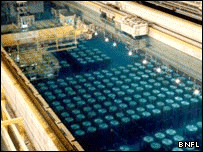 An accident or terrorist attack resulting in a rapid loss of cooling water from a pool could lead to a self-sustaining fire and release of a massive quantity of highly radioactive Cesium-137 into the environment.
NRC Report States That Storing Spent Nuclear Fuel In Wet Pools Is ‘Adequate’ To Protect Public http://www.ucsusa.org/news/media_alerts/nrc-report-adequate-not-enough-0380.html
Transferring It to Dry Casks Would Be Significantly Safer, Science Group Says Continue reading
Nuclear Regulatory Commission to refuse licensing for Calvert Cliffs nuclear reactor
Experts: NRC Licensing Board Expected Friday To Strike Down Calvert
Cliffs Nuclear Reactor Project, Market Watch, WASHINGTON, July 26, 2012 — End to Former “Flagships” of Sputtering U.S. “Nuclear Renaissance”: Foreign Ownership Rules to Block Licensing of Calvert Cliffs 3 in MD, Nine Mile Point 3 in NY, and South Texas Project. Continue reading
Runaway costs of USA’s unnecessary B61 nuclear bomb project
 The escalating cost of the B61 LEP adds to NNSA’s abysmal record of underestimating costs of nuclear weapons programs. It follows enormous budget overruns of the National Ignition Facility (NIF) at Lawrence Livermore National Laboratory in California,….
the U.S. should phase out its remaining non-strategic nuclear weapons, delay and redesign the B61 LEP, and focus its resources on maintaining the strategic nuclear weapons and
conventional forces that are actually needed
B61-12: NNSA’s Gold-Plated Nuclear Bomb Project, FAS Strategic Security Blog, . By Hans M. Kristensen, 26 July 12 Escalating cost estimates for the B61 Life- Extension Program threaten to make the new B61-12 bomb the most expensive ever.
The disclosure during yesterday’s Senate Appropriations Subcommittee hearing that the cost of the B61 Life Extension Program (LEP) is significantly greater that even the most recent cost overruns calls into question the ability of the National Nuclear Security Administration (NNSA) to manage the program and should call into question the B61 LEP itself. Continue reading
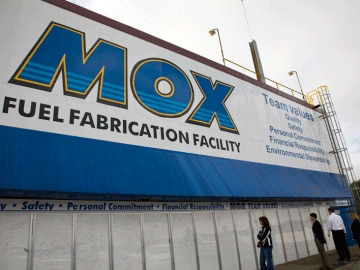
MOX nuclear reprocessing plant at Savannah River Site
NRC holding public meeting over MOX plant http://www.sacbee.com/2012/07/24/4654152/nrc-holding-public-meeting-over.html The Associated Press, Jul. 24, 2012 COLUMBIA, S.C. — Federal regulators are holding a public meeting to discuss a project to create mixed-oxide fuel at a former nuclear weapons site in South Carolina.
The U.S. Nuclear Regulatory Commission is having the open session on Tuesday at the Savannah River Research Campus in New Ellenton.
Construction on the MOX facility began at the Savannah River Site in 2007. Officials say the plant will be used to convert weapons grade plutonium into fuel that will be sold to run commercial power reactors.
The SRS complex once produced plutonium and tritium for atomic bombs. Officials say the nearly $5 billion MOX facility is on schedule and should be running in 2016.
MOX plutonium nuclear reprocessing plants for Tennessee and Alabama?
 TVA considering fuel made from nuclear weapons http://www.kfoxtv.com/news/ap/energy/tva-considering-fuel-made-from-nuclear-weapons/nP3m5/ CHATTANOOGA, Tenn. — The Department of Energy is preparing an environmental impact statement on the use of fuel made from surplus nuclear weapons to power Tennessee Valley Authority nuclear plants. TVA released a set of talking points on Tuesday about the environmental impact statement, which will appear as a draft this week in the Federal Register, TVA spokesman Ray Golden told The Chattanooga Times Free Press (http://bit.ly/MGUFrO ).
The mixed oxide fuel, also called MOX fuel, is a blend of plutonium and uranium, but the variety under consideration is made from retired nuclear weapons, according to the TVA.
The utility has tentatively agreed to consider using the fuel in its Sequoyah and Browns Ferry nuclear plants in Tennessee and Alabama, with a timetable set for 2018. Continue reading
Pitfalls in building nuclear reactors underground
 Just build them underground! http://daryanenergyblog.wordpress.com/ca/part-10-smallreactors-mass-prod/10-2-2-just-build-them-underground/ There is a common misconception, that we could solve a lot of the problems with reactor construction, both large and small (though in particular the small ones) by building them in subsurface pits. I’m assuming the person who thought up this one has never dug a hole in his back garden! If you have, you’d know that digging a hole is not as easy as it seems. Firstly, the soil type has a big bearing on things. Depending on where you live you could be looking at thick sticky soil that difficult to shift, loose gravely soil that collapses easily or rocky earth, that rapidly turns into bedrock (so after a while you’re not digging any more but blasting!). As we need to put foundations down under out reactor to suit the soil type, and probably piling too (due to its weight), this means we essentially need to design each reactor’s containment vessel individually to suit local soil conditions, which increases costs.
Another problem is water intrusion, as anyone who’s ever dug a pit, then gone in for lunch, come back out and found it full of water will know all about! Our reactor “pit” needs to be designed like the hull of a boat to stop water leaking in and flooding it. Doing that with concrete, particularly thick section of it, is always difficult. The fact that the reactor will be generating heat complicates things as it raises the risk of subsidence or settlement cracking. While this can happen if the reactor is on the surface too, putting it under ground level “complicates things”.
In general with any construction project significant efforts are made to reduce the amount of earth movement required to start construction, not increase it, as lots of earth moving nearly always results in delays, hold-ups and ultimately higher costs (not the least of those being the cost of hiring out of earth moving equipment, those guys charge an arm and a leg!).
Overall, except in a small number of narrow cases building reactors this way will often work out as more expensive and slower than just putting the containment dome above ground.
Building nuclear reactors underground
FirstEnergy looking into building small nuclear reactor By John Funk, The Plain Dealer , July 25, 2012 FirstEnergy said today it had signed an agreement with a subsidiary of Babcock & Wilcox Co. to study the “potential deployment of the B&W mPower small modular reactor in FirstEnergy’s service territory.” The reactor would generate just 180 megawatts and be built in an underground containment structure, …..
Obama government’s solar energy project for public lands

 Roadmap for Solar Energy Development on Public Lands Released to Public Loan Safe.org, BY ALEX FERRERAS JULY 25, 2012 As part of President Obama’s all-of-the-above energy strategy, the Department of the Interior, in partnership with the Department of Energy, will publish the Final Programmatic Environmental Impact Statement (PEIS) for solar energy
development in six southwestern states—Arizona, California, Colorado, Nevada, New Mexico, and Utah.
The final Solar PEIS represents a major step forward in the permitting of utility-scale solar energy on public lands throughout the west. Continue reading
Radiation hazard in too many CT scans for chest pain
 CT Scans For Chest Pain? Study Questions Benefit For Patients HUFFINGTON POST, By MARILYNN MARCHIONE 07/25/12 If you’re having chest pains, an advanced type of CT scan can quickly rule out a heart attack. New research suggests this might be good for hospitals, but not necessarily for you. Continue reading
Keep Virginia’s ban on uranium, says Norfolk Council
Norfolk council backs uranium mining moratorium By Steven G. Vegh The Virginian-Pilot July 25, 2012 NORFOLK The City Council called unanimously on Tuesday for a continuation of the state’s moratorium on uranium mining to safeguard rivers and reservoirs that provide Norfolk’s drinking water.
“This is a vote for us to stand up for the system and against anything that may somehow taint the quality of the water,” Mayor Paul Fraim said after the vote at the council’s regular meeting.
Fraim said the action intentionally echoed a similar resolution approved by Virginia Beach last month against mining and milling uranium ore…. Fraim said the city’s water system serves 700,000 people a day, including naval bases. “We’re very protective of that system,” he said, and cautious about anything that might interfere with the water quality.
USA safer with fewer nuclear weapons say experts, and defense chief
Leading experts and military officials agree that the United States would be more secure with fewer nuclear weapons. A new report chaired by Gen. James Cartwright, former Vice Chairman of the Joint Chiefs of Staff, argues that the U.S. could reduce its arsenal to 900 total nuclear weapons.
Defense Hawk Says Cut the Nuclear Arsenal HUFFINGTON POST, Benjamin LoehrkeSenior Policy Analyst, Ploughshares Fund. 24 July 12 A leading defense hawk took to the floor of the House of Representatives to argue that greater security in the 21st century means spending less on nuclear weapons. This could signal a turning point as leaders in Congress see the strategic and fiscal realities behind why the U.S. should reduce its nuclear arsenal.
Rep. Norman Dicks (D-WA) is a steadfast supporter of national defense. He is the Ranking Member of the House Appropriations Committee and has served on the Subcommittee on Defense for 34 years. He speaks forcefully — both in style and substance. Last week, he stood on the House floor to oppose a proposal on nuclear weapons. Continue reading
1 This Month



Shut down the radiation-damaged Heysham nuclear reactors now
To see nuclear-related stories in greater depth and intensity – go to https://nuclearinformation.wordpress.com

Say No to NASA’s Reckless Nuclear Reactor on the Moon
Say No to NASA’s Reckless Nuclear Reactor on the Moon
-
Archives
- October 2026 (247)
- September 2026 (339)
- August 2026 (330)
- July 2026 (355)
- June 2026 (287)
- May 2026 (306)
- April 2026 (356)
- March 2026 (251)
- February 2026 (267)
- January 2026 (308)
- December 2025 (358)
- November 2025 (359)
-
Categories
- 1
- 1 NUCLEAR ISSUES
- business and costs
- climate change
- culture and arts
- ENERGY
- environment
- health
- history
- indigenous issues
- Legal
- marketing of nuclear
- media
- opposition to nuclear
- PERSONAL STORIES
- politics
- politics international
- Religion and ethics
- safety
- secrets,lies and civil liberties
- spinbuster
- technology
- Uranium
- wastes
- weapons and war
- Women
- 2 WORLD
- ACTION
- AFRICA
- Atrocities
- AUSTRALIA
- Christina's notes
- Christina's themes
- culture and arts
- Events
- Fuk 2022
- Fuk 2023
- Fukushima 2017
- Fukushima 2018
- fukushima 2019
- Fukushima 2020
- Fukushima 2021
- general
- global warming
- Humour (God we need it)
- Nuclear
- RARE EARTHS
- Reference
- resources – print
- Resources -audiovicual
- Weekly Newsletter
- World
- World Nuclear
- YouTube
-
RSS
Entries RSS
Comments RSS

