2 workers sue Department of Energy over radiation exposure

 Radiation-exposed workers demand release of nuke plant accident video http://rt.com/usa/radiation-exposed-workers-suit-687/ August 19, 2013 Two workers have filed a lawsuit against the Department of Energy for failing to comply with the Freedom of Information Act by refusing to hand over a video of an incident in which 16 men, including the two plaintiffs, were exposed to radiation.
Brian Simmons and Ralph Stanton, two operators from the Idaho National Laboratory (INL) in Boise, are trying to force the agency to release the video through a lawsuit filed in federal court. Continue reading
USA’s Nuclear Regulatory Commission allows nuclear plant to run after its license expires
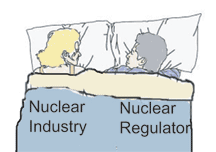 Indian Point nuclear plant can operate after license expires in September, regulators say,http://www.dailyfreeman.com/articles/2013/08/19/news/doc5212d0d93b28c839747942.txt August 19, 2013 WHITE PLAINS, N.Y. (AP) — Federal regulators have ruled, as expected, that a nuclear power reactor in the New York City suburbs can keep running after its license expires next month.
The Nuclear Regulatory Commission said Monday that Indian Point 2 in Buchanan can operate while its license renewal application is being reviewed.
That could be more than a year, given the controversy involved. New York state and environmental groups are opposing a new 20-year license.
NRC regulations allow continued operation if a plant applies for a new license five years before expiration. Indian Point’s owners applied in 2007.
Plants also must show they’ve taken any steps necessary to assure safe operation during the review.
The plant is 35 miles from Manhattan. Another reactor there, Indian Point 3, has a license that expires in 2015.
Reliable and cheap renewable energy storage
Rechargeable flow batteries could be cheaper solution to renewable energy storage http://www.treehugger.com/clean-technology/rechargeable-flow-batteries-could-be-cheaper-solution-renewable-energy-storage.html Megan Treacy August 19, 2013 Researchers at MIT have developed a battery that could bring us reliable and cheap large scale energy storage. Based on flow battery technology, the researchers took out the costly membrane and created a battery that has a power density that is an order of magnitude higher than lithium-ion batteries and three times greater than other membrane-less systems.
MIT reports, “The device stores and releases energy in a device that relies on a phenomenon called laminar flow: Two liquids are pumped through a channel, undergoing electrochemical reactions between two electrodes to store or release energy. Under the right conditions, the solutions stream through in parallel, with very little mixing. The flow naturally separates the liquids, without requiring a costly membrane.”
The reactants used are liquid bromine and hydrogen fuel, which is cheap, but also has had issues with breaking down the membrane in other flow batteries. By taking out the membrane they were able to speed up energy storage and extend the life of the battery.
“Here, we have a system where performance is just as good as previous systems, and now we don’t have to worry about issues of the membrane,” says Martin Bazant, a professor of chemical engineering. “This is something that can be a quantum leap in energy-storage technology.”
As we bring more renewable technologies like wind and solar into the grid, affordable and reliable energy storage is increasingly important. While solar and wind energy output varies based on weather conditions, large scale energy storage systems can smooth out the power delivery from those technologies by storing any excess energy when it’s produced and using it when the output is lower or demand is higher.
“Energy storage is the key enabling technology for renewables,” says Cullen Buie, an assistant professor of mechanical engineering. “Until you can make [energy storage] reliable and affordable, it doesn’t matter how cheap and efficient you can make wind and solar, because our grid can’t handle the intermittency of those renewable technologies.”
MIT says, “Braff built a prototype of a flow battery with a small channel between two electrodes. Through the channel, the group pumped liquid bromine over a graphite cathode and hydrobromic acid under a porous anode. At the same time, the researchers flowed hydrogen gas across the anode. The resulting reactions between hydrogen and bromine produced energy in the form of free electrons that can be discharged or released.
The researchers were also able to reverse the chemical reaction within the channel to capture electrons and store energy — a first for any membraneless design.”
Now that the team’s experiments have lined up with their computer models, they’re focused on scaling up the technology and seeing how it performs. They predict that the technology will be able to produce energy costing as little as $100/kWh, which would make it the cheapest large scale energy storage system built yet.
US doctors owning radiation facilities: conflict of interest
Gov’t report: Doctors with financial interests order more radiation Doctors who invest in radiation treatments and centers are more likely to prescribe it to their prostate cancer patients, a government report finds. CBS NEWS/ MICHELLE CASTILLO / August 19, 2013,
The U.S. Government Accountability Office said that most Medicare patients with prostate cancer who went to doctors with a vested interest were not made privy to the fact that there were alternative options to radiation therapy. Many of these other treatments were less expensive and may have been just as effective.
“We are extremely concerned that many older male patients are receiving such vigorous, possibly unnecessary treatment by urology groups,” Dr. Michael L. Steinberg, the chairman of the American Society for Radiation Oncology, said in astatement. “Clearly, these self-referring urology groups are steering patients to the most lucrative treatment they offer, depriving them of their full range of treatment choices, including potentially no treatment at all.”
Doctors who had a monetary stake in radiation treatment included those who invested in a treatment center or doctors who owned radiation therapy equipment that they shared with others in a medical group.
Between 2006 and 2010 the number of intensity-modulated radiation therapy (IMRT) procedures billed by self-referring medical organizations rose from 80,000 to 366,000 — an increase of 456 percent. IMRT involves using radiation beams to reshape a tumor in order to avoid touching healthy areas and to limit side effects, the Mayo Clinic explained. In contrast, the number of IMRT procedures billed by non-self-referring medical professionals went down 5 percent in the same time period.
IMRT spending by doctors who referred patients to their own centers or used their own equipment went up $138 million, compared to non-self-referral groups which just increased their spending by $91 million.
Urologists who were financially involved in radiation treatments advised 38 percent of their patients in 2007 to undergo the treatments. By 2008 to 2009, that number was as high as 54 percent.
In 2009, doctors with a vested interest were more 53 percent more likely to refer their patients to undergo radiation compared to other procedures like radical prostatectomy (removal of the prostate) or brachytherapy (radiotherapy where radiation is placed inside or next to the treatment area). Brachytherapy typically causes fewer side effects and has shorter overall treatment time compared to IMRT because it allows doctors to deliver more specific, higher doses of radiation to affected areas, the Mayo Clinic pointed out…….
“Unfortunately, when you look at the numbers in this report, you start to wonder where health care stops and where profiteering begins,” said Senate Finance Committee Chairman Max Baucus, D-Mont., in a statement. “Enough is enough. Congress needs to close this loophole and fix the problem.”……http://www.cbsnews.com/8301-204_162-57599131/govt-report-doctors-with-financial-interests-order-more-radiation/
Some American Republican advice on nuclear radiation, and climate change
 Oregon’s GOP Chair Wants to Sprinkle Nuclear Waste From Airplanes Mother jones, —By Tim Murphy Fri Aug. 16, 2013 After months of in-fighting, the beleaguered Oregon Republican Party elected a new chairman last weekend. His name is Art Robinson, and he wants to sprinkle radioactive waste from airplanes to build up our resistance to degenerative illnesses. …. Robinson, who has a Ph.D. in chemistry, has marketed himself for the last three decades as an expert on everything from nuclear fallout to AIDS to climate science in the pages of a monthly newsletter, Access to Energy, which he published from his compound in the small town of Cave Junction……
Growing opposition to nuclear waste dumping close to Lake Huron
Questions, concern surround plan to store nuclear waste near Lake Huron http://www.detroitnews.com/article/20130818/METRO08/308180008/ Jim Lynch
On Monday, two state legislators will host a town hall meeting in Detroit focusing on the plan to store low- to intermediate-level nuclear waste 2,230 feet below the ground near the Lake Huron shore. One of the legislators, Sen. Hoon-Yung Hopgood, D-Taylor, also posted a Facebook video on the project, laying out his concerns.
“This nuclear waste repository will be surrounded by Lake Huron on three sides and be located just upstream from the main drinking water intake for southeast Michigan,” he says in the two-minute video. “If this radioactive material leaks, the drinking water for 40 million people could be contaminated.”

The town hall, titled “Save the Great Lakes from Nuclear Waste,” will be held from 6:30-8 p.m. at Wayne State University’s Keith Center Lecture Hall.
For several years, Ontario Power Generation has been moving ahead with designs for an underground nuclear waste repository near Kincardine. During that time, the proposal has drawn sporadic interest and opposition in the United States — often in the form of isolated press releases by elected officials.
Ontario Power Generation officials have long argued their repository would be situated amid low-permeability limestone and shale formations that will keep the material there safe for “thousands” of years. U.S. and Canadian critics are concerned that, despite the company’s stated intentions, the repository could one day be used to house high-level nuclear waste.
In mid-September, Ontario’s federal review panel will begin a lengthy public hearing on the storage project. Then it will move north for additional hearings in Port Elgin in October.
“Some time in February would be the (earliest) that the panel would release its conclusions,” said Ted Grtuzner, an Ontario Power Generation spokesman. From there, the proposal would go on to the province’s Ministry of the Environment for a final review. jlynch@detroitnews.com (313) 222-2034
James Hansen’s pro nuclear video is false, a distortion of reality
A Nuclear Submariner Challenges a Pro-Nuclear Film NYT, By ANDREW C. REVKIN, 16 Aug 13 “……Now to the Hansen video. Untrained and inexperienced in nuclear engineering, he nevertheless claims that so-called Generation III reactors will be passively safe. If electrical power is lost, they will simply cool down on their own. Maybe. Maybe not.
Four Westinghouse AP1000 (Gen III) nuke plants are now being built (two in Georgia, two in South Carolina). But had the Fukushima plants all been AP1000s, they would have melted too, because they can only go without power forthree days, and it took 11 days to get power turned back on in all four reactors.
Worse yet, no one ever built a demonstration AP1000 nuke plant to prove they really are passively safe. Small demo plants often reveal design errors that can then be corrected before full-size plants are built. Without one, we’re investing $24 billion without knowing whether these four plants will ever work as promised. How rational is that?
Last, the ultimate inherently safe reactors the nuclear industry wants to build are the same liquid sodium fast breeder reactors that can explode or melt down. Good luck with that.
So I urge you, don’t believe “Pandora’s Promise,” James Hansen, or the nuclear industry. Their views are false, one-sided, and so contrary to reality that it is fair for me (now a Ph.D. social psychologist and journalist) to call them delusions — shared, motivated distortions of reality………. http://dotearth.blogs.nytimes.com/2013/08/16/a-nuclear-submariner-challenges-a-pro-nuclear-film/?_r=0
President Obama finally allows return of solar panels to the White House
Finally: Obama Green Lights Solar Panels on White House
Details are not yet final, but President Obama has finally allowed retrofitting the White House roof to allow for solar panels. No, this is not a plot from HBO’s hit series Veep: it is finally happening. The final total of panels will range between 20 and 50 solar panels according to Think Progress and the Washington Post—perhaps enough to power a few flat screen TVs or power the equivalent of 15 seconds of flight on Air Force One.
It is a step that is surely attracting all kinds of buzz in and outside of Washington, DC, one either seen as a token effort, a sign of leadership on sustainability, or as a yawner. The installation falls on the heels of a 2010 promise Obama had made to install a rooftop solar system. http://www.enn.com/green_building/article/46324
Democrats AND Republicans want tax reform to further renewable energy
 Raul Ruiz urges tax reforms to benefit renewable energy Aug. 16, 2013 Erica Felci The Desert Sun PALM DESERT — Calling renewable energy development a “critical area of economic growth,” Rep. Raul Ruiz on Friday called on his fellow lawmakers to reform the federal tax code in a way that benefits wind, solar and other green industries.
The Palm Desert Democrat joined two fellow representatives — Republican Jon Runyan of New Jersey and Democrat Earl Blumenauer of Oregon — in a letter that was sent to the House Committee on Ways and Means.
The letter said the United States saw a 34 percent decrease in renewable energy investments last year because of “policy uncertainty.” To stop that, officials are urging the committee to include “policies that promote America’s renewable energy economy” as part of much-discussed tax reform.
Such change could benefit the Coachella Valley and the rest of Ruiz’s district, which hosts geothermal, solar and wind developments from Palm Springs to the Salton Sea. It’s also home to the the Riverside East Solar Zone that runs along Interstate 10 from Joshua Tree National Park to Blythe.
The letter was signed by 60 Democrats and Republicans.
“The race to develop renewable energy is widely considered one of the most important areas of economic growth for the 21st century,” the letter states. “Maintaining policies in the tax code that promote investment in and deployment of renewable energy technologies will help ensure that the American consumer continues to benefit from renewable energy innovations while also reaping the benefits of a diverse energy economy.”….. http://www.mydesert.com/article/20130816/BUSINESS0302/308160004/Ruiz-urges-tax-reforms-benefit-renewable-energy?nclick_check=1
Dental X rays a serious public health cancer risk
 Radiation safety of dental X-rays questioned Straight.com, by ALEX ROSLIN on AUG 14, 2013“………..In a study in the journal Cancer last year, 1,433 people with meningioma were found to be two times more likely to have had a “bitewing” dental X-ray as those without the illness. Those who reported having a panorex scanning dental X-ray (which gives a two-dimensional panoramic view of the mouth) before age 10 were 4.9 times more likely to have meningioma.
Meningioma is the most common form of primary brain tumour (tumours that start in the brain). Women get it more than twice as often as men.
Other studies have linked dental X-rays to thyroid cancer, breast cancer (in women who hadn’t worn a shielded apron), saliva-gland tumours, and glioma (a cancerous type of brain and spinal tumour).
Pregnant women who got a dental X-ray were three times more likely to deliver a low-birth-weight baby (weighing less than 2.5 kilograms), according to a 2004 study in the Journal of the American Medical Association.
Dental X-rays are the most common way Americans are exposed to human-made radiation, the 2012 Cancer study said. Continue reading
Aging Palisades Nuclear Power Plant a worry to Chicago area residents
 Residents Express Concern Over Aging Nuclear Plant Feds increase inspections at 42-year-old Palisades Nuclear Power Plant by 1,000 hours this year Chicago-area residents with property at a popular nearby vacation spot are growing increasingly concerned about one of their neighbors: The Palisades Nuclear Power Plant.
The South Haven, Mich., plant is a 42-year-old facility that many seasonal neighbors said is showing its age.
“It is a socio-technical system that has failed. That’s extremely dangerous,” said Ann Scott, an Oak Brook resident who also owns a cottage near the power plant. The plant has reported seven leaks since 2012, according to the Nuclear Regulatory Commission. Six leaks caused plant shutdowns. A leak in May spilled about 80 gallons of radioactive water into Lake Michigan.
Gail Snyder is another Chicago-area resident who owns property near the power plant.
neighbors are concerned by the recent shutdowns and startups at the plant. Critics said that can stress equipment at a nuclear power plant. “It’s just too old to keep going,” said Dillon Reed, a resident of Darien who also owns a cottage near the plant.
“It takes a lot of steps or a lot of things to go wrong for a nuclear disaster to occur, but the more pre-existing failures you have, the shorter that path becomes,” Lochbaum said…..
“They have allowed radioactive waste to leak into the water and there is no guarantee that today it isn’t going to happen again on a much greater scale,” Scott said. http://www.nbcchicago.com/investigations/palisades-nuclear-power-plant-chicago-219870131.html#ixzz2cG5OCRl1
Report: American nuclear power plants could be a terrorist target: safety inadequate
 U.S. nuclear power plants vulnerable to 9/11-style attacks: report By Timothy Gardner WASHINGTON | Thu Aug 15, 2013 (Reuters) – U.S. nuclear power plants are not adequately protected from threats, including the theft of bomb-grade material that could be used to make weapons and attacks intended to cause a reactor meltdown, a University of Texas report said on Thursday.
Not one of the country’s 104 commercial nuclear reactors or three research reactors is protected against an attack involving multiple players such as the ones carried out by 19 airplane hijackers on 9/11, said the report by the Nuclear Proliferation Prevention Project, or NPPP, at the University of Texas, Austin The U.S. Nuclear Regulatory Commission (NRC) only requires power plants to protect against attacks carried out by five or six people, according to the report, entitled Protecting U.S. Nuclear Facilities from Terrorist Attack. In addition, the NRC does not require plants to protect themselves against attacks from high- powered sniper rifles and rocket-propelled grenades.
The three research reactors, including one in Gaithersburg, Maryland, 24 miles from the White House, are powered by highly enriched uranium, that if stolen, could be used to make nuclear weapons, the report said.
Power utilities have argued they have done all they can to ensure security at plants without dramatically raising power bills and that it is the responsibility of the U.S. government to defend against attacks, said Alan Kuperman, the NPPP coordinator, and a co-author of the report. “The problem is that’s not occurring,” he said. Continue reading
Regular radioactive releases into water, air are “normal” says nuclear industry
Radiological releases are an inevitable part of the nuclear power industry
“Dilution is not the solution to radioactive pollution,” “It rather guarantees a chronic exposure over years and decades to tritium, a known cause of cancer, birth defects and genetic damage, to all those who drink Lake Michigan water.”
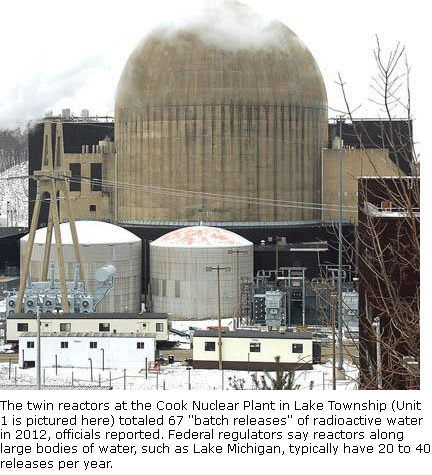 Release of nuclear plant ‘effluents’ into lake described as part of normal cycle Opinions differ on safety of practice Harbor Country News By Andrew Lersten July 17, 2013 COVERT — The May 5 release of about 80 gallons of slightly radioactive water from the Palisades nuclear power plant into Lake Michigan was unusual because it wasn’t planned.
But the incident brought into focus what many Southwest Michigan residents likely didn’t realize: The region’s two nuclear power plants (Palisades and the Donald C. Cook Plant in Lake Township) routinely discharge radioactive material into the air and into Lake Michigan.
In the nuclear industry, it’s called effluents. The federal Nuclear Regulatory Commission allows such releases, as long as they are closely monitored and do not exceed federal radiation release standards set in place by the NRC.
“Plants need to discharge small amounts of radioactive materials to operate,” said Jack Geissner, branch chief for the regional NRC office. Continue reading
107 potential 9/11 type targets – America’s nuclear power plants
Report: U.S. nuclear plants remain vulnerable to terrorists By Jamie Crawford, CNN August 15, 2013 Washington (CNN) — None of the 107 nuclear facilities in the United States are protected against a high-force terrorist attack, and some are still vulnerable to the theft of bomb-grade nuclear fuel, or sabotage intended to cause a nuclear meltdown, a new report says.
The Nuclear Proliferation Prevention Project (NPPP) at the LBJ School of Public Affairs at the University of Texas released the report Thursday. It wants to shine a light on the security gaps that still exist more than 10 years after the terrorist attacks of September 11, 2001.
“It would be a tragedy if the United States had to look back after such an attack on a nuclear reactor and say that we could have and should have done more to prevent the catastrophe,” said Prof. Alan J. Kuperman, co-author of the report.
The study was done at the request of the Defense Department after the Pentagon commissioned an academic study of the security vulnerabilities of the nation’s 104 commercial nuclear power reactors and three civilian research reactors……. Continue reading
Rapid City Council swamped by opponents of uranium mining
Water is precious thing, a gift of life,” said Mark Kammerer, an area rancher who opposes the operation. “I hope you go ahead and come up with a good resolution denying Powertech the use of this water. You have that responsibility to my kids, your kids and kids not yet born. Water is the gift of life. Without it, all life dies.”
 Uranium mining opponents swarm council committee Rapid City Journal, • John Lee McLaughlin Journal staff, 15 Aug 13, After learning that the mayor and three city council members met privately with Powertech representatives, opponents of a proposed uranium mine packed Rapid City’s council chambers on Wednesday to find out where the city stands on the matter.
Despite nearly an hour of testimony, the Legal and Finance Committee declined to take a stand on a resolution opposing the project near Edgemont that needs state and federal approval. The resolution will now be considered Monday night by the Rapid City Council…… opponents to Powertech’s proposed Dewey Burdock mining project were concerned the meeting may have watered down the council’s original opposition, which was discussed at a meeting where council members say they wanted assurance the proposed project wouldn’t hurt the local water supply……
Project opponents voiced concern over the mine’s potential impacts on regional water quality and contamination from heavy metals and radioactive material that they said would pose a risk for 4.4 billion years, which is the half-life of uranium. Continue reading
1 This Month
23-25 October – on Zoom – World BEYOND War’s annual global conferenc


Shut down the radiation-damaged Heysham nuclear reactors now
To see nuclear-related stories in greater depth and intensity – go to https://nuclearinformation.wordpress.com

Say No to NASA’s Reckless Nuclear Reactor on the Moon
Say No to NASA’s Reckless Nuclear Reactor on the Moon

-
Archives
- October 2026 (199)
- September 2026 (339)
- August 2026 (330)
- July 2026 (355)
- June 2026 (287)
- May 2026 (306)
- April 2026 (356)
- March 2026 (251)
- February 2026 (267)
- January 2026 (308)
- December 2025 (358)
- November 2025 (359)
-
Categories
- 1
- 1 NUCLEAR ISSUES
- business and costs
- climate change
- culture and arts
- ENERGY
- environment
- health
- history
- indigenous issues
- Legal
- marketing of nuclear
- media
- opposition to nuclear
- PERSONAL STORIES
- politics
- politics international
- Religion and ethics
- safety
- secrets,lies and civil liberties
- spinbuster
- technology
- Uranium
- wastes
- weapons and war
- Women
- 2 WORLD
- ACTION
- AFRICA
- Atrocities
- AUSTRALIA
- Christina's notes
- Christina's themes
- culture and arts
- Events
- Fuk 2022
- Fuk 2023
- Fukushima 2017
- Fukushima 2018
- fukushima 2019
- Fukushima 2020
- Fukushima 2021
- general
- global warming
- Humour (God we need it)
- Nuclear
- RARE EARTHS
- Reference
- resources – print
- Resources -audiovicual
- Weekly Newsletter
- World
- World Nuclear
- YouTube
-
RSS
Entries RSS
Comments RSS

