Michigan politicians unhappy about Nuclear waste dump near great lakes
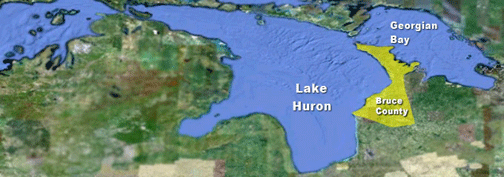 Michigan politicians voice concerns over burying nuclear waste near Kincardine CTV News September 30, 2013 Two American politicians made the trip to Kincardine Monday to share their opposition to burying nuclear waste near the Great Lakes.
“It’s just really astonishing to me that they would consider putting this type of nuclear waste so close to Lake Huron and to our Great Lakes. As I look out here, it’s just even more compelling of a case for me,” says Michigan State Representative Sarah Roberts.
Roberts and Michigan State Senator Hoon Yung Hopgood travelled to Bruce County to say Michigan doesn’t want nuclear waste permanently stored within 1.2 kilometres of the lake their share with Ontario. “In Michigan, every single person that I have talked to says ‘I cannot believe they are considering doing that,'” says Roberts.
Ontario Power Generation wants to bury 200,000 cubic metres of its low and intermediate level nuclear waste in an underground facility on the Bruce Power site…….
While there very well may be opposition in Michigan, it’s harder to find on this side of the border. Every mayor within 150 kilometres of the proposed site is favour of OPG’s plan, including Kincardine Mayor Larry Kraemer…… http://london.ctvnews.ca/michigan-politicians-voice-concerns-over-burying-nuclear-waste-near-kincardine-1.1477370#ixzz2gWBWQW7B
New Renewable Energy Storage System supported by U.S. Dept. of Energy
U.S. Dept. of Energy Supports New Renewable Energy Storage System Oil Price, By John Daly | Sat, 28 September 2013 The two bottlenecks inhibiting further use of renewable energy systems are cost and the fact that the sun doesn’t always shine or the wind blow-in one word, storage. While mass production of components such as solar photovoltaic cells means that their price has been dropping, the issue of storing and releasing electricity generated by renewable sources during their down times has led engineers worldwide to tackle the problem.
Large-scale, low-cost energy storage is needed to improve the reliability, resiliency, and efficiency of next-generation power grids. Energy storage can reduce power fluctuations, enhance system flexibility, and enable the storage and dispatch of electricity generated by variable renewable energy sources such as wind, solar, and water power.
Now one technology seems sufficiently promising that it is receiving funding from the U.S. Department of Energy’s Office of Electricity Delivery and Energy Reliability Energy Storage Program.
What is this promising new technology?
Isothermal compressed air energy storage (ICAES) refers to storage of compressed air at a constant temperature, which is a key element in the improved energy efficiency of the system.
SustainX has completed construction of its first utility scale ICAES system. It was hooked up to the grid earlier this month and it’s now in the process of revving up to speed. The DOE’s Office of Electricity Delivery and Energy Reliability’s Energy Storage Program underwrote $5,396,023 of the system’s cost……..
The DOE is certainly impressed, noting on its “Isothermal Compressed Air Energy Storage” webpage; “SustainX’s ICAES technology offers several advantages: it can be sited anywhere, and it is not dependent on advantageous geological formations. It allows power and energy to scale independently. It consumes no fuel and produces no emissions. It utilizes proven mechanical systems and is composed almost entirely of steel, water, and air. It offers 20 years of performance at full power and capacity and 100% depth of discharge.” Governmental endorsements don’t come much stronger than that.
And how big is the compressed air energy storage industry going to become? According to Navigant Research director Kerry-Ann Adamson, the market will grow dramatically over the next decade. Adamson remarked, “Rapidly changing energy mixes and increasing renewable energy penetration will continue to introduce instability onto electricity grids worldwide in the coming years, while the volatility of load profiles will challenge grid operators to deliver reliable and secure electricity. These macro conditions will drive demand for CAES, helping to rejuvenate a sector that has been largely dormant for the last two decades.” http://oilprice.com/Alternative-Energy/Renewable-Energy/Bill-Gates-Backs-New-Renewable-Energy-Storage-System.html
Obama’s efforts to placate Israel, over negotiations with Iran
Obama tries to reassure Israel over Iranian nuclear negotiations Erin Delmore, @erindelmore 09/30/2013 President Obama today sought to reassure Israeli Prime Minister Benjamin Netanyahu that the United States still has Israel’s back.
On Monday, Obama and Netanyahu met at the White House, just three days afterObama’s historic phone callwith the leader of Iran.
Newly-elected Iranian President Hassan Rouhani and Obama spoke on the phone on Friday, marking the highest-level direct contact between the two countries in more than 30 years.
Obama vowed to proceed with caution toward a potential diplomatic resolution to the Iranian nuclear standoff, and reaffirmed an “unshakable bond” with the Israeli people.
“Because of the extraordinary sanctions… the Iranians are now prepared, it appears, to negotiate,” Obama said, adding that negotiations “will not be easy” and that lifting sanctions would require “the highest standards of verification.”
Obama promised to consult Israel and other allies closely and pledged to “take no actions off the table, including military options.”……..
While Obama on Monday reinforced his step-by-step approach toward dealing with Iran’s nuclear program, which Iranian officials insist is for civilian energy use, Secretary of State John Kerry said in an interview on Sunday that a deal could be reached quickly……..http://tv.msnbc.com/2013/09/30/obama-tries-to-reassure-israel-over-iranian-nuclear-negotiations/
Nuclear chief involved in illegal gambling?
American nuclear chief investigated over casino cheating Navy Vice Admiral Timothy Giardina is accused of using counterfeit poker chips at an Iowa casino The Independent TIM WALKER SUNDAY 29 SEPTEMBER 2013 Apparently, the US military would prefer the officers in charge of its nukes not be the gambling sort. Over the weekend it emerged that Navy Vice Admiral Timothy Giardina, the second-in-command of the US nuclear arsenal, is the subject of an illegal gambling investigation into the use of counterfeit poker chips at an Iowa casino. Admiral Giardina, who has not been arrested or charged, was suspended from his duties on 3 September, officials said on Saturday…….
Financial meltdown facing Central New York nuclear plants
 Central New York nuclear plants struggle to avoid financial meltdown Syracuse.com, By Tim Knauss | tknauss@syracuse.com September 29, 2013 SCRIBA, N.Y. – As recently as four years ago, nuclear power companies were planning to spend billions of dollars to build a new reactor in Oswego County, alongside three existing nuclear plants.
Then the bottom fell out. Natural gas-burning power plants that benefit from a glut of cheap gas produced by hydrofracking cut wholesale electricity prices in half.
Now the outlook for nuclear power plants is so bleak that Wall Street analysts say one or more Upstate nuclear plants could go out of business if conditions don’t change.
Two Upstate nukes in particular – the James A. FitzPatrick Nuclear Power Plant in Oswego County and the R.E. Ginna Nuclear Power Plant in nearby Wayne County – are high on the watch list of plants that industry experts say are at risk of closing for economic reasons……Nuclear critics and industry supporters finally agree on something: Nuclear power, the bedrock of Oswego County’s economy and the biggest source of electricity in Central New York, faces a financial crisis…….
“We should expect more early (plant) retirements,” nuclear critic Mark Cooper, senior fellow at the Institute for Energy and the Environment at Vermont Law School, wrote in a July report. “Rising costs of an aging fleet and the availability of lower cost alternatives are likely to persist over the next couple of decades.”
Across the country, four nukes have shut down this year — the first plant retirements in 15 years — and a fifth announced it will close next year……
The fragile finances of nuclear power have provided new ammunition to anti-nuclear groups. In March, prior to the announcement of Vermont Yankee’s shutdown, a coalition of four groups petitioned the NRC to suspend Entergy’s license to operate FitzPatrick and Vermont Yankee arguing that the plants produce insufficient revenue to maintain and operate the reactors safely. Entergy has not yet responded to the petition…….http://www.syracuse.com/news/index.ssf/2013/09/oswego_county_nuclear_plants_struggle_to_avoid_financial_meltdown.html
Nuclear industry desperately lobbying for government funding
Faced with this situation, the NEI is on a public relations campaign to convince policy makers that nuclear power should be supported and expanded not because it is cheaper – because it is not – but because it provides for energy diversity, reliability and does not produce greenhouse gases.
As for reducing greenhouse emissions, lawmakers are more likely to support solar and wind power. The NEI’s arguments suggest a level of desperation.

Nuclear power rides an economic roller coaster The Day, By Paul Choinie 09/29/2013 It now appears more likely the nuclear industry is entering a period of steady decline, rather than preparing for a rebirth. Adding to the pricing pressure is lower demand for electricity in the United States, caused by a combination of the sluggish economy and improved conservation. Less demand equals lower prices.
It has not been a good year for the nuclear industry. Four reactors have shut down. Vermont Yankee will become a fifth next year. This will leave the nation with fewer than 100 nuclear plants for the first time in decades. The industry acknowledges that at least two of the closings, Vermont Yankee and Kewaunee in Wisconsin, directly relate to price competition. Continue reading
Can USA afford Oakridge’s $12 billion uranium processing folly?
 Estimate for uranium facility goes from $600 million to $11.6 billion, LA Times, 28 Sept 13 It would be one of the largest nuclear weapons investments since World War II. The cost of a proposed uranium processing facility for nuclear weapons in Oakridge, Tenn., has soared as high as $11.6 billion — 19 times the original estimate — even as critics accuse the Energy Department of overstating the need for spare bomb parts.
Under a proposal unveiled in 2005, the manufacturing plant at the Y-12 National Security Complex would produce new uranium cores for the nation’s stockpile of aging hydrogen bombs.
But not long after the plan was disclosed, with an estimated cost of $600 million, the price tag began to climb. Now, the processing facility would be among the largest investments in the U.S. nuclear weapons infrastructure since the Manhattan Project, which developed the atomic bomb during World War II.
The facility has drawn sharp criticism by the Project on Government Oversight, a Washington watchdog group, which advocates that the plan be scrapped. In a report issued Wednesday, the group cites a little-noticed report by the Army Corps of Engineers that made the $11.6-billion cost estimate and argued that the work could be done more cheaply at existing facilities……
The escalating cost reflects questions that have troubled the Energy Department’s nuclear weapons complex since the end of the Cold War: How long will the Pentagon need a stockpile of nuclear weapons, and how can the massive industrial network needed to maintain the bombs be kept going at an affordable level?…… http://www.latimes.com/nation/la-na-bomb-factory-20130925,0,6160248..story
Pilot study of cancer rates near nuclear sites
Oyster Creek plant part of new study examining cancer risks near nuclear sites NJ.com 29 Sept 13,A pilot study of cancer risks in people living near six nuclear power plants across the United States will include Oyster Creek in Ocean County, the nation’s oldest nuclear plant.
The U.S. Nuclear Regulatory Commission said Monday that the pilot study will examine multiple cancer types in populations of all ages living near the sites, and will study cancers in children born near the sites…… The National Academy of Sciences, which is conducting the study, said the sites provided a good sampling of facilities with different operating histories and population sizes. It would not say whether the locations were chosen because of their cancer rates. Continue reading
Public meeting on the disposal of dead San Onofre nuclear power plant
 Nuclear Regulatory Commission Debates San Onofre Plant Shutdown At (includes Video) First Public Meeting http://losangeles.cbslocal.com/2013/09/26/nuclear-regulatory-commission-debates-san-onofre-plant-shutdown-at-first-public-meeting/ September 26, 2013 SAN ONOFRE (CBSLA.com) — The Nuclear Regulatory Commission met on Thursday to debate the potential effects of shutting down the troubled San Onofre Nuclear Generating Station.
KCAL9′s Stacey Butler reports hundreds of residents gathered for their first chance to hear what’s next for the plant since it was permanently closed earlier this year.
Gary Headrick led the charge to have the plant shut down for good.
“There are issues that can challenge us even more than having a reactor operating,” he said.
Headrick and others asked the NRC what they plan to do with the radioactive spent fuel rods.
He says they don’t have a proven storage technique. “Not only nuclear waste, but toxic waste that’s part of the decommissioning process will be released into the ocean and the environment. There is high burn-up fuel which is much different than at other nuclear facilities which makes it harder to store nuclear waste,” he said.
Activist Carol Jahnkow is asking for a citizens oversight committee.
“We don’t want to wait two years to find out what they’re going to do, how much they’ve been spending in the interim and what safety precautions they’ve taken,” she said.
An NRC spokesman said the agency will be watching Edison’s every move. “The decommissioning activity will be done safely under the watchful eyes of the NRC, and it’s not over until we say it’s over,” he said.
An Edison spokesperson declined an on-camera interview but said that it will cost over $4 billion to decommission the plant. Customers’ rates, the spokesperson said, will not go up for five years.
An NRC spokesperson said Edison is looking at either disassembling the plant quickly or letting it sit for 30 years while waiting for the radioactivity to decay.
Citizens want to oversee decommissioning of San Onofre nuclear plant
 Citizens seek role in San Onofre decommissioning By ERIKA I. RITCHIE / ORANGE COUNTY REGISTER, 26 Sept 13, CARLSBAD – Speaking on behalf of several hundred people, Gene Stone asked officials from the Nuclear Regulatory Commission on Thursday night to consider the formation of a citizens coalition that would help oversee the decommissioning of the San Onofre Nuclear Generating Station, a process that could take decades.
“We are here today in the hope that the Nuclear Regulatory Commission will make San Onofre the flagship project for a safe-and-sane cleanup of America’s effort at decommissioning our old and … http://www.ocregister.com/articles/decommissioning-528288-nuclear-edison.html
Financially no chance for a nuclear power plant in Utah

 Expert calls proposed Utah nuclear power plant a ‘non-starter’ Trial » Energy analyst says Blue Castle lacks financing, market for proposed Utah project. By Brian Maffly The Salt Lake Tribune Sep 26 2013 Lacking sufficient financing and a real market, Blue Castle Holdings has no hope of developing a nuclear power plant in Utah, according to an energy analyst who testified Thursday in a trial over the project’s water rights.
“You can’t sell 14-cent power in a market where power costs 8 or 10 cents [per kilowatt-hour]. That’s why the nuclear renaissance has collapsed. If you can’t compete, you can’t raise money to build these projects,” said Mark Cooper in an interview, echoing his testimony in Price’s 7th District Court……..
The week-long trial before Judge George Harmond focuses on whether the state appropriately assigned 53,000 acre feet of water to the Blue Castle project. Closing arguments are scheduled Friday, but Harmond is not expected to rule right away…….
The suit, brought by Utah environmental groups and local water users, attacks the only issue in the nuclear controversy where the state exercises control. Should Blue Castle secure the right to suck enough water out of the Green River to supply a city the size of Orem, its proposal will rest entirely in the hands of the U.S. Nuclear Regulatory Commission (NRC).
To secure a water right, state law requires a finding that the proposed purpose is economically and physically feasible, is in the public interest, and financing is available. Blue Castle fails on all these points, according to Cooper, a fellow for economic analysis in the Institute for Energy and the Environment at Vermont Law School…….”The only states where [nuclear reactors] are being built is in states where the risk has been shifted to the ratepayers,” Cooper said. http://www.sltrib.com/sltrib/politics/56920646-90/nuclear-blue-castle-project.html.csp
If Indian Point Nuclear Reactor melted down – who would pay ?
 NEW YORK WONDERS WHERE NUCLEAR CLEANUP FUNDS WOULD COME FROM, Next Gov 25 Sept 13 Who — and what pot of money — would drive cleanup after a severe nuclear-power-plant incident is a question still left unanswered by the federal government, New York state officials say in a recent legal filing with the Nuclear Regulatory Commission.
Under the Price-Anderson Act, which Congress first passed in 1957 and has renewed several times since, the nuclear-power industry’s liability in the event of a catastrophe at one of its facilities is limited. The industry pays into an insurance account — which NRC officials say has a current value of $12 billion — that would be used to compensate the public for various damages incurred as the result of an incident. Those costs could be related to hotel stays, lost wages and property replacement.
However, how actual cleanup of the contaminated area surrounding a compromised facility would be paid for remains unclear, the New York state attorney general’s office notes in the Sept. 13 filing with the commission. In 2009, NRC officials informed their counterparts at the Homeland Security Department and the Environmental Protection Agency that the Price-Anderson money likely would not be available to pay for offsite cleanup — a revelation made public a year later when internal EPA documents were released under the Freedom of Information Act.
Another three years have gone by and the federal government has yet to provide a clear answer, the New York AG office says. Last year, NRC Commissioner William Magwood acknowledged in a presentation to the Health Physics Society that “[t]here is no regulatory framework for environmental restoration following a major radiological release.”……….
In the new filing, the state again asks the commission to identify which federal agency would be responsible for cleaning up radiation released by the Indian Point reactors and spent-fuel pools, as well as whether Price-Anderson funds would be available to support such a cleanup.
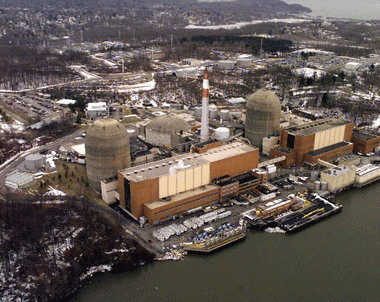
“Given the unique characteristics of Indian Point, the State believes it is especially important that the public have access to this information,” the New York AG office says, adding that more than 17 million people live within 50 miles of the facility.
“The communities within the 50-mile radius around Indian Point also contain some of the most densely-developed and expensive real estate around the country, critical natural resources, centers of national and international commerce, transportation arteries and hubs, and historic sites,” the state says. “Thus, the decontamination costs of a severe accident at Indian Point have the potential to be larger than an accident at any other reactor in the country.”
Asked to comment, NRC spokesman Scott Burnell said the commission’s general counsel office would respond directly to the New York AG office “as appropriate.” http://www.nextgov.com/defense/2013/09/new-york-wonders-where-nuclear-cleanup-funds-would-come/70800/?oref=ng-dropdown
World’s largest solar thermal plant now in action
World’s biggest solar thermal power plant fired up in California Grist By John Upton 25 Sept 13 Business Wire Ivanpah The 3,500-acre Ivanpah Solar Electric Generating System is a startling sight in the Mojave Desert. Three sprawling units each contain a circular array of mirrors reflecting rays from the sun toward a 459-foot central tower. Water in the tower is heated by the rays to produce steam, which spins turbines and — voila — electricity is produced.
It all seems a bit magical, but as of Tuesday, the world’s largest solar thermal power plant began feeding energy into a power grid for the first time.

How much energy? Once fully operational, the project is expected to produce 377 megawatts of power that will be sold to two Californian utilities, helping the state’s electricity sector meet ambitious, state-mandated renewable energy goals. During some days it could provide enough power for more than 200,000 homes.
Partners in the project include NRG Energy, BrightSource Energy, Google, Bechtel and, of course, you and me. The federal government leased public land to the effort and backed it up with one of those loan guarantees that you heard so much about in 2011 and 2012…….http://grist.org/news/worlds-biggest-solar-thermal-power-plant-fired-up-in-california/?utm_campaign=daily&utm_medium=email&utm_source=newsletter&sub_email=chris%40protectourwinters.org
Treating 56 million gallons of radioactive trash the fist step to clean up Hanford
At the height of World War II, the federal government created Hanford to build the atomic bomb. Today, it is the nation’s most contaminated nuclear site, with cleanup expected to last decades. The effort — at a price tag of about $2 billion annually — has cost taxpayers $40 billion to date and is estimated to cost $115 billion more.
The most challenging task so far has been the removal of highly radioactive waste from the 177 aging, underground tanks and construction of a plant to treat that waste
Phased start to Hanford nuclear cleanup recommended http://www.usatoday.com/story/news/nation/2013/09/24/doe-government-hanford-radioactive-waste-phased-start/2866155/AP September 24, 2013
Dep’t. of Energy urges starting to treat plant’s 56M gallons of waste as soon as possible. KENNEWICK, Wash. (AP) — The federal government is recommending a phased start to treatment of radioactive waste now held in underground tanks at the Hanford Nuclear Reservation in Washington state.
The Department of Energy, in a report released Tuesday, proposes starting to treat some of Hanford’s 56 million gallons of waste for disposal as soon as possible, while work continues to resolve technical issues at the vitrification plant’s Pretreatment and High Level Waste Facilities, the Tri-City Herald reported.
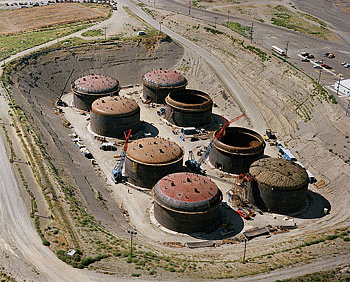
Treatment would include sending some low activity radioactive waste directly to the plant’s Low Activity Waste Facility to be prepared for disposal. That would require bypassing the Pretreatment Facility, which originally was planned to separate all the tank waste into low activity and high level waste streams for separate treatment. Continue reading
A litany of bad news for the US nuclear industry
 Wall Street firm Credit Suisse set the tone in February with a report that described the aging U.S. fleet of nuclear power plants as “facing declining performance, higher costs and inevitable mortality.
by Elizabeth Douglas, theguardian.com, Wednesday 25 September 2013 As the economics of building plants and maintaining old ones erode, some experts see little hope for an industry being touted by some as a climate savior.
A string of plant closures, project cancellations and other setbacks has raised new doubts about the future of nuclear power in the United States, but there’s disagreement about whether the retrenchment will be limited and temporary or the beginning of a broad and permanent decline.Renewed safety concerns and reinvigorated local opposition have played a role in the industry’s recent troubles. But the most potent foe—and the primary force behind the spate of closures and abandoned projects—is economic.The industry’s run of bad news includes: Continue reading
1 This Month
23-25 October – on Zoom – World BEYOND War’s annual global conferenc


Shut down the radiation-damaged Heysham nuclear reactors now
To see nuclear-related stories in greater depth and intensity – go to https://nuclearinformation.wordpress.com

Say No to NASA’s Reckless Nuclear Reactor on the Moon
Say No to NASA’s Reckless Nuclear Reactor on the Moon

Please sign the petition here: https://www.change.org/p/stop-japan-s…
-
Archives
- October 2026 (190)
- September 2026 (339)
- August 2026 (330)
- July 2026 (355)
- June 2026 (287)
- May 2026 (306)
- April 2026 (356)
- March 2026 (251)
- February 2026 (267)
- January 2026 (308)
- December 2025 (358)
- November 2025 (359)
-
Categories
- 1
- 1 NUCLEAR ISSUES
- business and costs
- climate change
- culture and arts
- ENERGY
- environment
- health
- history
- indigenous issues
- Legal
- marketing of nuclear
- media
- opposition to nuclear
- PERSONAL STORIES
- politics
- politics international
- Religion and ethics
- safety
- secrets,lies and civil liberties
- spinbuster
- technology
- Uranium
- wastes
- weapons and war
- Women
- 2 WORLD
- ACTION
- AFRICA
- Atrocities
- AUSTRALIA
- Christina's notes
- Christina's themes
- culture and arts
- Events
- Fuk 2022
- Fuk 2023
- Fukushima 2017
- Fukushima 2018
- fukushima 2019
- Fukushima 2020
- Fukushima 2021
- general
- global warming
- Humour (God we need it)
- Nuclear
- RARE EARTHS
- Reference
- resources – print
- Resources -audiovicual
- Weekly Newsletter
- World
- World Nuclear
- YouTube
-
RSS
Entries RSS
Comments RSS

