Department of Defense Releases Fiscal Year 2024 Military Intelligence Program Budget – just the bare $29.8 billion

Today, the Department of Defense released the Military Intelligence Program (MIP) appropriated top line budget for FY2024. The total was $29.8 billion and is aligned to support the National Defense Strategy.
The Department determined that releasing this top line figure does not jeopardize any classified activities within the MIP. No other MIP budget figures or program details will be released, as they remain classified for national security reasons.
Nuclear Energy “Renaissance”: Should You Buy NuScale Power Stock?

The Motley Fool, By Brett Schafer – Oct 27, 2024
Key Points
The stock is incredibly risky at the moment.
NuScale Power stock is up close to 500% this year.
The company wants to disrupt the energy market with small modular reactors.
Companies are betting big on nuclear energy to power AI…………..
Tens of billions are going to be spent on nuclear power in the next few decades, but there are few publicly traded nuclear energy stocks one can buy. One, NuScale Power Corp (SMR -0.68%), plans to disrupt the market with its new small modular reactors (SMRs). Its shares are up close to 500% this year as investors pile into the nuclear energy trade. Should you follow them and buy some shares yourself?
………………………NuScale won’t generate meaningful revenue for years
The problem is, NuScale Power is far from this reality. The company has never sold an SMR and has virtually zero revenue today. Many companies in multiple countries have proposed deals with NuScale, but none are operational and, if they ever get built, they won’t be ready until 2030 or later. That is over five years until NuScale Power is generating any form of revenue, let alone profits.
Given all the upfront costs in research and development, Nuscale is currently burning a lot of cash. Over the last 12 months, its free cash flow was negative $170 million. That is more than the cash it holds on the balance sheet ($130 million). What this means is NuScale is set to run out of money within a year but needs over five years of runway — if not more — before getting its SMRs commercialized. Management is going to need to raise money in the form of stock offerings or debt to bridge the gap between this cash burn and the time when its SMRs finally get sold.
The stock is shaky, at best
Investors in NuScale Power are thinking all about the upside of SMR technology right now. That is why the stock is up close to 500% in less than 12 months. However, there is a lot of potential downside that they may be forgetting right now, and that is how investors can get in trouble.
For one, it trades at a market cap of $1.7 billion and has zero revenue. Shareholders are likely going to be weighed down by stock offerings or debt, which will need to happen within the next 12 months. This will present a headwind to long-term shareholder returns.
Two, we don’t even know if the SMR technology will work. It isn’t proven, and it is unclear whether utilities want these solutions or the older large nuclear reactors. The idea of SMRs makes sense, but it is only an idea. And ideas don’t generate positive cash flow.
NuScale Power is a pre-revenue business burning a ton of cash that will likely stay pre-revenue through 2030. Even though the stock is soaring, smart investors will stay far away from this risky stock. There are better places to store your money right now. https://www.fool.com/investing/2024/10/27/nuclear-energy-renaissance-should-you-buy-nuscale/?fbclid=IwY2xjawGQ6g9leHRuA2FlbQIxMQABHTdbZQF5x3-PErplyYXEJmIRC-1UX_k9hjjgDgdnSdU8KfJLMojZSpSrlQ_aem_felvtV_-cil14iXalVC_yg
Technical troubles delay new tests at huge Eastern WA radioactive waste melter

BY ANNETTE CARY, Tri City Herald, June 21, 2024
The Department of Energy is unlikely to meet a deadline set by a federal court for the next step to prepare the Hanford site’s vitrification plant to treat radioactive waste for disposal. On Thursday DOE notified the Washington state Department of Ecology that it was at risk of not meeting the Aug. 1 deadline to start cold commissioning of the plant, a test of vitrification using nonradioactive chemicals to simulate waste before radioactive waste is introduced into the plant.
DOE is asking the Department of Ecology to agree to a four-month extension to Nov. 29 of this year. “The process for commissioning this first-in-kind facility is comprehensive and dynamic,” said DOE Hanford Manager Brian Vance in a message to Hanford employees Thursday…………………..
DOE remains committed to starting treating radioactive waste by the federal court consent decree deadline of August 2025, Vance said, despite the shortened time proposed between the start of cold commissioning and introducing radioactive waste into the plant for hot commissioning. DOE broke ground 22 years ago on the vitrification plant at the Hanford nuclear reservation to turn much of the 56 million gallons of radioactive and hazardous chemical waste stored in underground tanks into a stable glass form for disposal.
The waste is left from chemically processing uranium fuel irradiated at the Hanford site adjacent to Richland in Eastern Washington to produce nearly two-thirds of the plutonium for the nation’s nuclear weapons program from World War II through the Cold War.
The current plan is to begin treating some of the least radioactive tank waste next year as DOE continues to work toward meeting a consent decree deadline to also start treating high level radioactive waste in the tanks by 2033.
The 2010 consent decree resulted from a Department of Ecology lawsuit over legal deadlines that DOE had missed or was near certain to miss. The consent decree deadlines originally called for cold commissioning to treat both low activity radioactive waste and high level radioactive waste to begin in 2018. Consent decree deadlines have been extended several times over the last 14 years, including to allow DOE more time due to work delays caused by the COVID pandemic. The Department of Ecology said Thursday morning that it was reviewing the notification from DOE, which also was sent to Oregon.
If the Department of Ecology agrees to the extension, the federal court must then sign off on the change. TECHNICAL ISSUE AT HANFORD PLANT DOE told the Department of Ecology in its notification Thursday that it has had technical issues with the glass former system at the vitrification plant’s Low Activity Waste Facility.
Glass forming materials are planned to be mixed with waste and then heated to fill canisters with a molten glass mixture. After cooling, the radioactive waste will be immobilized and ready for disposal.
The glass forming material is trucked to 12 vertical tanks outdoors at the vitrification plant in central Hanford. From there horizontal pipes with a screw conveyor are used to move the solid glass forming material into vessels inside the plant before the glass forming material and waste or waste simulant are added to melters.
There have been problems with clogging as the system has been used so far to move 40,000 pounds of glass forming material into the plant. The issue with the glass forming system is the main reason DOE has asked for a deadline extension, but it also has some other issues it is addressing at the vitrification plant that might interfere with the Aug. 1 deadline to start cold commissioning. Other issues are with the thermal catalytic oxidizer, the steam plant Morrison tubes and the overall reliability of the mechanical handling system, DOE told the Department of Ecology.
The delay comes as DOE and its vitrification plant contractor Bechtel National have been making progress on preparing to treat waste at the vitrification plant……….
The first shipment of 10,000 gallons of the simulated waste, which is liquid sodium hydroxide, has been delivered to the vitrification plant for the start of cold commissioning after technical issues with the glass forming system are resolved…….. https://www.tri-cityherald.com/news/local/hanford/article289415648.html?fbclid=IwY2xjawGQ85pleHRuA2FlbQIxMAABHXSOmqPdX05-ob45hMlDtydxbNAUQaYy3hZHsjjJN36uXswbGOitN8vfCw_aem_T6xrJeHnpOhqhMLAvIemaQ
The Rise and Fall of NuScale: a nuclear cautionary tale

Kelly Campbell, October 29, 2024 ,
https://oregoncapitalchronicle.com/2024/10/29/the-rise-and-fall-of-nuscale-a-nuclear-cautionary-tale/
A decade ago, NuScale, the Oregon-based small modular nuclear company born at Oregon State University, was on a roll. Promising a new era of nuclear reactors that were cheaper, easier to build and safer, their Star Wars-inspired artist renditions of a yet to be built reactor gleamed like a magic bullet.

As of last year, NuScale was the furthest along of any reactor design in obtaining Nuclear Regulatory Commission licensing and was planning to build the first small modular nuclear reactor in the United States. Its plan was to build it in Idaho to serve energy to a consortium of small public utility districts in Utah and elsewhere, known as UAMPS.
This home-grown Oregon company was lauded in local and national media. According to project backers, a high-tech solution to climate change was on the horizon, and an Oregon company was leading the way. It seemed almost too good to be true.
And it was.
image

Turns out, NuScale was a house of cards. The UAMPS project’s price tag more than doubled and the timeline was pushed back repeatedly until it was seven years behind schedule. Finally, UAMPS saw the writing on the wall and wisely backed out in November, 2023.
After losing their customer, NuScale’s stock plunged, it laid off nearly a third of its workforce, and it was sued by its investors and investigated for investor fraud. Then its CEO sold off most of his stock shares.
NuScale’s project is the latest in a long line of failed nuclear fantasies.

Why should you care? A different nuclear company, X-Energy, now in partnership with Amazon, wants to build and operate small modular nuclear reactors near the Columbia River, 250 miles upriver from Portland.

Bill Gates’s darling, the Natrium reactor in Wyoming is also plowing ahead. Both proposals are raking in the Inflation Reduction Act and other taxpayer funded subsidies. The danger: Money and time wasted on these false solutions to the climate crisis divert public resources from renewables, energy efficiency and other faster, more cost-efficient and safer ways to address the climate crisis.
A recent study from the Institute for Energy Economics and Financial Analysis concluded that small modular nuclear reactors are still too expensive, too slow to build and too risky to respond to the climate crisis.
While the nuclear industry tries to pass itself off as “clean,” it is an extremely dirty technology, beginning with uranium mining and milling which decimates Indigenous lands. Small modular nuclear reactors produce two to thirty times the radioactive waste of older nuclear designs, waste for which we have no safe, long-term disposal site. Any community that hosts a nuclear reactor will likely be saddled with its radioactive waste – forever. This harm falls disproportionately on Indigenous and low-income communities.

For those of us downriver, X-Energy’s plans to build at the Hanford Nuclear Site on the Columbia flies in the face of reason, as it would add more nuclear waste to the country’s largest nuclear cleanup site.
In Oregon, we have a state moratorium on building nuclear reactors until there is a vote of the people and a national waste repository. Every few years, the nuclear industry attempts to overturn this law at the Oregon Legislature, but so far it has been unsuccessful. This August, Umatilla County Commissioners announced they’ll attempt another legislative effort to overturn the moratorium. Keeping this moratorium is wise, given the dangerous distraction posed by the false solution of small modular nuclear reactors. Let’s learn from the NuScale debacle and keep our focus on a just transition to a clean energy future–one in which nuclear power clearly has no place.
Biden to Bibi: ‘OK to continue Gaza genocide till after election’

Walt Zlotow, West Suburban Peace Coaliton, Glen Ellyn IL, 27 Oct 24
On October 14, President Biden sent a letter to Israeli Prime Minister Benjamin Netanyahu giving Israel 30 days to allow more aid of food, water and medicine into Gaza’s 139 square miles being utterly destroyed by Israel for the past year. It’s noteworthy that the 30 day time limit ends 9 days after the US election. Biden’s letter is brilliant politics and grotesque governance. Biden, who has been funding, supporting and enabling the yearlong genocide in Gaza, desperately needs to appear peace loving ahead of the election. He knows a majority of his Democratic voters are horrified by his genocide enabling. They want him to end the so far 50,000 tons of weapons he’s already given Israel to demolish Gaza.
The letter, designed to promote his concern for the devastation he’s enabled, will do nothing to end the genocide in Gaza. Netanyahu has ignored every one of Biden’s pleas for supplying life sustaining aid there. The letter doesn’t even state Biden will cut off aid to Israel. It merely implies that if US demands aren’t met, the US might consider enforcing foreign assistance laws. Those laws forbid the US from sending weapons to any nation committing wholesale destruction of civilian populations. But not one word about actually cutting off those weapons destroying Gaza.
Every day dozens, hundreds, even a thousand or more Palestinians die in Gaza, obliterated by Biden’s 2,000 lb. bombs, or killed more slowly from disease or starvation. Biden does not care. His toothless letter begging for more aid to the 2,300,000 Palestinians will do nothing to alleviate their suffering. But it may mollify his antiwar critics enough to help achieve Democratic victory Election Day.
Win or lose November 5, Biden is unlikely to do anything substantive to end the genocidal ethnic cleansing of Gaza. It goes against everything he’s believed in and supported about Israeli colonial domination of Palestine for his entire 52 year governmental career. But it will ensure he descends into historical infamy for enabling the worst genocide of the 21st century.
US nuclear regulator kicks off review on Three Mile Island restart
By Laila Kearney, October 26, 2024
- Summary
- Companies
- NRC holds first public meeting on Three Mile Island restart
- Constellation wants to restore Unit 1’s operating license
- NRC requests more emergency, environmental restart plan details
- Watchdog group questions plans, including simulator
NEW YORK, Oct 25 (Reuters) – U.S. nuclear regulators kicked off a long-winding process to consider Constellation Energy’s (CEG.O), opens new tab unprecedented plans to restart its retired Three Mile Island nuclear power plant in an initial public meeting held on Friday.
Constellation, which announced last month that it had signed a 20-year power purchase agreement with Microsoft that would enable reopening the Unit 1 reactor at Three Mile Island, made its case before the Nuclear Regulatory Commission to restore its operating license for the plant.
The company also sought to extend the life of the plant and change its name to the Crane Clean Energy Center.
Three Mile Island, which is located in Pennsylvania on an island in the Susquehanna River, is widely known for the 1979 partial meltdown of its Unit 2 reactor. That unit has been permanently shut and is being decommissioned.
Members of the NRC requested details about the emergency evacuation plans for the restarted plant and information about the commercial deal with Microsoft, while imploring Constellation to quickly work on permitting related to its water use for the plant.
The NRC also raised questions about how the restart of Unit 1 would intersect with the decommissioning of Unit 2, which began last year, nearly 45 years after the partial meltdown.
Utah-based nuclear services company EnergySolutions owns Unit 2 and related infrastructure, while Constellation owns Unit 1 and the site’s land.
Unit 1 shut down due to economic reasons in 2019, some 15 years before the operating license was set to expire. At the time, Constellation said it did not anticipate a restart.
Constellation now expects to restart the 835-megawatt Unit 1 in 2028, delivering power to the grid to offset electricity use by Microsoft’s data center in the region.
A recent jump in U.S. electricity demand, driven in part by Big Tech’s energy-intensive AI data center expansion has led to a revival of the country’s struggling nuclear industry.
No retired reactor has been restarted before. The Palisades nuclear plant in Michigan, owned by Holtec, is also in the process of being resurrected.
…………………..The physical work to restore Three Mile Island, which is expected to start in the first quarter of 2025, cost at least $1.6 billion, and could require thousands of workers, still needs licensing modifications and permitting.
Local activists have also vowed to fight the project over safety and environmental concerns, including the storage of nuclear waste on the site.
Scott Portzline, who is with nuclear watchdog group Three Mile Island Alert in Harrisburg, questioned the site’s backup power and criticized the proposed nuclear control room simulator used for training.
“I have a constitutional right to know how my nuclear plants are operating and the utility ought to be able to answer that,” Portzline said during the meeting……….
Under the National Environmental Policy Act, the NRC will be required to complete an environmental assessment within the final year of any restart. The plant will require other environmental permits, including ones for air emissions and water pollutants. https://www.reuters.com/business/energy/us-nuclear-regulator-hears-three-mile-island-power-plant-restart-plan-2024-10-25/
Wildlife Refuge’s Toxic Past Still A Colorado Concern
A national wildlife refuge that was contaminated by plutonium from the 1950s through the early 1990s is still a health concern for nearby Colorado communities.
Gary Stoller, Forbes, Oct 25, 2024
For many decades, Rocky Flats has been a controversial contaminated site south of Boulder, Colorado, about 20 miles north of Denver. The controversy continues, as nearby communities refuse to further develop the 6,200-acre site that’s now a wildlife refuge with trails for walkers and cyclists.
Rocky Flats, which housed facilities to produce nuclear weapons components from 1952 through the early 1990s, was contaminated by plutonium and other nuclear materials. Cleanup ended in 2006, and, a year later, the U.S. Fish and Wildlife Service designated the site as the Rocky Flats National Wildlife Refuge. Federal government officials say the area used for the refuge is safe for human visitors, but neighboring cities Westminster and Broomfield and the town of Superior apparently remain unconvinced.
For many decades, Rocky Flats has been a controversial contaminated site south of Boulder, Colorado, about 20 miles north of Denver. The controversy continues, as nearby communities refuse to further develop the 6,200-acre site that’s now a wildlife refuge with trails for walkers and cyclists.
Rocky Flats, which housed facilities to produce nuclear weapons components from 1952 through the early 1990s, was contaminated by plutonium and other nuclear materials. Cleanup ended in 2006, and, a year later, the U.S. Fish and Wildlife Service designated the site as the Rocky Flats National Wildlife Refuge. Federal government officials say the area used for the refuge is safe for human visitors, but neighboring cities Westminster and Broomfield and the town of Superior apparently remain unconvinced.
Last month, Westminster withdrew from an intergovernmental agreement to fund the building of a tunnel and a bridge into the refuge. Such construction would improve access to the refuge — home to more than 200 wildlife species— for hikers, walkers, cyclists and outdoor enthusiasts. Broomfield and Superior had previously withdrawn their support.
The refuge is part of the Rocky Mountain Greenway, a 25-mile trail that reaches from Commerce City, a Denver suburb, into Boulder and Jefferson counties. The trail links Rocky Flats with the Rocky Mountain Arsenal, land outside of downtown Denver that also was cleaned up after contamination from the manufacture of chemical warfare agents, including mustard gas, for World War II.
In a 2006 report, the U.S. Government Accountability Office said $10 billion had been spent since 1995 to clean up Rocky Flats. The amount of cleanup waste that had to be removed “was equivalent to a 65-story building the length and width of a football field,” the GAO said…………….
The majority of Westminster city councilors said last month they feared foot traffic could stir up plutonium, according to a story published by Colorado Community Media, which has publications in eight Colorado counties. Critics said measurable radioactive materials remain in and around the Rocky Flats site and will remain for thousands of years, the media group reported. https://www.forbes.com/sites/garystoller/2024/10/25/wildlife-refuges-toxic-past-still-a-colorado-concern/
Mission Innovation should not send tax-payer money to Bill Gates’ nuclear dream

We cannot trust billionaire philanthropists to lead the way on climate action, Online Opinion, By Noel Wauchope , 16 December 2015 “…….At the opening of the Paris Climate Summit (COP21), with the blessing of the White House, Bill Gates announced the Breakthrough Energy Coalition (BEA), with an ambitious goal to deal with climate change. 24 billionaire philanthropists have joined in the BEA. They include Richard Branson, Mark Zuckerberg, and Jeff Bezos.
Simultaneously 19 governments, including the United States, China and India, announce “Mission Innovation”, a project that will involve tax-payer money to explore and invent new ways to develop low carbon energy.
Not surprisingly, the two organisations will work in tandem. The billionaire philanthropists plan a public-private partnership between governments, research institutions, and investors that will focus on new energy methods especially for developing countries……
For a start, this twin project is directed at researching new forms of low carbon energy. A lot of money therefore is to go into trying out new plans, that exist at best, only in blueprint form. Yet already there are in operation large scale and small scale renewable energy projects that could be deployed. In particular, small scale solar energy is very well suited to being deployed in rural India, Africa, and other developing nations, as well as in Australia and other developed nations. It is happening now. Projects such as Barefoot Power have operated for years now, bringing affordable solar power to millions of rural poor in Africa, Asia Pacific, India and the Americas.
The energy need now for poor countries is deployment of existing technologies, not years of research and testing of so far non-existent ones………
- The one and only University that has joined BEA is the University of California, which runs the Lawrence Berkeley National Laboratory, well known for its nuclear research.
- Bill Gates is co-founder and current Chairman of the innovative nuclear energy company TerraPower Gates has a long term history of enthusiasm for small nuclear power reactors. Since the Fukushima nuclear disaster, USA’s Nuclear Regulatory Commission has tightened the rules for new reactors. Fortunately for Mr Gates, China is less fussy about this, so Gates has been able to do a deal with the China National Nuclear Corporation (CNNC). TerraPower and CNNC will build the first small 600 MW unit in China, and later deploy these nuclear reactors globally.
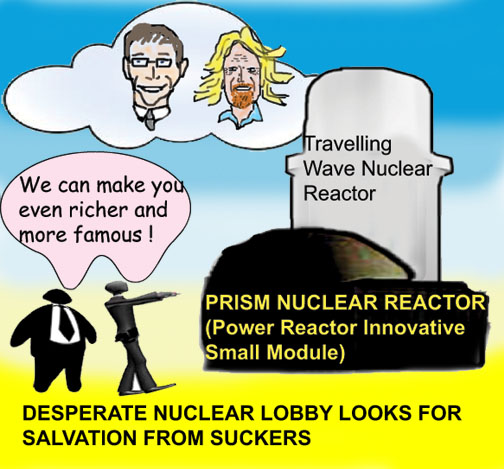
I don’t doubt that Bill Gates is sincere in his goal of reducing greenhouse gases. It’s just that I have reservations about Small Nuclear Reactors having any impact on global warming.
If Small Nuclear Reactors did in fact reduce greenhouse gases, the world would need thousands of them to be up and running quickly, but they’re still at the planning stage. They’re supposed to be much safer than conventional nuclear reactors, but still produce radioactive wastes, and are targets for terrorism. Each and every one of them would need 24 hour guarding. It gets expensive………
The term selected “Breakthrough Energy Initiative” gives the game away. For many years now, America’s Breakthrough Institute has lobbied and publicised “new nuclear” as the solution for climate change. The Breakthrough Institute has many well-meaning and enthusiastic environmentalists as members. Its philosophy, expressed in “The Ecomodernist Manifesto” is full of beautiful motherhood statements about climate and environment, and only a few paragraphs about new nuclear technology.
This Manifesto, by the way, appears as a Submission to the South Australian Nuclear Fuel Cycle Royal Commission.
The effect of the Breakthrough Institute, over the years, has been to slow down action on reducing the use of fossil fuels. It has also aimed to discredit renewable energy……..http://www.onlineopinion.com.au/view.asp?article=17899
The New Nuclear Push: New Package, Same Lies

Karl Grossman, https://www.counterpunch.org/2024/10/23/the-new-nuclear-push-new-package-same-lies/
Nuclear power zealots are engaged in their biggest push in years in the United States and internationally. Headlines of recent pieces online about nuclear power include: “Japan’s top business lobby proposes maximum use of nuclear energy.” And, U.S. “looks to resurrect more nuclear power.” And, “European nations back nuclear power ahead of major climate summit.” And, “The super-rich are looking at nuclear power for emission-free yacht voyages.” And, “France plans to turn nuclear waste into forks, doorknobs and saucepans.”
Central to the drive: they’re trying to latch on to climate change as a new reason for nuclear power with the claim that it is “carbon-free” or “emissions-free.”
This is untrue especially when the “nuclear fuel chain” is taken into account.
“The dirty secret is that nuclear power makes a substantial contribution to global warming. Nuclear power is actually a chain of highly energy-intense industrial processes,” Michel Lee, an attorney and chair of the Council on Intelligent Energy & Conservation Policy, has said. “These include uranium mining, conversion, enrichment and fabrication of nuclear fuel; construction and deconstruction of the massive nuclear facility structures; and the disposition of high-level nuclear waste.”
In a two-page fact sheet that is online titled “How Nuclear Power Worsens Climate Change,” the Sierra Club Nuclear Free Campaign says: “Nuclear power has a big carbon footprint. At the front end of nuclear power, carbon energy is used for uranium mining, milling, processing, conversion, and enrichment, as well as for formation of [fuel] rods and construction of nuclear…power plants….All along the nuclear fuel chain, radioactive contamination of air, land and water occurs. Uranium mine and mill cleanup demands large amounts of fossil fuel. Each year 2,000 metric tons of high-level radioactive waste and twelve million cubic feet of low-level radioactive waste are generated in the U.S. alone. None of this will magically disappear. Vast amounts of energy will be needed to isolate these dangerous wastes for generations to come.”
The main release of carbon occurs during this nuclear fuel cycle; however, nuclear plants themselves also emit carbon, a radioactive form, Carbon 14.
Still, many politicians and much of media continue to use the words “carbon-free” or “emissions-free” when it comes to nuclear-generated electricity. Consider the front-page story in the business section of The New York Times this month that began: “Technology companies are increasingly looking to nuclear power plants to provide the emissions-free electricity needed to run artificial intelligence and other businesses.”
And there was an Associated Press article last month in the Long Island daily newspaper Newsday which started: “Amazon on Wednesday said that it was investing in small nuclear reactors, coming just two days after a similar announcement by Google, as both tech giants seek new sources of carbon-free electricity to meet surging demand from data centers and artificial intelligence.”
Among the politicians buying into the climate change claim appears to be New York Governor Kathy Hochul who just organized a “summit” with a focus on nuclear power. At it, a “Draft Blueprint for Consideration of Advanced Nuclear Technologies” from the New York State Energy Research and Development Authority (NYSERDA) was released. It asserted that “a growing and innovative group of advanced nuclear energy technologies has recently emerged as a potential source of carbon-free power.”
As the Washington, D.C. organization Food & Water Watch says: “Governor Hochul’s latest bad idea is to build new nuclear power plants in New York. In September, she hosted an ‘Energy Future Summit’ in Syracuse where she wined and dined the nuclear industry, and now her administration has published a ‘blueprint’ for promoting the construction of new nuclear reactors.”
I live on Long Island, New York where for decades the now defunct Long Island Lighting Company (LILCO) planned to build seven to eleven nuclear power plants. Long Island was to become in the parlance of nuclear promoters what they called a “nuclear park.”
It took years, but the scheme was stopped by strong actions at the grassroots, opposition by Suffolk County government and also then New York Governor Mario Cuomo, and the creation by the state of the Long Island Power Authority (LIPA) with the power to utilize condemnation if LILCO persisted in its nuclear plans. The first nuclear power plant LILCO constructed, at Shoreham, was turned over to the state for $1 after problem-plagued low-power testing and was decommissioned as a nuclear facility.
Safe-energy activists on Long Island are now concerned that the area might again be targeted for nuclear power plants. The 120-mile-long island jutting out into the ocean east of Manhattan has been regarded as an advantageous area for nuclear power plants because of it being surrounded by vast amounts of water which can be tapped as coolant—a nuclear power plant needs up to a million gallons of water a minute as coolant.
Moreover, established on Long Island in 1947 by the U.S. Atomic Energy Commission (AEC) was Brookhaven National Laboratory with developing civilian uses of nuclear technology as a main mission. Its staff included many scientists and engineers who had worked at the Manhattan Project who at BNL sought to develop uses of atomic energy in addition to nuclear bombs. At the start of 1947, on January 1, 1947, the Manhattan Project, the World War II crash program to build nuclear weapons, was succeeded by the AEC.
BNL scientists and engineers joined with LILCO attorneys at hearings on LILCO nuclear plant projects and they formed an organization, Suffolk Scientists for Cleaner Power and Safer Environment, to promote them.
BNL’s administrators were closely involved with LILCO. Phyllis Vineyard, wife of BNL’s long-time director, George Vineyard, was a member of the board of directors of LILCO, advocating nuclear power. And in the years before LILCO went under due to its failed nuclear power pursuit, its CEO and chairman was William Catacosinos, a former assistant director of BNL
Long Island safe-energy activists —some who were veterans of the battle against LILCO’s drive for nuclear power—are now readying a letter to the board of trustees of LIPA stating they “reaffirm the long-held consensus that nuclear power has no place on Long Island. We are also convinced that nuclear power has no place in planning New York’s energy future.”
“LIPA exists because the people of Long Island said no to nuclear power. Public safety, the impossibility of evacuation and ever-rising costs and electric rates were the reasons for this decision. Nuclear energy was neither necessary nor appropriate for Long Island. This is still true,” it continues.
“A recent study by the Nature Conservancy found that ‘Long Island has enough low-impact solar PV siting potential to host nearly 19,500 megawatts (19.5 gigawatts) of solar capacity in the form of mid-to large-scale installations (250 kilowatts and larger),’” the letter went on. “A gigawatt of energy can power 750,000 homes. These estimates, totaling almost three times more power than is currently required, do not even include the potential for residential solar. Additionally, solar is the most widely accepted and supported form of renewable energy in the nation. By contrast, nuclear power garnered the most public opposition.
“Long Island’s abundant energy resources also include offshore wind. According to the National Renewable Energy Laboratory, the full offshore wind potential in our region is 323,000 megawatts or 323 gigawatts of energy. LIPA has led the way with the South Fork Wind Farm. Clearly, there is no shortage of renewable energy potential on Long Island. Nuclear energy will not be needed here.”
Also, the letter points out, “LIPA’s enabling legislation clearly states that the ‘authority shall utilize to the fullest extent practicable, all economical means of conservation, and technologies that rely on renewable energy resources, cogeneration and improvements in energy efficiency which will benefit the interests of the ratepayers of the service area.’”
It calls for opposing “any effort” by the state’s Public Service Commission or NYSERDA to site nuclear power facilities on Long Island.
Food & Water Watch is asking that people to relate their views about the Hochul administration’s advocacy of nuclear power by letter or email to Hochul and Doreen Harris, president of NYSERDA, both in Albany, before a November 8th deadline set for comments. “Take action: Demand they stop this fast-track to danger and instead chart a path to the renewable energy future we need,” asks the group.
This month, the U.S. Department of Energy released a report saying: “U.S. nuclear capacity has the potential to triple from 100 GW [gigawatts] in 2024 to 300 GW by 2050.” It said: “In 2022, utilities were shutting down nuclear reactors; in 2024, they are extending reactor operations to 80 years, planning to uprate capacity [pushing nuclear power plants to run harder and generate more electricity]; and restarting formerly closed reactors.”
The nuclear power issue remains—indeed, is getting even more intense.
“We are up against the biggest push for nuclear power that I’ve ever experienced in 32 years of anti-nuclear power activism,” said Kevin Kamps of the Takoma Park, Maryland-based organization Beyond Nuclear in a TV program I hosted this year. It and a follow-up program were syndicated by Denver, Colorado-based Free Speech TV and broadcast on nearly 200 cable TV systems in 40 states and the major satellite TV networks and also on internet platforms.
Of the new main argument for nuclear power, that it is “carbon-free,” Kamps stated: “It’s not true. It’s not carbon-free by any means,” and “not even low carbon when you compare it to genuinely low carbon sources of electricity, renewables like wind and solar.” But the nuclear industry, he said, is involved in a “propaganda campaign” attempting to validate itself by citing climate change. He speaks of many in government having “fallen for this ploy.”
Karl Grossman, professor of journalism at State University of New York/College at Old Westbury, and is the author of the book, The Wrong Stuff: The Space’s Program’s Nuclear Threat to Our Planet, and the Beyond Nuclear handbook, The U.S. Space Force and the dangers of nuclear power and nuclear war in space. Grossman is an associate of the media watch group Fairness and Accuracy in Reporting (FAIR). He is a contributor to Hopeless: Barack Obama and the Politics of Illusion.
Harris admits to US/Israeli genocide in Gaza….then says ‘Oops, never mind’.
Walt Zlotow, West Suburban Peace Coalition, Glen Ellyn IL
At a campaign stop in Milwaukee, Kamala Harris was confronted by a protester who charged the Biden administration “invested “billions of dollars in genocide in Gaza that has resulted in massive child casualties.”
Before Harris could consult her scripted genocide denial playbook, she blurted out “What he’s talking about, it’s real. That’s not the subject that I came to discuss today, but it’s real.”
Mainstream news didn’t cover Harris’ US genocide agreement comment. But just to be safe her campaign issued a statement that Harris “doesn’t agree with defining the war as a genocide, and she has not expressed such a stance in the past, as this is not her position.”
Perhaps the guilt of participating in the most grotesque genocide in this century is beginning to weigh on the conscience of Kamala Harris. If so campaign protesters, keep holding up the mirror of Biden/Harris genocide enabling in Gaza to Kamala at every campaign stop. She must be constantly reminded she cannot escape the depravity into which she has sunk to achieve the US presidency.
Walt Zlotow, West Suburban Peace Coalition, Glen Ellyn IL
US authorizes CIA mercenaries to run biometric concentration camps in Gaza Strip
A private intelligence corporation billed as “Uber for war zones” is preparing to create what Israel hopes will be the model for supplanting Hamas rule in Gaza.
Uncaptured Media, Dan Cohen, Oct 22, 2024
The Biden administration has approved the deployment of 1,000 CIA-trained private mercenaries as part of a joint U.S.-Israeli plan to turn Gaza’s apocalyptic rubblescape into a high-tech dystopia.
Starting with Al-Atatra, a village in the northwestern Gaza Strip, the plan calls to build what the Israeli daily Ynet calls “humanitarian bubbles” – turning the remains of villages and neighborhoods into tiny concentration camps cut off from their environs and surrounded and controlled by mercenaries.
This comes as Israel carries out daily massacres and ethnic cleansing in northern Gaza, enacting the proposal known as The Generals’ Plan, originally crafted by former national security chief Giora Eiland to turn Gaza into “a place where no human being can exist.”
The plan, approved by White House National Security Advisor Jake Sullivan, calls for the Israeli military to clear out pockets of Palestinian resistance, which it has failed to achieve, demonstrated by the recent killing of Israeli Colonel Ehasn Daksa, the highest ranking officer to lose his life in the year long war.
48 hours after stamping out resistance, they plan to erect separation walls around the neighborhood, forcing its residents, and no one else, to enter and exit using biometric identification under the CIA contractors’ control. Those who do not accept the biometric regime would be refused humanitarian aid…………………………………………………………………………………………………………………………….. https://open.substack.com/pub/uncaptured/p/us-authorizes-cia-mercenaries-to
Nuclear lobby propagandises to kids AGAIN!


They did this in the past – with rather pathetic little comics and posters
Like this one, from Canadian uranium company Cameco
Department of Energy Goes Nuclear with New Comic Book – Office of Nuclear Energy, 23 Oct 24
What does dodgeball have to do with nuclear power?
You can find out in a new comic book released by the U.S. Department of Energy (DOE) that’s geared toward young readers.
The Spark Squad Nuclear comic book follows middle schoolers Jasmine, Aria and Thomas on their quest to collect enough “joules” to qualify for the regional power fair.
The students quickly find out just how “energy dense” uranium fuel is after meeting Aria’s old friend Dakota at a nearby coal facility, which was recently converted to a nuclear power plant.
Dakota then asks for the Spark Squad’s help to initiate a chain reaction by getting enough uranium particles to play dodgeball with “neutron balls” to split apart other Uranium-235 atoms.
This epic game of dodgeball results in a sustained nuclear reaction AND more than enough joules for the students to qualify for regionals!………….
Spark-ing Interest in Nuclear Energy
The Spark Squad comic book and video were created by DOE to make nuclear power more accessible to younger audiences.
We developed a special activity called “Dodgeball Fission” and also worked with our national labs to create a STEM toolkit for the comic book to help engage learners of all ages. It can be used both in-school and out-of-school with standards-aligned, ready-to-use activities for educators.
Nuclear and STEM
The United States operates the largest fleet of reactors in the world with 94 units located at 54 sites across the country.
And, if you don’t live near one of these plants, then you might not know just how good of a neighbor nuclear can be.
These plants support thousands of high-paying jobs with salaries that are typically 30 percent higher than the local average.
Nuclear plants also contribute millions of dollars each year to their communities through federal and state taxes that are used to improve local infrastructure projects and schools.
DOE estimates our nuclear capacity could triple by 2050 to help meet our rising energy demand with clean power.
That means hundreds of thousands of new jobs could be created in the sector as current nuclear plants work to extend their operations and new plants come online.
To help cultivate this future workforce, it’s important to engage youth at an early age with activities like this comic book and the accompanying activities to spark their interest in future STEM careers.
You can also check out earlier Spark Squad comic books as the team explores hydropower.
The Spark Squad comic books were produced through a collaborative effort between the Office of Nuclear Energy, the Office of Energy Efficiency and Renewable Energy, the National Renewable Energy Laboratory, and Chromosphere Studio.
To explore more STEM activities related to nuclear power, check out our Navigating Nuclear Curriculum or visit our full suite of DOE STEM resources.
Three Mile Island nuclear plant gears up for Big Tech reboot

Reuters, By Laila Kearney, October 23, 2024
Summary
Companies
Activists say they will challenge licensing for the plant
Restart work is expected to begin in Q1 2025
Constellation has ordered major equipment
Microsoft would consider similar contracts to restart nuclear power plants
Work includes refurbishing cooling towers and millions of feet of scaffolding
THREE MILE ISLAND, Pennsylvania, Oct 22 (Reuters) – Giant cooling towers at Constellation Energy’s (CEG.O), opens new tab Three Mile Island nuclear plant in Pennsylvania have sat dormant for so long that grass has sprung up in the towers’ hollowed-out bases and wildlife roam inside.
Armed guard stations at an entrance to the shut concrete facility, surrounded by barbed wire, sit empty. The plant, which would run so loud when operating that workers were required to wear hearing protection, is nearly silent.
“It’s still eerie walking in here and it’s, just, quiet,” Constellation regulatory assurance manager Craig Smith said during a tour of the plant last week. Smith, who worked at Three Mile Island when Constellation shut the site’s remaining reactor in 2019, is now preparing for a restart.
Constellation announced last month that it would revive the half-century-old Three Mile Island with the purpose of fueling Microsoft’s (MSFT.O), opens new tab data centers. Microsoft is expected to pay at least $100 a megawatt-hour, nearly double the typical cost of renewable energy in the region, as part of the 20-year power contract.
The agreement shows the dramatic lengths Big Tech is willing to go to procure electricity for its artificial intelligence expansion and the undertaking by the U.S. power industry to meet that demand.
The effort to restore Unit 1 at Three Mile Island is expected to take four years, at least $1.6 billion, and thousands of workers to complete the unprecedented task of restarting a retired nuclear plant.
Constellation has already ordered costly equipment for the site and identified fuel for the unit’s reactor core, with work expected to start early next year, according to Reuters’ interviews with company executives, contractors and a tour of the site.
Successfully resurrecting Three Mile Island, which is widely known for a 1979 partial meltdown that cast a pall over the U.S. nuclear sector for decades, would put the plant at the front edge of an industry revival…………………………………………………..
A restart of the plant, however, is not certain. Three Mile Island, which will be renamed the Crane Clean Energy Complex, still requires licensing modifications and permitting. Local activists have also vowed to fight the project over safety and environmental concerns.
If the plan suffers the same lengthy delays and cost overruns that have plagued nearly every nuclear build in the country’s history, it could stymie other deals and set back Big Tech’s quest to rapidly expand, power experts say.
………………………………………………………………..The company has commissioned the fuel design for the reactor’s core, said Constellation Chief Generation Officer Bryan Hanson. The core holds the enriched uranium, the fuel source for the plant, stacked in pellets and sealed in tubes.
Constellation, which is the biggest U.S. operator of nuclear plants, will tap into fuel from its existing enriched uranium reserves as one of the final steps before starting up.
………………………………………………Not everyone is enthused about the prospect of a nuclear comeback. The power plants produce waste that can remain radioactive for thousands of years.
About a tennis court-size amount of spent nuclear fuel from Unit 1 is stored on Three Mile Island, which sits on a strip of land in the Susquehanna River. The decommissioning of Unit 2 is still underway about 45 years after the partial meltdown.
Local activist Eric Epstein, who remembers the March 1979 incident, said he will fight Constellation’s request to resume operating and water use licenses.
“It’s going to be a protracted battle,” Epstein said.
The first chance for the challenges comes on Oct. 25, when the Nuclear Regulatory Commission has scheduled its initial public hearing on Constellation’s plan to restart Unit 1.
Reporting by Laila Kearney Editing by Marguerita Choy
https://www.reuters.com/business/energy/three-mile-island-nuclear-plant-gears-up-big-tech-reboot-2024-10-22/
Navy ‘Innovation’ Center for “warfighting capabilities” will harm the Monterey Peninsula and ocean
Nina Beety
California Carmel Pine Cone, Monterey 23 Oct 24
The planned Navy Innovation Center for “warfighting capabilities” will
cause irreparable harm to the Monterey Peninsula and ocean. The Navy’s
track record of environmental damage is well-known – wanton disregard
for life, health, and safety, including its own personnel, maiming and
killing whales and dolphins, poisoning ocean, land, and drinking water –
while refusing accountability and transparency.
In its scant environmental assessment for the center, the Navy refused
to evaluate coastal zone management, hazardous materials and waste,
public health and safety, or recreation impacts, or existing local
impacts – [Navy] groundwater contamination from the airport flowing into
Laguna Grande, radioactive contamination under NPS, killing historic
trees along Del Monte Avenue, sonar, new 5G on the beach, and violating
federal laser limits. Its microwave emissions harm surrounding
residential areas and forests, and those emissions will increase with
the new center. The Navy’s nuclear waste dumps near the Farallons and
Half Moon Bay impact the bay.
This center is incompatible with the viability and health of this
community and the Earth. Please oppose it.
Widening the War: The US Sends Troops to Israel
October 20, 2024, Dr Binoy Kampmark, https://theaimn.com/widening-the-war-the-us-sends-troops-to-israel/
The dangers should be plastered on every wall in every office occupied by a military and political advisor. Israel’s attempt to reshape the Middle East, far from giving it enduring security, will merely serve to make it more vulnerable and unstable than ever. In that mix and mess will be its greatest sponsor and guardian, the United States, a giant of almost blind antiquity in all matters concerning the Jewish state.
In a measure that should have garnered bold headlines, the Biden administration has announced the deployment of some 100 US soldiers to Israel who will be responsible for operating the Terminal High Altitude Area Defense (THAAD) system. They are being sent to a conflict that resembles a train travelling at high speed, with no risk of stopping. As Israeli Defence Minister Yoav Gallant promised in the aftermath of Iran’s October 1 missile assault on his country, “Our strike will be powerful, precise, and above all – surprising.” It would be of such a nature that “They will not understand what happened and how it happened.”
In an October 16 meeting between the Secretary of Defense Lloyd J. Austin III and Gallant, the deployment of a mobile THAAD battery was seen “as an operational example of the United States’ ironclad support to the defense of Israel.” Largely meaningless bits of advice were offered to Gallant: that Israel “continue taking steps to address the dire humanitarian situation” and take “all necessary measures to ensure the safety and security” of UN peacekeepers operating in Lebanon’s south.
The charade continued the next day in a conversation between Austin and Gallant discussing the killing of Hamas leader Yahya Sinwar. THAAD was again mentioned as essential for Israel’s “right to defence itself” while representing the “United States’ unwavering, enduring, and ironclad commitment to Israel’s security.” (“Ironclad” would seem to be the word of the moment, neatly accompanying Israel’s own Iron Dome defence system.)
A statement from the Pentagon press secretary, Maj. Gen. Patrick Ryder, was a fatuous effort in minimising the dangers of the deployment. The battery would merely “augment Israel’s integrated air defense system,” affirm the ongoing commitment to Israel’s defence and “defend Americans in Israel, from any further ballistic missile attacks from Iran.”
The very public presence of US troops, working alongside their Israeli counterparts in anticipation of broadening conflict, does not merely suggest Washington’s failure to contain their ally. It entails a promise of ceaseless supply, bolstering and emboldening. Furthermore, it will involve placing US troops in harm’s way, a quixotic invitation if ever there was one.
As things stand, the US is already imperilling its troops by deploying them in a series of bases in Jordan, Syria and Iraq. Iran’s armed affiliates have been making their presence felt, harrying the stationed troops with increasing regularity since the Israel-Hamas war broke out on October 7 last year. A gradual, attritive toll is registering, featuring such attacks as those on the Tower 22 base in northern Jordan in January that left three US soldiers dead.
Writing in August for The Guardian, former US army major Harrison Mann eventually realised an awful truth about the mounting assaults on these sandy outposts of the US imperium: “there was no real plan to protect US troops beyond leaving them in their small, isolated bases while local militants, emboldened and agitated by US support for Israel’s brutal war in Gaza, used them for target practice.” To send more aircraft and warships to the Middle East also served to encourage “reckless escalation towards a wider war,” providing insurance to Israeli Prime Minister Benjamin Netanyahu that he could be protected “from the consequences of his actions.”
Daniel Davis, a military expert at Defense Priorities, is firmly logical on the point of enlisting US personnel in the Israeli cause. “Naturally, if Americans are killed in the execution of their duties, there will be howls from the pro-war hawks in the West ‘demanding’ the president ‘protect our troops’ by firing back on Iran.” It was “exactly the sort of thing that gets nations sucked into war they have no interest in fighting.”
Polling, insofar as that measure counts, suggests that enthusiasm for enrolling US troops in Israel’s defence is far from warm. In results from a survey published by the Chicago Council on Foreign Relations in August, some four in ten polled would favour sending US troops to defend Israel if it was attacked by Iran. Of the sample, 53% of Republicans would favour defending Israel in that context, along with four in 10 independents (42%), and a third of Democrats (34%).
There have also been some mutterings from the Pentagon itself about Israel’s burgeoning military effort, in particular against the Lebanese Iran-backed militia, Hezbollah. In a report from The New York Times, the chairman of the Joint Chiefs of Staff, Gen. Charles Q. Brown Jr., is said to be worried about the widening US presence in the region, a fact that would hamper overall “readiness” of the US in other conflicts. Being worried is just the start of it.
1 This Month
19 February – VIRTUAL EVENT-Decision Time: AI and Our Nuclear Arsenal
12:45 p.m. Central / 1:45 p.m. Eastern
To see nuclear-related stories in greater depth and intensity – go to https://nuclearinformation.wordpress.com

-
Archives
- February 2026 (181)
- January 2026 (308)
- December 2025 (358)
- November 2025 (359)
- October 2025 (376)
- September 2025 (258)
- August 2025 (319)
- July 2025 (230)
- June 2025 (348)
- May 2025 (261)
- April 2025 (305)
- March 2025 (319)
-
Categories
- 1
- 1 NUCLEAR ISSUES
- business and costs
- climate change
- culture and arts
- ENERGY
- environment
- health
- history
- indigenous issues
- Legal
- marketing of nuclear
- media
- opposition to nuclear
- PERSONAL STORIES
- politics
- politics international
- Religion and ethics
- safety
- secrets,lies and civil liberties
- spinbuster
- technology
- Uranium
- wastes
- weapons and war
- Women
- 2 WORLD
- ACTION
- AFRICA
- Atrocities
- AUSTRALIA
- Christina's notes
- Christina's themes
- culture and arts
- Events
- Fuk 2022
- Fuk 2023
- Fukushima 2017
- Fukushima 2018
- fukushima 2019
- Fukushima 2020
- Fukushima 2021
- general
- global warming
- Humour (God we need it)
- Nuclear
- RARE EARTHS
- Reference
- resources – print
- Resources -audiovicual
- Weekly Newsletter
- World
- World Nuclear
- YouTube
-
RSS
Entries RSS
Comments RSS
 nuclear-news