Effects on the brain from nuclear radiation – reports from Hanford
 NBC stations reveal nuclear workers suffering severe brain damage, dementia — Toxic waste raining down from sky, wore baseball caps for protection — Brains being eaten away, teeth falling out — Workers raising safety issues framed using false evidence, fired — Gov’t not allowed in to investigate (VIDEO) http://enenews.com/nbc-stations-reveal-nuclear-workers-suffering-severe-brain-damage-dementia-toxic-waste-raining-down-from-sky-wore-baseball-caps-for-protection-brains-being-eaten-away-workers-raising-safety NBC Right Now,Apr. 30, 2014: Former Hanford Worker Sick from Nuclear Waste
- Jane Sander, reporter: A nuclear waste spill happened hours before at the tank farm.
- Lonnie Poteet, Hanford worker: I was already burning from my glove line to my t-shirt line and… starting to lose a little bit of vision in my right eye… Why didn’t they say something?
- Sander: Poteet describes living his life now as recluse… sharp pains in his head, they cause him to often twitch. He says medication prevents him from collapsing in pain due to severe nerve damage in his brain.
- Poteet: [More Hanford workers] are going to be exposed to the same situation… Nobody is going to do anything to stop it… As long as there’s profit… and they get their bonuses on a decent time, that’s all they care about… Most of the workers onsite right now are running scared. They will not bring up any safety concerns because as soon as you do, you’re going to be labeled and thrown off the site, just as fast as they can go. They’ll either create stuff that never happened, or they’ll find ways to get you.
NBC Right Now, June 5, 2014: Sick Former Hanford Worker Speaks Out
- Jane Sander, reporter: He sadly lives his life with a deadly disease…
- Lawrence Rouse, Hanford worker: I have toxic encephalopathy… it eats your brain away.
- Sander: Near the end of his almost 20 years at Hanford… he began to develop severe symptoms. Stuttering, memory loss, losing teeth…emotionally unstable…violent outbursts.
- Rouse: [My son] wrote this letter, this little poem, and said that his dad is gone… It would rain the chemicals on you from the stack. That’s why we wore the baseball caps.
- Sander: The Washington Dept. of Labor and DOE denied [compensation]… Since the [EEOICPA] program began in 2001, they’ve paid more than $1 billion in compensation and medical bills to [6,936 Hanford] workers…
- Rouse: DOE has always denied everything. And that’s not going to change.
- Sander: More Hanford workers continue to file claims for their illnesses.
- Watch the broadcast here
KING 5 Seattle (NBC), June 4, 2014: It’s an unprecedented series of workplace accidents in the state. Since mid-March the number Hanford workers seeking medical help after breathing in chemical vapors has risen to 34.
- Susannah Frame, reporter: Vapors causing serious illnesses at Hanford is not new… at the most contaminated workplace in the nation, OSHA can’t get past the gates to investigate.
- Diana Gegg, Hanford worker: It’s turned my life upside down.
- Frame: Brain damage, sudden tremors, vision loss, dementia – Illnesses the gov’t admits were caused by exposure… she can’t go out without a wheelchair, cook, or drive.
America’s MOX nuclear waste recycling boondoggle

they must stop making this radioactive trash
Failed Nuclear Weapons Recycling Program Could Put Us All in Danger io9, Mark Strauss, 7 June 14, Some government screw-ups are so epic that they require decades of effort. Such was the case for the recently cancelled plan to convert surplus weapons-grade plutonium into nuclear fuel. Not only did the U.S. waste $4 billion dollars, it increased the likelihood that terrorists could obtain bomb-making materials.
It sounded like a good idea at the beginning. Let’s turn megatons into megawatts!
In 2000, the United States and Russia signed the Plutonium Management and Disposition Agreement (PMDA). Each country pledged to dispose of at least 34 metric tons of plutonium from their nuclear weapons programs. U.S. nuclear weapons contain less than four kilograms of plutonium, so the combined total of 68 metric tons is enough for some 17,000 nuclear weapons. Disposing of this plutonium would make it more difficult to reverse U.S.-Russian nuclear weapons reductions and would prevent terrorists from gaining access to the material.
The United States settled on a plan to convert most of its surplus plutonium into fuel for nuclear reactors. A massive reprocessing plant would be built at the Savannah River Site in South Carolina, which, during the Cold War, had refined nuclear material for deployment in warheads. Now, the site would have a new mission: creating nuclear fuel from a mixture of plutonium and uranium oxide, otherwise known as mixed oxide fuel, or MOX. Although nuclear power plants in the U.S. use fuel made from low-enriched uranium (LEU), other countries had demonstrated that MOX was a viable alternative.
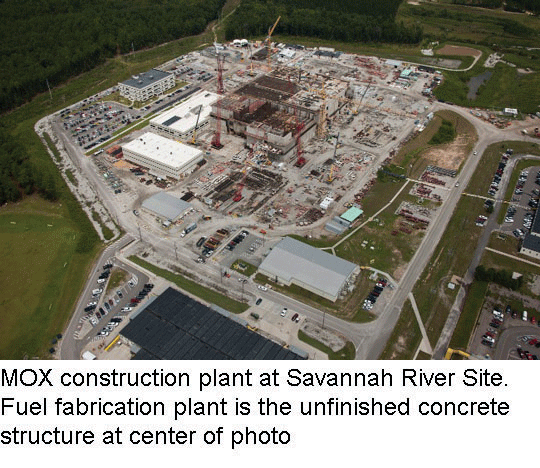
Instead, the final outcome was a mothballed facility and a still-increasing supply of surplus plutonium. Like I said, this isn’t your typical government boondoggle. It was twenty years in the making………. Continue reading
Hypocrisy of nuclear company Exelon – claims to be ‘green’, while trying to kill wind energy
 “The public policy position of Exelon is to oppose subsidies for wind and solar while the company itself purports to be this super-green company and also wants more subsidies for nuclear,” he said. “That’s just hypocritical.”
Nuclear Giant Exelon Blasts Win, by Elliot Negin, Director of News & Commentary, Union of Concerned Scientists Corporate executives often tout the benefits of competition in a free-market economic system, but it’s striking just how much large corporations don’t like it. In fact, some companies will do all they can to squash it, lobbying for favors and subsidies while working to deny them to their competitors.
The squabble over a key federal tax break for the wind industry is a case in point. Called the production tax credit (PTC), it has helped quadruple the wind industry’s generation capacity over the last five years, and six states now have enough wind turbines to meet more than 15 percent of their annual demand
Unlike most coal, nuclear, and oil and gas subsidies, the PTC — which has been around only since the mid-1990s — is not permanent. Congress has to renew it periodically. Last December, Congress let it expire yet again, and lawmakers likely will not restore it until after the November mid-term elections, if at all. The PTC represents roughly $1.2 billion in annual tax savings to the wind industry.
Wind’s more-established competitors want the PTC dead.
ExxonMobil, the Koch brothers and their front groups, for example, want Congress to let it die. Never mind that the oil and gas industry has been receiving an average of$4.86 billion annually in today’s dollars in subsidies and tax breaks since 1918. Or the fact that Congress exempted natural gas developers from key provisions of seven major environmental laws, including the Clean Air Act and Clean Water Act.
The nuclear power industry doesn’t like the wind tax break, either. Its most outspoken critic is Exelon, the nation’s largest nuclear plant owner with 23 reactors at 14 plant sites. Continue reading
South Dakota’s community livelihood at risk from uranium polluted water
 Uranium mine would affect more than West River http://www.argusleader.com/story/opinion/readers/2014/06/07/letter-uranium-mine-affect-west-river/10109709/ Kim C. Kraft Are you aware of the potential problem of uranium mining in western South Dakota to the rest of the state? Presently, there are more than 200 abandoned uranium mines leaching radioactive debris into our rivers. Radioactive residue from these mines can be detected as far as Vermillion. So it is not just a West River problem.
Now we have Powertech/Azarga, a China-based investment company, wanting to take vast amounts of water from two major aquifers of the Southern Black Hills for in situ mine leaching of uranium. Not only will they take the water from our ranchers, who desperately need it during the drought, but contaminating it for any future use by the ranchers and surrounding communities. With the Western states becoming dryer from prolonged drought, we cannot afford to waste clean water for the benefit of foreign countries. Our state government is allowing this. Our governor and Legislature have removed oversight and control over water usage in the Southern Black Hills, thus allowing the mining companies to use up precious clean water, pollute it and then leave with no responsibility to clean the mess up. They are putting our livelihoods on the line. Remember this for the November elections.
Management Problems in USA’s failed Nuclear Weapons Recycling Program
 Failed Nuclear Weapons Recycling Program Could Put Us All in Danger io9, Mark Strauss, 7 June 14 “…….In 2004, the National Nuclear Security Administration estimated that the Savannah River MOX facility would cost $1.6 billion. Three years later, that estimate jumped to $4.9 billion. In 2012, the forecasted expenditure increased again, to $7.7 billion. By this time, $4 billion had already been spent and the project employed more than 1,800 construction workers, designers and engineers. Then, in April 2013, an internal review conducted by the Department of Energy revealed that the total lifetime operating cost of the facility—including construction, maintenance and disposal of all the plutonium—would be $24.2 billion.
TJust one example of the poor management that led to cost overruns: NNSA and its primary contractor underestimated the number of safety systems required to meet Nuclear Regulatory Commission (NRC) requirements, which further increased equipment installation costs. More specifically, they were unaware of the costs associated with building a facility that could withstand an earthquake. The source of their confusion? The MOX facility’s design is based on a similar facility in France, but the NRC regulatory requirements differ from those in France.
The Department of Energy was also at fault, because it approved the initial cost and schedule estimate, when the overall design of the MOX facility was only about 58% complete.
A report published two weeks ago by the Department’s Inspector General noted:
In a separate July 2006 memorandum to the NNSA Administrator, NNSA’s Associate Administrator for Infrastructure and Environment expressed his concern regarding the MOX Facility project. He expressed the belief that incomplete project planning could lead to an unintended “design-build-design” process similar to that experienced by other major Departmental projects including the Waste Treatment Plant and the Highly Enriched Uranium Materials Facility. The Waste Treatment Plant at the Hanford Site was given the approval to start construction when the design was only about 45 percent complete. Since then, total project costs for that facility have increased significantly and the project is considerably behind schedule. He pointed out that, similarly, a comprehensive design review had not been conducted on the complete MOX Facility project and that the project had high-risk potential for increasing downstream costs and schedule.
The White House did its part, as well. In 2010, President Obama announced a loan guarantee of $8.3 billion to help the Southern Company build two new nuclear reactors in Georgia. As a result, workers with nuclear engineering design and manufacturing experience were suddenly in very high demand. The MOX construction site had an employee turnover of 20% per year because, after workers completed additional training at the Savannah River Site, they quit to take higher paying jobs in Georgia. The U.S. government was subsidizing its own labor shortfall.
Finally, in March 2014, the White House announced that it would put the whole project on “cold standby”—essentially, preparing it for shutdown—while the administration evaluated “alternative plutonium disposition technologies to MOX that will achieve a safe and secure solution more quickly and cost effectively.”
Adding up the losses
MOX may be mothballed, but the problem of what to do with our surplus weapons-grade plutonium remains. And, despite cool relations between Washington and Moscow, the disposal agreement still stands.
The Department of Energy has established a Plutonium Disposition Working Group that will spend the next 12 to 18 months trying to come up with a plan. You can see an initial working paper here. The options are depressingly similar to the ones suggested by the National Academy of Sciences, 20 years ago.he sticker shock prompted the Department of Energy to note in its Fiscal Year 2014 budget request that, “This current plutonium disposition approach may be unaffordable…due to cost growth and fiscal pressure.”
Any lingering doubts that the MOX program was on its last legs were dispelled when the Government Accountability Office (GAO) published a report in February 2014. Even by GAO standards, the assessment was scathing.
One of the biggest mistakes, according to the GAO, was entrusting this project to the National Nuclear Security Administration, which is a semi-autonomous agency within the Department of Energy:
NNSA has not analyzed the underlying, or root, causes of the Plutonium Disposition program construction cost increases to help identify lessons learned and help address the agency’s difficulty in completing projects within cost and schedule, which has led to NNSA’s management of major projects remaining on GAO’s list of areas at high risk of fraud, waste, abuse, and mismanagement.
………Even if we got this facility up and working, nobody wants what it’s making. The companies that run commercial nuclear reactors have lost confidence in the program. They can’t be certain that it would provide a reliable, steady supply of fuel, or keep enough surplus fuel on hand in case it was needed. And why would commercial nuclear reactors purchase MOX when low-enriched uranium is cheaper, easier to transport and doesn’t present a security risk? Adding to the climate of skepticism: a MOX fuel irradiation test in a commercial reactor had to be prematurely terminated in 2008 because of unanticipated problems.
The loss to the United States can be measured in more than the $4 billion to build the facility and the hundreds of millions of dollars sent to Russia to subsidize their program. The greater loss is that the U.S. could have spent those funds to shore up other nonproliferation programs…….. http://io9.com/failed-nuclear-weapons-recycling-program-could-put-us-a-1586851270
Political donations got the Texas Waste Control site going
 Breaking Bad: A Nuclear Waste Disaster By Joseph Trento, DC Bureau, June 5th, 2014 “………Former President George W. Bush and Texas Governor Rick Perry’s single largest political contributor, the late Texas billionaire Harold C. Simmons, founded Waste Control Specialists and used his political influence to get the West Texas nuclear disposal site approved by state and federal licensing officials. The political efforts used to secure the licensing caused years of controversy in Texas. Environmentalists opposed the site because it is on an important aquifer in Texas. Another reason is that one of Simmons’s companies had operated a lead incinerator in Dallas that became an EPA Superfund Site.
Despite this environmental pedigree, LANL and DOE officials chose Waste Control Specialists to administrator their alternative nuclear waste storage site. While technically the company has licenses only for low-level nuclear waste, under its Texas permit, Waste Control can accept certified waste from federal agencies.
DOE officials said the Waste Control site is just a temporary alternative to the disabled WIPP. That is not true. Los Alamos and other national laboratories with high-level nuclear waste have been planning to use the Texas site for years, well before is licenses had been approved. The political promises that were made that it would be only for low-level waste were a ruse. As long as four years ago, during a Savannah River Site Citizens Advisory Board meeting in Aiken, South Carolina, DOE officials and SRS contractors talked openly about using the Texas site to offload uranium waste from SRS.
In late May, DOE investigators became so concerned about the Los Alamos containers being stores in what amounts to an open pit, they halted the shipments to Waste Control. The 112 canisters already at Waste Control were ordered to be isolated and surrounded by large concrete containers as well monitored by television camera. As of May 28, seventy-three Los Alamos containers have been segregated and covered with the cement and gravel-filled barriers.
Harold Simmons’s team lobbied hard to get only the second license in U.S. history from DOE for a private nuclear dump. They got the licensing in the last days of the Bush administration. Prior to the LANL decision to ship containers of transuranic waste to the site, there were warnings to Waste Control that it had already been accepting waste it was not permitted to receive.
Pressure has been building for years for DOE to stabilize and isolate its growing high-level nuclear waste stream. After the WIPP explosion, the DOE suddenly concluded that the thousands of feet below earth in salt beds were no longer needed to store the most deadly radioactive material on earth. Open trenches in the West Texas desert would be good enough. On April 2, tractor trailers hauled the first of the Los Alamos casks of radioactive high-level waste to the Andrews County dump before the WIPP investigation team succeeded in halting the shipments……….http://www.dcbureau.org/201406059835/natural-resources-news-service/breaking-bad-nuclear-waste-disaster.html
Americas neo con hawks keen to provoke a nuclear war with Russia?
provoking a nuclear war is a crazy idea, and will kill us all
The Crazed in Washington http://www.opednews.com/articles/The-Crazed-in-Washington-by-Dave-Lefcourt-Insanity_NATO_Obama_Provocation-140604-928.htmlBy Dave Lefcourt (about the author) How should one characterize President Obama’s trip to Poland yesterday? He pledged a new $1 billion security plan for Central and Eastern Europe to stand against Russian “aggression”. He reassured the old Warsaw Pact counties of Poland, Bulgaria, Romania, Hungary, the Czech Republic, Slovakia, Latvia, Lithuania, Estonia, now all NATO members that the US in his words, “the security of our allies in Central and Eastern Europe is a cornerstone of our own security and it is sacrosanct. As friends and as allies, we stand united, together and forever”. So maybe it was “coach” Obama attempting to reassure his “players”.
You’d never know it though considering all the perceived (contrived?) jitters of the leaders of those countries in attendance who display seemingly in unison-since the Russian annexation of Crimea in March with all dismissing the popular referendum as illegitimate even after the people voted overwhelmingly to join the Russian Federation-the dread Russian President Vladimir Putin was ready to pounce, waiting for the right time to invade one or all their countries-as a sort of replay of the USSR’s crackdown in Hungary in 1956 and Prague, Czechoslovakia in 1968. Such is their fantasy which has no basis in fact.
The idea of Putin invading a NATO country is patently absurd. He even realizes sending Russian troops into Eastern Ukraine is a fools errand, though the ethnic Russian speaking people there would like him to do just that.
But that would be the “provocation” the US would like Putin to act on and be the pretext for NATO-aka the US-to initiate a war with Russia. Continue reading
South Carolina site now to get nuclear trash from Germany?
it is crazy to keep on making nuclear waste
 German nuclear waste may be dumped at US site http://www.news24.com/Green/News/German-nuclear-waste-may-be-dumped-at-US-site-20140605 Charleston – The US department of energy said on Wednesday it will study the environmental risk of importing spent nuclear fuel from Germany that contains highly enriched uranium, a move believed to be the first for the United States.
The department said it is considering a plan to ship the nuclear waste from Germany to the Savannah River Site, a federal facility in South Carolina. The 125Ha site already holds millions of gallons of high-level nuclear waste in tanks. The waste came from reactors in South Carolina that produced plutonium for nuclear weapons from 1953 to 1989.
The Energy Department said it wants to remove 900kg of uranium the United States sold to Germany years ago and render it safe under US nuclear non-proliferation treaties.
A technique for the three-year process of extracting the uranium, which is contained in graphite balls, is being developed at the site in South Carolina, according to the Energy Department.
Some critics question whether the department has fully developed a clear plan to dispose of the radioactive waste.
“They’re proposing to extract the uranium and reuse it as fuel by a process that has never been done before”, said Tom Clements, president of SRS Watch, a nuclear watchdog group in South Carolina.
“There’s no place to take high level waste in the US”, he said. “Uranium that is turned into commercial fuel is not contained inside nuclear waste. It’s pure material.”
A public environmental meeting on the proposed project will be held 24 June in North Augusta, South Carolina.
Clements said shipping the uranium to South Carolina would only add more nuclear waste to the Savannah River Site.
German and US officials signed a statement of intent for the import in March and April. A feasibility study is under way, the Energy Department said.
“The Germans couldn’t quite figure out what to do with it”, Clements said.
German officials have been embroiled in a fight over who will pay for clean-up of nuclear waste from nine remaining decommissioned nuclear plants.
Sources told Reuters in May that German utilities were in talks with the government about setting up a “bad bank” for nuclear plants, in response to German Chancellor Angela Merkel’s decision to close them all by 2022 after Japan’s Fukushima nuclear disaster.
West Michigan citizens tell NRC chair of problems with nuclear power plants
 Nuclear Regulatory Chair Hears Concerns About Plants in West Michigan, by Paul Chicchini Fox 17 BENTON HARBOR, Mich. (June 5, 2014) – A group of concerned citizens and environmental groups met today with the chairman of the Nuclear Regulatory Commission to discuss two plants in west Michigan.
The closed-door meeting was held at the Courtyard Marriott in Benton Harbor with Chairman Allison MacFarlane.
The conversation focused on the Donald C. Cook site in Bridgman and the Palisades Plant in Covert Township.
Palisades has been in the spotlight since its 2007 purchase by Entergy because of several problems.
Bette Pierman, a Democratic candidate for Michigan’s 21st District Senate seat, told FOX 17 she had concerns about the Palisades facility.
“There are failing infrastructure problems right now,” said Pierman. “There’s leaks that have been going on. Some of them since 2007 – recorded and reported.”
The most recent reported leak at the plant involved 70 gallons of oil, which officials said did not pose a threat to any bodies of water.
During a planned refueling outage between January and March, workers discovered a piece of metal – an impeller blade – lodged in a reactor vessel. It was determined the object wasn’t a hazard.
“That’s not the issue,” Pierman said. “The issue is that they’ve got failing equipment that continues to fail and they’re not taking care of the problem.”……… http://fox17online.com/2014/06/05/nuclear-regulatory-chair-hears-concerns-about-plants-in-west-michigan/#ixzz33ukJoMk5
Need for inquiry into cancer rates near Oyster Creek Nuclear Power PLant
Activists seek radiation study at Oyster Creek, Asbury Park Press, Kirk Moore, @KirkMooreAPP TOMS RIVER – Ocean County activists said Wednesday night that they want researchers to take a close look at historic radiation releases from the Oyster Creek nuclear power plant.
In particular, they want a review of 1979, when the plant in Lacey had high atmospheric emissions in the same year when a near-accident dropped reactor water levels dangerously low.
“The data was extremely hard to find,” activist Janet Tauro told a panel of cancer experts and epidemiologists working with a National Academy of Sciences’ pilot study of cancer rates around Oyster Creek and six other nuclear plants.
During five weeks, Tauro said, citizen researchers found records of large releases at Oyster Creek from 1974 to 1985.
“They appear to be staggering, and we never knew,” she said during a public comment session in Toms River on Wednesday night.At the request of the U.S. Nuclear Regulatory Commission, the NAS is conducting the study of cancer rates around nuclear plants to determine if a much broader, multi-year study is warranted. The public hearing in Toms River was one of a series where investigators are taking comments and suggestions.
An Ocean County activist group, Grandmothers, Mothers and More for Energy Safety, along with Clean Water Action obtained a 1995 report by the Brookhaven National Laboratory in Upton, New York, that summarized airborne and liquid effluent releases from U.S. nuclear plants from 1974 to 1992. Those numbers showed a peak in atmospheric emissions at Oyster Creek in 1979. In those years, the plant was operated by Jersey Central Power & Light.
“In 1972 and ’73 they had some pretty high releases, and again in 1978 and ’79,” said David Lochbaum, director of the nuclear safety program at the Union of Concerned Scientists and a nuclear engineer who worked on boiling water reactors like Oyster Creek.
“What we’re asking for is NAS to look into this more closely,” said Paul Gunter of the anti-nuclear group Beyond Nuclear, which helped the Ocean County activists with documents. The 1979 atmospheric emissions of 1.01 million curies “was not the biggest release (from a plant) but that’s a very large release,” he said……….
While admitting he’s just a medical doctor and not an epidemiologist, Joseph Sauer said his review of public health databases in Illinois showed higher rates of cancers in areas close to the Dresden and Braidwood plants owned by Exelon, which now operates the Oyster Creek reactor…..http://www.app.com/story/news/local/land-environment/2014/06/04/oyster-creek-cancer-study-ocean-county/9988805/
Warren Buffett backs revolutionary development in renewable energy
 Buffett’s $28 billion winning bet on clean energy, SMH, June 5, 2014 Warren Buffett’s $US26 billion (A$28 billion) bet on western US power plants, transmission lines and wind farms is poised to pay off.
The energy unit of Buffett’s Berkshire Hathaway, with the help of California’s grid operator, is moving to unite the holdings under a single market capable of dispatching power across seven states every five minutes. The system, designed to handle sudden swings in supply and demand, would revolutionise the markets from Oregon to Nevada, where 38 transmission operators manually balance their territories on an hourly basis.
The move would be a game-changer for the renewables that Berkshire Hathaway Energy has accumulated over the past decade, including two of the world’s largest solar farms, and for other clean-power producers, according to those who trade in the region’s markets. Berkshire’s plants stand to run for longer periods of time, and its NV Energy and PacifiCorp utilities will save as much as $US63.9 million annually by 2017, Energy and Environmental Economics reports show.
“It would be huge if all 38 balancing authorities joined,” Sean Breiner, a market design analyst for energy trader Viasyn, said by telephone June 2. “Instead of having these balkanised regions, you’d have resources from Idaho to Wyoming all flowing into one kind of large spot market.”
Green power……
California has a goal of securing 33 per cent of power from clean energy by 2020. By next year, the California Independent System Operator Corp. expects renewables to meet almost a quarter of demand. In the Northwest, renewables are nearly 7 per cent of total supply, excluding hydropower.
The market, scheduled to start Oct. 1 pending approval from the Federal Energy Regulatory Commission, would use hourly bids from generators to match the cheapest resources with supply, demand and transmission changes every five minutes. It would initially include the territories of the California ISO and PacifiCorp — spanning 42,200 miles of transmission lines in six states from California to Wyoming, extend to NV Energy’s Nevada network a year later and could accommodate all operators in the region…….
Berkshire Hathaway Energy’s spending in the western states included $US10.7 billion to acquire PacifiCorp and NV Energy, $US8.7 billion in renewable investments, a $US6 billion Northwest transmission project and at least $US568 million on the Lake Side natural gas-fired power plant being completed this year in Utah, according to company filings.
Power generators and transmission operators in other parts of the US already participate in real-time markets run by grid operators from the Northeast to Texas. California runs a five-minute market within its own territory. Should all the authorities in the western US join the new system, it would become the nation’s largest geographically.
Analyses prepared by San Francisco-based Energy and Environmental Economics show the real-time market would save the California ISO area as much as $US74.3 million, PacifiCorp $US54.4 million and NV $US9.5 million in the year 2017……….. http://www.smh.com.au/environment/climate-change/buffetts-28-billion-winning-bet-on-clean-energy-20140605-zry0t.html#ixzz33v2NcWMC
Wildfire danger to New Mexico nuclear waste facility
 U.S. nuclear waste facing wildfire risk THE HINDU, NARAYAN LAKSHMAN , 5 June 14, A New Mexico facility containing 3,706 cubic meters of toxic radiological materials may be on the precipice of a serious incendiary event after the U.S. Department of Energy confirmed that it would fail to meet a deadline to remove drums of nuclear waste from the wildfire-prone area owing to safety concerns.
Although the DoE initially planned to move the “transuranic waste,” from the federal Los Alamos National Laboratory to a Texas facility by June 30, shipments out of the facility were said to have been “put on hold due to concerns about the chemical stability of the mixture in the containers.”
The deteriorating conditions of nuclear waste storage at the facility in recent years were further exacerbated in 2011 by wildfires near the nuclear-weapons laboratory, and the state government of New Mexico ordered the site to complete transfer of the material to other locations “before this year’s wildfire season reaches its peak,” the Nuclear Threat Initiative group noted.
However, apparently one Los Alamos drum of transuranic waste, comprising “tools, rags and other debris contaminated with radioisotopes such as plutonium from U.S. nuclear labs,” may have been responsible for a radiological leak at a repository near Carlsbad, New Mexico, on February 14……. http://www.thehindu.com/news/international/world/us-nuclear-waste-facing-wildfire-risk/article6083055.ece
Compensation program for those made sick by Nevada atomic testing radiation
Compensation for radiation exposure discussed at event By SANDY LOPEZ, Las Vegas Review Journal, 4 June 14, View Staff Writer
More than 60 years after the testing of nuclear weapons at the former Nevada Test Site, the people who were affected are being compensated with the help of a school program.
The UNLV School of Medicine became the first institution to offer medical outreach and education to Nevada residents affected by nuclear weapons testing at the Nevada Test Site from 1951 to 1962. An outreach event took place May 16 at the Centennial Hills Active Adult Center, 6601 N. Buffalo Drive.
“We developed the Radiation Exposure Screening & Education Program to educate the public on the cancer risks that they may have been exposed to as a result of where they lived,” said Dr. Thomas Hunt, associate professor at the UNLV School of Medicine and principal investigator of the educational outreach. “We educate people, recommend screening tests based on age and gender and try to catch cancers early where people can still be cured.”
The school created the program nine years ago to offer free cancer screening clinics to Nevada residents exposed to radiation.
The program provides medical screening by appointment and diagnostic services to facilitate early detection and treatment of cancer and other health hazards associated with radiation.
Hunt estimates that between 300 and 400 Nevadans are screened annually through the program.
In addition, the program assists people through the Radiation Exposure Compensation Act, which provides payments to individuals diagnosed with certain illnesses as a result of the exposure to radiation released during atmospheric nuclear weapons testing or while working in the uranium mine industry.
Jenna Fox, program eligibility coordinator, estimates that as of February, people have been compensated almost $2 million and claims that more people have been approved than denied.
“We’ve had people who don’t have any insurance, but we can give them resources in the community that can help them,” Hunt said.
The most common cancers Hunt has seen due to radiation exposure are lung, breast and colon cancer. However, people can be compensated for 20 different cancers. hose eligible for compensation must have direct ties to above-ground nuclear testing or the uranium mining operation or they must have been physically present in a so-called downwind county.
Downwind counties include portions of Nevada, Utah and Arizona.
Nevada counties include Eureka, Lander, Lincoln, Nye, White Pine and the northeast area of Clark, which includes Moapa, Mesquite, Overton, Logandale and Riverside.
The act also includes survivor benefits, which are available to families of people affected by atmospheric nuclear testing or the uranium mining industry.
If the person who became ill with a compensable disease is deceased, the first person eligible to file a claim on his behalf is the spouse, followed by children, parents, grandchildren and grandparents.
Jeanette Shoemaker, a participant of the May 16 educational program, recalled living in North Las Vegas as a girl and witnessing effects of the mushroom cloud and the boom from the underground testing conducted at the former Nevada Test Site.
“I remember seeing debris from the test site on the cloth diapers that my mother used to hang outside,” Shoemaker said. “My father, grandfather and uncle all worked at the test site. I remember seeing my father come home with debris from his work, yet my mother never qualified for survivor’s benefits.”…….
Freley Hosannah, grant and project manager of the Radiation Exposure Screening & Education Program, said people should be proactive if they think they have been exposed to radiation.
“People can actually be diagnosed with cancer years later,” said Hosannah. “Two or even three generations can be affected by this. It’s important to catch cancers early before it gets to a late stage that isn’t treatable.”
For more information, call 702-992-6887 or visit medicine.nevada.edu/las-vegas/resep. Contact North View reporter Sandy Lopez at slopez@viewnews.com or
702-383-4686. Find her on Twitter: @JournalismSandy.
One Man’s AMAZING Plan To Replace Non-Renewable Energy
A Small Victory For Japanese Nuclear Residents & One Man’s AMAZING Plan To Replace Non-Renewable Energy Collective Evolution, June 4, 2014 by Jeff Roberts  http://www.collective-evolution.com/2014/06/04/a-small-victory-for-japanese-nuclear-residents-one-mans-amazing-plan-to-replace-non-renewable-energy/ “…….. VIDEO: One man’s AMAZING plan to replace non-renewable energy The big oil, gas, coal and nuclear companies claim that we need those energy sources in order to power America. Good news: it’s a myth. Mark Diesendorf – Associate Professor and Deputy Director, Institute of Environmental Studies, UNSW at the University of New South Wales – notes: The deniers and scoffers repeatedly utter the simplistic myth that renewable energy is intermittent and therefore cannot generate base-load (that is, 24-hour) power. Detailed computer simulations, backed up with actual experience with wind power overseas, show that the scoffers are wrong. Several countries, including Australia with its huge renewable energy resources, could make the necessary transition to an electricity generation system comprising 100 per cent renewable energy over a few decades. Diesendorf gave an update earlier this month: Continue reading
South Dakota – take heed from Colorado’s bad experience with uranium mining
 Colorado has ‘experience’ with uranium mines http://www.argusleader.com/story/opinion/readers/2014/06/03/letter-colorado-experience-uranium-mines/9942453/
 uranium mines and prospects, Colorado has 387. While South Dakota has yet to experience an operating in-situ leach uranium mine (Powertech/Azarga is attempting to permit the first one 15 miles northwest of Edgemont), Colorado has experienced experimental in-situ leach uranium mining, which left elevated levels of gross alpha radiation, beta radiation, nitrate, ammonia and selenium in the underground aquifer. The contamination got worse after the mine was declared “restored.”
Colorado has had enough. Colorado House legislators recently passed new regulations on uranium processing. The bill sets minimum standards for groundwater cleanups before a company can be let off the hook. It also requires uranium and thorium mines to get a radioactive materials license from the state health department if they use a new process that involves injecting water into the mine’s rock formations.
Colorado state Representative Jared Wright, R-Fruita, said new mining technologies often pollute, despite promises to be safe and clean. “This bill is about protecting our citizens, those we are all here today to serve,” Wright said.
Let’s hope our legislators take heed and protect our water in 2015’s legislative session.
1 This Month
23-25 October – on Zoom – World BEYOND War’s annual global conferenc


Shut down the radiation-damaged Heysham nuclear reactors now
To see nuclear-related stories in greater depth and intensity – go to https://nuclearinformation.wordpress.com

Say No to NASA’s Reckless Nuclear Reactor on the Moon
Say No to NASA’s Reckless Nuclear Reactor on the Moon
-
Archives
- October 2026 (170)
- September 2026 (339)
- August 2026 (330)
- July 2026 (355)
- June 2026 (287)
- May 2026 (306)
- April 2026 (356)
- March 2026 (251)
- February 2026 (267)
- January 2026 (308)
- December 2025 (358)
- November 2025 (359)
-
Categories
- 1
- 1 NUCLEAR ISSUES
- business and costs
- climate change
- culture and arts
- ENERGY
- environment
- health
- history
- indigenous issues
- Legal
- marketing of nuclear
- media
- opposition to nuclear
- PERSONAL STORIES
- politics
- politics international
- Religion and ethics
- safety
- secrets,lies and civil liberties
- spinbuster
- technology
- Uranium
- wastes
- weapons and war
- Women
- 2 WORLD
- ACTION
- AFRICA
- Atrocities
- AUSTRALIA
- Christina's notes
- Christina's themes
- culture and arts
- Events
- Fuk 2022
- Fuk 2023
- Fukushima 2017
- Fukushima 2018
- fukushima 2019
- Fukushima 2020
- Fukushima 2021
- general
- global warming
- Humour (God we need it)
- Nuclear
- RARE EARTHS
- Reference
- resources – print
- Resources -audiovicual
- Weekly Newsletter
- World
- World Nuclear
- YouTube
-
RSS
Entries RSS
Comments RSS

