Historical background to USA-Russia nuclear stand-off
Indications that the U.S. Is Planning a Nuclear Attack Against RussiaBy Eric Zuesse (about the author) OpEdNews Op Eds 6/14/2014 “………Some historical background is necessary here, so that a reader can understand why this is happening — the switch to an objective of actually winning a nuclear war (as opposed to deterring one). One cannot understand what’s happening now in Ukraine without knowing this bigger picture.
(This account is written under the assumption that the reader already knows some of the allegations it contains, but not all of them, and that the reader will click on the link wherever a given allegation requires documentation and support.) I have previously reported about “How and Why the U.S. Has Re-Started the Cold War (The Backstory that Precipitated Ukraine’s Civil War),” and, “Do We Really Need to Re-Start the Cold War?” I pointed out there that we don’t really need to re-start the Cold War, at all, since communism (against which the Cold War was, at least allegedly, fought) clearly lost to capitalism (we actually won the Cold War, and peacefully) but that America’s aristocracy very much does need to re-start a war with Russia — and why it does. (It has to do withmaintaining the dollar as the world’s reserve currency, something that benefits America’s aristocrats enormously.)
Consequently, for example, a recent CNN Poll has found that Americans’ fear of Russia has soared within just the past two years. Our news media present a type of news “reporting” that places Russia’s leader, Vladimir Putin, into a very bad light, even when it’s unjustified by the facts.
The situation now is thus rather similar to that right before World War I, when the aristocracy in America decided that a pretext had to be created for our going to war against Germany. That War had already started in Europe on 28 July 1914, and President Wilson wanted to keep the U.S. out of it, but we ultimately joined it on the side of J.P. Morgan and Company. This was documented in detail in an important 1985 book,Britain, America and the Sinews of War, 1914-1918, which was well summarized in Business History Review, by noting that: “J.P. Morgan & Co. served as Britain’s financial and purchasing agent, and the author makes especially good use of the Morgan Grenfell & Co. papers in London to probe that relationship. Expanding British demand for U.S. dollars to pay for North American imports made the politics of foreign exchange absolutely central to Anglo-American relations. How to manage those politics became the chief preoccupation of Her Majesty’s representatives in the United States,” and most especially of Britain’s financial and purchasing agent in the U.S…………http://www.opednews.com/articles/Indications-that-the-U-S–by-Eric-Zuesse-Nuclear-Weapons_Obama-Administration_PNAC-Neocon-Project-For-A-New-American-C_President-Barack-Obama-POTUS-140614-352.html?show=votes
New plan to assist Fukushima clean-up is really designed to protect and promote USA nuclear technology sales
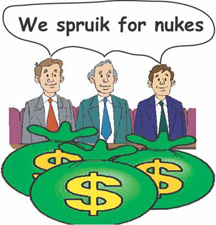 The U.S. is pushing the CSC because its nuclear industry needs new markets, said Tom Vanden Borre, a researcher in nuclear liability law at the Catholic University of Leuven in Belgium.
Countries with plans to build nuclear power plants are important because the U.S. hasn’t had a new atomic plant begin service since 1996, he said.
“It’s merely to protect the American industry and nothing more.”
Fukushima Fires Up Atomic Industry’s Removal-of-Liability Drive http://www.businessweek.com/news/2014-06-12/japan-may-ratify-atomic-treaty-for-u-dot-s- dot-aid-in-fukushima-cleanup By Jacob Adelman June 13, 2014 Japan will introduce legislation this year to ratify a controversial treaty backed by General Electric Co. and other atomic-plant manufacturers seeking protection from damage claims caused by nuclear accidents.
The treaty, known as the Convention on Supplementary Compensation for Nuclear Damage or CSC, will encourage experienced U.S. companies to assist in the cleanup and decommissioning at the Fukushima atomic accident site, Japan’s Foreign Ministry said in a statement today.
Protection from accident claims is needed because of the dangers and risks that remain at Fukushima, said U.S. Deputy Energy Secretary Daniel Poneman in an interview in Tokyo yesterday. The plant has three melted reactors and thousands of tons of radioactive water.
“The important thing is to do everything that we can to facilitate the cleanup and decontamination of the Fukushima site,” Poneman said. The CSC is a means to support U.S. companies in that role, he said.
Poneman was in Tokyo to attend a meeting of the U.S.-Japan Bilateral Commission on Civil Nuclear Cooperation, which was established after the March 2011 accident at Tokyo Electric Power Co. (9501)’s Fukushima Dai-Ichi plant.
The CSC puts all liability for accidents at a nuclear power plant on the operator of the facility. To cover potential damage claims, CSC member countries would each contribute the equivalent of about $465 million. An atomic plant operator would have access to that fund after paying out an equivalent amount itself.
CSC Critics
Critics of nuclear power, environmental group Greenpeace among them, say the CSC acts as a subsidy for atomic power plant makers, such as GE, Toshiba Corp.’s Westinghouse unit and Areva SA of France, by shielding them from accident claims. Continue reading
Fukushima radiation has killed one sailor from USS Ronald Reagan, with rare cancer
 First Sailor from USS Ronald Reagan dies from radiation from FUKUSHIMA http://investmentwatchblog.com/first-sailor-from-uss-ronald-reagan-dies-from-radiation-from-fukushima/#TpACD1zIVugkBWMs.99 June 12th, 2014 1st death in USS Reagan case; rare cancer takes 38 yr old Tomodachi samaritan. RIP Theodore Holcomb
Information just released today by the legal team representing the USS Reagan sailors in their billion dollar lawsuit against TEPCO.
http://www.nuclearhotseat.com/1964/
The Ronald Reagan spent a couple months at sea after being dosed off with radiation, trying to clean itself up; then, according to a lawyer for the sailors claiming injury, it was decontaminated at port in Washington State for another year and a half before returning to service.
Nuclear company sued over radiation exposure to workers
 Lawsuit filed against E. Idaho nuclear contractor June 12, 2014 San Francisco Chronicle, IDAHO FALLS, Idaho (AP) — A lawsuit has been filed involving a 2011 accident at an eastern Idaho nuclear facility that exposed 16 workers to plutonium. Jodi Stanton, the wife of an exposed worker, filed the lawsuit in federal court Tuesday, the Post Register reported (http://www.postregister.com/node/56654). She contends the couple’s home might have been contaminated with radioactivity because the company withheld information or offered false information about her husband’s medical condition following the accident.
The lawsuit targets Battelle Energy Alliance, the company contracted by the government to operate the Idaho National Laboratory. It seeks an undisclosed amount in damages………
The accident happened in a building that once housed a nuclear reactor. Workers had been taking plutonium fuel out of storage when they came upon radioactive materials held in two containers, each marked with a label stating the containers were damaged.
After talking to supervisors, workers removed the wrapping on one of the containers and a radioactive black powder spilled out. The workers had on lab coats and some had gloves, but none had respiratory gear or other protective clothing, according to a report released in 2013 by the Department of Energy. http://www.sfchronicle.com/business/energy/article/Lawsuit-filed-against-E-Idaho-nuclear-contractor-5548176.php
$264 Billion for USA nuclear weapons, and that’s not counting some of the costs
 Ten-Year, $264 Billion Nuclear Weapons Spending Estimate Leaves Out Some Things http://blogs.rollcall.com/five-by-five/ten-year-264-billion-nuclear-weapons-spending-estimate-leaves-out-some-things/?dcz= By Tim Starks June 11, 2014 Over the next decade, maintaining and modernizing nuclear weapon capabilities will cost $263.8 billion, according to a joint estimate by the departments of Defense and Energy. But a new report suggests that figure might fall far short of what the United States will actually spend.
The Government Accountability Office noted that the estimate doesn’t include the Air Force’s plans to develop a new bomber, or modernize intercontinental ballistic missiles. Consequently, DOD may be significantly underreporting its 10-year estimate, depending on the magnitude of the costs resulting from upcoming decisions about how to modernize these delivery systems,” a GAO report released Tuesday concluded.
“Air Force officials told us that it would be premature to include potential budget estimates for development programs in their early stages because their long-term costs are uncertain,” the report states, and added that the Air Force considered a specific bomber estimate too sensitive to include in the joint report with the DOE, produced annually for Congress.
But the GAO said the Pentagon should’ve supplied at least a range of possible estimates for the new bomber and ICBM modernization, rather than an assumption of no cost at all: “Without a range of potential estimates and fully documented assumptions and limitations, the report is an incomplete tool for congressional oversight.”
The “fully documented assumptions” part is a criticism of how DOD came up with its $40.8 billion estimate for nuclear command, control and communications, or NC3; the report states that the department didn’t do a good job of explaining how it arrived at the figure.
On the DOE side, the estimate doesn’t include enough funding for planned nuclear weapon life extensions and construction of key facilities, the GAO determined.
“To improve the completeness and transparency of subsequent joint reports, GAO recommends that the Secretary of Defense direct DOD components to (1) include at least a range of potential 10-year budget estimates for projects and programs, based on preliminary cost information (this is consistent with a December 2013 recommendation GAO made to DOE); and (2) document assumptions and limitations affecting its NC3 funding estimates,” the report stats. “DOD agreed with these recommendations.”
Renewabl eenergy investments by Warren Buffett set to increase to around $30 billion
 Warren Buffett could double renewable energy investment to $30bn http://blueandgreentomorrow.com/2014/06/11/warren-buffett-could-double-renewable-energy-investment-to-30bn/ Wednesday, June 11th, 2014 By Richard Heasman
Warren Buffett has said his Berkshire Hathaway holding company could invest a further $15 billion (£8.9 billion) in solar and wind projects in the US.
At a Las Vegas conference this week, the world’s third wealthiest man was reminded by his deputy Greg Abel of the company’s current $15 billion investment in the sectors.
Buffett swiftly declared that the same figure should be committed again, describing the overall potential of sustainable energy as an expanding market.
Bloomberg said Buffett responded to Abel’s prompt with, “There’s another $15 billion ready to go, as far as I’m concerned.” Buffett has remained one of the world’s leading investors in renewable energies,bankrolling major solar and wind power developments with multi-billion dollar investments.
Buffett’s Nebraska-based firm Berkshire Hathaway is now the fifth-largest in the world by market value. It has huge investments in regulated, capital-intensive businesses such as infrastructure and energy.
Buffett has described the renewables market as high in potential, with the predictability of reinvestment and large growth.
In 2011, he bought a massive California-based solar farm project from First Solar. Other investments include the acquisition of an Iowa energy holding company in 2011.
His unit now operates power grids in the UK, natural gas pipelines that run across the entirety of the US and wind farms in Iowa, Wyoming, California and Arizona.
Buffett’s pledge to boost renewables investment comes after Barack Obama declared tighter emission targets for coal power companies – with an overall aim of cutting emissions by 30% by 2030. The Environmental Protection Agency (EPA) declared this would bring net climate and health benefits of up to $82 billion (£48 billion).
U.S. shores continue to have increasing levels of Fukushima radiation
 Post-Fukushima radiation levels near US shores continue to increase
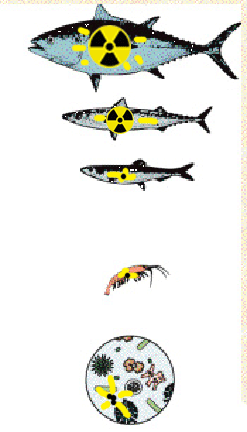
http://voiceofrussia.com/news/2014_06_11/Post-Fukushima-radiation-levels-near-US-shores-continue-to-increase-5967/ Radiation levels in Albacore tuna have tripled post-Fukushima, according to Oregon State University (OSU) researchers. The scientists came to that conclusion after conducting a study on fish caught off the coast of Oregon.
According to Delvin Neville, a graduate research assistant at OSU, these trace levels are too small to be a realistic concern. “A year of eating albacore with these cesium traces is about the same dose of radiation as you get from spending 23 seconds in a stuffy basement from radon gas, or sleeping next to your spouse for 40 nights from the natural potassium-40 in their body,” said Mr. Neville.
However, researchers with the National Oceanic and Atmospheric Administration (NOAA) and the GEOMAR Research Center for Marine Geosciences say the worst is yet to come and that the most highly radioactive water hasn’t reached US shores yet.
Regardless, all scientists apparently agree that the radioactive contamination is still traveling in ocean currents, the long-term effects of which remain to be seen.
Questions in US Congress on costs of NATO nuclear burden
House Bill Seeks Answers on Costs of NATO Nuclear Burden-Sharing, Global Security Newswire, By Rachel Oswald, 11 June 14 A defense bill approved by a House panel on Tuesday contains language that seeks to spotlight the costs of nuclear burden-sharing within NATO.
A measure contained in the House Appropriations Committee’s annual military spending bill would require the Pentagon to issue a report outlining “the proportional contributions of NATO members to the cost of sustaining forward-deployed nuclear weapons” as well as the impact that proportional cost-sharing would have on the U.S. military’s budget.
The United States presently shoulders the vast majority of the expense — about $100 million annually — for the operational deployment of less than 200 B-61 gravity bombs in Europe. The nonstrategic weapons are broadly understood to be fielded in Belgium, Germany, Italy, the Netherlands and Turkey. Those five nations in turn are supposed to maintain the aircraft capability necessary to deliver the nuclear bombs in an attack. The host states additionally pay for facility and security costs at the military installations where the weapons are stored.
Separate from the operational expense of keeping B-61s in Europe is the cost of modernizing the gravity bomb. The B-61 life-extension program is anticipated to cost as much as $11.5 billion — all of it currently to be borne by U.S. taxpayers, Kristensen told Global Security Newswire.
Some of the future costs of maintaining U.S. nuclear weapons in Europe include an estimated $1 billion to integrate the updated B-61 with European Tornado and F-16 aircraft and U.S. F-15E, F-16 and B-2 bombers; and about $154 million to enhance security at the European military bases that store the nuclear warheads, according to research compiled by Kristensen.
The House bill cites “the growing costs of this mission” as the reason for requiring a report on proportional cost-sharing with alliance members no later than six months after the legislation becomes law.
U.S. Representative Mike Quigley (D-Ill.) inserted the language during the bill’s markup on Tuesday. He sees the requested report as a “first step” toward achieving a “more equitable cost-sharing among NATO allies,” according to a press release from his office. He expects the report also will be useful in enabling U.S. legislators to better evaluate the cost-effectiveness of the B-61 modernization program and a plan give a nuclear capabilityto a future variant of the F-35 Joint Strike Fighter.
The military value of maintaining U.S. nuclear weapons in Europe has been questioned on both sides of the Atlantic, although nations shied away from altering the status quo at the 2012 NATO summit. In 2010, then-Vice Chairman of the U.S. Joint Chiefs of Staff Gen. James Cartwright indicated that U.S. long-range nuclear weapons and conventional arms could handle all of the military missions currently associated with the B-61 in Europe……. http://www.nationaljournal.com/global-security-newswire/house-bill-seeks-answers-on-costs-of-nato-nuclear-burden-sharing-20140611
The most radioactively poisoned site in America – Hanford
25 years on at America’s most contaminated nuclear waste site BBC News, Washington 10 June 2014 By Taylor Kate Brown The town of Hanford, Washington, has long been the most contaminated nuclear waste site in the US. But critics say poor management has put the site in further danger.
When Susan Leckband moved to eastern Washington state to take a job 30 years ago, radioactive contamination was not on her mind.
“I loved my job,” she says.
But it was only a handful of years before the place she worked, Hanford, turned from a plutonium production complex to a massive environmental clean-up site.
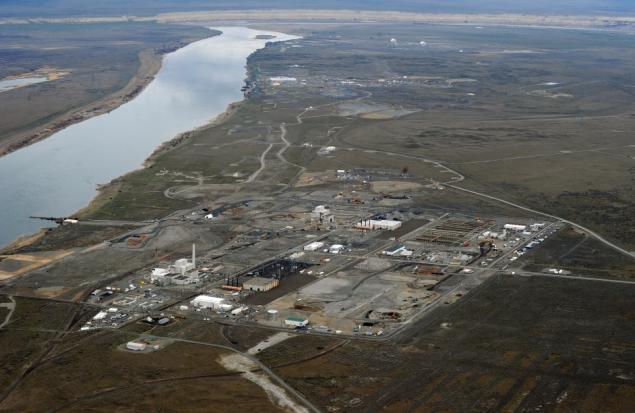
For Leckband, the question is not about the past, but the progress made on cleaning contaminated buildings and soil.
“It’s important to the entire Pacific North-West… the food crops, the salmon, the Indian tribes – it’s a huge, huge obligation,” she says.
Situated on a plain along the Columbia River, the Hanford site is where the US produced plutonium used in the Manhattan Project, for the bomb that destroyed Nagasaki, and for a Cold War stockpile………despite some progress, the site’s most complicated and potentially dangerous waste issue – 56 million gallons (255 million litres) of high-level radioactive waste sitting inside tanks at the centre of the site – is facing more problems.
In the mid-1980s, activists and reporters began to unwind Hanford’s history, detailing safety lapses and environmental hazards across the site. ………
Hanford’s daunting clean-up problem in 1989
100 sq miles (259 sq km) of contaminated groundwater
56 million gallons (254 million litres) of liquid waste, in tanks buried just below ground
More than 1,000 ad hoc burial sites of waste
Hundreds of contaminated buildings
450 billion gallons of contaminated water released at ground level……..http://www.bbc.com/news/magazine-26658719
Fracking brings instability and anxiety to the area around USA’s Waste Isolation Pilot Project (WIPP)

 Will Fracking Cause Our Next Nuclear Disaster? 09 June 2014 By Dahr Jamail, Truthout | The idea of storing radioactive nuclear waste inside a hollowed-out salt cavern might look good on paper. The concept is to carve out the insides of the caverns, deep underground, then carefully move in the waste. Over time, the logic goes, the salt will move in and insulate the containers for thousands of generations. “The whole game is to engineer something that can contain those contaminants on the order of tens of thousands of years,” Tim Judson, the executive director of the Nuclear Information Resource Service(NIRS), told Truthout. NIRS is intended to be a national information and networking center for citizens and environmental activists concerned about nuclear power, radioactive waste, radiation and sustainable energy issues, according to Judson.
Salt-cavern storage was the plan for the Waste Isolation Pilot Project (WIPP), the world’s third-deepest geological repository, constructed and licensed to permanently dispose of radioactive waste for 10,000 years. The repository sits approximately 26 miles east of the town of Carlsbad in southeastern New Mexico.
Since shipments began in 1999, more than 80,000 cubic meters and 11,000 shipments of waste have been transferred to WIPP.
But at the moment, there are several ongoing critical problems at the site, which has been closed and unable to accept shipments of radioactive waste ever since a fire and radiation release in February. Dozens of barrels of radioactive waste from Los Alamos National Lab, like the one that caused the radiation leak, now pose an “imminent” or “substantial” threat to public health and the environment.
Yet, these problems could pale in comparison to what might happen at the site if an earthquake were to strike, or if the protective salt layer were compromised by nearby drilling for oil and gas, and in particular, hydraulic fracturing, commonly known as fracking.
Fracking is a technique used in obtaining gas and petroleum, in which water is mixed with sand and toxic chemicals, and the mixture is injected at extremely high pressure into a wellbore to create small fractures.
Thus, one would logically deduce that fracking should never be done anywhere near WIPP. However, it is being done there, and experts expect it to increase.
“In the last three years, a dozen fracking wells have become operational within five miles of the site [WIPP],” Don Hancock, the director of the Nuclear Waste Safety Program at Southwest Research and Information Center, told Truthout.
Given that it is already well known that fracking causes earthquakes, it is clear that the nuclear waste storage site is now in danger of having its structural integrity compromised.
“These are the major concerns,” Hancock warned. “There is clearly a possibility that the deep fracking can affect the stability, but even more likely is fracking liquids nearing or entering the waste beds – which would be a very bad thing.”
“They Are Drilling All Around It”
Truthout spoke with a state of New Mexico employee who is intimately familiar with the permitting and drilling processes related to WIPP. The employee spoke on condition of strict anonymity, due to a fear of reprisals from the pro-drilling administration of radical right-wing Tea Party Governor Susana Martinez.
“There is so much drilling coming online down there now,” the employee explained. “They are going back into existing fields and drilling horizontally, and the WIPP siteis located right in the middle of all these fields, so they are drilling all around it.”
The source said that the oil and gas companies who are drilling and fracking near WIPP “have permission to go under the [WIPP] boundary to target the reservoirs there, so it appears as though most of the wells are horizontal, and that is a concern.”
According to the employee, “The fracking fluids they are injecting are very unstable, and if it continues like this there could be big problems…. There was a 5.2 [earthquake] in West Texas from fracking, and that’s a big concern given the sensitivity of the WIPP site and what the possible consequences could be.”…….http://www.truth-out.org/news/item/24201-will-fracking-cause-our-next-nuclear-disaster
Whistleblowers fired, as Hanford leaking radioactive waste problem continues
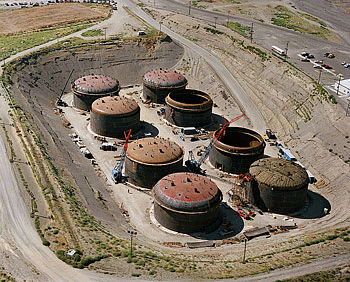 25 years on at America’s most contaminated nuclear waste site BBC News, Washington 10 June 2014 By Taylor Kate Brown “…….In February, Oregon Senator Ron Wyden accused the DOE of a “never-ending pattern of failing to disclose what it actually knows about conditions at Hanford”. Wyden is most recently concerned about the tanks holding by-products of plutonium production, buried just below the surface at the centre of the site.
The original containers, single-shell tanks built in the 1940s and 1950s, had already leaked at least 1 million gallons of liquid waste into the ground. Hanford officials built double-shell tanks in the 1970s and 1980s and began transferring the radioactive waste into the newer vessels.
But in October 2012, the energy department announced one of the double-shell tanks was leaking into the space between the two shells. Waste in that tank has not entered the environment.
Wyden released an engineering review that said six other double-shells had similar construction flaws. He accused the agency of hiding what they knew, as the report had been made months after the initial leak announcement, but no other warnings from the DOE had followed.
Meanwhile, Hanford officials have recently submitted a plan to start emptying the leaking tank in two years.
Then, in late March, two dozen workers fell ill because of chemical vapours near the tanks. Workers again noticed vapours around the tanks in May. The composition of the waste in the leaking tank makes it more likely to corrode, Fletcher says. No other double-shell tank holds such a mixture and full inspections on the tanks will now be done more frequently,
But in general, the double-shells must do their job for several more decades until a waste treatment plant – currently under construction – immobilises in glass all 56 million gallons of waste in the tanks.
The treatment plant was scheduled to become operational by 2019, but construction has been slowed or entirely halted on two key parts of the plant for additional testing. Once the treatment plant goes into operation, parts of it must be run entirely by robotics because of the high radioactivity of the waste. Regulators call it a “black-box” system.
Hanford Challenge represents two whistleblowers, Walt Tamosaitis and Donna Busche, who say they have been punished for expressing concerns about the treatment plant’s design.
Carpenter says the whistleblowers are speaking up now because once the plant begins operations, there will be no chance to fix potentially dangerous errors.
Both Tamosaitis and Busche have been fired by URS, one of the contractors at Hanford.
The energy department says it has asked its inspector general to “review the circumstances surrounding the termination of Ms Busche”, a safety manager who alleged continuing harassment since she first brought up concerns in 2011. Meanwhile the waste remains in the aging tanks. http://www.bbc.com/news/magazine-26658719
A Growing Number of Problems at Waste Isolation Pilot Project (WIPP)
Will Fracking Cause Our Next Nuclear Disaster? 09 June 2014 By Dahr Jamail, Truthout “…….Due to the ongoing problems at WIPP, the federal government’s Department of Energy (DOE) recently notified the state of New Mexico that it would be unable to meet a June 30 deadline to remove 3,706 cubic meters of nuclear waste from the mesa at Los Alamos National Lab where it is stored.
“As we work to assess the conditions of the transuranic waste program at the lab, we have decided to halt further shipments until we can reassure the public that it is safe to do so,” DOE Deputy Under Secretary David Klaus said.
As a result of the February radiation leak and fire within the facility, WIPP officials at the site discounted any effect of the current leak on human health, saying no radiation escaped to the surface. But they did not speak about the extent of the problem or how it eventually would be cleaned up.
“Officials at WIPP continue to monitor the situation,” DOE spokeswoman Deb Gillsaid at the time of the leak. “We are emphasizing there is no threat to human health and the environment.”
Contradicting Gill’s assurances, plutonium readings were detected at a DOE field office half a mile from the site. Joe Franco, the manager of the DOE field office, confirmed the readings……… Continue reading
Nuclear Regulatory Commission’s secrecy about San Onofre Nuclear Generating Station
 Nuclear regulators to Boxer: ‘None of your business’ Orange County Register, By TERI SFORZA / STAFF COLUMNIST 9 June 14,
The Nights of Fire and Explosions at WIPP
Breaking Bad: A Nuclear Waste Disaster By Joseph Trento, DC Bureau, June 5th, 2014 “…..There were warnings that not all was sanguine at WIPP. On Wednesday February 5, a truck used to haul salt taken out of the mine to make room for more and more radioactive casks caught fire because of a fuel spill. A fire in a mine is always serious. But a fire in a high-level nuclear storage facility is very serious. The first concern was a storage cask or canister had caused the fire but no radiation monitors went off, only a fire alarm. Eighty-six workers were slowly evacuated from the mine.
Fortunately, the workers made it to the surface and the fire was isolated to the ruined truck and involved no radioactive waste. That day there was no plutonium flash, no compromised canisters; just six workers were transported and treated at Carlsbad Medical Center. Another seven workers were treated at WIPP for smoke inhalation and the facility closed until everyone was certain the fire was out. A crew had to be sent in to do the inspection because, inexplicably, the WIPP facility is remarkably short of sophisticated remote sensing equipment. DOE immediately began an investigation.
The DOE Office of Environmental Management (EM) put together an Accident Investigation Board (AIB) to review what had gone right and wrong. The main contractor, Nuclear Waste Partnership, as well as the entire Carlsbad DOE field office was under scrutiny. DOE issued a press release saying, “The fire was a serious event that posed a threat to workers deep underground. In this case, the fire resulted in minor smoke inhalation to six workers, but it did not impact the public or the environment. There is no indication the fire was related to the February 14 radiological release.”
What investigators found was shocking. Carlsbad DOE officials did not conduct basic oversight of the private contractors running WIPP. The contractors failed to implement basic fire safety procedures, such as managing flammable truck fuel in an underground nuclear storage facility. In addition, WIPP officials repeatedly ignored the recommendations of the Defense Facilities Board – the gold standard for maintaining basic safety standards at all defense facilities. But the most damning part of the report said the safety culture required in such a dangerous environment no longer existed. Ironically, as the fire investigation was still underway, investigators had time to prevent the explosion that was to come. But their observations were ignored. The DOE EM report should have resulted in the immediate shutdown and full safety review of the facility. Instead, DOE Washington pressed to keep the waste flowing into WIPP. “The reality is DOE is overwhelmed with nuclear waste and has no safe place to put it,” Greg Mello says.
Nine days later, 2150 feet under the New Mexico desert, just before midnight on February 14, a canister of Los Alamos plutonium-tainted nuclear waste exploded. In a nuclear repository holding thousands and thousands of similar canisters and casks in what was supposed to be the most secure nuclear storage facility in the world, the very thing that was never supposed to happen did. No security cameras had been installed that could view the explosion. The radiation unleashed by the cracked canister quickly contaminated the sprawling underground salt mine. The seven football-field sized rooms in the Panels contain canisters that could have then caught fire and exploded. The continuous air monitor (CAM) finally detected the radiation and an alarm sounded alerting the night shift that high-level radiation had been detected. At that point, the contractors and DOE had no idea of the extent of the damage.
A DOE press release put the best face on a disaster: “Only 11 employees were at the WIPP site on the surface, no employees were in the underground. Two other WIPP employees reported to the site a couple hours later. The continuous air monitor measured airborne radioactivity close to the operating location where waste was being emplaced. Ventilation air is pulled from the underground repository by huge fans on the surface. This exhaust consists of unfiltered clean air… When the CAM alarmed, two dampers were automatically closed in the exhaust duct that redirected the exhaust through high efficiency particulate air (HEPA) filters that removes radioactive particles.
DOE said, “The next day an above ground exhaust air monitor on the WIPP site detected very low levels of airborne radioactive contamination. The 140 employees at the site were kept indoors as a precaution while air samples were taken. The 13 employees present during the radioactive release event on February 14 were tested for internal radioactive contamination after the event. The 140 employees have also been offered testing.
“It is believed that a small amount of radioactivity leaked by the exhaust-duct dampers, through the unfiltered exhaust ducts and escaped above ground. The exhaust duct dampers are large ‘butterfly’ valves that are designed to close and cut off the airflow through the exhausters. However, the valves do not fully seal the exhaust ducts and still allowed a small amount of unfiltered air to escape.”
In fact, DOE employees used spray foam to seal the dampers to keep more radiation contaminated air from escaping from a half mile underground.
That night America’s only official high-level nuclear waste site was rendered useless for at least the next three years. Everything that was supposed to happen did not. Air vents to the surface did not automatically close. DOE failed to keep computer records updated of what deadly waste was in what container and where it was located. That small explosion not only contaminated 21 workers and caused an unknown amount of radiation released into New Mexico’s air, but it also revealed a Department of Energy that is the midst of a nuclear security crisis not in some far off country like Pakistan or one of the former Soviet Republics but here at home.
This time the Environmental Management team asked to investigate by DOE did not have to face the pressure of telling headquarters that WIPP should be shuttered. Radiation contamination did that for them.
The loss of WIPP means the most deadly substances science has managed to create will have to be stored in place across our country in places totally unsuited for such storage. At WIPP, the deadly conditions created by the explosion will make monitoring the remaining radioactive materials very difficult. The official report of the WIPP accident was scathing. But scathing reports on DOE operations are common…. “.http://www.dcbureau.org/201406059835/natural-resources-news-service/breaking-bad-nuclear-waste-disaster.html
Big contributions to George W Bush and Rick Perry got WIPP nuke waste facility happening
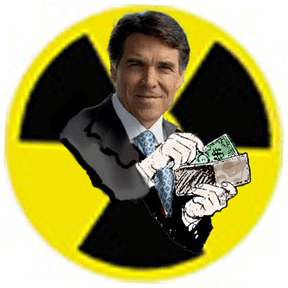 Breaking Bad: A Nuclear Waste Disaster By Joseph Trento, DC Bureau, June 5th, 2014″…….. Former President George W. Bush and Texas Governor Rick Perry’s single largest political contributor, the late Texas billionaire Harold C. Simmons, founded Waste Control Specialists and used his political influence to get the West Texas nuclear disposal site approved by state and federal licensing officials. The political efforts used to secure the licensing caused years of controversy in Texas. Environmentalists opposed the site because it is on an important aquifer in Texas. Another reason is that one of Simmons’s companies had operated a lead incinerator in Dallas that became an EPA Superfund Site.
Despite this environmental pedigree, LANL and DOE officials chose Waste Control Specialists to administrator their alternative nuclear waste storage site. While technically the company has licenses only for low-level nuclear waste, under its Texas permit, Waste Control can accept certified waste from federal agencies.
DOE officials said the Waste Control site is just a temporary alternative to the disabled WIPP. That is not true. Los Alamos and other national laboratories with high-level nuclear waste have been planning to use the Texas site for years, well before is licenses had been approved. The political promises that were made that it would be only for low-level waste were a ruse. As long as four years ago, during a Savannah River Site Citizens Advisory Board meeting in Aiken, South Carolina, DOE officials and SRS contractors talked openly about using the Texas site to offload uranium waste from SRS.
In late May, DOE investigators became so concerned about the Los Alamos containers being stores in what amounts to an open pit, they halted the shipments to Waste Control. The 112 canisters already at Waste Control were ordered to be isolated and surrounded by large concrete containers as well monitored by television camera. As of May 28, seventy-three Los Alamos containers have been segregated and covered with the cement and gravel-filled barriers.
Harold Simmons’s team lobbied hard to get only the second license in U.S. history from DOE for a private nuclear dump. They got the licensing in the last days of the Bush administration. Prior to the LANL decision to ship containers of transuranic waste to the site, there were warnings to Waste Control that it had already been accepting waste it was not permitted to receive.
Pressure has been building for years for DOE to stabilize and isolate its growing high-level nuclear waste stream. After the WIPP explosion, the DOE suddenly concluded that the thousands of feet below earth in salt beds were no longer needed to store the most deadly radioactive material on earth. Open trenches in the West Texas desert would be good enough. On April 2, tractor trailers hauled the first of the Los Alamos casks of radioactive high-level waste to the Andrews County dump before the WIPP investigation team succeeded in halting the shipments……”.http://www.dcbureau.org/201406059835/natural-resources-news-service/breaking-bad-nuclear-waste-disaster.html
1 This Month
23-25 October – on Zoom – World BEYOND War’s annual global conferenc


Shut down the radiation-damaged Heysham nuclear reactors now
To see nuclear-related stories in greater depth and intensity – go to https://nuclearinformation.wordpress.com

Say No to NASA’s Reckless Nuclear Reactor on the Moon
Say No to NASA’s Reckless Nuclear Reactor on the Moon
-
Archives
- October 2026 (170)
- September 2026 (339)
- August 2026 (330)
- July 2026 (355)
- June 2026 (287)
- May 2026 (306)
- April 2026 (356)
- March 2026 (251)
- February 2026 (267)
- January 2026 (308)
- December 2025 (358)
- November 2025 (359)
-
Categories
- 1
- 1 NUCLEAR ISSUES
- business and costs
- climate change
- culture and arts
- ENERGY
- environment
- health
- history
- indigenous issues
- Legal
- marketing of nuclear
- media
- opposition to nuclear
- PERSONAL STORIES
- politics
- politics international
- Religion and ethics
- safety
- secrets,lies and civil liberties
- spinbuster
- technology
- Uranium
- wastes
- weapons and war
- Women
- 2 WORLD
- ACTION
- AFRICA
- Atrocities
- AUSTRALIA
- Christina's notes
- Christina's themes
- culture and arts
- Events
- Fuk 2022
- Fuk 2023
- Fukushima 2017
- Fukushima 2018
- fukushima 2019
- Fukushima 2020
- Fukushima 2021
- general
- global warming
- Humour (God we need it)
- Nuclear
- RARE EARTHS
- Reference
- resources – print
- Resources -audiovicual
- Weekly Newsletter
- World
- World Nuclear
- YouTube
-
RSS
Entries RSS
Comments RSS

