Los Alamos officials have not silenced Jim Doyle’s thoughtful plea for debate about nuclear weapons
Los Alamos, Freedom of Speech, and Nuclear Disaster Lisbeth Gronlund, physicist & co-director, Global Security Union of Concerned Scientists August 4, 2014
As every high school student learns, the first amendment to the U.S. constitution guarantees the right to freedom of speech. That’s why government employees have the right to express their opinions as long as they make clear that their opinions do not represent those of their employer.
Apparently some folks at Los Alamos National Laboratory—one of the two labs that design and help maintain U.S. nuclear weapons—missed that day in class. Last year, Jim Doyle, then a nuclear security and non-proliferation specialist who had been at the Lab for 17 years, published an article in the journal Survival titled Why Eliminate Nuclear Weapons? Doyle included the requisite disclaimer: “The views presented in this article are the author’s own and do not represent those of the Los Alamos National Laboratory or the US government.” So far, so good.
But soon Los Alamos officials claimed the article contained classified information. Then they docked Doyle’s pay, took away his security clearance, and ultimately fired him. Not subtle.

The shameful tale of Los Alamos and Jim Doyle is thoroughly detailed in an article by Douglas Birch, an investigative journalist who works at the Center for Public Integrity. Among other things, Birch interviews several experts with security clearances who say that Doyle’s article contains nothing classified……..
An informed public debate about U.S. nuclear weapons policies is essential. That Los Alamos Lab officials went out of their way to stifle such debate is especially disturbing. Ironically, their actions have now brought Doyle’s article to the attention of a much larger group of people. http://blog.ucsusa.org/los-alamos-freedom-of-speech-nuclear-disaster-612
To help the nuclear industry, USA’s EPA to weaken radiation standards
 Green groups say EPA rules would weaken radiation standards The Hill, By Tim Devaney – 08/04/14 Green groups say the Environmental Protection Agency’s plan to weaken radiation standards at nuclear power plants would triple the likelihood of people in surrounding communities developing cancer.
The EPA said earlier this year it is considering new rules that green groups claim would actually weaken radiation standards, increasing public exposure by at least three times from the current level. The agency has not updated the standards since 1977. “The EPA admits that radiation is much more likely to cause cancer than was believed when the rule was originally written,” said Dan Hirsch, president of nuclear watchdog group Committee to Bridge the Gap. “So it’s perplexing that rather than tightening the rule, they’re proposing to weaken it further.”
The Committee to Bridge the Gap is one of about 70 environmental groups that sent EPA Administrator Gina McCarthy a letter over the weekend, asking her to reconsider the new rules as the public comment period closes and the agency enters the final stages of rule-making.
In addition to the environmental groups, more than 6,000 people have written to the EPA opposing the changes to the radiation standard, Hirsch said.
Under the EPA’s current standards, about one in every 500 people who are exposed to radiation develop cancer, but the new rules would increase the risk even more, Hirsch said.
“They’ve given a free pass to radiation,” Hirsch said……….
environmental groups speculate the Obama administration could be trying to replace coal production with nuclear energy, which they say is why the EPA is loosening radiation standards.
Environmental groups, however, express deep concerns about this plan.
“I would not say that nuclear is safer than coal, not at all,” Hirsch said.
“Choosing between coal and nuclear is a form of picking one’s poison, either carbon or plutonium,” he added. “But we believe that shouldn’t be the choice. The choice should be between dangerous pollutants and renewables, which are far safer.”
Renewable energies such as solar, wind and hydropower are all better replacements for coal than nuclear energy, Hirsch said. : http://thehill.com/regulation/214232-green-groups-say-epa-rules-would-weaken-radiation-standards#ixzz39gQFKYxi
Follow us: @thehill on Twitter | TheHill on Facebook
USA’s Nuclear – I mean – Environmental Protection Agency
Officially “Safe” RadiationBy William Boardman OpEd News 8/3/2014 More Radiation Exposure Won’t Hurt You, Says U.S. EPA
“Protection Standards for Nuclear Power Operations” means what?
The Environmental Protection Agency (EPA) of the United States is a full blown oxymoron when it comes to protecting U.S. residents from the danger of increased exposure to ionizing radiation. That’s the kind of radiation that comes from natural sources like Uranium and the sun, as well as unnatural sources like Uranium mines, nuclear weapons, and nuclear power plants (even when they haven’t melted down like Fukushima). The EPA is presently considering allowing everyone in the U.S. to be exposed to higher levels of ionizing radiation.
In 1977, the EPA established levels of radiation exposure “considered safe” for people by federal rule (in bureaucratese, “the regulation at 40 CFR part 190“). In the language of the rule, the 1977 safety standards were: “The standards [that] specify the levels below which normal operations of the uranium fuel cycle are determined to be environmentally acceptable.” In common parlance, this became the level “considered safe,” even though that’s very different from “environmentally acceptable.” “Acceptable by whom? The environment has no vote.
The phrase “considered safe” is key to the issue, since there is no “actually safe” level of radiation exposure. The planet was once naturally radioactive and lifeless. Life emerged only after Earth’s radiation levels decayed to the point where life became possible, in spite of a continuing level of natural “background radiation.” The reality is that there is no “safe” level of radiation exposure.
Is the EPA actually immersed in a protection racket?
The studied ambiguity of the proposal’s title — “Environmental Radiation Protection Standards for Nuclear Power Operations” — goes to the heart of the issue: who or what is really being protected, nuclear power operations?
Quite aware that it is perceived by some as placing the desires of the nuclear power industry above the safety needs of the population, the EPA begins its proposal for changing radiation limits with this defensive and apparently contradictory passage:
This Advance Notice of Proposed Rulemaking is being published to inform stakeholders, including federal and state entities, the nuclear industry, the public and any interested groups, that the Agency is reviewing the existing standards to determine how the regulation at 40 CFR part 190 should be updated and soliciting input on changes (if any) that should be made.
This action is not meant to be construed as an advocacy position either for or against nuclear power.
EPA wants to ensure that environmental protection standards are adequate for the foreseeable future for nuclear fuel cycle facilities. As far as the EPA is concerned, the uranium fuel cycle does not include Uranium mining, despite the serious environmental danger that process entails. Once the environmental and human degradation from Uranium mining has been done, the EPA begins regulating environmental protection from nuclear fuel cycle facilities, beginning with milling and ending with storage or reprocessing facilities for nuclear waste.
According to the agency itself, “EPA’s mission is to protect human health and the
environment. EPA sets limits on the amount of radiation that can be released into the environment.”
Radiation exposure is chronic, cumulative, and unhealthy
Given the pre-existing radiation load on the environment from natural sources, it’s not clear that there is any amount of radiation that can be released into the environment with safety. The EPA pretty much evades that question, since the straight forward answer for human health is: no amount. Besides, the semi-captured protection agency is just as much engaged in protecting economic health for certain industries as it is in protecting human health. This leads it to making formulations that manage to acknowledge human reality without actually supporting it:………
Lower radiation levels provide more environmental protection
Environmental organizations like the Nuclear Information and Resource Service (NIRS) are urging the EPA to lower radiation release standards, to “protect more, not less.” According to NIRS, regulation of nuclear power has a sorry history:……..
In 2005, the National Academy of Sciences addressed “safe” levels of radiation and concluded that there are none in any scientifically meaningful sense.
Humans are exposed to a basic, damaging level of ionizing radiation from multiple sources from gestation till death. This natural background radiation is at a relatively low level, but the risk from radiation is cumulative. Every additional exposure above background radiation adds to the risk. Some of these risks, like radiation treatment to ward off cancer, are widely accepted as reasonable trade-offs. The reasonableness of greater exposure from the nuclear fuel cycle and the uncontrolled growth of nuclear waste is not such an obviously beneficial trade-off. http://www.opednews.com/articles/Officially-Safe-Radiatio-by-William-Boardman-Cancer_Environment_People_Radiation-140803-863.html
USA’s unprecedented nuclear arsenal – the road to mass suicide
 Why We Must Disarm the U.S.’s Unprecedented Nuclear Arsenal http://time.com/3080077/why-we-must-disarm-the-u-s-s-unprecedented-nuclear-arsenal/ Elaine Scarry The potential for so vast a massacre has never before existed.
August 6 is the 69th anniversary of the day the United States dropped an atomic bomb on Hiroshima. The bombing of Nagasaki took place on August 9. An appropriate way to reflect on these events might be to contemplate our current nuclear arsenal and ask why it is being kept in place.The U.S. has by far the most powerful nuclear arsenal on Earth. Our 14 Ohio-class submarines together carry the equivalent of at least 56,000 Hiroshima blasts. These ships are not a remnant of the Cold War. Eight were made after the opening of the Berlin Wall during the presidencies of George H.W. Bush and Bill Clinton.
A fleet of 12 new Ohio-class submarines is currently undergoing design and construction: the first is scheduled for completion in 2021, the last in 2035. Also underway are a next-generation intercontinental ballistic missile and a next-generation heavy bomber, land-based and air-based delivery systems initiated by George W. Bush and continued by Barack Obama.
The country’s nuclear planners do not wait for a crisis to choose possible targets. Thousands of designated targets exist right now, often involving cities whose populations have no quarrel with us. Specific missiles have been assigned to each target city.
The U.S. citizenry cannot stop nuclear missiles once they are fired. Nor can we undo injuries—to humans, animals, plants and to the earth and sky themselves—once they are inflicted. Only by acting now— before they are fired and while the danger seems remote—can missiles be stopped and the injuries cancelled.
Polls conducted at the University of Maryland’s Center for International and Security Studies show that 73% of the U.S. population wants total elimination of nuclear weapons. But anonymous polls require no courage and carry no force. Making audible the population’s voice requires that people speak in their own voices and write their names, putting their opposition on record.
We have freedom over the ways we choose to express our opposition to these weapons. We have no freedom to determine what the stakes are or what happens if opposition fails.
Four factors make openly registering our opposition this summer and fall urgent:
1. Right now we have what we may never have again: a president who, in his Prague speech, put himself on record as saying nuclear weapons have to be eliminated. Furthermore, he acknowledged that because the U. S. is the only country to have used them, we are morally obligated to take the lead in eliminating them. So far Obama has failed to act. But if the U.S. population makes its will clear, he may act.
2. Next spring the Treaty on the Non-Proliferation of Nuclear Weapons will undergo its next five-year review at the United Nations. Article 6 requires that nuclear states give up their nuclear arms. Many of the treaty signers have expressed dismay and disgust with the failure of progress on Article 6. If by April 2015 the nuclear states have—after 45 years—still made little progress, the countries that have so far abstained from acquiring them may become convinced that a nuclear-free world is impossible. The dream of non-proliferation will end.
3. We have at present an ambassador to the United Nations, Samantha Power, who has written extensively about the moral horror of genocide inflicted on Armenians, Rwandans and others. She has criticized the United States for failing to act to stop genocide. Surely our citizenry can convince her that our own nuclear architecture is the genocide-ready instrument most in need of elimination.
4. The U.S. constitution makes Congress (through the requirement for a declaration of war) and the citizenry (through the second amendment) responsible for overseeing the country’s war making. A citizenry that turns its back on this responsibility is infantilized and marooned, severed from all governance. No one can take from us the authority over the country’s defense the constitution gives us; but if we do not act on it, it’s gone.
There are ways of honoring this responsibility that most of us might find too costly. Right now, Megan Rice, an 84-year old nun, is serving a three-year prison sentence for cutting through the security fences at the Oak Ridge, Tenn. nuclear facility. She and two companions set out in the middle of the night, crossing wilderness ground for several hours before they reached and broke through the fences. They risked not just prison sentences; they risked their lives.
The U.S. arsenal has taken away the right of self-defense from all creatures everywhere. Arrangements for so vast a massacre have never before existed on Earth. These arrangements must be unmade. They will not be unmade unless each of us steps forward and insists that it happen.
Elaine Scarry, who teaches at Harvard, is the author ofThermonuclear Monarchy: Choosing Between Democracy and Doom.
Callaway Nuclear Reactor – Radioactive Tritium, Cobalt 60 Found in Monitoring Well
“Groundwater doesn’t know boundaries,” Smith says. “So if the contamination happened on Ameren’s property, it could very well move off site.”…..http://stlouis.cbslocal.com/2014/08/04/radioactive-tritium-cobalt-60-found-in-monitoring-well-near-nuclear-reactor/
Fire risk at Waste Isolation Pilot Plant (WIPP)
 Lab Director: Expect radiation spikes coming from US nuclear facility — Gov’t pays for more air monitors to see impact on populated areas — DOE warns of ‘ignitability’ of 368 containers at site; “Significant fire risk” — Top Official: Material at WIPP “just disintegrated… got very hot, very quickly” (VIDEO) http://enenews.com/lab-director-radiation-spikes-expected-nuclear-facility-govt-pays-air-monitors-impact-populated-areas-doe-ignitability-368-containers-wipp-underground-significant-fire-risk-top-official-mater
Dept. of Energy – Carlsbad, NM Field Office (pdf), July 30, 2014: The purpose of this letter is to provide you [New Mexico Environmental Dept.] written notice that the Department of Energy [is] provisionally applying EPA Hazardous Waste Number (code) D001** for the characteristic of ignitability to some nitrate salt bearing waste containers that have been disposed at the WIPP facility. […] This affects up to 368 containers […] in the underground WIPP facility […] The Permittees plan to implement the [plan] to expedite closure of Panel 6 and Panel 7, Room 7 so that a potential release […] will not pose a threat to human health or the environment.
** “Significant fire risk due either to their low flash point, ability to self-combust and burn, or are able to combust or support combustion” –EPA hazardous waste specialist Daniel Stoehr
Reuters, July 26, 2014: A team of government investigators has turned its attention to Los Alamos in recent days […] to determine whether additional barrels are affected, said [New Mexico Senator Peter Wirth]. “We’re making progress in determining what happened. Now we are much more focused on the scope,” he said.
Minutes of the New Mexico Legislature (pdf), published June 26, 2014: In further explaining what occurred [at WIPP, NMED Secretary Ryan] Flynn said that the material holding the bags of magnesium oxide together that had been on top of the drums just disintegrated. By all indications, he added, the area got very hot very quickly […]
Carlsbad, NM Town Hall, July 24, 2014:
- 37:30 in – Question: Is Dr. Hardy saying that radiation from contaminated ventilation system will continue to be released to the environment periodically? Russell Hardy, director of the Carlsbad Environmental Monitoring & Research Center: That is Dr. Hardy’s assumption… we will probably see spikes at Station B, as contamination… makes its way out of the repository.
- 52:30 in – Hardy: We did receive additional funding from DOE to expand our ambient air sampling sites… very soon we will be deploying 3 additional ambient air sampling towers… one will be here in Carlsbad… we think those 3 additions will give us much better coverage in the future with respect to how this release — or the potential for future releases — may impact the area.
Liquid Fluoride Thorium Reactor (LFTR) simply too dangerous -that’s why it was stopped
 Perhaps these technical problems can be overcome, but why would anyone bother to try, knowing in advance that the MSR plant will be uneconomic due to huge construction costs and operating costs, plus will explode and rain radioactive molten salt when (not if) the steam generator tubes leak. There are serious reasons the US has not pursued development of the thorium MSR process.
Reports are, though, that China has started a development program for thorium MSR, using technical information and assistance from ORNL. One hopes that stout umbrellas can be issued to the Chinese population that will withstand the raining down of molten, radioactive fluoride salt when one of the reactors explodes.
The Truth About Nuclear Power – Part 28 Subtitle: Thorium MSR No Better Than Uranium Process, Sowell’s law blog July 20, 2014
Ukraine tensions cause stalling of U.S.-Russia nuclear deal
U.S.-Russia Nuclear Deal Stalls as Tensions Over Ukraine Rise NYT, By DAVID E. SANGER and WILLIAM J. BROADAUG. 2, 2014 WASHINGTON — The growing confrontation between Washington and Moscow over Ukraine has derailed a recent accord that promised one of the most expansive collaborations ever between the countries’ nuclear scientists, including reciprocal visits to atomic sites to work on projects ranging from energy to planetary defense.
It was only 11 months ago that the American energy secretary — Ernest J. Moniz, a former M.I.T. professor who has championed scientific programs that would bury the Cold War competitions between the United States andRussia — went to Vienna to sign the agreement, an indication of how recently the Obama administration believed it had a chance of building on a quarter-century of gradual integration of Russia with the West.
Handshakes and congratulations exchanged with Mr. Moniz’s Russian counterpart, Sergey V. Kirienko, sealed an arrangement that would let Russian scientists into, among other places, the heart of the American nuclear complex at Los Alamos National Laboratory in New Mexico, where the first atomic bomb was constructed 70 years ago, and a dozen sister laboratories devoted to the making of the American nuclear arsenal. In return, American scientists would be allowed deep into Russian nuclear facilities, including the birthplace of the Soviet bomb……
Today, the real-life accord is on ice. This year, the Energy Department canceled nuclear meetings, symposia and lab visits with Russia……http://www.nytimes.com/2014/08/03/world/europe/us-nuclear-deal-with-russia-fails-as-tensions-rise.html?_r=0
Upgrading USA nuclear power is costing $billions
 US nuclear industry spends billions on post-Fukushima upgrades Washington (Platts)–31Jul2014 The US nuclear power industry has so far spent about $3 billion taking actions and making plant modifications to address lessons learned from the 2011 Fukushima I accident in Japan, a utility official told the US Nuclear Regulatory Commission during a briefing Thursday.
NRC ordered US nuclear power plant operators in March 2012, almost exactly a year after the accident, to comply with new requirements designed to strengthen their ability to keep reactors and spent fuel cooled during severe external events, such as the earthquake and tsunami that hit the station in Japan………
Pete Sena, president and chief nuclear officer of FirstEnergy Nuclear Operating Company, told the commission during the briefing Thursday that since the March 2011 accident, in which three of six reactors at Fukushima suffered fuel damage and released radioactivity, FENOC has spent about $125 million to increase the safety margin of the four nuclear power reactors it operates.
If those figures are an accurate average cost for all 100 operating nuclear power reactors in the US, the industry has spent around $3 billion or more on post-Fukushima safety upgrades, Sena said.
Jim Scarola, executive director at NEI and co-chair of the industry’s Fukushima response steering committee, said during the briefing that the industry “does not look at this task as finished. It is a continuous improvement.” …….http://www.platts.com/latest-news/electric-power/washington/us-nuclear-industry-spends-billions-on-post-fukushima-21004195
Nuclear safety specialist fired from Los Alamos for pushing Obama’s Nuclear Agenda

 Fired From Los Alamos for Pushing Obama’s Nuclear Agenda, The Daily Beast, 31 July 14 The President says he wants to get rid of the world’s A-Bombs. But when an employee at the nation’s premier nuclear lab suggested the same thing, he got axed. By Douglas Birch, Center for Public Integrity

James E. Doyle’s ordeal with Washington began one morning in early February last year, when his supervisor stopped by his desk at Los Alamos National Laboratory and told him that senior managers wanted copies of all his publications.
The 55-year-old political scientist asked the reason for the request, and he eventually was told that someone at the House Armed Services Committee wanted to see the publications. But Doyle said officials refused to tell him who it was or why.
Later that day at the lab’s New Mexico campus, he said, two members of a Security Inquiries Team abruptly arrived with a special, silver-colored briefcase for secure documents, and pulled out an article he published a few days earlier on the website of a London nonprofit group.
They claimed that the article, an impassioned critique of the political theories undergirding the nuclear arms race and a defense of President Obama’s embrace of a nuclear weapons-free future, contained classified information.
The assertion astonished Doyle, since the laboratory’s security authorities had already reviewed the article and declared it unclassified. But it was the start of a series of events in which Doyle first had his pay docked and his security clearance withdrawn, and then eventually was fired.
He got that final news on July 8, a day after the Center for Public Integrity asked the Energy department’s National Nuclear Security Administration, which runs the nation’s nuclear labs, about the dispute over his article. “I was shocked,” he said, shortly afterward. “I am still shocked.”
Experts say Doyle’s treatment raises questions about the commitment of the nuclear weapons labs—which face increased competition for resources amid declining military interest in their key product—to intellectual independence in their workforce………..
Doyle, who holds a doctorate in international studies from the University of Virginia, has been at Los Alamos for the past 17 years. Before he joined the lab, he said, he wrote the Department of Energy’s strategic plan for keeping weapons-grade uranium and plutonium stored at hundreds of sites scattered across the former Soviet Union from falling into the wrong hands. He referred to this risky state of affairs as “the babushka-with-uranium-in-the-chicken-shed” problem.
As a nuclear safeguards and security specialist in the lab’s Nuclear Nonproliferation Division, which has 250 employees and an annual budget of about $185 million, Doyle has studied ways to verify reductions in United States and Russian nuclear weapons stockpiles beyond the current levels. He also edited a textbook, Nuclear Safeguards, Security and Nonproliferation: Achieving Security with Technology and Policy, which, he said, is used in three dozen universities in the U.S. and abroad. http://www.thedailybeast.com/articles/2014/07/31/fired-from-los-alamos-for-pushing-obama-s-nuclear-agenda.html#sthash.o3ZKvqHu.dpuf
Chem-Nuclear ordered by Court to protect groundwater from radiation

 Court urges Chem-Nuclear safety The Augusta Chronicle, By Sarita Chourey Morris News Service Thursday, July 31, 2014 COLUMBIA — The South Carolina Court of Appeals is ordering Chem-Nuclear to better protect the groundwater from contamination at the Barnwell County’s low-level radioactive waste disposal site. Under the order, the site operator and the S.C. Department of Health and Environmental Control have 90 days to turn in a plan to reach compliance.
The Sierra Club, represented by the South Carolina Environmental Law Project, had not asked for Chem-Nuclear’s license to be revoked, but rather that it improve waste-handling procedures at the 235-acre site near the town of Snelling.
In its ruling Wednesday, the three-person court said DHEC had not enforced the law on several parts of the regulation, and that the Administrative Law Court was wrong when it found Chem-Nuclear to be in compliance.
In one part of Wednesday’s decision, the court said the trenches at the site have no system to collect liquids that have drained or percolated through radioactive materials.
“DHEC and Chem-Nuclear argue Chem-Nuclear is justified in not having a … collection system due to ‘concerns regarding the radioactive exposure to workers handling and processing (it),’” wrote the court. “We fail to see how the danger of radioactive contamination to workers actually justifies releasing it into the groundwater without testing and remediation. Rather, it seems the danger to health and safety requires testing and remediation.”………
Tritium results from the manufacture of nuclear power, and is found in radioactive waste generated by nuclear power plants.
In 1999 a nearby church property was contaminated by radioactive material due to Chem-Nuclear’s disposal practice of pumping contaminated water out of a trench into lined ponds. ……. http://chronicle.augusta.com/latest-news/2014-07-31/court-urges-chem-nuclear-safety?v=1406837686
Obama cuts back on nuclear security, spends up big on nuclear weaponry
 Obama curbs nuclear security goals as bomb-building budget grows, http://news.yahoo.com/obama-curbs-nuclear-security-goals-005500310.html by Douglas Birch, 30 July 14 Since the start of his presidency, Barack Obama has been clear that one of his major goals was to secure nuclear weapons and materials, and as recently as March, at the Nuclear Security Summit in Holland, the president declared that “it is important for us not to relax but rather accelerate our efforts over the next two years.”
According to a new analysis of nuclear security spending by a bipartisan group at Harvard’s Kennedy School of Government, the administration in its proposed 2015 budget chose to cut nuclear nonproliferation programs in the Energy Department by $399 million while increasing spending on nuclear weapons by $534 million.
In addition, despite missing a self-imposed deadline of April 2013 for ensuring that nuclear materials were safe from terrorists across the globe, the White House at about the same time rejected a confidential Energy Department-sponsored plan to accelerate those efforts by 2016, the year Obama is slated to convene a fourth international summit on the issue.
The proposal, which appears in a May 2013 report obtained recently by the Center for Public Integrity, was intended to address the huge amount of unfinished work in the Obama administration’s nonproliferation plan.It said that more than two tons of portable, easily-weaponized uranium were still being held in scores of nuclear research reactors, while the world’s supply of another nuclear explosive, plutonium, was growing at a rate of about 740 bombs’ worth a year.
Despite progress, there remained enough nuclear explosive material in the hands of civilians to cobble together 40,000 atomic bombs.
40 $billion later America’s biggest nuclear waste site still leaking
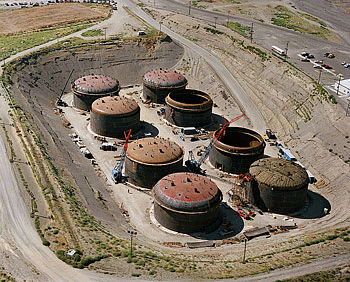 After $40 Billion, America’s Biggest Nuclear Dump Is Still Leaking by Charleston Voice 29 July 14, It’s cost $40 billion so far to clean up America’s biggest nuclear waste site—half the size of Rhode Island—and it’s going to take another 40 years and $100 billion to finish the job.
And delays keep piling up even though at least a third of the aging tanks storing 56 million gallons radioactive waste have leaked or are leaking, pouring some of the world’s most dangerous contaminants into the Columbia River.
Yet the treatment plant to create safe storage for all that waste—which will remain radioactive for hundreds of thousands of years—still isn’t built. It should have been finished three years ago. And the Environmental Protection Agency is skeptical that the plant’s current completion date of 2022 will be met.
Only Another 40 Years to Go The plant is a crucial part of a wider remediation job that’s decades from being done, according to Dennis Faulk, the EPA’s program manager for Hanford
“I think we have another 40 years to go,” Faulk told WhoWhatWhy. “And another $100 billion will be needed over that time.” It costs about $2 billion a year to keep cleaning.
The EPA oversees and enforces the cleanup efforts, which are carried out by the Department of Energy and the contractors it hires. Both Congress and the Department of Energy itself have given those efforts a failing grade.
The Department of Energy’s internal watchdog last year blamed the department and the contractor that’s building the plant, Bechtel National Inc., for the delays. The Department of Energy’s oversight lacked focus and Bechtel implemented scores of design changes without subjecting them to the required nuclear safety review, according to a report from the department’s Inspector General.
Congress’ Government Accountability Office was harsher. It recommended shutting down construction until the design work is completed safely, and said the Department of Energy was prematurely awarding millions in performance incentives to Bechtel. Meanwhile, Bechtel and another contractor are fighting whistleblower lawsuits from two former employees, and guess who’s paying for their legal fees? The Department of Energy is.
All of those complications are worsened by the fact that the search for waste keeps turning up surprises, like nearly 100 pieces of spent fuel found in Native American burial grounds. So as the Herculean task creeps forward, occasional new contamination findings like that add time to the clock, which means the projected completion dates are really only theoretical.
Hanford wasn’t built with an abundance of forethought. The job of making weapons-grade plutonium came first. Everything else, like planning for the waste and telling people about the release of radioactive materials, came second.
Most critical work on the plant has been shut down………..http://chasvoice.blogspot.com.au/2014/07/after-40-billion-americas-biggest.html
Nuclear industry must face up to chance of freaky disasters

|
Fukushima Study: Think About Unthinkable Disasters, SciTech Today,
|
July 28, 2014 |
According to a National Academy of Sciences report, the U.S. nuclear industry must think about earthquakes, floods, tsunamis, solar storms, multiple failures and situations that seem freakishly unusual. The 2011 Japanese Fukushima accident, caused by an earthquake and tsunami, should not have been a surprise, the report says. A U.S. science advisory report says Japan’s Fukushima nuclear accident offers a key lesson to the nation’s nuclear industry: Focus more on the highly unlikely but worst case scenarios.
That means thinking about earthquakes, floods, tsunamis, solar storms, multiple failures and situations that seem freakishly unusual, according to Thursday’s National Academy of Sciences report. Those kinds of things triggered the world’s three major nuclear accidents.
“We need to do a soul searching when it comes to the assumptions” of how to deal with worst case events, said University of Southern California engineering professor Najmedin Meshkati, the panel’s technical adviser. Engineers should “think about something that could happen once every, perhaps 1,000 years” but that’s not really part of their training or nature, he said.
You have to totally change your mode of thinking because complacency and hubris is the worst enemy to nuclear safety,” Meshkati said in an interview……..
David Lochbaum of the activist group Union of Concerned Scientists said the problem is that federal law financially protects the U.S. nuclear industry from accidents gives utilities little incentive to spend money on low-probability, high-consequence problems.……
Another issue the report raised was about how far radiation may go in a worst case accident.
The U.S. Nuclear Regulatory Commission orders plants to have emergency plans for a zone of 10 miles around a nuclear plant. But the academy study said Fukushima showed that “may prove inadequate” if a similar accident happened in the U.S. People nearly 19 miles away in Japan needed protectionfrom radiation. But the committee would not say what would be a good emergency zone. http://www.sci-tech-today.com/story.xhtml?story_id=130007CN9W8O
USA’s new nuclear power construction is not working out
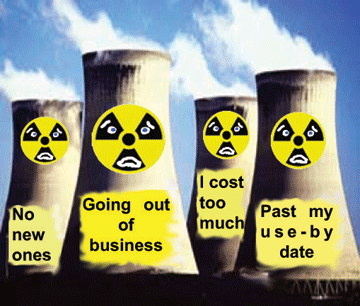 Promises of easier nuclear construction fall short, Tri City Herald, BY RAY HENRY Associated Press July 26, 2014 WAYNESBORO, GA. The U.S. nuclear industry has started building its first new plants in decades using prefabricated Lego-like blocks meant to save time and money and revive the once promising energy source.
So far, it’s not working.
Quality and cost problems have cropped up again, raising questions about whether nuclear power will ever be able to compete with other electricity sources. The first two reactors built after a 16-year lull, Southern Co.’s Vogtle plant in Georgia and SCANA Corp.’s VC Summer plant in South Carolina, are being assembled in large modules. Large chunks of the modules are built off-site, in an effort to improve quality and avoid the chronic cost overruns that all but killed the nuclear industry when the first wave of plants was being built in the 1960s and 1970s.
Analysts say engineers created designs that were hard or impossible to make, according to interviews and regulatory filings reviewed by The Associated Press. The factory in Louisiana that constructed the prefabricated sections struggled to meet strict quality rules. Utility companies got early warnings but proved unable to avoid the problems. Now the firms leading the project are phasing out the Louisiana factory for work on the biggest modules and contracting with new manufacturers………
Inspectors for the U.S. Nuclear Regulatory Commission halted their first review of the plant the following month, saying it was not ready for in-depth scrutiny. Follow-up inspections found more issues with the plant’s quality assurance programs. NRC officials proposed a $36,400 fine against The Shaw Group for firing a quality insurance supervisor elsewhere in its company who warned a potentially faulty part may have been shipped to a project in New Mexico. The fine was dropped after the company agreed to changes. The agency also said workers at the Lake Charles facility feared raising safety and quality concerns to their supervisors………http://www.tri-cityherald.com/2014/07/26/3079384/promises-of-easier-nuclear-construction.html?sp=/99/915/
1 This Month
23-25 October – on Zoom – World BEYOND War’s annual global conferenc


Shut down the radiation-damaged Heysham nuclear reactors now
To see nuclear-related stories in greater depth and intensity – go to https://nuclearinformation.wordpress.com

Say No to NASA’s Reckless Nuclear Reactor on the Moon
Say No to NASA’s Reckless Nuclear Reactor on the Moon
-
Archives
- October 2026 (170)
- September 2026 (339)
- August 2026 (330)
- July 2026 (355)
- June 2026 (287)
- May 2026 (306)
- April 2026 (356)
- March 2026 (251)
- February 2026 (267)
- January 2026 (308)
- December 2025 (358)
- November 2025 (359)
-
Categories
- 1
- 1 NUCLEAR ISSUES
- business and costs
- climate change
- culture and arts
- ENERGY
- environment
- health
- history
- indigenous issues
- Legal
- marketing of nuclear
- media
- opposition to nuclear
- PERSONAL STORIES
- politics
- politics international
- Religion and ethics
- safety
- secrets,lies and civil liberties
- spinbuster
- technology
- Uranium
- wastes
- weapons and war
- Women
- 2 WORLD
- ACTION
- AFRICA
- Atrocities
- AUSTRALIA
- Christina's notes
- Christina's themes
- culture and arts
- Events
- Fuk 2022
- Fuk 2023
- Fukushima 2017
- Fukushima 2018
- fukushima 2019
- Fukushima 2020
- Fukushima 2021
- general
- global warming
- Humour (God we need it)
- Nuclear
- RARE EARTHS
- Reference
- resources – print
- Resources -audiovicual
- Weekly Newsletter
- World
- World Nuclear
- YouTube
-
RSS
Entries RSS
Comments RSS

