PLUTONIUM ALERT!

 $30+billion Plutonium (Pu) Fuel Project, Good for France; Bad for America: AREVA-MOX Ça Pue! Pe-yoo! Mining Awareness 5 Apr 15“…….DOE will soon release its report to Congress on the life-cycle cost of two plutonium disposition options: MOX and disposal of plutonium as blended down waste. Watch for the report around April 15-16, if DOE actually delivers it to Congress and makes it publicly available.
PREDICTION: The report will officially confirm that the MOX option is far more costly than disposal of plutonium of that waste that it is. On release of the report, there will be much hand wringing by MOX boosters and CB&I AREVA MOX 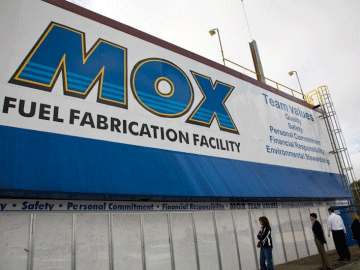 Services (designing and building the $12.7 billion MOX plant at SRS) and their political minions (primarily Senator Lindsey Graham and Representative Joe Wilson) but they will produce no report of their own. Congress will finally be forced to take in to account that MOX isn’t financially sustainable and can’t continue. But will Congress hold accountable those DOE mangers and contractors responsible for the massive MOX boondoggle?
The handwriting remains on the wall for the fate of the MOX boondoggle.” From http://www.srswatch.org. Read more and keep updated at their link.
It’s important to note that Shaw and CBI have benefited from this project, and note the funding given by Shaw CBI to politicians, including former Senator Landrieu of Louisiana. Senator Vitter has been given donations by Areva.
Areva ownership: http://fr.wikipedia.org/wiki/Arevahttp://en.wikipedia.org/wiki/State-owned_enterprise#France https://miningawareness.wordpress.com/2015/04/05/30billion-plutonium-pu-fuel-project-good-for-france-bad-for-america-areva-mox-ca-pue-pe-yoo/
Japan forced to give USA nuclear corporations legal immunity, in order to get help with Fukushima cleanup
 US: Japan should accept liability to receive international help at Fukushima Daiichi Enformable, Lucas W Hixson
Website 4 Nov 2013 As reported last week, United States Energy Secretary Ernest Moniz requested that Japan join a treaty called the Convention on Supplementary Compensation for Nuclear Damages. This treaty collects funds from participating nations to assist with payments for damages resulting from nuclear disasters.
What most mainstream media sources failed to relate, was that the treaty also assigns accident liability to the operators of the nuclear power plant, rather than the vendors which develop the technology or construct the equipment.
To receive help, the United States essentially told Japan that they would have to incur the losses and sign a treaty which would prevent them from seeking compensation from contracted companies, like those which built and constructed the Fukushima Daiichi nuclear power plant, and instead must satisfy itself only with seeking repayment from the operator, Tokyo Electric – who is facing bankruptcy and relies largely upon the Japanese government for funds to prevent a financial meltdown. In the wording of the treaty, “the operator’s liability for nuclear damage shall be absolute”, and “the right to compensation for nuclear damage may be exercised only against the operator liable.”……..
Seeing as Tokyo Electric will be unable to pay back the money they owe in the near future, this means Japan must accept to largely handle the financial costs themselves, aside from the amount that they would receive from the international funds.
Readers may ask why Japan would accept this deal that obviously appears to be the short end of the stick. Even if Japan were to attempt to seek compensation from the American companies that designed and constructed the Fukushima Daiichi nuclear power plant, like General Electric, they are not guaranteed to get judgment in their favor. By signing the treaty, Japan will receive some monetary compensation, and while it will likely be far less then they could seek as damages – it is more certain of a process then the legal system. http://enformable.com/2013/11/us-japan-accept-liability-receive-international-help-fukushima-daiichi/
The Dirty Tricks of US nuclear company Exelon
 Exelon plays dirty http://safeenergy.org/2015/04/02/exelon-plays-dirty/ Michael Mariotte It should surprise absolutely no one that a utility that relies on dirty energy to make its money also plays dirty when its money is threatened or when a state legislature is considering whether to bail out the company with its constituents’ money.
So don’t be surprised that we report that yes indeed, gasp, Exelon is playing dirty in Illinois. And just about everywhere else too.
Misleading robocalls. A subsidiary trying to sabotage energy efficiency programs. Even hiding–or at least not drawing attention to–a huge tax case loss. That’s Exelon in action.
Take those robocalls. Dave Kraft of Illinois’ Nuclear Energy Information Service (NEIS) reports that some NEIS members have received unidentified robocalls on their home phones, urging them to call their state legislators to “support clean renewable energy.”
The problem is, the bill the robocalls support is Exelon’s bill to establish a “low carbon portfolio standard.” As we reported last month, that’s the bill that was written to bail out Exelon’s uneconomic reactors in Illinois and prevent the expansion of “clean renewable energy” in the state.
NEIS, NIRS and those honestly in favor of clean energy are supporting a different bill also before the legislature, SB 1485/HB 2607, that actually would encourage clean energy in the state–and wouldn’t bail out Exelon’s failing nukes in the process.
Earlier this week, Crain’s Chicago Business, which continues to be the best source of reporting on Exelon and its machinations, reported that Exelon subsidiary Commonwealth Edison–the state’s largest distribution utility–“wants to make it illegal in Illinois to count the benefits of lowering energy prices when deciding which energy efficiency projects should qualify for ratepayer-funded financial assistance.”
In other words, while even CommEd can’t discount the fact that energy efficiency is cleaner than electricity generation, it wants the other main benefit of improving efficiency–lower electricity prices for ratepayers–to be ignored entirely.
Why? Because holding back gains in energy efficiency would help out Exelon’s six uneconomic reactors. Improving efficiency means less generation is needed. By attempting to sabotage the state’s efficiency programs, CommEd is trying to ensure that electricity demand goes up, making it at least somewhat more likely those reactors would be useful. In fact, those reactors still wouldn’t be needed; but the numbers conceivably could be manipulated enough to make it appear so.
Finally, Forbes reported on Monday that Exelon lost a major tax case, worth $661 million–or about 2% of the company’s value. The issue is complicated (it is tax law, after all) and has to do with decommissioning funds and Exelon’s purchase a decade or so ago of Amergen, which owned the Three Mile Island-1, Oyster Creek and Clinton reactors.
It doesn’t appear that Exelon actually misled anyone about the case; it’s all there in its Securities and Exchange Commission filings. But it’s there in footnotes, and Exelon didn’t exactly publicize its loss in the case either. So, instead of going down, Exelon’s stock went up. Maybe because no one reads footnotes. Perhaps they should.
It is vital that we reach everyone possible in Illinois to counter Exelon’s proposed nuclear bailout. That’s a bailout that would cost ratepayers hundreds of millions of dollars and provide them with nothing but the electricity they would receive even without the bailout. But instead of coming from cleaner energy sources, and helping to expand Illinois’ clean energy programs, the bailout would ensure that Illinois’ power would continue to come from dirty, aging and expensive nuclear reactors.
If you’re in Illinois, act now here. If you have any friends at all, any relatives, business colleagues, if a part of any e-mail list you’re on, includes anyone from Illinois, send them this link to our action page: http://org2.salsalabs.com/o/5502/p/dia/action3/common/public/?action_KEY=19803 And please post it on every social network you’re on.
As we’ve said, this is the most important state action this year. And the outcome will have national implications. It matters to all of us. Act. Now.
It’s time now for a tax on carbon
Why Now Is the Right Time for a Carbon Tax http://blogs.wsj.com/experts/2015/04/02/why-now-is-the-right-time-for-a-carbon-tax/ MARGARET WALLS: The current downturn in the oil and gas business, like the ups and downs of the cycles that came before it, is fundamentally a result of demand and supply. Weak economic activity in Europe, China and elsewhere has led to reduced demand at the same time that increased exploration and development, particularly from U.S. unconventional sources, has increased supply.
The low prices are creating winners and losers in the U.S., but the biggest loser may be the environment. As consumption of gasoline, diesel, jet fuel and other refined petroleum products rises in response to lower prices (and it will, mark my words), emissions of carbon dioxide and other greenhouse gases will rise, too, exacerbating the already dire projections for global climate change. The time couldn’t be better for implementing a carbon tax.
The timing is right for two important reasons. For one thing, low oil prices will dampen the blow. A tax of $25 a ton of CO2 would raise gasoline prices by about 25 cents a gallon, keeping pump prices still far below where they were a year ago. For another, a carbon tax might help to avert some capital investment decisions that would lock in higher emissions. Many observers are worried that low oil prices may lead households to increase purchases of SUVs and other gas guzzlers, cause manufacturers to back off from conversions of oil-fired boilers, and dampen plans for a variety of renewable-energy investments. A carbon tax would provide the right consumption and investment incentives.
As former Treasury Secretary Larry Summers put it in advocating for a carbon tax, “that which is not paid for is overused.” We pay a price for energy but that price reflects only its private costs and benefits and not the externalities associated with its use, the most serious of which is climate change. The call for a carbon tax is now coming from many quarters.
Former Secretary of State George Shultz has made an impassioned plea for a revenue-neutral carbon tax, an option many economists have supported for years. Coupling a carbon tax with reduced income or payroll taxes can improve the environment and the tax code. A lump sum per household annual “climate dividend” is another option.
Congress is gridlocked but a revenue-neutral carbon tax should have appeal to both political parties. And with oil prices at a five-year low, no time could be better.
Margaret Walls (@margaretwalls1) is research director and senior fellow at Resources for the Future, an independent nonprofit research organization in Washington, DC.
Read the latest Energy Report.
The Nuclear Power Agenda to block climate action, stop renewable energy, and subsidize old reactors.
Nuclear Economics Nuclear Information and Resource Service….…….September 11, 2014. Killing the Competition. The Nuclear Power Agenda to block climate action, stop renewable energy, and subsidize old reactors. Major new report by NIRS’ Executive Director Tim Judson details how major utilities and nuclear power companies have begun a campaign to rig energy markets, climate regulations, and clean energy programs to prevent the advance of renewable energy.
 Using a deceptive public relations campaign and heavily-funded front groups like Nuclear Matters, Third Way, and C2ES, corporations including Exelon and Entergy have tried to drum up fears of a national energy crisis stemming from the closure of several aging, uncompetitive nuclear plants and the advance of renewable energy. While touting the need to “preserve” nuclear power, nuclear interests have covered up the actual reforms they are seeking and their implications for the U.S.’s energy future.
Audio recording (mp3 file) of press conference release of the report featuring Tim Judson, Dr. Mark Cooper, Vermont Law School, Institute for Energy and the Environment; Tyson Slocum, energy program director, Public Citizen; Deb Katz, executive director, Citizens Awareness Network (New England); David Kraft, executive director, Nuclear Energy Information Service (Illinois); Jessica Azulay, program director, Alliance for a Green Economy (New York).”…..http://www.nirs.org/neconomics/neconomicshome.htm
A risky precedent – if ratepayers bail out Ginna nuclear plant
 Bailout of nuclear power plant would set bad precedent, Times Union By David O. Carpenter, March 30, 2015 The New York state Public Service Commissionand the Cuomo administration will soon decide whether ratepayers can be forced to bail out Exelon, the nation’s largest nuclear power plant operator, and its Ginna nuclear plant, one of the world’s oldest commercial reactors, built near Rochester in 1969. A bailout would set a costly, dangerous precedent with state and national implications.
Across New York and the U.S., as older nuclear plants age, their operating costs are rising while prices for electricity from competing sources are falling, making many of them uneconomical, including a third of Exelon’s fleet. So they seek shelter from market forces that increasingly favor cleaner, cheaper alternatives, including wind and solar.
Ginna is an important test case. It lost $100 million in the last three years. So Exelon negotiated a new purchase agreement withRochester Gas & Electric worth $735 million — $165 million above the market price for electricity — passing on its losses to customers by raising their rates.
Exelon threatens that without a bailout, it will close Ginna and other uneconomical reactors, undermining electricity supply. Supply fears are overblown — Ginna could be phased out and its power replaced more cost-effectively, including by improving substations and transmission lines. The PSC may be more worried about losing Ginna’s 600 jobs (though there would be hundreds of decommissioning jobs if the reactor shut down).
Meanwhile, many oppose the bailout. Physicians for Social Responsibility’s New York chapter opposes it because of growing public health and safety risks as Ginna ages. New York utilities and power producers oppose it because it violates established procedure for shuttering plants. A group of 60 large industrial, commercial and institutional energy consumers oppose it because it would distort electricity markets and trigger “potentially staggering” rate hikes. Alliance for a Green Economy opposes unjustly forcing consumers to subsidize Exelon and its obsolete reactor, which would also pre-empt better energy alternatives. It wants Ginna’s losses borne by RG&E, not ratepayers, and swift, orderly decommissioning.
New York City Mayor Bill de Blasio‘s administration opposes a Ginna bailout as bad precedent for other troubled plants, which might try to hold his city’s residents hostage to closure threats. For example, what if the aging, leaking Indian Point nuclear plant, which should be decommissioned, followed suit and demanded to be propped up through extortionate rate hikes?
These are all good reasons to say “no” to bailing out Ginna and other aging nuclear plants that might seek to follow in its wake…….. http://www.timesunion.com/tuplus-opinion/article/Bailout-of-nuclear-power-plant-would-set-bad-6168217.php
Shipping incident results in higher NRC oversight for Vogtle nuclear power plant
Nuclear Regulatory Commission increases oversight for Plant Vogtle following shipping incident, Augusta Chronicle By Meg Mirshak Staff Writer April 1 2015 The oversight includes an additional inspection at the commercial power plant near Waynesboro, Ga. about 26 miles southeast of Augusta, according to a NRC news release…….The violation had “low-to-moderate safety significance,” and it posed a risk to the public because of concerns the closure system on the type of cask used could fail if involved in an accident during shipping, according to the letter. …….http://chronicle.augusta.com/latest-news/2015-03-31/nuclear-regulatory-commission-increases-oversight-plant-vogtle-following
Americans want green energy, rather than nuclear power – Gallup poll
Poll: Americans Pick Green Energy Over Nuclear Power, vocatv, 30 Mar 15 According to a new Gallup poll, American support for nuclear energy number has sunk to 51 percent, with 43 percent of the U.S. in full opposition to its use. Acceptance of the power source a high point in 2010, when 62 percent of Americans were in favor of it.
The poll also reveals that majority of Americans believe that the U.S. should shift its focus to green energy and invest in natural gas, solar and wind power. Seventy-nine percent of those surveyed said the country should put greater emphasis on producing solar domestic energy, making it the most favored source in the poll. Wind power was the runner up with 70 percent…….. http://www.vocativ.com/culture/society/green-energy-nuclear-power/
Harry Reid led the charge to prevent another nuclear pollution of Nevada
 There will be a lot written about Harry’s advocacy on behalf of Nevada, and for those efforts he deserves a standing ovation. His actions will resonate for generations. Our grandchildren’s grandchildren will have been kept protected from the threats of nuclear waste. They won’t know who to thank, so on their behalf: Thank you, Harry.
They have considerably to celebrate, and we — and our youngsters and grandchildren — have considerably to be thankful for, including a legacy that will attain far into future generations of Nevadans.
The senator’s list of accomplishments, from preserving the environment to assisting bring overall health care to millions
with his championing of the Reasonably priced Care Act, will absolutely frame his legacy. But his everlasting accomplishment story will surely be his good results in staring down the nuclear power business and maintaining Nevada totally free of the highly radioactive nuclear waste that outsiders wanted to ship from distant states and bury inside Yucca Mountain. Continue reading
It’s getting serious when nuclear pollution threatens the wine industry
A 2012 report prepared for the Washington State Wine Commission indicates that the state is the “second largest wine producer in the U.S., after California.” Internationally, Washington State is the third-largest exporter of food and agricultural products, according to state officials, with leading products including fresh fruit, vegetables, dairy products, and seafood.
What is not on the Tri-Cities website, however, is a copy of the DOE report released last year that indicated trace amounts of the radioisotope tritium were found in wine samples collected near Hanford in 2013 “that could have potentially originated from the Hanford Site.” Tritium is considered one of the least-threatening radioisotopes because it generally passes from the body quickly, but it still can increase cancer risk because it releases radiation

 ATOMIC WINE Wine Country’s Nuclear Threat, The Daily Beast , Bill Conroy. 03.28.15 A nuclear facility in Washington state’s prime wine country is leaching radioactive groundwater and is one natural disaster away from Fukushima 2.0. The Hanford Site, a former nuclear-weapons production facility located in southeastern Washington State near the Oregon border, is one natural disaster away from a Fukushima-like catastrophe, according to environmental groups who also claim the site—which sits near some of the state’s best vineyards—is leaking radioactive groundwater into the nearby Columbia River. Continue reading
Texas city staunchly right wing, just saving money with 100% renewable energy
Texas city opts for 100% renewable energy – to save cash, not the planet, Guardian, Tom Dart in Georgetown, 29 Mar 15 Georgetown, Texas decision not about going green: ‘I’m probably the furthest thing from an Al Gore clone you could find,’ says city official News that a Texas city is to be powered by 100% renewable energy sparked surprise in an oil-obsessed, Republican-dominated state where fossil fuels are king and climate change activists were described as “the equivalent of the flat-earthers” by US senator and GOP presidential hopeful Ted Cruz.
“I was called an Al Gore clone, a tree-hugger,” says Jim Briggs, interim city manager of Georgetown, a community of about 50,000 people some 25 miles north of Austin.
Briggs, who was a key player in Georgetown’s decision to become the first city in the Lone Star State to be powered by 100% renewable energy, has worked for the city for 30 years. He wears a belt with shiny silver decorations and a gold ring with a lone star motif, and is keen to point out that he is not some kind of California-style eco-warrior with a liberal agenda. In fact, he is a staunchly Texan pragmatist.
“I’m probably the furthest thing from an Al Gore clone you could find,” he says. “We didn’t do this to save the world – we did this to get a competitive rate and reduce the risk for our consumers.”

In many Texas cities the electricity market is deregulated, meaning that customers choose from a dizzying variety of providers and plans. In Houston, for example, there are more than 70 plans that offer energy from entirely renewable sources.
That makes it easy to switch, so in a dynamic marketplace, providers tend to focus on the immediate future. This discourages the creation of renewable energy facilities, which require long-term investment to be viable. But in Georgetown, the city utility company has a monopoly.
When its staff examined their options last year, they discovered something that seemed remarkable, especially in Texas: renewable energy was cheaper than non-renewable. And so last month city officials finalised a deal with SunEdison, a giant multinational solar energy company. It means that by January 2017, all electricity within the city’s service area will come from wind and solar power.
while west Texas is an oil driller’s paradise, it is also sunny and gusty, making it a perfect corridor for renewable energy.
The region bordering New Mexico is one of the prime solar resource sites in the USand the wind whistles across the plains to such an extent that, as Scientific American pointed out last year, the state is America’s largest wind power producer – as well as leading the nation in the production of crude oil and the emission of greenhouse gases.
Renewable energy also uses much less water than traditional power generation – a bonus in a state where half the land and more than nine million people are affected by drought conditions, though Briggs said that for Georgetown, water conservation was only a “side benefit”………
Outside, Jon Klopf, a barber, sat on a bench enjoying a splendidly sunny Thursday afternoon.
“They were just looking out for the cheapest deal. That’s just business,” the 50-year-old said. “I don’t really think we should be relying too much on oil, even though they have to right now. That don’t last forever.
“Sun will, though. Long as the sun comes up, the wind will blow.”http://www.theguardian.com/environment/2015/mar/28/georgetown-texas-renewable-green-energy
Nuclear lobby claims to be clean and green , wants government money
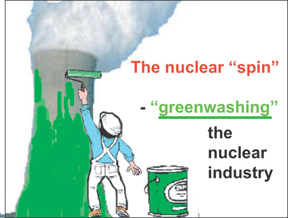 Nation’s biggest nuclear firm makes a play for green money, Herald News By RAY HENRY –Saturday, March 28, 2015 1 The Associated Press The biggest player in the beleaguered nuclear power industry wants a place alongside solar, wind and hydroelectric power collecting extra money for producing carbon-free electricity.
Chicago-based Exelon essentially wants to change the rules of the state’s power market as the nuclear industry competes with historically low prices for natural gas. Dominion Resources Inc. recently closed the Kewaunee Power Station in Wisconsin for financial reasons, and Entergy Corp. likewise shuttered its Vermont Yankee plant.
Plans for a new wave of U.S. nuclear plants have been delayed or canceled, aside from three projects deep into construction at Plant Vogtle south of Augusta, Georgia; V.C. Summer Nuclear Station north of Columbia, South Carolina; and Watts Bar Nuclear Plant in eastern Tennessee. Electric utilities in those states do not face competition…….
Though it wants financial assistance, Exelon will not release detailed information about the cost of running the three Illinois plants in Quad Cities, Byron and Clinton that company officials say are most at-risk. An analysis by state agencies estimated the cost of producing power at those plants may exceed the payments they get, though they could not be certain.
Exelon and other around-the-clock plants sometimes take losses when wind turbines produce too much electricity for the system.
Exelon remained profitable overall, making $1.6 billion last year.
“If the question is, ‘Are they under economic threat?’ I don’t think there’s any question they are,” said Paul Patterson, a utility analyst for Glenrock Associates LLC, who referred to nuclear plant closures elsewhere as evidence. “Will they shut down? I think it depends at what plant you’re looking at.”
The Illinois proposal would reward nuclear plants. Under the system, electric suppliers would have to buy credits from carbon-free energy producers. Exelon says the plan would benefit nuclear plants, hydroelectric dams, and other solar and wind projects. http://www.theherald-news.com/2015/03/29/nations-biggest-nuclear-firm-makes-a-play-for-green-money/axrimv5/
Don’t buy the hype for new nuclear plants: energy alternatives are better
Plant Closure Opportunity: Hitting Those Clean Energy Notes The Energy Collective By Larissa Koehler, 28 Mar 15 When the door to one power plant closes, a window to more clean energy solutions opens.
It may seem logical that once a power plant closes, another one needs to be built to replace it – after all, we need to make up for its potential energy generation with more natural gas or nuclear-powered energy, right? San Diego Gas & Electric (SDG&E) is certainly trying to convince Californians this is true. Trouble is, EDF and other environmental groups, along with theCalifornia Public Utilities Commission (CPUC), aren’t buying it. And you shouldn’t either……..
a plethora of clean, efficient resources exist that can help us manage energy demand more effectively without turning to fossil fuels. For example:
- California can make much greater use of demand response programs. Demand response sends a signal to customers to voluntarily and temporarily reduce their energy use at times when the grid is most burdened – thereby preventing the need to ramp up fossil fuel resources to meet demand and reducing system costs and emissions.
- Incorporate time-of-use (TOU) electricity pricing. By charging lower energy prices to encourage use during off-peak times, or when renewables are available, California can integrate more clean energy resources and relieve strain on the power grid during peak times. In fact, EDF has demonstrated that if half of Southern California Edison’s residential customers adopted a voluntary TOU electricity price, they could replace two-thirds of SONGS’ lost capacity, saving $357 million per year – and the same trend would likely follow in SDG&E’s service territory.
- Bolster energy efficiency programs. Emphasizing the use of energy-efficient technology will lower demand, offset the need for expensive and dirty fossil fuels, and reduce system costs by avoiding additional power plant, transmission, and distribution infrastructure. For example, in 2010 and 2011, CPUC energy efficiency programs produced enough energy savings to power more than 600,000 households and offset 1,069 megawatts (MW) of electric capacity.
- Utilize increasing viable storage technologies. By storing energy at times when the sun is shining or the wind is blowing, and drawing on that energy when these resources are not available, storage provides a powerful mechanism to integrate more clean energy and greatly reduces the need for fossil fuels. As demonstrated by the CPUC’s storage mandate for utilities – as well as the fact that Southern California Edison already went above and beyond this directive– storage is a reliable and growing part of the solution.
EDF applauds the CPUC for issuing a clear statement on how the SONGS capacity should be replaced – making it apparent that SDG&E should commit to more than the minimum required procurement of energy efficiency, renewable energy, energy storage, demand response, and other clean energy resources. And with SDG&E’s history of forward-thinking energy policy, they should embrace this opportunity for continued leadership. The key to California’s energy needs lies in a suite of solutions that are good for the grid, the environment, and the health of California’s citizens. The CPUC’s statement highlights an important priority for the state in the coming decades to address these needs. This should be the beginning, not the end, of Southern California’s push to adopt preferred resources. Diversifying the region’s energy mix opens the door to a clean, sustainable, and healthy future. http://theenergycollective.com/edfenergyex/2209746/hitting-those-clean-energy-notes
Damage to concrete is a threat to nuclear reactors
Part II: Nuclear Power Stations Need Testing for Concrete Damage – Comment Deadline Monday, March 30th, 2015 by miningawareness Deadline is on Monday, March 30th, 11.59 Eastern Time (DC) – one minute to midnight- for whether the US NRC should use proper methods to detect concrete degradation at Nuclear Power Stations: “The petitioner requests that the NRC amend its regulations to improve identification techniques against ASR concrete degradation at U.S. nuclear power plants. The petitioner suggests that the reliance on a visual inspection does not ‘adequately identify Alkali-Silica Reaction (ASR), does not confirm ASR, or provide the current state of ASR damage (if present) without petrographic analysis under current existing code.”http://www.regulations.gov/#!docketDetail;D=NRC-2014-0257 (Comment at link; can be anonymous.) It is critically important to also ask for ultrasonic testing for damage to the nuclear reactor pressure vessel, even though it is not on the docket. See:https://miningawareness.wordpress.com/2015/03/03/nuclear-reactor-cracks-widespread-disease-scourge-warns-nobel-in-chemistry-nominee/
The average age of US commercial nuclear reactors is 34 years with the oldest being over 45 years old (EIA, 2015). Even in the best of circumstances, concrete suffers age related damage. But, nuclear power stations suffer from extreme conditions. According to William et. al., for the NRC (2013): Continue reading
Two junior congressmen willing to pollute Nevada with nuclear waste
let’s look at how many states back in the 1980s had been willing to take the highly radioactive fuel rods off the hands of nuclear energy plant operators: zero. Not a one particular. In particular not Nevada, which currently had paid a human toll as the website of atmospheric atomic bomb detonations. No one gave much believed to the radioactivity in our sky — “don’t worry” — and, boy, had been we snookered.
The truth that two junior congressmen from Nevada would be open to filling a nearby mountain with radiation — placing not only Las Vegas’ economy, but the lives of our youngsters, grandchildren and generations of future Nevadans at threat — is beautiful.
Our delegation in Washington can definitely bicker more than other difficulties, but on Yucca Mountain, Nevadans anticipate solidarity, not betrayal, due to the fact absolutely nothing can be allowed to jeopardize our safe future.
Congressmen’s willingness to money in on Yucca Mountain endangers Nevadans, Herald Recorder , March 29, 2015 Two of our congressmen, who are the least skilled in our Capitol Hill delegation, have much to learn when it comes to watching out for the security, welfare and financial safety of Nevadans.
Cresent Hardy and Mark Amodei, a pair of Republicans, say they’d want Nevada to money in on the opening of Yucca Mountain as the final resting place for highly radioactive nuclear
waste if professionals are convinced it would be safe. If the feds and the nuclear power market genuinely want handle of Yucca Mountain, at least they can throw some money our way — perhaps to help fund education or enhance our public infrastructure.
In other words, they’re prepared to place Nevadans in harm’s way if the income is correct. In harm’s way, mainly because no one can be sure that the web site will remain safely benign when filled with this nuclear material. Hardy and Amodei definitely have signaled to Washington and the out-of-state nuclear energy industry that they’re open to bringing lethal nuclear waste to within 90 miles of Las Vegas.
We do not even know where to commence in showing how outrageous their position is…….. Continue reading
1 This Month
23-25 October – on Zoom – World BEYOND War’s annual global conferenc

To see nuclear-related stories in greater depth and intensity – go to https://nuclearinformation.wordpress.com

Say No to NASA’s Reckless Nuclear Reactor on the Moon
Say No to NASA’s Reckless Nuclear Reactor on the Moon
-
Archives
- October 2026 (149)
- September 2026 (339)
- August 2026 (330)
- July 2026 (355)
- June 2026 (287)
- May 2026 (306)
- April 2026 (356)
- March 2026 (251)
- February 2026 (267)
- January 2026 (308)
- December 2025 (358)
- November 2025 (359)
-
Categories
- 1
- 1 NUCLEAR ISSUES
- business and costs
- climate change
- culture and arts
- ENERGY
- environment
- health
- history
- indigenous issues
- Legal
- marketing of nuclear
- media
- opposition to nuclear
- PERSONAL STORIES
- politics
- politics international
- Religion and ethics
- safety
- secrets,lies and civil liberties
- spinbuster
- technology
- Uranium
- wastes
- weapons and war
- Women
- 2 WORLD
- ACTION
- AFRICA
- Atrocities
- AUSTRALIA
- Christina's notes
- Christina's themes
- culture and arts
- Events
- Fuk 2022
- Fuk 2023
- Fukushima 2017
- Fukushima 2018
- fukushima 2019
- Fukushima 2020
- Fukushima 2021
- general
- global warming
- Humour (God we need it)
- Nuclear
- RARE EARTHS
- Reference
- resources – print
- Resources -audiovicual
- Weekly Newsletter
- World
- World Nuclear
- YouTube
-
RSS
Entries RSS
Comments RSS

