The grim facts on the unsafety of Davis Besse, Columbia, Diablo, New York and other nuclear power stations
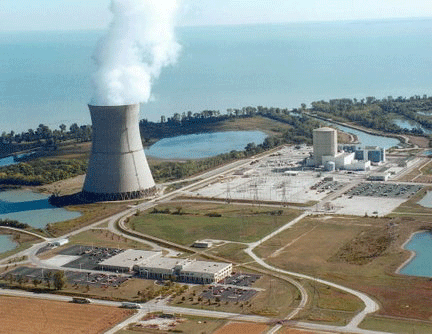 The Real Nuclear Threats, CounterPunch 12 Apr 15 by MIRIAM GERMAN “……….These are just some of the facts about Davis-Besse.
● Because it was built in a flood plain, a 1972 Lake Erie storm caused massive flooding of the entire construction site including the pre-operational reactor.
● In October 1977, a relief valve stuck.
● Uranium fuel must be submerged in water (coolant) at all times to prevent a meltdown. In June 1985, Davis Besse had a loss-of-feedwater accident. The Nuclear Regulatory Commission closed the plant for a year.
● A June 1998 tornado caused loss of external electric power.
● In March 2002, neglected, leaking boric acid in the coolant water had eaten through more than seven inches of the steel reactor lid, leaving only a 3/16″ liner to prevent radiation release. The plant closed for two years, costing ratepayers $600 million. Davis-Besse was fined $33.5 million, the largest in NRC history.
● The corroded lid was replaced before restart in 2004, but in 2010, cracks were found in this new lid, forcing its replacement in 2011.
● To replace aging, deteriorating, damaged parts, an unprecedented four large cuts have been made through the Davis-Besse concrete shield building which prevents release of radiation. Starting in 2011, cracks and voids were discovered in the building’s concrete.
Moniz must look over here, below his feet on US ground, to recognize and acknowledge the bomb fields laying in wait that you still believe are safe, inexpensive and necessary, but which I call ancient relics of poor technology based on the idiocy of a few terrible ideas by self-important arrogant fools who believed nukes would save the world but would instead, kill the very Earth we inhabit. What side of the gambling table are you on? Remember, the cards have already been shown. Fukushima, Chernobyl, Three Mile Island. Hanford.
There is no peaceful nuke and there is no peace with nukes. There is only a mirage.
Columbia Generating Station. Richland, WA. Located on the Columbia River. CGS was built on twelve fault lines. It was not known at the time but now we have facts. It is not built to withstand an earthquake of the 9.0 magnitude the NW is expecting any day. Not even close. With facts, we are armed with the ability to make changes for the sake of humanity. But we only care about being armed for war. There is no containment around the CGS fuel pool. The fuel pool is five stories high. Think Fukushima. Really. Think Fukushima. CGS is the same kind of nuclear reactor as Fukushima. CGS sits ten miles from 56 million gallons of highly radioactive nuclear waste at Hanford. If a meltdown or explosion happens at CGS, it will take Hanford with it. There will be no way to get in to the area to clean it up due to the massively high levels of radiation. The Columbia River flows directly into the Pacific. CGS has problems with the monitoring stacks just about every two to three weeks. They cannot monitor levels of radiation going into the environment from the plant properly without these stacks. On top of all of this, we have records of drug abuse from managers and workers at the plant caught stoned or drunk during surprise drug testing, so many records that we have a spreadsheet that we add to periodically. Would you like to live near CGS?
Where is the IAEA? They are waiting to be flown to Iran.
Diablo Canyon. Corruption. PG&E. Water Bureau. Illegal dumping of hot water into the Pacific. Fault lines. To see a photo of the fault lines at the base of Diablo Canyon and on out just a bit into the ocean off the coast of California is to understand a vision of insanity……..
New York City. Home to well over eight million people and the Indian Point Nuclear Power Plant, just twentyfive miles from the Bronx. Here we have a known leaking nuke plant but the IAEA and all of their grave concerns about safety in Iran can be found no where close to home. Indian Point leaks Tritium. Do you know how bad it is to have that in the ground water, drinking water or rivers and lakes? The Big Apple can turn to molten corium as far as the IAEA, the DOE and the NRC are concerned.
Let’s mention MOX fuel since Kerry and Moniz talk so much lately about oversight and care and safety and transparency from the IAEA to Iran. Plutonium from dismantled nuclear weapons can get used as fuel in nuke plants creating more heat and radioactivity than uranium if it explodes while causing twice as many civilian cancers as the same explosion using uranium. Fact: MOX fuel is the easiest type of fuel to explode; it is the Viagra for nuclear weapons. Yet knowing that it’s the easiest to explode, nuclear engineers still decided to put MOX fuel into nuclear power plants. Pure insanity…….
Miriam German is the director of RadCast.org. She founded No Nukes NW in 2012. http://www.counterpunch.org/2015/04/10/the-real-nuclear-threats/
Business realities are catching up with climate denialists
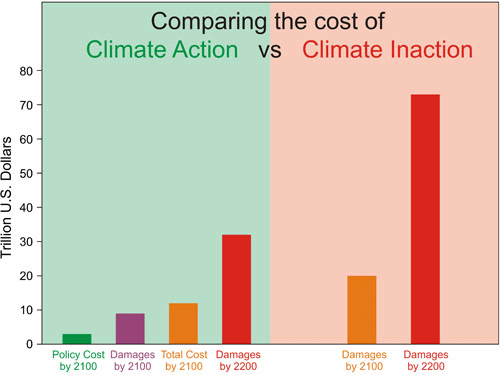
There’s even a fierce battle brewing in Florida between the Koch brothers and a free market Tea Party group pushing for solar power—a clear sign that, as with gay marriage, there is no longer just one single monolithic conservative position. Continue reading
Vancouver the latest of 50 cities to commit to %100 renewable energy
More than 50 cities have announced they are on their way to 100% renewable energy including San Diego and San Francisco in California, Sydney Australia, and Copenhagen. Some are aiming for 2020, others by 2030 or 2035.
Vancouver commits to run on 100% renewable energy http://www.theguardian.com/environment/2015/apr/10/vancouver-commits-to-run-on-100-renewable-energy
Canadian city of 600,000 people is the latest to announce it will use only green energy for electricity, transportation, heating and air conditioning within 20 years Vancouver has become the latest city to commit to running on 100% renewable energy. The city of 600,000 on Canada’s west coast aims to use only green energy sources for electricity, and also for heating and cooling and transportation. Continue reading
Who’s to blame for the faults in San Onofre Nuclear Plant: not us -says NRC

 NRC: Nuclear plant failure not our fault UT San Diego, By Morgan Lee .APRIL 10, 2015 As it turns the page on the breakdown of the San Onofre nuclear plant, the U.S. Nuclear Regulatory Commission is standing by its role in overseeing the replacement of steam generators that led to a radiation leak and the facility’s early retirement in 2013.
The safety agency also is warning the nuclear power industry that the destructive vibrations among generator tubes carrying radioactive water that occurred at San Onofre could emerge at other reactors over time.
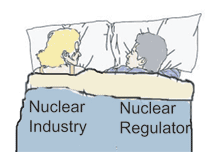
A detailed memo by nuclear commission staff on the lessons learned at San Onofre has concluded that efforts by plant operator Southern California Edison to avoid a more-detailed review of the generators by safety regulators are not necessarily to blame in the breakdown of the plant. Responsibility lies instead with design mistakes overseen by Edison, according to the 70-page memo quietly released last month……..
The commission is directing the nuclear power industry to revise design guidelines that do not sufficiently address the kind of destructive tube vibrations that disabled the replacement generators at San Onofre.
A letter from the agency to industry engineers last year warned that “events at San Onofre not only raise questions about industry standards for designing and fabricating steam generators, but also raise questions about the operation of existing steam generators.” It cited no immediate safety concerns but said active generators could become susceptible as conditions change.
A 2012 radiation leak at San Onofre was traced to rapid wear on generator tubes that carry radioactive water that circulates through the reactor core.
 Meanwhile, the nuclear commission is preparing to dismiss formal accusations that a more-thorough safety review of the San Onofre generators was warranted. That complaint was filed by the environmental group Friends of the Earth in 2012……….http://www.utsandiego.com/news/2015/apr/10/nrc-stands-by-process-at-onofre/
Connecticut’s sole nuclear under scrutiny for security issue
Federal energy regulators and a local oversight panel are set to meet to discuss safety issues at Connecticut’s sole nuclear plant.
Nuclear Regulatory Commission staff members and the state Nuclear Energy Advisory Council will meet in Waterford Tuesday to review operations at the Millstone nuclear plant.
Millstone’s Unit 3 is under heightened oversight due to problems related to the plant’s auxiliary water pump. It’s one of several used to help cool down the reactor.
The Nuclear Regulatory Commission announced increased oversight April 2. The agency didn’t disclose the security problem, but said Millstone’s problem rated a low-significance “greater than green” on a scale ranging from green for very low safety or security significance to red for high safety or security significance.
Unless the finding is successfully appealed, it will result in additional scrutiny. http://www.wfsb.com/story/28780712/us-nuclear-regulators-to-review-millstone-with-state-panel#ixzz3X8UtUviJ
Issues of anger and violence – in commander in charge of moving nuclear bombs
 He Handles American Nuclear Weapons, Has ‘Anger’ Issues A federal agent who ferries nuclear bombs around the U.S. allegedly threatened to kill a co-worker and got into physical fights with others—and bosses weren’t informed, an audit finds.The Daily Beast By R. Jeffrey Smith, 10 Apr 15 “…….the commander of a nuclear courier squad based in Oak Ridge, Tennessee—where the uranium portions of H-bombs are fabricated, stored, and periodically moved to other federal sites—allegedly threatened to kill one of his colleagues two years ago, and senior officials did not learn about it for five months, according to a recent inspection report by the Department of Energy’s top auditor.
Moreover, the commander in question repeatedly engaged in related misconduct without more senior officials being promptly informed, the report said. “Each of the seven incidents” described by the commander’s colleagues during the auditor’s investigation “involved physical or verbal altercations,” the report said. The misconduct began as long as a decade ago, but it wasn’t reported up the chain of command……….
The report noted that on two other occasions, in 2004 and 2008, the commander got into physical altercations with couriers, according to the accounts of those who worked with him, but senior officials said these also were not properly reported.
The alleged misconduct is embarrassing for a group of military and special forces veterans that arguably performs one of the nation’s most sensitive tasks—securely transporting nuclear bombs and weapons-usable nuclear materials among several dozen government factories, storage sites, and military installations nationwide, such as missile and bomber bases and submarine ports.
The stated mission of the little known courier group, the Office of Secure Transportation—an entity within the department’s National Nuclear Security Administration (NNSA)—is to “defend, recapture, recover” the bombs or explosives they transport. ……This story is from The Center for Public Integrity, a nonprofit, nonpartisan investigative news organization in Washington, D.C. To read more of their work on nationral security, go here or follow them on Twitter.….http://www.thedailybeast.com/articles/2015/04/10/he-handles-american-nuclear-weapons-has-anger-issues.html
Michigan lawmaker urges Congress to oppose Canada’s waste dump plan near Lake Huron
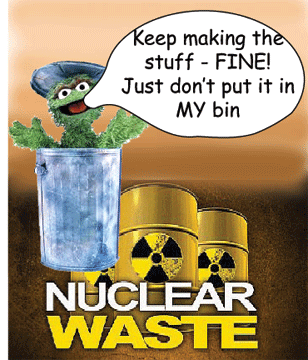 Michigan lawmaker: Congress should oppose Canada’s plan to bury nuclear waste near Lake Huron Star Tribune by: JOHN FLESHER , Associated Press April 10, 2015 – TRAVERSE CITY, Mich. — Michigan Rep. Dan Kildee said Friday he will push Congress to officially oppose Canada’s plans to allow nuclear waste to be stored underground less than a mile from Lake Huron, saying the country should find a site farther away from the Great Lakes, the world’s largest body of surface fresh water.
Kildee offered a similar resolution during the last congressional session, and numerous cities in the Great Lakes region have come out against the storage plan, but it failed to win House approval. Even if successful, it would have no force of law because Canadian officials will make the final decision.
Even so, the Democrat from Flint Township said the effort was worth making. He said the Ontario Power Generation plan to bury radioactive material, including discarded parts from the reactor core and ashes from incinerated floor sweepings and map heads, was “dangerous and an unnecessary risk we shouldn’t take.”
“The Great Lakes aren’t just a source of natural wonder,” said Kildee, whose district includes a section of the western Lake Huron coastline. “As the world’s largest body of fresh water, they’re vital to our way of life.”
Publicly owned Ontario Power Generation wants to bury 7.1 million cubic feet of low- and intermediate-level waste from its nuclear plants about 2,230 feet below the earth’s surface at the Bruce Power generating station near Kincardine, Ontario……..
Critics say there’s no way to guarantee the lake’s safety over the thousands of years that would be required for all the waste to lose its radioactivity.
Kildee’s office said the plan is opposed by 146 cities in the Great Lakes region, from Chicago to Toronto to Rochester, New York.
“My congressional resolution seeks to find an alternative location for this Canadian nuclear waste storage site so it does not endanger our state’s livelihood or economy — now or for future generations,” the congressman said.
A review panel of the Canadian Nuclear Safety Commission has conducted hearings on the project and is expected to issue a report by May 6. The Canadian environment minister would decide whether to approve or deny the project. If the minister endorses it, the review panel will decide whether to issue a construction license. http://www.startribune.com/politics/national/299322701.html
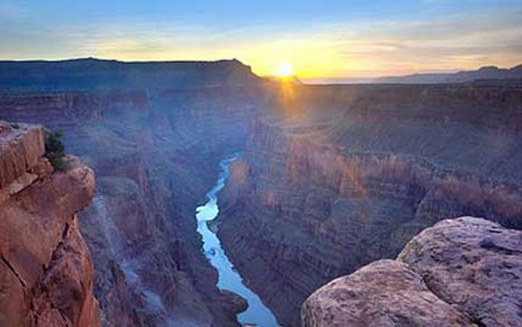
Federal Judge OKs Uranium Mining Next to Grand Canyon National Park
 http://www.biologicaldiversity.org/news/press_releases/2015/uranium-mining-04-08-2015.html
Decision Allows Mining Without Tribal Consultation or Update Decades-old Environmental Review
PHOENIX, Ariz.— U.S. District Court Judge David Campbell denied a request to halt new uranium mining at the Canyon uranium mine, located only six miles from Grand Canyon National Park’s South Rim. The Havasupai tribe and a coalition of conservation groups had challenged the U.S. Forest Service’s decision to allow Energy Fuels Inc. to reopen the mine without initiating or completing formal tribal consultations and without updating an obsolete federal environmental review dating to 1986. At stake are tribal cultural values, wildlife and endangered species, and the risk of toxic uranium mining waste contaminating the aquifers and streams that sustain the Grand Canyon and Colorado River.
“We are very disappointed with the ruling by Judge Campbell in the Canyon Mine case,” said Havasupai Chairman Rex Tilousi. “We believe that the National Historic Preservation Act requires the Forest Service to consult with us and the other affiliated tribes before they let the mining company damage Red Butte, one of our most sacred traditional cultural properties. The Havasupai Tribal Council will meet this week to talk about appealing this ruling.” Continue reading
Steady fall in support for nuclear power among American public
A Slim Majority of Americans Say They Support Nuclear Energy Public approval has steadily dropped over the last five years, greentech media Julia Pyper April 10, 2015 Nuclear energy is losing popularity. A recent Gallup poll found that a slim majority of Americans — 51 percent — say they favor nuclear energy for electricity generation in the United States, while 43 percent say they oppose it. This year’s support levels are among the weakest Gallup has recorded in the last two decades. With a 46 percent approval rating, 2001 was the only year support sank lower.
Public approval of nuclear energy peaked in 2010 at 62 percent, shortly after President Barack Obama announced $8 billion in federal loan guarantees for the construction of two nuclear reactors in Georgia. The new, roughly 1,200 megawatt nuclear reactors at the Alvin W. Vogtle Electric Generating Plant, are the first to be built in the U.S. in three decades.
Over the last five years, support for nuclear energy has fallen by more than 10 percentage points………
The new Gallup poll similarly found a preference for renewable energy alternatives to nuclear power. The vast majority of respondents — 79 percent — called for a greater emphasis on solar power. Wind was close behind at 70 percent.
Thirty-five percent of Americans think the U.S. should put more emphasis on nuclear power, while 33 percent favor less emphasis and 28 percent say the emphasis should remain unchanged. Only coal had less support, with 43 percent of respondents saying coal should have less emphasis as a domestic energy resource……..http://www.greentechmedia.com/articles/read/a-slim-majority-of-americans-say-they-support-nuclear-energy
As hydraulic fracturing (fracking) increases- so do indoor levels of radon
 Small increases in radon track natural gas development with fracking in Pennsylvania, The Conversation, Joan A. Casey Robert Wood Johnson Health and Society Scholar at University of California, San Francisco Brian S. Schwartz Professor of Environmental Health Sciences at Johns Hopkins University 11 Apr 15
Historically, Pennsylvania has had one of the biggest indoor radon problems in the country. Why? Much of the bedrock in Pennsylvania contains high levels of uranium, which is radioactive and eventually decays to radium and radon gas. Radon gas can then enter buildings by diffusing through cracks in the foundation or by dissolving in water. It can get trapped in the basement and other areas of the home and can lead to health effects. Radon is the second-leading cause of lung cancer in the United States.
Due to high levels in Pennsylvania, indoor measurements are often taken when buildings are bought and sold with results reported to the state. This created a huge database, with over 1.5 million measurements from 1989 to 2013. The first unconventional natural gas development in Pennsylvania was in 2005, and by 2013 the industry had drilled 7,469 unconventional wells in the Marcellus shale.
Fracking is just one step in the process of unconventional natural gas development. The sheer scale of development in Pennsylvania made us, and others, wonder if the industry might be influencing those indoor radon measurements collected by the state. Once fully developed, some have estimated that there will be over 50,000 wells in the state……….
In our study we sought to take into account the cumulative effect of thousands of wells drilled statewide, and at a location more relevant to health – in buildings where people live, work and play. By contrast, the state study evaluated a few point sources of radiation pollution.
But what happens if a building is surrounded by hundreds of wells, which are each a potential point source? Is there a cumulative impact that the state missed? We believe our study is better suited for that possibility.
As public health professionals, our goal is to protect public health. We discovered that 42% of basement radon levels exceeded the level at which the EPA recommends people take action. Homes using well water had 21% higher radon levels than homes using municipal water.
With upward trends in radon levels, Pennsylvania’s long-standing radon problem certainly hasn’t gone away. We now leave it up to others – health professionals, economists, politicians and community members debating together – to weigh the evidence regarding the risks and benefits of unconventional natural gas development. For now we suggest homeowners continue to measure radon in their homes, the state continue to be vigilant about possible impacts of this industry on pathways and levels, and that future studies move beyond this first look to better understand the relationships that we may have uncovered. http://theconversation.com/small-increases-in-radon-track-natural-gas-development-with-fracking-in-pennsylvania-39991
New legal case: sick USA sailors against Tokyo Electric Power
 U.S. Sailors Sick From Fukushima Radiation File New Suit Against Tokyo Electric Power, EcoWatch Harvey Wasserman | February 9, 2014 Citing a wide range of ailments from leukemia to blindness to birth defects, 79 American veterans of 2011’s earthquake/tsunami relief Operation Tomadachi (“Friendship”) have filed a new $1 billion class action lawsuit against Tokyo Electric Power.
The suit includes an infant born with a genetic condition to a sailor who served on the USS Ronald Reagan as radiation poured over it during the Fukushima melt-downs, and an American teenager living near the stricken site. It has also been left open for “up to 70,000 U.S. citizens [who were] potentially affected by the radiation and will be able to join the class action suit.”
The re-filing comes as Tepco admits that it has underestimated certain radiation readings by a factor of five. And as eight more thyroid cancers have surfaced among children in the downwind region. Two new earthquakes have also struck near the Fukushima site.
The amended action was filed in federal court in San Diego on Feb. 6, which would have been Reagan’s 103rd birthday. It says Tepco failed to disclose that the $4.3 billion nuclear-powered aircraft carrier was being heavily dosed from three melt-downs and four explosions at the Fukushima site. The Reagan was as close as a mile offshore as the stricken reactors poured deadly clouds of radiation into the air and ocean beginning the day after the earthquake and tsunami. It also sailed through nuclear plumes for more than five hours while about 100 miles offshore. The USS Reagan (CVN-76) is 1,092 feet long and was commissioned on July 12, 2003. The flight deck covers 4.5 acres, carries 5,500 sailors and more than 80 aircraft.
Reagan crew members reported that in the middle of a snowstorm, a cloud of warm air enveloped them with a “metallic taste.” The reports parallel those from airmen who dropped the Bomb on Hiroshima, and from central Pennsylvanians downwind from Three Mile Island. Crew members drank and bathed in desalinated sea water that was heavily irradiated from Fukushima’s fallout.
As a group, the sailors comprise an especially young, healthy cross-section of people. Some also served on the amphibious assault ship Essex, missile cruiser Cowpens and several others.
The plaintiffs’ ailments parallel those of downwinders irradiated at Hiroshima/Nagasaki (1945), during atmospheric Bomb tests (1946-1963), and from the radiation releases at Three Mile Island (1979) and Chernobyl (1986). Among them are reproductive problems and “illnesses such as Leukemia, ulcers, gall bladder removals, brain cancer, testicular cancer, dysfunctional uterine bleeding, thyroid illnesses, stomach ailments and a host of other complaints unusual in such young adults.”
One 22-year-old sailor declared to the court that “Upon my return from Operation Tomodachi, I began losing my eyesight. I lost all vision in my left eye and most vision in my right eye. I am unable to read street signs and am no longer able to drive. Prior to Operation Tomodachi, I had 2/20 eyesight, wore no glasses and had no corrective surgery.” Additionally, he said, “I know of no family members who have had leukemia.”
Plaintiff “Baby A.G.” was born to a Reagan crew member on Oct. 15, 2011—seven months after the crew members exposure—with multiple birth defects.
The suit asks for at least $1 billion to “advance and pay all costs and expenses for each of the Plaintiffs for medical examination, medical monitoring and treatment by physicians,” as well as for more general damages……..
Filed on Dec. 12, 2012, the initial suit involved just eight plaintiffs. It was amended to bring the total to 51.
That action was thrown out at the end of 2013 by federal Judge Janis S. Sammartino on jurisdictional grounds.
A January deadline for re-filing this second amended complaint was delayed as additional plaintiffs kept coming forward. Attorneys Paul Garner and Charles Bonner say still more are being processed.
The suit charges Tepco lied to the public—including Japan’s then Prime Minister Naoto Kan—about the accident’s radioactive impacts. Kan says Unit One melted within five hours of the earthquake, before U.S. fleet arrived. Such news is unwelcome to an industry with scores more reactors in earthquake zones worldwide.
The Plaintiffs say Tepco negligently leveled a natural seawall to cut water pumping expenses. The ensuing tsunami then poured over the site’s unprotected power supply, forcing desperate workers to scavenge car batteries from a nearby parking lot to fire up critical gauges. Tepco belatedly dispatched 11 power supply trucks that were immediately stuck in traffic.
Similar reports of fatal cost-cutting, mismanagement and the use and abuse of untrained personnel run throughout the 65-page complaint.
Attorney Bonner will explain much of it on the Solartopia Radio show at 5 p.m. EST on Tuesday, Feb. 11.
Some 4,000 supporters have signed petitions at nukefree.org, moveon.org, Avaaz and elsewhere.
Feb. 11—like the eleventh day of every month—will be a worldwide fast day for those supporting the victims of Fukushima’s deepening disaster.
The future of the U.S. Seventh Fleet, the nuclear power industry and a growing group young sailors tragically afflicted by Fukushima’s secret fallout will be hanging in the balance.
Visit EcoWatch’s FUKUSHIMA page for more related news on this topic. Harvey Wasserman edits www.nukefree.org, where petitions calling for the repeal of Japan’s State Secrets Act and a global takeover at Fukushima are linked. He is author of SOLARTOPIA! Our Green-Powered Earth. http://ecowatch.com/2014/02/09/u-s-sailors-fukushima-radiation/
Arrival of Fukushima’s radioactive isotopes on North American shores
 “BREAKING NEWS – Scientists detect Fukushima radiation on North American shores” — Coastal communities ‘concerned’ — Over 7 Bq/m3 of cesium from dock in Pacific Northwest — Professor: It indicates arrival of other radioactive substances — “Represents potential radiological health risk” (VIDEO) http://enenews.com/top-headline-fukushima-radiation-reached-north-american-shores-7-bqm3-cesium-detected-dock-pacific-northwest-professor-indicator-other-types-radioactive-substances-arrived-represents-potentia
Statesman Journal, Apr 6, 2015: BREAKING NEWS Scientists detect Fukushima radiation on North American shores — Seaborne radiation from Japan’s Fukushima nuclear disaster has reached North America… cesium-134 and cesium-137 in a sample of seawater taken in February from a dock on Vancouver Island… It’s the first time radioactivity from the March 2011 triple meltdown has been identified on West Coast shores [see: April 2011 — California seawater squeezed from kelp sample had 400,000 Bq/m3 of Iodine-131]… sample was taken Feb. 19… It contained 1.5 becquerels per cubic meter (Bq/m3) of cesium-134, the Fukushima fingerprint, and 5 Bq/m3 of cesium-137 [actually 1.4 and 5.8, respectively]… Fukushimaradiation concerns coastal communities… models have predicted that in general, the plume would hit the shore in the north first, then head south toward California… currents can be unpredictable… Woods Hole has received support from the National Science Foundation to analyze about 250 seawater samples that will be collected next month…
CTVNews, Apr 6, 2015: First low-level trace of Fukushima radioactivity detected off B.C. — But the levels are so low they are likely of little concern… Still, researchers say this is the first detectable of radioactivity from Fukushima found in a water sample taken from the U.S. and Canadian West Coast… Ken Buesseler, a marine chemist at WHOI who has been measuring radioactivity in Pacific seawater since 2011, says it’s been important to carefully monitor the oceans, given that the Fukushima disaster saw the largest accidental release of radioactive contaminants to the oceans in history.
Buesseler’s statement: “Even if the levels were twice as high, you could still swim in the ocean for six hours every day for a year and receive a dose more than a thousand times less than a single dental X-ray. While that’s not zero, that’s a very low risk.. We expect more of the sites will show detectable levels… Predicting the spread of radiation becomes more complex the closer it gets.”
CBC Radio, March 2015: Four years after the nuclear disaster in Fukushima, scientists like UVic’s Jay Cullen are still monitoring the Pacific waters near us for radiation. Listen to what he’s found and what he hasn’t… Cullen: “If we see cesium-134 in a water sample or a fish for example we know that that’s been affected by the Fukushima disaster… Not only is cesium a marker for other isotopes that were released… it also represents a potential radiological health risk because if its internalized… it can damage our cells and cause illness. So the risk of illness appearing in individuals relates to the activity, how much of that isotope ends up in their body. Given the nature of this disaster, with most of the isotopes going into the North Pacific Ocean, the most likely way that a human being would be exposed to this radioactivity at this point would be through the consumption of seafood.” >> Full interview here
Watch Woods Hole’s latest projection of Fukushima Cs-137 levels through 2021 here
Local opposition to nuclear waste dumping seems to work, in Canada
 environmental groups, including Sierra Club Canada, have raised significant concerns about the transportation of liquid nuclear waste from Chalk River Laboratories near Ottawa to a U.S. government site in South Carolina.
 Coincidence or success? Nuclear waste facility drops towns after protest, rabble.ca
On March 3, the towns of Creighton, Saskatchewan and Schreiber, Ontario were dropped from considerationby the Nuclear Waste Management Organization (NWMO) to host a facility for highly radioactive used nuclear fuel.
Since 2010 the NWMO has been actively seeking a location to build what it calls a ‘long-term management site’ for the storage of used nuclear fuel. While there were originally 22 communities on the NWMO’s list of potential hosts, only nine remain, all in Ontario, as candidates for a high-level waste site for used nuclear fuel.
While community activists celebrate being dropped from the lists, concerns about nuclear waste transportation remain. Local politicians are also quick to note a potential economic loss for their communities.
‘Geological complexities’ arise when there’s opposition Continue reading
USA’s Nuclear Regulatory Commission gambles with safety, using legalistic jargon
 US NRC Playing Brazen Legalese Games with Safety (Reactor Pressure Vessel Embrittlement) at Palisades Nuclear Power Station and Elsewhere, Mining Awareness, 9 Apr 15 In the April 18, 2013 US NRC “Summary of the March 19, 2013 Public Meeting Webinar Regarding Palisades Nuclear Plant” one finds brazen legalese statements by the US NRC in order to defend one of Entergy’s aging reactors, Palisades (Note that the NRC also had lawyer(s) working on the corporate side pushing the judge to ignore current concerns at Davis Besse Nuclear Power Station too. Davis Besse and Palisades endanger the largest surface fresh water system on earth.) The NRC inadvertently points out that, most likely, no US nuclear reactor has the more resistant materials required for safety starting in 1977.
Someone asked the NRC:
“Which are the other most embrittled plants in the U.S.? How many PWRs will reach their screening criteria in the next 10 years?”
The NRC responded:
“The NRC currently estimates that the following plants will exceed the PTS screening criteria of 10 CFR 50.61 during their 20-year period of operation beyond their original 40 year licenses. Updated fluence calculations, capacity factors changes, power uprate, new surveillance data, and improved material property information (i.e., the use of direct rather than correlative measurements of the vessel material’s resistance to fracture) can change these estimates…
1. Point Beach 2 (2017)
2. Palisades (2017)
3. Diablo Canyon 1 (2033)
4. Indian Point 3 (2025)
5. Beaver Valley 1 (2033)”
http://pbadupws.nrc.gov/docs/ML1310/ML13108A336.pdf
(It’s not clear if these years are the license expiration dates, or when they are estimated as in most danger of reactor pressure vessel fractures, minus uprates etc, which increase stress and put them at risk more quickly. PTS is Pressurized Thermal Shock. Point Beach is also on the Great Lakes (Lake Michigan, as is Palisades)
According to the NRC, Entergy-Palisades didn’t violate standards because there weren’t any! “Palisades did not violate the NRC’s PTS safety standards in 1981 since the NRC did not have any regulations pertaining to PTS until June 26, 1984.”
The NRC inadvertently explains that US Reactors are not up to even 1977 standards:
“For new plants, the reactor vessel beltline materials should have the content of residual elements such as copper, phosphorus, sulfur, and vanadium controlled to low levels. The levels should be such that the predicted adjusted reference temperature at the ¼ T position in the vessel wall at end of life is less than 200 °F. [These] recommendations … will be issued in evaluating construction permits docketed on or after June 1, 1977.”http://pbadupws.nrc.gov/docs/ML1310/ML13108A336.pdf
“There has been no ground-breaking on new nuclear plants in the United States since 1974. Up until 2013, there had also been no ground-breaking on new nuclear reactors at existing power plants since 1977.”http://en.wikipedia.org/wiki/Nuclear_power_in_the_United_States
Since permitting would normally come before ground-breaking this appears to mean that no nuclear reactors currently in operation are up to the 1977 standards for prevention of embrittlement. 1977 was 37-38 years ago. Jimmy Carter was President and the Cold War was far from over. Apple home computers weighed 11.5 pounds excluding the screen, which probably weighed almost as much. Apple Ipad air weighs less than one pound.
The NRC further states:
“In conclusion, there was no violation of NRC requirements concerning PTS at Palisades. Had Palisades ever violated PTS requirements the NRC would have shut down the plant.
Regulatory Guides do not contain requirements, only recommendations.”http://pbadupws.nrc.gov/docs/ML1310/ML13108A336.pdf
So, since the “Regulatory Guides only contain recommendations”, anything goes? What’s the NRC for then? Making the US tax-payer pay for lawyers and staff to protect the interests of the nuclear power industry? Safety doesn’t matter? Regulations are supposed to be laws. Aren’t they?
Where did concern about the US budget go anyway? A good place to start cuts is the US NRC, which has long been called an instance of regulatory capture. ……..https://miningawareness.wordpress.com/2015/04/09/us-nrc-playing-brazen-legalese-games-with-safety-reactor-pressure-vessel-embrittlement-at-palisades-nuclear-power-station-and-elsewhere/
Will Energy Secretary Moniz benefit France in MOX nuclear boondoggle deal? Or make AREVA accountable?
 $30+billion Plutonium (Pu) Fuel Project, Good for France; Bad for America: AREVA-MOX Ça Pue! Pe-yoo! Minimg Awareness, 5 Apr 15 [Recall that Areva is 89.9% French State owned and would be long gone if it weren’t for French taxpayers keeping it afloat. Furthermore, Areva has been under police investigation for years in France due to what is known as the Uramin scandal. After the French State the largest shareholder is Kuwait (Kuwait Investment Authority at 4.8%.]
From Savannah River Site Watch:
“Now, we’re being told the real reason for continuing construction of the $12.7 MOX plant at SRS – “it’s good for France!” Part of DOE’s foreign aid program fostered by Senator MOX….
“French ambassador impressed with MOX”
Aiken Standard, March 17, 2015,
We all know that with the gracious assistance of big-spender Senator Lindsey Graham that the bankrupt company AREVA has thrived on the transfer of US tax payer money into their coffers and are getting desperate as their plans for reprocessing of commercial spent fuel in the US have gone down the drain.
“We want to save the jobs in South Carolina because it’s good for the state, he (Wilson) believes it’s good for the U.S. and to me, it’s good for France,” Araud said. (Gerard Araud, France’s Ambassador to the United States)
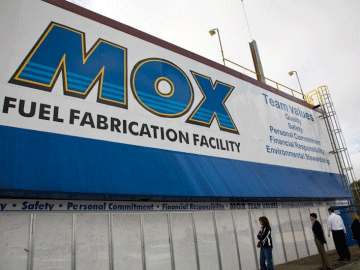 “The MOX facility is being designed by AREVA, a French company that is also the parent company to the MOX contractor, CB&I-AREVA MOX Services. Gilles Rousseau, the chief operating officer for the contractor, expressed his gratitude for having Araud on site.”
[…]
“Business at its Ugly Usual at DOE: As of April 4, 2015, there is No Accountability to the Tax-Paying Public for the U.S. DOE’s Grossly Mismanaged $30+-billion Plutonium Fuel (MOX) Project, a Textbook Case of Big Government’s Inability to Manage a Costly, Complex Project. When will Secretary of Energy Moniz and Congress act to hold those responsible accountable?
As DOE spins out of control in its management of large projects, the MOX coverup drags on and on and on. When will there be any accountability for the failed MOX project?
 SRS Watch requested in a letter hand delivered to US Secretary of Energy Ernest Moniz on July 29, 2014 that he “Take immediate steps to hold managers in DOE, NNSA and Shaw AREVA MOX Services accountable for the massive cost overruns and schedule delays associated with MOX project.”.http://www.srswatch.org/uploads/2/7/5/8/27584045/letter_to_moniz_from_srs_watch_july_28_2014.pdf
Will Secretary Moniz act responsibly and fulfill his obligations as a public servant? Will he hold specific individuals accountable and make sure that their glaringly inadequate abilities in managing the MOX boondoggle are not used elsewhere in DOE? Let us know who you think must be held accountable: srswatch@gmail.com https:// ……….miningawareness.wordpress.com/2015/04/05/30billion-plutonium-pu-fuel-project-good-for-france-bad-for-america-areva-mox-ca-pue-pe-yoo/
1 This Month
23-25 October – on Zoom – World BEYOND War’s annual global conference

To see nuclear-related stories in greater depth and intensity – go to https://nuclearinformation.wordpress.com

Say No to NASA’s Reckless Nuclear Reactor on the Moon
Say No to NASA’s Reckless Nuclear Reactor on the Moon
-
Archives
- October 2026 (149)
- September 2026 (339)
- August 2026 (330)
- July 2026 (355)
- June 2026 (287)
- May 2026 (306)
- April 2026 (356)
- March 2026 (251)
- February 2026 (267)
- January 2026 (308)
- December 2025 (358)
- November 2025 (359)
-
Categories
- 1
- 1 NUCLEAR ISSUES
- business and costs
- climate change
- culture and arts
- ENERGY
- environment
- health
- history
- indigenous issues
- Legal
- marketing of nuclear
- media
- opposition to nuclear
- PERSONAL STORIES
- politics
- politics international
- Religion and ethics
- safety
- secrets,lies and civil liberties
- spinbuster
- technology
- Uranium
- wastes
- weapons and war
- Women
- 2 WORLD
- ACTION
- AFRICA
- Atrocities
- AUSTRALIA
- Christina's notes
- Christina's themes
- culture and arts
- Events
- Fuk 2022
- Fuk 2023
- Fukushima 2017
- Fukushima 2018
- fukushima 2019
- Fukushima 2020
- Fukushima 2021
- general
- global warming
- Humour (God we need it)
- Nuclear
- RARE EARTHS
- Reference
- resources – print
- Resources -audiovicual
- Weekly Newsletter
- World
- World Nuclear
- YouTube
-
RSS
Entries RSS
Comments RSS

