Investor-State Dispute Settlement (I.S.D.S.) provisions should be removed from the Trans Pacific Partnership
 Investor-State Dispute Settlement (I.S.D.S.)-style provisions may once have made sense. But they’re now outdated and unnecessary. And including them in trade agreements undermines the broader case for free trade, by making it look like exactly what people fear—a system designed to put corporate interests above public ones.
Trade-Agreement Troubles, MULTUM NON MULTA BY JAMES SUROWIECKI, 19 June 15, In 2012, Australia implemented tough anti-tobacco regulations, requiring that all cigarettes be sold in plain, logo-free brown packages dominated by health warnings. Philip Morris Asia filed suit, claiming that this violated its intellectual-property rights and would damage its investments. The company sued Australia in domestic court and lost. But it had another card to play. In 1993, Australia had signed a free-trade agreement with Hong Kong, where Philip Morris Asia is based. That agreement included provisions protecting foreign investors from unfair treatment. So the company sued under that deal, claiming that the new law violated the investor-protection provisions. It asked for the regulations to be discontinued, and for billions in compensation.
The case has yet to be decided, but the concerns it raises help explain President Obama’s embarrassing setback last week, when the House failed to give him fast-track authority over one of two big trade agreements that had been envisaged as a key part of his legacy. Both agreements—the Trans-Pacific Partnership, with eleven Asian and Pacific countries, and an agreement with Europe called the Transatlantic Trade and Investment Partnership—include provisions very like the ones at the heart of Australia’s fight with Big Tobacco. Known as Investor-State Dispute Settlement (or I.S.D.S.) provisions, they typically allow foreign investors to sue governments when they feel they have not received “fair or equitable treatment,” and to have their cases heard not by a domestic court but by an international arbitration tribunal made up of three lawyers.
These provisions have been opposed by an unusual coalition of progressives and conservatives, who contend that they will let multinationals override government policy, and, as Senator Elizabeth Warren put it, “undermine U.S. sovereignty.”………. Continue reading
USA Department of Energy investigates radiation leaks, and exposure to workers at nuclear sites
DOE probes worker radiation exposure at test site By STEVE TETREAULT REVIEW-JOURNAL WASHINGTON BUREAU WASHINGTON, 19 June 15 — The Department of Energy has launched investigations into two incidents over the past year where workers at the Nevada National Security Site were exposed to potential contamination while conducting nuclear weapons activities.
The episodes took place on June 16, 2014, and Oct. 21, 2014, at the National Criticality Experiments Research Center, the laboratory where the government maintains a substantial stockpile of nuclear material used for research and training.
The department is looking into the circumstances surrounding “losses of contamination control of highly enriched uranium” at the lab, according to Steven Simonson, director of the DOE Office of Enforcement…….
The incidents that prompted the investigation were the latest disclosed missteps by Los Alamos and other outposts in the weapons complex that have come under close scrutiny within DOE and on Capitol Hill.
In May, the Energy Department proposed to fine the operator of the Los Alamos National Laboratory $247,500 after it lost track of classified material that was supposed to have been shipped to the Nevada National Security Site in 2007, but never arrived. The mistake was not detected until five years later.
The New Mexico laboratory also has been faulted in the 2014 release of radiation from the Waste Isolation Pilot Plant that contaminated nearly two dozen workers with low levels of radiation and forced the nuclear waste site to close.
Investigations uncovered violations at the laboratory in how transuranic waste destined for WIPP was packaged and managed……..http://www.reviewjournal.com/news/nevada/doe-probes-worker-radiation-exposure-test-site
Peach Bottom Atomic Power Station radiation leak – source is found
Exelon locates source of radiation leak at Peach Bottom, YDR.com Officials say the tritium posed no health risk By Brett Sholtis bsholtis@ydr.com @BrettSholtis on Twitter 06/19/2015
Peach Bottom Atomic Power Station. On April 17, 2015, Exelon detected a level of tritium in excess of the EPA-recommended guidelines. Exelon has located the source of the leak and is taking steps to correct the problem. The Nuclear Regulatory Commission said the tritium poses no health or environmental risk. (FILE — YORK DAILY RECORD/SUNDAY NEWS)
Exelon Corporation has located the source of a water leak that led to elevated levels of tritium in a groundwater well at Peach Bottom Atomic Power Station. Peach Bottom spokeswoman Krista Connelly declined to specify the source of the leak, but confirmed that they have located it………
Paul Gunter, a director at public interest group Beyond Nuclear, said the tritium points to a larger problem of recurring leaks, which the industry doesn’t take seriously. “This is a one-off measurement in one well,” Gunter said. “It doesn’t say how much got out. This is what they detected at that one point.”….http://www.ydr.com/local/ci_28347377/exelon-locates-source-radiation-leak-at-peach-bottom
USA’s (or Russia’s) nuclear weapons could be launched by a cyber hacker
 What happens when our nuclear arsenal is hacked? http://www.sfchronicle.com/opinion/openforum/article/What-happens-when-our-nuclear-arsenal-is-hacked-6333739.php One of the most chilling comments I’ve ever heard was the former commander of U.S. nuclear forces telling a San Francisco audience this month that our nuclear missiles could be hacked — launched and detonated without authorization.
Retired Marine Gen. James Cartwright used to have his fingers on all the nuclear buttons. As a former head of the U.S. Strategic Command, he was responsible for more than 5,000 nuclear weapons targeted at cities around the globe.
So when he told almost 200 Bay Area business, civic and philanthropic leaders gathered last week for the annual Ploughshares Fund gala that our nuclear strategy “made no sense,” he got their attention. But when he told them that our nuclear forces are hit by countless cyberattacks, he sent chills down their spines.
There are only two realities in the modern, interconnected world, he warned: “You’ve either been hacked and not admitting it, or you’re being hacked and don’t know it.”
CYBERSECURITY AND HACKING A key problem, he said, is that we keep hundreds of missiles on “hair-trigger” alert — a vestige of the Cold War that enables the launch of fully armed nuclear weapons in under 15 minutes. Continue reading
The tax-payers’ unnecessary burden of useless nuclear deterrence systems
 America and other nuclear states have come to a juncture, one where they have to weigh the costs and benefits of continuing this expensive status quo of nuclear deterrence; alternatives exist with the same ‘benefit’ and only marginal costs. The taxpayers need not bear this burden on their shoulders forever.
The Atlas Burden: The Cost of America’s Nuclear Arsenal, Ethical Technology By Steven Umbrello, 18 June 15, Over the course of the next three years, the United States projects that it will continue the reduction of its nuclear arsenal. As it stands, the country currently holds approximately 7’100 nuclear weapons, 2,340 of which are retired and waiting to be dismantled. This leaves approximately 4,760 warheads both in deployment and storage.
The cost of maintaining such an arsenal is understandably gargantuan. Over the next ten years, the American government plans to spend as much as $350 billion maintaining and upgrading its nuclear infrastructure. These upgrades include: Continue reading
Pentagon presents depleted uranium weapons as legal and acceptable!
 DU users conclude that depleted uranium weapons are legal and acceptable
The latest US DoD Law of War Manual argues that DU weapons are OK because the UK and France say that they are too.
Earlier this month the Pentagon published a 1204 page document on its interpretation of the Laws of War. The project had sought to collate manuals used by different arms of the military into a single document and covers a range of controversial weapons and practices, from drones and herbicides to autonomous weapons, nuclear weapons and landmines. Naturally the document presents the US’s interpretation of the law and this means that at times their views seem somewhat removed from the global consensus. The legality of DU weapons is dealt with briefly and follows a rather predictable pattern.
http://www.bandepleteduranium.org/en/du-users-say-du-is-fine
It is really in the interest of Republicans to act against climate change
As climate change unfolds around the globe, climate disasters will give undemocratic forces the justification they seek to commandeer resources, declare martial law, interfere with the market economy, and suspend democratic processes. This means that Americans who care about political freedom shouldn’t hold back when it comes to supporting climate scientists and acting to prevent the threats they have so clearly and fulsomely documented.
To do otherwise can only increase the chances that authoritarian forms of governance will come out ahead in a future in which our children and grandchildren, including those of the climate deniers, will all be the losers, as will our planet and so many of the other species on it. Recognizing and emphasizing this aspect of the climate equation may offer some hope of enabling more moderate Republicans to step back from the brinkmanship of denial.
 Climate Deniers Are Quickly Bringing About Their Own Worst Nightmare How climate denial became second nature to the new Republican Party, The Nation Naomi Oreskes June 16, 2015 “……As unlikely as it might seem today, in the first half of the 20th century the Republicans were the party that most strongly supported scientific work, as they recognized the diverse ways in which it could undergird economic activity and national security. The Democrats were more dubious, tending to see science as elitist and worrying that new federal agencies like the National Science Foundation and the National Institutes of Health would concentrate resources in elite East Coast universities.
Pentagon’s arms provider, and billionaires Bill Gates and Paul Allen in propaganda push for Small Nuclear Reactors
 Planet Ark 16-Jun-15 USA Timothy Gardner The Pentagon’s top arms provider and firms partly funded by Silicon Valley billionaires Bill Gates and Paul Allen are among dozens of companies collectively betting more than $1.3 billion that a new wave of nuclear power can be a force to fight climate change.
Advanced nuclear power plants, which will employ techniques such as using fuels other than uranium and coolants other than water, have attracted private investments from more than 40 companies from Florida to Washington state, the Third Way think tank says in the first report specifying the number of firms and total money invested in the technologies……..
Companies expressing faith in advanced nuclear power range from Lockheed Martin, the Pentagon’s largest supplier, to Holtec International, which is building a $260 million technology campus in economically depressed Camden, New Jersey.
Gates has partially funded TerraPower, a company that aims to build reactors cooled by liquid metal, and Allen has partially funded TriAlpha, a company that plans to make nuclear fusion plants……
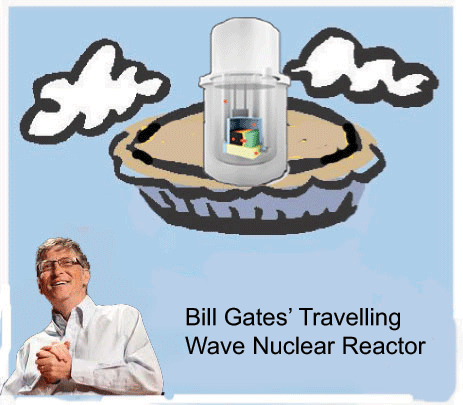
Critics of advanced nuclear say companies have yet to make small reactors economically viable despite decades of development by energy companies and the U.S. military. Advanced reactors using new fuels, such as thorium, and new cooling systems, such as molten salt, are also difficult to make economically viable, they say.
The nuclear industry has also been weakened by a political backlash following radioactive leaks at Japan’s Fukushima power plant in 2011. And the U.S. natural gas boom has slashed the cost of that fuel, making it harder for nuclear power to compete.
The Third Way report was not funded by the nuclear industry. But the think tank has received financial support from The Nuclear Energy Institute, the industry’s lobby group, and Babcock & Wilcox, a company hoping to build small nuclear reactors…….http://planetark.org/enviro-news/item/73313
Nuclear power industry cannot be saved by EPA Clean Power Plan
Report says EPA Clean Power Plan cannot save nuclear http://www.fierceenergy.com/story/report-says-epa-clean-power-plan-cannot-save-nuclear/2015-06-18 By Barbara Vergetis Lundin
The 20th Century model of large baseload electricity generation, including nuclear reactors, is in an irreversible decline in the face of the emerging 21st Century decentralized power model relying on renewables, energy efficiency, and technology-based demand management, says Mark Cooper, senior fellow for economic analysis, Institute for Energy and the Environment, Vermont Law School, in a new report.
For policymakers and ratepayers, Cooper’s stark conclusion means that “last-ditch efforts to prop-up nuclear power with amendments to the EPA Clean Power Plan (CPP), state-level subsidies (e.g., Exelon’s “nuclear blackmail” threat of Illinois lawmakers over five reactors in that state and FirstEnergy’s bailout scheme involving the Davis-Besse reactor in Ohio), attacks in Indiana, Ohio, Nevada, North Carolina and other states on renewable energy standards, and preferential rate-setting arrangements (e.g., Exelon’s Ginna reactor at Rochester, New York) are costly detours on the road to a much more consumer friendly, reliable and sustainable low carbon electricity sector.”
Cooper said: “Nuclear reactors old and new are far from a necessary part of a low-carbon solution. Nuclear power, with its war against the transformation of the electricity system, is part of the problem, not the solution. Following a path toward a 21st century electricity system poses no serious threat to reliability up to a 30-40 percent level. Beyond that, we already know the specific actions that can carry the system to much higher levels of reliance on renewables. Combining these measures which allow the system to operate at high levels of penetration with the implementation of aggressive efficiency measures meets 80 percent of ‘business as usual’ or base case demand. It is no longer a question of if this will happen, only when it will happen.”
 The report concludes that, even with tinkering, the EPA Clean Power Plan will not save nuclear power.
“After decades of claiming to be a low-cost source of power because of low operating costs, aging reactors are no longer cost competitive even in that narrow view of operating cost,” the report says. “Not even the full implementation of the EPA Clean Power Rule would save aging reactors from early retirement, so the owners of those reactors have launched a major campaign to increase revenues with direct subsidies from state and federal policymakers and secure jerry-rigged market pricing rules that undermine alternatives.”
The report further contends that the “Exelon reactor bailout schemes” in New York State and Illinois will not work.
The report says, “Ginna is a New York reactor and Quad Cities is a two-reactor site in Illinois for which Exelon has stated specific revenue increases are needed, although these estimates are shrouded in uncertainty. The operating costs are quite high and total costs are higher still, well above recent market clearing prices…Operating costs alone are almost twice the current market clearing price of electricity and…things are likely to get worse rather than better over time…The frantic push for states to bail out these reactors when a response at the regional level is more appropriate (if a reaction is needed at all) will saddle state ratepayers with much larger burdens.”
The report does contend that more renewables are feasible without creating reliability issues.
“In the mid-term, expansion of renewables to the 30-40 percent range can be easily accommodated with the existing physical assets and management tools with no negative impact on reliability. The electricity system only needs to be operated with policies that allow the renewables to enter. In the long-term, a wide range of measures to support the penetration of alternatives to much higher levels (80 percent or more) has been identified,” the report says. “Building an electricity system on principles of dynamic flexibility requires an institutional transformation and the deployment of supporting physical infrastructure. Given the need to respond to climate change and the cost of the alternatives, the 21st century model for the electricity system is the least-cost approach by a wide margin”.
For more:
– see this report
Mass Deaths of California Seabirds: Fukushima Radiation Casualties?

It’s being called “unprecedented” and “grisly” by National Geographic. Massive waves of dead seabirds are littering the coastline of the Western US and British Columbia (BC). In January 2015, National Geographic reported that thousands of blue-footed diving seabirds (Cassin’s auklets) were washing up on the beaches from San Francisco, Washington State and all the way to central BC (1).
Many of the dead birds are juveniles and are described as being “scraggly”. The die-off is said to be the largest ever recorded. So what is happening to these birds?
Cassin’s auklets (auks) are chunky small seabirds and are found in the North Pacific. They like to nest in small burrows by digging holes in the soil or find a safe place in natural crevices. When in flight they look to many people “like a flying tennis ball” (2).
National Geographic reports that in October 2014, the young birds began to wash up on the shores of California’s Farallon Islands to Haida Gwaii (Queen Charlotte Islands) off central British Columbia.
50,000 to 100,000 Dead Birds
The birds found dead along the shoreline are emaciated and this has led scientists to believe that the birds have starved to death. According to the Audubon, the food source these birds depend on is found at “the bottom of the food chain” – zooplankton, tiny marine creatures like krill.
Bill Sydeman, a senior scientist with the Farallon Institute (nonprofit marine ecology) has studied Cassin’s auklets for 30 years. He told the Audubon, “If ocean conditions change, auklets might be an early warning sign.” (3)
But what is the warning? Is it radiation from the Fukushima nuclear plant that’s killing off the birds’ food source? (4)
Researchers are concerned that the die-off could spread to other birds. Fish may also become victims if the problem is a lack of food sources.
In March 2015, Crosscut reported that the sea lion pups along the California coastline are dying. The pups were found to be emaciated. It’s believed that the “energy-rich copepods” have diminished, which are vital to the marine food chain (5).
NOAA (National Oceanic and Atmospheric Administration) reported in June 2015 that from January 2015 to May 2015, “California sea lion strandings were over 10 times the average stranding level for the same 5 month period, during 2004 – 2012.”
Birds Appear to Have Starved to Death
Are the deaths of seabirds and those of sea lion pups related? Is there something going on in the marine food chain?
National Geographic spoke with University of Washington seabird ecologist Julia Parrish who oversees the Coastal Observation and Seabird Survey Team (COASST). COASST is a 20-year program that tracks shoreline birds. When asked how many auklets had died Parrish responded, “We may be talking about 50,000 to 100,000 deaths. So far,” Parrish said.
To put the enormity of this die-off into context, out of the five largest bird die-offs recorded, the largest one recorded 11,000 birds dead.
National Geographic reported that the US Geological Survey as well as other agencies had conducted autopsies on the birds. So far, there’s been no cause of death. There hasn’t been any evidence of disease, trauma or oil coating the feathers (from an oil spill). The cause of death for now is being ruled as “starvation”.
If the birds starved to death, then what happened to their food source? Were the zooplankton killed off by disease, predators or as some have speculated, radiation from the Fukushima nuclear power plant?
Deep Sea News states that in Japan the bottom fish would be “prone to contamination because the fallout collects on the seafloor where they live.” As for the West Coast fish, it seems unlikely that they would suffer such a fate, based on the amount of radiation detected so far along the US west coast (6).
However, wide-ranging fish, such as tuna could be affected by Fukushima radioactive water. If the tuna were exposed while swimming in Japanese waters, they could arrive along the US West Coast contaminated.
Bluefin Tuna
In August 2013, Washington’s Blog reported that “More than a year ago, 15 out of 15 Bluefin tuna tested in California waters were contaminated with radioactive cesium from Fukushima.”
Bluefin tuna are known as “wide-ranging fish”. This means that blue fins “can swim back and forth between Japan and North America in a year.” Sockeye salmon also travel this wide range (7).
Oceanus Magazine states that the level of radiation in marine life isn’t a simple explanation – It’s complicated. The length of exposure to radiation, size of marine life, the radioisotopes involved, oxygen in water, salinity of water, the temperature of the water and other factors all play a part (8).
According to Oceanus, fish are able to excrete cesium and get rid of it daily. Unless the fish is continuously exposed to cesium, the tissue expels it fairly quickly by excreting it.
Beachapedia states that even two or three years after the accident radioactive water was still being released into the ocean and possibly still is. This type of continuous discharge of radiation into the water generates a continuous feed, creating radioactive water (9).
Back in Japan, The Smithsonian reported in an article titled, “Birds Are in a Tailspin Four Years After Fukushima”, that the bird population around the Fukushima-Daiichi plant is still on the decline. While the radioactivity “has dropped throughout the region” the bird population continues to show a “sharp decline” that escalates every year (10).
While this is ground zero, there are still many unknowns about the amount of radiation that leaked into the ocean and how it’s affected marine life long-range and long-term. Reassurances from scientists monitoring the radiation levels in the ocean haven’t satisfied many west coasters.
When such a massive die-off is seen, it’s only natural that people question if this isn’t the effects of Fukushima radiation.
Fukushima or the Blob?
There is a worldwide mass-mortality being seen in marine life. During the past 18 months, the west coast from Alaska to California witnessed the washing up of tens of millions of sea stars. The deaths were not linked to a virus and scientists suspect that the killer could be “uncharacteristically warm waters”.
Some scientists believe the “massive blob of warm water that heated the North Pacific in 2014” was responsible for the California drought. 2014 was recorded as being hottest year for California. The blob was not only hotter, but also stayed warm longer than any recorded.
The massive warm water spanned the Gulf of Alaska and eventually began to travel the coastline to California. The blob altered the environment that marine life depends on. It was especially unfavorable to the zooplankton. Cassin’s auklet aren’t the only birds that rely on these small fish for a food source. Other birds and fish feed on them, too.
According to National Geographic, scientists researching the Oregon coastal waters discovered “some of the tiny crustaceans at the bottom of the marine food chain were replaced by smaller species that provide less nutrition for larger animals.”
Scientists are asking why the auklets are the only species being affected if the reason is due to a food chain change.
According to National Geographic, Bill Sydeman, a senior scientist at California’s Farallon Institute predicts that this die-off “might spread to the salmon and forage fish that eat those same plankton species and then perhaps to the murres or other birds that, in turn, eat those fish.”
Whatever the cause of the Cassin’s auklets mass die-offs, it seems to be part of a larger marine life crisis being seen around the world. Scientists are still searching for answers in this latest die-off.
References & Image Credits:
(1) National Geographic
(2) Wikipedia: Cassin’s Auklet
(3) Audubon
(4) TSW: Is Fukushima Nuclear Fallout Far Worse Than Officials Admit?
(5) Crosscut
(6) Deep Sea News
(7) Washington’s Blog
(8) Oceanus
(9) Beachapedia
(10) Smithsonian Mag
Source: Top Secret Writers
Obama unveils $4bn project to form clean-energy investment clearinghouse
Obama commits $4bn to form clean-energy investment clearinghouse, Guardian, Brandon Keim 16 June 15 US energy secretary announces new office of technology transitions to help facilitate financing by connecting would-be investors with clean-energy firms With $4bn and a new government office, the White House has unveiled its latest clean energy initiative and cast a subtle new role for the federal government: not only is it a funder of new research, of the latest solar converter or biofuel source, but it is also a market builder.
“One of the real challenges is the gap in financing clean energy,” said Ernest Moniz, US secretary of energy, at a press conference on Monday. “There is a continuing need for new capital investment.”
The new initiative follows on a White House pledge in February to organize mission-driven renewable energy investors, concentrating their impacts and providing information to would-be investors daunted by an unfamiliar clean-energy landscape.
At the press conference on Monday, Moniz and senior advisor Brian Deese fleshed out the details: $4bn in commitments from pension funds, family foundations and other so-called impact investors, and a newly unveiled office of technology transitions that will serve as an all-purpose informational resource for clean-energy investment…….
The initiative represents the latest stage in the Obama administration’s clean-energy policies. In some quarters, these are still synonymous with Solyndra, the California-based solar cell manufacturer that went bankrupt after receiving $535m from the US department of energy.
Yet that reputation is mostly unfair – and not just because the loan program responsible for the Solyndra deal is expected to turn a $5bn profit. The US now leads the world in wind energy production; the price of solar energy has plummeted, and adoption jumped…..http://www.theguardian.com/environment/2015/jun/16/obama-administration-clean-energy-investment-initiative
USA could be 100% powered by renewable energy by 2015
 The US Could Run Exclusively On Renewable Energy By 2050 http://www.gizmodo.com.au/2015/06/the-us-could-run-exclusively-on-renewable-energy-by-2050/ ALISSA WALKERThere are many things holding up the US’s move towards renewable energy, but that one thing is not science: We already have all the technology we need to make this happen. A new study claims that a completely clean energy future is possible by 2050, and it plots roadmaps for all 50 states to achieve this goal.
The study, which is published in Energy & Environmental Science, is authored by Mark Z. Jacobson, a civil and environmental engineer who heads up Stanford’s Atmosphere and Energy Program. He’s known for publishing many similar roadmaps for America’s energy future, but this one is the most comprehensive — and useful — because it takes into consideration the unique environmental situations and policy quirks for each state.

Most enticing is this chart where incredible growth in solar and wind energy helps offset the gradual reduction in fossil fuels and nuclear energy. But the overall energy supply needed will also decrease, even with increased demand, due to better energy efficiency.
In that black zone that gets squeezed out: Nuclear power, coal with carbon capture, liquid or solid biofuels, and natural gas. Nope, not even biofuels, argues the study — since “their combustion produces air pollution at rates on the same order as fossil fuels and their lifecycle carbon emissions are highly uncertain.”
The irrationality of nuclear deterrence – General George Lee Butler
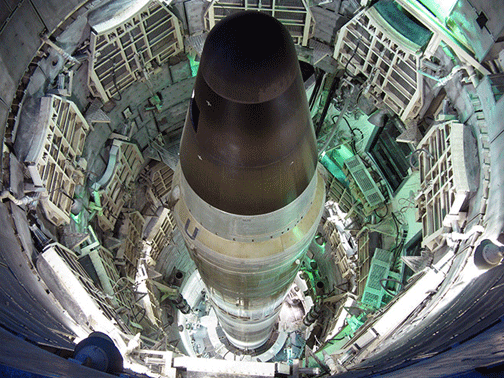
That we would pursue these weapons with such unfettered enthusiasm—competing amongst the [military] services for resources, going to roll out these shiny new things, cutting ribbons—spoke to me a great deal about the human condition. For some people, technology has absolutely mesmerizing qualities. If we can do it, we must.
That’s the kind of thinking that got us where we are today. To add to that, the military-industrial complex was being fed a virtually endless trough of money. There is no end to the number of people who will find any way to justify building something new, brighter and better. I’ve seen that happen time and time and time again
Ex-Chief of Nuclear Forces General Lee Butler Still Dismayed by Deterrence Theory and Missiles on Hair-Trigger Alert, TruthOut , 14 June 2015 00:00By Robert Kazel, Nuclear Age Peace Foundation | Interview After the Cold War ended in the early 1990s, the danger of nuclear weapons faded as a source of anxiety for some Americans. To them, worrying that the world’s stockpiles of missiles and bombs could eventually create catastrophe seemed as anachronistic as the duck-and-cover classroom drills of a previous generation. But for George Lee Butler, a four-star US Air Force general and the commander of US nuclear forces between 1991 and 1994, thinking about the possibility of just such a calamity didn’t end. The reality was always a phone call away.
The calls would come at least once a month, and there was never advance warning. Butler might be anywhere: his office at Offutt Air Force Base near Omaha, Neb., or traveling, or home sleeping. A hotline to other military officers and the White House sat on a bedside table, closer to his wife’s head because she was the lighter sleeper.
It always turned out to be an exercise—World War III obviously never broke out during Butler’s tenure. But, at least at the outset, he never knew for sure. The games were thought to be more useful if the participants—even a key player such as Butler—were kept in the dark about that…..
Actual presidents—in Butler’s day, George H.W. Bush and Bill Clinton—never took part in these “missile threat conferences.” Like a stand-in for a movie star who wished to avoid an unpleasant stunt, someone else always acted out the role of commander-in-chief at the other end of the line. Butler felt disgust that such a crucial task was left to a substitute.
Few knew it, but for Butler that sense of abhorrence gradually began to encompass nuclear weapons in general, as he became privy to more secrets about them………….
Former colleagues were surprised when Butler continued to make earnest, eloquent remarks to large audiences, condemning the same military systems he’d once managed. Now Butler was speaking freely about the “scourge” of nuclear weapons as being sinister and irreligious, and recommending they be dismantled everywhere they existed in the world through international agreements. These weapons were relics of a previous age when it was regrettably customary for rival nations to demonize one another, he argued. But they had no strategic value for any government in the post-Cold War world. Continue reading
USA Congress bars US assistance going to Ukraine’s Nazi military unit

 U.S. House Admits Nazi Role in Ukraine OpEdNews 6/12/2015 By Robert Parry (about the author) Last February, when ethnic Russian rebels were closing in on the Ukrainian port of Mariupol, the New York Times rhapsodically described the heroes defending the city and indeed Western civilization — the courageous Azov battalion facing down barbarians at the gate. What the Times didn’t tell its readers was that these “heroes” were Nazis, some of them even wearing Swastikas and SS symbols.
The long Times article by Rick Lyman fit with the sorry performance of America’s “paper of record” as it has descended into outright propaganda — hiding the dark side of the post-coup regime in Kiev. But what makes Lyman’s sadly typical story noteworthy today is that the Republican-controlled U.S. House of Representatives has just voted unanimously to bar U.S. assistance going to the Azov battalion because of its Nazi ties.
USA and Russia: top former generals plea to “de-alert” nuclear weapons
Ex-U.S., Russian brass: ‘De-alert’ nukes or risk disaster Politico. com By BRYAN BENDER 4/29/ 15
Amid all the talk about a new Cold War, here’s one hard, cold fact: Nearly 25 years after the collapse of the Soviet Union, Washington and Moscow still have nearly 2,000 atomic bombs ready to fly at a moment’s notice to destroy each other.
And that so-called hair-trigger alert is now sparking new concerns that deepening distrust between the former foes significantly raises the risk of a miscalculation and nuclear disaster.
Story Continued Below
On Thursday the American general who recently commanded U.S. nuclear forces will lead a group of ex-Russian officers and other national security leaders in an appeal for the United States and Russia to take immediate steps to “de-alert” their respective arsenals.
Their proposal starkly warns that the current dismal state of relations — combined with other new factors such as the threat of cyberattacks — demands leaders on both sides be given more time to respond to potential provocations before ordering the unthinkable.
“Tension between Russia and the West over the Ukraine crisis has brought the parties one step closer to the precipice of nuclear brinksmanship, the point at which nuclear risk skyrockets,” according to the findings of the commission convened by the disarmament group Global Zero, which will be delivered at the United Nations. “This tension is uncharacteristic of their post-Cold War partnership, but it has flared to the point that it is producing dangerous misunderstandings and action-reaction cycles with strong escalatory updrafts.”
The group, led by retired four-star General James Cartwright, who oversaw the U.S. nuclear arsenal before leaving the military in 2011, says the United States and Russia are at serious risk of an accidental nuclear confrontation, spurred by flawed intelligence or a misreading of the other side’s intentions. The primary reason: Fully half of their large arsenals remain designed to respond within minutes, what is known as launch-on-warning. As the report points out, “the go-code comes as a message that is the length of a tweet.” And “Minuteman missiles are so named for a reason.”
By requiring more steps be taken to prepare the weapons for launch, Russia and the United States would have hours — if not several days — to develop better information before reacting, while still maintaining a strong deterrent force, Cartwright told POLITICO.
“These weapons that are on alert are particularly vulnerable to being hijacked or [the systems] indicate something that is not true in a situation where you only have a few minutes to make a decision,” said Cartwright, who was head of the U.S. Strategic Command before becoming vice chairman of the Joint Chiefs of Staff.
“In a tense military-political situation, like the one that exists currently as a result of the crisis in Ukraine, the probability of making erroneous decisions increases,” added retired Russian Major General Vladimir Dvorkin, former director of Research Institute No. 4 in the Russian Ministry of Defense. “That is why at the present time it would be necessary for the presidents of Russia and the U.S. to formally renounce the launch-on-warning form.”
…………….. http://www.politico.com/story/2015/04/russian-nukes-risk-disaster-117489.html#ixzz3d6YDSvLK
1 This Month
15 October. Joint Appeal for Nuclear Abolition Day -presentation to the UN on October 15 will be live on UNWebTV
Endorse the Nuclear Abolition Day Appeal
23-25 October – on Zoom – World BEYOND War’s annual global conference

To see nuclear-related stories in greater depth and intensity – go to https://nuclearinformation.wordpress.com
-
Archives
- October 2026 (149)
- September 2026 (339)
- August 2026 (330)
- July 2026 (355)
- June 2026 (287)
- May 2026 (306)
- April 2026 (356)
- March 2026 (251)
- February 2026 (267)
- January 2026 (308)
- December 2025 (358)
- November 2025 (359)
-
Categories
- 1
- 1 NUCLEAR ISSUES
- business and costs
- climate change
- culture and arts
- ENERGY
- environment
- health
- history
- indigenous issues
- Legal
- marketing of nuclear
- media
- opposition to nuclear
- PERSONAL STORIES
- politics
- politics international
- Religion and ethics
- safety
- secrets,lies and civil liberties
- spinbuster
- technology
- Uranium
- wastes
- weapons and war
- Women
- 2 WORLD
- ACTION
- AFRICA
- Atrocities
- AUSTRALIA
- Christina's notes
- Christina's themes
- culture and arts
- Events
- Fuk 2022
- Fuk 2023
- Fukushima 2017
- Fukushima 2018
- fukushima 2019
- Fukushima 2020
- Fukushima 2021
- general
- global warming
- Humour (God we need it)
- Nuclear
- RARE EARTHS
- Reference
- resources – print
- Resources -audiovicual
- Weekly Newsletter
- World
- World Nuclear
- YouTube
-
RSS
Entries RSS
Comments RSS

